
Lasko MyHeat Mini
4.3Editor score
Low 400W power draw
Compact six-inch personal format
Simple single-switch operation
Automatic overheat protection
Low wattage space heaters for RV can provide focused warmth without placing the same demand on an electrical system as many high-wattage models. The right heater depends on your available amperage, campground power, outlet arrangement, desired warmth, and tolerance for noise while traveling.
We compared ten heaters using their stated power draw, dimensions, portability, safety features, operating controls, noise levels, and suitability for confined spaces. The list includes ultra-low-wattage personal heaters, compact ceramic models, remote-controlled wall units, and higher-wattage options that may require more electrical capacity.
Each review explains where the heater fits best and where its limitations matter. Rankings reflect the supplied specifications and customer ratings, while product availability and prices can change. Always verify RV electrical limits, heater clearances, and manufacturer instructions before use.
4.3Editor score
4.4Editor score

4.2Editor score
As an Amazon Associate we earn from qualifying purchases.
This side-by-side comparison highlights power draw, physical size, controls, safety provisions, and practical RV use cases, helping you identify the model that best matches your travel setup.


The Pereysi Ceramic Personal Space Heater earns the top position because it explicitly combines RV and office use with two lower-wattage settings. Its 4.4 customer rating reflects a well-regarded option, while the 700W and 1000W choices give users more flexibility than a fixed-output personal heater. It is designed to warm a person rather than an entire RV, which is especially useful in a compact sleeping area or workstation.
We may earn a commission when you buy through this link, at no additional cost to you.
Its strongest feature is the balance between electrical demand, size, and operating comfort. The listed noise level of no more than 45dB makes it suitable for reading, remote work, or rest without creating the impression that a full-room appliance is running. The control knob is uncomplicated, while the compact design is intended to fit under a desk and preserve legroom. Tip-over shutoff and flame-retardant materials add practical protections in a travel environment where equipment may shift during transit.
The heater does not promise to heat an entire RV, and its 1000W maximum is still a meaningful load compared with the smallest units in this list. Because the product is framed as personal heating, users wanting broad room coverage may find it less effective than a higher-output oscillating model. It also lacks the digital thermostat, remote, timer, and memory functions offered by some competing heaters. Those omissions are acceptable when straightforward operation and a smaller electrical footprint matter more.
This is the most broadly suitable choice for RV travelers who want flexible wattage, quiet personal warmth, and a compact footprint. Select the 700W setting when electrical capacity is limited and move to 1000W only when the RV's available power can support it. For boaters, campers, and road trippers seeking a heater explicitly designed around personal-space use, it offers the strongest combination of relevant features in the group.
The 700W setting is valuable when power availability is limited, while 1000W provides more heat when the installation can support it. Because a 700W heater draws roughly 5.8 amps at 120 volts and 1000W draws roughly 8.3 amps, always check the connected circuit before selecting a level.
Rather than attempting to warm the entire RV, the Pereysi focuses airflow around a seated or resting person. Its under-desk positioning and compact format make it a practical choice for feet, hands, and personal comfort during cool evenings.
We may earn a commission when you buy through this link, at no additional cost to you.
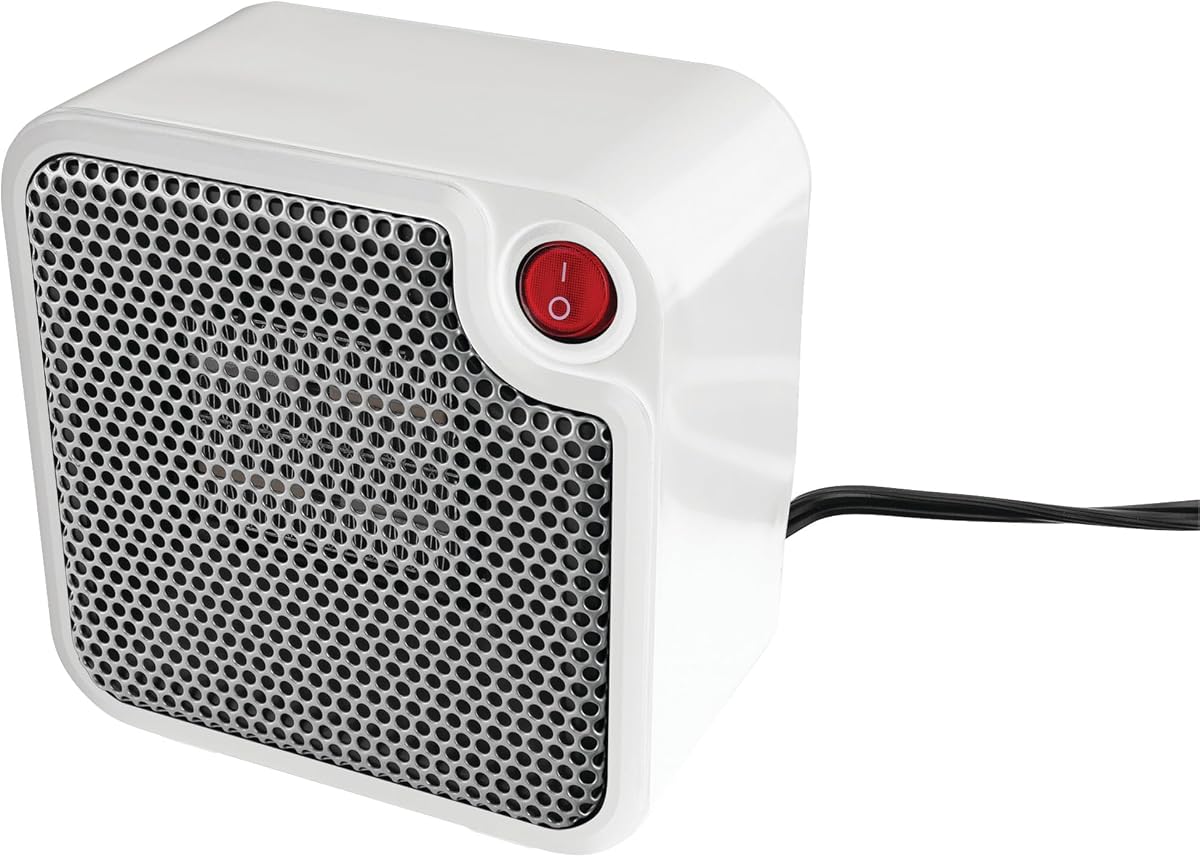
The Performance Tool W5011 is the clear electrical-consumption leader in this group because it operates at just 250W. That makes it the most naturally aligned option with the low wattage concept, particularly for travelers who want a personal heater without committing a substantial share of a circuit to supplemental warmth. Its customer rating of 4.1 indicates generally positive reception, though it trails several better-rated models.
We may earn a commission when you buy through this link, at no additional cost to you.
At 250W, the W5011 draws approximately 2.1 amps from a 120-volt source. That makes it easier to combine with laptops, lighting, and other low-demand devices than higher-wattage space heaters, subject to the RV's total circuit capacity. As a personal space heater, it is better suited to warming one small area near a desk, reading position, or sleeping area than heating the entire vehicle.
The supplied product information provides fewer details than the other listings, so buyers should not assume unlisted features such as a thermostat, timer, remote control, or particular safety system. The white finish may coordinate better with some RV interiors, but color should not outweigh electrical fit. Its low output also means it will take longer to create perceptible warmth than a 500W or 1000W model and may not match the feel of a full convection heater.
Choose the W5011 when minimizing electrical draw is the top priority and gentle personal warmth is enough. It is a particularly conservative choice for small RVs, older electrical systems, or campground sites where conservative power use is important. Confirm the product's current dimensions, controls, and safety certifications on the listing before purchase, because those details are not supplied here.
A 250W load is about one-fifth the power of a 1000W personal heater. That difference can be meaningful when powering a laptop, charging devices, running lights, or using a small refrigerator on the same circuit.
The W5011 is designed to warm a person rather than provide broad room coverage. Position it where you spend time and allow the smaller output to provide gradual, localized comfort.
We may earn a commission when you buy through this link, at no additional cost to you.
The Brightown Plug in Heater stands out for offering the most complete control package in the roundup. It combines an 800W low-wattage output, remote operation, a clear LED display, adjustable temperature, and a twelve-hour timer. Its 4.2 rating is solid, and the design is especially convenient for an RV because it uses a standard wall outlet without requiring a separate wall-mounted installation.
We may earn a commission when you buy through this link, at no additional cost to you.
The rotating plug is a particularly useful RV feature. Because it turns 180 degrees, the heater can accommodate upright or inverted receptacles and reduce cord strain, which can be helpful in tightly arranged interiors. At 3.9 by 3.5 by 6.5 inches, it avoids occupying floor space, while the stated noise level below 40dB supports quiet use during sleep or work. Safety features include automatic overheat shutoff and flame-retardant materials.
Its 800W maximum means it is not as conservative as the 250W, 400W, or 500W options. On a 120-volt circuit, the heater draws about 6.7 amps, so users need to account for other appliances and confirm that the outlet is appropriate for sustained heating. The remote and timer are not substitutes for a thermostat-equipped room heater, and the listing specifically recommends bathroom installation above the sink to avoid direct splashing.
This is the most convenient pick for an RV owner who wants remote control, scheduling, and a compact outlet-based design. It works well for small spaces up to the stated 100 square feet when supplemental heat is sufficient. Choose it over ultra-low-wattage personal heaters if remote operation and a timer justify the additional electrical demand.
The included remote and LED display make it possible to adjust temperature and operate the timer from across the room. This is useful in an RV where repositioning a tabletop or floor heater can be inconvenient.
The rotating plug and cordless body provide flexibility around standard receptacles. Confirm outlet compatibility and clearance from bedding, curtains, and other combustible materials before operating the heater.
We may earn a commission when you buy through this link, at no additional cost to you.
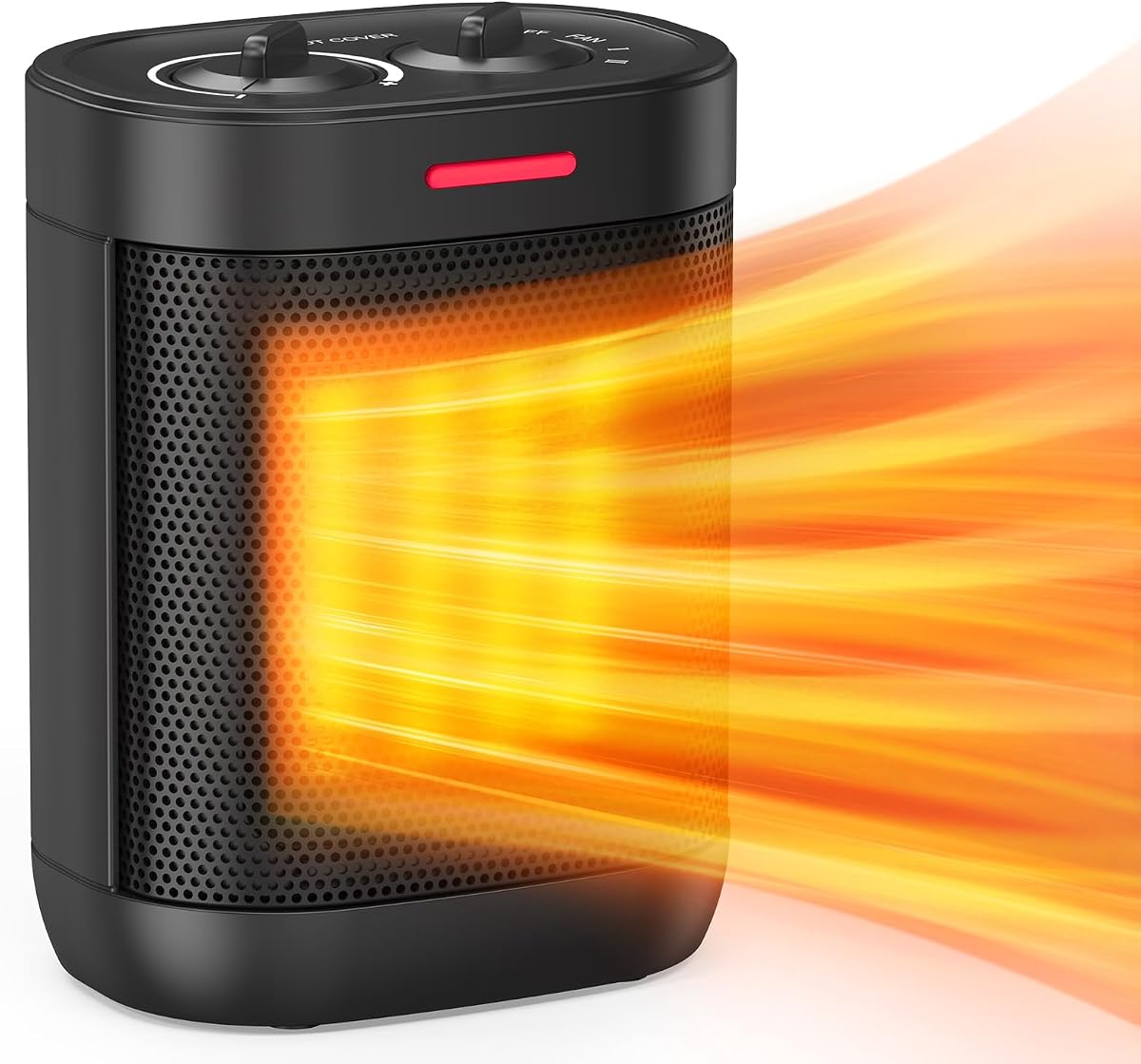
The Lasko MyHeat Mini combines a useful 400W power draw with a body small enough to suit cramped RV living spaces. Its 4.3 customer rating and straightforward design make it a dependable middle ground between ultra-low-wattage heaters and larger room models. The product is explicitly positioned for personal use at a table, desk, or under a desk.
We may earn a commission when you buy through this link, at no additional cost to you.
Its simple setup is valuable in travel. It plugs into a standard 120-volt outlet, draws about 2 amps, and starts with a flip of a switch. A six-foot cord adds placement flexibility, while the compact dimensions make storage easier. The ceramic element is described as self-regulating, with automatic overheat protection and an exterior designed to remain cool to the touch.
The main trade-off is limited adjustability. There is no listed digital thermostat, remote, timer, oscillation, or memory function, so the user has less control over output and scheduling. At 400W, it produces less heat than the 500W Amazon Basics and Gaiatop models, while the Lasko emphasizes compact personal heating rather than broad circulation. It is also designed for indoor use, so it should not be placed outside or in damp locations.
The Lasko is a strong choice for travelers who want simple, compact personal warmth and value electrical efficiency. It is well suited to a desk area, reading nook, or foot-warming position and can be stored easily when not needed. Choose it when straightforward operation matters more than digital controls or room-wide coverage.
The six-inch format and light weight make the MyHeat Mini easier to carry and stow than many conventional space heaters. It can sit on a desk or table, or be placed under a desk where the airflow remains unobstructed.
At 400W, the heater is designed to focus warmth around one person. A single switch and a six-foot cord remove setup complexity, while overheat protection and an ETL listing support safer operation.
We may earn a commission when you buy through this link, at no additional cost to you.
The black Amazon Basics Ceramic Portable Mini Space Heater is a balanced choice for RV travelers who want more output than the smallest personal models without moving into the power demands of a full-room heater. Its 4.4 rating matches the Pereysi and is among the strongest in the lineup. At 500W, it produces enough demand to warm a personal zone while remaining modest compared with 1000W and 1500W appliances.
We may earn a commission when you buy through this link, at no additional cost to you.
Ceramic coils are advertised for fast heat, and the stated 48dB operating noise is appropriate for a desk or sleeping area where silence is useful but not paramount. The 5.87-by-3.15-by-5.95-inch body and 1.4-pound weight make it easy to move from a table to another surface. Tip-over protection automatically shuts the heater off if it is knocked over, which is reassuring in a compact vehicle.
The feature set is intentionally modest. No thermostat, timer, remote, or oscillation is listed, and the 500W output is fixed. The heater is also designated for indoor use, so it should not be operated in wet or exterior areas. Users should preserve airflow around the unit and follow the included instructions, particularly around bedding, curtains, furniture, and other heat-sensitive materials.
This Amazon Basics model is well suited to RV users who want an uncomplicated, lightweight ceramic heater for personal warmth. It is an especially sensible selection for desk work or sleeping when 500W feels appropriate and tip-over shutoff is the primary safety requirement. It is a solid all-around compact option without a remote or digital interface.
Ceramic coils and a 500W rating support quick, focused warmth for an individual. The heater's narrow footprint makes it easy to place on a desk, nightstand, or other stable surface.
Tip-over protection is valuable in an RV where movement can occur. At 1.4 pounds, the unit is light enough to reposition easily, although it should always be placed on a stable surface.
We may earn a commission when you buy through this link, at no additional cost to you.
This Amazon Basics Ceramic Space Heater offers the same central strengths as the black 500W listing: a lightweight ceramic design, quick heat, and tip-over protection. Its 4.4 customer rating places it among the best-reviewed products here. For RV users comparing compact heaters, it is a familiar, uncomplicated option designed for office desks and other small indoor spaces.
We may earn a commission when you buy through this link, at no additional cost to you.
The dimensions are approximately 5.9 by 3.2 by 6.0 inches, and the heater weighs 1.4 pounds. At 500W, it offers a middle ground between the 250W Performance Tool and 700W or 1000W Pereysi options. The stated 48dB noise level makes it appropriate for use while working, reading, or resting, while ceramic coils are intended to provide heat within seconds.
Its simplicity can be both a strength and a limitation. Tip-over protection helps reduce one common risk, but the supplied information does not mention an automatic overheat system, thermostat, remote, timer, or display. Users who require more comprehensive controls should look to the Brightown or DREO models. The fixed output may also be less adaptable than the Pereysi heater's two settings.
This is a practical pick for a traveler who values a proven rating, light weight, and simple personal heating over programmable operation. It can be moved readily between a desk and a bedside area, provided the surface is stable and the required clearance is maintained. It is a solid alternative to the other 500W Amazon Basics listing for shoppers who prefer this specific variant.
The ceramic element is built for quick warmth around a desk or resting position. At 500W, the heater works harder than ultra-low-wattage personal units but remains far below the maximum output of the two DREO heaters.
Its slim rectangular body uses little surface area and weighs only 1.4 pounds. Those qualities make it easy to store during travel and reposition when the RV's layout changes.
We may earn a commission when you buy through this link, at no additional cost to you.
The Gaiatop Mini Space Heater is the strongest-rated model among the 500W heaters, with a customer rating of 4.5. It combines a compact body, PTC ceramic heating, and a fast two-second warmup claim. That combination makes it a credible option for an RV desk, nightstand, or other space where localized warmth and quick response are priorities.
We may earn a commission when you buy through this link, at no additional cost to you.
Safety is the listing's strongest differentiator. The heater includes 45-degree tip-over protection, overheating protection, and V0-class fireproof material. An LED indicator shows when the unit is operating, while the stated quiet operation supports use during focused activities. Its power draw remains moderate at 500W, placing it in the same broad electrical class as the Amazon Basics ceramic heaters.
The product information does not list a thermostat, remote, timer, or oscillation, so its appeal rests on rapid heating, compactness, and safety protections rather than advanced control. The two-second claim describes element response rather than the time needed to warm an entire RV. As with any small heater, airflow should remain unobstructed and the unit should not be covered or placed too close to combustible objects.
Choose the Gaiatop if you want a 500W heater with more explicitly stated safety systems than several similarly sized competitors. It is particularly appropriate for personal-space heating, desk use, or travel setups where a compact unit with overheating and tip-over protection is desirable. It is not the right choice for users who require remote scheduling or precise temperature selection.
Tip-over and overheating protection cover two distinct ways a small heater can encounter excessive heat. The V0-class fireproof housing material adds another stated layer of material safety for indoor use.
The PTC ceramic element is advertised to produce warmth within two seconds, making the heater convenient for short, on-demand sessions. It is still a personal heater rather than a substitute for a properly sized RV heating system.
We may earn a commission when you buy through this link, at no additional cost to you.
The blue Amazon Basics Ceramic Space Heater is a compact 500W option that shares the strengths of the other Amazon Basics personal heaters: fast ceramic heating, light weight, and tip-over protection. Its 4.4 rating indicates strong customer reception, and the blue finish gives RV buyers a visible alternative to the black versions.
We may earn a commission when you buy through this link, at no additional cost to you.
The heater measures approximately 5.9 by 3.2 by 6 inches and weighs 1.4 pounds. Those dimensions are appropriate for desks, tables, and compact storage areas. Its stated 48dB noise level balances quick heating with relatively restrained sound, while the 500W draw remains below the Pereysi's upper setting and the DREO heaters' 1500W maximum.
The trade-offs are the same limitations associated with a basic personal heater: fixed output, no listed thermostat, and no remote, timer, or oscillation. It is intended for indoor use and should have ample clearance. The supplied information mentions tip-over protection but does not identify an automatic overheat function, so shoppers should review the current product instructions and safety labeling.
This model is a good fit for an RV owner who wants a small, familiar ceramic heater with a 4.4 rating and tip-over shutoff. It can also serve as a year-round desk companion for people sensitive to air-conditioning drafts. Select it when compactness and simple operation matter more than programmable controls or wide-area heat distribution.
The small body uses little desk or shelf space, and the light weight makes repositioning effortless. The absence of advanced controls keeps the operating concept straightforward for travel.
The Amazon Basics listing also emphasizes year-round personal comfort, including use under an air-conditioning vent. In an RV, that makes it most useful for a seated workstation rather than whole-vehicle temperature control.
We may earn a commission when you buy through this link, at no additional cost to you.
The DREO Space Heater with Thermostat has the highest customer rating in the roundup at 4.6 and offers the broadest feature set. Although its maximum output is 1500W, it remains a 120-volt portable heater and may be suitable for some RV circuits. It is included because control precision, quiet operation, and safety make it relevant to travelers with adequate electrical capacity.
We may earn a commission when you buy through this link, at no additional cost to you.
The NTC thermostat adjusts from 41 to 95°F in one-degree increments, allowing more targeted heating than a fixed-output personal unit. A brushless DC motor and winglet fan design reduce noise to as low as 34dB. Multiple heating levels and modes, including Power Heat, ECO, and Fan Only, allow the user to adapt output, while a remote, 12-hour timer, mute, child lock, and memory function improve convenience.
Its primary drawback is the 1500W maximum, which draws approximately 12.5 amps at 120 volts. That is a substantial sustained load and may exceed the capacity of a particular RV receptacle or circuit. The claimed heat-funnel design and reach are also room-heater features rather than strictly low-wattage personal-heating features, and the product is designated for indoor use.
This DREO is the recommendation for an RV traveler who wants premium controls and can verify adequate circuit capacity. It is less appropriate for boaters or campers with limited power. Before using it, confirm the rating of the connected outlet, avoid extension cords unless the manufacturer explicitly permits them, and maintain the required clearance from walls and flammable materials.
The one-degree temperature adjustment and ECO mode make it easier to maintain a chosen comfort level without leaving maximum output running continuously. These functions offer more control than any other heater in the list.
A stated minimum noise level of 34dB is the lowest listed here. The brushless motor and fan design can make this model attractive beside a bed or on a desk, provided the electrical load is suitable.
We may earn a commission when you buy through this link, at no additional cost to you.
The DREO Atom One Heater shares the top customer rating at 4.6 and provides an appealing combination of thermostat control, oscillation, and quiet airflow. It operates at up to 1500W, so it is less strictly low wattage than the 250W to 1000W models here. Its value for an RV depends on whether the electrical system can support its maximum setting and whether broader circulation justifies the higher potential load.
We may earn a commission when you buy through this link, at no additional cost to you.
The digital thermostat covers 41 to 95°F in one-degree increments, while ECO mode is designed to reach and maintain the selected temperature efficiently. A 70-degree oscillation sweeps warm air across a wider area than a fixed-direction personal heater. The brushless DC motor and nine aerodynamic blades are advertised to reduce turbulence, with a stated noise level as low as 37.5dB.
Safety provisions include an ETL-listed Shield360° system, tip-over and overheat protection, an enhanced safety plug, and UL94 V-0 flame-retardant materials. Despite these features, maximum 1500W operation remains the decisive constraint. At 120 volts, the heater can draw about 12.5 amps, and oscillation can be less useful in a very small sleeping compartment where the desired warmth is concentrated around one person.
Choose the Atom One when precise temperature control and wider directional coverage are more important than ultra-low power. It is a strong fit for larger RVs, stationary travel, or travelers with a dedicated 120-volt circuit. For a compact camper or restricted hookup, choose one of the 400W to 800W alternatives instead and verify all electrical requirements before use.
The 70-degree oscillation distributes warmth across a broader zone than a stationary personal heater. It can be useful in an RV main living area, provided the unit has enough safe space to turn without contacting walls or furnishings.
The adjustable thermostat and ECO mode allow users to define a target temperature with one-degree precision. This helps avoid running maximum heat continuously when the room has reached the selected level.
We may earn a commission when you buy through this link, at no additional cost to you.
Selecting a low wattage RV heater requires balancing electrical demand against personal warmth, physical space, controls, and safety. The most important starting point is the power available at the outlet you intend to use.
A heater's wattage determines how much current it draws from a 120-volt outlet. The relationship is approximately amperage equal to watts divided by 120. That makes a 250W heater draw about 2.1 amps, a 400W heater about 3.3 amps, a 500W heater about 4.2 amps, an 800W heater about 6.7 amps, a 1000W heater about 8.3 amps, and a 1500W heater about 12.5 amps. Add the draw of laptops, lights, refrigerators, charging equipment, and other appliances, then compare the total with the circuit rating. Never assume that a receptacle physically fitting means the circuit can support the heater.
Personal heaters concentrate warmth around your hands, feet, torso, or desk. They generally consume less power and work well in small sleeping spaces or seating areas. Larger portable heaters can move more air across a wider area, but their maximum output may be much higher. If your goal is warmth while sleeping, a 400W to 800W model is generally more proportionate than a 1500W unit. If you need to heat an entire main living area for a long period, a low-wattage personal model may not satisfy the goal. Assess where you spend time and how far warmth must travel before choosing a format.
RV interiors reward compact appliances that can be used in more than one location and stored without taking over valuable space. The Lasko MyHeat Mini has a six-inch format, while the Amazon Basics models weigh 1.4 pounds and occupy only a small section of a desk or table. The Brightown unit uses wall-outlet space rather than floor space, and the Pereysi is designed for under-desk placement. Measure the available surface or outlet area, then check the heater's cord length, rotating plug, and required airflow clearance. A compact design is not useful if it blocks a walkway or prevents the heater from being positioned safely.
Simple switches are reliable and easy to understand, but digital controls can make a heater more adaptable. The Brightown model includes a remote, LED display, and 12-hour timer. Both DREO heaters add a thermostat, one-degree temperature selection, and multiple operating modes; the newer model also includes a timer, mute, child lock, and memory function. The Lasko and Amazon Basics models use more basic operation, which may be preferable if you want minimal buttons. Consider whether you benefit more from precise automatic control or from a unit that starts with one action and is easy to adjust while traveling.
A compact heater should include meaningful protection against common heat-related risks. Tip-over shutoff is listed on the Pereysi, Amazon Basics, and Gaiatop models. The Gaiatop also includes overheating protection and V0-class fireproof material. The Brightown lists automatic overheat shutoff, while the DREO models combine overheat protection with tip-over detection, safety plugs, and flame-retardant materials. The Lasko is ETL listed and includes automatic overheat protection. Certification matters, but it does not replace correct placement: keep heaters away from bedding, curtains, furniture, splashing water, and airflow obstructions, and unplug them when leaving the RV or sleeping.
Noise becomes particularly noticeable in a small RV, especially during sleep or focused work. The listed operating levels range from 34dB for the newer DREO to 48dB for the Amazon Basics heaters, with the Pereysi at no more than 45dB and the Brightown below 40dB. Lower noise does not mean silent operation, and actual sound can vary with placement and surface vibration. Position the heater on a stable, level surface rather than directly on a hollow bench or sleeping platform, and avoid blocking its vents.
An RV may have outlets in inconvenient locations, making cord reach and plug orientation important. The Lasko includes a six-foot cord and a two-pronged plug. The Brightown's 180-degree rotating plug is designed to work with upright or inverted receptacles and reduce cord strain. Other models do not list rotating plugs. Check the plug format, cord length, and outlet location, and avoid relying on an extension cord unless the heater instructions expressly allow it. A heater should be connected directly to a suitable, properly grounded outlet with no other load exceeding the circuit rating.
Ceramic and PTC systems are common among the compact heaters in this roundup. The Amazon Basics products use ceramic coils, the Gaiatop uses a PTC ceramic element, and the Lasko uses a personal ceramic format. Technology alone does not determine suitability: power draw, airflow, insulation, outlet placement, and desired coverage all influence results. A thermostat-equipped PTC heater may regulate output over time, while a basic 500W ceramic unit may provide a simpler and less precise experience. Match the technology to your comfort preferences rather than relying on heating-speed claims alone.
Before first use, read the heater's full instructions and identify a stable, level surface with adequate clearance from walls, bedding, curtains, furniture, and other combustible materials. Do not place a heater beneath or directly against flammable surfaces, even when the housing is designed to remain cool to the touch. Make sure the outlet, cord, and plug are in good condition, and confirm that the RV circuit can support the selected wattage alongside other connected appliances.
Start with the lowest available output or energy-saving mode and increase the setting only as needed. Position a personal heater where warmth can reach you without the unit being knocked over. For an oscillating model, verify that the full sweep remains clear of walls and furnishings. Clean the surface only after unplugging and allowing it to cool completely, and never insert objects into the intake or outlet. Keep the heater away from water and do not use it in an exterior, wet, or unusually dusty location unless the instructions specifically permit that environment.
Unplug the heater when leaving the RV, when it is not in use, or before cleaning. If the breaker trips, stop using the unit and have the RV electrical system checked rather than resetting and immediately increasing the load. If the heater smells unusual, becomes excessively hot, vibrates, makes abnormal noise, or repeatedly shuts off, disconnect it and seek support. Periodic cleaning and careful placement help maintain efficient airflow and reduce avoidable safety risks during extended travel.
The Performance Tool W5011 is the lowest-wattage model listed, operating at 250W. On a 120-volt supply, that corresponds to approximately 2.1 amps of current. It is designed as a personal heater, so its output should be expected to provide localized warmth rather than heat an entire RV. Verify the outlet and circuit before use.
A small heater can draw heavily from a battery bank even when its wattage seems modest. A 500W heater, for example, would consume about 500 watts of electrical power while operating, which can reduce stored energy quickly. Battery charging, inverter size, conversion losses, and other household loads all matter. It is generally more practical to use a lower-power personal heater temporarily or run approved heaters from shore power.
A 500W heater uses 500 watts of electrical power at full output. On a nominal 120-volt circuit, the current is approximately 4.2 amps. The RV's inverter or shore-power system must be able to supply that continuous load, and the total current must remain within the connected circuit's rating when other appliances are operating.
It can be, but only if the RV's electrical system is designed for that sustained load. A 1500W heater draws about 12.5 amps at 120 volts, which may be too much for a small circuit or a limited inverter. The two DREO models in this guide include useful controls but are less aligned with the lowest-wattage category. Check the outlet, breaker, and inverter specifications before use.
The Lasko MyHeat Mini, Pereysi personal heater, and compact Amazon Basics models are among the most practical choices because they are small and designed for personal warmth. The DREO Atom One offers a stated low noise level of 37.5dB and precise thermostat control but uses up to 1500W. Select for quietness, electrical fit, and safe clearance from bedding rather than output alone.
The requirement depends on the heater's wattage and the RV electrical system's design. Higher-wattage models may require a dedicated or appropriately rated circuit, while low-wattage units can sometimes share one. Do not assume sharing is safe: calculate the combined current, inspect the breaker rating, and follow the heater manufacturer's instructions. Never use an extension cord unless explicitly permitted by the manufacturer.
They can be used when their safety features, placement requirements, and electrical demands are respected. Look for tip-over and overheat protection, recognized safety certification, and flame-retardant materials. Keep the unit away from bedding and other combustibles, maintain airflow, never cover it, and unplug it when leaving. The RV's own heater may offer a different and more appropriate method for warming the entire vehicle.
A compact personal heater is better suited to a defined zone, such as a bed, desk, or seating area. Heating an entire RV requires a much greater heat output than the 250W to 800W models can provide effectively. Even the 1500W DREO units are portable room heaters rather than integrated vehicle systems. Use a low-wattage model for focused supplemental comfort and consider the RV's built-in heating for broader temperature control.
The Pereysi Ceramic Personal Space Heater is the strongest all-around RV choice because it is explicitly designed for RV use, offers 700W and 1000W settings, stays compact, and operates quietly enough for work or rest. The Lasko MyHeat Mini is an excellent lower-draw alternative at 400W, while the Brightown Plug in Heater adds remote control, a timer, and flexible outlet positioning.
The right decision starts with your available amperage and then narrows according to the area you need to warm. Choose a 250W to 500W model for highly personal comfort and conservative electrical use, an 800W model for supplemental heat with remote controls, or a 1500W thermostat heater only when a 120-volt circuit can support the sustained load. Always prioritize stable placement, required clearances, tip-over and overheat protection, and manufacturer instructions.
Product specifications, ratings, and prices can change, so review the current listing before ordering. Confirm dimensions, outlet requirements, control functions, and safety details on the seller's page, and compare the heater's draw with the RV's inverter, shore power, and circuit capacity. That final compatibility check is essential for keeping supplemental heating useful, portable, and safe.