
Klein Tools 34056 Ferrule Crimping Tool
4.7Editor score
Hex crimp for six dies
Handles 10–22 AWG
Automatic ratchet sizing
Fine adjustment dial
Discover the best ferrule crimping tools for terminal work, comparing capacity, crimp profiles, included ferrules, ratcheting systems, and ease.
Ferrule crimping tools turn loose wire and terminal sleeves into dependable electrical connections, but the best results depend on matching the tool to the wire, connector, and crimp profile. A useful crimper should provide consistent pressure, clear size selection, comfortable handling, and a termination that resists vibration, corrosion, and accidental separation.
This guide compares ten ferrule crimping tools by wire capacity, hex or square profile, ratchet behavior, adjustment controls, included terminals, storage, and intended applications. The list covers compact DIY kits, broad workshop assortments, and professional self-adjusting pliers, allowing buyers to compare both standalone tools and all-in-one packages.
Each review highlights the product's most useful attributes, relevant limitations, and the jobs it is best suited to handle. The top selections represent the strongest options for overall versatility, value, and professional use, while current ratings and availability may change. Prices and product details should be confirmed on the retailer's listing before purchase.
4.7Editor score

4.9Editor score
4.8Editor score
The comparison below organizes all ten tools by crimp style, supported wire range, included components, and key handling features, making it easier to identify the right option for electronics, automotive work, control panels, or professional electrical installations.




The Hex Ferrule Crimping Tool Kit AWG 24-4 Wire Ferrules 11 Sizes earns a 4.6 rating by combining a self-adjusting crimper with a substantial 760-piece terminal assortment. Its most impressive feature is the unusually broad AWG 24–4 range, which allows one kit to address delicate electronics wiring alongside heavier power conductors. The molded hard case also makes the many components easier to organize.
We may earn a commission when you buy through this link, at no additional cost to you.
The tool uses a six-sided hex die to create a uniform crimp around the terminal and wire. A selector changes the working range between AWG 24–8 and AWG 8–4, while the stated capacity includes single wires up to 4 AWG and twin ferrules up to 2×8. The indexed finger release can free a stuck terminal without forcing the jaws, and the ratchet mechanism supports repeatable results.
Included terminals are made from tinned copper tubes with nylon insulation and follow DIN 46228 color standards. That combination provides useful size identification and is appropriate for control panels, switching cabinets, circuit breakers, automotive audio, solar inverters, and RV systems. The trade-offs are its substantial physical footprint and the need to learn the range selector, particularly for users who only occasionally make terminations.
This is a compelling choice for installers who want one coordinated package instead of separately purchasing a crimper and many terminal sizes. It is especially useful for mixed-size projects where a narrow-range tool would require multiple purchases. Buyers whose work is limited to light electronics can choose a smaller kit, but for broad workshop and vehicle-wiring coverage, this product offers an unusually capable combination.
The two operating ranges are the key advantage. Fine electronics conductors and heavier power lines can be handled without changing tools, although the appropriate selector position and terminal size must still be confirmed before each crimp.
With 760 insulated ferrules across 11 sizes, the package supports repeated wiring jobs and reduces the need for immediate replenishment. The hard case is particularly useful when keeping size-coded components separated in a van, workshop, or installation kit.
We may earn a commission when you buy through this link, at no additional cost to you.
The Klein Tools 34056 Ferrule Crimping Tool holds a 4.7 rating and offers a focused alternative for electricians, technicians, and advanced DIY users who primarily work with stranded wire from 10 to 22 AWG. Unlike the larger kits in this guide, it concentrates on the crimping tool itself, making it easy to pair with an existing supply of suitable terminals.
We may earn a commission when you buy through this link, at no additional cost to you.
Its six precision dies are designed to produce strong, 360-degree hex crimps. The built-in ratchet automatically adjusts to the ferrule size and supports a complete, repeatable crimp cycle, while the adjustment dial provides finer control over the result. These features are especially relevant when consistent conductor compression matters more than the convenience of a preloaded terminal assortment.
The main limitation is its narrower AWG 10–22 range. It cannot accommodate the fine electronics conductors found in the 24–28 AWG products, nor does it cover the heavier conductors handled by the AWG 2 or AWG 4 options. Terminals are not included, so buyers also need to source connectors in the exact size and profile required by their wiring system.
Despite those limits, this is an attractive pick for panel work, control cabinets, and other recurring electrical tasks in the covered range. It is easier to organize than a large case and offers the ratchet and adjustment features expected from a professional tool. For users already collecting their own ferrules, it provides a clean and capable standalone solution.
The automatic ratchet is intended to keep the crimp cycle consistent from one termination to the next. It is a useful feature for production-like work, repetitive panel wiring, and any application where a loose or incomplete crimp would be inconvenient to diagnose.
By omitting the bulk of a terminal kit, the tool is easier to carry and quicker to set up. It is a sensible option for technicians who already have standardized bins of 10–22 AWG ferrules and want a dedicated instrument for crimping them.
We may earn a commission when you buy through this link, at no additional cost to you.
The Klein Tools 34060 Ferrule Crimping Tool Set with Square Crimper has the highest listed rating in this comparison at 4.9. It stands out as the most complete general-purpose package for users working with 10–22 AWG stranded wire, combining a ratcheting square crimper, 1,200 terminals, and a soft storage case in one organized set.
We may earn a commission when you buy through this link, at no additional cost to you.
Four precision dies form secure, 360-degree square crimps designed for strong, reliable connections. The ratchet automatically accommodates the ferrule size, and the adjustment dial permits fine tuning. Because the crimp geometry is square rather than hexagonal, this set is especially relevant to projects that call for that style of compression or use terminals specified for a square-die tool.
The 1,200-piece terminal supply is a major convenience for repetitive panel work, industrial controls, and maintenance inventories. A soft case is less protective in a harsh transport environment than a rigid molded case, however, and square crimps should not be assumed to be interchangeable with every hex-style ferrule application. Correct wire size, conductor insertion, and manufacturer-specified tooling remain essential.
This is the most balanced choice for a new ferrule-crimping setup serving a broad range of common electrical work. It avoids the need to purchase tools and connectors separately, while offering a defined crimp profile and ratcheting control. Professionals who only require hex compression may prefer the 34056, but buyers seeking a comprehensive, ready-to-use package will find this model especially convenient.
The matching terminal supply removes the inconvenience of discovering that a job needs a different ferrule size after the work has begun. It also gives new users a large sample of the crimper's intended range.
The four dies apply a square crimp around the connector, creating a distinct geometry from the six-sided profile offered by several alternatives. Buyers should select this set when their wiring specification calls for a square crimp or when a complete matching system is more important than hex compatibility.
We may earn a commission when you buy through this link, at no additional cost to you.
The SOMELINE Ferrule Crimping Tool Kit, AWG 24-8 with 23 Sizes Wire Ferrules earns a 4.7 rating for its combination of a ratcheting crimper, 23 terminal types, and a double-layer storage box. The stated AWG 24–8 range makes it well suited to electronics, control wiring, automotive maintenance, machinery, and household projects.
We may earn a commission when you buy through this link, at no additional cost to you.
The included ferrules use tinned copper tubes and nylon insulating sleeves, providing conductivity and corrosion resistance while helping identify sizes. The crimper's ratcheting mechanism, professional-grade die, and ergonomic handles support controlled terminations. The package also includes a range of lengths, which is valuable when different conductor-exposure requirements apply within the same project.
The package does not explicitly emphasize twin ferrules, and its upper capacity is below the broadest kits in the list. Buyers needing very heavy conductors or a specialized selection of two-wire terminals may need another product. It also provides no stated numeric crimp-force adjustment, so its simplicity may appeal to users who prefer not to manage a complicated setup.
This kit is a strong general option for technicians and serious DIY users who want both a tool and a useful assortment of common ferrule sizes. The portable double-layer case helps keep small components organized and accessible. It is a particularly sensible selection for maintenance work that repeatedly draws from several wire sizes and terminal lengths.
The inclusion of 23 types and multiple lengths provides flexibility for selecting a terminal that suits the conductor and termination requirements. This reduces reliance on a small collection of one-size connectors.
The double-layer case separates the crimper and organized terminal supply for portable use. It is a practical format for service kits that travel between automotive, machinery, office, and household electrical assignments.
We may earn a commission when you buy through this link, at no additional cost to you.
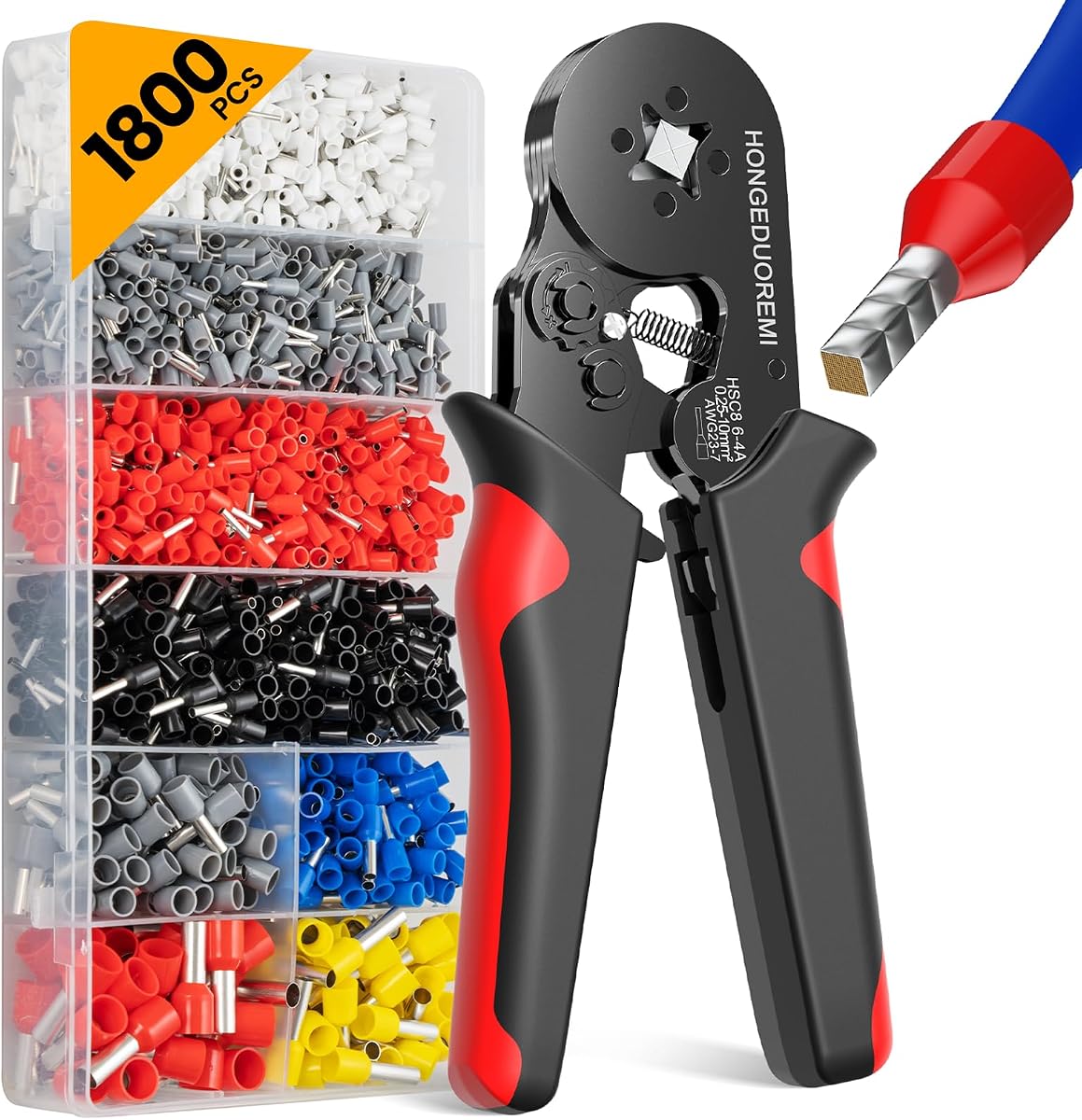
The Ferrule Crimping Tool Kit with 1,800 ferrules holds a 4.7 rating and emphasizes terminal quantity, accessible organization, and a self-adjusting crimping mechanism. Its eight size categories cover 0.5–10 mm², corresponding to 20–8 AWG in the product specifications, making it practical for audio, car, battery, switch, and household wiring projects.
We may earn a commission when you buy through this link, at no additional cost to you.
The copper and nylon ferrules are arranged by standard color coding in the supplied box, allowing users to separate sizes and reduce selection errors. The crimper incorporates ratcheting pliers and four-corner self-adjustment, while the large assortment is intended to support numerous projects without repeated replenishment.
Its 20–8 AWG range is less accommodating for very fine conductors than kits beginning at 24 or 28 AWG. The tool's stated design is centered on a broad set of common sizes rather than heavy power wiring, and the package dimensions may be inconvenient for small tool bags. Users should also confirm that the included connector type and crimp geometry align with their specific wiring requirements.
This package is most attractive to builders who expect high terminal consumption or want a ready-organized supply for a broad range of small and medium conductors. It can simplify repeated automotive audio and general electrical work. For delicate electronics or professional heavy-gauge applications, a narrower but more technically specialized crimper may be the better choice.
A supply of 1,800 ferrules supports sustained project work and provides a useful reserve for common sizes. The quantity makes this package more about production capacity and convenience than carrying the absolute minimum of components.
Organized color categories make it easier to locate a matching connector while working. Clear differentiation is valuable in automotive builds and household panels where several conductor sizes may be present in the same project.
We may earn a commission when you buy through this link, at no additional cost to you.
The HKS Ratcheting Wire Crimper has a 4.5 rating and stands out for its AWG 10–2 range, equivalent to 6–35 mm². That heavy-wire focus distinguishes it from most kits in the roundup and makes it relevant for larger power conductors, industrial equipment, and other applications that exceed common electronics sizes.
We may earn a commission when you buy through this link, at no additional cost to you.
Its ratchet mechanism holds the connector securely before the wire is inserted, then requires a complete handle cycle before automatic release. A dedicated knob adjusts crimp strength, and a quick-release lever opens the jaw from any position. The numerically marked jaw assists size identification, while cushioned, non-slip handles are intended to maintain a secure grip during demanding crimping cycles.
The tool is sold without a terminal assortment, so the appropriate sleeves must be sourced separately. Its suitability for pin cord ends as well as ferrule sleeves broadens its practical use, though the exact connector and conductor combinations should be checked before purchase. The lower listed rating and narrower specialization make it less attractive as a general-purpose electronics kit.
This is a strong choice for electricians and installers who regularly terminate larger wire but do not need a large bundled case. The adjustable force and ratchet support controlled results, and the marked jaw reduces setup ambiguity. It is best viewed as a specialized heavy-wire instrument rather than the single solution for every ferrule size.
The ratchet arrangement allows the connector to be secured first and the wire inserted afterward. This sequence can make positioning more controlled on heavier terminals where the conductor and sleeve are less forgiving.
A dedicated crimp-force knob lets the user tune the tool for different conductor thicknesses. The quick-release lever prevents a jammed terminal from interrupting the workflow, while numeric jaw markings simplify selection.
We may earn a commission when you buy through this link, at no additional cost to you.
The Preciva Ferrule Crimping Tool Kit earns a 4.6 rating with an AWG 28–5 range, six-sided crimping, and a particularly useful combination of 950 single and 350 twin ferrules. It is well matched to projects that include fine electronics wiring as well as conductors approaching 16 mm².
We may earn a commission when you buy through this link, at no additional cost to you.
The self-adjusting ratchet and professional-grade crimping die are designed to produce a consistent termination, while limit points help prevent the jaws from closing too far and becoming stuck. A star-shaped adjustment disk changes crimping pressure for different wire thicknesses. The bow-shaped handles and flexible shaft are also intended to reduce the hand force required during a crimp.
The kit does not reach the very heavy AWG 2–4 end of the market, and its 1,300-piece terminal collection may be more than a mobile technician needs. Because the product is a broad aftermarket package, buyers should verify the terminal dimensions and crimp profile against their wiring specifications. Seller support is stated to respond within 24 hours for quality questions, which offers some reassurance for an unfamiliar brand.
This is a well-rounded choice for assembly work that includes both single and twin ferrules, especially when fine wires are common. The combination of broad range, pressure adjustment, and a substantial matching assortment reduces the need for separate purchases. It is less compelling for heavy industrial power wiring, where a specialist AWG 10–2 crimper would be a better fit.
Having both connector formats in one organized package simplifies mixed wiring jobs. Users can select the appropriate two-wire or single-wire terminal while retaining the same crimping tool and storage system.
The curved handles and flexible shaft offset some of the applied pressure without changing the stated crimping strength. This design consideration is useful during repeated work and helps preserve control when closing the ratchet.
We may earn a commission when you buy through this link, at no additional cost to you.
The KNIPEX 97 53 04 Tools – Crimping Pliers, Self-Adjusting carries a 4.7 rating and combines a 0.08–16 mm² range, equivalent to AWG 5–28, with a compact professional design. It is intended for ferrule crimping according to DIN 46228 parts 1 and 4, giving it relevance where standardized sleeve dimensions are important.
We may earn a commission when you buy through this link, at no additional cost to you.
An integral lock supports repetitive, high crimping quality, while the self-releasing mechanism helps the tool release after a completed cycle. The narrow handle width and improved ergonomics are stated to reduce manual force by 20 percent. Ferrules enter laterally, allowing the sleeve and wire to be positioned from the side rather than requiring a different loading motion.
This is a tool rather than a kit, so it does not include terminals, a case, or a supply of connectors. It also occupies the premium end of the market without the large assortment offered by several lower-cost packages. Buyers should determine whether their connectors are specified for the DIN 46228 profile and the tool's terminal loading method before committing.
For professional technicians who work repeatedly with standardized ferrules and want a dedicated, compact instrument, the 97 53 04 is a refined and practical choice. Its broad range covers fine electronics through 16 mm², while the locking system and ergonomic handles support consistent daily use. It is better suited to an established professional toolset than a first-time buyer wanting a complete starter package.
Support for DIN 46228 parts 1 and 4 is valuable where wiring documentation specifies those terminal standards. This gives the crimper a defined application beyond simply fitting a visually similar sleeve.
A narrower profile and a stated 20-percent reduction in manual force make the tool easier to operate during repeated terminations. The integral lock contributes to consistency, while the self-releasing mechanism avoids an unnecessary secondary release step.
We may earn a commission when you buy through this link, at no additional cost to you.
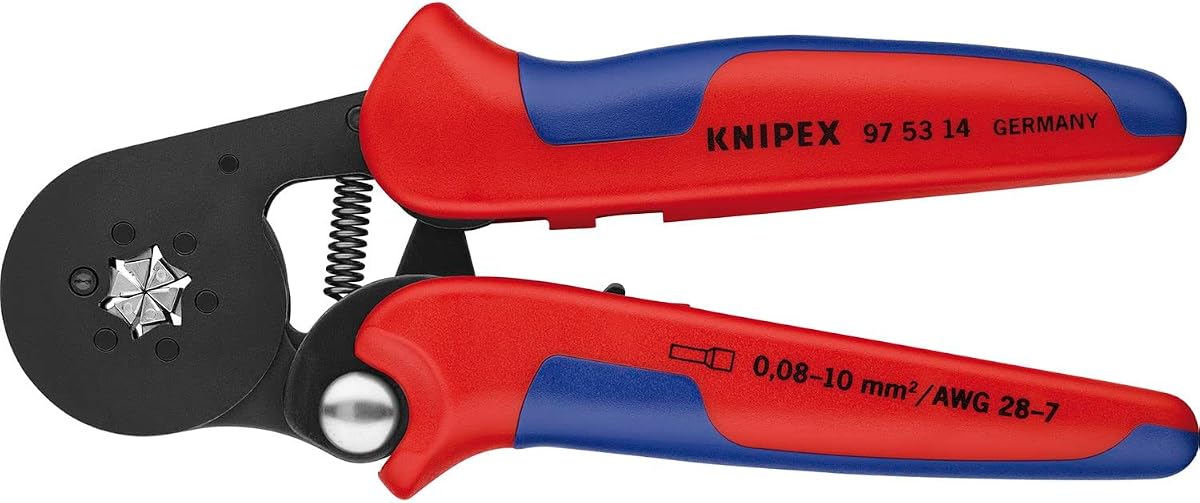
The Knipex 97 53 14 Crimping Pliers for end sleeves with self-adjustment holds a 4.8 rating and is a strong premium selection for technicians who want a dedicated hex termination tool. Its hexagonal compression is designed for confined connection dimensions, where the shape of the finished crimp can influence available space inside an assembly.
We may earn a commission when you buy through this link, at no additional cost to you.
The pliers support end sleeves up to 10 mm² and are particularly suited to twin end sleeves up to 2×6 mm², or 2x AWG 10. Self-adjustment allows the tool to respond to the terminal being crimped, reducing the need to manually set a stop for each size. The compact plier format also keeps the tool close to the work area.
Like other standalone professional tools in this roundup, it does not include a collection of ferrules or a storage case. Its specialized emphasis is hex compression, so it is not the natural choice for a project expressly requiring a square crimp. Buyers should also confirm the exact wire and twin-sleeve specifications before selecting connectors.
For professional panel work, equipment assembly, and other applications where a compact hex profile and twin-ferrule support are important, the 97 53 14 provides a refined solution. It is a better fit as a specialist addition to an established toolkit than as a budget-oriented all-in-one purchase. Its strong rating and focused design justify consideration by users who value a dedicated professional instrument.
The hex compression profile can be advantageous where the terminated conductor is installed in a confined area. Its geometry offers a distinct alternative to the square-style complete kit and the broad four-corner package.
Compatibility with twin ferrules up to 2×6 mm² expands the tool's usefulness for paired conductors. This is particularly valuable in control and electrical assemblies where a two-wire terminal is part of the wiring design.
We may earn a commission when you buy through this link, at no additional cost to you.
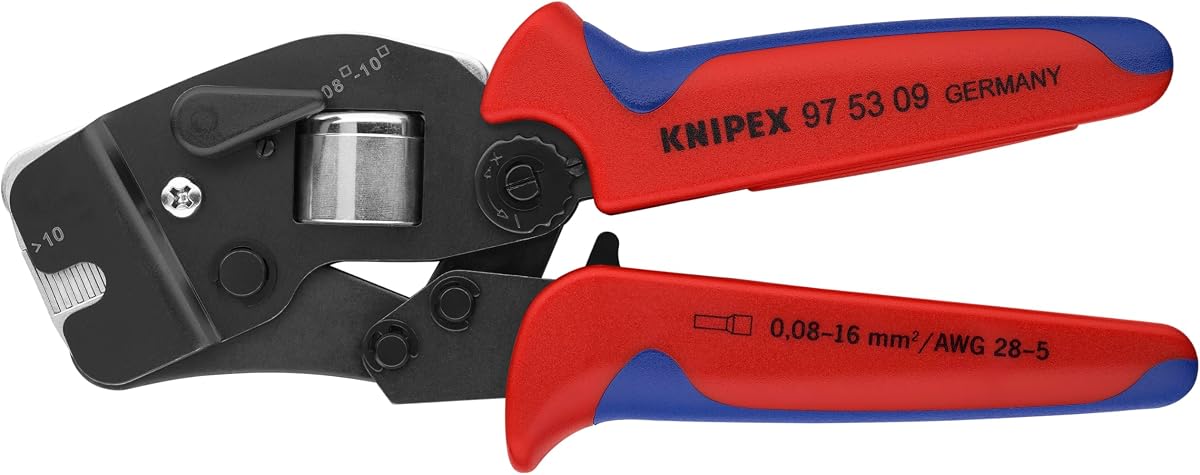
The KNIPEX 97 53 09 Self-Adjusting Crimping Pliers has a 4.4 rating and offers a broad AWG 5–28 range with a two-position selector. It is designed for end sleeves compliant with DIN 46228 parts 1 and 4, covering 0.08–10 mm² and 16 mm² in one tool.
We may earn a commission when you buy through this link, at no additional cost to you.
The selector lets the user move between the 7–28 AWG range and the range extending to 5 AWG. Ferrules load laterally, and an integral self-releasing lock supports repeatable crimping quality. This combination of standardized profile, explicit range selection, and self-adjustment is aimed at technicians who need dependable results across multiple conductor sizes.
As a standalone tool, it lacks the convenience of included ferrules and a dedicated carrying case. Its listed rating is the lowest among the ten products here, although rating alone does not describe the tool's mechanical features or intended professional application. The selector must be set correctly for the conductor size, and the connector profile needs to match the standardized end-sleeve design.
This crimper is best for professional users who already maintain a connector inventory and value a specialized instrument. It handles a very broad range without replacing the tool, while the self-releasing mechanism helps maintain an efficient workflow. Buyers seeking an immediate project-ready collection may prefer one of the bundled kits, but this standalone model offers focused functionality for experienced users.
The selector makes the active range visible and lets the user work from 7 through 28 AWG or extend to 5 AWG without changing tools. This approach is useful for technicians who alternate between fine control wiring and larger conductors.
The integral lock is designed to promote consistent crimping across repetitive tasks. Once the required cycle is complete, the self-releasing behavior helps the pliers reopen without a separate manual release step.
We may earn a commission when you buy through this link, at no additional cost to you.
The right ferrule crimping tool depends on conductor size, terminal geometry, expected workload, and the need for portability or standardized professional results. Comparing these factors before buying helps avoid a tool that is awkward to use, incompatible with existing terminals, or too limited for the intended work.
Begin with the wire sizes and cross-sectional areas that appear most often in your work. Fine electronics and control wiring may require coverage down to 24 or 28 AWG, while automotive, industrial, and power applications can reach AWG 2 or 4. The listed range should also account for the exact terminal construction, including whether single or twin ferrules are required. A broad AWG number alone does not guarantee compatibility with every connector sold under the same label.
Hexagonal, square, and four-corner profiles create different finished shapes and may be specified differently by terminal manufacturers or wiring standards. DIN 46228 references are useful when your documentation follows that standard, particularly for professional control-panel work. If a project has a defined tooling instruction, follow it rather than assuming a visually similar terminal will crimp correctly in any profile.
A ratchet mechanism helps maintain pressure throughout the crimp and often releases automatically when the cycle is complete. Self-adjusting dies can simplify work across different sizes, while an adjustment dial or crimp-force knob offers more precise control. Consider how the tool identifies the selected size: a numeric jaw, selector lever, adjustment ring, or range switch should be clear enough to use in a busy work environment.
All-in-one kits can be economical for a new setup because they combine the crimper with many terminal sizes. The value depends on the assortment matching your actual work and on whether the included connectors meet the required dimensions, insulation, and color-coding system. Standalone tools are often more convenient for professionals who already maintain standardized connector stocks and prefer a compact tool bag.
A crimper may be operated many times per day, so handle shape, opening angle, grip texture, and required hand force matter. Rounded or non-slip handles, narrow profiles, and self-releasing mechanisms can reduce fatigue and interruptions. Also consider whether the tool will be used overhead, inside cabinets, or while wearing gloves, because those conditions may favor a plier-style design with a controlled ratchet cycle.
Service technicians often need connectors that remain sorted and easy to retrieve away from a workbench. Hard cases offer better protection for a mixed assortment, while double-layer boxes and soft cases can keep components separated with less bulk. A smaller standalone crimper may travel more easily but requires a separate way to store loose terminals and keep sizes clearly separated.
Control panels, electronics, automotive systems, marine wiring, solar inverters, and household projects can all benefit from ferrules, but their tooling requirements may differ. Heavy-gauge or high-current work may call for a specialized AWG 10–2 or AWG 10–4 crimper, while standardized industrial work may favor a DIN-compliant professional model. In every case, disconnect power, verify conductor size, and follow the connector manufacturer's instructions.
Start by de-energizing the circuit and confirming the conductor size with a suitable wire-gauge measurement. Strip only the length required by the ferrule, remove the insulation without nicking the conductor, and clean or prepare the wire as directed by its manufacturer. Select the matching ferrule and confirm that the tool's profile, size selection, and crimp settings correspond to that connector before inserting either component.
Place the ferrule into the tool using its intended loading method, then insert the stripped conductor fully so no copper strands are outside the sleeve or near the insulation. Close the handles through the complete ratchet cycle. A self-adjusting tool should stop at its natural release point; a tool with a force adjustment should be set according to the manufacturer's size guide. Do not force the handles beyond the designed endpoint or attempt to open a locked ratchet by forcing it.
After the crimp, inspect the connector for full conductor insertion, a compact finished profile, correct size selection, and any visible movement of the wire inside the sleeve. Pull-test the termination when the application and safety procedure call for it, then reconnect and recheck the circuit. Keep the die clean, remove debris with a soft brush, store the tool dry, and avoid dropping it or placing loose terminals inside the crimping jaws.
Choose a tool that comfortably covers the smallest and largest wires you regularly terminate, rather than selecting only by maximum capacity. Fine electronics and control wiring may require coverage down to 24–28 AWG, while power and industrial applications may need AWG 2–4 tools. Confirm that the range includes the exact single or twin ferrule sizes used in your wiring system.
No. Hex and square tools create different finished geometries, and the terminal may be designed for a particular crimp profile. Using the wrong profile can produce an unsuitable termination even if the wire size fits. Follow the terminal manufacturer's tooling instructions and use the profile specified for the connector and applicable wiring standard.
A ferrule is a metal sleeve placed around a stripped conductor and mechanically crimped onto it. Unlike some terminals that accept a pin or blade, a ferrule is typically intended to be inserted into a matching terminal block or connector. The crimp organizes the conductor strands and creates a dependable connection without relying on solder.
A ratchet is strongly preferable for most electrical work because it helps the jaws reach a consistent pressure and usually holds the connector securely while the wire is inserted. It also reduces the chance of an incomplete crimp caused by inconsistent handle pressure. For occasional DIY work, a suitable non-ratcheting tool may suffice, but repeatability favors a ratcheting design.
Some tools support both, but only if their specified capacity and crimp geometry include the relevant twin-terminal size. For example, the Knipex 97 53 14 is stated to support twin end sleeves up to 2×6 mm², while the Preciva kit includes both single and twin ferrules. Always check the tool's instructions rather than assuming a twin sleeve will be accepted.
A good crimp should retain the conductor firmly, show a completed and uniform compression profile, and have the correct ferrule size and wire fully seated. A proper pull test can help verify retention, but the appropriate test method should follow project and safety requirements. If the ferrule moves, splits, shows an uneven profile, or leaves copper outside the sleeve, it should be replaced and terminated again.
A kit is convenient for beginners, maintenance inventories, and projects that repeatedly use common sizes. A standalone crimper is often better for professionals who already own sorted connectors and want a compact, purpose-built tool. Compare the included sizes, case protection, and connector quality with your real workload rather than choosing the largest package automatically.
Self-adjustment refers to the crimping mechanism responding to the connector, not necessarily to a calibration process. A separate adjustment dial, selector, or star disk may still need to be set for the conductor size, depending on the model. Follow the supplied instructions, confirm the selected range visually, and avoid changing settings without matching them to the appropriate size guide.
The Klein Tools 34060 is the strongest all-in-one choice, combining a ratcheting square crimper, a large terminal supply, and a storage case in a polished package. The Klein Tools 34056 is a more focused value pick for standard 10–22 AWG work, while the Knipex 97 53 14 stands out as a premium specialist for compact hex crimps and twin end sleeves. Broader kits serve users who want many connector sizes immediately.
Prioritize exact wire range, matching terminal profile, and a mechanism that can produce a complete, repeatable crimp. Add ratcheting for consistency, adjustment for varied conductor sizes, and organized storage if terminals will be used in the field. For heavy-gauge work, specialized tools such as the HKS crimper are more suitable, while fine-wire assemblies may favor kits beginning at AWG 28 or DIN-standard professional pliers.
Ratings, package contents, product details, and prices can change over time, so consult the current retailer listing before purchasing. Confirm the crimper's compatibility with the ferrule manufacturer, verify the wire size, and use the tool exactly as instructed. With those checks in place, the right ferrule crimping tool can make wiring faster, cleaner, and more dependable.