
78W 4-Port Charger with Voltmeter
4.7Editor score
Real-time LED voltage display
PD, PPS, and QC protocols
Aluminum alloy outer shell
Explore the best 4 Port USB Car Chargers, comparing fast charging, port layouts, safety protections, vehicle compatibility, and everyday power needs for trips.
A 4 Port USB Car Charger is one of the most useful upgrades for drivers, families, rideshare professionals, and anyone who regularly travels with multiple devices. The best models combine USB-C and USB-A connectivity, intelligent power management, reliable heat dissipation, and enough total output to charge several phones or a mix of phones, tablets, cameras, and navigation equipment at once.
We compared all ten options by examining port configurations, maximum power output, supported fast-charging protocols, device compatibility, construction, safety protections, physical fit, and useful extras such as voltage displays and ambient lighting. The list includes conventional plug-in adapters, a voltage-monitoring model, a rugged DEWALT option, and a hardwired installation kit with a different power-delivery approach.
Each review identifies the product's strongest use case and any limitations that shoppers should understand before buying. Our top picks represent the most balanced option, the best value-oriented model with a voltage display, and the highest-output premium choice. Product specifications and availability can change, so readers should verify current details and compatibility before making a final purchase.
4.7Editor score
4.6Editor score

4.4Editor score
The comparison below makes the differences among the ten chargers easy to assess. Pay particular attention to total wattage, port balance, supported protocols, physical construction, and whether a plug-in or permanently installed design better suits your vehicle.
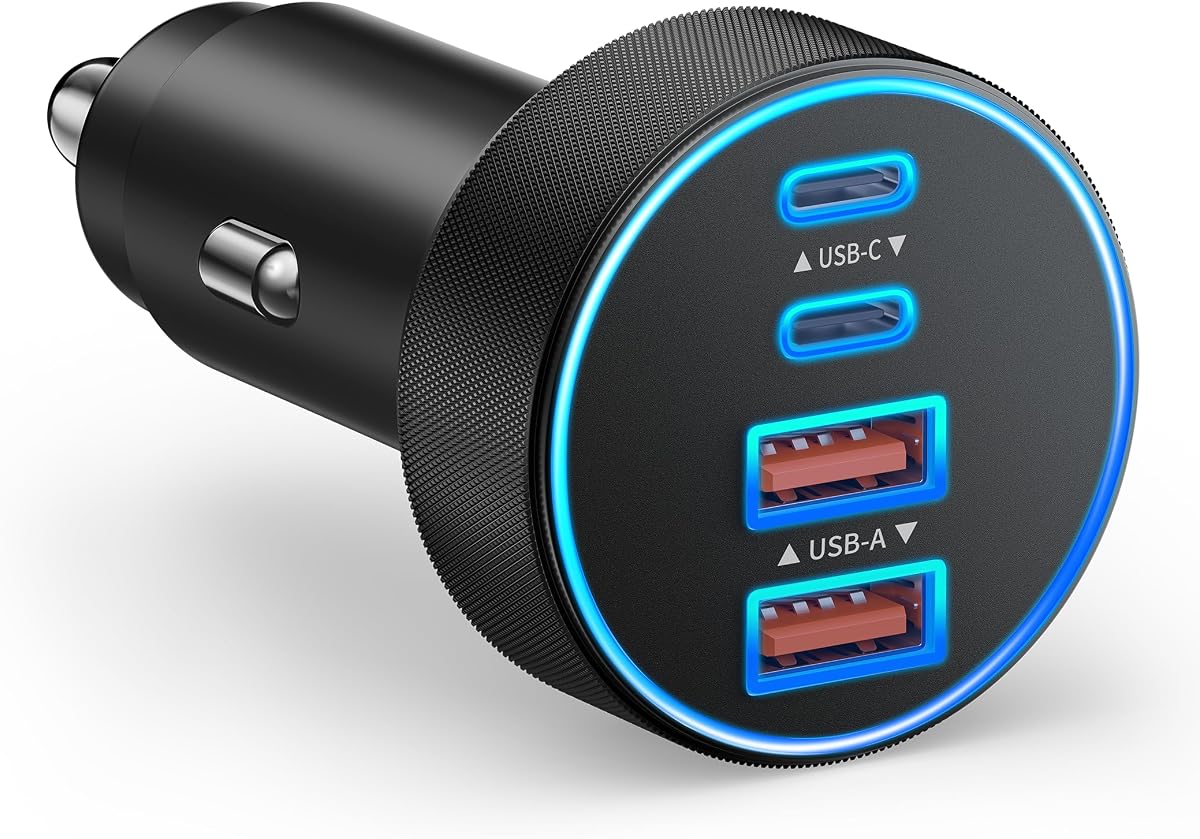



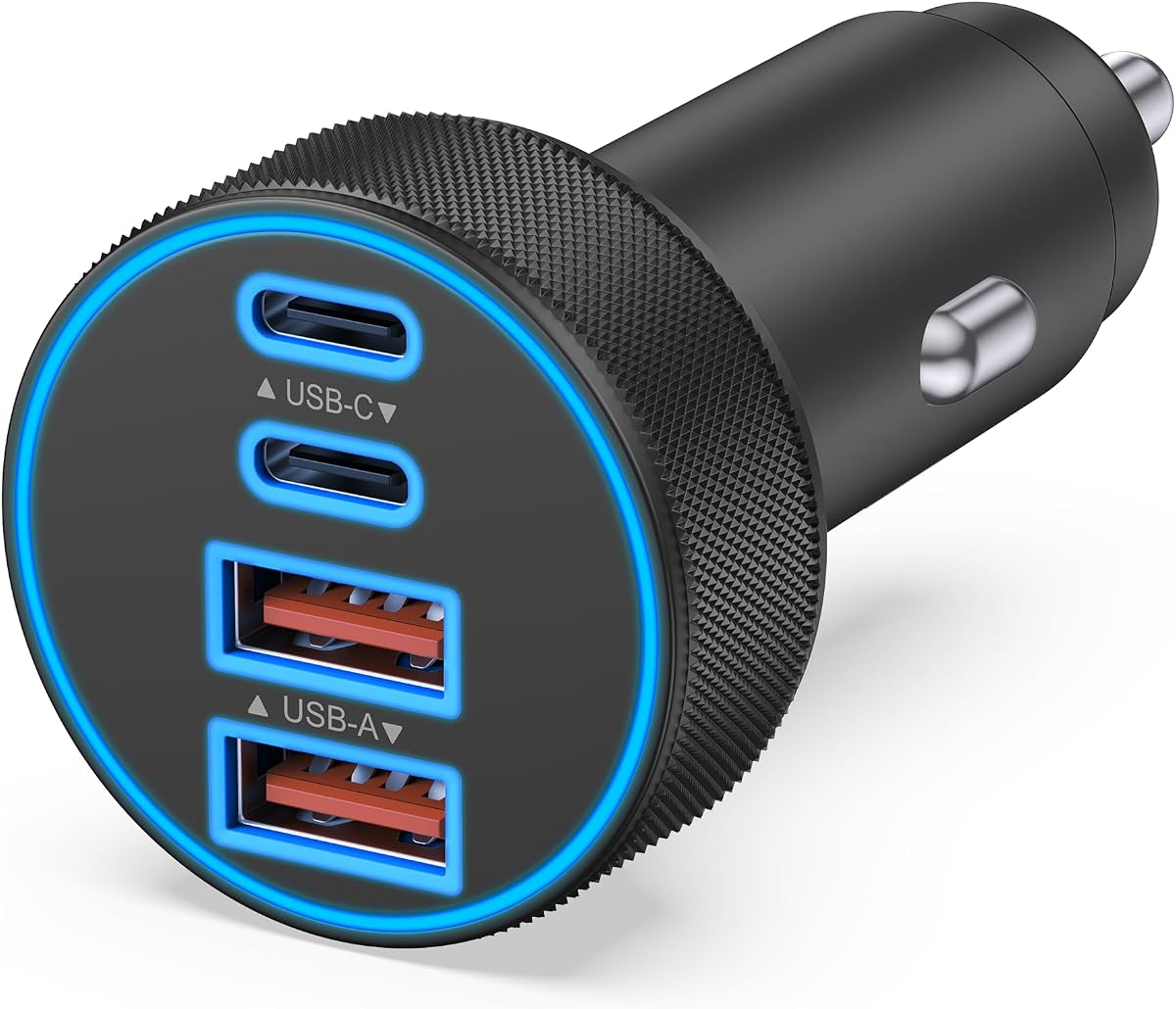
This 90W USB-C car charger combines two USB-C ports with two USB-A ports, giving it one of the most versatile layouts in the group. Its 4.6 rating reflects a generally strong combination of fast-charging support, broad device compatibility, and a compact all-metal housing. It is well suited to drivers who regularly connect more than one phone or mix a modern USB-C device with older accessories.
We may earn a commission when you buy through this link, at no additional cost to you.
The charger supports PD, PPS, and QC fast-charging technologies, with the product description identifying USB-C output up to 45 watts and USB-A output up to 45 watts. Its intelligent power-management chip is designed to guard against overcurrent, overvoltage, overload, overheating, and short circuits. The dense metal enclosure is particularly relevant because sustained multi-device charging creates more heat than charging a single phone.
As with every adapter in this roundup, the published charging percentages are device-specific rather than universal. A compatible phone, tablet, cable, battery state, and temperature can all affect the result. The product should not be treated as a guaranteed replacement for wall charging, but it is well designed for topping up devices during a commute, a family trip, or a longer drive. Buyers should also confirm that their vehicle has a suitable 12-24V cigarette-lighter socket.
This is the strongest all-around recommendation because it balances a modern port mix, generous total output, several fast-charging protocols, and heat-conscious construction. Choose it if your household regularly needs four charging positions and you want one adapter to cover recent phones, older USB-A accessories, tablets, power banks, and navigation devices.
The two USB-C and two USB-A arrangement avoids forcing every device into the same connection type. It also gives the adapter a more useful role than a basic four-USB-A model, particularly for households with newer and older devices in regular use.
The all-metal housing helps dissipate heat during demanding charging sessions. Combined with the stated short-circuit, overcurrent, overvoltage, overload, and overheat protections, it is a sensible choice for frequent long drives.
We may earn a commission when you buy through this link, at no additional cost to you.
This four-port adapter also uses a two-USB-C and two-USB-A configuration, but its chief attraction is the combination of 90 watts of stated total output and broad protocol support. It carries a 4.6 rating and is marketed for phones, tablets, laptops, power banks, driving recorders, and other common travel electronics.
We may earn a commission when you buy through this link, at no additional cost to you.
PD, PPS, and QC technologies are listed as its fast-charging foundation, while the product information identifies a maximum of 45 watts from USB-C and 45 watts from USB-A. Its safety system is described as preventing overheat, overcharge, overcurrent, and short-circuit conditions, with charging stopping automatically when a connected device reaches full power.
The claimed performance figures should be treated as device-specific targets rather than guarantees. A laptop may require a compatible USB-C cable and sufficient input from a 24-volt vehicle, and some phones will negotiate different power levels when several ports are active. The adapter is also less informative than some alternatives because it lacks the real-time voltage display found on competing models.
This charger is a good fit for commuters and families who want a simple plug-in solution with a strong port mix. It is particularly attractive when fast charging and simultaneous multi-device use matter more than monitoring the vehicle's electrical voltage.
PD, PPS, and QC support allow the adapter to negotiate suitable charging rates with many compatible devices. PPS is especially useful for compatible Android phones, while PD and QC cover a broad range of phones, tablets, and other electronics.
The stated protections cover common electrical risks, and automatic shutdown at full charge helps prevent unnecessary continued power delivery. The system remains dependent on the quality of the connected cable and the vehicle socket.
We may earn a commission when you buy through this link, at no additional cost to you.
This 78W charger is a standout value-oriented option because it combines a balanced four-port arrangement with a built-in LED voltmeter. Its 4.7 rating is the highest among the listed products. The display can show the vehicle's input voltage while the adapter is connected, adding a useful diagnostic feature to an otherwise conventional car charger.
We may earn a commission when you buy through this link, at no additional cost to you.
Two USB-C and two USB-A ports allow up to four compatible devices to charge simultaneously. PD 3.0, PPS, and QC 3.0 are supported, and the product information cites strong charging results for compatible iPhone, iPad, and Samsung Galaxy devices. Its aluminum alloy housing is designed to improve heat dissipation, while an internal smart chip supplies overvoltage, overcurrent, overheating, and short-circuit protection.
The voltage display is best treated as a monitoring convenience rather than a complete vehicle diagnostic tool. It can help users notice changes in the power available at the socket, but it does not replace battery testing or professional electrical inspection. Likewise, stated charging percentages depend on device support, cable quality, starting battery level, and whether multiple outputs are operating at once.
This is the top choice for shoppers who want more than a basic four-port adapter without moving to the highest-output premium category. It is especially attractive to drivers who appreciate seeing vehicle voltage at a glance and want a durable adapter with modern and legacy ports.
The real-time display provides a quick indication of the voltage reaching the charger. That information can be useful when diagnosing an older socket or noticing an unexpected change while multiple accessories are connected.
Two USB-C ports serve newer phones, tablets, and accessories, while two USB-A ports preserve support for older cables and devices. This makes the adapter practical for a mixed group of passengers.
We may earn a commission when you buy through this link, at no additional cost to you.
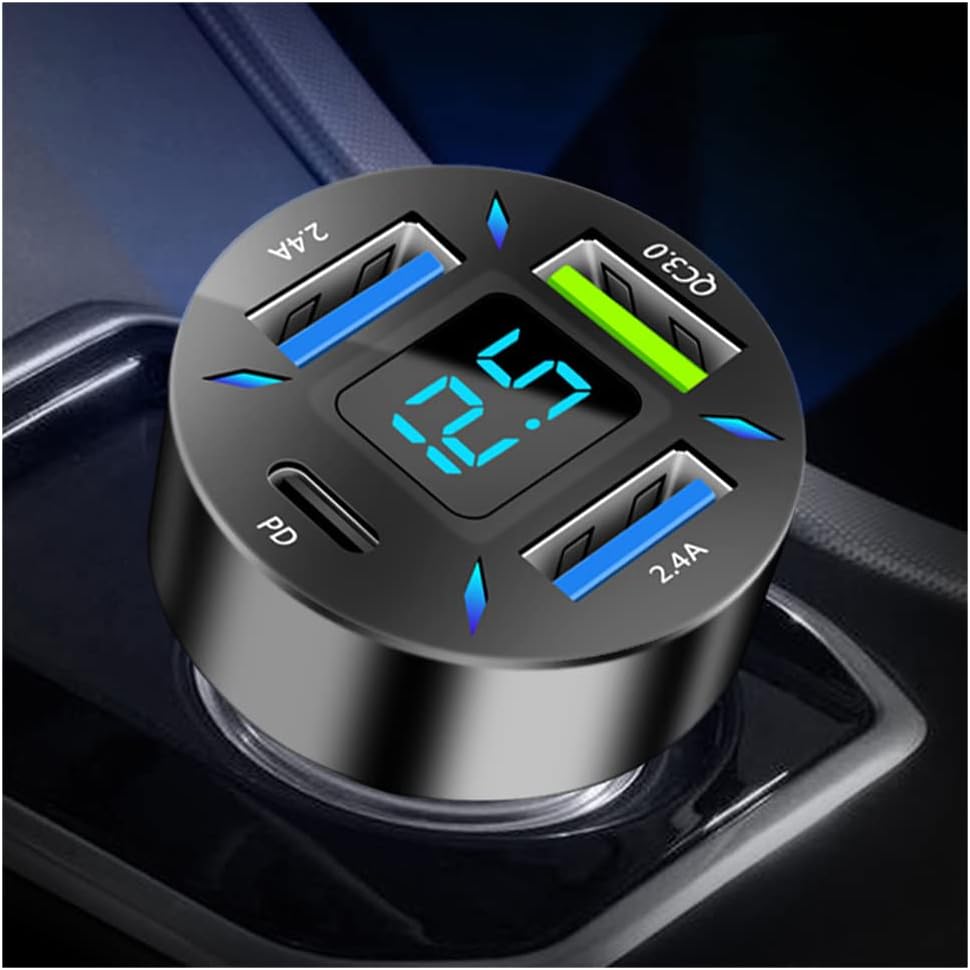
This compact adapter combines a 20-watt USB-C port, one Quick Charge 3.0 USB-A port, and two additional USB-A ports. Its 4.4 rating reflects a practical design that prioritizes broad device support and a built-in voltage display rather than maximum total power.
We may earn a commission when you buy through this link, at no additional cost to you.
A prominent selling point is the LED digital voltmeter, which displays the vehicle battery voltage in real time while the charger is plugged in. The unit also has an LED light that makes the socket easier to locate in darkness. Reinforced anti-slip features around the plug are intended to help maintain contact over uneven roads.
The internal smart master-core system is described as identifying connected devices and adjusting current output, while providing overvoltage, overcurrent, overtemperature, over-power, and short-circuit protection. Its 20-watt USB-C output is still sufficient for many phones, but it is well below the 35- to 60-watt USB-C levels offered by several competitors.
Choose this model if you need four ports, want a visible voltage reading, and do not expect to power a demanding USB-C laptop from the adapter. It is also a sensible option for older USB-A accessories that still make up a significant part of your daily charging kit.
The digital display makes socket voltage visible without a separate tool. It is useful for quick checks during commutes and can be especially useful for older vehicles or frequently used outlets.
Reinforced anti-slip sections around the charger are intended to reduce movement in the socket. A more secure fit helps maintain both power delivery and the visibility of the display.
We may earn a commission when you buy through this link, at no additional cost to you.
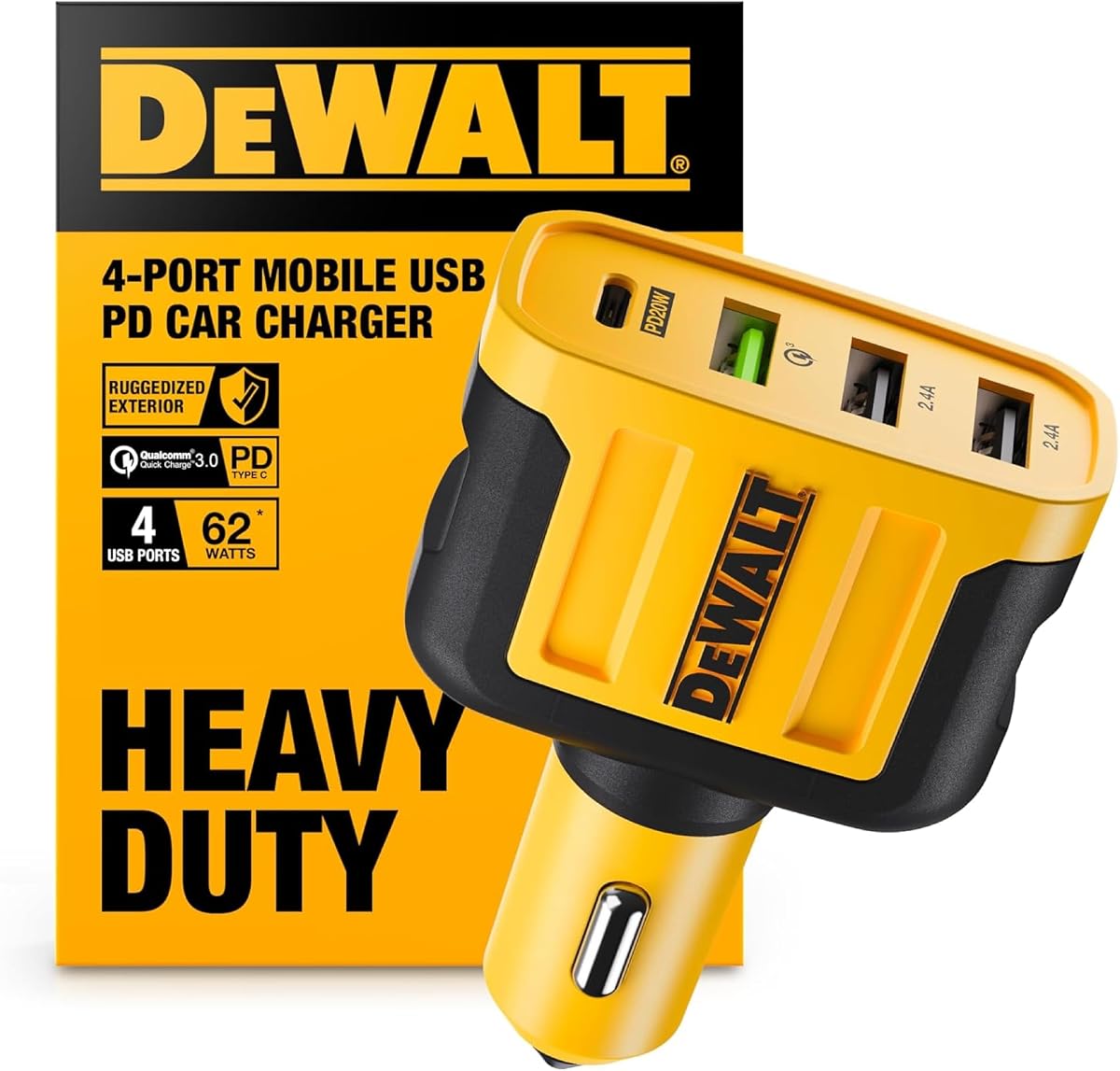
The DEWALT Heavy Duty four-port car charger offers 60 watts of available charging power and a rugged exterior intended to withstand repeated travel use. Its 4.6 rating places it among the stronger products in the roundup, while the recognizable brand and substantial housing give it a different character from the more compact plastic adapters.
We may earn a commission when you buy through this link, at no additional cost to you.
The charger includes a USB-C Power Delivery port and a Quick Charge-enabled USB-A port. The product information says compatible devices can reach 50 percent within 30 minutes, and all four ports can charge simultaneously. Fastest results still depend on the device, its charging protocol, the cable, and the allocation of power across active ports.
The primary appeal is durability rather than a unique feature such as a voltage display. Buyers who routinely carry the adapter between work, vehicles, and hotels may value the rugged exterior. The information does not specify the exact number of USB-C and USB-A ports, so shoppers who require a particular cable mix should confirm the product's current port layout before ordering.
This charger suits drivers who value a sturdy, brand-backed adapter and need four charging positions without installing permanent wiring. It is less compelling for buyers whose main priority is a high-watt USB-C port, but it remains a balanced travel accessory for a broad range of devices.
The rugged exterior is designed for wear and tear associated with repeated removal, transport, and insertion. That makes the adapter appealing for anyone who keeps emergency charging equipment in a vehicle.
Supporting four devices simultaneously reduces the need to carry several wall chargers and cables. Drivers can keep a phone, navigation unit, passenger device, and accessory connected during a longer journey.
We may earn a commission when you buy through this link, at no additional cost to you.
This 90W four-port adapter provides two USB-C and two USB-A ports, matching the balanced layout of several higher-ranked competitors. Its 4.6 rating is supported by a broad device list, multiple fast-charging protocols, and a flame-retardant PC housing designed for heat dissipation and durability.
We may earn a commission when you buy through this link, at no additional cost to you.
PD 3.0, PPS, and QC are supported, with USB-C output stated at up to 45 watts per port. The product information also describes emergency charging for a MacBook Air, although it explicitly notes that cables are not included. A device with a demanding USB-C input and the correct cable is therefore necessary for that use case.
The shockproof construction is intended to maintain power delivery over bumpy roads, and a blue LED indicator makes the unit easier to find in a dark cabin. Built-in power management provides overcurrent, overvoltage, and short-circuit protection. As with the other adapters, actual charging times depend on the connected equipment and the power shared among four active ports.
This is a versatile option for family vehicles, rideshare drivers, and commuters who need one charger to serve many device types. It is especially appealing when the included protection, ambient light, and modern port mix matter more than a voltage display.
The ability to supply emergency power to a compatible MacBook Air makes the adapter more versatile than a basic phone charger. You must provide a suitable USB-C cable, and sustained laptop use will also depend on available vehicle power.
Flame-retardant PC is described as offering heat dissipation, scratch resistance, and durability. The blue indicator provides a subtle way to locate the adapter during nighttime travel without adding a distracting display.
We may earn a commission when you buy through this link, at no additional cost to you.
Rocoren's 55W adapter uses one USB-C port and three USB-A ports, prioritizing broad compatibility and a secure fit over a premium-style two-USB-C layout. It carries a 4.6 rating and supports simultaneous charging for up to four devices, making it useful for mixed device groups.
We may earn a commission when you buy through this link, at no additional cost to you.
The USB-C port delivers up to 35 watts and supports PD 3.0, QC 3.0, PPS, and other mainstream protocols. The product information reports that compatible iPhone 15 Pro Max and Samsung S24 Ultra devices can reach substantial charge levels in 30 minutes, though actual results vary with devices, cables, and simultaneous load.
A distinctive feature is the brass-plated rectangular plug contact. The manufacturer says it fits more firmly than a conventional round contact, improves conductivity, and is designed to avoid accidental disconnection on bumpy roads. Overcharge, overheating, short-circuit, and overvoltage protections are included, along with a soft blue ring for nighttime visibility.
This model is a good fit for travelers with several USB-A accessories but only one primary USB-C device. It offers a thoughtful secure connection and useful warranty support, although shoppers wanting two USB-C ports or the highest possible total output should look at the 90W or 120W alternatives.
The rectangular brass-plated contact is designed to resist movement and maintain a stable connection. That can be valuable on rough roads or during long drives where a loosely fitting charger may interrupt charging.
A 35-watt USB-C output with PD 3.0 and PPS support is suitable for many modern phones and smaller compatible devices. Its lower aggregate rating compared with the 78W and 90W models limits its appeal for more demanding USB-C equipment.
We may earn a commission when you buy through this link, at no additional cost to you.
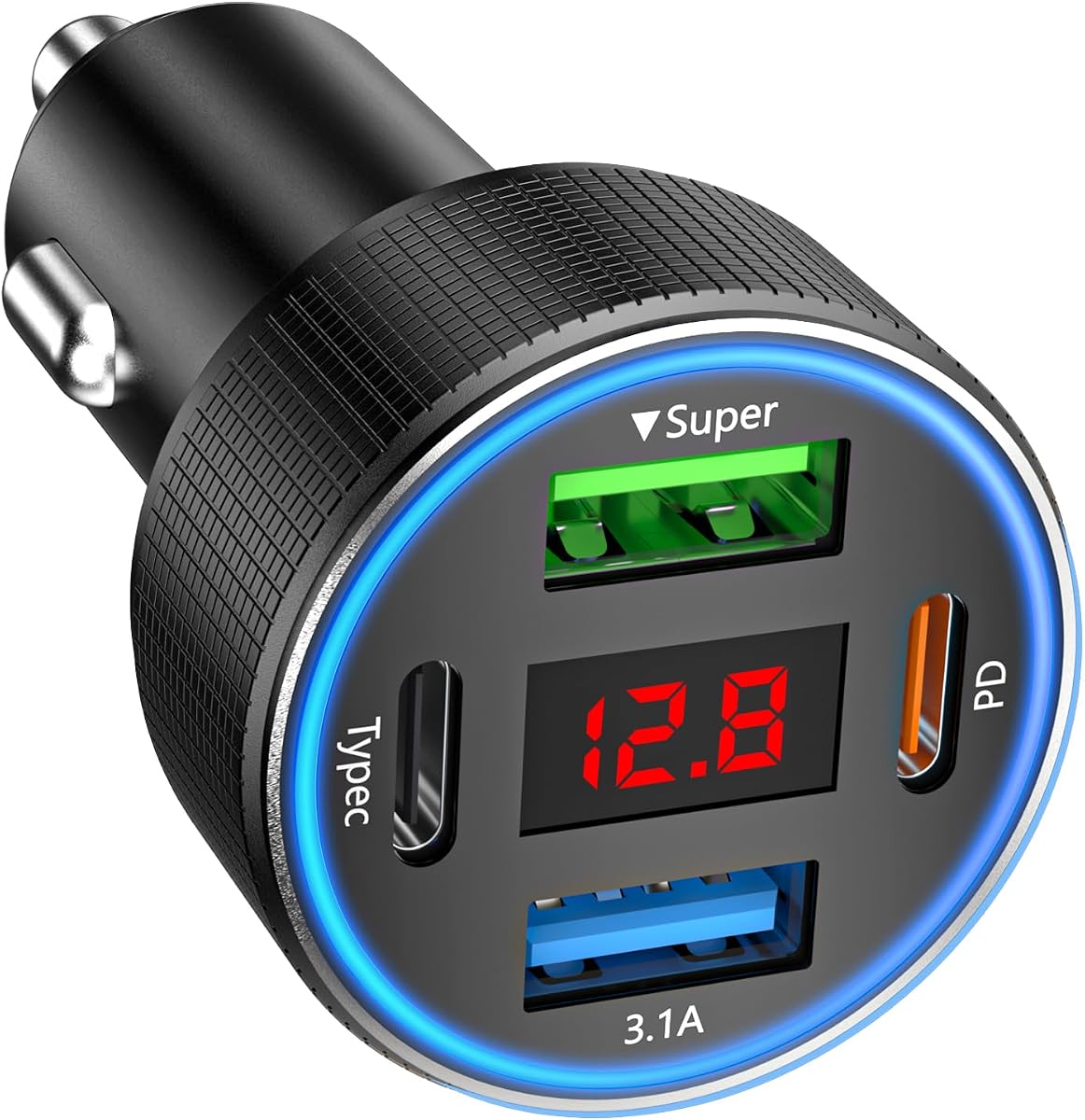
This 78W charger pairs two USB-C and two USB-A ports with a real-time LED voltage display. Its 4.7 rating makes it one of the most well-regarded products in the group, and the combination of modern ports, broad protocol support, and monitoring gives it a balanced feature set.
We may earn a commission when you buy through this link, at no additional cost to you.
Power Delivery, PPS, SUPER, and Quick Charge 3.0 are listed as supported protocols. Compatible devices include recent iPhone and Samsung Galaxy series phones, Google Pixel devices, iPads, Android equipment, power banks, earbuds, smartwatches, and dash cams. The product can power up to four compatible devices simultaneously.
The full-metal or aluminum-alloy housing is designed to dissipate heat efficiently, while built-in safeguards address overcurrent, overvoltage, overheating, and short circuits. The voltage display gives users a quick view of the socket's input while the charger is working. As with the 78W voltmeter alternative, this display offers visibility but does not replace a full battery or alternator diagnosis.
Choose this model when you want a balanced port count, a visible power reading, and support for several common fast-charging standards. It is a strong choice for daily commuting and family travel, especially when passengers use a mixture of modern and older devices.
The digital display updates the visible vehicle voltage while the charger is connected. This makes it easy to notice power changes without carrying a separate multimeter or diagnostic display.
PD, PPS, SUPER, and QC 3.0 support make the adapter adaptable across many current devices. It remains important to use cables capable of carrying the intended power level for the fastest results.
We may earn a commission when you buy through this link, at no additional cost to you.
This package includes two permanently installed 12-volt USB outlet units, each with four ports. Its 4.6 rating and hardwired design make it distinct from every conventional cigarette-lighter adapter in the roundup. It is intended for cars, boats, marine vessels, motorcycles, ATVs, RVs, golf vehicles, and other 12- or 24-volt installations.
We may earn a commission when you buy through this link, at no additional cost to you.
Each outlet contains two 30-watt PD 3.0 USB-C ports and two 18-watt QC 3.0 USB-A ports, with a stated maximum combined output of 78 watts. All four ports can charge simultaneously, but the output is shared, so connecting several demanding devices can reduce the rate available to each one.
A push-button power switch prevents the outlet from drawing power after the engine has been started and the installation is no longer needed. The package includes a 60-centimeter fused cord, two spare fuses, and blue terminals. Installation involves connecting the red wire to positive and the black wire to negative, with the bottom marked accordingly. Incorrect polarity prevents operation.
This is the best choice for a builder, boat owner, RV traveler, or vehicle enthusiast who wants a permanent charging point in multiple locations. It is less convenient for someone seeking a simple adapter that can move from vehicle to vehicle, and professional electrical help is advisable if you are not comfortable with low-voltage wiring.
Two outlet units allow charging points to be installed around a larger cabin, cockpit, or passenger area. This is especially useful where a single socket location would be inconvenient for multiple riders.
Marine, motorcycle, ATV, RV, and golf-cart compatibility broadens the appeal beyond ordinary cars. Waterproof construction and fused wiring support the demands of installations exposed to vibration or changing conditions.
We may earn a commission when you buy through this link, at no additional cost to you.
The SONRU 120W charger is the highest-output conventional adapter in this guide. It combines two USB-C and two USB-A ports, with the product information identifying USB-C output up to 60 watts and USB-A output up to 30 watts. Its 4.4 rating is slightly below several alternatives, but the unusually high power ceiling and certification set it apart.
We may earn a commission when you buy through this link, at no additional cost to you.
The adapter supports PPS, PD 3.0, QC 3.0, AFC, and FCP protocols. The product information reports that compatible iPhone 14 models can reach 80 percent in 30 minutes and many Android devices can reach 70 percent in 35 minutes. Its 120-watt total is shared across connected devices, so those individual results depend on how the charger allocates power.
UL certification and a flame-retardant PC-and-ABS construction are notable strengths. Protection against short circuits, overheating, overcurrent, and overcharging is included, and the unit automatically recognizes devices to assign suitable efficiency. The transparent-and-gray design, blue light, integrated plug, and locking cigarette-lighter connection give it a polished appearance.
This is the premium recommendation for users with demanding USB-C devices, multiple passengers, or a need for higher aggregate output. One important caveat is that its 15- and 20-volt outputs require a 24-volt vehicle input, so compatibility should be checked before purchase. It also includes a user manual, 12-month warranty, and stated customer support.
A stated 60-watt maximum on USB-C gives this model more headroom for compatible tablets and other power-hungry devices. The extra capacity is most useful when fewer accessories are connected and the vehicle can supply the required input.
UL certification adds a distinct trust element, while the PC-and-ABS housing is described as flame retardant. The integrated locking plug, blue illumination, and transparent design details also improve usability and appearance.
We may earn a commission when you buy through this link, at no additional cost to you.
Choosing a four-port car charger involves balancing total power, port types, protocol support, physical fit, and installation style. A model that looks impressive can still disappoint if its output is divided inefficiently, its socket contact is loose, or the vehicle does not provide the voltage required for its fastest mode.
Total wattage indicates the adapter's total charging capacity, but it does not mean every port receives the full advertised amount. Models in this guide range from 55 watts to 120 watts, and some provide up to 60 watts through a single USB-C connection while others divide power among several active ports. Consider how many devices you normally connect and whether one of them requires a high-wattage USB-C session.
For ordinary phone charging, a midrange model may be sufficient. For a tablet, demanding phone, compact laptop, or several simultaneous users, 78 watts or more provides more headroom. Choose enough shared output for the group, and do not assume a headline wattage will be delivered to all four devices at once.
A four-port adapter can contain two USB-C and two USB-A ports, one USB-C and three USB-A ports, or another arrangement. USB-C is essential for modern phones, tablets, and many other accessories, while USB-A remains useful for older devices, battery packs, and legacy cables. The most versatile arrangement for a mixed household is two of each.
Look at the devices you need to charge before deciding. If only one modern USB-C device is present, a one-USB-C design may still work. If several passengers use USB-C phones, a model with two such ports prevents constant cable swapping and makes the four-port capacity more useful.
Power Delivery, Programmable Power Supply, and Quick Charge are among the most important protocol families in this category. PD is widely used by modern Apple devices and many accessories, PPS supports certain fast charging modes on compatible Android phones, and QC covers a substantial range of Android products. Some adapters add AFC, FCP, or other proprietary protocols.
A charger can have a high wattage and still charge slowly if the device and cable do not support a common protocol. Check the phone or tablet manufacturer's charging requirements, then confirm that the adapter supports the matching standard. Also use a cable rated for the intended output, especially when expecting high-watt USB-C charging.
Most cigarette-lighter adapters support standard 12- and 24-volt vehicle systems, allowing them to work across many cars, SUVs, trucks, and vans. Some high-voltage modes need a 24-volt input, and the SONRU model specifically notes that 15- and 20-volt output requires a 24-volt vehicle. Always check both the adapter and the device's requirements.
Inspect the socket for fit and looseness as well. A rectangular or reinforced contact may be preferable in a frequently used socket, while a compact profile can help if the adapter blocks another control or sits close to a center console. A permanently installed outlet is another option, but it requires correct wiring and appropriate fuses.
Every reputable multiport charger should include protection against overcurrent, overvoltage, overheating, overload, overcharging, and short circuits. A smart power-management chip is especially important because it can identify connected equipment and distribute available power safely. Automatic cutoff when a device is fully charged is another useful feature.
Protection claims are only one part of overall quality. Look for a clearly described internal system rather than vague references to safety, and ensure the charger has a suitably sized connector for the vehicle socket. A stable connection and proper heat management can be as important as the list of protection functions.
Multi-device charging generates more heat than charging one phone, especially when a USB-C port operates near its maximum. Metal housings, including aluminum alloy or high-density metal shells, are useful because they spread heat away from internal electronics. Some models use flame-retardant PC or PC-and-ABS combinations instead, which can still provide adequate protection while keeping weight down.
Choose a housing that feels solid without overstating what appearance alone can prove. A secure socket connection, effective internal power management, and suitable heat dissipation are stronger indicators than color or finish. If you travel in hot weather or regularly use all four ports, thermal design deserves particular attention.
A real-time LED voltmeter is a useful addition on several models because it shows the voltage reaching the charger. It can help with quick checks of the socket and may reveal an unexpected drop while accessories are connected. It is particularly appealing to drivers of older vehicles, professionals who spend long periods in the car, and owners of multiple 12-volt accessories.
Do not treat the display as a complete diagnosis of the vehicle's battery, alternator, or wiring. It is a monitoring convenience. If readings seem abnormal, the proper next step is to inspect the socket, check the system with appropriate tools, and seek professional service when necessary.
A plug-in adapter is the easiest and most flexible option. It can move between vehicles, requires no electrical modifications, and is convenient for temporary travel use. A hardwired outlet, by contrast, can provide a permanent charging point in a boat, RV, motorcycle, custom car, or multiple areas of a large cabin.
Permanent systems require correct positive and negative connections, appropriate fusing, and careful attention to weather and vibration. The included two-pack hardwired option includes a fused cord, spare fuses, and terminals, but the product is still aimed at people comfortable with installation. For a standard passenger car, a plug-in adapter is usually the more sensible choice.
Start by confirming that the vehicle has a compatible 12- or 24-volt cigarette-lighter socket and that the adapter's dimensions will not interfere with nearby controls. Insert the charger firmly but gently, then connect each device with a cable that supports both its connector and the desired charging rate. Avoid forcing a cable or adapter into a socket that does not fit properly.
Once connected, allow the charging system to negotiate its output. A single high-power device may receive a faster rate than it would when all four ports are active. Keep the charger visible enough to inspect its indicator, but do not place flammable objects against it. If the socket becomes unusually hot, the plug smells odd, charging behaves erratically, or the voltage display shows an unexpected reading, unplug the charger and inspect the connection.
For long-term care, remove the adapter before repairing wiring, replacing fuses, or working around the socket. Keep the charging ports free of lint and moisture, and do not use the voltage display as a substitute for periodic vehicle maintenance. Store the charger in a dry location when it is not needed, particularly if the vehicle is exposed to coastal air, intense heat, or significant dust.
Usually not. Total wattage is shared among connected devices, and each phone negotiates the fastest rate supported by its own charging protocol and the available power. A four-port adapter is excellent for keeping several phones topped up, but two or more demanding devices may reduce one another's charging speed.
No. The models reviewed include layouts with two USB-C and two USB-A ports, as well as models with one USB-C and three USB-A ports. Check the product listing carefully if you require multiple USB-C connections, particularly for modern tablets, power banks, or laptops.
A properly functioning charger with device recognition and overcharging protection should manage the power delivered to a compatible phone. Charging speed is controlled through communication between the device and charger, so the phone will not accept more power than its design and battery management system allow. Using a reputable adapter and a sound cable remains important.
The display shows the vehicle input voltage reaching the charger while it is plugged in. It can provide a quick indication of the socket's condition or reveal a voltage change, but it is not a complete battery, alternator, or wiring diagnostic. Professional equipment is still needed for a thorough electrical inspection.
Some high-output models can provide emergency power to compatible USB-C laptops, but you need an appropriate USB-C cable and adequate vehicle input. The vehicle may also need to provide 24 volts for the highest USB-C voltage modes. Check the charger and laptop requirements before relying on it for sustained laptop use.
A quality plug-in adapter with overcurrent, overvoltage, overheating, and short-circuit protection is designed for regular use. A hardwired outlet can be equally suitable when installed with the correct polarity, fuse, wiring, and weather protection. Both types should be checked for secure contact and unusual heat during use.
The cause may be device sharing, a cable that cannot carry the required power, an unsupported charging protocol, or a phone that reduces its input when the battery is warm. Verify that the charger and phone support a common standard such as PD, PPS, or QC, then try a rated cable and reduce the number of other connected devices.
A model with two USB-C and two USB-A ports offers the broadest immediate compatibility. High total output, support for PD, PPS, and QC, and a secure plug fit are additional priorities. The 90W and 78W dual-USB-C models in this guide are particularly balanced, while the 120W SONRU provides the most output headroom.
The USB C Car Charger 90W 4-Port is the best overall option because its two-USB-C and two-USB-A layout, broad protocol support, and metal housing balance capability and practicality. The 78W Car Charger with Voltmeter is the best value-oriented choice, combining a highly rated balanced design with real-time voltage visibility, while the SONRU 120W Four-Port Charger is the premium option for buyers who need the highest stated output.
Prioritize the port mix and shared wattage that match your actual devices rather than focusing only on the largest headline number. A high-wattage adapter cannot accelerate an unsupported phone, and four active ports may reduce individual output. Also consider socket fit, heat management, protection systems, and whether a portable plug-in design or permanent installation is more appropriate for your vehicle.
Specifications, device support, and prices can change, so shoppers should confirm the current listing, included accessories, warranty terms, and vehicle requirements before purchasing. The most reliable choice is the one that pairs suitable protocols and sufficient shared power with a secure fit and the exact connector types you use on the road.
