
Taurus 25–1300 MHz Glass Mount Scanner Antenna
4.3Editor score
Broad 25–1300 MHz range
Removable 28-inch whip
No-drill window installation
Discover the best Glass Mount Scanner Antenna options, comparing frequency coverage, connectors, mounting hardware, gain, and features for scanners today.
A glass mount scanner antenna can give compatible radios better reception without requiring permanent modifications to a vehicle. The most useful options combine wide frequency coverage, a reliable whip, secure window attachment, and a connector that matches your scanner. Installation simplicity and construction quality also influence which models suit mobile or stationary listening.
The products in this guide were compared using their stated frequency ranges, mounting methods, connector types, cable lengths, gain, physical construction, and intended radio applications. Some are general-purpose scanner antennas, while others target particular bands or popular scanner models. The list includes both budget designs and more specialized glass-mounted alternatives.
Each review explains what stands out, where limitations may appear, and which listener is most likely to benefit. Ratings reflect the supplied customer feedback, while technical details come from the listed product information. Availability and prices can change, so confirm connector compatibility, current specifications, and the latest listing before buying.
4.3Editor score

4.4Editor score

4.4Editor score
This side-by-side overview highlights the most important differences among the ten glass-mounted antennas, including supported bands, gain, connector standards, cable lengths, mounting approaches, and whether a model is intended for general scanner reception, amateur radio, or compact portable use.


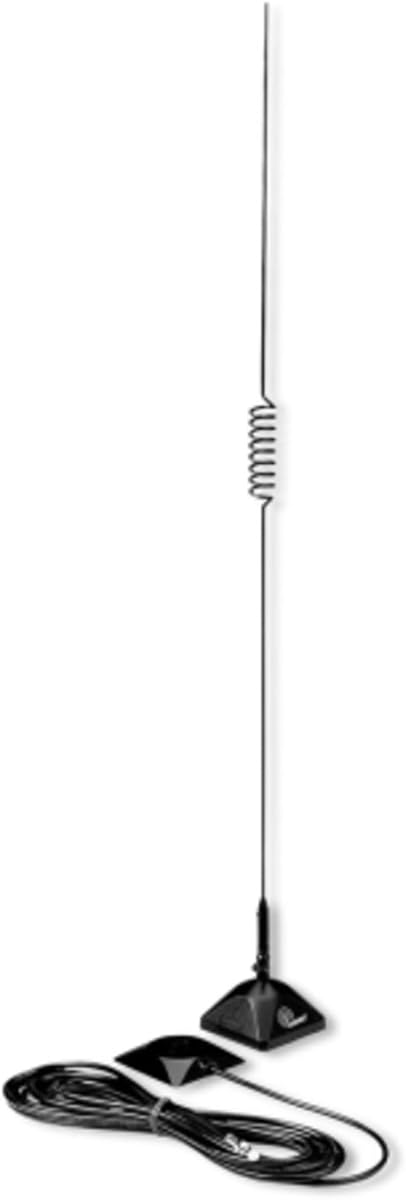
The Tram 25 MHz to 1,300 MHz Scanner Glass-Mount Antenna is the strongest all-around choice in this guide, combining a 4.4 customer rating with broad scanner-oriented coverage. Its center-loaded design and extra-long whip are intended to improve gain and bandwidth, while the glass-mount base allows installation without a permanent roof or body modification.
We may earn a commission when you buy through this link, at no additional cost to you.
A major strength is the 25–1300 MHz range, which covers many conventional, aviation, public-safety, and amateur bands that listeners commonly monitor. The 28-inch whip and 17-foot RG58/U cable provide generous positioning freedom, allowing the base to remain on the glass while the whip is routed toward a suitable part of the vehicle. The included BNC connector also makes it straightforward for scanner owners who already use that connection standard.
The practical trade-off is the size of the antenna system. A long whip and extensive cable can take more space than a compact glass puck or wire design, and garage clearance may become relevant on lower vehicles. Some scanners also use SMA or proprietary connectors rather than BNC, so buyers should check the radio before ordering and obtain an appropriate adapter if necessary.
This Tram model is best for listeners seeking one antenna to serve many scanner bands and who value a long whip, low-loss-style RG58/U cable, and straightforward glass installation. It combines clear specifications with a well-established accessory layout, making it a practical starting point for general-purpose mobile scanning.
The 25–1300 MHz specification gives this antenna a wider reach than many of the specialized alternatives. That makes it useful for users who move between local public-safety channels, aviation frequencies, weather services, and amateur radio activity rather than relying on one narrow segment.
The 17-foot RG58/U lead offers enough slack to place the whip and route the cable carefully inside a vehicle. This is helpful when the best window position is not directly beside the scanner, while the glass base avoids drilling through the vehicle body.
We may earn a commission when you buy through this link, at no additional cost to you.
The ProComm Disguise Glass Mount Scanner Antenna offers a 4.4 rating and a design intended to blend into a vehicle while providing multiband reception. Its 22-inch 17-7 stainless steel whip and glass-mount hardware create a conventional but relatively discreet scanner antenna arrangement, avoiding a roof-mounted visual profile.
We may earn a commission when you buy through this link, at no additional cost to you.
Its stated 30–1200 MHz coverage supports many of the same practical listening interests as higher-frequency wideband models. The included 15-foot Belden RG58 coax provides ample cable length for routing, while the transmission coupler box adds a degree of flexibility for setups that may need to handle transmitted RF as well as received signals.
Users should pay particular attention to how the coupler is connected. A coupler that is installed or used incorrectly can undermine the system, and a listener with a simple receive-only BNC arrangement may prefer a more direct antenna design. The stated upper limit of 1200 MHz also leaves portions of the spectrum beyond that point uncovered compared with the 1300 MHz alternatives.
The ProComm is best for a listener who values a low-profile base, a durable stainless steel whip, and enough coax to position the system well. It is especially relevant when transmitting may be part of the planned setup, subject to the radio's compatibility and the proper use of the supplied coupler.
The disguise-oriented glass mount keeps the main hardware against the window rather than on a roof rack or trunk. Its stainless steel whip still provides visible antenna height, but the overall appearance is less conspicuous than a permanently mounted roof antenna.
Coverage from 30 to 1200 MHz makes this suitable for many general scanner bands, while the included transmission coupler offers additional connection options. The Belden RG58 cable provides useful installation slack for routing around trim panels.
We may earn a commission when you buy through this link, at no additional cost to you.
The Taurus 25-1300 MHz Glass Mount Scanner Antenna is our Best Budget selection because it delivers a 4.3 rating while including the core features mobile scanner users need. Wideband coverage, a full-length whip, a 17-foot RG58 lead, and a no-drill window installation make it a capable general-purpose option.
We may earn a commission when you buy through this link, at no additional cost to you.
The removable 28-inch black Kote stainless steel whip is particularly useful for owners of vehicles with sensitive roof heights or those who remove the antenna before entering a garage. Its center-loaded design is intended to provide gain and bandwidth, and the stress-relief BNC connection is a thoughtful detail that helps protect the coax termination during handling.
As a receive-oriented scanner antenna, it does not list a power-handling rating, so it should not be assumed to be suitable for transmitting through an amateur transceiver. Scanner users with SMA-equipped radios will also need to verify connector compatibility or use a suitable BNC-to-SMA adapter.
Overall, the Taurus provides an appealing balance of coverage, installation convenience, and removable hardware. It is a sensible choice for a first scanner antenna, a second vehicle setup, or any listener who wants broad reception without committing to a roof-mounted system.
The threaded whip can be removed for safe keeping or before vehicle washing. That practical feature helps preserve the antenna and makes it easier to accommodate vehicles with limited overhead clearance.
A 25–1300 MHz range gives the Taurus broad utility across many scanner bands. The included 17-foot RG58 cable and no-drill mounting method also make it a complete, approachable package for everyday mobile reception.
We may earn a commission when you buy through this link, at no additional cost to you.
The BNC Scanner Radio Receiver Glass Mount Wire Antenna has a 4.1 rating and takes a different approach from conventional whip antennas. Instead of relying on a rigid element, it uses an approximately eight-foot wire that can be positioned around a window, with two suction cups providing a removable mount.
We may earn a commission when you buy through this link, at no additional cost to you.
That flexibility makes the antenna useful in two environments. It can serve as a mobile antenna in a vehicle, or it can be attached to an exterior window to improve reception for a home scanner. The stated 25–1300 MHz range covers many conventional and digital scanner bands, and the included BNC connector supports scanners using that standard.
The primary concern is physical stability. A flexible wire may move as the vehicle travels, while suction cups can lose grip because of heat, cold, window coatings, dust, or moisture. Because the element is so long, users should plan a clean routing path and avoid creating sharp bends or pinched sections.
This model is worth considering when removable mounting and adjustable placement matter more than a compact, rigid appearance. It is especially useful for apartment or home listeners who want to move a scanner antenna to different windows, as well as mobile users seeking a wire-based alternative.
The two suction cups allow the antenna to be removed without leaving adhesive or making a permanent hole. This is useful for temporary mobile installations and for testing different window locations.
The approximately eight-foot wire can follow a window frame or be routed toward a less obstructed area. That flexibility may help when a conventional short whip cannot be placed in an ideal location.
We may earn a commission when you buy through this link, at no additional cost to you.
The Wideband Receive Window Scanner Antenna is a compact option with a 3.8 rating and an explicit compatibility focus. Its listing names a range of Uniden, RadioShack, and Whistler scanners, making it appealing to buyers who already know the model of radio they plan to connect.
We may earn a commission when you buy through this link, at no additional cost to you.
The antenna provides stated receive coverage from 50 to 1200 MHz and 3 dB of receive gain. Double-sided tape secures the glass mount, while the included BNC-SMA adapter broadens its usefulness with radios that use SMA connections. This is a receive antenna rather than a dual-band transmitting kit.
Its 3.8 rating is the lowest among the rated products in this roundup, so buyers should weigh customer feedback carefully. Adhesive mounting is less reversible than suction cups, and the narrower lower frequency limit means it is not equivalent to antennas that begin at 25 or 30 MHz. The supplied model list should also be checked against the exact connector on the user's scanner.
The product is best for someone with one of the named compatible scanners who prioritizes a simple adhesive setup and a compact receive antenna. It remains a functional choice, but the lower rating and more limited frequency floor make it less universally compelling than the 4.3-and-above alternatives.
The product title identifies numerous Uniden, RadioShack, and Whistler models, giving buyers a clear starting point. The included BNC-SMA adapter also helps bridge common connector differences between the antenna and scanner.
Double-sided tape creates a simple installation without a suction cup or permanent hole. Its compact form may work well for fixed indoor listening, though removal may require care around the glass.
We may earn a commission when you buy through this link, at no additional cost to you.
The Tram 50-Watt Pretuned Dual-Band Amateur Radio Antenna Kit is the Best Premium choice for users who need more than a basic receive accessory. It combines a 4.4 rating with stated 50-watt power handling, making it relevant for amateur radio transmission as well as reception on two tuned bands.
We may earn a commission when you buy through this link, at no additional cost to you.
The antenna is pretuned for 150–154 MHz and 450–470 MHz, offering 2.5 dBd gain on VHF and 4.5 dBd gain on UHF. A 29.25-inch overall height, black-Kote base, and extra-long stainless steel whip produce a substantial mobile installation. The kit includes 17 feet of RG58/U cable terminated with a UHF male PL-259 connector.
This is not a general wideband scanner antenna. Its narrow, band-specific tuning and PL-259 connection make it a better fit for compatible amateur radios, dual-band transceivers, and listeners using appropriate adapters. It also has greater physical demands than a compact glass puck or wire antenna.
The Tram kit is best for an amateur operator or technically confident user seeking a capable transmitting glass mount with long cable and durable hardware. For conventional scanner-only use, one of the broad 25–1300 MHz models will usually be more straightforward.
A stated maximum of 50 watts differentiates this kit from receive-focused scanner antennas. The tuned bands, plunger contact, and RG58/U system are aimed at amateur-radio users who may transmit through the mounted antenna.
The 17-7 stainless steel whip, black-Kote base, gold-plated contact pin, and 17-foot cable form a more substantial package. It suits users who value a robust mobile installation over minimal size.
We may earn a commission when you buy through this link, at no additional cost to you.
The SMA Wideband Car Radio Glass Mount has a 4.3 rating and targets radios equipped with an SMA connection. Its 30–1200 MHz receive range, stated 3 dB gain, and three-meter cable provide a straightforward package for mobile communication and scanner reception.
We may earn a commission when you buy through this link, at no additional cost to you.
The glass-mount style uses adhesive or tape, so it avoids drilling and can be installed relatively quickly. An SMA male connector is a common choice on many compact wideband receivers, although compatibility still needs to be confirmed for the specific radio. The product's broad band makes it more versatile than dual-band amateur antenna kits.
Compared with several long-cable models, the three-meter lead gives less freedom to route the connector to a dashboard-mounted scanner. Buyers should evaluate whether their radio sits near the intended window location. Installation quality will also depend heavily on cleaning the glass and applying the adhesive pad evenly.
This antenna is best for a scanner or wideband radio with an SMA input that needs a compact, no-drill antenna. It offers a balanced combination of coverage, stated gain, straightforward attachment, and connector convenience without the larger whip-and-cable arrangement of some alternatives.
The SMA male connection is the defining feature for this model. It simplifies connections with compatible modern wideband radios and can avoid buying an adapter solely for the antenna.
A 30–1200 MHz range and 3 dB receive gain cover many common radio interests in a relatively small package. The adhesive glass base makes the unit easy to add without altering the vehicle's bodywork.
We may earn a commission when you buy through this link, at no additional cost to you.
The Compact BNC Mobile Scanner Antenna has a listed rating of 5.0, making it an appealing newer option in this collection. Its stated 30–1200 MHz range, 3 dB gain, BNC male connection, and ABS construction fit the basic requirements of many mobile scanner installations.
We may earn a commission when you buy through this link, at no additional cost to you.
The product information emphasizes ease of installation, a standardized design, and durability. ABS is used for the main housing, while the connector section incorporates brass. Those material choices suit a portable or vehicle-mounted accessory that may be handled repeatedly, and the straightforward design should appeal to users who prefer a small, modern-looking base.
The biggest limitation is the limited depth of the supplied information. Mounting hardware is not clearly described, there is no stated cable length in the bullet points, and the 5.0 rating may reflect a smaller number of customer reviews. Buyers should inspect the package contents and current listing details before assuming a particular attachment method.
This antenna is best for a scanner user seeking a compact BNC-mounted option with broad coverage and a strong listed rating. It deserves consideration, but the potential of its modern materials and simple installation should be balanced against the need to verify the included hardware and real-world feedback volume.
The ABS body and brass connector assembly provide a modern, practical construction for mobile use. A compact housing can also reduce visual obstruction compared with long external whip designs.
A 5.0 customer rating is notable, but the available information does not establish how extensive the review history is. Consider it alongside connector fit, package contents, and the need for a longer cable if the scanner is not mounted near the glass.
We may earn a commission when you buy through this link, at no additional cost to you.
The Bidirectional Wideband Scanner Antenna is a lightweight option for mobile radio, field, and emergency-response use. It is described as covering 30–1200 MHz with 3 dB of gain, using a three-meter low-loss coaxial cable and an SMA male connector. The compact ABS housing weighs only 50 grams according to the product information.
We may earn a commission when you buy through this link, at no additional cost to you.
Installation is designed to be fast and nonpermanent. The mounting pad uses industrial-grade adhesive and hook-and-loop backing, while the product description emphasizes resistance to vibration, temperature shifts, and frequent repositioning. A stated setup time of under one minute makes it convenient for users who move between vehicles or need to redeploy equipment quickly.
No customer rating is available, so the review performance cannot be compared numerically with the other products. The three-meter cable may also be restrictive for dashboard installations, and adhesive should be tested carefully on coated or tinted glass. Users should verify that their radio accepts an SMA male connection without requiring an adapter.
This antenna is best for portable setups, field operations, and owners who need a lightweight wideband unit that can be installed or removed rapidly. Its broad band and simple connector are attractive, but the lack of customer feedback makes careful review of the package contents and current listing especially important.
The adhesive and hook-and-loop system allows the compact antenna to be positioned quickly and removed for transport. That makes it useful where the same radio moves among vehicles, work sites, or temporary operating positions.
Coverage from 30 to 1200 MHz supports many common reception interests, while the stated 3 dB gain and low-loss three-meter cable provide a practical receiving package. The SMA male plug supports immediate use with compatible receivers.
We may earn a commission when you buy through this link, at no additional cost to you.
The Larsen Dual Band Glass Mount Antenna has a 4.8 rating, the highest confirmed customer score among the products reviewed. It is a specialized 2-meter and 440 MHz on-glass antenna rather than a conventional 30–1200 MHz scanner model, and its construction is clearly aimed at demanding amateur-radio installations.
We may earn a commission when you buy through this link, at no additional cost to you.
Its patented low-impedance design uses heavy-duty air-wound base coils intended to minimize RF loss. Tough 17-7 stainless steel whips support radiation efficiency, while an optional internal shock spring uses highly flexible insulated wire to reduce distortion. These are meaningful construction features for users who care about a durable, efficient mobile antenna.
The antenna is not appropriate for a listener expecting one unit to cover a wide range of scanner frequencies. The 2-meter and 440 MHz bands are especially relevant to amateur operators, and the PL-259 connection requires a compatible radio or a proper adapter. A scanner user should not mistake its high rating for broad scanner compatibility.
The Larsen is best for amateur-radio operators seeking a premium, heavy-duty glass mount with efficient coils and durable whips. Among the specialized models here, it stands out for customer rating and construction detail, even though its narrow band coverage makes it less directly relevant to general-purpose scanning.
Heavy-duty coils are air wound to reduce RF loss within the base. That construction can be valuable in a permanently installed mobile setup where efficiency and mechanical durability matter.
The 17-7 stainless steel whips and optional internal shock spring are designed to withstand mobile use and reduce distortion. These features make the antenna most appropriate for dedicated amateur-radio installations.
We may earn a commission when you buy through this link, at no additional cost to you.
The right glass mount scanner antenna depends on radio compatibility, intended frequency bands, installation space, and whether reception or transmission is required. These factors help narrow a large field of similarly named accessories into a model that suits a particular scanner setup.
Begin by identifying the antenna connector on the scanner or radio. BNC, SMA, FME, and PL-259 are not interchangeable, and even visually similar fittings can differ by gender or impedance. A scanner advertised as BNC-equipped may require a BNC-to-SMA adapter, while a PL-259 antenna usually needs a matching SO-239 socket or the correct cable arrangement. The included BNC-SMA adapter on the model-specific wideband antenna is useful, but it does not solve every connector combination.
Match the connector before considering other features. Confirm the radio model and its antenna specification, then verify the connector included with the glass mount.
Choose a range that covers the services and bands you actually monitor. The products in this guide span 25–1300 MHz, 30–1200 MHz, 50–1200 MHz, or two narrow amateur bands. A broad scanner antenna offers more flexibility, but a dual-band radio antenna can be more appropriate when only 2-meter and 440 MHz operation is required. Lower limits matter for certain long-wave and lower-frequency services, while the upper limit determines whether portions of the 1.2 GHz range are covered.
Prioritize a range that comfortably includes your listening interests rather than relying on a vague wideband label. Check the published lower and upper limits in MHz.
Several antennas in this guide state 3 dB of receive gain, while some longer center-loaded designs are described more generally as offering superior gain and bandwidth. Antenna height and placement can affect reception, but a gain figure alone does not predict performance in every location. Vehicle glass, roof materials, wiring, terrain, and nearby structures can influence the final result. Longer whips may improve available signal in some setups while also creating greater clearance and routing concerns.
Treat the stated gain as one part of the decision. A correctly positioned antenna with suitable coverage is generally more valuable than choosing a marginally higher figure without considering the vehicle and installation.
Glass mounts typically use adhesive, tape, suction cups, or a combination of adhesive and hook-and-loop retention. Adhesive can provide a low-profile, secure base, but it may leave residue or be difficult to remove from coated glass. Suction cups are more reversible and can be repositioned, although heat, cold, dust, and window treatments may affect holding strength. A removable base is valuable for owners who wash vehicles carefully, switch cars, or prefer not to commit to a permanent location.
Choose the retention method that matches how often the antenna will move. Test any adhesive in a discreet area and confirm that a suction-mounted installation remains secure.
Coaxial cable length determines how freely the antenna can be separated from the scanner. Seventeen-foot RG58/U leads provide substantial routing room, while three-meter and eight-foot options are more compact. A longer lead can make it easier to place the base on a high-quality window and the radio near a dashboard or console, but excess cable must be coiled and kept away from sharp trim edges. A short lead may suit a scanner already mounted near the intended glass location.
Measure the planned route before purchasing. Include the distance from the base to the radio, cable routing space, and room for an inline connector.
Whip antennas in this guide range from 22 to nearly 30 inches, while the wire model uses an approximately eight-foot flexible element. A removable or flexible whip can make it easier to accommodate low garages, car washes, and crowded parking structures. A rigid extra-long whip may hold a more consistent orientation but requires attention to overhead clearance. Flexible wire adds positioning options but can shift and become more difficult to route neatly.
Check garage height, roof racks, nearby branches, and the vehicle's antenna routing. A removable whip offers the safest compromise when clearance varies.
Most general scanner antennas are intended for reception and do not list a safe transmit-power rating. Products such as the Tram dual-band amateur kit and Larsen on-glass antenna specify band tuning or construction features associated with transmitting. A receive-only antenna should not automatically be connected to a transmitter, because the radio's power and the antenna's matching characteristics may differ. The inclusion of a transmission coupler on one model may add flexibility, but proper setup still matters.
If you plan to transmit, select a model explicitly designed and tuned for the relevant amateur band. If you only listen, prioritize receive coverage and the correct connector.
Material choices can indicate how an antenna is likely to withstand repeated installation and removal. The selections include stainless steel whips, black-Kote finishes, brass connector parts, ABS housings, and air-wound coils. Also verify whether the package contains the glass mount, coax, connector, coupler, adapter, and attachment materials you need. The ProComm includes a transmission coupler, the model-specific antenna includes a BNC-SMA adapter, and other products emphasize suction cups or adhesive. Complete packages reduce the need for extra purchases.
Compare the full kit rather than focusing only on the whip. Confirm mounting hardware, cable length, connector type, and whether adapters are included.
Confirm that the antenna's connector and frequency range are compatible with the radio before installation. Clean the selected glass area thoroughly, dry it, and inspect it for chips, coatings, or textures that could weaken adhesion. If using suction cups, warm them slightly in cool conditions and press each cup firmly until it holds a stable seal. Follow the model's specific mounting method rather than mixing adhesive and suction hardware without checking the instructions.
Route the coaxial cable carefully through the vehicle, keeping it away from sharp metal edges, moving window frames, and components that generate electrical noise. Avoid pinching the cable or creating tight bends. Position the whip where it has the clearest view of the sky and is not obstructed by a roof, rack, or parked structure. For a removable whip, remove it before automatic car washes or whenever the antenna could strike an overhead obstacle.
For ongoing care, wipe the base and whip with a damp cloth and dry them before reinstalling. Check adhesive edges for lifting, inspect suction cups for trapped moisture, and confirm that the connector remains firm without twisting the coax. If reception changes unexpectedly, test another window or compare the setup with a known-good antenna, as vehicle wiring, vehicle configuration, and nearby interference can affect results as much as the antenna itself.
A glass mount scanner antenna attaches to a vehicle window with adhesive, suction cups, or a similar base and receives radio signals without requiring a permanent roof or body modification. Most are designed for receiving scanner traffic, while a few specialized models also support amateur-radio transmission. Connector type and frequency range are the two most important compatibility points.
It can, especially when the included stock antenna is short, poorly positioned, or obstructed by the vehicle roof. Actual results depend on frequency, antenna placement, vehicle construction, electrical noise, and terrain. A higher or better-positioned antenna generally has more opportunity to improve reception than a compact model placed in a poor location.
They are not directly compatible because they use different connector standards. An antenna with a BNC male plug normally needs a BNC-to-SMA adapter when the radio uses an SMA female connection, or the appropriate female-to-male arrangement when genders differ. Check both the connector type and gender before purchasing an adapter.
The range should comfortably include every service and band you plan to monitor. Models covering 25 or 30 MHz through 1200 or 1300 MHz suit many general scanner listeners, while narrower antennas can work when the radio is limited to specific frequencies. A dual-band amateur model is not a substitute for a broadband scanner antenna across many services.
No assumption should be made that a receive-only antenna can safely handle transmitter power. Transmit-capable glass mounts should state suitable frequencies and a maximum power rating. Connecting a mismatched or receive-only antenna to a powerful radio can produce high reflected power, damage the radio, or create an unsafe RF situation.
Choose a large area of clean glass with the fewest obstructions and route the cable to the radio without sharp bends. A higher placement may receive more open sky, but metal roof racks, tinted coatings, and nearby structures can affect the result. Test several locations when practical and avoid placing the cable near high-current wiring.
Adhesive can be difficult to remove from some tinted or coated windows, and aggressive cleaning afterward may cause additional damage. Check the glass manufacturer's guidance and test a small discreet area when possible. Suction-cup models offer a more reversible alternative, though their holding strength should be checked regularly.
Wipe the whip and base with a lightly damp cloth, then dry them fully before reinstalling the antenna. Do not flood the base or connector with liquid, and avoid abrasive cleaners on black finishes or glass coatings. Check the mounting point, cable routing, and connector regularly, especially after extreme heat, cold, or extended travel.
The Tram 25–1300 MHz model is the most balanced general-purpose selection, combining wide coverage, a long center-loaded whip, a 17-foot RG58/U cable, and a BNC connection. The Taurus offers a similar broad-band approach with a removable whip, while the Tram dual-band amateur kit stands out for users who require stated transmit power and dedicated VHF/UHF tuning.
Prioritize connector compatibility before appearance, and choose the frequency range that matches the services you actually use. Consider cable routing, whip clearance, mounting reversibility, and whether the antenna must support transmission. A compact wideband model may be ideal for an SMA-equipped portable radio, while a long-lead BNC design offers more freedom for a permanently installed dashboard scanner.
Ratings and specifications can change as products evolve, and availability and prices also fluctuate. Before ordering, verify the current product listing, package contents, connector gender, supported radio models, frequency range, and mounting instructions. Checking those details against your scanner setup is the surest way to avoid an incompatible or disappointing purchase.