
Handeful Grip Strength Tester
4.6Editor score
198-pound maximum capacity
19 user profile storage
0.2-pound measurement divisions
Battery-powered LCD display
Our Digital Grip Strength Tester guide compares 10 top models for accuracy, capacity, profiles, displays, handle comfort, training features, and ease of use.
A digital grip strength tester turns an otherwise subjective hand-strength assessment into a repeatable measurement that can be compared over time. The best models combine accurate readings, comfortable adjustable handles, clear displays, useful profile memory, and enough capacity for the athlete, family member, or patient being evaluated.
We compared all 10 products by maximum measurement, stated resolution, display features, profile capacity, handle adjustability, included training equipment, and intended applications. Some choices focus on data tracking, while others combine measurement and resistance training for climbers, gym users, therapists, and people working on hand rehabilitation.
Each review explains the device's strongest qualities, limitations, and best-fit buyer, while the comparison table makes the main differences easier to scan. Product availability and prices can change, so check the current listing and verify specifications before making a final purchase.
4.6Editor score

5.0Editor score

4.7Editor score
The following comparison covers measurement range, resolution, memory, adjustability, and training features across all 10 digital grip strength testers, helping you identify the most appropriate option for home use, sports, or clinical settings.


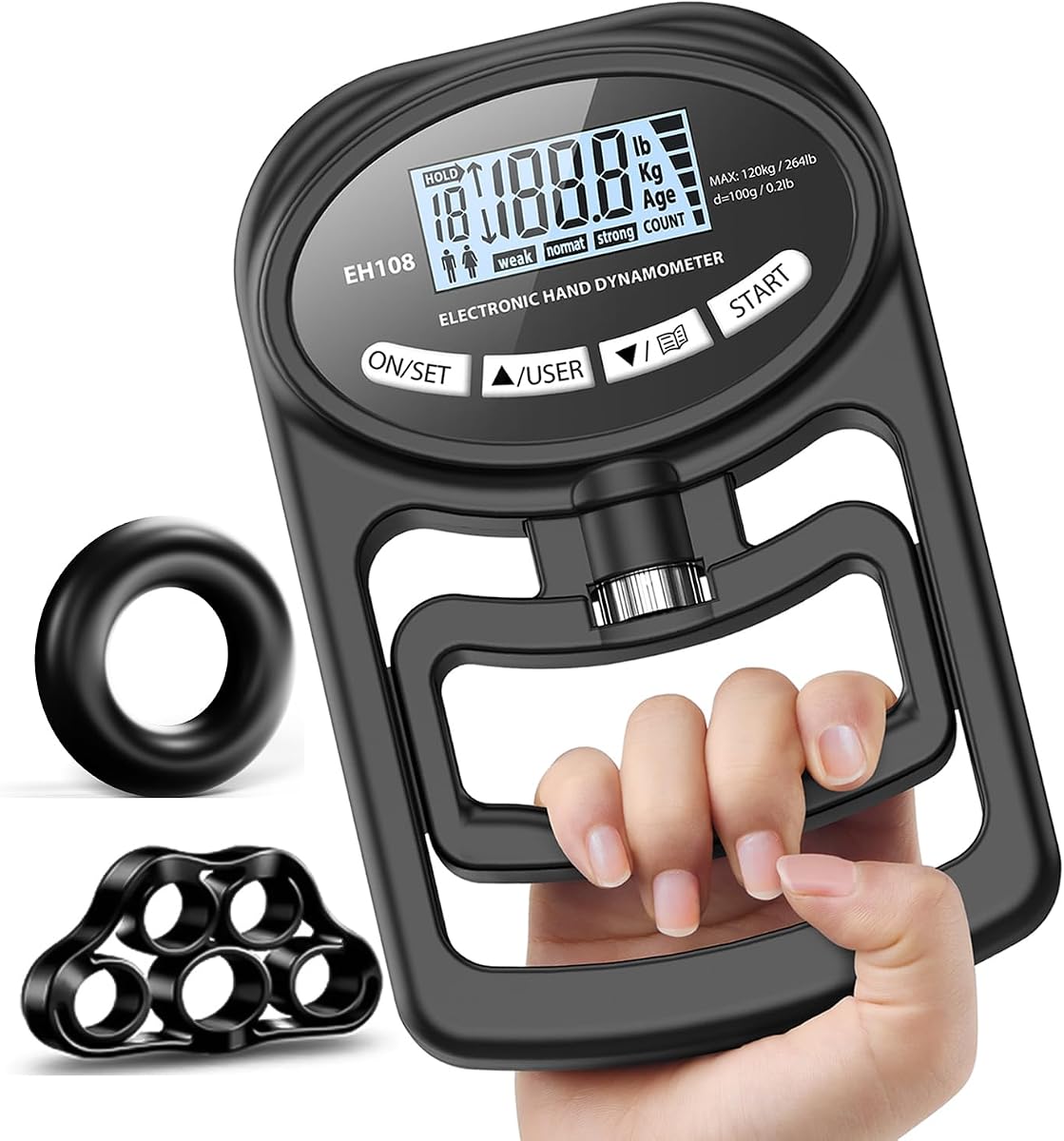


The Handeful Grip Strength Tester combines a 198-pound maximum capacity with a 4.6 rating, making it a practical lower-cost option for home and sports measurements. Its strain-gauge sensor is stated to measure in 0.2-pound or 0.1-kilogram increments, while the large LCD keeps grip values, user information, and strength status visible together.
We may earn a commission when you buy through this link, at no additional cost to you.
Profile management is one of its most useful features. The device can store up to 19 users with age and gender information, save maximum grip values, and recall them for comparison. That makes it well suited to families, school teams, and athletic trainers who need to separate results rather than relying on handwritten notes.
The curved plastic handle adjusts for different hand sizes, although buyers should verify the stated internal width of 3.23 inches before ordering. The manufacturer also advises against long-term continuous use and recommends gloves if extended contact becomes necessary. Its 198-pound ceiling is adequate for many users, but stronger athletes may prefer a higher-capacity model.
This is a strong choice for someone seeking a straightforward digital dynamometer without paying for a large training bundle. It suits general fitness, school sports, rock climbing, wrestling, gymnastics, and basic progress tracking. Choose it when profile storage, readable results, and adjustable handling matter more than maximum capacity or included resistance equipment.
Storing 19 profiles makes the tester convenient for shared households, team assessments, and small training groups. Saved maximum results and strength indicators can provide a consistent baseline without manually recording every reading.
The adjustable handle broadens its appeal, but the published internal size may not suit every hand. Measuring before purchase can help avoid a squeeze that feels cramped or produces inconsistent positioning.
We may earn a commission when you buy through this link, at no additional cost to you.
The 265lb Digital Hand Dynamometer stands out for its backlit LCD, a useful feature when measurements are taken in a dim room, evening home setting, or clinic with uneven lighting. It offers a 265-pound, 120-kilogram maximum and is listed as FDA registered, with accuracy stated within 0.2 pounds or 0.1 kilograms.
We may earn a commission when you buy through this link, at no additional cost to you.
Its adjustable handle is designed to fit most hands, including those of teenagers and adults, while the non-slip surface is intended to remain secure during firm squeezes. The device is marketed for rehabilitation tracking, senior hand-health checks, competitive training, and sports such as rock climbing and tennis.
The main limitation is that the supplied feature list does not mention multi-user memory. It therefore appears less convenient for families or teams than several 19-profile alternatives, and it does not include a separate trainer for resistance exercises. Also, FDA registration should not be confused with a claim that the device is approved for a specific medical purpose.
Overall, this is a well-rounded choice for a buyer who prioritizes a clear backlit screen, generous capacity, and straightforward adjustable handling. It works particularly well for an individual, a therapist maintaining simple records, or a training partner who wants dependable readings without a larger kit.
The illuminated screen reduces guesswork when ambient light is poor. Its immediate display format also supports quick comparisons between pre-training and post-training squeezes.
This model focuses on testing rather than bundled exercise equipment. That makes it a clean option for users who already own a gripper and want a dedicated dynamometer.
We may earn a commission when you buy through this link, at no additional cost to you.
The Grip Strength Tester with Trainer offers a broader setup than a basic dynamometer, pairing the digital tester with a finger expander and a two-pack hand gripper. Its 4.4 rating still reflects a well-liked product, while the three-part arrangement appeals to buyers who want both measurement and targeted conditioning.
We may earn a commission when you buy through this link, at no additional cost to you.
The tester reaches 265 pounds or 120 kilograms and provides 0.2-pound or 0.1-kilogram divisions. Up to 19 profiles can be stored with age and gender details, and the device can display changes from the previous test. This makes it particularly suitable for teenagers, adults, and seniors working on foundational hand strength.
The included trainer supports both hands at once, while the finger expander and palm ring focus on separate grip patterns. That breadth can be useful for rock climbers, wrestlers, gymnasts, and pull-up users, although the three components require more storage than a standalone tester. Buyers who only need a measurement device may find the bundle unnecessary.
This kit is a good fit for a home user who wants to measure progress and then train specific grip qualities. It is especially appealing when a family shares the device or when a coach wants a simple way to demonstrate both performance and repetition-based work.
The finger expander and palm ring broaden the exercise stimulus, helping users work on finger separation and palm engagement rather than relying exclusively on a standard closed-hand grip.
Automatic display of incremental changes reduces the need to remember the last score. Consistent test positioning remains important for those comparisons to be meaningful.
We may earn a commission when you buy through this link, at no additional cost to you.
The 400lb Tester and Trainer combines a high-capacity digital dynamometer with an adjustable resistance trainer, giving buyers a measurement-and-training setup in one package. Its 4.6 rating reflects broad appeal, and the stated 400-pound measurement ceiling provides additional headroom over many competing devices.
We may earn a commission when you buy through this link, at no additional cost to you.
The strain-gauge tester records up to 19 user profiles and displays user code, age, gender, grip value, and status. The separate trainer offers adjustable resistance from 11 to 132 pounds, allowing resistance to be matched to test results and individual goals. Its mechanical counter tracks squeezes without adding another charging routine.
Both components use adjustable ergonomic handles, which is helpful for accommodating different hand sizes. The trade-off is that two substantial pieces take up more room and may be unnecessary if the buyer's goal is strictly clinical measurement. The listing also does not clearly identify the battery requirements, so checking the current product information is advisable.
This set is well suited to strength athletes, climbers, wrestlers, and advanced users who want measurement and progressive resistance work together. It is less compelling for someone who already owns a trainer, but the high measurement range and repetition tracking make it a strong performance-oriented package.
The 11-to-132-pound trainer range can be adjusted against measured performance, helping users avoid progressing by guesswork. The tester provides the baseline while the trainer supplies the repeated-work component.
A mechanical squeeze counter removes the need to recharge the trainer. It also provides a simple record of work volume between dynamometer sessions.
We may earn a commission when you buy through this link, at no additional cost to you.
The GD DYNO-200 is the premium-oriented choice in this roundup, combining a 4.7 rating with the highest stated maximum capacity at 440 pounds. Its S45C carbon-steel body is designed to withstand forceful squeezing, giving it a substantial feel for users who test near their maximum or simply prefer rugged construction.
We may earn a commission when you buy through this link, at no additional cost to you.
Operation is refreshingly direct: hold the dynamometer, squeeze, and read the measurement. The compact format should be easier to carry to a gym, climbing venue, or sports facility than a larger multi-component kit. It is also positioned for athletes and fitness users who want a straightforward instrument without extensive menus or profile setup.
Unlike many alternatives, the supplied information does not mention multi-user memory, a backlit display, or a stated measurement resolution. The product listing also notes that two AAA alkaline batteries are required and not included. Those omissions make it less attractive for clinics or families needing organized records, despite its impressive capacity and materials.
The DYNO-200 is best for serious strength users who value durability, high capacity, and uncomplicated operation. Choose it over a profile-heavy model when a rugged measurement tool is the priority. It may be particularly useful for grip-focused athletes who want a portable device capable of documenting very strong squeezes.
The carbon-steel body gives the device a more robust construction than many plastic-centered alternatives. It is well suited to high-force testing and repeated use by strong users.
Its compact construction and squeeze-to-measure operation reduce setup time. That makes it convenient for quick checks before training or when carrying a larger training system is inconvenient.
We may earn a commission when you buy through this link, at no additional cost to you.
The FitBeast 3-in-1 Grip Kit is a broad training package containing a digital grip strength tester, an adjustable hand gripper, and a finger exerciser. Its 4.5 rating and broad range of applications make it appealing to fitness users, families, and people rebuilding hand strength.
We may earn a commission when you buy through this link, at no additional cost to you.
The hand gripper adjusts from 10 to 160 pounds, which is the widest stated trainer range among the kits in this guide. The tester provides instant readings, while up to 19 profiles and a repetition counter help organize progress for household or clinic use. The digital display offers a more objective reference than counting exercises alone.
The tester itself does not have a stated maximum measurement capacity in the supplied information, so buyers who require a particular upper limit should verify that detail. The included pieces also add bulk and may be more than needed for basic testing. Secure non-slip handles and an ergonomic presentation improve the appeal of the box set for regular use.
This kit is a strong fit for users who want progressive training and measurement in one purchase. It is especially relevant to rehab work, hand conditioning, climbing preparation, and family fitness routines. Those who need a simple standalone dynamometer can instead choose a slimmer profile-based model.
The 10-to-160-pound adjustment supports beginners working on foundational grip and advanced users seeking harder contractions. The wide span can also accommodate different users sharing the same equipment.
Instant readings and stored profiles help turn grip work into a trackable routine. The repetition counter complements the tester by documenting exercise volume, not just peak force.
We may earn a commission when you buy through this link, at no additional cost to you.
The WESTHEY Digital Hand Dynamometer is the most balanced pick in the guide, earning a 5.0 supplied rating while combining 396-pound capacity, 0.1-kilogram resolution, profile memory, and a backlit display. It offers the key features buyers most often want from a dedicated digital grip strength tester.
We may earn a commission when you buy through this link, at no additional cost to you.
Its adjustable ergonomic handle is intended to suit men, women, seniors, teenagers, and athletes, while the large backlit LCD presents grip values, user information, battery status, and Weak, Normal, or Strong indicators. Storing 19 profiles makes it useful for families, trainers, therapists, clinics, and fitness centers that rotate among multiple users.
The principal trade-off is that it is a measurement device rather than a combined grip-training system. It also publishes 0.1-kilogram resolution, so buyers focused on very fine imperial increments should confirm the corresponding display behavior. Despite those points, its clean feature set and strong rating make it particularly versatile.
This is the recommendation for most buyers who want a clear, adjustable, multi-user dynamometer without extra training hardware. It suits general fitness, rehabilitation, climbing, tennis, golf, baseball, senior hand-health checks, and sports-team monitoring. Choose the DYNO-200 for greater maximum capacity or this model for broader everyday versatility.
The backlit screen presents force alongside user and status information, reducing interpretation time. Strength-level indicators offer a quick reference, although they should not replace professional assessment.
Nineteen stored profiles make the tester suitable for shared household and clinical use. Separate histories prevent one user's score from being confused with another's during longitudinal tracking.
We may earn a commission when you buy through this link, at no additional cost to you.
The TIPRE 396lb Grip Tester is a capable multi-user dynamometer with a 4.5 rating, 396-pound maximum, and 19 stored profiles. It focuses on making progress easy to interpret, with automatic display of the difference from the last recorded result.
We may earn a commission when you buy through this link, at no additional cost to you.
The large LCD includes gender, age, grip value, grip fluctuation status, comparison difference, and grip power level. An adjustable curved handle is designed to improve positioning and comfort for different hand sizes, while the compact body supports use at home, school, in sports, or in a clinical environment.
Its profile and comparison features closely match several higher-ranked devices, but no training equipment is included. The supplied details do not mention a backlight, which may matter for use in dim conditions. Buyers relying on specific clinical protocols should also verify certification and intended-use details beyond the consumer listing.
This tester works well for users who want immediate feedback showing whether performance has increased or decreased. It is a particularly practical option for a family, school program, or small team that needs multiple records but does not require resistance-training accessories in the same package.
Showing the difference from the previous test makes progress easier to notice. This is useful during weekly check-ins, provided each repetition follows a consistent position and protocol.
The compact format and adjustable handle suit quick assessments in several environments. A school, travel bag, or home gym can all serve as testing locations.
We may earn a commission when you buy through this link, at no additional cost to you.
The 400lb Electronic Tester Set pairs a strain-sensor dynamometer with an adjustable trainer, reaching a stated 400-pound measurement capacity and 4.5 rating. The setup is aimed at rehab, fitness, sports, and home-gym users who want both numerical feedback and resistance practice.
We may earn a commission when you buy through this link, at no additional cost to you.
The trainer adjusts from 11 to 132 pounds and includes a mechanical counter. The tester stores up to 19 profiles with age and gender details, recalls prior records, and indicates whether current strength has increased or decreased. The large LCD shows user code, grip value in pounds or kilograms, maximum grip, and weak, normal, or strong status.
Construction differs by component: the dynamometer uses ABS, while the trainer combines PP, TRP, and stainless steel. The package omits a printed manual, directing buyers to scan a QR code and download the electronic version from the product page. That approach reduces paper waste but requires a phone and internet access during setup.
This set is a compelling option for users who want measurement and progressive resistance work at a moderate purchase level. It is especially useful when one device must serve multiple family members or when a therapist wants a counter to support exercise volume. Dedicated measurement buyers can find a smaller alternative.
Recalling the prior result and showing whether strength rose or fell makes the tester useful for regular check-ins. Stable technique remains essential for a valid comparison over time.
The downloadable manual keeps the package compact and supports digital access to instructions. Buyers should save any relevant operating details locally in case they need them offline.
We may earn a commission when you buy through this link, at no additional cost to you.
The 396lb Electronic Dynamometer is a compact combination package with a 4.9 rating, one of the strongest ratings in the roundup. It combines a digital tester, an adjustable resistance trainer, 19 user profiles, and a repetition counter for users who want measurements and exercise work in one setup.
We may earn a commission when you buy through this link, at no additional cost to you.
The trainer adjusts from 11 to 132 pounds, while the tester has a stated 396-pound or 180-kilogram maximum. Weekly gains and instant readouts are intended to make improvement visible, while the counter tracks each squeeze. Non-slip ergonomic handles are designed to stay comfortable through longer sessions.
Its 132-pound trainer ceiling is lower than the 160-pound resistance offered by the FitBeast kit, and the supplied information does not state the tester's fine measurement divisions. The package also appears more elaborate than a standalone dynamometer. However, the high rating, broad range, and integrated tracking make it appealing for progressive users and shared family routines.
Choose this model for a compact, high-rated combination of testing and training. It is suitable for rehabilitation, general fitness, advanced grip work, and users who want a motivating combination of force readings and repetition counts. Those prioritizing the widest training range should examine the FitBeast alternative.
Displaying logged gains helps users see whether a training routine is producing measurable change. It also encourages more consistent testing intervals, which is valuable for meaningful comparisons.
Secure handles and stored profiles make the package practical for several household members. The counter can turn individual practice into a lighthearted, measurable activity without requiring separate devices.
We may earn a commission when you buy through this link, at no additional cost to you.
The right digital grip strength tester depends on the intended user, required capacity, need for stored records, and whether you also want resistance-training equipment. Compare the measurement specifications and handle design before considering added features or bundled accessories.
In short, match the maximum to the strongest expected user and leave additional headroom when possible.
In short, favor fine stated divisions and consistent units, but never treat a digital reading as perfectly repeatable without a consistent testing method.
In short, check dimensions and hand clearance before buying, especially for smaller hands, limited mobility, or use by multiple family members.
In short, choose stored profiles for multi-user tracking and a simpler standalone model when only one person will regularly use the device.
In short, prioritize a readable and well-lit screen, and treat automatic strength labels as convenient summaries rather than clinical conclusions.
In short, add trainer equipment for a combined routine, but choose a standalone dynamometer when your primary need is clean measurement and compact storage.
In short, prioritize durable construction for repeated or forceful use and portability when frequent transport matters more than a premium heavy-duty feel.
In short, identify the environment and professional requirements before buying, and do not treat a general fitness rating as medical validation.
Before the first measurement, read the supplied instructions, install the required batteries with the correct polarity, and confirm that the display powers on normally. Adjust the handle for a secure but comfortable grip. A consistent starting position matters: keep the device away from the body, hold it in the same way each session, and avoid twisting the wrist while applying force.
When taking a test, relax first, then squeeze smoothly and firmly for the duration specified by the manufacturer. Do not jerk against the device or change hand position during the attempt. Record the result under the correct user profile, repeat only as directed, and allow the hand to rest between attempts. For a meaningful baseline, use the same time of day and similar warm-up conditions across sessions.
For care, keep the sensor and adjustment mechanism free from moisture, dust, and oils, and clean the handle with a lightly damp cloth rather than immersing the unit. Store it in a dry location, remove batteries during long periods of nonuse if the manual recommends it, and replace batteries as needed. If readings become erratic, confirm handle position and battery status before suspecting a fault, and follow the manufacturer's support process for calibration or service.
A digital grip strength tester measures the force produced by a hand squeeze and displays the result numerically. It can be used to track hand strength during fitness training, sports preparation, rehabilitation, and general health monitoring. Consistent positioning and testing procedures are essential if readings are to be compared over time.
A higher maximum provides more headroom for very strong users and maximal-effort testing. It is not automatically more accurate, however, so resolution, construction, handle stability, and repeatability also matter. Most general users can choose a mid-range model with a 265 to 400-pound capacity, while strong athletes may prefer an even higher limit.
A single person who records results separately may not need profile memory. Families, schools, clinics, and team programs benefit from separate profiles because they keep previous results and user details organized. Most products reviewed here store up to 19 profiles, making them suitable for several regular users.
A combined set is convenient when you want to measure grip force and perform resistance exercises in the same routine. It also helps create a progression based on measured strength. Choose a dedicated dynamometer if you already own a suitable trainer, need a more portable device, or want to avoid keeping several accessories.
Several models are marketed for rehabilitation, hand conditioning, and tracking recovery-related progress. A consumer device can provide useful measurements, but it should not replace guidance from a qualified clinician. Anyone recovering from an injury, managing pain, or following a clinical protocol should follow the advice of their healthcare professional.
Grip strength is a measure of maximum or near-maximal force during a squeeze. Hand endurance concerns how long or how many repetitions someone can sustain, which is a different performance quality. A dynamometer with a trainer or repetition counter can support both goals, but the numerical squeeze result primarily represents force rather than endurance time.
Accuracy depends on the sensor, calibration, battery condition, hand position, and squeezing technique. The reviewed devices state resolutions of 0.1 or 0.2 kilograms in pounds or provide comparable small increments. Even with a precise display, differences caused by posture or effort can exceed the final displayed digit.
A weekly or biweekly schedule is often practical for tracking training progress while limiting the influence of daily variation. Testing under similar conditions makes comparisons more useful. Heavy training, fatigue, illness, and time of day can all influence the result, so a regular schedule and consistent protocol are more useful than frequent unplanned checks.
The WESTHEY Digital Hand Dynamometer is the strongest overall choice because it combines a high-capacity range, backlit readability, 19 user profiles, strength indicators, and an adjustable handle. The Handeful model is a compelling budget-oriented option for shared family or school use, while the GD DYNO-200 serves strong users who prioritize rugged carbon-steel construction and a 440-pound maximum.
Before choosing, prioritize the capacity you need, the precision of the stated resolution, handle fit, and whether you require multiple user profiles. Add a trainer only if you want integrated resistance work, and consider display backlighting when measurements may be taken in low light. For professional rehabilitation work, verify the manufacturer's current intended-use and regulatory information.
Ratings, product details, and prices can change over time, so check the current Amazon listing and manufacturer instructions before ordering. Comparing the listed specifications with your actual users and training plan will produce the most useful purchase, whether you need a dedicated dynamometer or a combined measurement-and-training system.