
AgiiMan 850GPH Pool Cover Pump
4.4Editor score
850 GPH drainage rate
Dry-run temperature protection
16-foot drainage hose
25-foot power cord
A submersible pump is a versatile tool for moving water from flooded basements, pools, hot tubs, ponds, window wells, and other low-lying areas. The best model for your situation depends on flow capacity, vertical lift, suction depth, discharge compatibility, automatic controls, and the type of debris the water may contain.
We compared ten submersible pumps using their published specifications and stated design features, including motor power, maximum flow, lifting capacity, cord length, hose fittings, solids handling, filtration, and operating modes. The list covers compact pool-cover pumps, high-output utility pumps, automatic sump pumps, and quiet circulation models for ponds and water features.
Each review explains where the pump is strongest, identifies practical limitations, and clarifies the situations in which it is most appropriate. Flow and lift figures also vary with hose length, elevation, and operating conditions, so readers should compare the full setup rather than consider one specification alone.
4.4Editor score

4.6Editor score
4.5Editor score
As an Amazon Associate we earn from qualifying purchases.
This side-by-side comparison highlights each pump's core capabilities, including rated flow, lift, cord length, discharge connection, and primary control method. It also helps distinguish utility drainage pumps from automatic pool-cover pumps, pond circulators, and compact transfer pumps.


The Superior Pump 91250 is a well-balanced utility pump with a 4.6 rating, strong flow capacity, and enough solid-handling ability for many household drainage tasks. Its 1/4 HP motor is advertised to move up to 1,800 gallons per hour and lift water as high as 25 feet vertically. That combination makes it a versatile option for basements, garden areas, tanks, and similar locations where dependable water removal matters.
We may earn a commission when you buy through this link, at no additional cost to you.
The removable suction screen protects the impeller while allowing the pump to handle solids up to 1/8 inch. Its 1-1/4-inch NPT discharge provides useful capacity, and the included 3/4-inch garden hose adapter simplifies common hookups. The 10-foot cord is short compared with several models in this guide, but it can be sufficient for installations near an appropriate outlet. Tough thermoplastic construction and factory testing add confidence for routine utility work.
Its main limitation is that this is a manual pump, so someone must position it, connect it, and switch it off when the job is complete. The short cord also limits reach in larger yards or rooms. As a result, it is most attractive when simplicity, compact construction, and useful solids handling matter more than automatic controls or an extended reach.
Overall, the Superior Pump 91250 is the strongest all-around recommendation for buyers who want one capable pump for multiple water-removal tasks. It is particularly appropriate for a basement, utility room, garden, or small drainage project where water contains ordinary grit and the discharge can be connected through an appropriate hose adapter.
The removable suction screen and stated 1/8-inch solids capability make this pump more versatile than a basic clean-water model. It is better suited to ordinary yard, basement, and utility water that may contain small debris than to jobs involving larger obstructions.
A 1-1/4-inch NPT outlet supports high-capacity routing, while the supplied 3/4-inch garden hose adapter allows a familiar connection for shorter discharge runs. Confirm hose dimensions and the required lifting distance before installation.
We may earn a commission when you buy through this link, at no additional cost to you.
The SEESII 1HP Water Pump is built for users who need substantial moving capacity and greater vertical reach than a basic household utility pump. It carries a 4.4 rating and is advertised to deliver up to 4,755 gallons per hour while lifting water as high as 36 feet. Those figures make it a candidate for larger basements, pools, yards, and other transfer situations.
We may earn a commission when you buy through this link, at no additional cost to you.
The pump arrives with a 23-foot discharge hose, adapters, and a 25-foot power cord, reducing the need to assemble an entire setup before use. A built-in filter helps block small debris, while the polypropylene construction is intended to support stable outdoor and indoor use. The stated three-year warranty and lifetime support add useful service coverage around the product.
This model is intended for clean or lightly dirty water rather than demanding solids handling. That distinction matters when the water contains leaves, gravel, branches, or other sizable debris. It is also a manual pump, so it does not automatically stop when the water recedes. The substantial hose and power cord require careful routing to avoid kinks, trip hazards, and unnecessary lift losses.
The SEESII is a strong recommendation for large-volume transfer work where the included hose kit and extended reach are priorities. Buyers should verify that their discharge route can accommodate the hose and that the water is sufficiently free of obstructions for the internal filter.
The stated 4,755 GPH output is the main attraction for users trying to move substantial amounts of water quickly. Actual delivery will depend on lift height, hose diameter, bends, and how completely the pump is submerged.
Including a 23-foot discharge hose is useful because hose length and diameter influence pumping performance. The 25-foot cord also provides more placement flexibility than the short leads offered by several other utility pumps.
We may earn a commission when you buy through this link, at no additional cost to you.
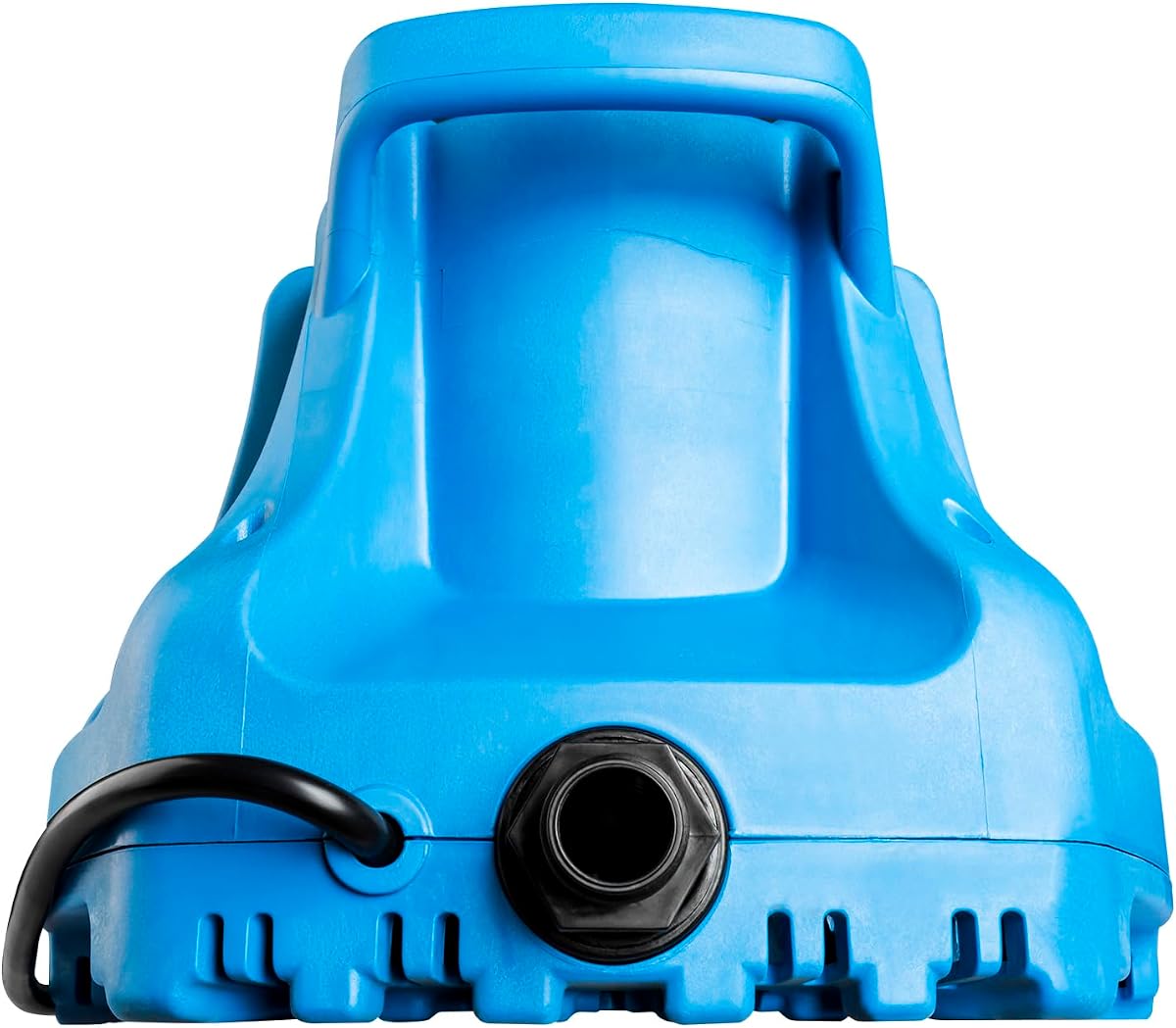
The AgiiMan 850GPH is a specialized above-ground pool-cover pump with a 4.4 rating. Its listed maximum drainage rate of 850 gallons per hour is well suited to removing accumulated rainwater from a pool cover, while its IPX8 waterproof level and weather-resistant ABS shell suit outdoor placement.
We may earn a commission when you buy through this link, at no additional cost to you.
All four sides of the pump use mesh screens, giving water a broad intake area and helping block larger debris. A built-in temperature-control core is designed to prevent dry burning, an important safeguard when a pool cover stops collecting rain and the water level drops. The 16-foot anti-twist drainage hose works with 1/2-inch, 3/4-inch, and 3/4-inch elbow connections, while the 25-foot cord offers ample distance from the outlet.
This is not a high-output basement pump, and its 10.5-foot maximum lift is substantially lower than the figures advertised by several utility models. It also lacks an integrated automatic float, meaning it must be monitored and disconnected when the water is gone. Those limitations are understandable for a focused pool-cover application but may make it unsuitable for large flooding jobs.
The AgiiMan is a practical choice for owners who want a straightforward pump dedicated to pool-cover drainage. Its screened intake, dry-run protection, and generous hose selection offer the most useful combination for that task, provided users monitor it and remove it when the cover is no longer collecting water.
An above-ground pool cover can trap substantial rainwater after storms. This pump's broad screened intake and 850 GPH rate target that focused drainage task without requiring a larger general-purpose utility pump.
The built-in temperature-control core helps prevent damage if the pump runs without sufficient water. Even with that protection, disconnecting the pump as soon as drainage is complete remains the safest operating practice.
We may earn a commission when you buy through this link, at no additional cost to you.
The Acquaer 1/3 HP Automatic Submersible Water Pump is a practical option for homeowners who want a sump-style pump that can start and stop without constant supervision. Its 4.3 rating reflects a useful balance of automatic operation, 2,160 GPH flow, and the ability to remove water down to 1/4 inch.
We may earn a commission when you buy through this link, at no additional cost to you.
The electronic sensor activates when it detects approximately 1-1/2 inches of water and stops when the level falls below 1/4 inch. A bottom suction design draws water from low points while the strainer base catches debris. That base can be removed for cleaning without tools or screws, reducing routine maintenance time. The package includes a 3/4-inch check valve adapter, a 1-inch NPT discharge, and a 10-foot three-prong power cord.
The pump also uses a temperature-control core to reduce dry-run damage, though users should still keep it from operating without water. Its maximum output is lower than that of the 1 HP and 1.5 HP models, and the included cord may not reach an outlet in a large basement or yard. The automatic sensor is convenient, but it does not make the pump suitable for every environment.
The Acquaer is best for relatively contained sump pits, pool covers, hot tubs, and similar spaces where automatic shutoff is valuable. Its low suction threshold and cleanable strainer make it particularly thoughtful for routine maintenance, while the included check valve supports a practical installation.
The electronic sensor removes the need to watch the pump continuously. It starts at the stated activation level and shuts off after the water falls to a lower threshold, which is useful in recurring drainage locations.
Bottom suction allows the pump to remove water to 1/4 inch, reducing puddles that a higher-mounted conventional sump pump can leave behind. Debris caught by the strainer base should be cleaned regularly for sustained performance.
We may earn a commission when you buy through this link, at no additional cost to you.
The 1.5HP 4000GPH submersible pump is an output-focused transfer pump with a 4.4 rating. It is advertised to move 4,000 gallons per hour, or 66 gallons per minute, at a five-foot lift, while supporting a maximum vertical lift of 31 feet. That makes it a compelling option for larger water-transfer and flooding-management tasks.
We may earn a commission when you buy through this link, at no additional cost to you.
Its complete package includes both a 25-foot power cord and a 25-foot discharge hose. The outlet has an 1/2-inch diameter and the pump includes adapters for 1-inch and 1.5-inch NPT connections and for 3/4-inch and 1-inch barb fittings. Low suction capability of 1/5 inch helps it recover shallow water, while a thermoplastic housing, hardened stainless steel motor shaft, and automatic thermal overload protector support durability.
The stated 1.5 HP motor is much more powerful than the motors in most compact household models, which means it is not ideal for light-duty circulation or small pools. The unit weighs 10.8 pounds and remains a manual pump that needs to be switched off before it runs dry. Although it is labeled for residential and light commercial use, appropriate electrical service and safe handling are essential with a high-output motor.
This pump suits buyers who already understand they need a complete, high-capacity transfer setup and want the hose and connection options in one package. It is especially useful for larger basements, ponds, pools, and yards where rapid removal and low-level suction are priorities.
The included 25-foot discharge hose removes the need to purchase a matching length immediately. Several adapters broaden the range of compatible hose and connection arrangements.
A 1.5 HP motor provides strong water-moving capability, while the automatic thermal overload protector helps guard against overheating. Users should still keep the pump submerged and disconnect it once the task ends.
We may earn a commission when you buy through this link, at no additional cost to you.
The 1HP 5000GPH model has the highest stated maximum flow in this group, with a 4.2 rating and a claimed output of up to 5,000 gallons per hour. It also offers a 30-foot maximum lift, giving it the specifications of a high-capacity portable transfer pump for pools, ponds, hot tubs, and flooded basements.
We may earn a commission when you buy through this link, at no additional cost to you.
Bottom suction removes water down to 1/5 inch, making it effective for shallow pools and puddles. An included mesh bag filters sediment and solids, expanding its usefulness for dirty water compared with a simple clean-water pump. The discharge accepts a standard 3/4-inch garden hose adapter and a multi-size adapter compatible with 1-inch and 1-1/4-inch connections. Corrosion-resistant thermoplastic construction and thermal overload protection add practical safeguards.
Its 10-foot cord is the shortest among the high-output models in this comparison, so an extension may be necessary in some installations. The pump is manual and still requires supervision. Its 1 HP motor also makes it more substantial than users may expect for a garden pond or small water feature, where excessive flow can be difficult to control.
The 1HP 5000GPH is a strong choice when maximum stated capacity and shallow suction are the primary priorities. It is best suited to larger water volumes and appropriately sized discharge equipment rather than small, precision-controlled circulation work.
The 1/5-inch suction threshold is useful when complete drainage matters. Position the pump on a stable, level surface and avoid letting the intake pull in sediment faster than the strainer can capture it.
The included mesh bag gives this model an advantage for water containing sediment and small solids. The bag requires periodic inspection and cleaning so that restricted intake does not reduce flow.
We may earn a commission when you buy through this link, at no additional cost to you.
The Cleartide 1/3 HP Utility Pump combines a 4.5 rating with one of the most versatile feature sets in this guide. Its 2,790 GPH maximum flow and 30-foot vertical lift are strong for a 1/3 HP model, while an integrated water sensor supports both automatic and manual operation.
We may earn a commission when you buy through this link, at no additional cost to you.
In automatic mode, the sensor starts at approximately 1-1/5 inches of water and stops near 1/5 inch. Manual mode provides immediate pumping for ponds, gardens, tanks, and on-demand transfers. A copper-wound motor, corrosion-resistant thermoplastic housing, dry-run shutdown, overload protection, and power-cycling behavior for rotor locks add multiple layers of protection. The pump can handle solids up to 1/8 inch and includes a 10-foot cord, 1-1/4-inch NPT elbow, and adapter for 3/4-inch garden hose.
Those many operating protections do not make it maintenance-free. The automatic mode still requires appropriate placement, and the sensor's starting threshold means the pump should be positioned where water can reach the intake. The included outlet components are helpful, but users may still need a suitable hose. Automatic switching can also create noise or vibration if the pump is not firmly seated.
The Cleartide is a compelling middle ground for buyers who want more capability than a basic manual utility pump without moving to the highest-output models. It is particularly well suited to basements, window wells, pools, hot tubs, ponds, and garden drainage where both manual and automatic operation are useful.
Automatic mode is convenient for unattended water-level management, while manual mode offers immediate control when draining a pond or watering a garden. Switching between them makes the pump adaptable to temporary and recurring jobs.
Dry-run shutoff, overheating protection, overload protection, and rotor-lock recovery work together to reduce motor damage risks. These safeguards support reliability, although routine cleaning and correct placement remain essential.
We may earn a commission when you buy through this link, at no additional cost to you.
The Little Giant APCP-1700 is a purpose-designed automatic pump for pool covers, boat covers, and rooftops. Its 4.5 rating reflects a specialized design centered on integrated float-switch control. It activates when two inches of water accumulate and shuts off when the level falls to one inch.
We may earn a commission when you buy through this link, at no additional cost to you.
The compact weighted body is intended to remain stable during operation, while an ergonomic handle makes the pump easier to place and retrieve. Its removable intake screen supports cleaning, maintenance, and air-lock removal. A 1-inch FNPT discharge accepts the included 3/4-inch garden hose adapter, and the 25-foot power cord provides ample reach for many outdoor installations.
Specification highlights include 115 volts, 60 Hz, 2.2 amps, 270 watts, and a 21.5-foot shutoff height. Output is listed at 1,700 GPH at one foot of lift. Because the automatic float has a defined activation range, the pump does not remove the final trace of water below its shutoff level. It is also specifically oriented toward covered areas rather than general-purpose pond circulation or precise water transfer.
This is a strong recommendation for a homeowner who wants a dedicated, automatically controlled cover pump and values a removable screen and long cord. Install it where accumulated water can reach the float's operating range, and keep the discharge hose arranged so the pump cannot be tipped or pulled from position.
The integrated float switch handles a recurring problem without requiring continuous supervision. The pump begins at the stated water threshold and stops before the source becomes completely dry.
A weighted, compact body helps the pump remain in position on a pool or boat cover. The built-in handle simplifies repositioning when users need to clean the removable intake screen.
We may earn a commission when you buy through this link, at no additional cost to you.
The AOLTCUZ 100W Pond Pump is designed for circulation rather than emergency drainage. Its 4.3 rating comes with a feature set tailored to koi ponds, fish ponds, fountains, streams, waterfalls, and filtration systems. The stated output range of 690 to 1,800 GPH allows the user to match flow more closely to the feature and tubing being served.
We may earn a commission when you buy through this link, at no additional cost to you.
Magnetic-drive technology eliminates an oil-filled rotating seal, and the listed operation below 40 dB makes the pump attractive for peaceful garden settings. The stainless steel rotor, ceramic shaft, IPX8 waterproof construction, and thermal protection switch support dependable outdoor use. A front knob adjusts flow, while the outlet rotates from zero to 180 degrees to direct water. Suction cups help stabilize the pump, and the mesh cover, water chamber, and rotor can be removed without tools.
This model should not be confused with a general-purpose utility or sump pump. It is intended for relatively clean pond water and lacks the high-lift capability of several drainage models. The listed maximum lift of 13 feet is more than adequate for many garden features but may not reach elevated fountains or distant filtration equipment. Filters and moving parts still require periodic cleaning.
The AOLTCUZ is a strong pick for pond owners who value quiet operation, oil-free construction, adjustable output, and easy maintenance. It is less appropriate for flooding, dirty-water transfer, or applications requiring high vertical lift.
The magnetic-drive design and listed sub-40 dB operation are useful near patios, gardens, and fish habitats. Quieter operation also makes continuous circulation more practical than with a louder conventional utility pump.
The flow knob lets users reduce output for delicate pond circulation or increase it for a waterfall. Rotating the outlet further helps position the stream without continuously repositioning the entire pump.
We may earn a commission when you buy through this link, at no additional cost to you.
The WAYNE WaterBUG is a compact manual pump designed to remove small amounts of standing water from spaces where a larger utility pump would be inconvenient. It carries a 4.5 rating, moves up to 1,350 gallons per hour, and can draw water down to 1/16 inch, making it effective for the final remnants of a flooded area.
We may earn a commission when you buy through this link, at no additional cost to you.
Multi-Flo technology allows the user to select between top and side discharge. Top discharge suits small or confined locations such as window wells and buckets, while side discharge works well for flat surfaces such as roofs, basements, and yards. The non-corrodible plastic outlets accept standard garden hoses, and a multi-ring suction strainer helps keep debris away from the intake.
The pump requires active monitoring and does not include an automatic switch. Its instructions specifically call for unplugging it once the water is gone, since continued dry operation can damage the motor. The 1,350 GPH rating is also lower than that of the high-output models in this guide, so it is better for targeted removal than for rapidly emptying a large volume of water.
The WaterBUG is a practical recommendation for small spaces, window wells, buckets, and leftover water where portability and low-level suction matter. It is particularly useful as a secondary pump for drying an area after a larger utility pump has removed most of the water.
A 1/16-inch suction level can collect thin residual water that a standard sump pump leaves behind. This makes the WaterBUG useful for finishing a flooded room, roof, yard, or window-well area.
Top and side discharge options make the pump easier to use in narrow wells and open areas. Choose the orientation that provides stable placement and a clear route for the connected hose.
We may earn a commission when you buy through this link, at no additional cost to you.
The right submersible pump depends on the source of the water, the volume involved, the required lift, the available electrical outlet, and the debris in the water. These factors determine whether a compact pool-cover model, automatic utility pump, high-output transfer pump, or quiet pond circulator is the most appropriate choice.
Maximum flow describes the pump's stated water-moving capacity under its advertised test conditions. A general-purpose household pump may begin around 1,800 GPH, while larger utility models in this guide reach 4,000 to 5,000 GPH. A pool-cover pump around 850 GPH is more focused, and the pond circulator offers an adjustable range for circulation rather than rapid drainage. Buyers should match capacity to the size of the water source rather than automatically choosing the largest number available.
Vertical lift is the maximum height to which a pump can move water. The figure becomes more important when water must travel to a drain, outdoor outlet, elevated area, or higher hose connection. In this group, stated maximum lift ranges from 10.5 feet for the AgiiMan to 36 feet for the SEESII, with several models around 30 to 31 feet. Actual performance declines as lift, hose length, bends, and friction increase.
Low suction capability determines how much water the pump can collect from a shallow source. The WAYNE WaterBUG reaches down to 1/16 inch, while the 1.5HP 4000GPH and 1HP 5000GPH models can draw from approximately 1/5 inch. The Acquaer removes water to 1/4 inch. These low thresholds are valuable for finishing a drained area, though users must prevent the intake from pulling in sediment that can obstruct the pump.
Pumps intended for clean or lightly dirty water should not be expected to process leaves, stones, twigs, or other large obstructions. The Superior Pump and Cleartide state 1/8-inch solids handling, while the 1HP 5000GPH uses an included mesh bag for sediment and solids. The WAYNE uses a multi-ring strainer. Pond circulation pumps are intended for cleaner water, and the SEESII filter is designed to block small debris rather than large objects.
Automatic pumps can start and stop according to a float or electronic water sensor, making them suitable for recurring drainage in a sump pit, window well, pool cover, or similar installation. The Acquaer, Cleartide, and Little Giant include automatic control. Manual pumps give the operator direct control and are often preferable for pond draining, water transfer, and temporary cleanup tasks.
The power cord determines how far the pump can be placed from an outlet, but longer cords are not always better because they can introduce additional resistance and must be routed safely. The AgiiMan and SEESII provide 25-foot cords, as does the Little Giant, while several other models use 10-foot leads. A dedicated electrical circuit and sound connection are especially important for higher-powered units.
The outlet connection must match the available hose or discharge pipe. Common options in this guide include 3/4-inch garden hose adapters, 1-inch and 1-1/4-inch NPT outlets, and multi-size adapters accepting different barb fittings. Pump capacity and hose diameter should be considered together because a restrictive or undersized hose can reduce flow and increase the chance of kinks.
Thermoplastic housings are common among these pumps because they resist corrosion and remain relatively lightweight. Stainless steel shafts, copper windings, premium bearings, thermal overload protection, and dry-run controls add durability. Maintenance needs depend on design: removable screens and tool-free chambers are convenient, while filtered pumps require inspection and cleaning to maintain intake flow.
Before operating any model, inspect the pump, cord, plug, outlet, screen, and hose for damage. Place the unit in a stable position within the water source, connect the discharge before energizing it, and confirm that the intake is unobstructed. For automatic pumps, position the float or sensor where it can detect the intended activation level.
Follow the manufacturer's directions when priming the pump. Many submersible models benefit from being lowered into the water at an angle so trapped air can escape before operation. Keep the unit fully submerged while it runs, and do not operate it dry. Manual pumps should be disconnected as soon as the water is gone, while automatic models should be checked to confirm that their sensor has shut the pump off correctly.
After use, disconnect power before removing the pump from the water. Clean the screen, strainer, mesh bag, or filter as applicable and allow the housing to dry before storage. Inspect hose connections for leaks and kinks, and route the power cord where it cannot be damaged by traffic, debris, or changing weather. Periodic maintenance is especially important in ponds and dirty-water applications.
A high-capacity utility pump with a low suction threshold is generally the most useful for a flooded basement. Look for a stated flow rate appropriate to the room, enough vertical lift to reach the selected discharge point, and a debris-resistant intake screen. An automatic model is convenient for recurring water management, while a manual pump provides direct control during cleanup.
Some utility pumps can handle clean or lightly dirty water, but their stated solids capability is important. Pumps with 1/8-inch solids handling or a filter bag are more adaptable than clean-water circulation models. Large leaves, stones, and branches should be removed before pumping, and the intake screen should be inspected frequently during dirty-water jobs.
Maximum lift is the greatest vertical height the pump can move water upward under its stated conditions. Long hoses, sharp bends, restrictive fittings, and higher discharge points reduce actual performance. Buyers should measure the vertical distance from the water source to the destination and compare it with the pump's lift rating.
Automatic models can reduce the risk of a forgotten pump running dry because their sensors shut them off at a specified water level. They still require proper positioning, routine cleaning, and a reliable power supply. Manual pumps offer more direct control and can be preferable for temporary jobs where the operator is actively monitoring the water.
Choose a cord long enough to reach a safe outlet without stretching, kinking, or creating a trip hazard. Remember that a longer cord can add electrical resistance and reduce available pump performance. If an extension is necessary, it should be properly rated for the motor and connected according to electrical safety guidance.
A dedicated pond circulation pump is often better than a general utility pump because it offers quieter operation, adjustable flow, and an oil-free magnetic-drive design. It is intended for clean pond water and may not provide the lift or debris tolerance required for draining or dirty-water transfer.
Common causes include a blocked intake screen, trapped air, an air lock, a kinked or disconnected hose, insufficient submergence, or a discharge route that is too high for the pump's lift capability. Unplug the unit, restore adequate water around the intake, inspect the screen and hose, and reposition the pump before trying again.
Clean the intake screen after every use in dirty water and inspect it frequently during extended jobs. Pond and clean-water circulation pumps need less frequent cleaning but should still have their filters and accessible chambers checked on a regular schedule. A blocked screen increases strain and can reduce flow or contribute to motor overheating.
The Superior Pump 91250 is the most balanced overall recommendation, combining a 1/4 HP motor, 1,800 GPH maximum flow, 25-foot lift, small-solids handling, and a straightforward utility-pump design. The AgiiMan 850GPH is the focused budget choice for pool-cover drainage, while the Little Giant APCP-1700 stands out for automatic float-switch control and its removable intake screen.
For large-volume transfer work, the SEESII, 1.5HP 4000GPH, and 1HP 5000GPH models offer greater stated capacity, while the Cleartide provides an unusually flexible combination of automatic and manual modes. The WAYNE WaterBUG is valuable for residual water in confined spaces, and the AOLTCUZ pond pump serves a different need by providing quiet, adjustable circulation for water features.
Before purchasing, confirm the water volume, required lift, discharge connection, cord reach, debris conditions, and need for automatic operation. These details will narrow the field quickly. Product specifications, included accessories, ratings, and current prices can change over time, so check the latest listing before making a final decision.