
Low Noise RF Amplifier 0.1-2000MHz
4.2Editor score
Broad 0.1–2000MHz coverage
Typical 32dB signal gain
Low 27mA power draw
Ham Radio Amplifier for Boosting Signal: compare 10 models for power, gain, frequency range, connectivity, protection, and reception.
A ham radio amplifier can improve weak-signal reception, strengthen a receive chain, or add substantial transmit power when paired with a suitable transceiver. The right model depends on whether you need broad low-noise coverage, dedicated HF amplification, scanner reception, or a compact battery-powered option for portable work.
This guide compares ten amplifiers using the supplied frequency ranges, gain figures, output capabilities, power requirements, modes, connector details, protection features, and user ratings. It covers both receive-focused LNA modules and high-power linear amplifiers so readers can distinguish reception enhancement from transmit amplification.
Each review explains the product's strongest benefits, practical limitations, and ideal operating environment. The top picks represent distinct use cases, from a low-cost USB-powered preamp to a sophisticated HF linear amplifier and a wideband receiver module. Prices and availability can change, so confirm current listing details before buying.
4.2Editor score

5.0Editor score

4.2Editor score
The comparison below separates receive preamplifiers from high-power linear amplifiers, highlighting the frequency range, gain, power requirements, operating modes, and connector arrangements that determine which product fits a particular radio setup.



This Low Noise RF Amplifier is a broad receive-chain module designed to strengthen weak signals from shortwave through VHF and UHF. Its 0.1–2000MHz range, typical 32dB gain, and 13dBm maximum output make it a versatile option for ham radio, CB, SDR, FM, and general RF receiving applications. The supplied rating is 4.2 out of 5.
We may earn a commission when you buy through this link, at no additional cost to you.
The main attraction is coverage without a complicated frequency plan. A typical gain of 32dB can make faint stations more noticeable, while the stated low noise figure is intended to preserve weak signals rather than merely adding noise. Operation from 9–12V DC and a current draw of only 27mA also make it appealing for field use with a suitable battery or fixed operation from a 12V supply.
Its biggest limitation is that a high-gain amplifier cannot improve the antenna, eliminate local interference, or make every receiver configuration more effective. In a noisy urban environment, excessive gain may reduce dynamic range or overload an attached receiver. There are also no stated automatic overload, temperature, or reverse-polarity controls, so careful gain and input-signal management remain the operator's responsibility.
This is a compelling choice for a builder who wants one inexpensive module to cover shortwave, broadcast, CB, and multiple VHF/UHF bands. It is less suitable for someone seeking a self-contained transmit amplifier. For those needing a straight antenna-receiver solution with flexible gain and modest power consumption, it delivers an unusually broad range of applications.
The wide frequency range reduces the need to keep several narrow preamplifiers on hand. It can be used ahead of compatible SDR, scanner, radio, and test equipment, provided the receiver's input limits and system impedance are respected.
Running at 27mA from a 9–12V source suits mobile listening and field experiments. A stable supply and appropriate connector arrangement remain important because improvised power connections can introduce noise or create unsafe conditions.
We may earn a commission when you buy through this link, at no additional cost to you.
The Xiegu GPA100 is a dedicated linear power amplifier for turning a compatible low-power HF transceiver into a substantially more capable station. It can produce up to 100W on HF and 80W on 6 meters, with the solid-state design intended to provide clean output across SSB, AM, FM, CW, and digital modes. Its supplied rating is 4.2 out of 5.
We may earn a commission when you buy through this link, at no additional cost to you.
Band control is one of its most distinctive features. Manual selection is available across seven bands, with indicator lights for confirmation, while automatic mode can follow band changes. Built-in Bluetooth allows direct connection to the IC-705 without an additional control cable, making the amplifier especially attractive to operators who regularly move between SSB, CW, and digital modes.
Protection and thermal management are notably more developed than those of generic linear amplifiers. The intelligent system is described as detecting high SWR, overcurrent, overheating, low efficiency, and overpower. Automatic band tracking also reduces the chance of selecting an inappropriate band manually, although operators must still confirm that their radio, antenna, feed line, and operating class are compatible.
This is the pick for an operator seeking a refined linear amplifier rather than a simple receive preamp. It works with a listed group of Xiegu transceivers, the IC-705, and other suitable QRP radios. Buyers should confirm radio compatibility, supported bands, power requirements, and ALC behavior before purchase. When those conditions are met, the GPA100 offers the most purpose-built station-building experience in this list.
The GPA100 is designed to preserve signal quality while increasing RF output. Its stated linear operation across multiple modes makes it suitable for operators who need more reach without abandoning SSB, CW, AM, FM, or digital operation.
Manual and automatic band selection give the operator flexibility, while Bluetooth integration with the IC-705 simplifies synchronized operation. Automatic control does not extend compatibility to radios that lack a supported control link.
We may earn a commission when you buy through this link, at no additional cost to you.
The RF Wideband LNA is a compact, high-gain receive module covering 10MHz through 6GHz. Its 30dB gain and stated 5dB noise figure are intended to make weak signals easier to distinguish in SDR, ham radio, broadcast monitoring, and remote-control receiving systems. It carries a supplied rating of 5.0 out of 5, the highest numerical rating among the listed products.
We may earn a commission when you buy through this link, at no additional cost to you.
Its 50-ohm SMA-female interface fits a broad range of compatible RF equipment and cables, while the aluminum-alloy enclosure helps create a compact package for radio or signal-test setups. A Type-C 5V supply and current draw below 80mA make it convenient for USB-powered arrangements. The stated 10dBm P1dB figure at 2GHz provides an additional indication of the output range supported by the design.
The primary caution is receiver sensitivity to excessive gain. A 30dB booster placed directly in front of an SDR can raise the noise floor, compress AGC, or block stronger local stations. Even a well-regarded low-noise module benefits from appropriate filtering and gain control. The package contains one unit, so users who want redundant channels must purchase separately.
This module is the strongest general-purpose choice for an experimenter who needs very broad receive coverage in a small package. It is well suited to ham radio, SDR, FM monitoring, and remote-control work as long as the receiving chain includes sensible gain management. For portable operation, compact installations, or a single module covering widely separated services, it provides an especially attractive mix of range and gain.
The 10MHz–6GHz range allows one module to serve multiple receiver systems. That breadth is valuable in a portable kit, although filters or attenuators may still be needed in areas with exceptionally strong local signals.
Type-C 5V operation and SMA connections simplify setup around compatible SDR equipment. The sub-80mA current specification also suits power-conscious bench and mobile configurations.
We may earn a commission when you buy through this link, at no additional cost to you.
The AURSINC ZK09-BM is a broadband LNA created for TinySA Ultra, SDR, and general weak-signal reception. It spans 100kHz to 10GHz and provides 21dB gain at 10MHz, with flatness emphasized as a key characteristic. Its supplied user rating is 3.8 out of 5, placing it among the well-regarded but more specialized options here.
We may earn a commission when you buy through this link, at no additional cost to you.
The integrated 300mAh battery is the defining feature. It offers up to five hours of continuous operation according to the supplied information, removing the need for a separate power bank during outdoor antenna tuning, field testing, and distant-signal work. A compact metal housing provides shielding, while the small enclosure is intended to fit into a portable toolkit.
The manufacturer gives an unusually important warning about overload. The module should not be used in excessively noisy environments where it could cause AGC compression, signal blocking, or distortion. It also should not operate at the same time as the TinySA's built-in LNA when optimal spectral purity is desired. Those restrictions make signal planning more important than with a modest preamp.
This is a strong choice for operators who regularly take TinySA or SDR reception outdoors and value battery independence. The kit includes the amplifier and a USB charging cable, making it relatively complete for field use. It is less suitable for a fixed urban receiver, where local interference may produce more harm than benefit. For portable, wideband diagnosis of faint signals, it is especially practical.
The internal battery removes one common field dependency: access to mains power or a separate battery pack. Up to five hours of stated operation makes the module suitable for extended outdoor listening and antenna experiments.
Using an external LNA while the TinySA's internal LNA is also active can reduce spectral quality. Disable or bypass the internal stage when appropriate, especially when measuring weak or delicate signals.
We may earn a commission when you buy through this link, at no additional cost to you.
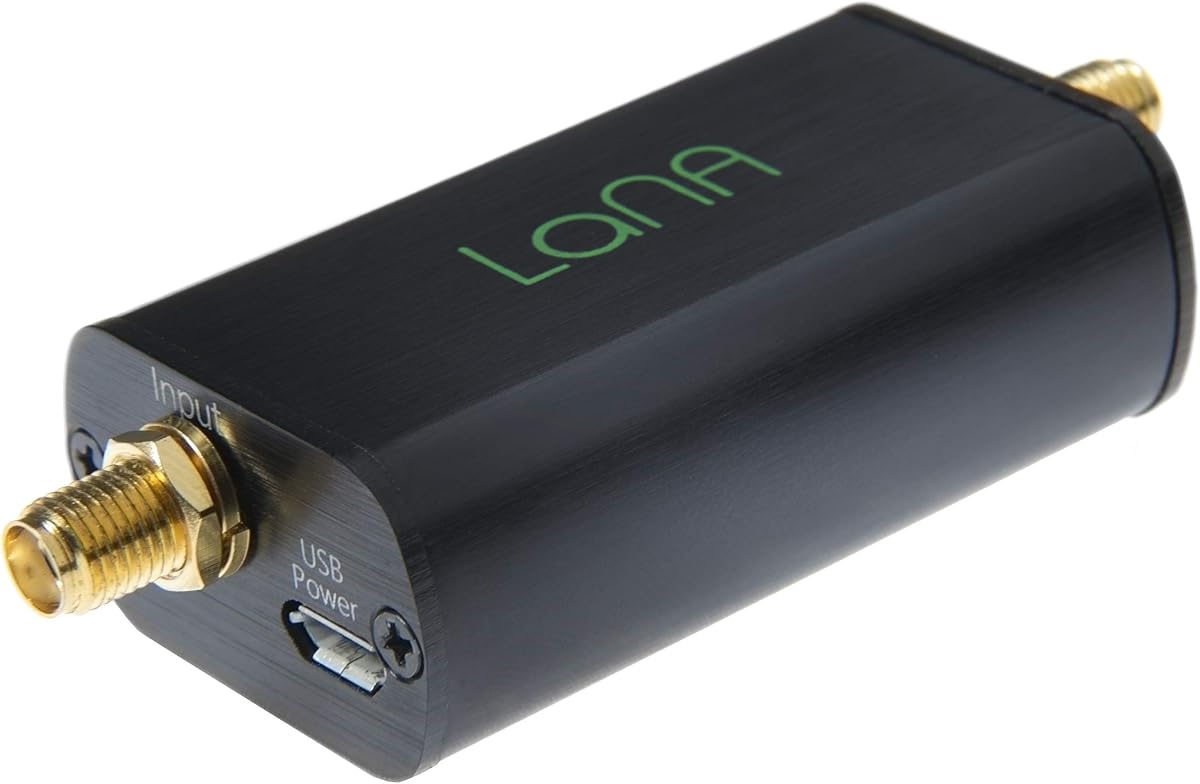
The Nooelec LaNA is a general-purpose low-noise amplifier intended to improve signal-to-noise ratio and reception performance across 20MHz to 4GHz. It is particularly relevant to RTL-SDR and other software-defined radio systems. The supplied rating is 4.2 out of 5, and the product's main strengths are its low-noise design, enclosure, and flexible power options.
We may earn a commission when you buy through this link, at no additional cost to you.
It can be powered through a bias tee at 3.3–5V, through USB, or from DC using the included adapter. A male SMA-to-male SMA connector is also included, reducing the need for an additional cable during basic installation. The manufacturer states that the module offers higher gain, lower noise figure, lower power use, and better linearity than modules built around SPF5189Z and similar devices.
Setup is not entirely automatic across every SDR combination. Some receivers require a DC block between the LNA and the radio when external power methods are used. That warning matters because improper bias or DC feed can cause unwanted behavior or equipment issues. The broad frequency range also means a receiver's filters and input characteristics remain important to the final result.
The LaNA is a sound choice for an SDR operator seeking a low-noise front end with several practical power options. It is less appropriate for HF-focused reception below its lower range or for transmit amplification. For a compatible SDR, however, the combination of enclosure, accessories, and power flexibility makes it a convenient and adaptable receive accessory.
Bias-tee, USB, and DC power support allow the amplifier to fit different bench and mobile arrangements. Check the receiver's documentation before selecting a method so the module does not receive unintended DC.
The module is designed to improve weak-signal visibility while preserving a clean receive chain. Results still depend heavily on antenna placement, filtering, cable quality, and sensible gain adjustment.
We may earn a commission when you buy through this link, at no additional cost to you.
The Generic Taurus MK2 is a one-channel scanner preamplifier designed for simpler receiver setups. It covers 25–2000MHz and offers adjustable gain from 6–20dB. The supplied rating is 4.1 out of 5, and its straightforward battery-powered design makes it especially relevant to scanner listeners who want more flexibility than a fixed internal preamp.
We may earn a commission when you buy through this link, at no additional cost to you.
Its PP3 battery power is convenient for portable monitoring, while the included BNC patch lead simplifies connection to a compatible scanner receiver. The 6–20dB gain range gives users some ability to balance sensitivity against overload risk instead of forcing a single fixed amplification level.
This is a limited product by design. It serves one channel rather than multiple simultaneous paths, and it offers none of the sophisticated monitoring, protection, or digital control found in more specialized LNA modules. The operator must also ensure that the scanner's antenna and input circuitry can accept the added gain without creating distortion in strongly signaled areas.
The Taurus MK2 is best for a straightforward scanner installation where portability and basic gain control matter more than laboratory flexibility. It may suit an existing radio that uses compatible BNC connections, but modern SDR users may prefer a wider-range module with USB power. For a single scanner receiver and uncomplicated operation, it delivers the essential functions clearly.
The 6–20dB range provides more control than a fixed-gain booster. Start conservatively, particularly when strong local services may already be present near the receiver.
PP3 battery operation removes the need for a mains-powered bench arrangement. The included BNC patch lead also helps users complete a basic compatible scanner setup quickly.
We may earn a commission when you buy through this link, at no additional cost to you.
The BJ-300 Plus with Fan is a high-power broadband linear amplifier intended for CB and ham radio operation. It supports AM, FM, SSB, and CW, with listed maximum outputs of 100W FM, 120W AM, and 150W SSB. Its supplied rating is 3.1 out of 5, so buyers should investigate compatibility and installation details particularly carefully.
We may earn a commission when you buy through this link, at no additional cost to you.
Input flexibility is one of its practical strengths. The amplifier is described as accepting 3–5W for AM and FM and 2–10W for SSB, allowing it to work with many HF transceivers and compatible CB equipment. An active cooling fan and large red aluminum heatsink help manage heat during extended operation, which is important when approaching the stated output levels.
Electronic reverse-polarity protection and dual 15A fuses add safeguards against incorrect power connections and electrical surges. Nevertheless, protection features do not eliminate the need to match drive level, antenna impedance, feed line, and operating mode correctly. A high-power amplifier can also create interference well beyond the intended signal if it is operated incorrectly.
This amplifier suits an established HF station with a compatible radio, appropriate antenna system, and the ability to manage 13.8V power demands and cooling. It is a specialized alternative to receive preamps, not a general-purpose signal booster. For operators seeking a rugged high-power design with straightforward controls and standard PL-259 connections, it offers useful features, but the lower user rating warrants added care.
The combination of an active radiator fan and a large aluminum heatsink addresses a central challenge in linear amplification: removing heat while preserving stable operation. Adequate airflow around the unit remains important.
Reverse-polarity protection and dual fuses help guard the amplifier, but correct drive and antenna tuning still determine signal quality. Verify the radio's output level and use a suitable antenna system for the selected mode.
We may earn a commission when you buy through this link, at no additional cost to you.
The AURSINC ZK09-UM is a USB-powered preamplifier spanning 100kHz to 10GHz. It provides 21.5dB gain at 10MHz, 21dB at 2GHz, and 17.5dB at 6GHz, with a typical 13dBm OP1dB. Its supplied rating is 4.9 out of 5, making it one of the strongest-rated products in this guide.
We may earn a commission when you buy through this link, at no additional cost to you.
The module uses an on-chip bias solution and draws 52mA from its USB supply. A high-PSRR LDO is included to suppress power-supply noise, which the manufacturer says produces an obvious noise-floor improvement compared with regular USB-powered LNA modules. The adjustable bias resistor also allows operating current to be reduced for different use cases.
Its high-frequency performance makes it particularly useful with the TinySA Ultra, whose onboard LNA is stated to perform well only below 3.5GHz. The ZK09-UM can improve reception and measurement performance at higher bands. As with any high-gain front end, excessive input can saturate the module or cause permanent damage, so strong local signals require attention.
This is an excellent choice for SDR users who want a quiet USB-powered preamp with a remarkably broad range. It is particularly valuable for TinySA Ultra users working above 3.5GHz and for test setups where power-supply noise would undermine weak-signal measurements. For a fixed receive chain, the module's flexibility and low current draw make it easier to integrate than a more elaborate amplifier.
The integrated high-PSRR regulator helps prevent USB supply fluctuations from appearing in the measured noise floor. That makes the module relevant to delicate spectrum observation as well as ordinary reception.
The module extends the useful external preamp option beyond the frequency range where the TinySA Ultra's onboard LNA performs well. Operators can use it to improve high-band receiving and measurement performance.
We may earn a commission when you buy through this link, at no additional cost to you.
The BJ-300 Plus Radio Amp is a broadband linear amplifier built for higher-power HF and CB-radio operation. It supports AM, FM, SSB, and CW, delivering listed maximum outputs of 100W FM, 120W AM, and 150W SSB. The supplied rating is 3.1 out of 5 reflects a mixed user response that warrants careful evaluation before installation.
We may earn a commission when you buy through this link, at no additional cost to you.
The amplifier accepts a stated input range of 3–5W for AM and FM and 2–10W for SSB. It combines an efficient cooling fan with a large red aluminum heatsink to dissipate heat, while electronic reverse-polarity protection and dual 15A fuses help protect against power errors. Simple controls include a power switch, mode selector, and high or low power adjustment.
Its PL-259 connections for the transceiver and antenna ports reflect the traditional approach used in many linear amplifiers. This can make integration with established HF equipment familiar, but it also means the radio and antenna system must be able to handle the amplifier's output. Correct drive adjustment, grounding, tuning, and filtering remain essential.
This model is most relevant to an operator with a low-power HF transceiver who needs much more transmit power and prefers simple physical controls over computerized band management. It is not appropriate for a portable receive-only setup or for an antenna system unable to support the desired output. Its cooling and protection features are reassuring, but the low supplied rating makes compatibility research essential.
The power switch, mode selector, and high/low adjustment provide a direct operating model. This is useful for a fixed installation where changing modes and power levels should be quick and predictable.
A high-power amplifier needs a dependable 13.8V supply, correct drive, and an antenna system rated for the output. The fan and heatsink support cooling, but the station must still provide suitable airflow and electrical capacity.
We may earn a commission when you buy through this link, at no additional cost to you.
The BJ-300 Broadband Linear AMP is a high-output amplifier for HF transceivers, supporting AM, FM, SSB, and CW. It lists maximum output levels of 100W FM, 120W AM, and 150W SSB from a stated 3–5W input. No numerical customer rating was supplied for this listing, so it cannot be compared on the same rating basis as the other nine products.
We may earn a commission when you buy through this link, at no additional cost to you.
Its controls are direct and practical for a fixed radio installation. A high/low power selector lets the operator reduce output when appropriate, while an on/off switch and LED indicator simplify daily use. The aluminum-alloy heat-sink construction supports thermal management, and standard ANT and RTX ports provide a recognizable layout for HF transceiver connections.
Electronic switching and polarity-inversion protection help guard against incorrect connections. Overvoltage protection adds another layer around the 13.8V supply. These safeguards are useful, but they cannot compensate for incorrect drive, poor antenna tuning, inadequate grounding, or an unsuitable feed line. Transmit amplification also creates a greater interference responsibility than a receive-only LNA.
The amplifier is best considered by established operators who understand linear amplifiers and already have a compatible HF station. It offers no smart band synchronization or detailed monitoring, so it is less convenient than the Xiegu GPA100 for some integrated transceiver systems. Confirm the radio's output, operating mode, supply requirements, antenna capacity, and local operating conditions before installation.
The high and low power options let an operator match output more closely to different conditions. Lower output may be appropriate for local contacts, simple antennas, or setups where maximum drive is unnecessary.
Overvoltage and polarity-inversion protection help reduce the consequences of common power wiring mistakes. They work alongside, rather than replace, correct grounding, drive control, and antenna-system preparation.
We may earn a commission when you buy through this link, at no additional cost to you.
The most important first step is deciding whether the amplifier must improve reception or increase transmit power. Frequency coverage, gain, noise performance, drive level, power demands, connector types, and protection features then narrow the choice to a model suited to your radio and antenna system.
A receive preamplifier increases the strength of signals entering a receiver, often with a low noise figure and modest output level. It can make weak stations more visible to an SDR or conventional receiver but does not add RF power to your own signal. A linear power amplifier takes drive from a compatible transceiver and produces substantially greater transmit output, requiring careful tuning, cooling, and a capable antenna system. Choosing between these categories based only on the word amplifier can lead to an unsuitable purchase.
Match the amplifier's stated frequency range to the bands and services you actually use. Receive modules in this guide range from narrow lower limits to broad coverage approaching 10GHz, while the GPA100 is intended for HF and 6m operation. A wide numerical range does not guarantee equal performance throughout the span, so note the gain figures at the frequencies that matter. Antenna, filter, connector, and receiver capabilities must also support the intended bands.
Gain describes how much a signal increases as it passes through the amplifier, while noise figure influences how much the amplifier itself degrades the signal-to-noise ratio. A high-gain LNA can make weak signals easier to see, but excessive gain may also raise the receiver's noise floor or cause overload. The ZK09-BM, LaNA, and other low-noise modules are primarily intended for sensitive reception rather than boosting the power of your own transmission.
High-power linear amplifiers must be matched to the radio that drives them. The BJ-300 models list specific input ranges, while the GPA100 is designed for compatible low-power QRP transceivers. Excessive drive can distort signals or damage equipment, while insufficient drive may prevent the amplifier from reaching its intended output. Confirm the transceiver's mode, output range, ALC behavior, and connector requirements before choosing a power amplifier.
Portable receive modules may run from USB or a small battery, while 100W-class linear amplifiers need a dependable 13.8V DC supply capable of handling sustained current. Battery-powered products such as the ZK09-BM offer field convenience, but their operating duration depends on battery condition and use. Station amplifiers also need appropriate power distribution, grounding, and ventilation, so their electrical demands extend beyond the amplifier enclosure.
Connector type determines whether an amplifier can integrate cleanly into an existing station. SMA-female modules suit many SDR and RF-test arrangements, the Taurus MK2 includes a BNC patch lead, and the high-power BJ-300 and GPA100 products use conventional radio interfaces suited to their respective roles. Check both ends of every cable and confirm impedance, gender, adapter availability, and whether an external DC block is required.
Protection features can include reverse-polarity prevention, overvoltage detection, dual fuses, high-SWR shutdown, overheating control, and automatic overpower recognition. The GPA100 includes intelligent monitoring of several operating conditions, while the BJ-300 models emphasize reverse-polarity protection and cooling. No protection system makes an incorrect setup safe, but it can reduce the consequences of common installation or operating mistakes.
A compact USB LNA can fit in a pocket, tool bag, or field radio setup, while a high-power amplifier generally belongs on a bench with ventilation, a substantial supply, and well-supported RF connections. The ZK09-BM's internal battery is particularly useful outdoors, and the LaNA supports several power methods for mobile use. By contrast, large outputs require space, cooling, and permanent installation planning even when their enclosures are described as compact.
Before connecting an amplifier, identify whether it is a receive preamp or transmit power amplifier and read its instructions for power, impedance, drive, and connector requirements. Check the radio, antenna, feed line, and grounding arrangement. For an LNA, begin with conservative gain and avoid using external and internal receiver amplifiers simultaneously when the manufacturer warns against double amplification.
Install receive modules close to the antenna feed where practical, use suitable 50-ohm cables, and observe all DC-block requirements. For a transmit amplifier, connect the radio to the designated drive port, establish a proper antenna and ground, set the correct operating mode, and adjust drive gradually. Never operate a high-power amplifier into an unmatched or unloaded antenna system, and follow the manufacturer's guidance for cooling and airflow.
During use, monitor signals for distortion, unexpected noise, instability, or excessive output. A transmit amplifier should be switched off or its drive disconnected before changing antenna or feed-line arrangements. Clean receive modules with care, keep moisture away from metal housings, inspect connectors and cables, and periodically check cooling paths, fan operation, fuses, and power connections. Turn the system off before changing wiring or making hardware adjustments.
An LNA is designed primarily to improve reception by increasing weak incoming signals while minimizing added noise. A ham radio power amplifier increases the output power of a compatible transmitter. The former belongs in the receive chain, while the latter belongs between a low-power transceiver and an antenna system.
No. An amplifier cannot correct a badly matched antenna, damaged feed line, poor grounding, or badly located antenna. A receive amplifier may make a marginal antenna more useful, but it cannot create signal quality that the antenna system never received. A transmit amplifier also requires an antenna capable of handling the increased power.
A higher gain figure means the amplifier can produce a stronger output signal relative to its input. This can make faint signals more visible to a receiver. However, excessive gain can also amplify interference, raise the noise floor, or overload the receiver, so gain should be balanced with filtering and signal strength.
Several modules in this guide are specifically suited to TinySA Ultra use, including the AURSINC ZK09-BM and ZK09-UM. The ZK09-UM is particularly intended to improve high-band performance beyond 3.5GHz. Follow the instructions regarding the receiver's built-in LNA, because using both stages simultaneously can lead to AGC compression, blocking, or reduced spectral purity.
It depends on the LNA, the power method, and the receiver. The Nooelec LaNA documentation specifically notes that some SDRs require a DC block when external power options are used. Check the receiver's input specifications and the amplifier's documentation before connecting bias-tee, USB, or DC power to avoid unintended DC reaching the radio.
The required drive depends on the amplifier's design and operating mode. The listed BJ-300 models accept stated input ranges of 3–5W for AM and FM and 2–10W for SSB, while the GPA100 is intended for compatible low-power transceivers. Consult the relevant manual, set the radio to the correct mode, and adjust drive gradually rather than assuming full output is always desirable.
No. Output power and emissions must comply with the amateur-radio rules that apply in the operator's country, band, mode, and station category. A product's advertised maximum output does not automatically make every operating level or installation permissible. Operators should also manage spurious emissions and interference responsibly.
If a strong local signal reaches an already-sensitive receiver, the added gain can push the receiver or another amplifier into overload. That may suppress weak stations, distort nearby signals, or increase the effective noise floor. Filters, attenuators, appropriate bypass switching, and conservative gain settings can prevent the problem.
The Low Noise RF Amplifier stands out as a budget-friendly, broadly usable receive option, while the Xiegu GPA100 offers the most advanced HF transmit-amplification experience in the group. For wideband reception across many frequencies, the RF Wideband LNA provides substantial gain in a compact package, and the AURSINC modules add specialized options for portable TinySA and SDR work.
Prioritize the function you actually need. Reception users should consider noise figure, bandwidth, gain control, power options, connector compatibility, and overload risk. Transmit users should verify drive range, mode support, cooling, protection, antenna capacity, and the radio's interface. A more expensive or higher-power unit is not automatically better if it does not match the station.
Before ordering, confirm the current listing specifications, included accessories, connector arrangement, and operating requirements. Product designs, bundle contents, availability, and prices can change, so checking the current product page helps ensure that the amplifier you select is still the right fit for your radio, antenna, and operating conditions.