
Multi-Zone Dometic CCC2 Thermostat
4.7Editor score
Four-zone temperature control
Direct CCC2 board replacement
Programmable memory settings
Our smart thermostat for RV guide compares Wi-Fi, app control, multi-zone options, compatibility, and installation needs to help you choose the right unit.
A smart thermostat for RV can make temperature control more convenient, especially when your coach is equipped with multiple cooling zones, a furnace, or a heat pump. The most useful unit combines accurate climate control with remote access, clear scheduling, and a thermostat designed for the electrical and equipment requirements found in recreational vehicles.
We compared ten thermostats based on the information supplied for each product, paying particular attention to RV-specific fit, heating and cooling modes, app connectivity, zone control, installation requirements, and power compatibility. The list includes purpose-built RV controls as well as adaptable residential smart thermostats and an IR-based controller for portable air conditioners.
Each review explains the product's standout strengths, limitations, and best-fit owner, while the comparison table makes key differences easier to scan. Ratings reflect the supplied customer feedback, while specifications and compatibility details remain subject to manufacturer updates. Product prices and availability can change, so confirm the current listing before purchasing.
4.7Editor score
5.0Editor score

4.6Editor score
This side-by-side comparison highlights each thermostat's RV relevance, control method, climate features, and installation considerations. It also distinguishes purpose-built RV replacements from general HVAC controls and universal infrared controllers.




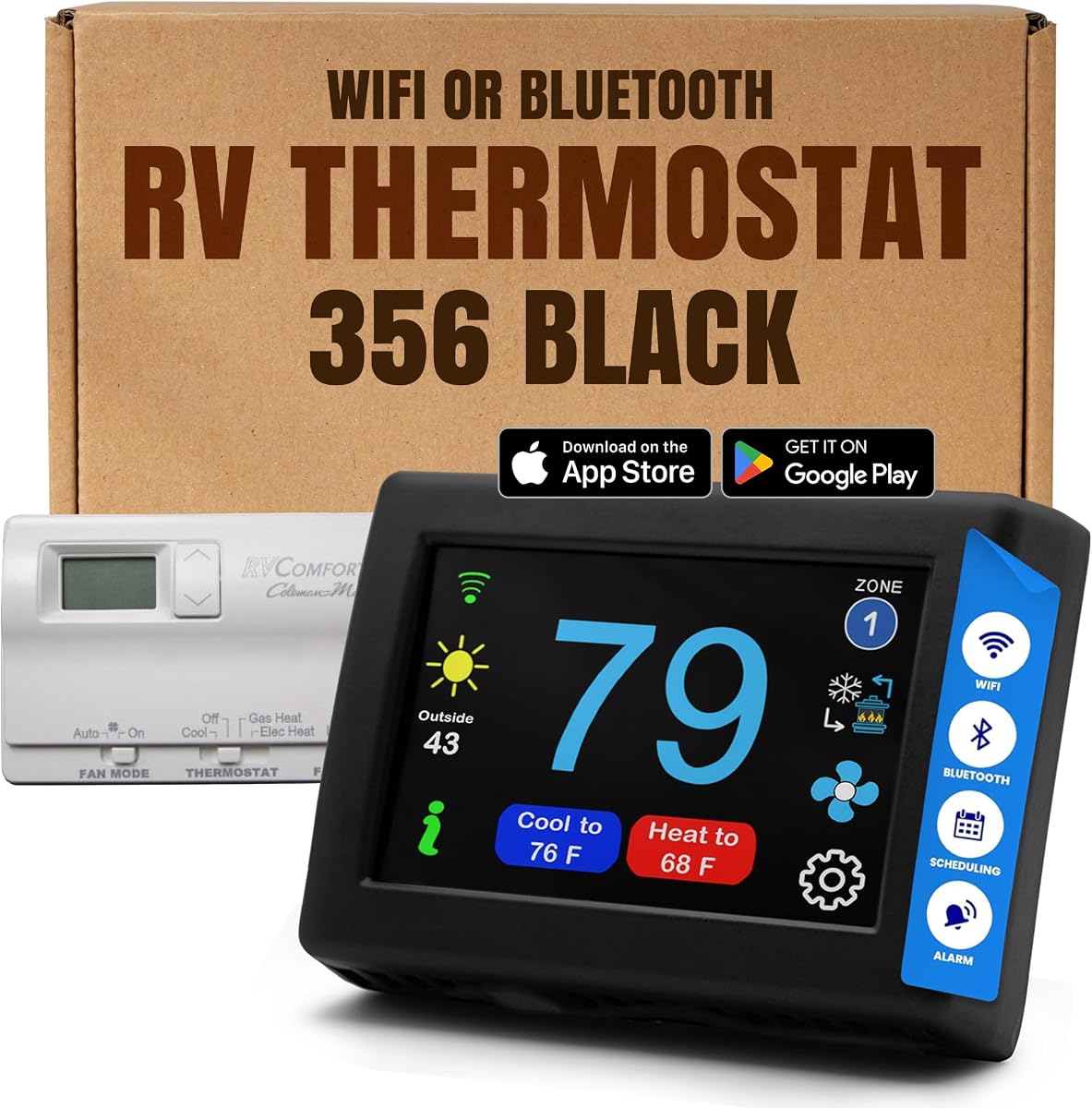
The MICRO-AIR EasyTouch 356 Black combines a purpose-built RV interface with Wi-Fi and Bluetooth control, earning a supplied rating of 5.0. It is designed as a replacement for specified Coleman RV COMFORT P.H.P thermostats and supports a large collection of control numbers. The 4-by-3.05-inch color touchscreen gives temperature adjustments a clear, modern appearance while keeping the controls accessible in low-light conditions.
We may earn a commission when you buy through this link, at no additional cost to you.
Its strongest feature is the combination of system detection and app connectivity. The thermostat can automatically recognize connected furnaces, heat strips, cooling equipment, and heat-pump sources. Owners can monitor and control the RV's air conditioner, furnace, or heat pump through a smartphone, making it possible to begin cooling before arriving. The supplied information also states that feature updates are delivered over Wi-Fi without a monthly service fee.
Compatibility is the principal limitation and should be checked before buying. The listed Coleman model numbers are extensive, but the thermostat still must match the control, wiring arrangement, and system found in the coach. The product information does not advertise independent multi-zone management, so owners seeking that capability should confirm whether their existing RV controls can be linked or paired as required.
This is the strongest all-around choice for an RV with a compatible Coleman thermostat and a strong interest in remote climate control. It combines the most explicit RV positioning in the group with a touchscreen, programmable operation, and wireless access. Verify the model guide and wiring requirements first, then favor this option for its polished and convenient control experience.
The smartphone app allows the RV's air conditioner, furnace, and heat pump to be monitored and adjusted remotely. That convenience is particularly valuable for a coach equipped with a rooftop air conditioner or other equipment that benefits from pre-cooling.
Automatic detection of furnaces, heat strips, and cooling sources reduces guesswork during configuration. The system also supports programmable schedules and free wireless updates for evolving control features.
We may earn a commission when you buy through this link, at no additional cost to you.
The MICRO-AIR EasyTouch 350 White is a digital RV thermostat intended to replace the Dometic CCC2 3314082.011 control. Its supplied rating of 4.2 reflects generally favorable customer feedback, while its defining benefits are a color touchscreen, programmable climate controls, and access through a smartphone app over Wi-Fi or Bluetooth.
We may earn a commission when you buy through this link, at no additional cost to you.
The thermostat supports heating and cooling and can work with sources including furnaces, heat strips, cooling systems, and heat pumps. Automatic source detection helps the unit configure itself around the RV's installed equipment. A 4-by-3.05-inch display makes the controls relatively compact without sacrificing the modern touch interface, and the backlit display is intended to remain convenient to operate in darkness.
The key caveat is that the replacement scope is narrower than the model number alone may suggest. The supplied details specifically identify the Dometic CCC2 3314082.011 thermostat. Buyers should compare the existing control, wiring, and system configuration with the manufacturer's model guide rather than assuming every Dometic installation is interchangeable.
The EasyTouch 350 White is a compelling option for a Dometic CCC2 owner who wants to move from a traditional control to an app-connected digital thermostat. It is less broadly suited than a universal or multi-zone product, but for a confirmed compatible installation it offers a practical balance of touchscreen operation, programmability, and remote access.
Owners can use the smartphone app to monitor and adjust the RV's cooling, furnace, or heat pump. Remote control is useful for preparing the living space before arrival and checking conditions while the coach is stored.
The 350 White is positioned as a direct replacement for a specified Dometic CCC2 thermostat. Confirming the exact original control before ordering is essential for a smooth installation.
We may earn a commission when you buy through this link, at no additional cost to you.
The ecobee Smart Thermostat Essential is a general-purpose Wi-Fi thermostat with a color touchscreen, app-based control, energy tracking, and broad smart-home integration. Its supplied rating is 4.2. Although it is not presented as an RV-specific replacement, it may suit travelers whose RV uses a conventional 24-volt HVAC system supported by the manufacturer's compatibility checker.
We may earn a commission when you buy through this link, at no additional cost to you.
The thermostat can be adjusted from the touchscreen or the ecobee app and automatically follows a programmed schedule. Energy consumption can be reviewed while away, and eco+ features include humidity detection, schedule assistance, and time-of-use functions. It also works with Apple HomeKit, Google Assistant, and Alexa, giving owners multiple ways to incorporate climate control into a connected home.
Most conventional gas, oil, electric, dual-fuel, forced-air, and heat-pump systems are listed as compatible, but the product claims 85 percent system compatibility rather than universal RV compatibility. Homes without a C-wire may need the separately sold Power Extender Kit. Optional SmartSensor accessories can also improve temperature readings in specific rooms, adding flexibility where the RV's main thermostat location does not reflect the occupied space.
This is a strong option for an RV with a supported conventional HVAC layout and an owner who values reports, ecosystem integration, and a polished app. It is less convenient as a plug-and-play RV replacement because compatibility, voltage, wiring, and mounting all need verification. Run the ecobee compatibility checker before considering it.
The app provides remote temperature control, schedule support, and energy-consumption tracking. These features make it easier to see how the climate system operates rather than simply changing the setpoint.
Support for Apple HomeKit, Google Assistant, and Alexa provides flexible options for travelers who already use one of these ecosystems. Voice control should be viewed as an added convenience rather than a substitute for checking system compatibility.
We may earn a commission when you buy through this link, at no additional cost to you.
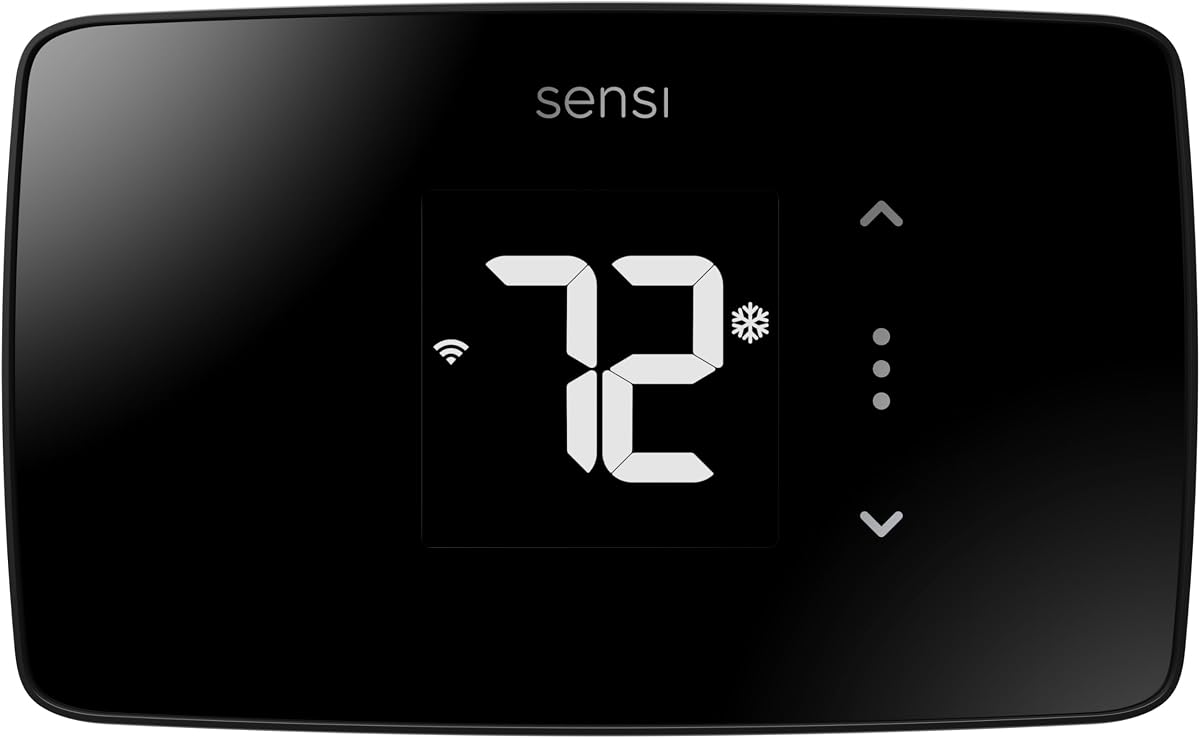
The Sensi ST55 combines a familiar thermostat layout with Wi-Fi access, flexible scheduling, usage reports, and Alexa compatibility. Its supplied rating of 4.4 makes it one of the better-rated conventional smart thermostats in this guide. It is not labeled for RVs, so its usefulness depends on whether the RV's heating and cooling equipment follows a compatible conventional HVAC design.
We may earn a commission when you buy through this link, at no additional cost to you.
Installation guidance includes a built-in level and step-by-step app instructions, while a common C-wire is not required in most applications. Its physical design retains physical buttons and occupies similar wall space to a traditional thermostat, which can make the transition less disruptive. The app supports remote access, flexible schedules, usage reports, equipment alerts, and maintenance reminders such as filter-replacement prompts.
RV electrical systems vary considerably, so the lack of a C-wire requirement in most homes does not guarantee simple RV installation. A traveler should confirm thermostat voltage, relay configuration, equipment type, and available wiring before purchasing. The product also does not advertise multi-zone management, making it better suited to a single-zone or independently controlled environment.
The ST55 is an attractive middle ground for an RV owner who wants established smart-thermostat features, straightforward physical controls, and privacy-conscious operation. It stands out for maintenance reports and reminders rather than RV-specific functions. Confirm compatibility first, and choose it when a single central thermostat can effectively represent the space that needs temperature control.
Usage reports, equipment alerts, and maintenance reminders can make system ownership more manageable. These functions are particularly relevant when an RV's equipment is used intermittently or inspected infrequently.
The built-in level and guided app instructions help with positioning and setup. Physical buttons make core adjustments accessible even when an owner does not want to reach for a phone.
We may earn a commission when you buy through this link, at no additional cost to you.
The Multi-Zone Thermostat for Dometic CCC2 RV AC delivers one of the most RV-specific feature sets in this guide, with independent control for four zones and a supplied rating of 4.7. It is designed as a direct replacement for the Dometic CCC2 control board and works with rooftop air conditioners, heat pumps, and dual-zone configurations.
We may earn a commission when you buy through this link, at no additional cost to you.
Its blue-lit digital display and ten-button layout provide direct temperature adjustment from 40 to 90 degrees Fahrenheit. Four-zone management is the main attraction, allowing separate RV areas to be regulated independently. Programmable settings and a memory function help retain user preferences, while the 12-volt DC housing is designed around RV electrical demands.
Installation is presented as plug-and-play without wiring modifications, but that convenience depends on an exact match with the existing CCC2 board and associated equipment. The listed Dometic compatibility includes several AC series and part numbers, yet the full coach configuration still needs verification. The product does not include Bluetooth or Wi-Fi, so it lacks app control and remote pre-cooling.
This thermostat is a strong value-oriented choice for an RV with a compatible Dometic CCC2 system and a need to manage several zones. It prioritizes practical climate organization over connected features. Buyers seeking remote access should choose a wireless replacement, while those with multiple roof units and a confirmed board match will find the four-zone design unusually practical.
Four-zone control is valuable in larger coaches where the living area, bedroom, and other spaces may need different temperatures. Independent regulation avoids forcing every area to follow one shared setpoint.
The 12-volt DC housing and stated plug-in connection to an existing CCC2 board make this more purpose-built for an RV than a typical residential thermostat. Compatibility should still be confirmed before removal of the original control.
We may earn a commission when you buy through this link, at no additional cost to you.
The Sensi Lite ST25 is an accessible smart thermostat for conventional HVAC systems, offering Wi-Fi control, geofencing, flexible schedules, and usage reports. Its supplied rating of 4.0 reflects a more mixed customer response than the leading models, so compatibility and required wiring deserve careful attention before installation.
We may earn a commission when you buy through this link, at no additional cost to you.
The product works without a C-wire in most applications, which can simplify installation when the available wiring supports that arrangement. Heating-only, cooling-only, and heat-pump systems may require a C-wire or another compatible power accessory. A built-in level and app-based instructions help with physical placement and configuration, while the app provides control from a phone or tablet.
The listed energy-saving tools include flexible scheduling, geofencing, remote access, and usage reports. The company also states that it does not sell personal information to third parties or use thermostat activity data for targeted advertising. As with the Sensi ST55, however, the unit is designed for residential equipment and is not specifically marketed for RV power systems.
The ST25 suits a straightforward RV installation with a conventional thermostat footprint and an owner who values a simple app. It is less suitable for systems requiring special low-voltage power arrangements, and it does not address multi-zone control in the supplied information. Check wiring and equipment type before selecting it, then focus on its scheduling and privacy features.
Flexible schedules and geofencing can reduce unnecessary operation when no one is home. In an RV, these functions may be especially useful for owners whose use patterns change from one trip to another.
The Android and iOS app provides remote adjustment and usage information without requiring a separate display system. A built-in level supports a more orderly installation, although the C-wire exception remains important.
We may earn a commission when you buy through this link, at no additional cost to you.
The Dometic analog RV thermostat is a straightforward replacement for a 3106995.032-style control, with a supplied rating of 4.1. It operates on 12 volts DC and provides a temperature slider from 40 to 90 degrees Fahrenheit. Its controls cover cooling, furnace, fan, and off, making it relevant for RV systems that do not require networked temperature management.
We may earn a commission when you buy through this link, at no additional cost to you.
The slider offers direct adjustment without a touchscreen, app, or account setup. A continuous fan setting can circulate air through the coach, while the separate mode control lets the owner determine whether cooling, the furnace, or fan operation is used. Because the same wiring can often be retained, it may be a practical way to refresh an old RV thermostat.
Calling this unit a smart thermostat for RV would be misleading because it offers no wireless connectivity, remote access, automated schedules, or energy-use reporting. Its available modes also exclude a heat-pump setting. The relevant buying consideration is therefore reliable local operation, not connected control. The compatible original model and wiring should be identified before ordering.
This analog unit is best for owners who value a simple repair over smart features or whose RV wiring favors a conventional controller. It can restore straightforward cooling, furnace, and fan control without adding complexity. Travelers who want to pre-cool remotely or coordinate several zones should look elsewhere, while those replacing a matching Dometic unit may appreciate the uncomplicated design.
The physical slider changes the temperature directly across a 40-to-90-degree range. This provides a familiar interface that can be useful when a tactile control is preferred.
The dedicated fan mode can run continuously to move air through the RV. This adds flexibility beyond simply selecting cooling or furnace operation.
We may earn a commission when you buy through this link, at no additional cost to you.
The Honeywell Home RTH9600WF is a feature-rich smart color thermostat with a customizable high-definition display, Wi-Fi programming, and voice-assistant compatibility. Its supplied rating is 4.3. It is designed for conventional forced-air, hot-water, steam, and heat-pump systems with electric backup rather than a dedicated RV control.
We may earn a commission when you buy through this link, at no additional cost to you.
Its most distinctive user-facing feature is the color display, which owners can change to suit their preferences. The home screen shows indoor and outdoor temperature, humidity information, and a daily weather forecast. Flexible programming and remote app control are supported, while compatibility is offered with Amazon Alexa, Google Assistant, Microsoft Cortana, and other connected-home partners.
Installation requirements are more restrictive than those of many choices in the guide. A C-wire is required, and a suitable power adapter may also be needed. Electric baseboard heat is not supported, and heating-only oil furnace systems require a C-wire. The product claims compatibility with most heat-and-cool oil furnace systems, so an RV owner should not assume all roof, furnace, and heat-pump arrangements qualify.
The RTH9600WF is best for a supported conventional HVAC installation where a C-wire is readily available and visual information matters. Its polished display and weather data are more elaborate than those of many competing models. Verify the RV's wiring and equipment before purchasing, and favor it when smart-home integration and customizable comfort information outweigh RV-specific convenience.
Indoor and outdoor temperatures, humidity, and the daily forecast are visible directly on the home screen. This makes the thermostat useful for checking conditions without opening the app.
The thermostat supports remote app control and several major voice-assistant ecosystems. Programmable scheduling provides a conventional alternative when hands-free control is not desired.
We may earn a commission when you buy through this link, at no additional cost to you.
The Breez Max Smart WiFi Thermostat is a specialized controller for mini-split, window, and portable air conditioners that use infrared remotes. Its supplied rating of 4.6 and broad smart feature set make it an appealing premium option for an RV whose cooling equipment is portable rather than permanently wired into a rooftop system.
We may earn a commission when you buy through this link, at no additional cost to you.
An automatic detection algorithm is designed to identify compatible air-conditioner brands and models, with support claimed for more than 20,000 units. Owners can also use on-device buttons, an app, or a true-thermostat experience. Built-in temperature and humidity sensors can be calibrated, while the Comfy Max feature is intended to prevent excessive cooling or heating. Weekly schedules, Home, Away, and Sleep presets, geofencing, energy-use history, and filter-status tracking add further utility.
Installation is nontraditional because the unit communicates by infrared rather than replacing a wired thermostat. It must be placed approximately six to 12 feet from the air conditioner and within its line of sight. The device connects to a 2.4 GHz Wi-Fi network, and schedules continue locally if internet connectivity is lost. The touch controls can be unlocked by pressing the temperature buttons together if they stop responding.
The Breez Max is best for a portable or mini-split cooling setup, including travelers who want their existing equipment to gain smart scheduling and app control. It cannot replace a conventional rooftop thermostat or integrate with a furnace, so it addresses a narrower use case. Its broad feature set and flexible placement make it a premium option when infrared equipment is present.
Because it communicates through the air conditioner's infrared remote, the Breez Max can add connectivity without changing the cooling unit itself. This makes it especially useful for portable equipment that cannot be wired to a smart thermostat.
Multiple Breez Max controllers can be paired with separate indoor units, and one can coordinate modes or turn off other units to reduce conflicts. This is useful for multi-zone arrangements built around individually controlled portable systems.
We may earn a commission when you buy through this link, at no additional cost to you.
The Dometic Standard CT Single Zone Thermostat is a straightforward control for a single RV rooftop air-conditioning zone. It has a supplied rating of 4.2 and emphasizes ease of use rather than connected intelligence. Its large LCD, blue backlight, and intuitive interface suit owners who want a clear local display without managing a phone app.
We may earn a commission when you buy through this link, at no additional cost to you.
The thermostat works with both ducted and non-ducted rooftop air-conditioning units, which gives it relevance across a broader range of RV cooling configurations than a model restricted to one control type. As a single-zone device, it suits coaches where one representative location is sufficient for monitoring and adjusting the overall cabin temperature.
It does not provide the remote access, automated scheduling, energy history, or multi-zone coordination found in the more connected alternatives. Buyers should therefore evaluate it as an easy-to-use RV thermostat rather than a fully smart one. It may be especially appealing as a practical replacement for an aging rooftop control or for a travel trailer with a straightforward single-zone air system.
The Dometic CT is best for owners who prioritize a straightforward rooftop-air-conditioner interface and do not need Wi-Fi control. It provides a clear display and broad ducted compatibility while avoiding the setup complexity of app-based devices. Confirm the wiring and replacement fit before purchase, then choose it when simplicity and local operation outweigh remote convenience.
The large LCD and blue backlight improve visibility during evening or early-morning operation. This is a practical benefit in an RV where a wall-mounted control may be viewed at varying times of day.
Compatibility with both ducted and non-ducted rooftop units expands the potential fit. The single-zone format keeps the interface focused on one climate area.
We may earn a commission when you buy through this link, at no additional cost to you.
The right smart thermostat for RV depends less on smartphone features and more on exact equipment compatibility, low-voltage wiring, cooling architecture, and the number of climate areas you want to control. These factors determine whether a thermostat can be installed safely and whether it will operate the RV as intended.
Start by identifying the exact thermostat, control board, and cooling system currently installed in the RV. A product designed for a Coleman COMFORT P.H.P control, a Dometic CCC2 board, or a conventional 24-volt HVAC system is not automatically interchangeable with another. Compare model numbers, mounting dimensions, wire labels, voltage, and the equipment the original control operates. The supplied listings for the two MICRO-AIR models include detailed compatibility lists, while the multi-zone Dometic unit names specific CCC2 board and AC series numbers. These details are more useful than a general description such as RV compatible.
In short, match the replacement to the installed control before considering display size or app features.
RV thermostats may operate on 12-volt DC systems, while many residential smart thermostats are designed around 24-volt AC equipment. The Honeywell RTH9600WF explicitly requires a C-wire, and the ecobee may need its separately sold power extender when a C-wire is absent. The Sensi models often work without a C-wire in homes, but the supplied information notes that some heating-only, cooling-only, and heat-pump arrangements still require one. Never assume a household thermostat's wiring requirements carry over to an RV. Confirm the coach's power source, transformer arrangement, available wires, and whether an adapter is permitted in the installation area.
In short, verify voltage and C-wire requirements against the RV's actual wiring before ordering.
A useful thermostat must support every climate mode found in the coach. Some RV controls handle only cooling and furnace operation, while others support cooling, heating, heat pumps, and mixed HVAC sources. The two MICRO-AIR EasyTouch models advertise support for furnaces, heat strips, cooling, and heat pumps. The Dometic analog replacement offers cool, furnace, fan, and off modes, and the Dometic CT is focused on rooftop air conditioning. The Breez Max takes a different approach by controlling infrared cooling equipment rather than operating a wired furnace or rooftop system. Selecting a controller that lacks a required mode can leave part of the RV without usable climate control.
In short, compare the available modes with every heating and cooling source installed in the coach.
The number of independently controlled areas should guide the choice. A single-zone thermostat is easier to operate and may be sufficient for a compact trailer, while a larger coach may benefit from separate controls for the living area and bedroom. The multi-zone Dometic CCC2 product is built around four-zone management and can work with rooftop units, heat pumps, and dual-zone configurations. The Breez Max can also coordinate multiple infrared indoor units, one controller per unit. Neither feature replaces a properly designed duct system or confirmed equipment compatibility, but both offer more control than a conventional single-panel thermostat.
In short, choose a zone count that reflects the RV's physical layout and installed cooling equipment.
Wi-Fi and app control are most valuable when an owner wants to cool the RV before arrival, monitor conditions while it is stored, or adjust the setpoint from another location. The MICRO-AIR models provide smartphone monitoring and control over Wi-Fi and Bluetooth, and the ecobee, Sensi, Honeywell, and Breez Max products also emphasize remote operation. These features require a reliable connection, correct account setup, and compatible phone or tablet access. By contrast, the Dometic analog and CT thermostats focus on local operation. A connected thermostat is not automatically better for every RV; a simpler unit can be more dependable when the vehicle's Wi-Fi coverage is limited.
In short, choose app control for convenience, but prioritize reliable local operation and system compatibility.
Schedules can improve comfort and energy use, but their usefulness depends on how often the RV follows a repeatable routine. The ecobee includes schedule assistance, time-of-use functions, humidity detection, and energy tracking. The Sensi models provide flexible schedules, with geofencing listed for the ST25. The Breez Max includes one-time and recurring schedules, Home, Away, and Sleep presets, and schedules that continue during an internet outage. The two MICRO-AIR units are programmable but the supplied information provides fewer details about their exact scheduling options. Travelers who alternate between short weekends and long trips may prefer manual controls or easily editable schedules.
In short, select automation that matches how predictably the RV is used rather than choosing the longest feature list.
Temperature readings are only useful when they represent the occupied space. In an RV, a control mounted near a door, roof vent, window, or cooling unit can differ significantly from the temperature experienced on a sofa or bed. The Breez Max includes adjustable temperature and humidity sensors and asks users to place it within six to 12 feet and in line of sight of the air conditioner. The ecobee can accept optional SmartSensors for rooms that matter most. Purpose-built rooftop thermostats are designed around the location of the unit, but the most accurate operating position will still depend on the coach's layout and sun exposure.
In short, consider where the sensor will sit and whether additional room sensing would improve accuracy.
The easiest installation is the one that matches the existing equipment without improvised wiring. The multi-zone Dometic CCC2 unit is advertised as a direct, no-modification replacement, while the Sensi models include a built-in level and guided setup. Other thermostats may require identifying low-voltage wires, connecting a C-wire, or purchasing a power accessory. Ongoing support also matters: MICRO-AIR states that it offers free feature updates over Wi-Fi, while the Breez Max provides customer support by phone and email during published hours. Look for clear instructions, known replacement models, accessible support, and a product whose manufacturer can answer configuration questions for the specific RV system.
In short, favor clear documentation and direct replacement guidance over unverified assumptions.
Begin by documenting the existing control, wiring labels, equipment type, and available power before disconnecting anything. Take clear photographs, record each wire's original location, and confirm that the selected thermostat is compatible with the RV's cooling, furnace, heat-pump, and control-board arrangement. For an upgrade that requires a C-wire, power extender, or other accessory, follow the manufacturer's installation instructions and local electrical guidance rather than improvising a connection.
After installation, power the system and test each available mode. Confirm that cooling engages the rooftop unit or portable air conditioner, heating or furnace mode operates the correct equipment, and the fan behaves as expected. Then connect the thermostat to its app if wireless control is included, join it to a 2.4 GHz network when required, name the device clearly, and review schedules before leaving the RV unattended. Calibrate any built-in temperature or humidity sensor in the app and compare its reading with a separate thermometer in the occupied area.
For long-term care, keep the thermostat area clean and free of obstruction, avoid blocking vents, and inspect the air filter according to the cooling system's maintenance guidance. Review usage reports, equipment alerts, and filter reminders periodically, especially before a long trip. Update the app when prompted, preserve the original control for possible future reinstallation, and recheck compatibility after replacing any roof unit, furnace, board, or thermostat component.
The best choice is the one that matches the RV's existing thermostat, voltage, wiring, and heating or cooling equipment. MICRO-AIR offers purpose-built wireless replacements for specified Coleman and Dometic systems, while the multi-zone Dometic CCC2 unit is designed for zone control. General smart thermostats such as the ecobee, Sensi, and Honeywell models may work only when the RV uses a compatible conventional HVAC arrangement.
It is possible if the RV's power, wiring, and HVAC equipment meet the thermostat's requirements. Many residential models expect 24-volt AC systems, while RV rooftop controls often use 12-volt DC components, and some residential thermostats require a C-wire. Check the manufacturer's compatibility guidance and the RV's wiring diagram before purchasing, especially if the installation involves a furnace, heat pump, or unusual control board.
That depends on the thermostat and the RV's wiring. The Honeywell RTH9600WF requires a C-wire, and the ecobee may require its separately sold Power Extender Kit in installations without one. The Sensi models often operate without a C-wire in typical systems, but certain heating-only, cooling-only, and heat-pump arrangements still need one. Purpose-built RV units may use 12-volt DC power instead, so inspect the coach's system before ordering.
Only when both the thermostat and the installed equipment support independent zones. The multi-zone Dometic CCC2 product is specifically designed to regulate four areas and can work with rooftop units, heat pumps, and dual-zone configurations. The Breez Max can coordinate multiple infrared indoor units, with one controller paired to each unit. A standard single-zone panel cannot create additional zones by itself.
A wired thermostat connects directly to the RV's climate-control system and can operate supported heating, cooling, and fan equipment. An infrared controller, such as the Breez Max, communicates with an air conditioner through its remote-control signal. Infrared installation is simpler for portable or mini-split units, but the controller must have line of sight and it does not control a wired furnace or rooftop system.
Yes, if the selected thermostat can control the installed cooling equipment through a reliable network connection. The MICRO-AIR models, ecobee, Sensi, Honeywell, and Breez Max all provide app-based remote control. The owner must complete setup, connect the RV to Wi-Fi, configure a schedule or send a manual command, and ensure the cooling equipment can operate safely while the coach is unattended.
Local thermostat functions generally do not require cellular service, but remote access depends on the RV's internet connection. Wi-Fi can come from a campground network, hotspot, or another onboard connection, while the Breez Max specifically requires a 2.4 GHz network. The Breez Max states that its schedules continue if internet connectivity is lost. A cellular plan may still be needed for remote control when the RV has no Wi-Fi coverage.
Record the current thermostat's brand, model number, control-board number, dimensions, voltage, and connected equipment. Then compare those details with the replacement's model guide and supported wiring. The MICRO-AIR 350 White targets a specified Dometic CCC2 thermostat, the 356 Black targets listed Coleman controls, and the multi-zone product replaces a named CCC2 board. If the original part number is unclear, contact the RV manufacturer or the thermostat supplier before installation.
The MICRO-AIR EasyTouch 356 Black stands out as the best overall option for a compatible Coleman installation because it combines a 5.0 supplied rating with touchscreen operation, system detection, and Wi-Fi and Bluetooth control. The multi-zone Dometic CCC2 thermostat is the practical budget-oriented pick for owners who need four-zone management, while the Breez Max offers the most extensive automation for portable air conditioners controlled through infrared.
Prioritize exact equipment compatibility before any display, scheduling, or voice-control consideration. Verify the original thermostat, control board, voltage, wiring, heating and cooling modes, and zone architecture. A purpose-built RV unit usually offers the most straightforward path when one matches the system, but a conventional smart thermostat can be appropriate when the RV uses compatible 24-volt equipment. For portable cooling, an infrared controller avoids the need to replace existing wiring.
Finally, confirm the current product listing, included accessories, installation requirements, and manufacturer compatibility guidance before purchasing. Product prices, availability, firmware, and support policies can change, and ratings may evolve with additional customer feedback. A final check of the coach's actual system will help prevent an attractive feature set from becoming an installation problem.