
GardePro 64GB SD Card
64GB full-size capacity
V30 U3 Class 10
4K video support
Compare the best SD Cards for Trail Cameras, including ten top-rated options for speed, capacity, durability, and device compatibility in outdoor setups.
SD cards for trail cameras must handle continuous recording, changing temperatures, vibration, moisture, and long periods without supervision. Capacity determines how much footage can be stored, while speed ratings and durability help the card support photos and video reliably. A trail camera also requires a format and capacity supported by its specific card slot.
The ten products in this guide were compared using the supplied specifications, compatibility claims, capacity, pack quantity, speed grades, and intended recording formats. The list covers full-size SDHC and SD cards, single-card and multipack options, standard Full HD choices, and higher-speed models positioned for demanding trail camera workflows.
Each review explains who benefits from a particular card and where its trade-offs appear. The leading choices include the GIGASTONE five-pack, the GardePro 64GB card, and the STEALTH CAM 16GB card, while the remaining entries provide alternatives for different capacities, pack sizes, and recording requirements. Product availability and prices can change.

4.7Editor score

4.6Editor score
This side-by-side comparison highlights the cards' capacities, pack quantities, speed grades, and stated device compatibility so readers can match a card to a trail camera's recording needs.




The GIGASTONE 32GB five-pack is our Editor's Choice because it balances a trail-focused configuration with features that are also useful in ordinary cameras. It carries a 4.7 rating, uses full-size SDHC cards, and has a UHS-I U1 Class 10 speed grade. The package includes five 32GB cards and five mini cases, making it especially convenient for users who regularly rotate media between a camera, a laptop, and protected storage.
We may earn a commission when you buy through this link, at no additional cost to you.
The card's listed transfer speed reaches up to 80MB/s, which is appropriate for moving sizable batches of photos and Full HD video. Its Class 10 and U1 ratings are described as suitable for Full HD recording and display. Compatibility is explicitly listed for SPYPOINT, TACTACAM, and WOSPORTS trail cameras, while the broader specification also identifies point-and-shoot cameras, HD camcorders, DSLRs, and PCs as suitable applications.
Environmental protection is a major strength in this category because trail cameras are exposed to rain, dust, temperature changes, and accidental impacts. The supplied information identifies the cards as waterproof, temperature-proof, x-ray-proof, shock-proof, and magnetic-proof. Those claims are more relevant here than a fashionable speed figure because reliability in the field determines whether footage can be recovered after an extended deployment. A five-year limited warranty adds another layer of confidence.
The main limitation is that 32GB is a moderate capacity for a camera that records high-resolution video continuously. The same multipack also exceeds the needs of a user with only one basic camera, while the U1 speed grade is not the appropriate starting point for a demanding 4K workflow. Nevertheless, the five-card rotation substantially reduces the chance of being left without usable storage. The included cases help keep each card identified, protected, and ready for the next swap.
This is the strongest all-around choice for a trail camera owner who records substantial amounts of Full HD content and wants several cards. It combines a well-regarded 4.7 rating, broad device compatibility, environmental resistance, and a practical pack quantity. For a single basic camera, one card may be sufficient, but the multipack is a better fit for hunting properties, wildlife monitoring projects, or any setup where regular card rotation is valuable.
Five individually stored cards make it easier to maintain a dependable rotation rather than relying on one card until it becomes full. This is useful when footage must be transferred regularly and a fresh card must be ready for the next deployment.
The U1 Class 10 rating supports Full HD workflows, while the stated resistance to water, temperature, shock, x-rays, and magnetic fields suits cameras placed in exposed outdoor locations.
We may earn a commission when you buy through this link, at no additional cost to you.
The SanDisk 32GB Ultra is a straightforward option for a trail camera that accepts standard SDHC cards. Its supplied title lists a 100MB/s speed, while the 4.7 rating places it alongside the best-rated products in this guide. It is a single-card package, so it offers a simple way to add or replace storage without committing to a large multipack.
We may earn a commission when you buy through this link, at no additional cost to you.
The 32GB capacity offers a practical balance for many trail camera users. It can hold a selection of photos and video clips, and its transfer figure is useful when moving files from the card to a computer or card reader. The SDHC format is widely recognized, although buyers should still verify that the camera supports 32GB SDHC cards before ordering. Capacity support is determined by the device, not merely by the card's availability.
Compared with the GIGASTONE five-pack, this product offers less storage redundancy. It does not include multiple cards or protective mini cases, and the supplied listing provides little detail about its exact durability credentials. That makes it a more straightforward purchase for one camera and one planned recording period, but a less compelling option for users who value a rotation system.
Its high stated speed and strong rating are the primary attractions. The specification is also more economical in concept because the buyer receives one card rather than a collection. For a compatible camera used primarily for Full HD wildlife monitoring, the SanDisk Ultra can deliver the essential combination of capacity, speed, and simplicity.
Choose this card when you own a single trail camera, already know it supports 32GB SDHC media, and need a recognizable full-size card with a strong rating. A multipack is preferable when uninterrupted recording, frequent swaps, or several cameras are part of the plan. For those circumstances, the SanDisk remains a solid core option, just not a complete fleet-management solution.
A listed 100MB/s speed is valuable when transferring captured files to a computer. The advantage is most noticeable when regularly moving larger batches rather than retrieving a few isolated clips.
The single-card format keeps ownership uncomplicated for users with one camera. It is also a practical replacement purchase when an existing compatible card has been retired or reached capacity.
We may earn a commission when you buy through this link, at no additional cost to you.
The PNY 32GB Elite three-pack is built around a clear outdoor-recording proposition. It is named for trail camera use, carries U1 and V10 speed grades, and is rated Class 10. Its supplied details also claim a sequential read speed of up to 100MB/s and uninterrupted Full HD video at 1920 by 1080, making it a credible fit for conventional HD wildlife recording.
We may earn a commission when you buy through this link, at no additional cost to you.
The three-card pack is the main convenience. Users can move footage, retain one card as a spare, or rotate cards among compatible cameras. That flexibility makes this product more versatile than a single-card option without committing to the larger quantity offered by the GIGASTONE ten-pack. The 32GB capacity per card is also a common middle ground for cameras that support standard SDHC media.
The supplied information emphasizes durability unusually strongly. Shock, temperature, water, drop, x-ray, wearout, vibration, electrostatic discharge, and humidity resistance are all listed. These protections are meaningful for a device that may remain outdoors for long periods, although the card's real-world performance will still depend on correct formatting, proper insertion, and the camera's own operating conditions.
Its 4.1 rating is the lowest numerical rating among the rated products in this list, which gives buyers more reason to examine compatibility and workload carefully. The stated V10 rating is designed for Full HD video, not high-bitrate 4K. Users recording very long continuous video or working with cameras that demand newer speed classes should look toward the GardePro instead.
The PNY Elite is a good middle option for anyone who wants several cards and a card explicitly marketed for trail cameras and outdoor devices. Its strengths are the three-card quantity, Full HD focus, broad device compatibility, and extensive environmental protection. It falls short of the GIGASTONE's higher rating and does not offer 4K-oriented speed grades, but it remains a practical and flexible package.
Rather than presenting the cards only as general-purpose media, the supplied specifications emphasize trail cameras, outdoor devices, wildlife photography, and HD videography. That direct positioning helps narrow the buying decision.
The three-card configuration supports scheduled transfers and rotation. A spare card can remain formatted and ready while two cards cycle through active recording and file review.
We may earn a commission when you buy through this link, at no additional cost to you.
The STEALTH CAM 16GB card is our Best Budget pick because it focuses on the practical requirements of a basic trail camera without adding a multipack or advanced video rating. It has a 4.6 rating, a Class 10 speed grade, and broad compatibility with digital hunting and trail cameras. It is a practical choice for users who need a small, straightforward card for basic monitoring.
We may earn a commission when you buy through this link, at no additional cost to you.
Low power consumption is one of the most useful supplied specifications for an unattended camera. A card designed to work efficiently can complement a trail camera's battery limitations, although actual battery life also depends on the camera, recording mode, temperature, image quality, and motion settings. The card's low-power emphasis therefore makes sense in a device expected to operate for extended periods in the field.
The card supports high-speed data transfer for videos and high-resolution pictures, while the stated compatibility includes most digital hunting trail cameras and other SDHC devices. Its 16GB capacity is modest, but it may suit cameras configured for still images, short clips, or less frequent recording. Users should confirm that the camera accepts 16GB SDHC cards and does not require a larger maximum capacity.
The obvious trade-off is storage. Sixteen gigabytes can fill quickly when a camera records continuous HD video, and the single-card package provides no immediate spare. A higher-capacity option such as the SanDisk 32GB Ultra or STEALTH CAM 32GB two-pack would better serve a video-heavy deployment. For a basic setup, however, the lower storage demand of the card can itself be useful.
Choose this product for a compatible entry-level trail camera, a wildlife feeder, or a basic scouting setup that records selectively rather than constantly. It combines a reputable rating, Class 10 performance, broad game camera compatibility, and a power-conscious design. It is also a sensible compact option for users who want to keep the number of spare cards they carry to a minimum.
Low power consumption is particularly relevant when a trail camera operates on batteries for long stretches. The card's efficiency-oriented specification helps it fit that environment.
A 16GB SDHC card can serve basic setups that capture photographs or shorter video segments. It is best paired with a regular transfer schedule to avoid overwriting useful footage.
We may earn a commission when you buy through this link, at no additional cost to you.
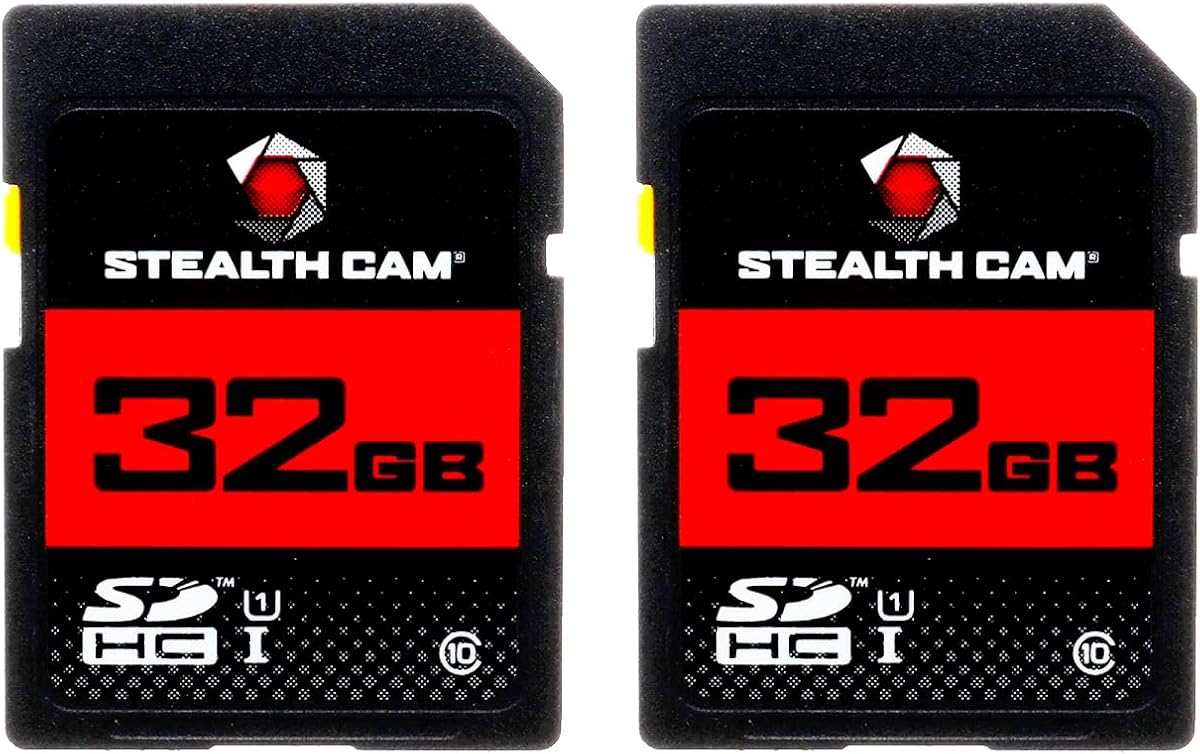
The STEALTH CAM 32GB two-pack combines two of the category's most useful baseline elements: 32GB SDHC capacity and a Class 10 speed rating. It has a 4.7 rating and is explicitly intended for game trail hunting, scouting, photo, and video recording cameras. The two-card configuration offers enough redundancy for a basic rotation without reaching the storage volume of larger multipacks.
We may earn a commission when you buy through this link, at no additional cost to you.
A Class 10 card is a sensible match for conventional HD capture, and the supplied description emphasizes seamless recording of videos and high-resolution images. Compatibility extends across most digital hunting trail cameras and other devices. Low power consumption is again highlighted, making this package relevant to cameras that need to remain active in remote locations where changing batteries or media may be inconvenient.
The two-card format gives users a practical advantage over a single card. One card can be in service while the other is being reviewed, transferred, or kept ready as a replacement. That makes it easier to maintain a steady recording schedule and reduces the chance that a full card interrupts a deployment. It is a sensible middle ground for one or two compatible cameras.
The limitation is that the package does not carry a V30 or U3 rating, so it is not the clearest match for high-bitrate 4K recording. It also includes only two cards, which may be insufficient for a large fleet. Those constraints do not matter for a typical Full HD trail camera, but they should influence buyers whose cameras produce demanding video or operate several units at once.
This is a strong recommendation for a hunter or wildlife observer who wants a two-card rotation, a 32GB capacity, and a well-rated trail-camera-focused product. It avoids the small capacity of a 16GB option and the redundancy of a ten-card package. The result is a balanced setup for regular Full HD use and straightforward media management.
Keeping two cards creates a practical cycle between active recording and file transfer. It provides a practical safety margin without creating a large collection to organize.
The Class 10 grade aligns with conventional HD recording needs. It is a more natural fit for standard trail camera footage than cards carrying higher U3 and V30 classifications.
We may earn a commission when you buy through this link, at no additional cost to you.
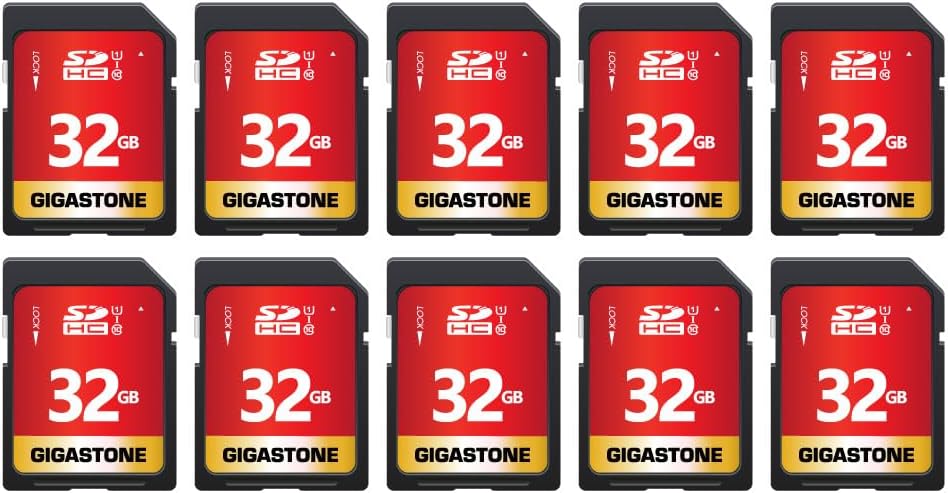
The GIGASTONE 32GB ten-pack is built for buyers who need storage depth rather than a single simple replacement. It includes ten 32GB full-size SDHC cards and ten mini cases. Each card has a UHS-I U1 Class 10 grade and a listed transfer speed of up to 80MB/s, placing it firmly in the Full HD trail camera category.
We may earn a commission when you buy through this link, at no additional cost to you.
The large quantity makes this package attractive for hunting properties, multiple camera locations, research projects, or users who prefer to avoid visiting each camera frequently. Ten cards allow several to remain in active rotation, several to hold backed-up footage, and the rest to be stored in their cases. The included cases help protect cards during transport and make each one easier to identify.
The specification explicitly names SPYPOINT, TACTACAM, and WOSPORTS trail cameras, along with digital point-and-shoot cameras, HD camcorders, DSLRs, and PCs. The cards are also described as waterproof, temperature-proof, x-ray-proof, shock-proof, and magnetic-proof. A five-year limited warranty provides an additional stated support benefit for a large storage purchase.
The trade-off is obvious. A person operating one camera may not need ten cards, and the package's quantity does not itself improve the speed of any individual card. The U1 Class 10 specification also does not target high-bitrate 4K. Buyers should therefore avoid choosing this option solely because it contains more cards; the quantity must correspond to a genuine rotation, fleet, or archival need.
For an established multi-camera setup, this is a capable bulk solution with a strong emphasis on organization and outdoor protection. Its 4.6 rating, trail camera compatibility claims, and substantial inventory make it more specialized than a general single-card purchase. Users with only one basic camera will usually find the five-pack or a two-card package easier to manage.
Ten cards are useful when recording locations are numerous or widely separated. They support scheduled rotation and provide enough media to keep each camera supplied between visits.
Ten mini cases help keep cards protected during storage and transport. The matched quantity also makes it easier to keep a finished card with the footage it contains.
We may earn a commission when you buy through this link, at no additional cost to you.
The GardePro 64GB card is the premium selection because it combines the largest capacity in the list with the strongest stated speed classification. It is a full-size SD card carrying V30, U3, and Class 10 ratings, making it intended for high-bitrate 4K video, fast continuous shooting, and devices that can benefit from more demanding storage performance.
We may earn a commission when you buy through this link, at no additional cost to you.
With 64GB, a compatible camera has substantially more room for photos and video before replacement or transfer becomes necessary. That is useful for high-resolution recording, continuous motion clips, or installations where visits are infrequent. The card is also described as suitable for trail cameras, security cameras, and other full-size SD devices, providing broader relevance than a single-purpose wildlife card.
A listed read speed of up to 100MB/s supports quick access during review and backup. The industrial-grade component design is another important feature for a card used in demanding outdoor and long-term scenarios. Its stated compatibility with all GardePro trail cameras and mainstream full-size SD devices makes it especially relevant to buyers who already use that camera ecosystem.
The main limitation is the absence of a numerical customer rating in the supplied data. That leaves fewer customer signals than are available for the other selections, so compatibility and workload remain especially important. The card is also a single-card package rather than a rotation set. In addition, a camera must support 64GB full-size SD media and have a sufficient speed requirement to benefit from U3 and V30.
The GardePro is the right choice for a modern, compatible camera producing 4K or high-bitrate video, especially when a single high-capacity card is preferred. It offers the most room for data and the most advanced ratings in the guide. For owners of older Full HD cameras, the faster specification may be unnecessary, but the 64GB capacity can still reduce how often media must be changed.
V30 and U3 ratings position the card for high-bitrate 4K workflows and fast continuous shooting. These classifications matter when the camera can generate files faster than basic Full HD storage can comfortably handle.
The 64GB capacity is the largest listed here and can ease the burden on cameras that record high-resolution clips continuously. Longer recording intervals also reduce the frequency of physical maintenance visits.
We may earn a commission when you buy through this link, at no additional cost to you.
The HME 16GB two-pack is a compact, versatile option for devices with an SDHC slot. It carries a 4.6 rating and includes two cards, giving users a simple rotation without the commitment of a larger multipack. The supplied description emphasizes dependable performance, outdoor durability, and easy transfer of photos and HD videos.
We may earn a commission when you buy through this link, at no additional cost to you.
Compatibility with any device that has an SDHC slot is the broadest practical claim in the product information. That makes the cards useful not only in trail cameras but also with smartphones, tablets, and computers that support the format. Their additional uses include nature photography, research, and documenting outdoor adventures, which makes them practical beyond a single hunting scenario.
The cards are described as engineered to withstand temperature extremes, moisture exposure, and rugged handling. Those characteristics are appropriate for trail cameras, where cards may remain in enclosed housings during severe weather and may be handled repeatedly during installation or retrieval. A compact two-card set can also be easier to carry into the field than a larger collection of media.
The main limitation is 16GB per card. A camera that records frequent HD video can fill that amount quickly, and the two-card total does not extend the period between transfers as much as a 64GB option. No U3 or V30 rating is stated either, so the pack is better suited to standard HD content than demanding 4K workflows. The absence of a more detailed speed specification also warrants checking the camera's requirements.
Choose HME for a compatible SDHC device that produces a manageable amount of media or serves as a secondary outdoor camera. The two-card quantity, 4.6 rating, and durability focus make it a good general-purpose pick. Users prioritizing high-resolution video or long recording intervals should consider a larger and faster card, such as the GardePro.
The SDHC slot compatibility claim allows the cards to move beyond trail cameras into compatible phones, tablets, computers, and other equipment. That flexibility adds value beyond the initial hunting or wildlife use.
Two cards are easy to carry, label, and rotate. This makes the pack suitable for users who want a spare without maintaining a larger media inventory.
We may earn a commission when you buy through this link, at no additional cost to you.
The Stealth Cam 32GB memory card is a focused game camera accessory with a 4.6 rating. Its defining benefit is simplicity: it works with SD card-compatible game cameras, boosts storage capability, and can be reused after users upload data and erase its contents. It offers a familiar 32GB capacity for cameras that support the format.
We may earn a commission when you buy through this link, at no additional cost to you.
The ability to upload, erase, and reuse a card makes it particularly suitable for a recurring monitoring routine. Rather than treating each card as a permanent archive, the user can transfer valuable clips to another storage device, clear the card, and return it to service. That workflow is useful for properties where wildlife observations need to be reviewed frequently.
Compatibility is stated across all SD card-compatible game cameras, which gives the product a clear audience. The 32GB capacity is also more accommodating than 16GB options for a camera that captures both photographs and video. The listing notes that the brand may vary, so buyers should pay close attention to the actual package details and confirm compatibility before purchasing.
The supplied information is limited compared with several other products in the guide. It does not state a detailed transfer speed, a UHS speed class, or specific environmental protections. As a result, buyers with a high-bitrate 4K camera or a need for intensive continuous shooting should seek a card with clearer advanced specifications, such as the GardePro. For conventional game camera use, the simpler offering may be adequate.
This card is best for a compatible game camera that benefits from 32GB storage and a straightforward reusable workflow. It suits buyers who prioritize capacity and familiar game camera compatibility over specialized speed or durability claims. For more demanding recording, the Gardepro or PNY Elite provides clearer performance information, while this option remains a practical basic choice.
The ability to upload, erase, and reuse the card supports an efficient recurring media routine. It is especially helpful when a camera needs the same storage card back after each retrieval.
Thirty-two gigabytes offers more room for images and video than smaller cards. The camera must support 32GB SDHC media, and buyers should confirm the applicable format limit.
We may earn a commission when you buy through this link, at no additional cost to you.
The STEALTH CAM 16GB two-pack is a compact option for trail cameras, scouting setups, and hunting cameras that support SDHC media. Its 4.6 rating and two-card quantity make it more useful for ongoing rotation than a single small card. The Class 10 speed grade supports the conventional recording tasks described in the supplied information.
We may earn a commission when you buy through this link, at no additional cost to you.
Compatibility is stated across most digital hunting trail cameras and other devices. That makes the pack relevant to a range of scouting and wildlife observation tasks, while the low power consumption feature aligns well with cameras expected to operate for long periods in the field. The cards are designed to handle both video recording and high-resolution images.
Two identical cards simplify rotation because the user does not have to manage cards with different capacities. One can remain in the camera while the other is transferred and cleared. This is a practical arrangement for a single property, a pair of cameras, or a user who prefers to keep a formatted spare close at hand.
The central trade-off is capacity. A 16GB card can fill rapidly in a high-resolution video recording scenario, requiring more frequent visits and transfers. The Class 10 grade is also not intended for the advanced 4K workloads addressed by V30 and U3 cards. Buyers who expect constant high-resolution recording may receive better service from the 32GB alternatives or the 64GB GardePro.
Choose this pack for a compatible trail camera that captures a moderate amount of media between visits. It offers the convenience of two matching cards, a solid rating, broad compatibility, and low power consumption without a large media footprint. It is a particularly good fit for basic scouting, feeder monitoring, or a backup pair kept with a camera kit.
Two identical 16GB cards make it easier to alternate between devices without mixing capacities or formats. The spare can remain ready for the next scheduled swap.
The package works well when the camera records photos, short clips, or a limited number of daily events. A regular transfer schedule keeps the limited capacity from becoming a disadvantage.
We may earn a commission when you buy through this link, at no additional cost to you.
The right trail camera card depends on device compatibility, recording format, storage volume, and environmental conditions. Use the following factors to narrow the field before selecting a capacity or multipack.
Start with the camera's manual or manufacturer guidance, because a trail camera's supported capacity and format are more important than any general performance claim. Products in this guide include full-size SD and SDHC cards at capacities of 16GB, 32GB, and 64GB. A card may be physically the same size while using a different format or capacity class, and the camera must explicitly support it. Older devices may impose stricter maximum-capacity limits, while newer models may support larger cards and faster classes. Do not assume that a card advertised for a different trail camera model will work with yours. Check the maximum card capacity, accepted format, and any manufacturer guidance before ordering.
Capacity determines how long a camera can record before files must be transferred, erased, or replaced. A 16GB card can suit a camera used for photos, short clips, or relatively light activity, but it may fill quickly during continuous high-resolution video. A 32GB card provides a more useful middle ground for regular Full HD capture. The 64GB GardePro offers the most room in this list and may reduce the number of maintenance visits, especially for cameras recording 4K or frequent motion clips. Actual storage duration depends on the camera's resolution, frame rate, compression, motion sensitivity, and how often it records.
Speed classifications indicate minimum performance levels relevant to recording workflows. Class 10, U1, and V10 cards are appropriate for conventional Full HD video and are represented by several options in this guide. V30 and U3, found on the GardePro, indicate stronger support for high-bitrate 4K video and fast continuous shooting. The listed read speed figures of up to 80MB/s or 100MB/s can make file transfers faster, but the card must also meet the camera's write requirements. A fast card cannot compensate for a camera that produces files faster than its own recording system can handle, so device specifications remain the deciding factor.
Trail cameras are commonly installed in locations exposed to rain, dust, cold, heat, vibration, and accidental impact. The GIGASTONE cards list water, temperature, x-ray, shock, and magnetic resistance. The PNY Elite adds drop, wearout, vibration, electrostatic discharge, and humidity claims, while the HME cards emphasize resistance to temperature extremes, moisture, and rugged handling. These features do not make any card immune to every environment, and a sealed camera housing remains important. They do provide a better foundation for outdoor use than choosing solely on capacity. Handle the cards carefully, keep them dry during handling, and avoid forcing them into a slot.
Multipacks are most useful when media can be rotated or distributed across several devices. A two-card pack provides a simple working-and-spare arrangement, while three or five cards support more varied schedules. The ten-card GIGASTONE pack is better suited to multiple camera locations, researchers, or users who want a substantial reserve. Extra cards are not automatically better for a single camera, because they add organization and storage requirements. Buyers should estimate how many cards can be filled between visits, then buy enough to maintain a workable rotation without accumulating cards that will rarely be used.
A trail camera card is working storage, not necessarily a permanent archive. Plan a retrieval schedule that allows footage to be copied to a computer, network drive, or other safe location before cards are erased. The Stealth Cam card is specifically described as reusable after uploading and erasing data, while multipacks make it easier to keep one card active and another ready. Bring a suitable card reader, verify that the files open correctly, and keep a record of the camera and card used for each session. Regular transfers also reveal damaged or unrecognized cards before they are needed in the field.
A trail camera's runtime depends on the entire system, including its battery, sensor, transmission features, and recording behavior. Memory card power consumption can still be a relevant part of that equation, particularly in remote installations. The STEALTH CAM products explicitly highlight low power consumption, making them worth considering for extended deployments. Higher-capacity and higher-speed cards can also reduce the frequency of handling visits, but card choice should never substitute for a proper battery and operating plan. Test the complete camera setup under expected conditions before leaving it unattended.
Begin by confirming that the camera supports the card's capacity, format, and speed class. Insert the card according to the camera's instructions while the device is powered off. If the camera includes a formatting option, use it so the file system and card structure are prepared for that device. When a card is used in more than one camera, format it again in the device where it will be used and allow the formatting process to finish before removing it.
Set a transfer and replacement schedule that fits the camera's recording volume and your access to the site. Retrieve footage before the card becomes full, copy the files to more than one safe location when practical, and confirm that the copies open properly. Review each card for errors before erasing it. Keep cards in their protective cases when they are not inserted, and avoid leaving them in extreme heat, moisture, or a parked vehicle.
Do not remove a card while the camera is writing files, and never use the camera's card removal function to interrupt an active recording. If a card is damaged, frequently unreadable, or produces recording errors, stop relying on it and replace it. Maintaining a small rotation with one card actively recording, one recently transferred, and one formatted as a spare makes equipment changes faster and reduces the risk of lost footage.
Most compatible trail cameras use full-size SD cards, commonly in the SDHC format at capacities such as 16GB and 32GB. Some newer models may support 64GB cards or other capacities, but the camera's manual is the authoritative source. Check its maximum supported capacity and accepted format before ordering, and format the card in the camera when possible.
It depends on whether the camera records still photos, short video clips, or long continuous videos. A 32GB card is a practical middle ground for many Full HD setups because it offers more room than 16GB while remaining easy to manage. High-resolution or continuous recording can fill it quickly, so check the footage regularly and keep a spare card available.
For conventional Full HD recording, a Class 10 card is a common and appropriate minimum. Cameras that support high-bitrate 4K or fast continuous shooting may benefit from stronger ratings such as V30 and U3, such as those listed for the GardePro. Compatibility with the camera's write requirements matters more than a card's headline read speed.
Yes, provided the card remains healthy and is erased or formatted correctly. The Stealth Cam 32GB card is specifically described as reusable after uploading and erasing data, a process that applies to compatible cards in general. Use the camera's formatting function when available and do not erase a card while it is actively recording.
A multipack is useful if you operate several cameras, visit a location infrequently, or want to rotate media without waiting for a used card to be transferred. Two cards provide a simple active-and-spare arrangement, while larger packs suit multi-camera operations. For one lightly used camera, a single 32GB or 64GB card may be more convenient.
Cards with environmental resistance can be better suited to outdoor conditions, but they should still be handled carefully and paired with a properly sealed camera housing. Several products in this guide list water and temperature resistance, while the PNY and HME cards emphasize additional environmental protections. Resistance specifications do not eliminate the need to protect connectors and card contacts.
The right interval depends on capacity, recording activity, video quality, and how long the camera must operate unattended. Check the camera's recording indicators or available-space status if available. A smaller card or high-activity camera needs more frequent retrieval, while a 64GB card in a lightly used setup may provide a longer interval.
Not directly. Image quality is primarily determined by the camera's sensor, lens, sensor resolution, focus, lighting, and recording settings. A faster card mainly helps the camera handle demanding recording workloads and allows faster file transfers. It can prevent recording interruptions caused by insufficient write performance, but it cannot improve the captured image beyond the camera's capabilities.
The GIGASTONE 32GB five-pack is the strongest overall choice because it combines a 4.7 rating, Full HD-oriented speed, environmental protection, and a useful rotation quantity. The GardePro 64GB card is the premium option for compatible cameras that need more capacity or advanced 4K speed ratings, while the STEALTH CAM 16GB card offers a focused, power-conscious solution for basic setups.
Prioritize compatibility before any other consideration. Confirm the camera's supported capacity and format, then choose a speed class that matches the recording resolution. Select enough capacity to reach the next planned retrieval, and consider a two-card rotation for a single camera or a larger pack for multiple locations. Durability features and included cases become especially valuable when cards are frequently handled outdoors.
Ratings, product details, availability, and prices can change over time, so check the current listing before purchasing. Review the camera's manual alongside the card specifications, and make sure your recording schedule and transfer habits can take full advantage of whichever option you select.