
RVBOATPAT 150A Bus Bar
4.7Editor score
150A continuous current capacity
Large 1/4-inch stud
Includes copper lugs
A 12V bus bar creates a dependable central connection point for batteries, chargers, inverters, and DC accessories. The right model can reduce clutter, improve cable organization, and make troubleshooting easier, especially in boats, RVs, trucks, and off-road electrical systems where space and vibration demand careful planning.
This guide compares ten 12V bus bars based on their published current ratings, supported voltages, stud sizes, terminal counts, conductor materials, mounting bases, protective covers, and included hardware. It covers both compact distribution blocks for lighter accessory circuits and higher-capacity dual-bus assemblies designed for demanding marine, mobile, and solar installations.
The rankings show how products differ in connection flexibility, capacity, and installation convenience, helping buyers match a block to their wiring plan. Product details and availability can change over time, and prices fluctuate, so confirm the current specifications, dimensions, and included accessories before purchasing.
4.7Editor score

4.8Editor score

4.7Editor score
As an Amazon Associate we earn from qualifying purchases.
The comparison below organizes all ten products by their most practical differences: maximum current, voltage range, heavy-duty connection hardware, and the number and type of available terminals.


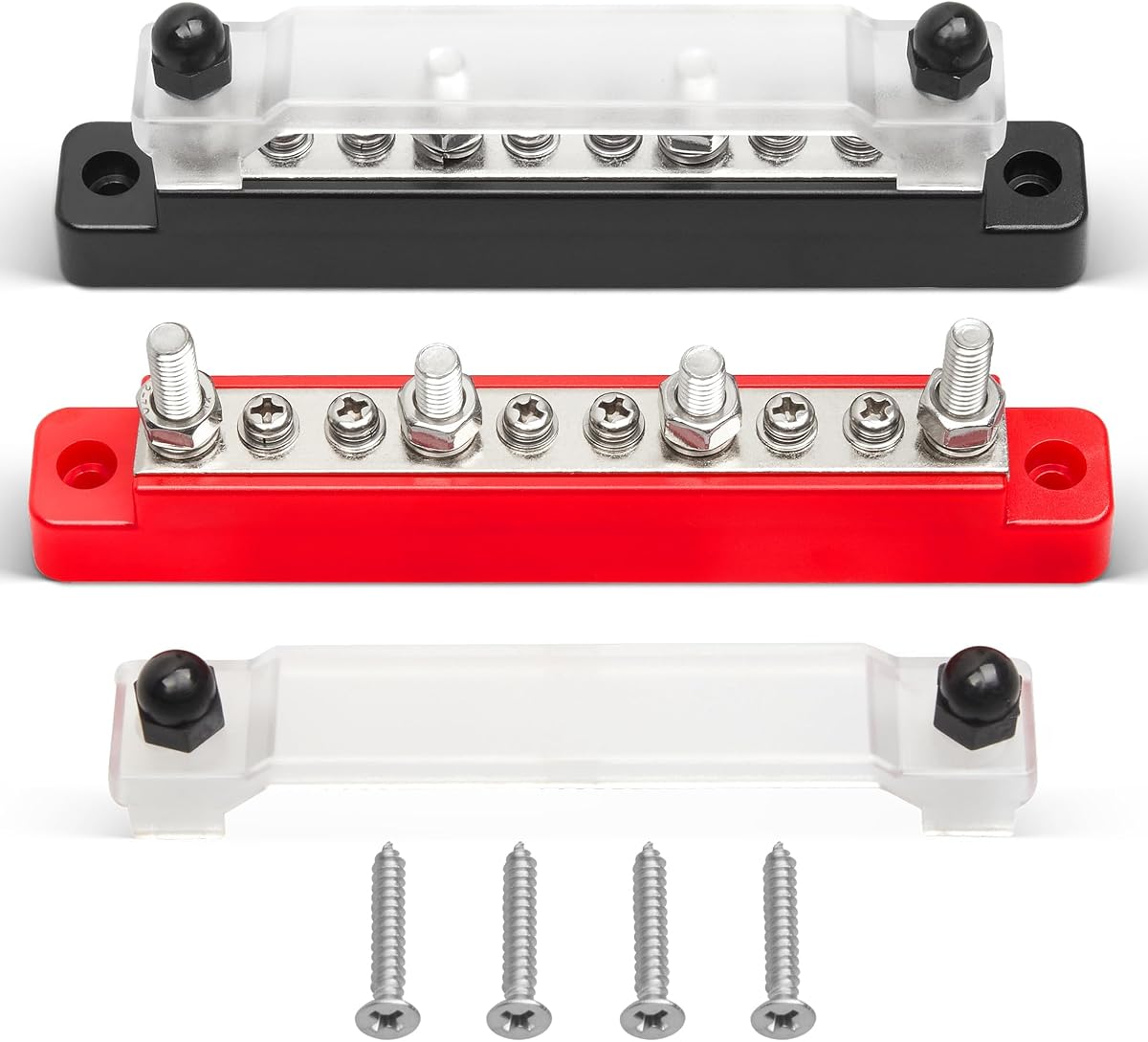


The RVMARINEPAT 12V Bus Bar combines a published 250A maximum current rating with six 5/16-inch M8 studs on each bus. Its 4.8 rating is the highest among the ten products, and the positive-and-negative assembly provides a coordinated foundation for a complete 12V DC distribution system.
We may earn a commission when you buy through this link, at no additional cost to you.
Copper plates serve as the conductors, while stainless steel studs are intended to withstand demanding automotive and marine environments. The open-area covers support wire-lug installation from up to 180 degrees, which adds flexibility when cable direction is restricted. Twelve copper ring lugs and twelve heat-shrink tubes are also included.
The main trade-off is capacity and physical scale. A block designed for 250A and numerous large studs is more substantial than a compact accessory distribution point, and it may require extra care during installation. Nevertheless, those characteristics make sense for a boat, caravan, solar system, or vehicle with several high-demand circuits.
This is the strongest all-around choice for buyers who want generous connection options and substantial current capacity. Select it when the number of loads, cable thickness, and environmental demands justify a more robust distribution block. For smaller systems, a 150A model may be easier to accommodate.
Six large studs on each bar make it practical to divide a battery system into dedicated branches without repeatedly stacking several ring terminals on a single battery post. The 180-degree lug access helps installers route cables where space is limited.
The stated 250A capability and 48V DC limit suit high-output installations that may include inverters, chargers, or other substantial DC loads. Copper conductors and stainless steel hardware support the premium construction emphasis.
We may earn a commission when you buy through this link, at no additional cost to you.
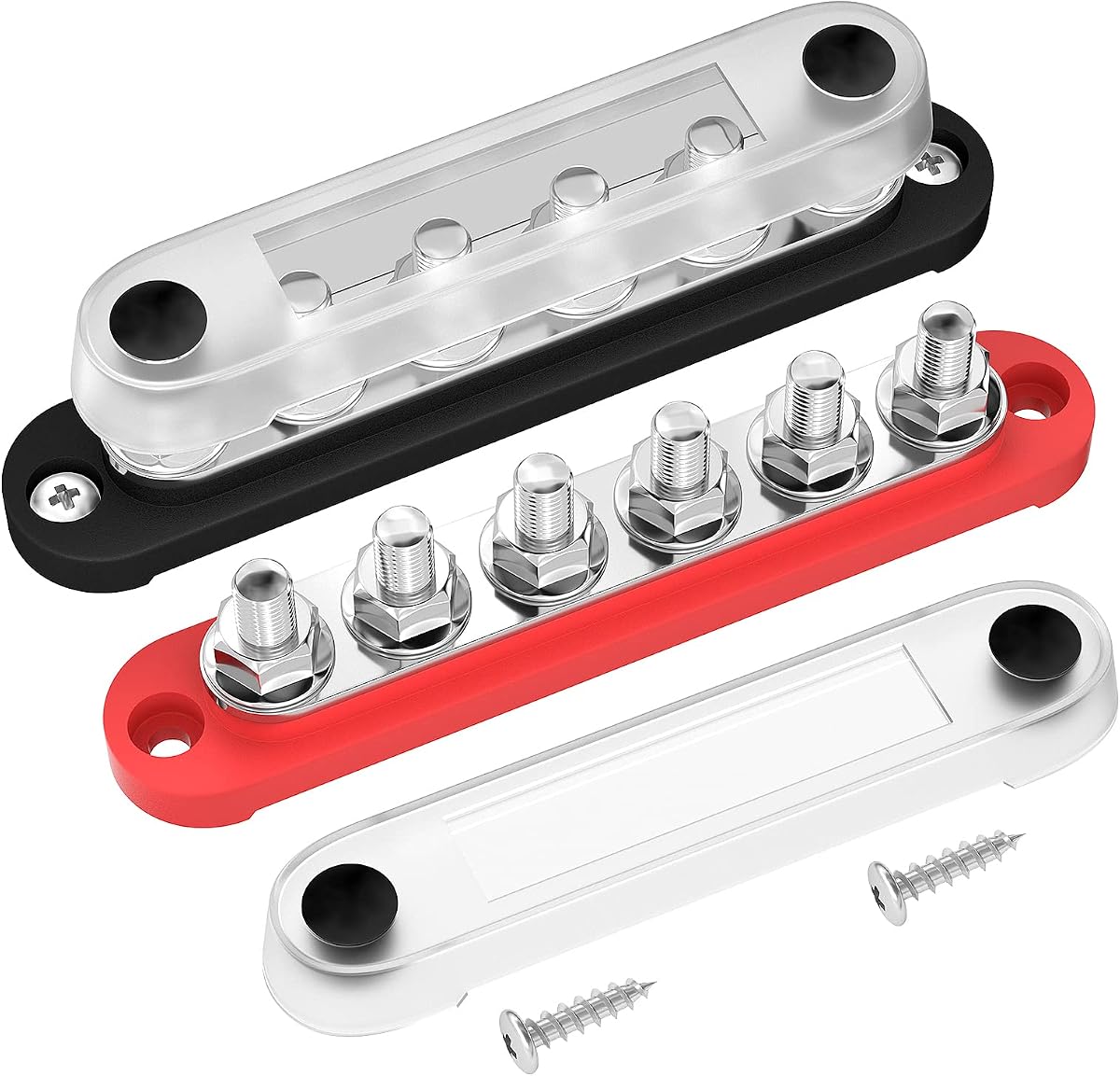
The RVBOATPAT Power Distribution Block offers a 150A continuous-current design, a 1/4-inch main stud, and twelve smaller M4 terminal screws on each bus. It is a practical option for organizing accessory circuits while preserving a straightforward positive and ground connection.
We may earn a commission when you buy through this link, at no additional cost to you.
Its thick tinned copper plate is mounted to an insulated ABS base described as mechanically strong, heat resistant, and flame resistant. The package includes two covers, two 1/4-inch copper lugs, and twenty-four terminals, reducing the need to source several common connection pieces separately.
Because there is only one large stud per bar, several branch circuits must share the main connection or use smaller screw terminals. That is reasonable for a typical accessory distribution panel, but installers with many heavy loads may prefer a model with multiple high-current studs.
Choose this bus bar for a tidy, cost-conscious installation that needs one main battery feed, multiple smaller accessory connections, and protection for both positive and ground sides. It is particularly suitable for cars, boats, caravans, and solar wiring where compact organization matters more than maximum connection count.
Included covers, copper lugs, and ring terminals give installers several essential pieces at once. This convenience is useful for first-time builds and for replacing a loose, improvised battery-post distribution arrangement.
The combination of one large feed stud and twelve smaller terminals offers a straightforward way to separate low-current accessories. The dual-bar configuration keeps positive and ground wiring organized in the same area.
We may earn a commission when you buy through this link, at no additional cost to you.
The Joinfworld Bus Bar is built around 4mm copper plates, four 3/8-inch studs, and three M4 screw terminals on each side. Its 250A rating makes it a high-capacity choice, while the thick copper construction is a clear point of emphasis in the product specifications.
We may earn a commission when you buy through this link, at no additional cost to you.
M10 posts secure the nylon base and are intended to resist stripping during installation. Each bus includes a protective cover and two nuts. The mixture of large studs and smaller screw terminals allows installers to combine high-current feeds with accessory-level connections.
Compared with six-stud competitors, this model provides fewer large connection points, though each is larger. Its substantial copper plates may appeal to installers seeking robust current handling, but the assembly is bulkier and may be more than a modest system requires.
This is a strong choice for premium marine, automotive, truck, or solar installations where large cables, sturdy mounting, and a 250A design are priorities. Buyers should verify the available panel space and cable bend radius before selecting it.
The stated 4mm plate thickness distinguishes this model from many conventional blocks. It gives the conductors a substantial construction while supporting large ring lugs on the 3/8-inch studs.
Three M10 mounting posts help keep the nylon base firmly attached. Protective covers reduce exposed conductive area and help guard against accidental contact during servicing.
We may earn a commission when you buy through this link, at no additional cost to you.
The DAIERTEK Mini Power Distribution Block is designed for installations where mounting space is limited. It combines a stated 150A DC rating, four 5/16-inch M8-style posts, and a cover on each of the positive and negative bus bars.
We may earn a commission when you buy through this link, at no additional cost to you.
Tin-plated copper bars, stainless steel nuts and stud terminals, a nylon base, and a polycarbonate cover form a material package intended for automotive, marine, and solar use. Side-post positioning allows wire-lug installation from up to 180 degrees.
One important consideration is the listed 300V AC maximum. Although the product is marketed primarily for 12V DC distribution, the additional AC notation does not make it an AC-rated distribution panel. Users should follow the appropriate current and installation limits for their circuit type.
This is a useful choice for compact panels that still need four substantial connection points on each side. It fits installers who value space efficiency, directional lug access, and straightforward positive-and-negative organization.
The mini format preserves four large terminals without using the footprint of a six-stud block. That makes it easier to incorporate into a crowded battery or electronics compartment.
Tin-plated copper and stainless steel hardware form the conducting and fastening elements. The insulated nylon base and polycarbonate cover add physical protection around the connections.
We may earn a commission when you buy through this link, at no additional cost to you.
This two-pack of 150A bus bars provides a straightforward way to organize positive and ground distribution in an RV, boat, truck, or off-road build. Each assembly uses a tinned copper bar and includes 1/4-inch studs and twelve smaller terminals.
We may earn a commission when you buy through this link, at no additional cost to you.
The snap-lock covers are intended to resist vibration and reduce accidental contact with conductive terminals. A central distribution layout can consolidate multiple battery leads, making the system easier to inspect, organize, and troubleshoot than a cluster of loose battery-post connections.
The listing provides approximate dimensions, including a 5.4-inch length with the cover, but offers less detail than some competing descriptions about every mounting feature. It also does not list copper lugs among the included accessories, so installers may need separate ring terminals.
Choose this product when you want two compact, covered 150A distribution blocks and value a vibration-conscious cover design. It is especially relevant to mobile electrical systems where wire management and protection from movement are important.
Receiving two units allows one block to serve as positive and the other as ground, or provides separate distribution points in larger panels. The compact listed measurements aid initial layout planning.
Snap-lock covers are designed to remain closed under vibration. They also shield terminals during transport and routine service while preserving a more professional finished appearance.
We may earn a commission when you buy through this link, at no additional cost to you.
The DAIERTEK Six-Stud Bus Bar offers six 5/16-inch M8 studs on each positive and negative bus. Its listed 150A DC capacity makes it a strong option for systems that need numerous independent connections without relying on a very high maximum-current block.
We may earn a commission when you buy through this link, at no additional cost to you.
Copper plates provide the conducting surfaces, while stainless steel terminals resist corrosion. The open-area cover permits 180-degree wire-lug installation, helping installers work around nearby equipment, structural members, and cable-routing constraints.
With twelve main studs across the pair, the model offers more branch options than compact four-stud designs. The tradeoff is a larger physical footprint and the need to confirm adequate space and lug clearance in a crowded installation area.
This bus bar is a good match for automotive, marine, and boat systems with numerous medium-to-high-current branches. It gives installers more connection points than the budget-oriented 150A alternative while retaining a stated 150A DC rating.
Six studs on each bar make it easier to assign separate circuits to the positive and ground sides. This reduces the need to share one terminal among unrelated loads.
The cover design leaves sufficient open space for large lugs to enter at different angles. That makes the block more adaptable to real-world compartments with uneven clearance.
We may earn a commission when you buy through this link, at no additional cost to you.
The RED WOLF 150A Bus Bar mixes four 1/4-inch M6 studs with six smaller M4 screw terminals on each bar. That combination supports both substantial cable connections and compact accessory wiring within the same positive-and-ground distribution assembly.
We may earn a commission when you buy through this link, at no additional cost to you.
Pure copper studs serve as conductors, while stainless steel screws and nuts provide fastening and corrosion resistance. The insulated PC base and open-frame heat-resistant cover add physical protection without making the terminal area completely inaccessible.
The listing notes that maximum continuous current decreases as temperature and humidity increase. This environmental qualification is important in hot engine compartments, enclosed marine panels, and other installations where conditions can vary considerably.
Choose this model when a project mixes heavier branch circuits with smaller accessory loads and benefits from a transparent, service-friendly cover. It is especially useful in cars, RVs, yachts, caravans, and ships where organized multi-size connections are valuable.
Large M6 studs accept heavier conductors, while six M4 terminals handle smaller accessories. This mixed layout can simplify panel design and reduce the number of separate blocks needed.
The transparent open-frame cover provides physical separation while allowing installers to inspect connections. Its 180-degree opening range also supports varied lug orientations.
We may earn a commission when you buy through this link, at no additional cost to you.
The RVBOATPAT Marine Bus Bar delivers a published 250A continuous-current rating with two 3/8-inch M10-style studs per bus. Its simpler connection layout is intended for installations with fewer branches but heavier cables.
We may earn a commission when you buy through this link, at no additional cost to you.
All studs are described as 304 stainless steel for corrosion resistance. The package includes one positive bar, one ground bar, two protective covers, two 1/0 AWG copper lugs, and four 6 AWG copper lugs, providing useful options for different conductor sizes.
The chief limitation is connection count. With only two large studs per side, several loads must be combined or connected through downstream distribution equipment. That is manageable in a carefully designed system but less convenient when every circuit needs its own terminal.
This model is a strong candidate for high-current marine, automotive, caravan, yacht, or solar installations that emphasize a few large branch connections. The included copper lugs make it appealing to buyers who want a more complete installation package.
The 3/8-inch studs are suited to substantial battery cables, and the included 1/0 AWG copper lugs help support high-current connections. The product listing specifically emphasizes continuous-current capability.
304 stainless steel studs and tough polycarbonate covers add durability in environments exposed to moisture and vibration. The dual-bus arrangement also creates a clean positive and ground layout.
We may earn a commission when you buy through this link, at no additional cost to you.
This 250A power distribution block combines four 3/8-inch M10 posts and six smaller M4 screw terminals on each bus. It sits between high-current marine products and more compact accessory blocks by providing a generous capacity with multiple smaller connection points.
We may earn a commission when you buy through this link, at no additional cost to you.
The listing specifies a 3mm copper bus bar and 304 stainless steel screw terminals, while also describing a brass bottom plate. The conductive and structural descriptions therefore differ by component, but the listed materials are intended to resist rust and provide durable connections.
The package includes four battery lugs and four heat-shrink tubes, adding useful installation pieces. On the other hand, the product information does not provide exact dimensions, so physical fit should be confirmed carefully before ordering.
Choose this model for automotive, truck, marine, boat, or yacht systems that need a 250A-rated block with both heavy main connections and smaller accessory terminals. It is a versatile middle ground, provided the enclosure offers adequate room and cable clearance.
Four large posts can serve major branches, while the six small terminals handle additional accessories. The combination gives installers more routing options than a two-stud block.
Four battery lugs and four heat-shrink tubes provide ready-made connection and insulation pieces. They can help complete a clean installation without requiring a separate search for matching accessories.
We may earn a commission when you buy through this link, at no additional cost to you.
The Aienxn Bus Bar emphasizes installation security with an inverted buckle base that holds the protective cover firmly. A single 1/4-inch M6 stud and twelve M4 terminals are provided on each bus, supporting a large incoming feed and multiple accessory connections.
We may earn a commission when you buy through this link, at no additional cost to you.
The conductors are described as 3mm copper plates, and the terminals use 304 stainless steel. The ABS base is presented as mechanically insulated, strong, heat resistant, and flame resistant, creating a protected and durable mounting platform.
The package includes positive and ground bars, two silicone terminal covers, two copper lugs, and twenty-four ring terminals. As with other single-main-stud designs, the limited number of large connection points limits flexibility when every branch requires a heavy conductor.
This product is best for a compact accessory distribution panel with one main battery connection and several smaller circuits. Its locking base design and included hardware make it especially convenient for organized automotive, marine, and boat installations.
The inverted buckle is intended to resist separation and secure the cover over the terminals. A bottom-to-top mounting bolt further improves the structure during installation.
Two copper lugs and twenty-four ring terminals support immediate connection work. Silicone covers provide additional protection around the selected terminal areas.
We may earn a commission when you buy through this link, at no additional cost to you.
The right 12V bus bar depends on current demand, conductor size, available space, environmental conditions, and the number of circuits you need to organize. Compare published ratings and physical layouts rather than choosing only by capacity.
A bus bar must be rated for the total current it will carry, but choosing far more capacity than necessary can make the installation larger and harder to route. Most products in this guide range from 150A to 250A maximum or continuous ratings. The distinction matters because some listings specify a maximum rating, while others identify continuous DC capacity, and environmental conditions can reduce usable output.
Main studs range from 1/4 inch to 3/8 inch, with 5/16-inch and 3/8-inch options appearing among the top picks. A larger stud generally accepts a larger ring lug and heavier conductor, while a smaller stud can be sufficient for accessories. Check the actual lug dimensions, not only the bolt diameter, because the lug hole and terminal stack must be compatible.
A large stud is valuable for a battery feed, but branch circuits need their own connection points. Some models offer twelve main studs across the positive and ground pair, while others use one main stud plus twelve smaller screws per bus. Consider both the quantity and type of loads, and include room for future circuits without creating an unnecessarily crowded panel.
Although the keyword is 12V bus bar, many products also state compatibility with higher DC voltages. The listed limits vary between 48V DC and broader figures that also include AC. A higher number does not automatically make a product appropriate for every circuit type, so use the rating that specifically applies to your intended system.
Copper and tinned copper are prominent in the stronger designs, while brass appears in one listed construction. Stainless steel studs, screws, and nuts are used throughout the category for mechanical strength and corrosion resistance. Material selection should complement the environment, especially in boats, vehicles, and outdoor solar installations where moisture and corrosion are concerns.
A compact base may be essential inside a crowded boat console, RV cabinet, or vehicle electrical bay. Covers add protection, but their design can affect lug access, installation clearance, and serviceability. Open-frame and wider-area covers support 180-degree lug positioning, while locking or snap-fit covers help resist vibration and accidental contact.
Several blocks include copper lugs, ring terminals, heat-shrink tubes, nuts, and protective covers. These accessories can simplify an installation, but the quantities and sizes must be checked against the wiring plan. Included pieces are convenient when properly matched; they do not eliminate the need to select the correct cable and terminal gauge.
Marine, RV, solar, and automotive installations can expose a bus bar to heat, humidity, vibration, dust, and salt. Look for insulated bases, corrosion-resistant hardware, secure covers, and a rating suitable for the location. Installers should also maintain cable bend radius, strain relief, ventilation, and access for inspection rather than relying on the bus bar alone.
Begin by disconnecting the battery according to the vehicle or boat procedure, then plan the location, cable routes, and branch assignments before mounting the block. Verify that the base fits securely, the cover has clearance, and every cable can bend without being forced. Use the positive and ground buses only for their intended poles, and confirm that the main feed cable and lug size suit the load and stud.
Attach the battery or supply feed to the main stud, install branch-circuit lugs on their assigned terminals, and tighten hardware to the manufacturer's guidance while avoiding excessive torque. Keep positive and negative conductors separated, provide strain relief near moving parts, and use the included or correctly sized covers where appropriate. Recheck the installation visually for loose strands, incorrect polarity, pinched insulation, and incompatible cable gauges before reconnecting power.
For ongoing care, inspect terminals periodically for corrosion, discoloration, looseness, heat discoloration, or damaged insulation, especially after heavy use or maintenance in damp environments. Disconnect power before touching connections, clean only with methods suitable for the conductors and base, and replace damaged lugs or covers rather than improvising around them. Recheck cable routing as equipment changes, because a sound block cannot compensate for damaged conductors or unsafe installation practices.
A 12V bus bar provides a centralized connection point for distributing battery power and ground across multiple circuits. It can replace cluttered adapters on a battery post, organize accessory wiring, and make individual circuits easier to inspect and service. Common applications include boats, RVs, trucks, solar installations, and off-road electrical systems.
The better choice depends on the combined current draw and the size of the cables feeding each branch. A 150A block is often suitable for typical accessory systems, while a 250A block provides more headroom for substantial loads or demanding mobile installations. You should also compare the number and size of connection points, since raw current rating does not determine layout flexibility.
Choose a stud that accepts the ring lug required by your cable and installation. The guide includes 1/4-inch, 5/16-inch, and 3/8-inch options, with the larger studs generally supporting heavier conductors. Verify the inside diameter of the lug, terminal stack height, and available tool clearance rather than relying on nominal bolt size alone.
A matched positive and ground pair is usually easier to organize and can shorten cable routes, but the electrical design must remain correct. Never connects a positive conductor to a ground bar or reverses polarity. Follow the wiring plan for the equipment and use appropriately rated cables and protective devices for each branch.
Only if the particular bus bar is explicitly rated for the higher voltage. Most products in this guide list 48V DC as a maximum operating voltage, but maximum voltage is not the same as suitability for every high-voltage circuit. Confirm the complete electrical specifications, load requirements, and applicable safety standards for the intended system.
A cover helps prevent accidental contact with conductive terminals and can protect the assembly from dust and minor impact. Mounting hardware is also important because a secure base reduces movement and cable strain. The amount of included hardware varies by product, so confirm the package contents and purchase any missing fasteners or additional lugs separately.
The answer depends on the available studs and screw terminals, not simply the advertised amperage. A product with one large main stud and twelve smaller terminals can support several accessory circuits, while a model with six large studs per bus offers more independently terminated branches. Each circuit still needs the correct cable, fuse or breaker, and protective routing.
Choose corrosion-resistant hardware and ensure the cover is correctly fitted, but also consider cable selection, sealing, and maintenance. Inspect connections periodically for moisture, discoloration, or corrosion, and address the source of water intrusion rather than simply applying another layer of coating. Proper strain relief and secure terminals are equally important in a moving marine environment.
The RVMARINEPAT 250A model stands out for its strong rating, six large studs per bus, open cover design, and included connection accessories. The RVBOATPAT 150A pair offers a more economical route to tidy accessory distribution, while the Joinfworld 250A block emphasizes thick copper plates, large studs, and secure mounting.
Prioritize the factors that affect your actual installation: total current, conductor diameter, number of branches, available space, environmental exposure, and cover access. A smaller 150A block can be the more sensible engineering choice for a modest system, while a 250A unit is appropriate when load headroom and large branch connections justify the extra size.
Finally, review the live listing before buying. Specifications, included parts, and availability may change, and prices fluctuate, so compare the current product details with your planned cable gauges and panel dimensions before making a final selection.