
Pyle PLMRA402
4.0Editor score
Four-channel marine amplification
RCA and high-level inputs
Adjustable gain controls
Our Boat Amplifiers guide compares 10 marine-rated models for channel flexibility, RMS power, weather resistance, sound controls, connectivity, and easier
Boat amplifiers are built to deliver dependable power in environments where moisture, salt, vibration, and limited installation space can challenge ordinary audio equipment. The strongest units combine useful RMS output, marine-grade protection, flexible speaker-level controls, and secure connections suited to the demands of life on the water.
We compared these ten amplifiers by examining channel count, stated power, speaker configuration options, protection features, crossover flexibility, connectivity, and marine construction. The list covers multi-channel systems, dedicated subwoofer arrangements, compact Class D designs, and amplifiers with Bluetooth or PA microphone support for different boat layouts.
Each review identifies the feature that makes a particular amplifier stand out while also identifying trade-offs that buyers should consider. Specifications and product availability can change, so always verify the current listing, connector layout, and speaker requirements before purchasing equipment for your boat.
4.0Editor score

4.3Editor score

4.8Editor score
The table below compares channel capacity, power, marine protection, and major features across all ten amplifiers, making it easier to match an amplifier with your speaker layout and installation needs.




The Pyle Hydra Marine PLMRA402 is a straightforward four-channel amplifier for boaters who need more output than a small head unit can provide. Its rating of 4 out of 5 reflects a practical design centered on broad speaker compatibility, straightforward inputs, and protection features rather than an extensive menu of tuning controls.
We may earn a commission when you buy through this link, at no additional cost to you.
One of the amplifier's strongest advantages is its support for both premium RCA stereo inputs and high-level speaker-wire connections. That flexibility makes it easier to use with a marine receiver that has line-level outputs or one that only offers speaker-level connections. Dual adjustable gain controls provide basic calibration, while the aluminum heatsink, thermal overload protection, and speaker short protection help guard the unit during demanding conditions.
The trade-offs are important. Four channels can cover several full-range speakers, but pairing every channel leaves fewer opportunities for a dedicated subwoofer unless the speaker arrangement is carefully planned. Compared with the more tunable models in this guide, the PLMRA402 offers limited filtering and bass-shaping features. Its stated maximum output should also not be confused with continuous RMS output when assessing compatibility with low-impedance speakers.
This amplifier makes the most sense for a straightforward multi-zone boat audio system where easy source connection, basic gain adjustment, and four powered channels matter more than highly detailed signal processing. It is a sensible starting point for owners who want clean, organized upgrades without a complicated control layout.
RCA and high-level inputs allow the PLMRA402 to work with more than one type of marine audio source. This is especially useful when upgrading a boat that has an older receiver without dedicated preamp outputs.
An aluminum heatsink, thermal overload protection, speaker short protection, and gold-plated output terminals create a practical foundation for a boat installation. Those details do not replace a protected installation location, but they support dependable operation when the equipment is used as intended.
We may earn a commission when you buy through this link, at no additional cost to you.
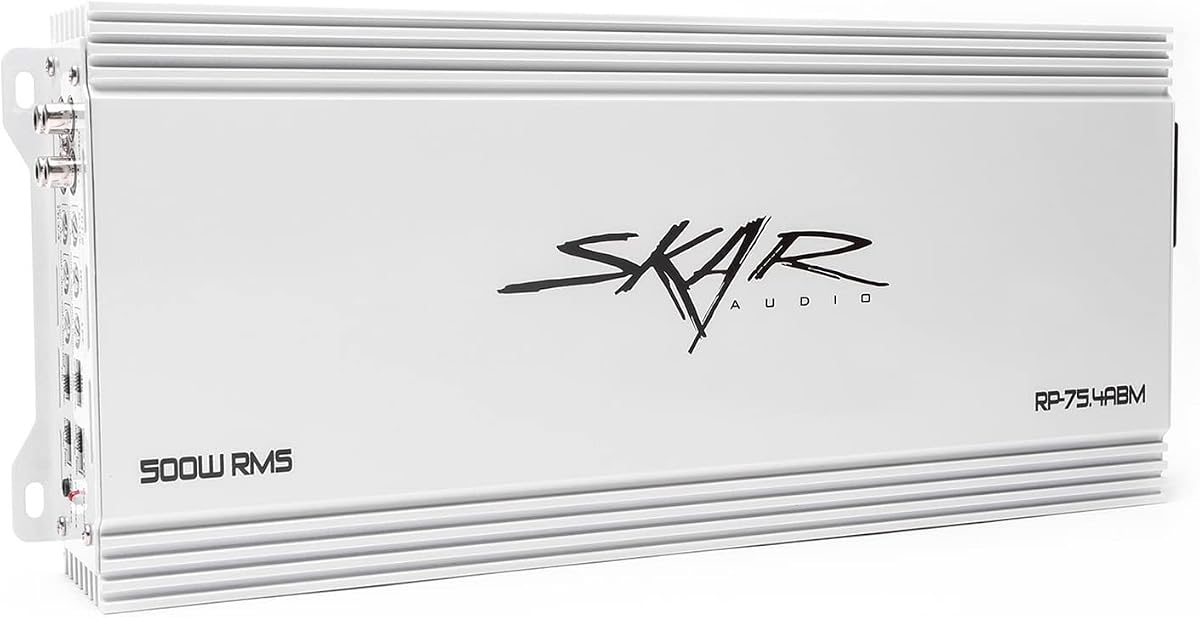
The Skar Audio RP-75.4ABM is a feature-oriented four-channel Class A/B marine amplifier with a rating of 4.5 out of 5. Its combination of useful continuous power, selectable filtering, and robust terminal design makes it particularly appealing to boaters who want meaningful control over multiple speaker zones.
We may earn a commission when you buy through this link, at no additional cost to you.
The amplifier delivers 75 watts RMS per channel at 4 ohms and 125 watts RMS per channel at 2 ohms, giving installers meaningful headroom for compatible marine speakers. Adjustable gain, variable low-pass and high-pass filters, and a bass EQ switch with 0, +6, and +12 dB positions let users allocate channels more effectively. A 105 dB signal-to-noise ratio also supports clean playback, while the four-way protection circuitry adds safeguards against operating faults.
Its primary limitation is that the four-channel format is less flexible for a large dedicated-subwoofer arrangement. The absence of Bluetooth also means the amplifier depends on an external head unit or source device rather than serving as a complete wireless audio hub. Installation still requires careful attention to the 4- or 8-gauge power and ground terminals described in the product information, particularly in a confined marine compartment.
Choose the RP-75.4ABM when you want several amplified speaker zones with dedicated crossover and bass controls. It is a strong fit for larger boats with a conventional marine head unit, especially when the priority is clean four-channel output rather than wireless convenience.
Variable HPF, LPF, and gain controls give this amplifier more tuning flexibility than a basic four-channel unit. The three-position bass EQ switch is useful for quickly increasing low-frequency output in a selected zone without making every adjustment manually.
The stated 75-watt RMS output at 4 ohms is more useful for real speaker matching than maximum marketing wattage alone. It allows the amplifier to serve several full-range marine speakers while retaining a conventional Class A/B operating style.
We may earn a commission when you buy through this link, at no additional cost to you.
The Rockville Atom 8B is the most versatile conventional multi-channel amplifier in this roundup. Its rating of 4.3 out of 5 reflects a capable design with eight output channels, wireless streaming, extensive filtering, and marine-oriented construction. It suits boats where speakers may be distributed across several distinct zones.
We may earn a commission when you buy through this link, at no additional cost to you.
The amplifier provides 3,500 watts of peak output and 880 watts of Dyno-Certified RMS power across eight channels, with up to 110 watts per channel at 2 ohms. Independent crossovers for channels 1-4 and 5-8, variable HPF and LPF controls from 50 to 250 Hz, and adjustable bass EQ give installers useful allocation options. Bluetooth auto-pairing removes the need for a traditional head unit when streaming from a compatible phone or tablet.
Marine protection is supported by a conformal-coated circuit board, stainless steel hardware, and a corrosion-resistant casing. Its 6.7-inch by 2-inch by 10.8-inch housing is relatively compact for an eight-channel amplifier, which helps in tight installation spaces. The trade-off is that eight channels and grouped crossover controls can be more complicated than necessary for a simple two-zone system, and installers must plan outputs carefully to avoid unnecessary load or configuration errors.
The Atom 8B is a compelling choice for a sophisticated boat audio system that needs several speaker zones, optional subwoofer support, and convenient Bluetooth playback. It offers more channel flexibility than nearly every other model here, making careful system planning especially important.
Eight outputs can serve separate cockpit, bow, wakeboard, or other full-range zones while retaining the possibility of subwoofer use. Grouped crossover controls provide enough control for most installations without requiring separate external processors.
Automatic Bluetooth pairing allows a phone or tablet to become the primary music source. That convenience is particularly useful on smaller boats where installing a traditional marine head unit would consume space or add complexity.
Conformal coating, stainless steel hardware, and a corrosion-resistant case address common threats in marine environments. The slim enclosure also reduces the space needed for an amplifier with a high channel count.
We may earn a commission when you buy through this link, at no additional cost to you.
The Rockville DBM50 is a well-balanced five-channel marine amplifier for boaters who want dedicated subwoofer power without carrying multiple separate amplifiers. Its 4.4-out-of-5 rating reflects a versatile design with an IPX6 rating, flexible crossover controls, PA microphone support, and a mix of Class AB and Class D amplification.
We may earn a commission when you buy through this link, at no additional cost to you.
Four full-range channels deliver 120 watts each at 2 ohms, while the dedicated mono channel provides 500 watts at 2 ohms. That arrangement can power multiple speaker zones and a subwoofer from one chassis. The fully adjustable 12 dB-per-octave crossover supports low-pass, high-pass, band-pass, and subsonic modes, allowing each group to be matched more closely to its speakers.
Durability is a major strength. The product information identifies an IPX6 waterproof rating, rustproof aluminum heatsink, stainless steel hardware, and a conformal-coated circuit board. The included PA microphone enables onboard announcements, while the remote subwoofer control makes bass adjustments easier from a convenient location. The tradeoff is that the mixed amplifier classes and five-channel layout are more complex than a simple four-channel system, and Bluetooth is not listed among the connectivity features.
This is an attractive option for a boat with several full-range speaker areas and a subwoofer. Buyers should map the four full-range channels, configure the appropriate crossover modes, and confirm speaker impedance before installation. For that kind of comprehensive setup, the DBM50 reduces the need for multiple amp units and centralizes system control.
The fifth channel provides 500 watts at 2 ohms, allowing a subwoofer to have dedicated amplification instead of sharing channels. Remote level control adds convenience after the rest of the system has been balanced.
IPX6 protection, a conformal-coated circuit board, stainless steel hardware, and a rustproof heatsink provide several layers of environmental resilience. Positioning remains important, but the construction is clearly designed with exposed marine installations in mind.
The included PA microphone lets a skipper or passenger make announcements over the audio system. This makes the amplifier particularly relevant to boats where communication is a daily need rather than an occasional accessory.
We may earn a commission when you buy through this link, at no additional cost to you.
The Rockville RXM8BTW combines eight channels, Bluetooth, flexible input selection, and multiple wiring modes in a compact white marine amplifier. Its rating of 4.3 out of 5 makes it a strong option for owners who want a wireless source and extensive configuration without moving to a larger enclosure.
We may earn a commission when you buy through this link, at no additional cost to you.
Output is rated at 65 watts RMS per channel at 4 ohms, 95 watts per channel at 2 ohms, or 190 watts per channel in a four-channel bridged configuration. A 4CH/8CH input selector allows the amplifier to adapt to different source arrangements, while adjustable crossovers, RCA line output, and bridged options provide room for system expansion. Bluetooth auto-pairing supports streaming from compatible phones and tablets, including apps such as Spotify and Pandora.
The enclosure measures 6.7 inches by 2 inches by 11.5 inches and uses efficient Class D operation. UV and salt resistance, conformal-coated circuitry, stainless steel terminals, and four-way protection help it cope with marine conditions. The compact footprint helps with space management, although a white finish may not visually complement every boat or compartment. Some users may also find the range of input and output modes more involved than required.
The RXM8BTW is a strong candidate for distributed systems with several speaker zones, especially when Bluetooth convenience and an expandable architecture are priorities. It can also serve a smaller installation if the installer takes advantage of its four-channel input mode rather than operating every output unnecessarily.
The four-channel or eight-channel input selector lets the unit integrate with different marine source equipment. RCA line output also provides a path to another amplifier, which can make it easier to expand a larger installation.
Class D operation supports a compact chassis and cool, stable operation. The amplifier can handle full-range speakers or participate in a bridged configuration where appropriate speaker impedance allows it.
Conformal-coated circuitry, stainless steel terminals, and UV and salt resistance are important features in a boat environment. The 11.5-inch length is manageable in many compartments while still accommodating eight output channels.
We may earn a commission when you buy through this link, at no additional cost to you.
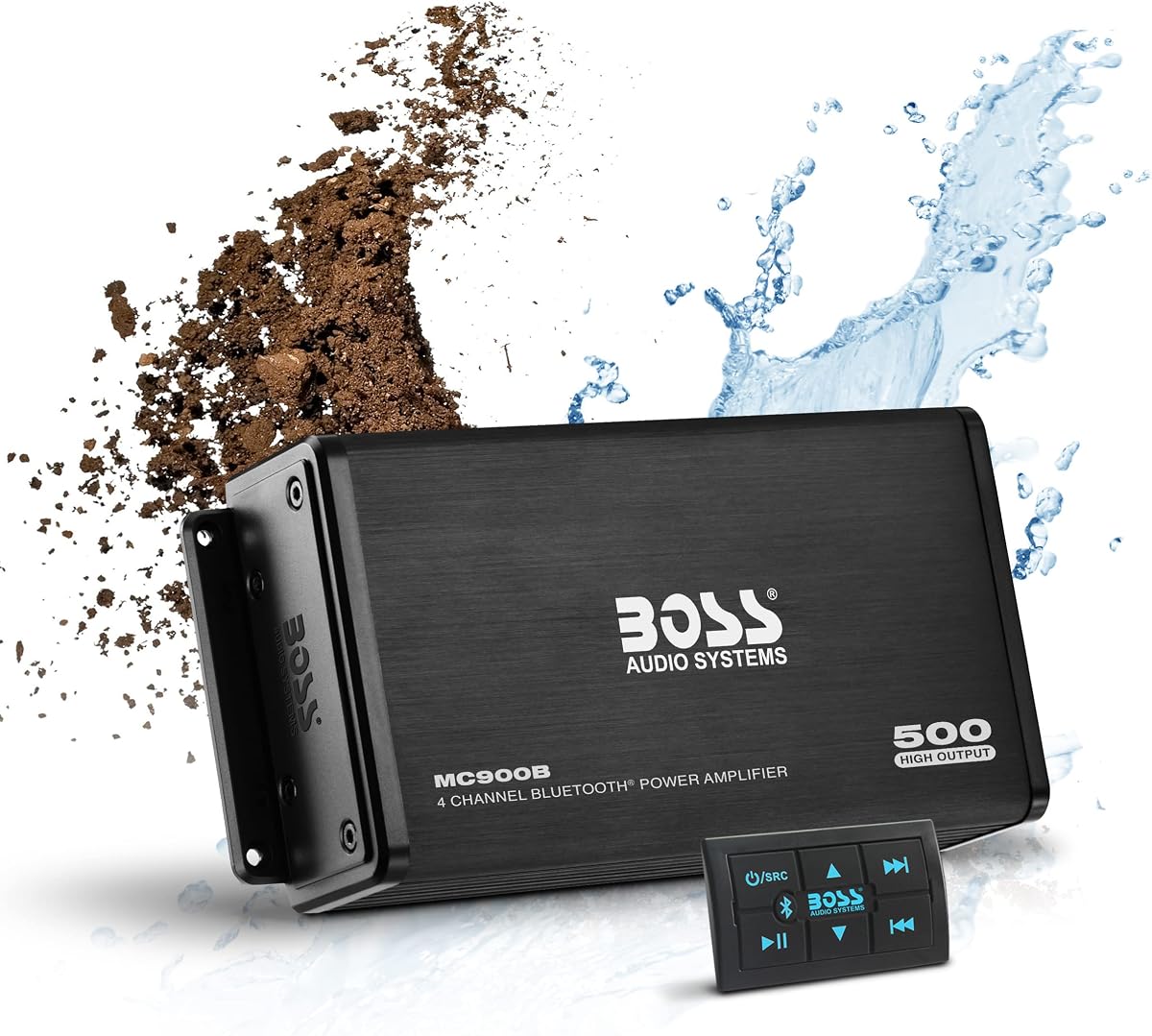
The BOSS Audio Systems MC900B is a compact four-channel amplifier designed for convenient source-free operation. Its rating of 4.2 out of 5 reflects an approachable design with 94 watts RMS per channel, Bluetooth control, USB charging, and a housing intended to handle light weather conditions on boats and similar vehicles.
We may earn a commission when you buy through this link, at no additional cost to you.
Its standout feature is the included Bluetooth remote, which lets users stream from a smartphone or other Bluetooth device and operate supported music apps without a traditional head unit. Auxiliary input compatibility broadens the source options further, and the USB port adds practical device-charging functionality. The amplifier provides 125 watts maximum per channel at 4 ohms, while its stated continuous output is 94 watts RMS per channel.
The enclosure is only 1.75 inches by 6.6 inches by 1.75 inches and weighs 2.9 pounds, making it easy to position in a constrained compartment. Class AB operation and full-range capability suit conventional marine speakers, and the product information notes suitability for subwoofers as well. On the other side, the MC900B provides fewer crossover and signal-shaping controls than many competitors. It is described as weatherproof rather than carrying the more explicit IPX6 or IP66 protection ratings found elsewhere in this guide, so buyers should take care with its placement.
The MC900B is most appropriate for a straightforward boat upgrade where space is tight and a phone or tablet will be the primary music source. It is less suited to complex multi-zone systems that need detailed crossover control, bridged subwoofer channels, or extensive environmental protection specifications.
The included Bluetooth remote places playback controls in the passenger area and allows direct streaming from a compatible device. That arrangement can simplify installations on smaller boats or temporary audio systems.
At just 1.75 inches tall and 6.6 inches long, the amplifier is easy to fit where larger units would be inconvenient. Its low weight also helps during installation, although final mounting still needs to be secure and protected from movement.
Auxiliary input accepts audio from sources without Bluetooth, while the USB port can charge connected devices. These conveniences make the system more useful for passengers who carry different types of phones and media players.
We may earn a commission when you buy through this link, at no additional cost to you.
The Rockville RXM-S6 is a six-channel marine amplifier that combines substantial output with flexible wiring and onboard communication features. Its rating of 4.2 out of 5 positions it as a practical option for boats that need multiple speaker groups, a subwoofer, or PA announcements from one unit.
We may earn a commission when you buy through this link, at no additional cost to you.
The amplifier delivers 2,600 watts of peak power and 660 watts RMS, with up to 110 watts per channel at 2 ohms. It supports six-, four-, or three-channel configurations, which allows the wiring plan to adapt to full-range speakers, subwoofers, or wakeboard speakers. An adjustable 12 dB-per-octave crossover, bass equalizer, and auto-start turn-on provide useful control and integration features.
The included PA microphone stands out. Its circuitry automatically lowers music volume during announcements, helping a skipper communicate without repeatedly reaching for a control. Marine durability comes from a conformal-coated circuit board and stainless steel screws designed to resist moisture, dust, and ocean elements. The trade-off is the lack of stated Bluetooth connectivity, and the multiple channel modes can be difficult if the installer does not map the system first.
The RXM-S6 is ideal for boats where clear communication matters alongside music. It is also suitable for owners who want more configuration freedom than a four-channel amplifier but may not need the full channel count or wireless control of an eight-channel model.
The PA microphone lowers the music during spoken announcements, creating a more professional onboard communication system. This is a meaningful advantage for family boats, touring boats, and vessels used by crews.
Six-, four-, and three-channel modes allow the amplifier to match different speaker combinations. This flexibility can make it easier to reserve certain outputs for subwoofers or specialized wakeboard speakers.
The adjustable crossover and bass equalizer provide basic tuning beyond basic gain control. Auto-start turn-on allows the amplifier to activate with a compatible source system without requiring constant manual switching.
We may earn a commission when you buy through this link, at no additional cost to you.
The Rockville RXM-F3 is a four-channel marine amplifier that emphasizes flexible source connections, PA communication, and multiple output modes. With a rating of 4.2 out of 5, it is a useful choice for boats that need a subwoofer-capable system without moving to a larger six- or eight-channel amplifier.
We may earn a commission when you buy through this link, at no additional cost to you.
At 4 ohms, it provides 65 watts RMS per channel and supports 95 watts per channel at 2 ohms. When properly configured, the amplifier can also be bridged for two channels at 200 watts RMS each. High-level and RCA inputs broaden source compatibility, while 2-channel and 4-channel modes help simplify wiring for different speaker arrangements.
The included PA microphone automatically lowers music during announcements, matching the communication-focused design. A fully adjustable 12 dB-per-octave crossover supports high-pass, low-pass, and band-pass operation, and a 12 dB bass equalizer provides additional tonal shaping. Marine durability is addressed by conformal-coated circuitry and stainless steel screws designed to resist moisture, salt, and temperature changes.
The main compromise is output density: the four channels provide less total power than several larger multi-channel amplifiers in this roundup. There is also no listed Bluetooth function, so a separate source device or head unit is required for music playback. The RXM-F3 nevertheless offers an attractive combination of PA capability, input flexibility, and bridging for owners who prioritize system features over maximum channel count.
Bridged operation can deliver higher output to two compatible channels, making the amplifier useful for a subwoofer or reduced full-range setup. Speaker impedance must be checked carefully before selecting this configuration.
Both high-level and RCA inputs let the amplifier integrate with marine receivers that differ in their output connections. That makes it easier to retain an existing head unit while upgrading amplification.
The included PA microphone lowers the music automatically during announcements. For boating families or active crews, this integrated feature may be more valuable than adding another standalone communication component.
We may earn a commission when you buy through this link, at no additional cost to you.
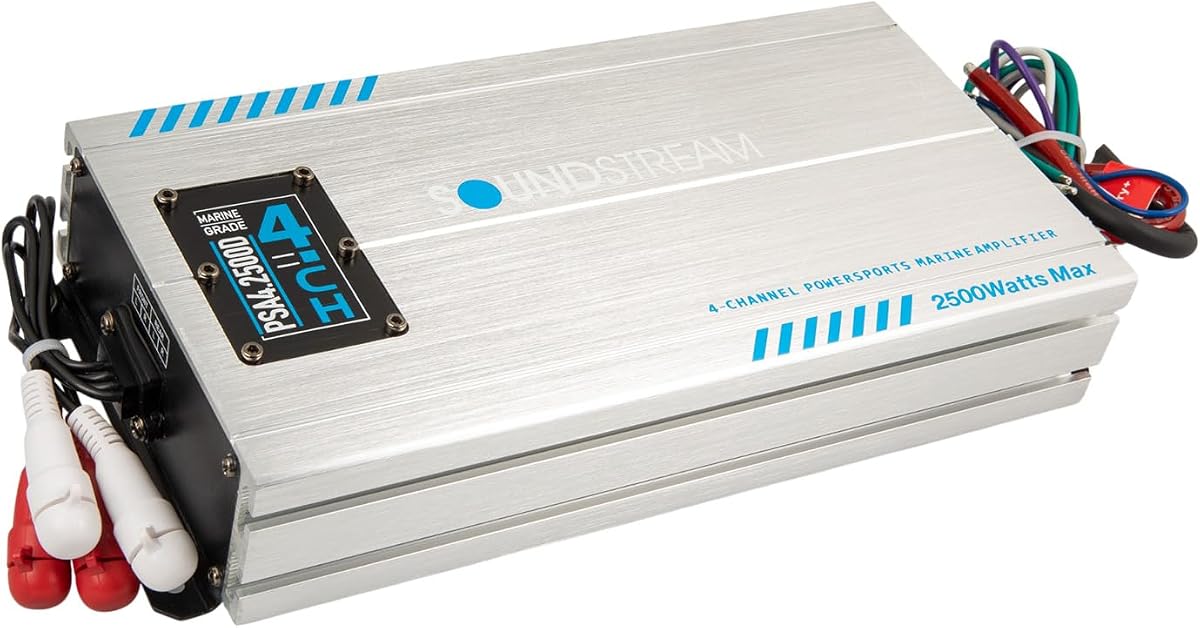
The Soundstream PSA4.2500D is built around rugged enclosure protection and substantial Class D output. Its rating of 4.4 out of 5 makes it an appealing choice for installers who prioritize environmental resistance and space efficiency. The listing explicitly cites IP66 protection, sealed circuit boards, and corrosion-resistant components.
We may earn a commission when you buy through this link, at no additional cost to you.
The amplifier is described as a four-channel waterproof marine unit with up to 2,500 watts maximum output and RMS performance stated at up to 800 watts at 4 ohms. Class D efficiency helps it operate cooler and draw less power than a comparable conventional design. Fully variable 12 dB low-pass and subsonic crossovers, along with adjustable bass boost, focus on low-frequency control and subwoofer use.
Its compact chassis and marine-grade terminals are particularly useful in tight compartments. The stated UV, salt, spray, and mud resistance makes it relevant to boats, jet skis, wakeboard towers, and other powersports installations. The main source of uncertainty is the supplied product description, which alternates between four-channel and monoblock terminology. Buyers should confirm the exact channel configuration, terminal arrangement, and continuous output directly in the current listing before installation.
This amplifier is a good candidate for a high-output, bass-focused system where weather resistance matters and a compact enclosure is essential. It is less suitable for buyers seeking built-in Bluetooth, PA announcements, or a clearly documented multi-zone control panel.
The IP66 rating is one of the clearest marine-protection claims among the listed products. Combined with sealed circuitry and corrosion-resistant components, it supports use in locations exposed to spray, mud, and heavy moisture.
Class D operation supports high output from a compact amplifier. That is advantageous in boats where every available inch of compartment space matters and cooling airflow is limited.
Variable low-pass and subsonic filters help separate bass frequencies from the subwoofer range, while adjustable boost can add impact. These controls are most useful when the amplifier is dedicated primarily to subwoofer duty.
We may earn a commission when you buy through this link, at no additional cost to you.
The Kicker KMA600.6 earns the highest rating in this guide at 4.8 out of 5. It is a six-channel, weather-resistant full-range marine amplifier offering 100 watts per channel, variable crossovers, and construction details that focus squarely on durability and practical installation.
We may earn a commission when you buy through this link, at no additional cost to you.
Six channels give it enough flexibility for a large multi-zone boat while remaining simpler than an eight-channel system. The built-in variable crossovers let installers match the amplifier's behavior to different speakers, and the full-range design supports conventional marine speaker arrangements. Its conformal-coated circuit boards repel moisture, while 316L stainless-steel hardware is designed to avoid rust in a saltwater environment.
The small footprint helps owners tuck the amplifier away in a compartment without sacrificing channel capacity. Its primary trade-off is the absence of listed Bluetooth or PA microphone functionality, so streaming and onboard announcements require separate equipment. Six channels can also be more than a basic two-zone installation needs. Nevertheless, the combination of output, crossover control, corrosion-conscious hardware, and compact construction makes this a well-rounded choice for serious boat audio.
The KMA600.6 is recommended for owners who want a reputable six-channel platform and intend to create a multi-speaker system with proper filtering. It is especially attractive when durable hardware and a smaller enclosure are more important than integrated wireless features.
Six full-range outputs can cover cockpit, bow, and additional speaker zones. The channel count is broad enough for larger layouts without the wiring complexity associated with eight-channel models.
Conformal-coated circuit boards provide a moisture barrier around sensitive electronics. The 316L stainless-steel hardware is another meaningful safeguard in saltwater environments where ordinary fasteners may deteriorate.
Variable crossovers allow each speaker group to receive an appropriate frequency range. This improves system control and reduces the need for additional external filtering components in many installations.
A small enclosure reduces installation space while six powered channels preserve system flexibility. The result is well suited to boats with sophisticated audio plans but limited compartment room.
We may earn a commission when you buy through this link, at no additional cost to you.
Choosing a boat amplifier involves balancing channel count, continuous output, environmental protection, tuning controls, and available installation space. A good match should support your speaker layout without forcing unnecessary wiring complexity.
Begin by counting the speaker groups you intend to power and whether one or more subwoofers need dedicated channels. A four-channel amplifier may suit two stereo zones, a six-channel unit can cover three full-range groups, and an eight-channel model offers even more routing options. Do not purchase based only on the largest headline wattage figure; the number and type of outputs should correspond to the actual speakers.
Choose a channel count that leaves room for expansion, but avoid paying for unused outputs that complicate wiring.
Continuous RMS output provides a more realistic basis for matching an amplifier to speaker power than maximum or peak wattage. Compare the manufacturer's stated RMS power at the impedance you intend to use, especially if speakers are wired in parallel or bridged. Also check whether the amplifier remains within specification when several channels are loaded simultaneously.
Use RMS ratings for matching, then leave suitable headroom rather than operating constantly at the limit.
Marine amplifiers should be designed for moisture, corrosion, temperature changes, and vibration. Conformal-coated circuit boards, stainless-steel terminals or screws, corrosion-resistant cases, and clearly stated IP ratings are useful indicators. A waterproof enclosure does not make every installation location safe, so avoid exposing terminals to standing water and secure the unit where it will not collect moisture.
Look for multiple environmental protections rather than relying on a single vague weather-resistant claim.
Every speaker connected to an amplifier must be compatible with its channel impedance and wiring configuration. Pay particular attention to bridged operation, parallel speaker arrangements, and mixed full-range and subwoofer loads. Verify the manufacturer guidance before connecting multiple speakers to one channel, and check terminal markings rather than relying only on channel labels.
Confirm impedance and wiring mode before every connection to protect speakers and the amplifier.
Variable high-pass and low-pass filters allow full-range speakers and subwoofers to operate in appropriate frequency ranges. Band-pass filtering and bass EQ can be useful for specialized zones, while gain controls help match the amplifier to the source. More controls do not automatically mean a better system, but they do allow finer correction when the amplifier and speakers are well matched.
Prioritize useful filtering and gain control over decorative controls that will never be adjusted.
A head unit with preamp outputs offers cleaner integration, while Bluetooth can eliminate the need for a traditional source unit. High-level inputs are valuable when retaining an older receiver, and RCA line outputs may help connect another amplifier. PA microphone support serves a different purpose by enabling onboard announcements and automatic music attenuation.
List the source, streaming, and announcement functions your boat actually needs before choosing connectivity features.
Marine compartments are often cramped, and the shortest chassis is not always easiest to install if connectors or airflow are obstructed. Consider the amplifier's dimensions, weight, terminal clearance, mounting orientation, and available service access. Heavy-gauge power and ground terminals may simplify high-current connections, but cable routing and strain relief remain the installer's responsibility.
Measure the compartment, inspect connector clearance, and leave enough room for secure mounting and maintenance.
Thermal, overload, short-circuit, and DC protection circuits help an amplifier respond safely to common electrical faults. Four-way protection systems are especially comprehensive, while LED indicators and voltage displays can make troubleshooting easier. Protection features are safeguards rather than substitutes for correct polarity, suitable fuses, solid connections, and proper speaker impedance.
Treat protection circuitry as a safety net and still install every cable and speaker exactly as specified.
Before installing an amplifier, disconnect the boat's power source and follow the wiring diagram supplied with the unit. Connect the amplifier to compatible speakers, fuse the positive power cable as specified, and use a clean, short ground connection to a suitable bare-metal point. Confirm polarity and check every impedance calculation before restoring power.
Start with gain and crossover settings at conservative levels, then increase gain gradually while listening for distortion. Use the variable filters to keep full-range speakers out of the sub-bass range and prevent subwoofers from reproducing frequencies that cause audible problems. Take time to balance each zone, and use a measurement tool or an experienced installer when precise results are important.
Keep the amplifier and connectors protected from standing water, direct spray, and debris. Inspect wiring periodically for corrosion, looseness, heat damage, or chafing, especially after long trips or seasonal storage. Clean the enclosure with a soft, damp cloth, avoid harsh chemicals, and let the unit dry fully before reconnecting power or covering it.
The right boat amplifier depends on your speaker layout, output needs, and environmental requirements. A four-channel unit works for two full-range zones, while six- or eight-channel models provide more distributed-speaker options. Look for RMS power matched to the speakers, marine construction, appropriate impedance support, and protection features that suit the installation.
Marine-rated construction is strongly recommended because humidity, spray, and salt can damage unprotected electronics. A clearly stated IP rating is useful, as are conformal-coated circuit boards and corrosion-resistant hardware. Even a waterproof amplifier should be mounted where terminals are not exposed to standing water, and all openings should be protected during storage.
A regular car amplifier may work in a protected and dry compartment, but it is not optimized for prolonged moisture, salt, vibration, or outdoor temperature changes. A marine amplifier has more appropriate circuit-board and hardware protection. If a non-marine unit is used, it must be installed in a sealed, ventilated location that prevents condensation and water exposure.
The appropriate output depends on speaker power, impedance, number of channels, and how many speakers share each channel. Use the amplifier's RMS output at the planned impedance as the comparison point and avoid driving low-impedance loads beyond its specifications. Leaving some headroom generally produces cleaner results than operating continuously at the amplifier's maximum output.
Peak power describes a short-duration maximum, while RMS power represents continuous output over time. Peak ratings can make different amplifiers appear similar even when their sustained performance differs. For speaker matching and everyday system planning, RMS ratings at the intended speaker impedance are the more useful figures.
A separate or dedicated subwoofer channel is often preferable because it provides cleaner bass and more control than sharing an amplifier channel with full-range speakers. Five-, six-, and eight-channel models can include flexible subwoofer outputs or bridged configurations. Check all impedance and wiring requirements before connecting the subwoofer.
Bluetooth is convenient when the amplifier can act as the main source and the driver does not want a separate head unit. It is less essential if a boat already has a reliable marine receiver with preamp outputs. Bluetooth can also create latency, so a wired source may be preferable for critical listening or video-related use.
Choose an amplifier with conformal-coated circuitry, stainless-steel hardware, and corrosion-resistant terminals, then install it away from standing water. Protect exposed connections and provide strain relief so wires cannot move against sharp edges. Periodic inspection is important because salt and humidity can damage even well-protected installations over time.
The Pyle PLMRA402 is a practical four-channel starting point, the Rockville Atom 8B offers exceptional routing and wireless flexibility, and the Kicker KMA600.6 delivers a refined six-channel marine platform. Each serves a distinct boat layout, so the strongest choice depends on speaker count, available space, and the control features you genuinely need.
Start with RMS output and impedance compatibility, then prioritize environmental protection and clean wiring access. Consider PA microphone support for onboard communication, Bluetooth for convenient streaming, and dedicated subwoofer channels for stronger low-frequency performance. A simpler amplifier that matches the system is usually easier to configure and maintain than an oversized multi-channel unit.
Before purchasing, verify the current product listing, specifications, connector layout, and included accessories. Marine conditions and installation requirements vary by boat, so confirming compatibility with your speakers, source unit, electrical system, and mounting area is the final and most important step.