
RF40H
3.9Editor score
20,000+ preloaded games
Open-source Linux system
4-inch square IPS display
WiFi and wired support
A handheld emulation console combines classic-game libraries, modern displays, and portable controls in one device. The best model depends on whether you prioritize a huge ready-to-play collection, a polished screen, authentic retro controls, Android flexibility, or a device that disappears easily into a pocket for short travel sessions.
We compared all ten products by examining operating system, included content, processor, screen, controls, storage, battery, connectivity, portability, and display output. The list covers Linux handhelds, Android-based systems, compact clamshell designs, and larger models suited to both solo play and television gaming.
Each review identifies the console that best fits a particular use case, while badges call out the strongest overall, budget, and premium choices. Product availability and pricing can change, so verify the current listing, included games, accessories, and compatibility before making a final purchase.
3.9Editor score

4.6Editor score

4.4Editor score
As an Amazon Associate we earn from qualifying purchases.
The table below compares the ten handhelds across their core hardware, software, display, and everyday-use characteristics. It is designed to make the differences clear before you consider display size, library readiness, controls, connectivity, and portability.


The RG56PRO is a large Linux handheld aimed at players who want a substantial screen and a very deep game library without navigating a complicated initial setup. Its 4.0 rating reflects a generally capable package, while the standout combination is a 5.5-inch laminated 1280 by 720 IPS screen, a 128GB TF card preloaded with more than 31,000 games, and a four-core RK3562 processor running at up to 2.0GHz.
We may earn a commission when you buy through this link, at no additional cost to you.
The hardware is designed for more demanding emulation than a simple 8-bit or 16-bit machine can provide. Active cooling and ventilation help sustain performance during longer sessions, while the laminated, anti-glare display provides wide viewing angles and clear detail. Hall effect L1, L2, R1, and R2 triggers offer consistent shoulder input, dual 3D joysticks support analog movement, and the 16-million-color RGB lighting adds visible customization without changing the underlying control scheme.
Its size is the principal compromise. The 5.5-inch panel and full-style controller layout are more substantial than the screen of a compact travel unit, making the RG56PRO less discreet for short commutes. Two-player WiFi also depends on compatible games and devices rather than working automatically with every title. Even so, the supplied game card, 5000mAh battery, HDMI output, and included EVA hard case create a convincing all-in-one package for a player who values immediate access to a huge library.
Choose the RG56PRO if your priority is a large display, generous preloaded selection, and the flexibility to connect to a television. It is especially suitable for adults with an established interest in retro and fifth-generation 3D games, weekend game nights, and trips where carrying a protected handheld is convenient. For smaller hands or constant pocket use, one of the more compact options will be easier to manage.
The preloaded 128GB TF card is the RG56PRO's defining convenience. With more than 31,000 classic and fifth-generation 3D games available through an open-source Linux interface, it is better suited to browsing and playing than starting from an empty storage device and hunting through menus for every supported format.
Active cooling, a 5000mAh battery, and up to eight hours of stated playtime make the device more comfortable for extended play. Actual runtime varies with the game, brightness, volume, wireless use, RGB lighting, and vibration, so heavy users should keep a charging cable nearby.
We may earn a commission when you buy through this link, at no additional cost to you.
The Anbernic RG40XX H focuses on portable 8-bit and 16-bit play. It has a 4.0 rating and weighs about 200 grams, making it one of the more travel-friendly options in this guide. The supplied 64GB TF card contains 5,000+ preloaded games, while the Linux-based system gives buyers a clear library without requiring them to assemble one from scratch.
We may earn a commission when you buy through this link, at no additional cost to you.
Its 4-inch IPS screen uses OCA full-fit lamination and a 640 by 480 resolution. The specification is modest by modern handheld standards, but it is appropriate for the pixel-oriented games that form the core of this device's appeal. Underneath, quad-core ARM Cortex-A53 processing, PowerVR graphics, and 1GB of RAM support the lightweight emulation workload, while the 3200mAh battery is rated for up to eight hours of continuous play.
Connectivity is unusually flexible for a compact retro unit. The listed features include HD output, a vibration motor, Wi-Fi online pairing, streaming, 2.4G wireless controller support, and wired controller support. RGB joystick lighting offers several effects and color customization. The trade-off is that the screen resolution and memory are less advanced than those of Android handhelds designed for more demanding titles, and the 3200mAh battery is smaller than those in several larger models.
The RG40XX H is a good match for someone who values traditional button-based gaming, pocketability, and a broad included collection. It suits commutes, short trips, and relaxed sessions where screen size is less important than low weight. Buyers seeking sharper presentation, a touchscreen, modern applications, or more demanding emulation should look toward the larger Android or higher-resolution Linux devices instead.
The included 64GB card and 5,000+ game library make the RG40XX H approachable for a first-time retro buyer. Its Linux interface and dedicated game focus keep the experience direct while retaining the familiar look and feel of older console libraries.
Wired and 2.4G controller support expands the possibilities for multiplayer, while HD output and streaming provide routes to a larger display. The range of supported connection methods is useful for users who want more than solitary handheld play.
We may earn a commission when you buy through this link, at no additional cost to you.
The RF40H is a value-focused handheld for an adult buyer who wants a large game selection out of the box. It carries a 3.9 rating and is distinguished by more than 20,000 preloaded classic games, support for over 20 emulators, 64GB of built-in storage, and an open-source Linux system that experienced users can customize.
We may earn a commission when you buy through this link, at no additional cost to you.
Its unusual 4-inch 720 by 720 IPS panel offers a near-square canvas, which can suit certain older systems while also creating a distinctive appearance. The display includes wide viewing angles and tempered glass protection. Stereo speakers and a 3.5mm headphone jack cover both shared and private listening, while WiFi and wired-controller support open the door to online battles and couch co-op when the selected software supports them.
The main limitation is that its 3.9 rating is the lowest among the ten products, and the specifications do not suggest performance for demanding modern Android workloads. Its 4000mAh battery is listed at approximately six to eight hours, which is solid but smaller than the 5000mAh or 5500mAh batteries used by several competitors. The manufacturer also explicitly notes that the product is not suitable for anyone under 12.
The RF40H nevertheless represents a strong choice for someone who values immediate access to a deep library more than premium processing power. The package includes the console, 64GB TF card, Type-C cable, organizer bag, screen film, and manual, reducing the need to purchase basic accessories. It is well matched to travel, commuting, and relaxed at-home play, especially for adults who understand how to add and manage their own ROMs.
More than 20,000 preloaded games and support for over 20 emulators provide exceptional variety for the class. The square screen and simple Linux interface are designed around quick access to recognizable arcade and home-console titles rather than advanced mobile computing.
The included TF card, charging cable, organizer bag, screen film, and manual make the package feel complete. Storage can be expanded with personal ROMs, allowing the preloaded collection to serve as a starting point for a larger custom library.
We may earn a commission when you buy through this link, at no additional cost to you.
The Retroid Pocket 4 Pro is the strongest all-round recommendation in this guide, combining a 4.6 rating with capable hardware, a polished 4.7-inch touchscreen, and Android 13. Its MediaTek Dimensity 1100 octa-core processor includes four A78 cores operating at 2.6GHz, while the G77 MC9 GPU and 8GB of LPDDR4X memory are designed to provide responsive emulation and smooth system performance.
We may earn a commission when you buy through this link, at no additional cost to you.
Storage is another strength. The handheld includes 128GB of UFS 3.1 internal storage and a Micro SD expansion slot, making it practical to maintain a substantial personal game and media collection. The display is large enough for detailed console titles while the body remains manageable at 251 grams and 18.4 by 8.2 by 1.5 centimeters. WiFi 6, Bluetooth 5.2, and active fan cooling add modern conveniences to the emulation experience.
The main drawback is that the product data does not advertise a large preloaded library. Buyers must therefore be comfortable adding games, arranging emulators, and managing their own content. Another consideration is that its high-resolution screen may show the uneven geometry and limited color palettes of older software more visibly than a lower-resolution retro display. Those are meaningful drawbacks for some buyers, but they do not outweigh the device's broad capability for a user who values flexibility.
Choose the Retroid Pocket 4 Pro when you want a capable Android handheld that can handle more demanding emulation without becoming cumbersome to carry. It is a strong option for older-console fans, travelers, and buyers who want one device to combine emulation with general Android functionality. Its combination of performance, storage, connectivity, cooling, and output options makes it the most versatile recommendation here.
The Dimensity 1100, 8GB of LPDDR4X memory, and active cooling provide a stronger foundation than entry-level Linux handhelds. That extra headroom is valuable when moving beyond 8-bit and 16-bit libraries into demanding retro systems, older portable consoles, and some Android software.
Android 13, WiFi 6, Bluetooth 5.2, and 128GB of fast internal storage make the Pocket 4 Pro useful beyond emulation. Micro SD expansion and 720p HDMI or 1080p USB Type-C output also help it transition from portable play to a larger-screen setup.
We may earn a commission when you buy through this link, at no additional cost to you.
The Anbernic RG476H is a feature-rich Android handheld with a 4.4 rating and a strong focus on display quality, precise controls, and modern utility. Its 4.7-inch LTPS In-Cell screen supports 1280 by 960 resolution, multi-touch, and a maximum refresh rate of 120Hz, while OCA full lamination keeps the presentation crisp and visually cohesive.
We may earn a commission when you buy through this link, at no additional cost to you.
Performance comes from a Unisoc T820 processor with quad-core Mali-G57 graphics, 8GB of LPDDR4X memory, and 128GB of UFS 2.2 storage. Hall effect triggers, a large-angle 3D Hall effect joystick, a six-axis gyroscope, and a vibration motor support precise control across different software. A high-speed fan and heat pipe manage sustained performance, and the 5000mAh battery is rated for up to six hours of use.
It is important to distinguish this package from ready-to-play Linux handhelds. The RG476H has no game card and no preinstalled games. Its built-in frontend provides a convenient starting point, while the product data mentions access to up to 30 popular emulator games and Android games through third-party software such as RixelHK. Users can also add their own titles to the relevant emulators. That setup requirement is the main cost of its advanced hardware.
The RG476H is ideal for a buyer who wants a high-refresh screen, accurate controls, active cooling, AI-assisted functions, streaming, screen mirroring, and online features in a refined Android device. It is especially compelling for owners of larger libraries who understand emulator installation. Buyers seeking a turnkey collection of thousands of games may prefer one of the preloaded Linux models instead.
The 1280 by 960 LTPS In-Cell panel and 120Hz maximum refresh rate offer a more modern visual presentation than basic retro screens. Multi-touch support also broadens the device's usefulness beyond controllers that rely entirely on physical buttons.
Hall effect triggers and joysticks are built for consistent input, while the gyroscope, vibration motor, heat pipe, and high-speed fan add refinement. These features are especially valuable for titles that benefit from precise control or sustained performance.
We may earn a commission when you buy through this link, at no additional cost to you.
The Miyoo Mini Flip is the most distinctive compact design in the guide, offering a 4.2 rating, a 2.8-inch IPS display, and a three-stage folding mechanism. It can serve as a desktop companion, a palm-sized electronic device, or a conventional handheld, making it appealing to buyers who value unusual industrial design and minimal pocket bulk.
We may earn a commission when you buy through this link, at no additional cost to you.
The display specification lists 750 by 680 resolution and supports 3x pixel-perfect scaling for 3:2 retro games and 2x scaling for 4:3 content. Its focus on authentic proportions helps preserve original graphics without stretching. The Linux system includes a beginner-friendly interface and offers custom firmware options such as Onion, Allium, MinUI, Spruce, and Koriki, although those systems must be downloaded and installed separately.
The main limitation is size. A 2.8-inch screen can make menus and text feel cramped, and the 2500mAh battery is listed at approximately four hours of play. This is still reasonable for breaks, travel, camping, and work pauses, but it is less suitable for long journeys than devices with larger batteries. The product data also notes that it runs classic retro emulators up to P1, so buyers should align their expectations with older systems.
The Mini Flip is best for minimalists, collectors, and travelers who want the lightest, most unusual option in this comparison. Its folding mechanism, quiet buttons, vibration, WiFi multiplayer support, and real-time-clock functionality make it charming as well as practical. Those wanting a larger display, longer runtime, or a ready-made library should choose a conventional handheld.
The three-stage hinge lets the Mini Flip adapt to different play positions, from compact travel to a more stable desktop arrangement. That flexibility makes better use of the small screen without requiring a larger traditional controller layout.
Pixel-perfect scaling options preserve classic proportions, while the supplied system offers a straightforward entry point. More experienced users can install alternative Linux frontends, creating a device that is approachable initially but capable of deeper customization.
We may earn a commission when you buy through this link, at no additional cost to you.
The Anbernic RG477V is the most technically advanced product in this guide, pairing a 4.1 rating with a 4nm Dimensity 8300 processor and Android 14. Its octa-core CPU combines one A715 core at 3.35GHz, three A715 cores at 3.20GHz, and four A510 cores at 2.2GHz, with Mali-G615 graphics for demanding emulator and Android games.
We may earn a commission when you buy through this link, at no additional cost to you.
The 4.7-inch LTPS In-Cell display offers 1280 by 960 resolution, multi-touch, and a maximum 120Hz refresh rate. Storage is 8GB of LPDDR5 memory and 128GB of UFS storage, while the 5500mAh battery is rated for up to six hours. Connectivity is equally advanced, with WiFi 6E, Bluetooth 5.3, 1080p USB Type-C display output, streaming, screen projection, and support for multiple Bluetooth controllers and headsets.
Its main limitation is also its most important distinction: no game card or preloaded games are included. Users must download relevant software themselves through a third-party game downloader or install it into the appropriate emulators. That makes the RG477V unsuitable for buyers who expect to power it on and immediately browse thousands of included titles. It also makes setup quality dependent on the user's own selections and configuration.
The RG477V is best for enthusiasts who want a premium Android device with abundant processing power and modern connectivity. Hall effect joysticks, RGB lighting, a gyroscope, AI assistance, FOTA updates, and online multiplayer broaden its appeal. Choose it when performance, Android 14, and future software flexibility matter more than instant game-library convenience.
The Dimensity 8300 provides far more processing headroom than entry-level retro handhelds. Its efficient 4nm construction and strong graphics are intended to handle larger Android games and demanding emulator software while preserving stable performance.
WiFi 6E, Bluetooth 5.3, and direct 1080p USB Type-C output make it simple to move between portable and television play. The device can also support multiple Bluetooth controllers, streaming, and wireless screen projection for a broader entertainment setup.
We may earn a commission when you buy through this link, at no additional cost to you.
The R46H occupies a practical middle ground between an entry-level retro handheld and a premium Android device. It has a 4.2 rating, a 4.2-inch 1024 by 768 OCA-laminated IPS display, and a 128GB TF card preloaded with more than 20,000 classic games across numerous supported formats.
We may earn a commission when you buy through this link, at no additional cost to you.
The emulator list includes PS1, PSP, N64, MAME, GBA, FC, and SFC, among others. This makes the R46H a more capable Linux option for a buyer interested in 32-bit and 64-bit classics as well as traditional 8-bit and 16-bit software. An RK3326 quad-core processor handles the workload, while the high-resolution panel gives older titles a clean and colorful presentation.
Its processor generation is not as advanced as the Dimensity-based Android models, and the product data does not provide a specific battery capacity or runtime figure. That missing detail matters for frequent travelers, even though the product is described as suitable for commuting, camping, and relaxed home use. The absence of a touchscreen and modern application ecosystem also makes it less versatile outside gaming.
The R46H is a solid recommendation for a Linux-focused buyer who wants a large included library, a sharp screen, and support for several older console families. Its 128GB card and WiFi multiplayer keep it practical for groups, while the compact format remains manageable during travel. Choose it over a more expensive Android device when dedicated retro gaming and immediate content access are the main goals.
Support for PS1, PSP, N64, MAME, GBA, FC, and SFC broadens the R46H beyond the simplest retro platforms. Buyers can move between arcade, handheld, and home-console libraries without changing devices.
The 1024 by 768 OCA-laminated IPS screen offers a sharper canvas than many 4-inch models, while the included 128GB TF card provides ample room for the preloaded collection. Both features support a library-focused experience.
We may earn a commission when you buy through this link, at no additional cost to you.
The Retroid Pocket Classic earns the highest rating in this comparison at 4.8, and its defining feature is a 3.92-inch 1240 by 1080 OLED touchscreen running at 60fps. The display provides vibrant color, deep blacks, and broad viewing angles, giving classic games a more polished presentation than a typical LCD panel.
We may earn a commission when you buy through this link, at no additional cost to you.
Android 14 is central to its flexibility. Unlike a locked-down dedicated console, the device supports the Google Play Store, allowing users to download and update applications. It includes 6GB of memory and 128GB of internal storage, plus a Micro SD slot for expansion. WiFi 5, Bluetooth 5.1, USB-C television output, and a 5000mAh battery round out a versatile portable package.
The trade-off is the same one found on other modern Android handhelds: there are no preloaded games. New owners must obtain and install their own software, so the product is best for someone comfortable with emulator configuration. The unusual 1240 by 1080 resolution is also not an exact 4:3 canvas, which means some classic titles will depend on the emulator's scaling and display settings to achieve ideal proportions.
The Pocket Classic is an excellent choice for a buyer who places visual quality and Android flexibility above instant setup. It is particularly compelling for owners of a curated game library who want a beautiful screen, a modern operating system, and an easy route to app updates. Those who want thousands of preloaded titles should instead examine the RF40H, RG40XX H, R46H, RG52MINI, or RG56PRO.
The OLED panel's deep blacks and vivid color give dark, saturated, and high-contrast retro games a distinctive presentation. Its 60fps rating and wide viewing angles also make it attractive for longer portable sessions.
Google Play Store support sets the Pocket Classic apart from simpler Linux handhelds. Users can install or update applications, expand storage through Micro SD, and use Bluetooth or WiFi accessories, making the device useful as more than a fixed game library.
We may earn a commission when you buy through this link, at no additional cost to you.
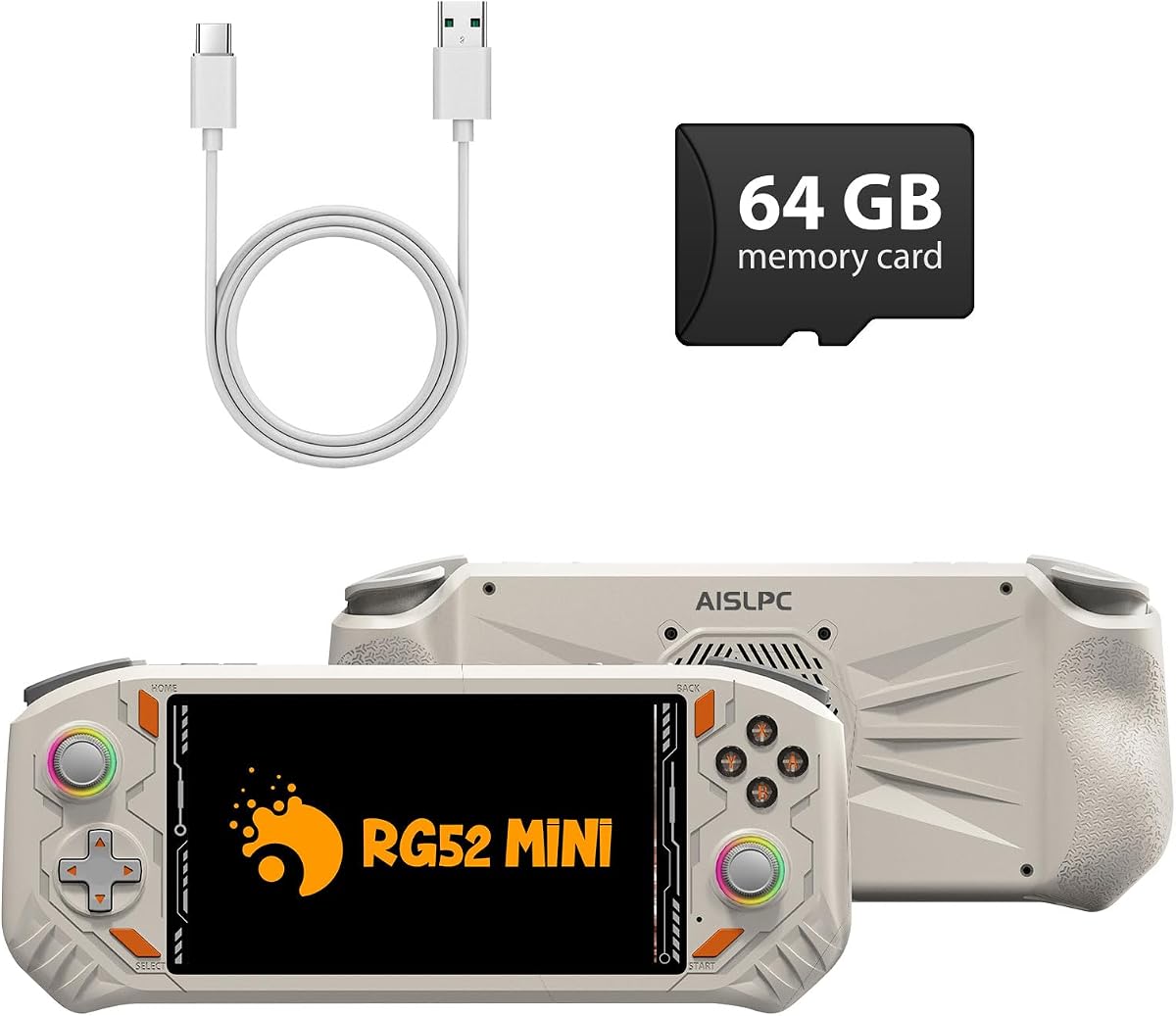
The RG52MINI is a large-screen Linux handheld designed for both immediate play and flexible library management. It has a 4.1 rating, a 5.5-inch fully laminated 1280 by 720 IPS screen, an RK3562 quad-core Cortex-A53 processor operating at 2.0GHz, and 2GB of RAM alongside 4GB of storage.
We may earn a commission when you buy through this link, at no additional cost to you.
Its distinguishing software feature is the EmuELEC and RGBOX dual-system arrangement. The built-in 64GB storage includes more than 5,000 classic games, while the RGBOX app can provide access through the WiFi downloader to a collection of more than 22,000 retro games. It supports more than 30 emulators, 2D and fifth-generation 3D games, and additional compatible software, offering considerable variety for a Linux-based device.
Physical features are designed for long sessions. Dual 3D joysticks include confirmation keys, mechanical buttons provide tactile feedback, Hall linear triggers support analog input, and vibration motors add feedback. A 5000mAh battery is listed for up to eight hours, storage can be expanded through a TF card slot to 1TB, and HDMI plus USB Type-C provides multiple output and accessory options.
The trade-off is bulk and mild learning curve. A 5.5-inch screen and full-size controls are less convenient for a pocket than the Miyoo Mini Flip or RF40H, while the dual-system setup may require more navigation than a single-interface Linux handheld. Even so, the RG52MINI suits a buyer who wants a large display, extensive game access, modern controls, long battery life, and easy television connection without moving to a full Android platform.
EmuELEC and RGBOX provide separate approaches within one device. The system can begin with its included collection while offering a WiFi downloader and broad emulator support for users who want to expand the library.
TF expansion up to 1TB gives the device exceptional room for games and media. HDMI output supports television play, while the Type-C port supports OTG, charging, and DisplayPort output, making it adaptable to different entertainment arrangements.
We may earn a commission when you buy through this link, at no additional cost to you.
The right handheld emulation console depends on the games you want to play, how much setup you are willing to do, and how you will carry the device. Screen quality, controls, processing power, storage, connectivity, and battery life should be weighed together rather than considered in isolation.
Linux systems are generally designed around a focused retro-gaming experience and may come with a large TF card, ready-to-browse menus, and multiple emulator frontends. Android systems provide a broader software environment, downloadable applications, Google Play support on some models, and more ways to add emulators, but they may arrive without games. The RG56PRO, RF40H, RG40XX H, R46H, and RG52MINI emphasize preloaded Linux content, while the Retroid Pocket 4 Pro, Anbernic RG476H, Anbernic RG477V, and Retroid Pocket Classic rely more heavily on user-managed software. The Miyoo Mini Flip supports both a simple system and separately installed custom frontends.
Choose a preloaded Linux model for the shortest route to playing. Choose Android when you value app access, customization, and a broader software ecosystem.
A 2.8-inch screen is ideal for extreme portability, while 4-inch and 4.7-inch panels are easier on the eyes for menus and older console games. The 5.5-inch RG56PRO and RG52MINI models emphasize television-style visibility but occupy more bag space. Resolution also affects how sharply modern interfaces appear: the RG40XX H uses 640 by 480, the RF40H and Anbernic models use 720 by 720 or 1280 by 960, and the Retroid Pocket Classic uses a 1240 by 1080 OLED panel. Emulator scaling, aspect ratio, and screen technology can influence the final image more than raw pixel count alone.
Prioritize a comfortable, correctly scaled image over the largest specification. A smaller high-quality panel may produce a better experience than a larger but dim or low-resolution screen.
Traditional D-pad and face-button layouts remain the safest choice for classic arcade and console titles. Dual 3D joysticks, confirmation buttons, vibration, gyroscopes, and Hall effect shoulder triggers can improve comfort and precision in modern ports and 3D games. The RG56PRO, Anbernic RG476H, and Anbernic RG477V highlight Hall effect controls, while the RG52MINI pairs dual 3D joysticks with mechanical buttons and linear triggers. Touchscreens add menu convenience but do not replace good physical controls for emulation.
Try to use the layout you are accustomed to, and check whether a game relies on triggers, face buttons, or a D-pad. Precision-oriented controls are valuable only if your software makes meaningful use of them.
Basic 8-bit and 16-bit libraries place relatively light demands on a system, while PS1, PSP, N64, and fifth-generation 3D titles need more capable processors and adequate memory. The RG56PRO and RG52MINI use RK3562 chips, the R46H uses RK3326, the RF40H lists a high-performance quad-core processor, and the Android models use increasingly powerful platforms. The Retroid Pocket 4 Pro combines a Dimensity 1100 with 8GB of memory, while the Anbernic RG476H and RG477V use T820 and Dimensity 8300 hardware respectively.
Match processing power to the most demanding titles in your planned library. A highly capable system is less necessary for a strictly 8-bit collection, but it provides more room for growth.
Storage requirements vary from a compact set of favorites to tens of thousands of games. A preloaded 128GB card is offered with the RG56PRO and R46H, while the RF40H includes 64GB and claims more than 20,000 games. The RG52MINI provides 64GB of built-in storage and access to more than 22,000 games through its WiFi downloader. Android handhelds commonly use 128GB internally and add Micro SD expansion. Confirm whether games are actually preloaded, whether a card is included, and whether the included library is accessible immediately.
For a large collection, prioritize high-capacity storage and easy import tools. For a curated setup, 128GB of fast internal storage plus expansion may be more practical than tens of thousands of unselected titles.
Published runtime figures are useful comparisons but should be treated as conditional. The RG56PRO and RG40XX H list up to eight hours, the RF40H and RG52MINI list roughly six to eight hours, the Retroid models carry 5000mAh batteries, and the Anbernic RG477V has a 5500mAh battery. Actual use depends on brightness, volume, wireless connections, RGB lighting, vibration, and game complexity. Active cooling appears in the RG56PRO, Retroid Pocket 4 Pro, Anbernic RG476H, and other higher-performance designs, helping maintain performance during longer sessions.
For travel, check both battery capacity and charger compatibility. For extended play, look for active cooling and use a screen brightness or lighting setting that matches your environment.
WiFi can enable streaming, screen projection, downloads, and online play when both the game and peer devices support them. Bluetooth expands the range of headsets and controllers, while 2.4G and wired controller support can help local multiplayer. Television output is available through HDMI, USB Type-C DisplayPort, or proprietary video connections depending on the model. The Retroid Pocket 4 Pro supports 720p HDMI and 1080p USB Type-C output, while the RG477V supports 1080p Type-C display output. Always check cable and display requirements before planning a console-style setup.
Choose the outputs and wireless standards you actually intend to use. Extra connectivity is useful, but it should not distract from control comfort or portability.
The lightest option is not always the most practical. The Anbernic RG40XX H weighs about 200 grams, the Retroid Pocket 4 Pro weighs 251 grams, and the Miyoo Mini Flip is designed to fit in a palm or pocket. Conversely, the 5.5-inch RG56PRO and RG52MINI favor a large display and fuller controls. The Mini Flip's folding body can adapt to different play positions, whereas traditional handhelds keep a consistent shape. Consider pocket space, grip, and how often you expect to play away from a desk.
Choose a compact model for daily carry and a larger one for stationary or travel gaming where screen space matters more. A comfortable grip and manageable weight are often more important than the smallest possible footprint.
Begin by fully charging the console with the specified cable and a compatible power source, then confirm that the operating system, storage, controls, speakers, and display are working correctly. For models that include a TF card, check that the card is seated properly and that the game library appears. Android devices may require account setup, emulator installation, or the device's game downloader before titles are available.
Choose settings that suit the game and screen. Emulator menus commonly provide options for aspect ratio, pixel-perfect scaling, region, controls, and save behavior. Use wired or wireless controllers only when the game and system support them, and test multiplayer before relying on it for a social session. For television play, use the required output cable and compatible display settings rather than assuming every handheld mode is supported by every game.
Protect the console by keeping it in its case or a separate pouch, using a low-power charging source where the manufacturer specifies a limit, and avoiding moisture, direct heat, and pressure on the screen. Clean the surface with a soft dry cloth, and avoid exposing ports to dust. For long-term storage, power the device down, remove the TF card if appropriate, and keep it in a dry environment. A screen protector can reduce the risk of scratches on high-resolution touch devices.
The RF40H, Anbernic RG40XX H, and RG56PRO are among the most approachable because they include preloaded game cards and open-source Linux interfaces. A new user can browse the supplied library without first building a collection. The RG52MINI also includes games, although its dual-system design introduces a little more navigation. If you prefer a guided Android experience, the Retroid Pocket 4 Pro may feel more familiar, but it requires software setup.
The legality of obtaining and using game files can depend on your jurisdiction and the source of the files. A product listing that mentions preloaded games does not by itself establish where every included file came from or whether it is licensed. Users should use games they are legally entitled to access and follow the applicable terms for their own copies. Saving personal game data and configuring emulators are separate considerations from acquiring the game content.
No. The RG56PRO, Anbernic RG40XX H, R46H, and RG52MINI include TF storage, while Android models use internal storage and some support microSD expansion. The Retroid Pocket 4 Pro, Anbernic RG476H, Anbernic RG477V, and Retroid Pocket Classic have 128GB of internal storage but require users to install their own games. Check the product details for the exact storage arrangement and supported card capacity.
No. A higher resolution can make menus and Android applications look sharper, but older games were not created for that pixel count. Aspect ratio, pixel-perfect scaling, panel quality, and emulator filtering can matter more to the final image. The Retroid Pocket Classic OLED may suit buyers who value contrast and modern visuals, while lower-resolution Linux devices can provide a more period-appropriate presentation for some systems.
Many models support WiFi, Bluetooth, 2.4G wireless, or wired controllers, but multiplayer depends on the individual game and the number of compatible devices available. The RG56PRO, RF40H, and RG52MINI explicitly mention networked or WiFi play, and the RG40XX H supports wireless pairing. Verify that a title offers local or online multiplayer and that the required controller or communication method is included.
The listed figures range from about four hours for the Miyoo Mini Flip to approximately eight hours for several 5000mAh models. Real runtime can be shorter or longer depending on screen brightness, audio volume, wireless connections, RGB lighting, vibration, and the demands of the game. For travel, treat the published figure as a best-case estimate and carry the specified charging cable.
Choose Linux if you want a game-focused device, especially one that includes a preloaded TF card. Choose Android if you value downloadable apps, broader software, modern connectivity, and the ability to install and update emulators yourself. Android models also offer more processing power in the premium tier, but they generally require more initial configuration and may not include any games.
Yes, but the connection method varies. The RG56PRO and RG52MINI support HDMI, the Retroid Pocket 4 Pro supports HDMI and 1080p USB Type-C output, and the Anbernic RG477V supports 1080p DisplayPort through USB Type-C. The Anbernic RG40XX H lists HD output. You may need a suitable cable, and individual games or emulator settings can determine whether the external display works as expected.
The Retroid Pocket 4 Pro stands out as the strongest overall choice because it combines capable hardware, 8GB of memory, fast 128GB storage, active cooling, a 4.7-inch touchscreen, and useful display output in a portable body. The RF40H is the best value-oriented pick for its enormous included library and accessible Linux system, while the Anbernic RG476H takes the premium feature set further with a high-refresh display, Hall effect controls, cooling, and extensive Android functions.
Prioritize the features that align with your actual habits. Buy a preloaded Linux console if immediate game access and simple navigation matter most. Choose an Android handheld if you want modern applications, stronger performance, and a custom library. Pick a compact model for pockets and commutes, or a large-screen model for visibility, television play, and longer at-home sessions.
Before ordering, check the current listing details, included storage, game library, supported formats, charging requirements, and output compatibility. Ratings, product configurations, software, and pricing can change over time, so the latest seller page remains the best source for current availability and package contents.
