
Workman A28 Lightning Arrestor
4.5Editor score
PL-259 male and female ends
Side-mounted grounding screw
Compact inline installation
Designed for amateur radio
Expert guide compares the best Ham Radio Lightning Protection for Antennas, including connector types, frequency bands, grounding needs, and surge protection.
Ham Radio Lightning Protection for Antennas works by intercepting dangerous surges before they reach a radio, amplifier, transceiver, or other connected equipment. A useful arrester must match the coaxial connector, operating frequency, and grounding arrangement of the installation. Connector fit and a dependable ground are as important as the protective component itself.
The products in this guide were compared using the information supplied for each model, including supported frequency ranges, connector configurations, insertion loss, construction, grounding provisions, and intended applications. The list covers PL-259, SO-239, and N-type options for amateur radio, CB, two-way radio, and related RF installations across a range of common operating environments.
Each review shows where a product is especially useful, while also noting important limitations such as connector constraints, required grounding, or maximum power guidance. The top selections include versatile inline protection, a compact budget option, and a broad-band model for demanding applications. Availability and prices can change, so readers should verify current listing details before purchasing.
4.5Editor score

4.6Editor score

4.8Editor score
The comparison below organizes the ten arresters by connector, frequency coverage, construction, and installation requirements, making it easier to identify the option that fits a particular radio and antenna system.



The XRDS-RF UHF Lightning Arrestor is a female-to-female inline unit designed to protect a coaxial antenna installation from lightning strikes and electrical surges. Its stated DC-to-500MHz operating range, low RF insertion loss, and VSWR below 1.2 make it a practical option for ham radio, CB, and two-way base-station feeds. The product is especially relevant where the existing coaxial cable terminates in PL-259 connectors.
We may earn a commission when you buy through this link, at no additional cost to you.
Construction is a major strength. The supplied information identifies a nickel-plated brass body, brass inner conductor, Teflon or PTFE insulation, and nickel electroplating. The device installs in series between the amplifier and outdoor antenna, allowing the protected equipment to remain on the building side of the assembly. The listed low-loss specification helps this product suit installations where maintaining the integrity of the RF signal is important.
The main limitation is that the protection is not complete without an additional ground cable. That requirement should be considered before installation, particularly for operators who lack a suitable grounding point or bonding arrangement. Its PL-259 interface is also less flexible than options that accept multiple connector formats, so users should verify the type of connector on both sides of the intended installation.
This arrestor is best for a conventional PL-259 coax run that needs straightforward inline surge diversion. It is especially attractive to amateur radio operators and CB users who want a clearly specified low-loss product covering the UHF range. Confirm connector compatibility, provide a proper ground connection, and install the unit where it can protect the vulnerable equipment without creating unnecessary cable strain.
The stated insertion loss below 0.4dB and VSWR below 1.2 show attention to the RF side of surge protection. These figures make the device suitable for inline use in a 50-ohm coaxial system where preserving signal quality remains essential.
Nickel-plated brass, a brass inner conductor, and PTFE insulation provide a clear construction description. The grounding requirement remains essential, because the unit is designed to divert harmful surge energy to an external ground.
We may earn a commission when you buy through this link, at no additional cost to you.
The Diamond SP1000 is a wideband coaxial surge protector intended for mobile and base-station antennas. It is described as protecting radios, transceivers, and associated equipment from lightning-induced damage while directing high-voltage energy toward ground. The product data emphasizes low signal loss, durable outdoor construction, and ease of integration into an existing antenna system.
We may earn a commission when you buy through this link, at no additional cost to you.
Its key specification is an insertion loss below 0.3dB, alongside a stated impulse-wave discharge capacity of 6000 amps. The internal surge element is replaceable, which makes this model more relevant to operators who want a serviceable component rather than a sealed throwaway device. Insulating resistance above 10,000 megohms at 100 volts DC is also listed among its technical attributes.
One point to verify is the exact coaxial connector arrangement, because the supplied product information does not explicitly list the connector type. It is also described as compatible with Diamond SP-Series antennas and coaxial lines, but that should not be interpreted as limiting it to those products. Users still need to match the physical interfaces and ensure that the antenna, radio, and cable arrangement are compatible with the installation.
The Diamond SP1000 is a strong candidate for permanent base stations, vehicle installations, towers, and portable setups where broad-band operation and a replaceable element are priorities. It may be particularly useful for operators managing multiple radio functions. Confirm connector fit and grounding details before purchase, and install it according to the manufacturer’s intended configuration.
A replaceable surge arrester element separates the protective module from disposable status. That can be valuable in a station exposed to repeated surges or where long-term serviceability is important.
The SP1000 is described for mobile and base-station antennas, as well as two-way and amateur radio use. Its stated 6000-amp impulse capacity and very low insertion loss support its positioning as a broad-band station protector.
We may earn a commission when you buy through this link, at no additional cost to you.
The Workman A28 is a compact inline lightning surge protector intended for CB antennas, amateur radio stations, and two-way radio applications. Its defining feature is a simple PL-259 male-to-female arrangement, allowing it to sit between the radio or amplifier and the coaxial feedline without requiring an adapter when the surrounding connectors match.
We may earn a commission when you buy through this link, at no additional cost to you.
A side-mounted ground screw provides a direct method for attaching a grounding conductor. The product is described as a surge diverter for coaxial cable, giving operators a familiar and accessible installation point. The absence of a permanently attached pigtail can also make it easier to route the ground lead according to the physical layout of the station or antenna support.
The supplied information does not state a frequency range, insertion loss, VSWR, discharge voltage, or whether the internal element is replaceable. Those omissions make it especially important to compare the device with the operating requirements of the intended system. It is also not described as weatherproof in the same explicit terms as some other products in this guide, so an appropriate outdoor enclosure may be needed where the unit will be exposed.
The A28 is a practical selection for a user who values simple construction, direct grounding access, and an economical addition to a PL-259 antenna line. It suits a straightforward CB or ham radio base antenna arrangement where the listed functions meet the installation needs. Confirm frequency suitability, ensure the coax interface is correct, and provide a suitable ground before relying on it for equipment protection.
The PL-259 male and female ends make the A28 a natural inline component. It can sit directly in the coax path, keeping the protected radio or amplifier on the protected side of the installation.
The side grounding screw provides a visible and accessible termination for the required ground conductor. Good bonding practices remain important because the device depends on that connection to divert surge energy safely.
We may earn a commission when you buy through this link, at no additional cost to you.
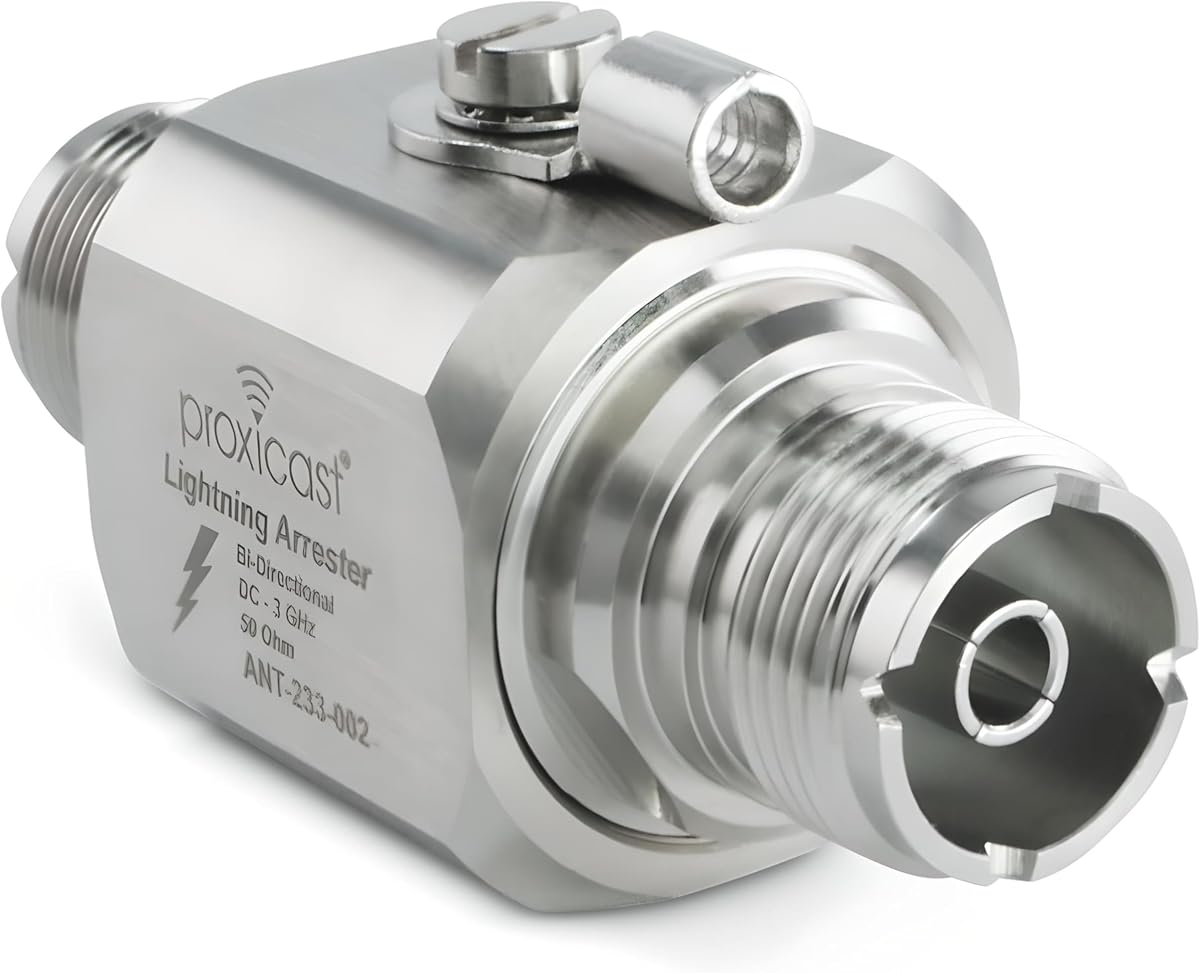
The Proxicast ProGrade 230V is a female-to-female SO-239 coaxial arrester designed for VHF, UHF, two-way, amateur radio, and CB applications. Its 230-volt gas discharge tube provides bidirectional protection by shunting damaging surges, transients, and lightning energy toward ground. DC pass-through makes it suitable for installations that also carry power or control signals on the coax.
We may earn a commission when you buy through this link, at no additional cost to you.
The stated 50-ohm impedance and very low RF insertion loss are important for a device intended to remain in the signal path. Outdoor rating and an inline configuration allow it to be used where the coax transitions between an outdoor antenna system and protected indoor equipment. Unlike mixed or adapter-based designs, the matched SO-239 ends simplify the physical layout of a compatible installation.
The product still requires a proper earth ground. Its protective function depends on the surge path, so a loose, corroded, or poorly bonded connection would undermine the installation. The fixed SO-239 interface also means that operators using PL-259 cables must account for that cable type, usually with suitable adapters outside the arrester itself.
This model is well suited to amateur radio, CB, VHF, UHF, and professional two-way installations using SO-239 coax interfaces. It is particularly appropriate when bidirectional protection, DC pass-through, and multi-strike capability are priorities. Verify the connector arrangement, establish a solid ground, and place the unit in the intended in-line position according to the installation plan.
Because the gas discharge arrangement protects in both directions, the device is not limited to one assumed direction of energy flow. That makes it a practical choice for modern coaxial systems carrying bidirectional RF traffic or additional DC services.
The 50-ohm impedance and low attenuation support use directly in the coax path. DC pass-through adds flexibility for powered antenna systems that use the same cable for control or power functions.
We may earn a commission when you buy through this link, at no additional cost to you.
This PL-259 female-to-female coaxial surge protector is designed for VHF, UHF, two-way radio, amateur radio, CB, and other antenna systems. Its most practical feature is the included earth lead, allowing the arrester to be connected directly to a suitable grounding terminal. The standard inline interface supports installation within an existing PL-259 feedline.
We may earn a commission when you buy through this link, at no additional cost to you.
The product uses a sturdy aluminum housing described as providing heat dissipation and corrosion resistance. Its internal protective components are stated to react without requiring fuse replacements, making the design appealing to operators who do not want to maintain a conventional fuse as part of the surge path. The broad compatibility list also extends the product’s usefulness beyond traditional amateur radio stations.
Compared with many alternatives in this roundup, the listing provides less detailed performance information. It does not quantify insertion loss, VSWR, discharge voltage, or a specific upper frequency limit. The claim of no fuse replacement is useful, but the internal protective technology and its replaceability are not further defined. Users should therefore consider the missing specifications when making a technically demanding installation.
This protector is a good fit for a PL-259 coax run where a supplied earth lead simplifies the grounding connection. It can suit VHF, UHF, ham, CB, and two-way stations, including protected equipment placed near the cable entry point. Confirm the station’s frequency requirements and provide a proper ground before installation. The included lead and corrosion-resistant housing make it convenient for straightforward deployments.
The supplied ground lead is a meaningful convenience because every effective installation still requires surge energy to reach a proper ground. It reduces one assembly step, although it does not remove the need for sound bonding.
The aluminum housing is presented as resistant to corrosion and capable of dissipating heat. These characteristics suit exposed antenna-line applications, provided connectors and the ground termination remain secure.
We may earn a commission when you buy through this link, at no additional cost to you.
The Diamond Antenna SP3000 is a coaxial lightning arrester with a stated DC-to-3000MHz frequency range, making it the broadest numeric coverage in this guide. It uses N-type male and female connectors and carries a 200-watt model designation. It is positioned for amateur radio antennas and other coax installations that need a device spanning widely separated RF bands.
We may earn a commission when you buy through this link, at no additional cost to you.
Broad frequency capability is the central attraction. A single unit can cover applications extending from conventional lower-frequency work into much higher RF ranges, subject to the limits of the antenna, feedline, and connected equipment. The stated 1000-volt impulse-wave discharge specification adds a defined surge figure, while the N-type interface is common on many higher-frequency and broadband installations.
The trade-off is physical compatibility. N-type connectors are not interchangeable with PL-259 or SO-239, so the cable ends must already use N-type connections or appropriate adapters must be included. The 200-watt designation also calls for attention in higher-power applications. As with every protective device, the installation needs a suitable ground and correct placement to provide maximum benefit.
The SP3000 is the premium pick for operators who want one arrestor to cover a very broad frequency range, especially where N-type coax is already installed. It is a strong choice for modern wideband antenna systems, contest stations, and technically demanding setups. Verify the system’s power level, connector type, and grounding arrangement before finalizing the installation.
The DC-to-3000MHz specification is the key differentiator. It allows the same inline device to support a wide assortment of RF services, reducing the need to change arrestors as an operator changes bands or antenna functions.
A stated 1000-volt impulse-wave discharge rating provides a useful protection figure. The 200-watt model designation gives users a clear limit to compare against their transmitter and amplifier output.
We may earn a commission when you buy through this link, at no additional cost to you.
The XRDS-RF bulkhead arrestor combines a PL-259 male connector with a SO-239 female socket and includes hardware for mounting through a panel, enclosure, or copper strip. Its stated DC-to-500MHz range, insertion loss below 0.4dB, and VSWR below 1.2 make it suitable for ham radio, CB, and two-way base-station systems.
We may earn a commission when you buy through this link, at no additional cost to you.
The bulkhead design is the distinguishing feature. It can serve as both a protective component and a coax feedthrough, helping organize a permanent station where cables enter an outdoor enclosure or enter a radio room through a panel. The body is described as nickel-plated brass, with a brass inner conductor, PTFE insulation, and nickel electroplating.
The main technical constraint is the stated maximum power of 50 watts. That makes the device better suited to lower-power equipment than high-output amplifiers, even though the connector arrangement and broad UHF range may otherwise appear appropriate. The product data also does not clearly state whether an earth lead is included, so grounding hardware should be confirmed before installation.
This bulkhead unit is a good match for a permanent installation in an outdoor enclosure or a structured panel entry. It is especially useful for operators who value a tidy coax transition and a mixed PL-259-to-SO-239 arrangement. Ensure the transmitter and amplifier remain within the power limit, mount the unit securely, and connect it to a proper ground before placing valuable equipment on the protected side.
The integrated nut and sufficient thread depth support bulkhead installation through a suitable panel. This can simplify a clean coax entry while placing the surge device near the boundary between outdoor and protected areas.
A PL-259 male end and SO-239 female end allow the unit to bridge two common UHF connector types. This is useful in installations where the antenna-side and equipment-side cables naturally use different interfaces.
We may earn a commission when you buy through this link, at no additional cost to you.
This two-pack includes a pair of UHF female-to-female SO-239 coaxial lightning arresters. Each uses a brass nickel-plated outer conductor, a brass-plated inner pin, and PTFE insulation. The product is designed for outdoor use and uses gas discharge tubes to divert sudden voltage or current caused by external interference, including lightning-related effects.
We may earn a commission when you buy through this link, at no additional cost to you.
Receiving two units creates flexibility. One can protect a primary antenna feed, while the second can cover another coax line, a backup path, or a separate piece of RF equipment. The construction details are particularly useful for operators who pay close attention to connector durability, corrosion resistance, and stable center-pin contact in outdoor environments.
The listing describes wide bandwidth, low insertion loss, and small VSWR without publishing exact numerical values. It also states that the arresters must be connected to a ground wire and should be installed as close as possible to the protected equipment, often at the building cable-entry point. A ground conductor is not included, so that item must be supplied separately.
This two-pack is a practical selection for operators with more than one antenna system or who want protection at both an outdoor transition and a secondary entry point. It is particularly suitable for SO-239-equipped UHF, GSM base-station, satellite, GPS, walkie-talkie, and other communication systems. Plan the grounding paths, position each unit near the equipment it protects, and verify the coax interfaces.
Two arresters allow a more comprehensive installation than a single inline unit. They can serve separate coax runs or provide protection at two different points in the same broader station design.
The nickel-plated brass body and PTFE insulation are described for durability and outdoor suitability. A stable brass-plated center pin supports consistent signal connection, while weather exposure still demands careful connector sealing.
We may earn a commission when you buy through this link, at no additional cost to you.
The RAIGEN arrestor is an N-type male-to-female outdoor antenna protector with a stated 0-to-6GHz range and 50-ohm impedance. It is designed for a wide range of RF systems, including LoRaWAN gateways, outdoor WiFi access points, 4G and 5G antennas, GPS receivers, cell boosters, CB equipment, ham radio, and solar-linked installations.
We may earn a commission when you buy through this link, at no additional cost to you.
Its technical highlights include insertion loss below 0.1dB and a replaceable 90-volt gas discharge tube with multi-strike capability. The heavy-duty nickel-plated brass body, Teflon insulation, and brass-plated needle are intended for permanent outdoor deployment. A ground lug is included for bonding to a building grounding system, though the grounding cable itself is not supplied.
The product is unusually broad in both frequency and application. However, its N-type connectors may require adapters in a typical PL-259 amateur radio installation, and the long list of supported technologies should not substitute for checking whether a particular device’s coax, connector, and grounding method are compatible. Operators should also follow the guidance to place the protected device close to the arrester, often near the point where the cable enters a building.
The RAIGEN is a strong option for an operator whose station combines amateur radio with modern wireless infrastructure, or for a technical installer supporting several wideband RF services. Its low loss, replaceable protection element, and outdoor construction are the primary benefits. Confirm the required connector arrangement and provide a proper ground cable before installation.
The 0-to-6GHz range covers applications from traditional radio through cellular, WiFi, LoRa, and GPS equipment. That makes the unit useful where one protection strategy must serve a diverse collection of RF endpoints.
The replaceable 90-volt gas discharge tube provides a serviceable protective stage. Multi-strike capability is intended to let the unit handle repeated surge events without losing its normal signal-path function.
We may earn a commission when you buy through this link, at no additional cost to you.
The Opek LP-350a is a 50-ohm lightning and static surge protector made for amateur radio, two-way radio, and CB antennas. Its stated frequency coverage extends from 0 to 600MHz, while the model is associated with applications up to 350 watts. A ground terminal is included, allowing the unit to be bonded into a suitable grounding system.
We may earn a commission when you buy through this link, at no additional cost to you.
The product’s combination of frequency range and power allowance distinguishes it from several lower-power options in the roundup. That makes it a candidate for stations using more capable amplifiers or transmitters, provided the exact installation and accessory cables remain compatible. The listing also notes that optional cables with PL-259 connectors can be accepted.
Because the supplied information does not clearly state the standard connector configuration, users should examine the physical product and current listing details before ordering. Insertion loss, VSWR, and discharge parameters are not provided, so the available specifications should be considered alongside the broader installation requirements. The ground terminal is useful, but the quality and bond of the grounding conductor will determine how effectively surge energy is handled.
The LP-350a is well suited to CB and ham radio base antennas that need a stated higher power allowance within the 0-to-600MHz range. It can be especially relevant to operators running a conventional PL-259 feed arrangement and looking for an integrated ground point. Confirm connector compatibility, compare the unspecified performance figures against the system’s requirements, and ensure the ground is installed correctly.
The stated use up to 350 watts gives the LP-350a a useful advantage over the 50-watt bulkhead option in this guide. Actual suitability still depends on the complete antenna, feedline, amplifier, and protection arrangement.
A built-in ground terminal provides a direct connection point for the required surge path. The conductor should be appropriately bonded and routed to minimize added impedance and improve the overall grounding system.
We may earn a commission when you buy through this link, at no additional cost to you.
The right antenna surge protector depends on connector compatibility, radio frequencies, transmitter power, installation layout, and the quality of the station’s grounding system. These factors matter more than decorative features or broad claims because the device must preserve the RF signal while providing a controlled surge path.
Start by identifying the connectors on both sides of the intended installation. The roundup includes PL-259 female-to-female units, a PL-259 male and SO-239 female bulkhead model, SO-239 female-to-female options, and N-type male-to-female designs. Connector type is not cosmetic: a mechanically incompatible fitting can require adapters, add avoidable connection points, or prevent the protector from being mounted where it is needed most.
The arrester must cover every frequency used by the antenna system. Listed ranges range from DC-to-500MHz and DC-to-3000MHz to zero-to-6GHz, with the Opek model covering 0-to-600MHz. A device that appears to cover ham radio may still be a poor match for a particular wideband setup if the station uses frequencies above its stated range.
Compare the station’s output with the product’s stated power guidance. The XRDS-RF bulkhead model is limited to 50 watts, while the Diamond SP3000 carries a 200-watt designation and the Opek LP-350a is described for applications up to 350 watts. The other products do not all provide equally clear power limits, so ambiguous listings deserve additional scrutiny.
Every effective surge-protection strategy needs a low-impedance route to ground. Some products include an earth lead or ground lug, while others provide a screw or terminal, and the Workman A28 explicitly identifies a side ground screw. A ground attachment alone is not enough; the conductor must connect to a suitable grounding and bonding system that can carry surge energy safely.
A protective device remains part of the signal path, so insertion loss and VSWR matter. The listed highlights include less than 0.4dB for the XRDS-RF PL-259 unit, less than 0.3dB for the Diamond SP1000, less than 0.1dB for the RAIGEN, and VSWR below 1.2 for the XRDS-RF models. For listings without figures, the absence of published data should be considered when balancing the choice.
Outdoor equipment is exposed to moisture, temperature changes, vibration, and corrosion. Common construction details across the roundup include nickel-plated brass, brass conductors, PTFE insulation, and aluminum or other weather-resistant housings. The Opek, Workman A28, and several generic listings do not provide the same level of explicit weather-resistance detail, which may affect enclosure requirements.
Some designs use a replaceable surge element, including the Diamond SP1000 and RAIGEN, while the PL-259 Female Coaxial Surge Protector states that no fuse replacement is required. Serviceability can be valuable at permanent stations, but the term replaceable does not mean maintenance-free. The protective element should still be inspected, and damaged or displaced components should be addressed before the unit is relied upon again.
The preferred location is often close to the equipment being protected or near the point where the coax enters a building. The two-pack option and bulkhead model are particularly flexible for permanent installations. Keep the protected side of the arrester connected to valuable equipment, route the ground lead appropriately, and minimize sharp bends or strain that could compromise the coax.
Begin by identifying the antenna-side and equipment-side coax connections, then place the arrester in series between them. Position it so the equipment remains on the protected side. Confirm that the connector type, frequency range, and power level match the installation before tightening any fittings, and avoid forcing unlike connector interfaces together.
Attach the arrester’s ground connection to the station’s proper grounding and bonding system using an appropriately sized conductor and a secure connection. Route the ground lead to reduce strain and follow the product’s intended orientation. Weatherproof exposed connections as required, ensure cable entry points are protected from moisture, and never treat a ground lead as optional simply because the arrester is installed inline.
Inspect the arrester and connections periodically, particularly after severe weather. Look for corrosion, damaged insulation, loose connectors, or evidence of arcing around the protective element. Keep surrounding vegetation and structures from contacting the antenna or feedline, and follow local grounding requirements. If the device has a replaceable element, check the manufacturer’s guidance for inspection and replacement intervals.
Install the arrester in series with the coax so valuable equipment remains on the protected side. A common location is close to the point where the antenna feedline enters a building or near the equipment inlet. Exact placement depends on the antenna system, grounding layout, and whether the entire feedline or only the indoor equipment is being protected.
No. A coaxial arrester needs a dependable connection to a suitable grounding and bonding system so surge energy can be diverted away from the radio. The grounding conductor and terminations are as important as the arrester itself. A loose, corroded, or improvised ground can leave the equipment inadequately protected.
They are not automatically interchangeable because each uses a different physical interface. Adapters can bridge connector types, but they add connection points and may complicate the installation. Choosing an arrestor that matches the existing coax on both sides usually produces a cleaner and more reliable result.
The voltage figure relates to the protective element, while the entire installation must still match the connector, frequency, power, and grounding requirements. Compare the manufacturer’s specifications with the coax and equipment in use rather than selecting only by discharge voltage. The Proxicast and RAIGEN products also differ in connector format and frequency coverage.
A single arrester can protect equipment connected downstream on the same protected coax path if the installation is correctly rated and grounded. Different antennas, radio bands, or connector types may require separate arresters. The two-pack option can be useful when two entry points or coax runs need protection.
No. Surge protection is only one part of a safer installation. Operators should still avoid hazardous antenna locations, maintain clearances where applicable, secure the mast and feedline, and use appropriate grounding and bonding practices. A surge arrester should complement rather than replace sound antenna-planning decisions.
Insertion loss describes how much RF signal is reduced as it passes through the arrester. Lower loss is generally desirable, especially in receiving systems and long or complex feedline arrangements. Several models list specific low-loss figures, while others do not, so published specifications should be considered when technical requirements are important.
Inspection should occur during routine station maintenance and after notable severe weather. Check the ground connection, coax fittings, weather protection, and the body of the unit for damage, corrosion, or heat effects. If the model contains a replaceable element, follow the manufacturer’s replacement guidance and replace a damaged or spent component as specified.
The XRDS-RF PL-259 female-to-female arrestor is the most versatile editor’s choice for a conventional PL-259 installation, combining a stated DC-to-500MHz range with low insertion loss and detailed construction information. The Workman A28 offers a simpler budget approach with male and female PL-259 ends and a side grounding screw. For broad numeric coverage, the Diamond SP3000 supports DC-to-3000MHz and provides a defined 1000-volt impulse discharge specification.
The right choice ultimately depends on the antenna system rather than on one universal feature. Match the connector, frequency, power, installation position, and grounding arrangement first. A technically suitable device with a properly installed ground is more valuable than a model whose headline specification does not align with the station or whose required termination is inconvenient or missing.
Before purchasing, verify the current listing details, included ground hardware, connector arrangement, and manufacturer guidance. Availability and prices change, and installation conditions vary, so readers should compare the latest product information with their antenna and station requirements before making a final selection.