
SOLPERK 20W Solar Panel Kit
4.5Editor score
20W monocrystalline panel
Smart 10A MPPT controller
Adjustable 360-degree bracket
Our expert guide compares the best small solar panels for shed, evaluating power output, weather resistance, installation, expandability, and lighting.
Small solar panels for sheds range from dedicated lighting systems and security-camera chargers to compact power kits for batteries, tools, and portable power stations. A useful panel depends on the intended load, available sunlight, mounting area, and whether the shed needs lighting, device charging, or a dependable off-grid energy source.
We compared the listed products by examining their stated power, efficiency, weather resistance, battery compatibility, installation requirements, cable reach, and expansion options. The guide covers both integrated solar lights and standalone panels, separating convenience-oriented choices from systems designed for larger shed electrical projects.
Each pick highlights a different practical use, from a budget-friendly maintainer to a high-output kit and a portable panel. Ratings reflect the supplied customer feedback, while specifications describe the listed products; prices and availability can change, so confirm current details before purchasing.
4.5Editor score

4.6Editor score

4.7Editor score
The comparison below covers dedicated shed lighting, security-camera charging, compact battery maintainers, portable power-station panels, and fixed solar kits, making it easier to match panel size and output to the intended job.




The ECO-WORTHY 200W kit is the strongest all-around option for a shed that needs more than occasional trickle charging. It carries a 4.6 rating and combines two 100-watt monocrystalline panels with a 30A PWM charge controller, mounting brackets, connectors, and wiring. That combination makes it more useful for sustained off-grid power than a small single-panel maintainer.
We may earn a commission when you buy through this link, at no additional cost to you.
Its standout benefit is the balance of capacity and included hardware. The listed daily output is 800 watt-hours under four hours of full sunshine, while the panels use monocrystalline cells rated at up to 21.5% efficiency. The two-panel system can be connected in parallel for 12-volt operation or in series for 24 volts, allowing the installer to match the battery arrangement more closely to the intended load.
The construction details are also appropriate for an outdoor shed installation. Each panel has a corrosion-resistant aluminum-alloy frame, an IP65-rated junction box, a 2400Pa wind rating, and a 5400Pa snow-load rating. Pre-drilled mounting points and plug-and-play cables simplify the physical work, although the two-panel arrangement requires enough uninterrupted roof or wall space and a sound mounting substrate.
This is the most appropriate selection for users who want to power a battery bank, operate small equipment, or build toward a larger off-grid setup. It is less convenient for a portable shed project because the rigid panels are not foldable. Even so, the complete kit, flexible system voltage, and meaningful output make it the most versatile fixed installation in this list.
The 200-watt total rating provides a stronger foundation than a maintenance-only panel, particularly when a shed contains LED lighting, tools, pumps, or other low-to-moderate electrical loads. Actual production still depends on sun exposure, panel orientation, temperature, and seasonal conditions.
The package includes two 100-watt panels, two sets of Z brackets, the charge controller, solar and tray cables, and 2-in-1 connectors. That inclusion reduces the need to source extra core components, though users should still verify battery type, fusing, grounding, and system voltage before connecting anything.
We may earn a commission when you buy through this link, at no additional cost to you.
This dual-lamp solar system is a focused lighting solution rather than a general-purpose solar panel. It has a 4.6 rating, delivers a stated 2000 lumens from two pendant lights, and includes a 12000mAh battery and a separate charging panel. It is a strong fit for a dark shed, garage, chicken coop, tool room, or covered outdoor work area.
We may earn a commission when you buy through this link, at no additional cost to you.
One central power box operates both lamps, making it possible to illuminate separate work zones without installing two independent systems. A pull string provides direct mode control, while visible battery and operating-mode indicators help users check status at a glance. The three settings offer medium light for 6-8 hours, high brightness for 3-4 hours, and automatic medium lighting for 12-14 hours.
The solar panel measures 11.4 by 13.7 inches and has a stated 30% conversion rate. A 16.4-foot cable between the panel and power box allows the panel to sit in direct sun while the control box remains closer to the interior. Each lamp has a 9.8-foot lead, and an additional extension cable adds placement flexibility. The system operates without grid wiring.
Choose this product when illumination, rather than battery charging or portable power, is the primary requirement. It is not designed to run power tools or serve as a general solar generator, and its longest runtime depends on a full charge. Within the specialized shed-lighting category, however, the dual-lamp arrangement and long installation cables make it particularly adaptable.
The dual-lamp configuration is especially useful in a long shed, detached garage, or workshop where a single overhead fixture would leave one section poorly illuminated. Because both lamps draw from the central battery, runtime and brightness settings apply across the entire installation.
The separate panel, generous cables, and pull-string controls make the system approachable for a new installation. Choose a sunny location for the panel and use the provided mounting and hanging hardware to position the lamps where they provide the most useful coverage.
We may earn a commission when you buy through this link, at no additional cost to you.
The SOLPERK 20W kit is the sensible budget choice when the main goal is keeping a compatible 12-volt rechargeable battery healthy. It has a 4.5 rating and includes a 20-watt monocrystalline panel, a smart 10A MPPT controller, an adjustable bracket, an alligator clip, an O-ring, and mounting accessories.
We may earn a commission when you buy through this link, at no additional cost to you.
Its compact output makes it better suited to maintenance than to running substantial shed equipment. The panel can maintain 12-volt LiFePO4, lithium-ion, AGM, SLA, gel, EFB, and MF batteries, making it useful for a gate opener, water pump, tractor, lawn mower, or an auxiliary battery near a shed. The listed 21-30% cell efficiency range indicates a relatively efficient panel for its size.
The smart controller uses an intelligent three-stage charging process intended to prevent overcharging, over-voltage, and short circuits. The supplied 360-degree bracket permits directional adjustment, while pre-drilled holes and plug-and-play connections simplify installation. Low-iron tempered glass, a corrosion-resistant frame, a 2400Pa wind rating, and a 5400Pa snow-load rating support outdoor use.
This is the pick for a small battery-maintenance project where space, simplicity, and cost matter more than high output. It cannot be expected to power tools or provide a large energy reserve, but it offers a complete installation and a more advanced controller than a basic panel-and-wire maintainer. Verify battery chemistry and charge limits before connecting it.
The included MPPT controller is a meaningful upgrade for a compact system because it regulates charging according to the connected battery and indicates status through two lights. That makes the kit more useful for unattended maintenance than a bare panel connected by a simple cable.
The 20-watt format makes this panel practical for smaller sheds, posts, and auxiliary installations where a 100- or 200-watt panel would be excessive. The fully adjustable bracket allows the installer to change the sun-facing angle as seasonal conditions change.
We may earn a commission when you buy through this link, at no additional cost to you.
The Renogy 100W Starter Kit combines a single 100-watt panel with a Wanderer 30A PWM controller and earns a 4.7 rating. It is a polished fixed-installation option for a shed that needs a dependable starting point, and it can be expanded with additional panels up to the controller's stated 400W limit.
We may earn a commission when you buy through this link, at no additional cost to you.
Renogy lists an average generation of 500 watt-hours per day, with output varying according to sunlight. The panel uses cells with a stated 22.5% efficiency, and every dispatched panel undergoes electroluminescent testing for hidden cracks. The included controller supports AGM, gel, flooded, and lithium batteries, giving users several common battery options.
Longer warranty coverage distinguishes this kit from many competitors. The listed service plan provides 10 years for solar-panel material and workmanship, two years for the controller, and 25 years for panel power output. The panel also carries UL 61730, CSA C22.2 No. 61730, and IEC 61730 and IEC 61215 certifications, plus stated wind and snow-load ratings.
Optional remote monitoring is available through the controller's RS232 Bluetooth port when a Renogy BT-1 module is added, allowing voltage, current, and warning information to be viewed in the Renogy DC Home app. This is an excellent choice for a fixed, expandable shed system. Buyers who want the absolute highest controller efficiency may prefer an MPPT alternative, but this kit's certification and support package are particularly substantial.
Supporting expansion to 400W gives a shed owner room to increase collection as energy needs grow. Start with one panel and add compatible modules only after checking the controller, charge profile, wiring, and battery bank's safe charging current.
The combination of recognized safety certifications, extensive listed coverage, and 100% panel testing makes this kit attractive for a permanent installation. The optional monitoring path is also useful for users who want to check system behavior without visiting the shed.
We may earn a commission when you buy through this link, at no additional cost to you.
This 100W foldable panel is the most highly rated product in the group, with a 4.8 customer score. It is designed for portable power stations and can serve as a temporary shed backup, emergency charging source, or power input for a mobile RV setup where a permanent roof installation is undesirable.
We may earn a commission when you buy through this link, at no additional cost to you.
The panel provides a stated 19.8-volt, 100-watt output through an XT60 connection and supports 12-volt batteries up to 12 amps. Its monocrystalline cells are listed at 23.7% efficiency. A built-in smart IC is said to provide reverse-charge, overcharge, and overload protection, making the unit more versatile than a basic unregulated panel.
Its bifold format includes adjustable kickstands, reinforced hanging loops, and a compact folded profile. It can also be linked in series or parallel with another matching panel. ETFE lamination, dust resistance, high-temperature resistance, and an IP65 rating are designed for outdoor conditions, although the product should still be protected from prolonged submersion and handled according to its instructions.
This panel is ideal for a shed owner who wants solar capability without committing to permanent wiring. It can supplement a portable power station during outages or take over routine charging duties when sunlight is strong. Compatibility with the intended power station or battery is the main consideration, and buyers should confirm connector type and input limits before use.
The folding design stores more easily than a rigid panel and can be moved between the shed, an RV, or a campsite. Because it can be redeployed when needed, it offers flexibility that fixed roof panels cannot match.
The stated 23.7% efficiency and 100-watt rating make this a capable compact option. Adjustable kickstands help maintain a favorable angle, while reinforced loops provide another way to position the panel in bright outdoor conditions.
We may earn a commission when you buy through this link, at no additional cost to you.
The Renogy 200W portable panel is built for users who want more charging capacity without a permanent roof installation. Its 4.5 rating reflects strong customer feedback, while its 16BB N-type cells are listed at 25% efficiency, placing it among the more efficient panels in this comparison.
We may earn a commission when you buy through this link, at no additional cost to you.
It folds to 23.72 by 22.99 by 1.97 inches and weighs 13.89 pounds, giving it a backpack-like storage profile. A magnetic closure and reinforced grommets support transport, while four kickstands provide 40-, 50-, and 60-degree positioning options for RV roofs, tents, campsites, and temporary shed use.
Unlike many portable panels, this model can charge three devices directly through one USB-C PD port rated at 45 watts and two USB-A ports. It is also compatible with several named power-station models when the required requirements are met, including selected Jackery, EcoFlow, Anker, and other systems. MC4 is the only panel output, and the 4-in-1 adapter is sold separately.
This is the right choice for higher temporary energy needs, such as replenishing a power station during a blackout or supporting a weekend project away from the grid. Direct device charging adds convenience, but the maximum charging rate still depends on sunlight and the connected device. Check the power station's input requirements and obtain the appropriate adapter if needed.
The 25% efficiency claim and 200-watt rating create a useful combination for portable use. The panel can collect substantial energy while remaining compact enough to fold between deployments, making it more practical than carrying a full fixed installation.
The USB-C PD and dual USB-A outputs can charge phones, tablets, cameras, GPS devices, and some laptops without routing energy through a power station. This convenience is particularly helpful during an outage when several low-power devices need replenishment.
We may earn a commission when you buy through this link, at no additional cost to you.
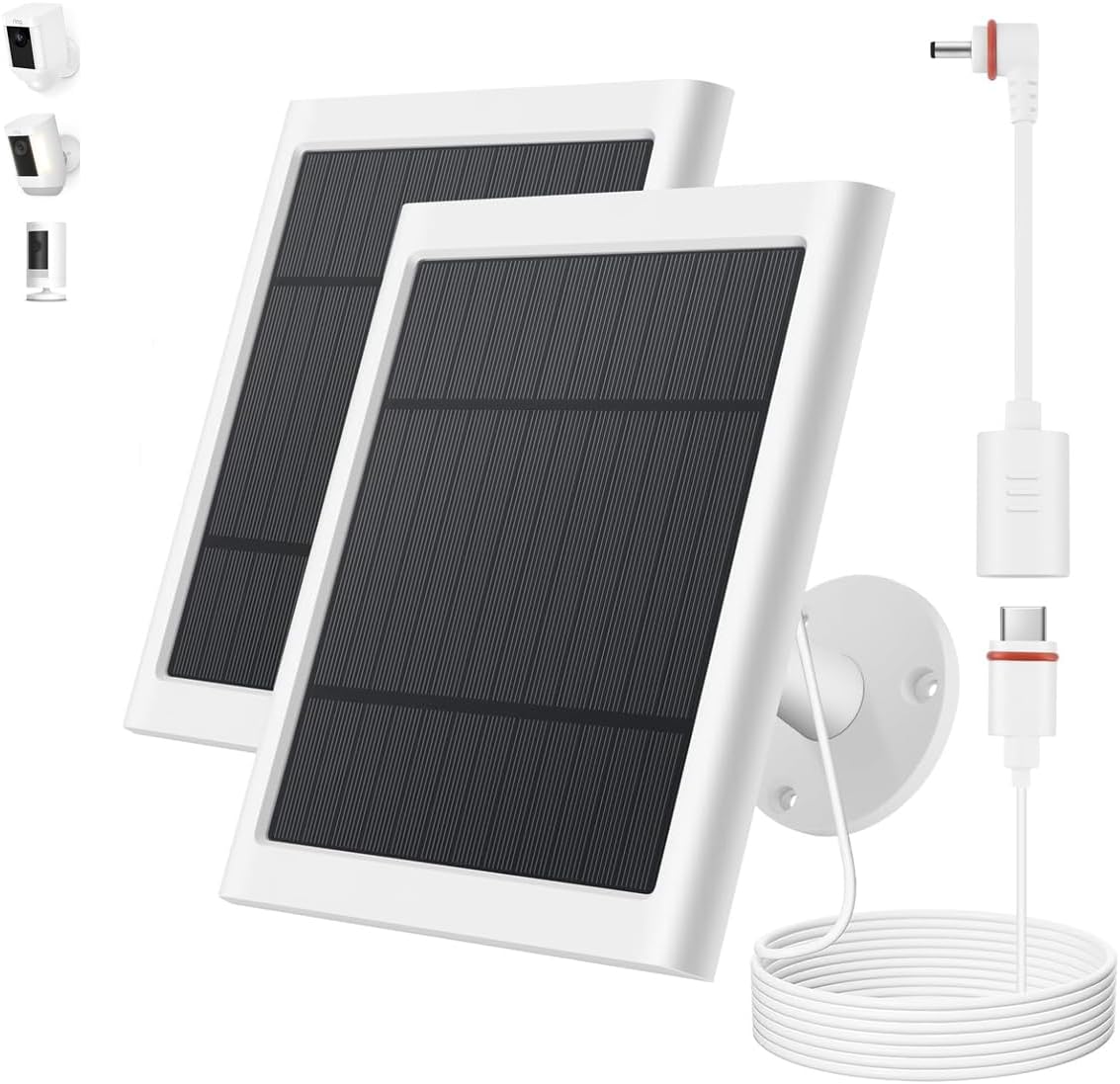
This two-pack of 4W solar panels is a specialized solution for maintaining compatible security cameras around a shed, porch, gate, or outbuilding. It has a 4.2 rating and supports selected Ring Stick Up Cam and Spotlight Cam battery models, along with the listed Reolink Argus Pro, through included USB-C and barrel-plug adapters.
We may earn a commission when you buy through this link, at no additional cost to you.
Each panel provides 6-volt, 4-watt trickle charging under direct sunlight. A 10-foot cable and a 360-degree rotatable mount allow the panel to be positioned away from the camera housing where it can receive better light. The package includes two panels, two Type-C cables, two adapter cables, two mounting brackets, cable clips, and screws.
The interfaces are designed to resist damage and continue operating in rainy, windy, and sunny conditions. Solar charging can reduce how often a compatible camera battery must be removed for manual charging. The product description notes that some Ring devices do not begin accepting solar charging until their battery falls below approximately 90%, and recommends an initial manual charge when a battery is nearly depleted.
This is the appropriate pick for a homeowner whose primary shed-related solar need is continuous security-camera power. It cannot charge a battery bank, power tools, or operate a shed-lighting system. Compatibility should be confirmed before ordering, and the camera should be mounted in a position where the small panel receives sufficient direct sunlight.
A 4-watt panel is sufficient for a compatible low-consumption camera but would be undersized for larger equipment. Using dedicated adapters and the correct controller avoids trying to power a broader battery system with a trickle panel.
The long cable and rotating mount allow the panel to face sunlight while remaining connected to a camera under an eave or on a shaded wall. The included cable clips help keep the wiring orderly along the mounting surface.
We may earn a commission when you buy through this link, at no additional cost to you.
The 396-LED solar shed light is designed for broad, flexible illumination and has a 4.1 rating. It uses 396 integrated LED beads to cover up to 400 square feet, making it suitable for a yard, patio, workspace, barn, chicken coop, gazebo, or covered balcony.
We may earn a commission when you buy through this link, at no additional cost to you.
A split design separates the solar panel from the light. The 16.4-foot extension cable allows the panel to charge in full sun while the lamp hangs where it is needed. The product claims six to eight hours of charging for eight to twelve hours of nighttime operation, although the manufacturer recommends an initial full eight-hour charge for best starting performance.
Its remote provides five operating modes: motion on/off, motion bright/dim, all-night constant, daytime on with a pause for charging, and automatic activation at dusk. Brightness, mode selection, and 2-, 4-, or 6-hour auto-off schedules can be programmed from the remote. This is more adjustable than many simple solar shed lights.
The IP65-rated construction is intended for outdoor exposure, and the hanging hook enables installation without electrical wiring. It is a good match for users who want remote-controlled lighting in a larger area. The tradeoff is its lower listed rating and the normal dependence of every rechargeable solar light on adequate sun exposure and correct placement.
Motion-sensitive modes can conserve stored energy in low-traffic areas, while constant or dusk-to-dawn settings suit work zones that need predictable visibility. Programmable timers help prevent the light from operating longer than required.
The extended cable solves a common solar-light problem: the best sunny position may not be the most convenient place for the lamp. Keeping the panel in direct sun and the light under cover or near a doorway maximizes practical usefulness.
We may earn a commission when you buy through this link, at no additional cost to you.
The HISHEN 100W panel is a low-profile fixed option for sheds where debris accumulation and long-term maintenance matter. It has a 4.6 rating and uses a frameless Cleanedge design intended to reduce dust, water, snow, and debris collecting around the panel edges.
We may earn a commission when you buy through this link, at no additional cost to you.
Its smooth, frameless surface is designed so rain can help wash away residue more easily than it might on a panel with a raised frame. The panel uses 16BB A-grade monocrystalline cells and is listed for 12-volt or 24-volt battery-charging systems, offering a useful middle ground between compact maintainers and larger kits.
Pre-drilled mounting holes and standard MC4 connectors make the panel easier to integrate with an existing controller and wiring. It is described as suitable for shed roofs, small rooftops, RV roofs, marine cabins, home backup systems, and other off-grid installations. The streamlined profile also fits visually into modern residential and mobile applications.
This panel is best for a user who already has a compatible charge controller or wants to build a system gradually. It is not a complete kit, and the frameless construction deserves secure, compatible mounting. Buyers should compare the listed electrical specifications with their controller and inverter before purchase, as the product description specifically recommends doing so.
The absence of a conventional raised frame reduces the number of ledges where dirt and precipitation can collect. That design supports more consistent exposure to sunlight and can make routine cleaning less demanding in dusty or seasonal environments.
Standard MC4 connectors and a 12V/24V-oriented design make the panel suitable for common off-grid architectures. Because no controller is included, it offers flexibility for builders who already have compatible power electronics.
We may earn a commission when you buy through this link, at no additional cost to you.
The ZOUPW 100W portable panel is a versatile emergency and off-grid panel with a 4.6 rating. It combines a stated 23.5% efficiency with a foldable 100-watt design, an IP67 waterproof rating, and a broad collection of connection options for portable power stations and direct device charging.
We may earn a commission when you buy through this link, at no additional cost to you.
Its 5-in-1 cable includes DC8020, XT60, Anderson, DC7909/8mm, and DC5521 connectors. The listed compatibility covers selected Jackery, EcoFlow, Anker, and Bluetti models, as well as generic lithium batteries. A built-in intelligent controller also provides one USB-C port at 15V/3A and two USB-A ports, including a QC3.0 output.
The panel weighs 9.48 pounds and folds to 24.13 by 21.06 by 1.77 inches. Two adjustable kickstands can set the panel at a 45-degree angle, which the manufacturer says can capture up to 25% more sunlight than laying the panel flat. ETFE lamination offers resistance to heat, dust, rain, and splashes, while a zippered pocket protects the controller and cables from moisture.
This is an appealing choice for a shed emergency kit because it combines broad power-station support with direct charging for smaller devices. Its actual input rate remains limited by the connected power station; for example, a station with a 60W input limit will not draw the panel's full stated output. Always check connector shape, electrical limits, and weather exposure before relying on it during an outage.
The five-in-one connector approach reduces the need to carry a separate adapter for each supported power station. Users should still identify the correct plug for their specific model and avoid forcing an unfamiliar connector into a port.
The folding format and included handle make the panel easier to store in a garage or transport for an outage. Direct USB outputs add another layer of usefulness by keeping essential low-power devices charging even when no large battery is being replenished.
We may earn a commission when you buy through this link, at no additional cost to you.
The right small solar panel for a shed depends on the load, available roof or wall space, battery configuration, and tolerance for manual installation. Separate lighting, security-camera, battery-maintenance, and portable-power applications should be evaluated separately rather than by wattage alone.
Begin by listing the devices or tasks the system must support. A camera charger, LED fixture, battery maintainer, and power-station refill have very different energy requirements. A 4W camera panel is designed for one low-power device, while 20W systems are generally better for maintaining a small battery and 100W or 200W products suit larger charging or off-grid projects.
Choose a panel that comfortably matches the load rather than one that only works under ideal conditions. Also distinguish between charging a battery and powering equipment directly, because continuous output and stored energy serve different purposes.
Solar output depends heavily on direct sunlight, panel angle, shade, weather, and season. A shed roof with a clear southern exposure in the Northern Hemisphere or a suitable northern exposure in the Southern Hemisphere generally offers better conditions than a wall under trees. Portable panels should be repositioned as needed, while fixed panels require an angle that balances winter production, structural mounting, and the need to clear accumulated debris.
Avoid placing a panel where tree branches, roof overhangs, or stored objects will cast shadows. Even partial midday shade can reduce generation more than many buyers expect, so inspect the location across a full day before committing to an installation.
Check the battery's nominal voltage, chemistry, capacity, and permitted charging current before choosing a controller. Many compact products support common 12-volt rechargeable battery types, but compatibility still needs confirmation. Fixed systems also need a controller suited to the battery chemistry and a system voltage that matches the panel arrangement.
The number of panels also matters. Two 100W panels may be connected in parallel for a 12V system or in series for 24V, but the charge controller and battery bank must support that configuration. For portable systems, confirm the power station's maximum solar input because it can limit charging speed.
A charge controller regulates energy flowing from the panel into a battery and helps prevent improper charging conditions. PWM controllers are established and straightforward, while MPPT controllers can extract more power from certain panel and battery combinations. Integrated lights and security chargers have their own built-in charging electronics, so a separate controller is usually unnecessary.
For a complete off-grid kit, verify that the controller is actually included. Some panels use standardized MC4 connectors but arrive without a controller. Conversely, purpose-built camera chargers and shed lights should be treated as integrated appliances rather than general battery controllers.
A shed panel may face rain, snow, dust, insects, and temperature swings. Look for a corrosion-resistant frame, tempered or laminated glass, sealed junction boxes, suitable connector ratings, and stated wind and snow-load capabilities. Products with an IP65 or IP67 rating offer useful protection, but the rating does not replace sensible placement or routine inspection.
Portable folding panels benefit from reinforced grommets, ETFE lamination, and stable kickstands. Fixed frameless designs reduce edge debris but require secure mounting. Always follow the manufacturer's instructions because connector assemblies and openings may have separate environmental limits.
Decide whether the system should be permanent, semi-permanent, or entirely portable. A fixed kit may need roof anchors or wall brackets, cable routing, battery enclosures, and possibly electrical work. A lighting system may need only a sunny panel location and hanging points. A portable panel should fold or store without creating a trip hazard and should remain accessible for repositioning.
Pre-drilled holes, plug-and-play cables, adjustable brackets, and long extension leads simplify setup. Longer cables provide placement freedom but should be protected from foot traffic, sharp edges, and moisture at exposed connections. Plan the complete path before drilling or mounting anything.
If energy needs may grow, select a controller and panel arrangement that can be expanded. The Renogy 100W kit lists support for expansion to 400W, and some portable panels can be linked in series or parallel. Expansion is not automatically beneficial, however: wiring, controller capacity, battery bank size, and load requirements must all support the additional output.
For portable use, connector compatibility can be more important than maximum wattage. MC4, XT60, DC8020, Anderson, DC7908, DC5521, USB-C, and USB-A connections serve different equipment. Check the exact model and port rating before purchase so the panel can be used without improvised adapters.
Before installation, identify the load, battery voltage, connector type, and intended operating location. Read the included instructions, test the system with the battery disconnected, and confirm that the panel, controller, cables, and battery are compatible. For a fixed roof panel, inspect the mounting area for structural strength, leaks, and obstructions before drilling.
Place fixed panels where they receive the most direct sunlight and keep the surface free of dirt, leaves, snow, and bird droppings. For portable products, unfold the kickstands fully and angle the panel toward the sun. Recharge integrated lights fully before first use, and follow the stated battery-level guidance for security cameras so they enter the appropriate charging mode.
Inspect connections periodically for corrosion, looseness, cable damage, and water intrusion. Clean the glass with a soft cloth and mild water rather than abrasive materials, and never spray water directly into an electrical port. During long periods without use, maintain the battery according to its manufacturer and disconnect only with the proper equipment and procedures.
The correct size depends on what the shed needs. A dedicated lighting or camera system may need only a few watts, while a 20W panel is better suited to maintaining a small battery. A 100W or 200W panel is more appropriate for a battery bank, portable power station, or several connected loads. Calculate the expected load and daily energy use before choosing.
A conventional photovoltaic panel needs meaningful direct sunlight, so indoor placement usually produces very little energy. The panel should generally be mounted outdoors in an unobstructed sunny location, even when the battery, controller, or light is installed inside the shed. Integrated solar lights can operate indoors once their batteries are charged.
It depends on the panel rating and the device load. A 4W camera charger is designed for one compatible low-power camera, while a 100W panel can support a power station or battery bank used for several devices. Always check the output limits of the controller, power station, and connected equipment.
A standalone panel charging a battery normally needs a controller matched to the battery voltage and chemistry. Complete kits such as the ECO-WORTHY, SOLPERK, and Renogy selections include a controller. Integrated shed lights and camera chargers contain their own charging controls, so another controller is neither required nor normally intended.
Many products support common rechargeable 12V battery types, including AGM, gel, flooded, lithium-ion, and LiFePO4, but the exact list varies by product. The Renogy 100W kit also lists lithium compatibility. Verify the manufacturer's supported chemistries and confirm charge voltage and current before connecting the system.
It can be stored there, but it should not be left folded or disconnected from its charging target if it is expected to maintain a battery or power station. For frequent use, store the panel unfolded in a safe location with direct sun, or use a fixed panel. Protect cables and connections from foot traffic and moisture.
Maintenance is generally modest but not zero. Keep the glass clean, inspect brackets and cables, remove accumulated snow or debris, and check connectors for corrosion. Frameless panels may collect less edge dirt, while integrated lights and portable folding systems need their batteries and controls checked periodically.
No. A higher rating can produce more energy, but it may be unnecessary for a small camera or one LED light and may require more space, a larger controller, and a more capable battery. Match the panel to the actual load, available sunlight, and installation area so the system remains efficient and manageable.
The ECO-WORTHY 200W kit is the most capable fixed all-around system, with two monocrystalline panels, a 30A controller, and flexible 12V or 24V arrangement. The SOLPERK 20W kit is the practical budget option for maintaining compatible batteries, while the Renogy 100W Starter Kit offers a well-supported fixed foundation with strong certification and expansion options.
Prioritize the job before focusing on wattage. Dedicated lights and camera chargers are simpler for a narrow need, portable panels are best for flexible and emergency use, and complete kits suit users building a battery-powered shed. Confirm sunlight, battery compatibility, controller needs, connectors, and mounting requirements before ordering.
Customer ratings and listed specifications provide a useful starting point, but they do not guarantee performance in every location. Confirm current product details, included accessories, compatibility, and prices at the time of purchase, and choose the smallest system that can reliably meet the shed's intended load.