
Ai Smart Vending Machine with Card Reader
4.2Editor score
Up to 700-item capacity
Cashless payment options
Remote monitoring included
Our AI Smart Vending Machine for Businesses guide compares capacity, recognition, payments, app controls, refrigeration, and support for operators.
AI smart vending machines combine camera-based product recognition, contactless checkout, remote inventory management, and refrigerated or flexible storage to create convenient unattended retail. The strongest systems let customers select several products in one visit while giving operators useful sales, stock, temperature, and maintenance data.
This guide compares ten commercial vending machines using the information supplied for each model. We examine capacity, AI recognition, payment options, app functionality, refrigeration, physical design, installation requirements, warranty coverage, and intended business environments. We also distinguish between standard-power units, high-capacity systems, and models designed for daily essentials.
The list begins with a versatile refrigerated combo machine and progresses through larger and more specialized commercial systems. Each selection highlights a different reason to consider an AI vending machine, from remote multi-machine control to flexible merchandising and extensive storage. Product costs and availability can change, so confirm current details before making a purchase.
4.2Editor score

5.0Editor score

5.0Editor score
The table below compares all ten machines by their most important commercial features, including stated capacity, AI system, payment approach, and remote-management capabilities.



The Smart Combo Vending Machine is the strongest all-around option in this guide because it combines a 99%-accurate AI checkout system, refrigerated merchandising, contactless payments, and remote management in one practical commercial format. Its 4.4 rating also gives buyers more customer feedback than several unrated alternatives, although the system should still be evaluated against the intended location and product mix.
We may earn a commission when you buy through this link, at no additional cost to you.
Customers can open the door, select several items, and close it before the machine identifies the products and completes the transaction. That supermarket-style process is more flexible than traditional spiral or gravity dispensing and is particularly useful when a business wants to combine beverages, snacks, fresh food, or daily necessities. The app adds stock monitoring, sales tracking, restock-order generation, and real-time complaint handling, reducing the need for routine on-site administration.
Cashless operation is another major strength. The card reader supports credit cards, Apple Pay, Google Pay, Samsung Pay, mobile payments, and NFC transactions, eliminating coin jams, cash collection, and refund complications associated with traditional vending equipment. The trade-offs are that the unit has less stated storage than the 1100L Ultra, the M680 Max, and the 520L model, and buyers still need to verify the shelf configuration against the dimensions of their products.
This machine is a strong recommendation for offices, gyms, hotels, schools, clinics, and other indoor locations that want refrigerated products, multiple payment options, and a manageable first deployment. It is especially compelling for operators who want remote controls without moving up to the largest cabinet. Confirm electrical requirements, service access, connectivity, and local installation requirements before ordering.
The open-door format allows shoppers to take several products before the door closes and AI vision completes the order. This creates a more natural self-service experience and supports wider product assortments than single-item pickup systems.
Inventory monitoring, sales tracking, automatic restock orders, and complaint management give operators a centralized view of machine activity. These features are particularly valuable when the business eventually operates more than one site.
We may earn a commission when you buy through this link, at no additional cost to you.
The M680 Max is designed for operators who want to sell beyond ordinary snack-and-drink combinations. Its flexible storage can hold up to 572 bottled drinks or products such as toilet paper, toothbrushes, and toothpaste, making it relevant to hotels, schools, hospitals, gyms, workshops, and community locations.
We may earn a commission when you buy through this link, at no additional cost to you.
The stated 99.7% AI vision accuracy is a standout specification. Open-door grab-and-go shopping reduces the spills and broken bottles associated with gravity-fed equipment, while the 31.5-by-26.8-by-79.6-inch cabinet provides a substantial but comparatively manageable footprint. Remote app tools cover inventory, sales records, restock lists, customer complaints, and multi-location administration.
The machine supports Visa, Mastercard, Discover, American Express, Apple Pay, Google Pay, and NFC mobile payments. Its only-cashless design can simplify operations, but it also makes dependable connectivity and an available card reader essential. A lack of published customer feedback and a 120V electrical requirement should be considered when evaluating the unit for a high-traffic site.
Choose the M680 Max when a hotel, school, hospital, or community facility needs a broad mix of drinks, meals, snacks, and urgent personal supplies. It is a better fit than a smaller snack machine for mixed-merchandise strategies, while remaining less bulky than the 1100L Ultra. Buyers should confirm shelf spacing, door clearance, network coverage, and local refrigeration requirements.
Flexible shelf arrangements let operators move beyond beverage-only vending. The ability to stock urgent daily supplies gives the machine relevance in locations where customers may need practical essentials at unpredictable times.
The claimed 99.7% recognition rate supports confidence in automated multi-item checkout. As with any vision-based system, dependable lighting and clear product presentation remain important to achieving consistently accurate results.
We may earn a commission when you buy through this link, at no additional cost to you.
The XMAI Max 680L is a roomy smart vending system aimed at operators seeking a broad product assortment and flexible connectivity. It supports snacks, drinks, fresh food, bakery items, and delicate packaged goods, while its 680-liter cabinet provides room for more merchandising than smaller refrigerated units.
We may earn a commission when you buy through this link, at no additional cost to you.
Its AI vision system offers stated 99.7% checkout accuracy, and the transaction process records what happens after the door opens. That recording can provide useful evidence when a customer disputes an order or when the operator investigates a possible mis-pick. The 4G and Wi-Fi connections also improve deployment flexibility in locations where a wired network is inconvenient.
Remote management covers stock, sales, restock orders, and customer complaints. Credit cards, Apple Pay, Google Pay, American Express, and NFC payments are supported. The main uncertainties are the absence of a published rating and the lack of a detailed refrigeration specification, so buyers focused on chilled products should request temperature and product-condition information before purchase.
This model is well suited to offices, campuses, hotels, transportation areas, and other busy indoor locations that need more inventory variety. It is a sensible middle ground between the 520L machine and the larger 1100L Ultra. Confirm the available shelf configurations, how snacks and fresh products affect recognition, and whether the operator can maintain reliable 4G or Wi-Fi coverage.
Supporting both 4G and Wi-Fi makes the system easier to place in locations without a convenient Ethernet connection. Operators can use the app to monitor sales and stock without traveling to the machine for routine checks.
The camera records the selection process after the door opens, creating a transaction record for disputes and mis-picks. This adds accountability, although buyers should still review local privacy and surveillance requirements.
We may earn a commission when you buy through this link, at no additional cost to you.
The Ultra 1100L is the highest-capacity machine in this comparison, with a flexible interior capable of holding up to 848 bottled drinks or a mix of drinks, meals, snacks, and daily necessities. It is aimed at busy operators who want substantial inventory in one cabinet and can accommodate a 48.8-by-28.3-by-78.5-inch footprint.
We may earn a commission when you buy through this link, at no additional cost to you.
Its 99.7% AI vision specification, remote app, and flexible product layout make it a credible choice for high-traffic hotels, offices, factories, schools, hospitals, and transportation hubs. Cashless payment support includes major card brands, mobile wallets, and NFC transactions, while the remote tools cover inventory, sales, restocking, and complaints.
Capacity is the primary advantage, but it also creates a meaningful trade-off. A larger cabinet requires more floor space, replenishment planning, and potentially a higher total inventory commitment. There is no published customer rating, and the product description does not provide the same level of detail about glass construction, noise, or specific temperature ranges as some alternatives.
The Ultra 1100L makes the most sense for a high-demand location with a broad product mix and sufficient space. Operators should compare its physical footprint with their available alcove, confirm the door-opening clearance, and make sure the electrical and network requirements fit the intended site. It is a strong high-capacity choice rather than a compact option for a modest office.
The ability to hold up to 848 drinks can reduce replenishment visits in locations with steady demand. Effective merchandising still depends on selecting fast-moving products and maintaining disciplined stock rotation.
Flexible storage can accommodate drinks, fresh meals, snacks, and urgent supplies. That versatility makes the cabinet easier to adapt as customer preferences change throughout the year.
We may earn a commission when you buy through this link, at no additional cost to you.
The HAHA 252 Cans Capacity machine stands out for SKU flexibility and merchandising control. It can hold up to 252 bottles and more than 75 unique products across five flexible shelves, giving operators a broad snack, drink, and essentials assortment without moving to a much larger cabinet.
We may earn a commission when you buy through this link, at no additional cost to you.
The professional app supplies real-time low-stock alerts, live inventory and sales information, automated restocking orders, and reports broken down by item, time, and location. Its double-glazed hollow glass and internal desiccant are intended to reduce condensation, improve product visibility, and retain cold air. The exterior lightbox and side panels can also carry a company logo or custom design.
Its 4.6 rating is among the stronger published scores in the group, although there is no exact AI recognition figure in the supplied information. The standard 110V plug supports straightforward placement in offices, campuses, gyms, and lobbies, but the stated 252-item capacity is lower than several larger alternatives. Operators should match shelf dimensions to the products they intend to stock rather than relying only on the total capacity figure.
This is a good option for businesses prioritizing variety, visibility, and branding over maximum volume. It is also attractive for a first AI vending deployment because it combines remote management with a relatively straightforward power connection. For locations with exceptionally high sales volume, one of the 520L or 1100L systems may hold more inventory between service visits.
The ability to carry more than 75 unique SKUs lets operators create a more useful assortment of drinks, snacks, and essentials. Product-level sales reports can help identify which items deserve more shelf space.
Customizable lightboxes and side panels turn the machine into a visible business asset. This is useful in lobbies and offices where appearance and brand recognition influence customer engagement.
We may earn a commission when you buy through this link, at no additional cost to you.
The HAHA Contactless Grab and Go combines multi-item shopping, camera-based checkout, cashless payment, and a capable remote app. Its 5.0 rating is the highest published score among the machines here, making it a strong choice for operators who value a complete operating system rather than only the physical vending cabinet.
We may earn a commission when you buy through this link, at no additional cost to you.
The app provides remote device control, sales statistics, replenishment management, customer complaint handling, inventory counts, sales counts, and automatic restocking orders. Connectivity through both 4G and Wi-Fi supports flexible deployment, while the cabinet can stack goods and allow customers to select several products in a single visit. The electromagnetic lock opens after card authorization, and visual recognition determines what was removed.
The machine is ETL-certified, operates on 110V to 120V at 60Hz, and can be placed in offices, factories, colleges, healthcare settings, hotels, residences, airports, shopping malls, or gyms. Lightboxes and sides are customizable, and the seller states that it includes a one-year warranty and lifetime free technical support. The lack of a stated maximum capacity or recognition percentage means product-fit questions should be resolved directly.
This is the review choice for businesses seeking strong app functionality, support, and flexible merchandising. It also works well for operators building a multi-machine business because remote control and replenishment workflows are central to the system. Before ordering, verify cabinet measurements, shelf configuration, local connectivity, payment processor details, and installation requirements.
Remote control, sales statistics, complaint handling, and replenishment workflows make the app more than a basic stock viewer. These functions are especially useful when an operator manages multiple machines or multiple locations.
Product stacking and multi-item selection allow a smaller footprint to serve a varied assortment. Operators can update the product mix more easily as demand changes or when a new location has different preferences.
We may earn a commission when you buy through this link, at no additional cost to you.
The 456-liter refrigerated combo is a polished choice for operators who want detailed remote control and a broad assortment. It holds up to 294 items, supports more than 100 SKUs, and uses AI visual recognition with stated accuracy up to 99.5% for automated checkout.
We may earn a commission when you buy through this link, at no additional cost to you.
Its app and web portal can manage one or multiple machines, monitor status, adjust temperature, add products, manage orders and exceptions, and control multiple user accounts. Built-in product templates and photo-based product setup should reduce the work involved in creating a new catalog. AI-powered restock reminders and machine-level stock tracking support daily unattended operation.
The main trade-off is that the supplied information gives fewer electrical and warranty details than several competing listings. Buyers should confirm whether the unit uses a standard commercial connection, how the refrigeration system is rated, what service access is required, and what after-sales terms apply. A 5.0 rating is positive, but it should be considered alongside the amount of published customer feedback.
This machine is a strong recommendation for a business planning remote management across multiple units, especially when the assortment includes drinks, snacks, and different package sizes. It also suits operators who want a dedicated web interface for administrators. Confirm temperature settings, product dimensions, and installation requirements before finalizing the purchase.
The web portal and app support centralized oversight of several machines and user accounts. This makes the system attractive to operators who need delegated management rather than a single-user kiosk setup.
Built-in templates and photo-based product creation simplify the initial setup. Faster catalog entry matters when an operator wants to add new items or adapt stock to seasonal demand without excessive manual work.
We may earn a commission when you buy through this link, at no additional cost to you.
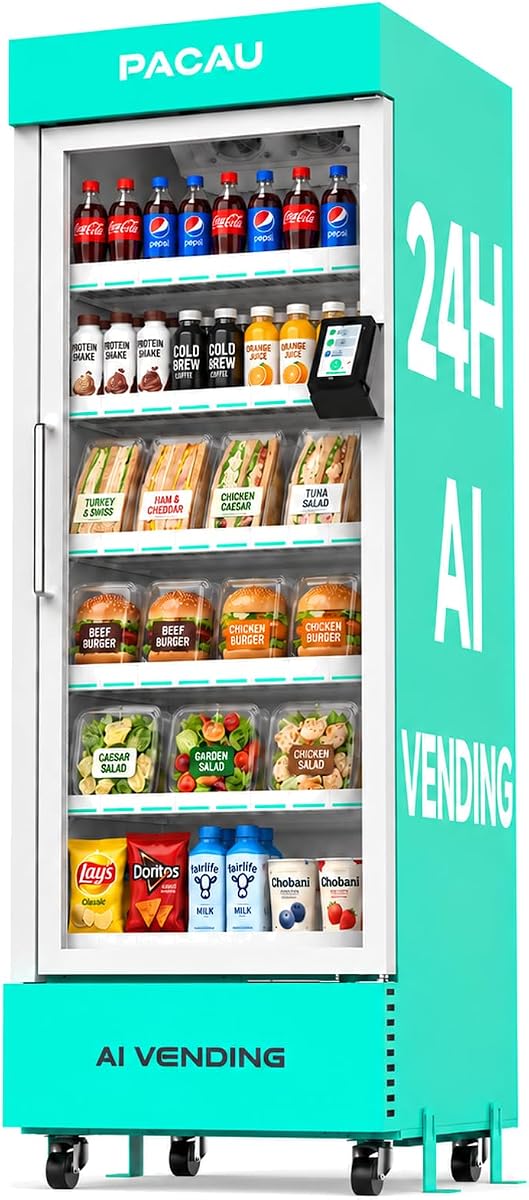
The Ai Smart Vending Machine with Card Reader is the value-focused choice in this roundup, combining up to 700 stored products with cashless checkout, remote monitoring, restock alerts, and a simple 110V installation format. Its 4.2 rating is supported by published customer feedback, which is helpful for a category where many listings lack ratings.
We may earn a commission when you buy through this link, at no additional cost to you.
The 28-by-29-by-79-inch cabinet is designed for beverages, snacks, coffee, candy, pizza, chocolates, and daily essentials. It supports Visa, Mastercard, Apple Pay, Google Pay, and American Express through tap, swipe, or chip transactions. Remote inventory monitoring and simple plug-and-play setup make it approachable for operators who want useful data without committing to the most elaborate app ecosystem in the list.
The trade-offs are that the listing does not state an exact AI recognition rate, and the remote-management features appear less expansive than those offered by the HAHA, XMAI, and 456L systems. Cash is not accepted, so operators should consider customer demographics and connectivity. Remote monitoring still requires a stable network link and regular attention to low-stock alerts.
This is a good machine for offices, homes, retail areas, and other locations that need broad capacity and contactless payment. It is particularly attractive for a business that wants the basic benefits of AI vending without moving to the largest cabinet. Before ordering, confirm the usable shelf dimensions, temperature configuration, door clearance, and what is included in the stated component warranty.
A stated capacity of up to 700 products reduces the need for frequent replenishment while cashless payment simplifies collection. The result is a practical operating model for relatively busy sites.
Inventory tracking and restock alerts give operators a clear view of what needs attention. The feature set is less elaborate than some competitors, but it covers the core requirements for efficient daily management.
We may earn a commission when you buy through this link, at no additional cost to you.
The 520L AI Smart Vending Machine is a compelling indoor option for offices, hotels, gyms, schools, hospitals, factories, and apartment properties. Its 520-liter cabinet can hold up to 800 standard 300ml bottles, depending on product size and shelf layout, while the stated 5.0 rating gives it a strong customer-feedback signal.
We may earn a commission when you buy through this link, at no additional cost to you.
The machine uses an open-door, pre-authorized checkout flow. Customers open the door, take products, close it, and allow AI vision recognition to complete the charge. The remote app monitors inventory, sales, temperature, and machine status, and an integrated card reader supports cashless and contactless payments. Adjustable shelves allow the operator to mix drinks, snacks, packaged foods, and daily essentials.
Its most distinctive physical features are active anti-fog glass, insulated construction, operation below 45 dB, a reinforced cabinet, and a secure center door lock. These specifications suit indoor environments where noise, visibility, and unattended security matter. The exact AI recognition percentage is not provided, and the 800-bottle figure depends on using 300ml bottles and a suitable shelf configuration.
Choose this machine when a business wants a large vending footprint, relatively quiet operation, and clear refrigerated displays. It may be especially useful in offices and apartment buildings where distracting machinery noise would be unwelcome. Confirm actual capacity with the products you plan to sell, review the temperature range, and verify the app's regional payment and connectivity requirements.
Operation below 45 dB is useful in offices, gyms, hotels, and residential areas where a louder compressor could affect the atmosphere. The stated noise level makes the machine feel more like a retail fixture than industrial equipment.
Active anti-fog glass helps customers see products through the closed door, while the reinforced cabinet and center lock support unattended operation. These details improve both merchandising and loss prevention.
We may earn a commission when you buy through this link, at no additional cost to you.
The MAYCHI Smart Vending Machine differentiates itself with a three-camera AI vision arrangement, a specific 32°F to 50°F refrigeration range, and six adjustable shelf tiers. The 16.67-cubic-foot interior is designed to accommodate snacks, bottled and canned beverages, and everyday essentials in a 120V commercial installation.
We may earn a commission when you buy through this link, at no additional cost to you.
Three cameras capture different viewing angles during the shopping session, potentially improving recognition when products are positioned near shelves, corners, or one another. The app provides remote inventory, sales, machine status, and product-setting management through 4G, making the system suitable for operators who do not want to depend exclusively on a local network connection.
The reinforced top-and-bottom locking system adds security for unattended retail, while the six adjustable tiers offer more layout freedom than a fixed spiral configuration. The trade-off is that the supplied information gives no exact AI accuracy rating or customer score, so operators cannot compare the vision performance with the 99.5% and 99.7% figures published by other products.
This machine is worth considering for businesses that value multiple recognition angles, clearly stated refrigeration, and flexible shelving. It is also appealing to operators who want remote management over 4G and U.S. warehouse shipping. Before buying, confirm the 16.67-cubic-foot figure against available floor space, review the locking system, and request clarification on recognition performance and after-sales coverage.
Using cameras at multiple viewing angles can reduce blind spots during product identification. The system is designed to observe the entire shopping session after the door opens and then settle the transaction.
The stated 32°F to 50°F range is useful when matching refrigeration performance to chilled beverages and food. Temperature requirements should still be checked against the exact products intended for sale.
We may earn a commission when you buy through this link, at no additional cost to you.
The right AI vending machine depends on location traffic, product dimensions, refrigeration needs, payment preferences, and the level of management required. Compare the following factors before ordering a commercial system.
Capacity figures are only useful when they align with the products you intend to sell. Some manufacturers state bottle counts, others cite total products, and cabinet volume alone does not account for wasted space around irregular packages. Compare the internal dimensions, number of flexible shelves or tiers, maximum SKUs, and the dimensions of individual products against the merchant's actual assortment. The Ultra 1100L and M680 Max offer the largest stated inventories, while the 520L can hold up to 800 standard 300ml bottles with the appropriate layout. The 456L and 252-bottle models may suit businesses that value product variety over maximum volume.
AI vision identifies the products a customer takes and enables automatic charging without scanning each item. Published accuracy claims range from 99% to 99.7% across several machines, while others do not provide an exact figure. Look for the camera arrangement, transaction recording process, and how disputes or mis-picks are handled. The MAYCHI uses three cameras for multiple angles, and the XMAI records the complete selection session. Recognition performance also depends on lighting, shelf placement, product visibility, and a clean camera lens, so attractive accuracy claims should not be treated as a substitute for a well-lit installation.
Cashless systems simplify coin collection, jams, refunds, and manual cash reconciliation. Most models support credit cards and NFC, and several accept Apple Pay, Google Pay, and Samsung Pay. A cashless-only machine should be placed where customers are comfortable using digital payment. Remote management also requires dependable connectivity; 4G support provides an alternative to fixed Wi-Fi, while machines using only a local network need reliable coverage at the exact position. Confirm processor coverage, whether SIM or connectivity service is required, and whether the machine can continue operating through a temporary network interruption.
The management platform is the operational backbone of an unattended vending business. Look for real-time stock levels, sales reports, automated restock lists, machine-status monitoring, exception handling, customer complaint tools, and multi-machine support. The HAHA AI Plus, 456L, and XMAI systems provide broad remote control, while some alternatives emphasize simpler monitoring and alerts. Businesses managing several units should also examine user roles, product templates, photo-based setup, and whether reports can be filtered by item, time, or location. An app that is easy to navigate and provides actionable alerts is generally more useful than one with many features that are difficult to interpret.
Refrigeration is essential for beverages, fresh meals, dairy products, and other temperature-sensitive inventory. Compare stated temperature ranges, glass construction, anti-fog features, insulation, and cooling technology. The MAYCHI specifies a 32°F to 50°F range, the HAHA 252-bottle model uses double-glazed hollow glass with desiccant, and the 520L emphasizes active anti-fog glass and quiet operation. A refrigeration claim alone is not enough; buyers should verify how ambient room conditions, door-opening frequency, and product types affect the cabinet environment. Proper airflow around the unit is also important for reliable performance.
Commercial vending cabinets need adequate floor space, door clearance, ventilation, and access to power. The Ultra 1100L is the largest listed machine, while the M680 Max and 456L options occupy a middle ground. Before ordering, measure the delivery path, final position, service access, and the area needed to open the front door. Most units operate on 110V or 120V at 60Hz, but the exact connection, cord length, dedicated circuit recommendation, and ventilation requirements should be confirmed. Although plug-and-play operation is advertised for several systems, commercial installation rules and the seller's guidance still apply.
Unattended machines need locks, reinforced structures, durable payment hardware, and clear procedures for unusual events. The 520L has a reinforced cabinet and center door lock, the MAYCHI uses top-and-bottom locking, and the budget-oriented model includes an upgraded locking structure. AI recognition and recorded transactions can also deter theft and help resolve disputes, but they do not replace sound physical security. Consider the construction, lock design, serviceability of high-wear components, and the level of local technical support available if a machine needs attention.
Commercial equipment should be supported by a clear warranty and knowledgeable service process. The HAHA AI Plus states a one-year warranty with lifetime free technical support, the MAYCHI includes a one-year warranty and U.S. warehouse shipping, and the 456L listing highlights a support portal without giving a precise duration. Other models mention component warranty coverage or ongoing technical assistance. Before buying, ask what the warranty covers, whether labor and shipping are included, how replacement parts are supplied, and how remote diagnostics are handled. A strong support policy is particularly valuable when the machine is in a location that is inconvenient to visit.
Begin with a controlled site survey. Measure the final position and delivery path, confirm electrical and network requirements, and choose an indoor or sheltered location that matches the machine's stated operating conditions. Keep the front door, ventilation areas, and service panels unobstructed. Before loading products, clean and dry the shelves, inspect the camera lenses and lighting, and connect the management app using the operator account provided by the seller.
Add each product through the app or web portal using the correct template, name, price, category, and photograph. Arrange products so labels and shapes remain visible, keep similar items in clearly separated positions, and leave enough clearance for the camera to identify selections. Test a small group of products before filling every shelf. Then run a supervised multi-item purchase, check the recorded transaction, and confirm that inventory deductions and the completed sale agree.
For routine care, review low-stock and exception alerts each day, clean the camera glass and door seals regularly, and check that cooling airflow remains unobstructed. Keep the cabinet and payment area free of dust, moisture, and visible damage. Restock according to sales reports, rotate dated food, and document technical issues with photos and machine identifiers. The seller or support provider should handle major electrical, refrigeration, or vision-system repairs rather than allowing unqualified staff to open protected components.
It is a self-service retail machine that uses cameras and AI-based visual recognition to identify products selected by a customer. After payment is authorized, the customer opens the door, removes the desired items, and closes it, allowing the system to charge for the detected products. Many also provide remote inventory, sales, temperature, and restocking tools.
The customer normally authorizes a card or mobile payment first, after which the door unlocks. Cameras record and classify the products taken during the session. When the door closes, the system applies the identified product prices, completes the transaction, and updates its inventory records. Accuracy can be affected by lighting, product placement, obstructions, and camera cleanliness.
They can be suitable when the site has enough traffic, reliable connectivity, and a clear product assortment. A compact or mid-capacity model may work well in an office lobby, while a larger unit may better serve a busy hotel, gym, factory, or school. The operator should compare capacity, replenishment effort, refrigeration, and the machine's physical footprint before choosing.
Most models in this comparison are cashless and emphasize credit cards, contactless wallets, and NFC payments. The HAHA AI Plus, M680 Max, 456L, 520L, MAYCHI, and budget-oriented listing are described as cashless, while other listings emphasize contactless checkout without clearly confirming cash support. Buyers should verify payment acceptance before placing an order.
Several products explicitly support multi-machine or multi-location management, including the HAHA AI Plus, XMAI, Ultra 1100L, 456L, and MAYCHI systems. Operators can monitor stock, sales, machine status, and restocking needs through a central interface. The exact account, reporting, and user-permission features should be confirmed with the seller.
The best assortment depends on the location and customer profile. Offices may favor beverages and convenient snacks, hotels may need drinks and travel essentials, and gyms may benefit from sports drinks and energy products. Operators should begin with familiar, clearly recognizable packages, use sales data to identify winners, and maintain enough variety without filling every shelf with slow-moving inventory.
Restocking frequency should follow sales volume, machine capacity, and the time needed to travel to the location. Remote stock alerts and sales reports make it easier to identify low items, but frequent locations may require scheduled visits. Large-capacity units reduce the number of trips when they are filled, while high-traffic products still need prompt replenishment to avoid lost sales.
Operators should regularly clean the camera lenses, inspect the door and lock, check product presentation, and review inventory or exception alerts. Refrigerated units also need unobstructed airflow and periodic temperature checks. Major electrical, cooling, payment, or AI-system repairs should be directed to qualified support personnel rather than handled by operators without technical instructions.
The HAHA Contactless Grab and Go stands out for its complete remote-management suite, multi-item merchandising, support commitments, and 5.0 rating. The 456L refrigerated combo is another polished option for operators managing multiple machines through app and web tools, while the Ai Smart Vending Machine with Card Reader offers substantial capacity and core remote tools at the value end of the list.
Before choosing, prioritize the factors that will determine daily performance: usable shelf space, product visibility, refrigeration requirements, payment compatibility, network reliability, physical security, and the ease of managing restocks. High-capacity systems are not automatically the best choice for every business, and sophisticated AI features are most useful when the product layout, lighting, and site conditions support them.
Current costs, availability, installation terms, and service details may change, so review the seller's latest listing and ask for written confirmation of specifications. Verify the exact capacity with real products, confirm electrical and connectivity requirements, and understand warranty coverage before placing an order. Those checks can prevent an attractive-looking machine from becoming a poorly matched operating investment.

