
LeapFrog LeapPad Academy Kids’ Learning Tablet, Green
4.3Editor score
Educator-approved learning apps
Shatter-safe seven-inch screen
Stylus and kickstand bumper
Choosing a tablet for a 3-year-old means balancing engaging play with simple controls, strong parental controls, eye-comfort features, and a construction that can handle daily use. The best option should be easy for small hands, suitable for short learning sessions, and flexible enough to accommodate a child as learning skills develop.
We compared ten tablets using the supplied specifications, focusing on age guidance, screen size, storage, performance, battery life, included accessories, cameras, connectivity, and the parental tools available to adults. The list includes general-purpose Android kids tablets, compact models, and purpose-built LeapFrog learning devices.
Each pick highlights a different balance of features, from basic entertainment and hands-free viewing to advanced performance and stylus-based creativity. Ratings and specifications reflect the current product information, while prices and availability can change, so shoppers should confirm the latest listing details before making a purchase.
4.3Editor score
4.6Editor score

4.0Editor score
As an Amazon Associate we earn from qualifying purchases.
The comparison below highlights age range, display size, core performance, and the protective or parental-control features that matter most when selecting a tablet for a 3-year-old.


The COLORROOM 2026 Upgraded Android 15 Tablet combines a child-focused Android environment with hardware suited to videos, reading, learning, and casual games. Its 4.2 rating reflects a generally capable package, and the strongest elements are the 10.1-inch display, Google Kids Space, expandable storage, and generous 6000mAh battery. For a 3-year-old, it offers enough screen space for shared viewing without becoming a full-size adult tablet.
We may earn a commission when you buy through this link, at no additional cost to you.
Performance comes from an octa-core processor, 10GB of combined RAM, and 64GB of internal storage. The included Kids Space contains educator-endorsed activities such as coloring, crafts, story listening, and puzzles, while parental tools allow adults to filter content, establish educational targets, and set time restrictions. Automatic brightness adjustment and an anti-blue-light design help make the 1280-by-800 screen more comfortable for short, supervised sessions.
There are some trade-offs. The listed 10GB RAM figure combines 4GB of physical memory with 6GB of expansion, so it should not be compared directly with tablets offering 24GB of RAM. A separate MicroSD card is required for storage beyond 64GB, and the initial full charge is described as taking at least three hours with a suitable wall charger. These are understandable limitations for a value-oriented family tablet.
This is a strong recommendation for parents who want a conventional Android tablet with a dedicated child experience, generous expandable storage, and an eye-comfort screen. It works particularly well for a 3-year-old beginning to explore stories, games, and simple educational apps. The included battery and Google Kids Space make it more focused than a standard tablet, while its 10-inch format should remain useful as the child gets older.
Google Kids Space gives younger children a more focused starting point than a standard Android home screen. The included activities cover simple crafts, animal coloring, puzzles, and story listening, giving a 3-year-old useful choices without requiring an adult to locate every suitable app.
The 64GB internal capacity should hold basic games, music, and videos, while MicroSD expansion up to 1TB provides room for a larger collection. The card is sold separately, so families should confirm that their preferred apps can use expandable storage before relying on it.
We may earn a commission when you buy through this link, at no additional cost to you.
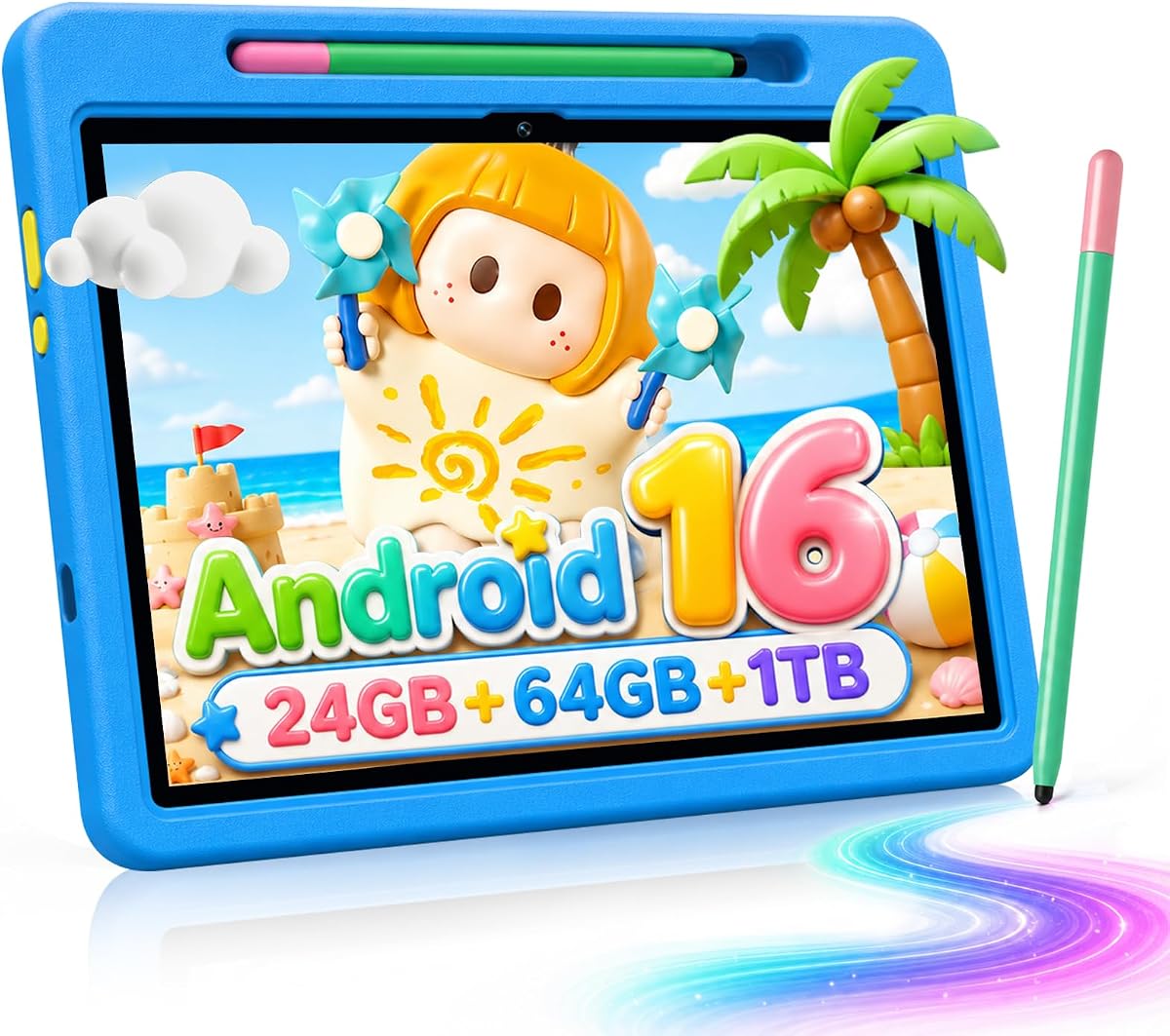
The Android 16 Kids Tablet HD 10 Inch with Stylus & Case is the most balanced recommendation in this guide. Its 4.6 rating is the highest among the ten products, and its defining combination of a 10-inch display, 24GB RAM, 64GB storage, included stylus, and adjustable case makes it well suited to a child who is beginning to learn, draw, watch, and explore independently.
We may earn a commission when you buy through this link, at no additional cost to you.
The tablet is explicitly positioned for ages 3 through 12 and uses an A333 processor rated up to 1.8GHz. That performance specification supports app launches, educational applications, videos, reading, and casual games, while storage can be expanded to 1TB with a separately sold TF card. UKIDOZ Kids Space provides age-appropriate learning games, educational content, and picture books, and the parental system supports screen-time limits, app permissions, and content filtering.
Its physical package is especially useful for a 3-year-old. The case is described as anti-slip, anti-scratch, and drop-resistant, with a 180-degree adjustable stand that can provide a stable viewing position during stories or lessons. The stylus gives the child another way to practice writing and drawing, reducing reliance on direct finger taps. A 6000mAh battery, 5MP front camera, and 8MP rear autofocus camera add versatility for family calls and creative projects.
This is the best all-around choice for families seeking a full Android tablet that still feels tailored to young children. It is more advanced than a basic learning toy and more complete than a small media tablet, while the included accessories reduce the need for separate purchases. Parents should still create individual profiles, review the preinstalled environment, and supervise internet and app use, as with any connected device.
The included case and stylus make this a more complete setup than many competing kids tablets. The case improves grip and protection, the stand supports hands-free viewing, and the stylus introduces drawing and writing without requiring a separate accessory.
UKIDOZ Kids Space, age-specific learning material, and configurable parental controls create a useful starting point for a 3-year-old. The broader Android platform and Google Play access also allow the child to use more advanced tools later without changing devices.
We may earn a commission when you buy through this link, at no additional cost to you.
The LeapFrog LeapPad Academy Kids’ Learning Tablet in green is designed specifically for children ages 3 through 8, placing it squarely in the range of a 3-year-old’s needs. Its 4.3 rating and child-centered design make it a premium option for parents who value structured learning over the broader app access found on general Android tablets.
We may earn a commission when you buy through this link, at no additional cost to you.
More than 20 educator-approved applications cover math, reading, writing, coding, problem-solving, and creativity. The LeapFrog App Center can expand the experience with additional games, videos, music, and eBooks, while a three-month LeapFrog Academy trial introduces more than 2,000 games, activities, eBooks, videos, and songs. A rechargeable battery means the child can use it without being tethered to a cable during every session.
The hardware is tailored to young hands and energetic use. The seven-inch screen is described as shatter-safe, and the tablet includes a stylus, a tough bumper, and a kickstand for stable viewing. Parents can set time limits, manage applications, and guide the child toward kid-friendly web content through the included parent controls. These features reduce the setup burden compared with configuring an unrestricted tablet from scratch.
This is an excellent choice for a 3-year-old whose tablet will serve as a dedicated learning companion. The trade-off is that extra media and some learning content require separate purchases or a continuing subscription, and it is less flexible than an Android tablet for conventional apps. Families prioritizing age-appropriate education, a focused environment, and a simple stylus-based experience will find that focus valuable.
The application library begins with foundational subjects, including letters, numbers, reading, and creative problem-solving. A young child can explore age-appropriate activities without encountering the broad and sometimes unpredictable content of a standard app marketplace.
The shatter-safe seven-inch display, tough bumper, kickstand, and included stylus make the device practical for children who may drop devices, tap forcefully, or need a stable surface for drawing and activities.
We may earn a commission when you buy through this link, at no additional cost to you.
The YINOCHE 10-inch Kids Tablet offers a large screen, an inclusive protective case, and access to familiar Google Play apps in a child-oriented package. Its 3.8 rating is the lowest shown in this roundup, so it represents a value-focused alternative rather than the strongest all-around recommendation. The 10.1-inch touchscreen is still well suited to videos, reading, and simple learning activities.
We may earn a commission when you buy through this link, at no additional cost to you.
The hardware uses a 2.0GHz dual-core processor, 2GB RAM, and 32GB of internal storage. A MicroSD card can add up to 1TB, although a card is not included. The preloaded Yubabe kids app includes offline games, videos, and eBooks intended to support creativity, STEM exploration, and early reading, while Google Play allows access to services such as Netflix and YouTube Kids when an adult permits it.
Parental controls are the key strength for a 3-year-old. Adults can set time limits, block unsuitable content, and create separate profiles for children. The low-blue-light display and automatic eye-protection features are also appealing for early users. On the other hand, limited memory may produce less smooth performance than the higher-ranked models, especially with several demanding apps open at once.
This tablet is best for families seeking a large, inexpensive Android screen with a case and useful controls. It offers more flexibility than a closed learning ecosystem and a larger display than the compact models, but its lower rating and modest specifications make it less attractive for intensive app use. Viewed as a supervised first tablet, however, it can provide plenty of value.
The 10.1-inch display offers enough space for an adult and child to look at a story, puzzle, or video together. That makes it useful beyond individual entertainment and can support shared learning at home or during travel.
Google Play access lets parents select educational tools and familiar entertainment services, while the preloaded Yubabe app provides a convenient offline starting point. The main requirement is thoughtful adult setup, particularly for younger children.
We may earn a commission when you buy through this link, at no additional cost to you.
The Compact 7-Inch Kids Tablet is an appealing entry point for a 3-year-old because it is small, protected, and explicitly designed for children ages 3 through 9. Its 4.0 rating reflects a straightforward Android device with useful controls, and the included shockproof case with an adjustable stand makes it easier to use independently than an unprotected tablet.
We may earn a commission when you buy through this link, at no additional cost to you.
The tablet runs Android 12 with a quad-core processor, 4GB of RAM including 2GB of expansion, and 32GB of internal storage. MicroSD expansion reaches 512GB, while the 1024-by-600 IPS display supports automatic brightness adjustment. Wi-Fi, Bluetooth, dual speakers, a 3.5mm headphone connection, a 2MP front camera, and a 2MP rear camera cover the basics for stories, music, video, and simple communication.
For parents, the strongest features are the control options. The device supports screen-time limits, password protection, separate profiles for each child, app blocking, and unsafe-page filtering. Preinstalled kid apps and GMS certification make it convenient to add suitable Google Play applications. The trade-off is its modest resolution and storage, both of which may feel limited compared with the 10-inch models.
This is the best budget option in the guide for households that want a dedicated, portable device without spending more. Its smaller body may be easier for a 3-year-old to hold than a full-size tablet, and the stand reduces the need for constant support. Families prioritizing inexpensive, simple, supervised use should find the trade-offs reasonable, especially if storage is expanded and activities are kept age-appropriate.
A seven-inch display and slim body are easier to carry and less likely to be dropped like a much larger tablet. The included case adds a soft protective layer, making the package more practical for travel and everyday play.
Passwords, screen-time limits, app blocking, and individual child profiles allow adults to shape the experience without relying entirely on supervision. These tools are particularly useful once a child begins moving beyond preinstalled content.
We may earn a commission when you buy through this link, at no additional cost to you.
The LeapFrog 2-in-1 LeapTop Touch is less conventional than the other picks, but it may be one of the most developmentally appropriate options for a 3-year-old. Rated 4.7, it is a compact learning toy for ages 2 through 5 that uses a flipping screen and physical keyboard rather than a general-purpose tablet operating system.
We may earn a commission when you buy through this link, at no additional cost to you.
The screen converts between keyboard mode and touch mode. In keyboard mode, children can explore the A-Z alphabet and numbers 1 through 10; in tablet mode, the same device supports touch activities. Five learning modes cover letters, numbers, games, music, and messages. Role-play options let children imitate common adult activities, and parents can customize the toy to help a child spell their own name.
The biggest advantage is its simplicity. There is no app store, advertising environment, or complicated setup, which makes it easier to introduce a screen-based learning tool to a young child. The trade-off is that it cannot provide the apps, connectivity, camera functions, or media library of an Android tablet. It also requires three AA batteries, and the included batteries are intended only for demonstration, so regular-use batteries should be added separately.
This is a strong recommendation for parents seeking a first electronic learning toy rather than a full tablet. A 3-year-old can use it to practice letters, numbers, and role-play in a controlled environment, then transition to a more capable device later. It is also a useful alternative for families who want learning without connected-app risks. For users seeking a general-purpose tablet, the other options in this roundup are more versatile.
The LeapTop Touch keeps the experience focused on letters, numbers, games, music, and messages. A young child can begin immediately without learning how to navigate an app store, manage accounts, or evaluate unfamiliar downloads.
The convertible design makes typing and touch interaction part of the play experience. It can help a child understand basic device concepts while supporting activities that mirror how adults use computers and tablets.
We may earn a commission when you buy through this link, at no additional cost to you.
The YINOCHE 7-Inch Kids Tablet combines a compact Android device with a protective case, an adjustable stand, offline educational content, and a 3.8 rating. Designed primarily for ages 3 through 7, it offers a practical combination of size and features, although the explicit choking-hazard warning deserves attention before buying it for a very young child.
We may earn a commission when you buy through this link, at no additional cost to you.
A quad-core processor and 32GB of internal storage provide the foundation for educational apps, videos, games, and creative tasks. Storage can be expanded to 512GB with a TF card. The Yubabe app includes puzzles, storytelling content, and games intended to encourage creativity, critical thinking, and problem-solving. The device also supports Google Play services, giving parents access to options such as YouTube Kids, Netflix, and other suitable applications.
Parental features include custom profiles, app blocking, content filtering, and screen-time limits. Its dual cameras support simple photography and video creation, while Wi-Fi and Bluetooth cover everyday connectivity. The rugged case is designed to withstand drops, bumps, and spills, and the adjustable stand allows hands-free viewing during lessons or movies. However, the warning about small parts and the fact that it is not intended for children under three make it less universally suitable.
For a 3-year-old who is old enough for the product and comfortable with the included accessories, this is a capable compact tablet. It is particularly useful for travel because the smaller form factor is easier to carry. Families should inspect the warning, supervise accessory handling, and avoid allowing unsupervised use if the child tends to mouth small components. It offers good portability, but its lower rating and safety warning place it behind the safer, more clearly age-targeted options.
The combination of preloaded storytelling, puzzles, cameras, and downloadable creative apps gives a child more ways to explore than a basic media player. The adjustable stand is particularly useful for drawing, video calls, and watching lessons.
The product information specifically warns of a choking hazard and says it is not for children under three. Buyers should carefully assess the child, the included accessories, and the manufacturer's guidance rather than relying solely on the broader age-oriented marketing.
We may earn a commission when you buy through this link, at no additional cost to you.
The WXUNJA Android 15 Kids Tablet is a 10.1-inch Android 15 device built around smooth everyday performance, a child-focused software environment, and modern connectivity. Its 4.2 rating places it among the stronger options here, while the octa-core processor, 64GB storage, and expandable memory make it suitable for a child moving beyond simple games.
We may earn a commission when you buy through this link, at no additional cost to you.
The screen is a 1280-by-800 HD IPS touchscreen with wide viewing angles and eye-comfort technology designed to reduce blue-light exposure. Google Kids Space provides age-appropriate activities, while parental controls help adults create profiles, manage screen time, and guide content. Google Play access expands the possibilities with educational applications, games, and conventional entertainment when appropriately configured.
Its 6000mAh battery is stated to provide up to six hours of video playback, and 18W PD fast charging helps reduce downtime. Dual-band Wi-Fi, Bluetooth, GPS, wireless screen casting, and split-screen functionality add useful versatility. The included silicone case protects against bumps and has an adjustable stand. One point to note is that the listed 18GB of virtual RAM supplements rather than replaces the 3GB of physical RAM.
This is a compelling recommendation for families who want a larger Android tablet with a polished set of child and parental features. It should work well for educational videos, reading, games, and creative tasks, and the five-year warranty adds reassurance. The lack of an included stylus means drawing activities may require another accessory, but the strong display, performance, and charging specifications compensate for that limitation.
The Android 15 operating system, octa-core processor, and dual-band Wi-Fi create a more responsive platform for apps and media. Split screen and screen casting also make the tablet useful beyond solitary use, including shared learning and family entertainment.
A 6000mAh battery and 18W PD charging support are helpful for regular use, particularly on longer trips. The included silicone case and adjustable stand provide basic protection and a stable hands-free position at a lower cost than adding separate accessories.
We may earn a commission when you buy through this link, at no additional cost to you.
The aiprotablet 10-Inch Kids Tablet brings Android 16, a Unisoc T606 octa-core processor, 24GB of combined RAM, and 64GB of internal storage to a child-focused device. Its 4.0 rating makes it a credible modern option for a 3-year-old, especially for parents who want a large screen and flexible app access under controlled settings.
We may earn a commission when you buy through this link, at no additional cost to you.
Preloaded kid-friendly apps and a dedicated children's app store provide a controlled starting point, while content filtering helps keep activities age appropriate. The advanced parental-control system can manage app usage, set learning goals, adjust settings for a child's age, and restrict screen time. GMS certification supports access to Google Play, allowing families to add educational applications and child-oriented entertainment.
The 1280-by-800 IPS display offers wide viewing angles and eye-protection features, while 6000mAh battery capacity and 18W PD fast charging suit frequent use. Dual speakers, dual-band Wi-Fi, Bluetooth, FM radio, face recognition, automatic wake-up, and charging reminders make the package versatile. A protective case is included, and storage can expand to 1TB with a separately purchased MicroSD card.
This is a good recommendation for a family that wants more control over learning goals than standard screen-time settings provide, combined with a modern full-size Android device. The absence of a bundled stylus makes it less compelling for drawing than the top pick, and the virtual-memory contribution should not be treated like physical memory. Otherwise, it offers a generous feature set for its category.
The parental system can do more than block content or end a session. Learning goals, age-based adjustments, app management, and filtering make it possible to structure how and why the child uses the device.
Android 16, an octa-core processor, dual-band Wi-Fi, fast charging, and face recognition create a modern platform. These features are useful for a child who will gradually move from games and stories toward school-oriented applications.
We may earn a commission when you buy through this link, at no additional cost to you.
The LeapFrog LeapPad Academy Kids’ Learning Tablet in pink is a focused educational device intended for ages 3 through 8. It shares the core strengths of the green LeapPad Academy model, including a 4.3 rating, a seven-inch shatter-safe screen, more than 20 educator-approved learning apps, and a rechargeable battery, but its pink design may appeal to a different preference.
We may earn a commission when you buy through this link, at no additional cost to you.
The learning library addresses math, reading, writing, coding, problem-solving, and creativity. Children can also access a broader LeapFrog App Center for additional games, videos, music, and eBooks, although this extra content is sold separately. A three-month LeapFrog Academy trial provides access to more than 2,000 learning adventures, activities, books, videos, and songs during the trial period.
A stylus, tough bumper, and kickstand support writing, drawing, and stable viewing. Parent controls allow adults to set time limits, manage applications, and explore kid-friendly web content, providing a controlled alternative to unrestricted browsing. The seven-inch size also makes it easier to carry and less likely to overwhelm a 3-year-old than a large family tablet.
This remains an excellent choice when educational focus matters more than access to mainstream Android applications. It is especially well suited to children beginning letters, numbers, reading, and creative exercises, while the age range provides several years of potential use. The principal limitation is cost when parents want the entire optional content library, but the core tablet and included applications deliver a coherent learning experience.
Activities span early literacy, mathematics, coding, problem-solving, and creative expression. That range gives a young child multiple ways to learn while keeping the software experience centralized and age-aware.
The seven-inch size offers a practical viewing area for games, books, and drawing without making the device difficult to carry. The shatter-safe screen, kickstand, bumper, and stylus create a child-friendly package for regular use.
We may earn a commission when you buy through this link, at no additional cost to you.
The right first tablet for a 3-year-old should combine age-appropriate content, manageable parental controls, safe handling, and enough battery for short learning or entertainment sessions. Screen size, included accessories, storage, and connectivity should support the child’s current needs without creating an unnecessarily complicated setup.
A 3-year-old benefits from an interface that is visually clear, easy to launch, and populated with simple activities. Google Kids Space, UKIDOZ Kids Space, the Yubabe app, and the LeapFrog Academy library are designed with children in mind, offering age-appropriate games, stories, crafts, and early-learning exercises. General Android models offer more flexibility, but their safety depends heavily on adult configuration. Before purchasing, check whether the device includes a dedicated child space, whether that space is easy to enter without a complex setup process, and whether parents can maintain separate profiles for siblings. A useful first tablet should make safe choices easier rather than placing the full burden of content discovery on the parent.
Screen size affects both usability and portability. A seven-inch display is easier for small hands to hold, generally lighter to carry, and appropriate for individual activities. A 10-inch screen is better for shared reading, educational videos, artwork, and family use, but it may be more difficult for a young child to hold securely. The resolution also matters: the COLORROOM and WXUNJA use 1280-by-800 panels, while several compact models offer 1024-by-600 displays. Rather than choosing solely by size, consider where the tablet will be used. For travel and quiet individual play, compact may be preferable; for table-based learning or viewing with an adult, a larger display may create a better experience.
Useful parental controls go beyond a single screen-time button. Look for individual child profiles, app blocking, content filtering, password protection, and the ability to establish time restrictions or learning goals. The compact 7-inch model supports all of those core controls, while the aiprotablet adds age-based settings and learning goals. The COLORROOM and Android 16 Kids Tablet also offer content filtering and time management. No system can replace active supervision, especially for a child who is just three, but well-designed controls can prevent an unsuitable app from appearing in the first place and make routines easier for parents to maintain.
Young children frequently grip, drop, scratch, and tap devices, so the case and physical design are meaningful buying factors. Seven of the products include a protective case or bumper, often with an adjustable stand. The Android 16 Kids Tablet adds a 180-degree stand, anti-slip and anti-scratch protection, and a stylus. The COLORROOM is described as rugged, while the WXUNJA includes a silicone case with a stand. A stand is particularly useful for videos, drawing, and lessons because it prevents the child from having to support the device continuously. A stylus can also make early writing and drawing more precise, although it is not essential for every family.
A 3-year-old does not need maximum processing power, but adequate RAM and storage prevent frustrating delays when switching between stories, games, and videos. The guide includes models from 2GB RAM and 32GB storage to 24GB RAM and 64GB storage, with several supporting 512GB or 1TB memory-card expansion. Some listed RAM totals include virtual memory, so compare physical capacity carefully and avoid assuming that a larger combined number automatically guarantees better performance. For a child, 32GB is usually a workable starting point if the family keeps the library focused and adds a memory card when needed. Extra storage should not be viewed as a substitute for sensible app organization.
Battery life should comfortably cover stories, games, and a short learning session without frequent charging. Battery figures range from 5000mAh in the YINOCHE 10-inch model to 6000mAh in several other picks. Claimed usage varies, and actual runtime depends on screen brightness, video, Wi-Fi use, and running applications. Fast charging is a convenience rather than a substitute for battery capacity, though it helps when a child needs the device before a trip or bedtime routine. Check whether a suitable charger is included. The COLORROOM requires an initial charge of at least three hours with a 15W or 18W wall charger, while the Android 16 Kids Tablet includes a 5V 2A Type-C charger.
Many of the tablets include automatic brightness adjustment, blue-light filtering, or eye-protection modes. These features can make viewing more comfortable, but they do not make unlimited screen time appropriate. A 3-year-old should use the device in short, age-appropriate sessions with regular breaks, adequate room lighting, and adult supervision. The 10-inch models may be better for shared viewing because an adult can join the activity, while the compact devices can be positioned closer with a stand. The 1280-by-800 resolution of the COLORROOM, WXUNJA, and aiprotablet provides a sharper starting point than the 1024-by-600 displays on some compact options.
Wi-Fi, Bluetooth, cameras, Google Play access, and optional styluses determine how versatile the tablet can become. Most Android picks include dual cameras and Google Play, while the LeapFrog options emphasize educational apps and a dedicated stylus. For video calls, a device with a front camera and stable stand is useful; for drawing and handwriting, a stylus and included case improve the experience. FM radio, GPS, screen casting, split-screen operation, and dual-band Wi-Fi add further versatility but should not outweigh the basics. Start with the activities the child will actually use and add advanced features later if the device supports them.
Begin by configuring the tablet before handing it to the child. Create an individual profile, set a password that children cannot discover easily, select the correct age range, enable content filters, and establish reasonable screen-time boundaries. Download only a small group of suitable apps at first, and place the most useful learning and entertainment tools in a location the child can reach without navigating through the full app library.
Use the device in short, purposeful sessions rather than allowing continuous access. Preschool children may benefit from beginning with ten to twenty minutes of stories, simple puzzles, drawing, or songs, followed by a break away from the screen. The adjustable stands included with several models support hands-free viewing during lessons, but an adult should remain nearby to discuss what the child sees and help with confusing instructions.
For care, use the supplied case or bumper and keep the tablet away from liquids, sand, and extreme heat. Clean the screen gently with a soft, dry cloth rather than harsh chemicals, and avoid leaving the device charging on soft bedding where heat can build up. Inspect cases, styluses, cables, and other small accessories for damage, especially if the child mouths objects. Save important files, review installed apps periodically, and update parental settings as the child becomes more capable.
The best tablet for a 3-year-old is one with a simple child-focused interface, strong parental controls, a durable case, and age-appropriate content. The Android 16 Kids Tablet is the most complete general option in this guide, while the LeapFrog LeapPad Academy is better for a dedicated learning experience. The best choice also depends on whether the child needs drawing, video calls, or a large screen.
An Android tablet offers broader apps, media, camera functions, and long-term flexibility, but it requires careful setup and supervision. A learning toy such as the LeapFrog 2-in-1 LeapTop Touch offers a narrower experience with fewer online risks and simpler activities. A learning tablet is often preferable when the goal is early education, while Android is more useful when a child will gradually need general-purpose applications.
There is no single screen-time target that works for every preschooler, but short, purposeful sessions with frequent breaks are generally more appropriate than long uninterrupted periods. Parents should consider the child's overall activity, sleep, behavior, and whether the content is educational or passive. A tablet should complement reading aloud, drawing, outdoor activity, and conversation rather than replace them.
Yes, parental controls are one of the most important features to configure on any internet-connected tablet. Useful controls include individual profiles, app blocking, content filtering, screen-time limits, and adult passwords. They reduce accidental access to unsuitable material, but they do not replace supervision or careful selection of applications.
A 7-inch tablet is easier for small hands to hold and is convenient for travel, drawing, and individual use. A 10-inch tablet is better for shared reading, video, detailed activities, and family viewing because the larger display is easier to see. The best size is the one the child can comfortably handle without excessive dropping and that matches the intended activities.
Wi-Fi is highly recommended for downloading apps, streaming educational media, and receiving updates. Some products also include preinstalled offline games, stories, or eBooks, but the full benefit usually comes with a connection. Families should use a secure home network, avoid sharing the parental-control password, and keep automatic Wi-Fi connection and purchasing functions under review.
Automatic brightness adjustment, blue-light filtering, eye-protection modes, and a clear display can improve viewing comfort. These features should be combined with breaks, reasonable viewing distance, and good room lighting. A 3-year-old should not be encouraged to use any tablet for long periods simply because the device includes an eye-care mode.
A stylus is not required for basic use, but it can make drawing, tracing, and early writing more precise and less frustrating. The Android 16 Kids Tablet and both LeapPad Academy models include one. Families that do not need drawing activities can save space and reduce loose accessories by choosing a model without a stylus.
The Android 16 Kids Tablet stands out as the most complete first tablet in this roundup because it combines a child-focused Android 16 environment, generous performance specifications, a large display, a protective adjustable case, and an included stylus. For families seeking a dedicated learning ecosystem, the LeapFrog LeapPad Academy provides educator-approved content, a shatter-safe screen, and a more focused preschool experience.
Budget-conscious households can consider the compact 7-inch Android tablet, while families wanting a large screen and extensive app flexibility may prefer the COLORROOM, WXUNJA, or aiprotablet. In every case, prioritize age-appropriate software, configurable parental controls, durable handling, and a screen size the child can comfortably manage. A slightly simpler setup that the child understands is usually more valuable than advanced hardware that creates frustration.
Ratings, product configurations, and availability can change, and optional subscriptions, accessories, or memory cards may affect the final cost. Before purchasing, verify the current listing, included items, charger details, age guidance, and storage expansion requirements. That final check helps ensure the selected tablet remains a suitable, safe, and engaging first device for a 3-year-old.