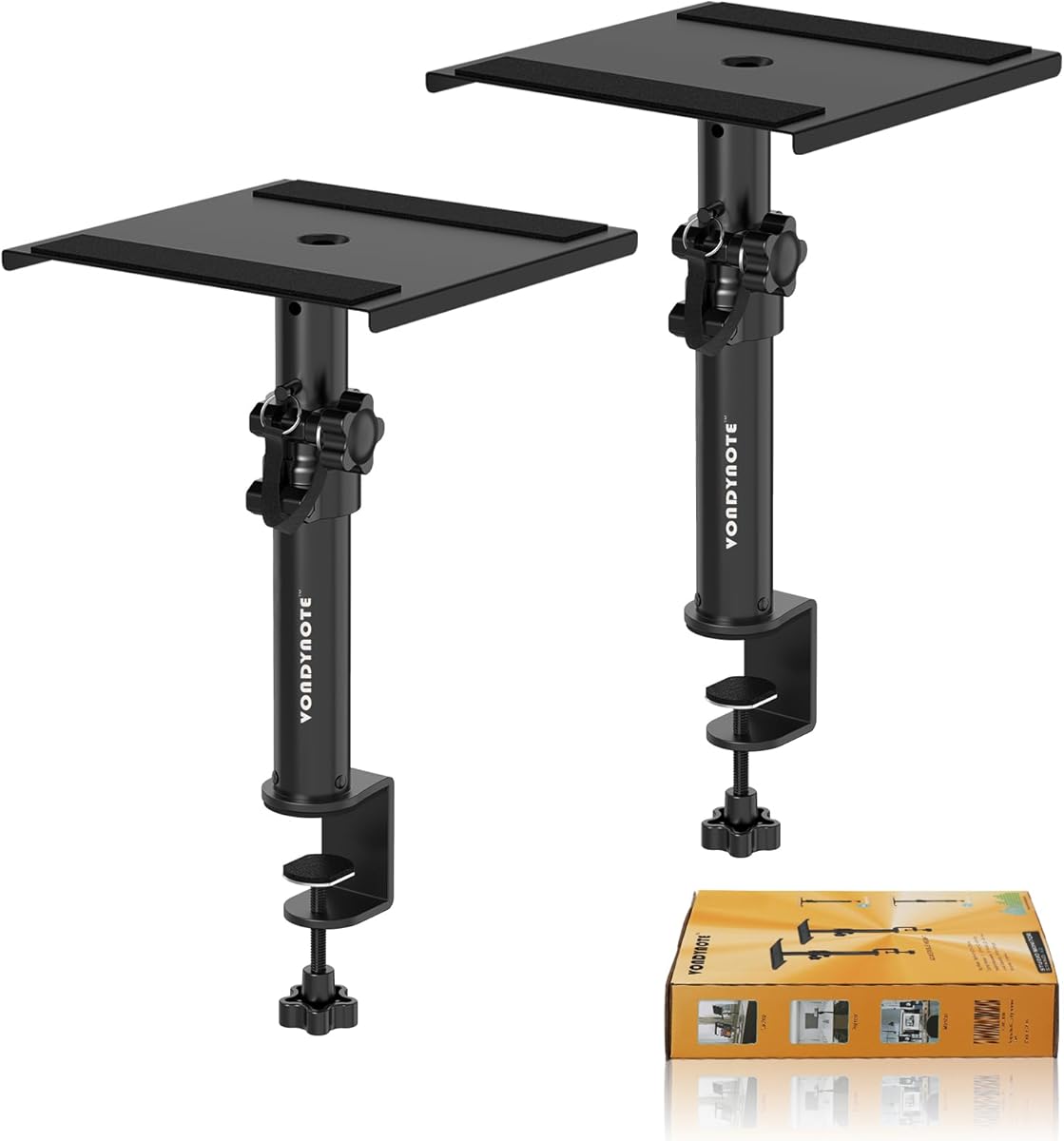
Vondynote Short Desktop Clamp Stands
4.6Editor score
Space-saving clamp-on construction
Four secured height positions
Supports monitors up to 50 pounds
Desktop speaker stands can improve a listening setup by raising speakers, reducing desk vibration, controlling their angle, and reclaiming valuable work area. The right model depends on speaker size, desk construction, desired height, and whether you prefer a freestanding platform, an adjustable pedestal, or a clamp mounted beneath the desktop.
We compared ten stands using the supplied specifications, focusing on load capacity, adjustment ranges, platform dimensions, tilt and rotation options, isolation materials, installation requirements, and cable-handling features. The list includes compact stands for smaller bookshelf speakers, robust studio monitor supports, and taller options intended for nearfield listening.
Each numbered review explains the stand’s strongest qualities, practical limitations, and most suitable setup. Ratings and specifications reflect the available product information, while prices and availability can change, so readers should verify current listings and confirm that their speakers and desk are compatible before buying.
4.6Editor score

4.7Editor score

4.8Editor score
As an Amazon Associate we earn from qualifying purchases.
The comparison below highlights the main differences in mounting style, height, adjustment, and support capacity, helping you identify the stand that best matches your speakers and workspace.


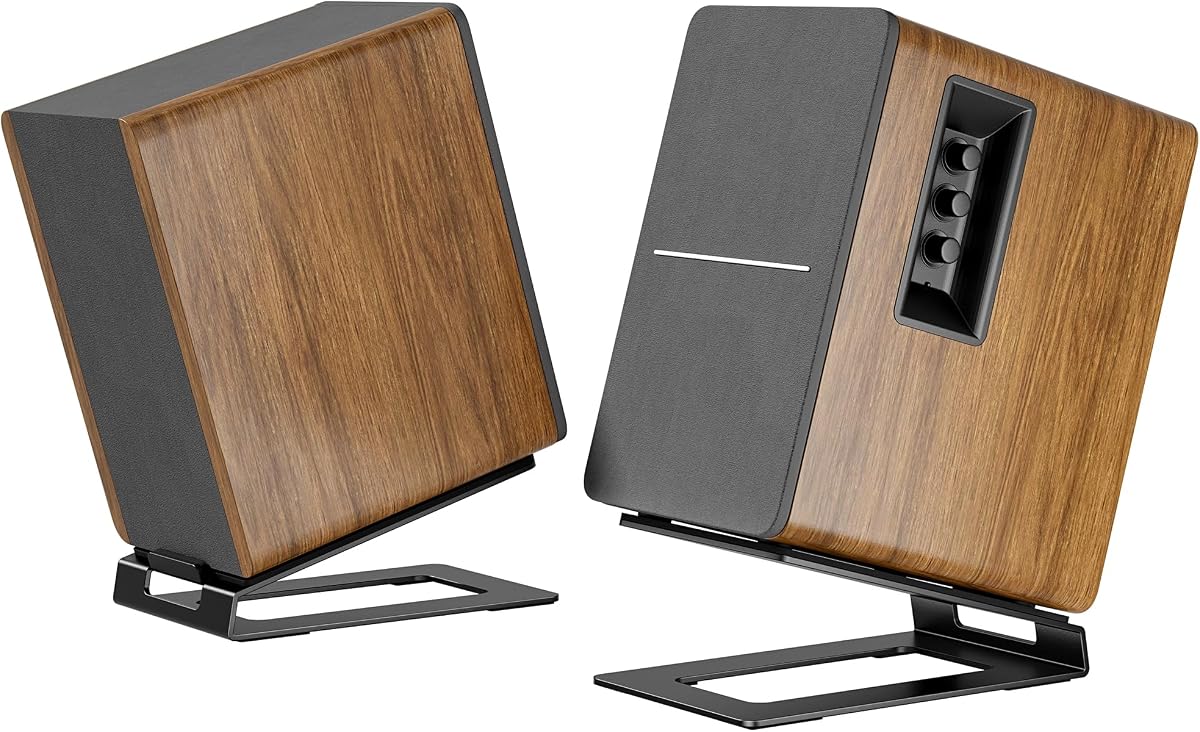


The Vondynote Set of 2 Desktop Clamp Speaker Stands Short Studio Monitor Stands is a space-conscious option for users who want their speakers elevated without adding bulky bases to the desktop. Its 4.6 rating reflects a generally favorable balance of useful adjustment, sturdy hardware, and practical clamp-on construction.
We may earn a commission when you buy through this link, at no additional cost to you.
The stands adjust from 9 to 14 inches and can be secured at 9, 10.6, 12.3, and 14 inches. Their 9-by-9-inch metal plates carry studio monitors weighing as much as 50 pounds, while a 2mm EVA pad helps limit movement and vibration. A reinforced 8.8-grade steel screw system and a 5mm-thick clamp improve confidence in the mounting assembly.
Because the units clamp to the desk, each stand needs only 32.5 square centimeters of surface area. The 3mm EVA pad helps protect the desktop, and the clamp fits desktops up to 2.6 inches thick. The main limitation is the lower maximum height, which may not suit listeners who need their tweeters precisely at ear level.
This is a strong choice for compact studios, offices, and gaming desks where surface area matters. It is especially useful for moderately sized studio monitors, laptops, projectors, and other supported equipment. Choose this model if clamp installation and space savings matter more than the highest possible elevation.
The under-desk mounting approach keeps the top plates compact and leaves more room for keyboards, notebooks, and other everyday equipment. It is especially effective when a pair of wide monitor bases would otherwise consume much of the available workspace.
Multiple drilled height positions, a locking screw, and reinforced clamp hardware create a more controlled setup than a simple friction-fit column. The added EVA surfaces also address desk protection and minor speaker movement.
We may earn a commission when you buy through this link, at no additional cost to you.
The Kanto SP6HD Desktop Speaker Stands combine a clean, purposeful design with the features music listeners and studio users look for most. Its 4.7 rating places it among the strongest options in this group, while the 6-inch elevation suits many 4- to 7-inch bookshelf speakers and studio monitors.
We may earn a commission when you buy through this link, at no additional cost to you.
Heavy steel provides the main structure, and closed-cell foam padding is used to absorb resonance between the speaker and top plate. Two included plate sizes accommodate different speaker styles, with a mounting hole and quarter-inch 20 screw available for compatible models. Each top plate can rotate up to 15 degrees in either direction for controlled toe-in.
The primary compromise is that the height is fixed rather than adjustable. That makes the Kanto less flexible for unusually high or low listening positions, and it will not suit users who require a broad elevation range. Even so, the sturdy construction, isolation padding, and tidy cable-routing columns create a well-balanced package.
This pair is well suited to desktop hi-fi systems, project studios, and home offices with 4- to 7-inch monitors. It is a particularly appealing option when the speaker can be rotated rather than physically raised, and when a refined appearance matters alongside practical acoustic benefits.
The combination of heavy steel and closed-cell foam helps limit the transfer of cabinet and desk vibrations. That makes the stand useful for reducing unwanted resonance while retaining a compact, furniture-like appearance.
Plate rotation allows a stereo pair to be aimed toward the listener, while the hollow support columns provide a practical route for cables. These details improve both setup flexibility and the appearance of a finished desktop system.
We may earn a commission when you buy through this link, at no additional cost to you.
The Vondynote Pair of Studio Monitor Stands Desk Clamp Speaker Stands 12°Tilt offers a more adjustable alternative to a basic riser. Its 4.6 rating reflects a versatile design that combines clamp-on space savings with height positioning, tilt control, and a substantial stated load capacity.
We may earn a commission when you buy through this link, at no additional cost to you.
Height extends from 10.4 to 15.4 inches, with four drill-hole positions at 10.4, 12, 13.7, and 15.4 inches. A locking knob and security pin secure the selected height. The top plate tilts from zero to 12 degrees and measures 9 by 12 inches, giving compatible monitors a stable, padded surface.
The stand is rated for monitors up to 60 pounds, and its 3mm EVA pad is intended to reduce vibration. It also uses another 3mm EVA layer at the clamp to protect the desktop. Its limitation is that the platform does not rotate, so achieving left-to-right toe-in may require careful positioning of the entire stand.
This pair is a good match for medium-sized studio monitors, creative workspaces, and compact home studios. Buyers should confirm that their desktop thickness falls within the supported clamp range and that their speaker dimensions suit the 9-by-12-inch top plate before ordering.
The independently useful height and tilt adjustments make it easier to align monitors with seated ear level. Because the entire platform remains fixed in width, it is best suited to speakers that do not require side-to-side rotation.
EVA padding appears both beneath the speaker and around the desktop contact point. This dual-pad approach is intended to limit movement, reduce unwanted vibration, and avoid scratching the desk during installation.
We may earn a commission when you buy through this link, at no additional cost to you.
The Liquid Stands Studio Monitor Stands stand apart with heavy-duty stainless steel construction, extensive orientation options, and the highest customer rating in this roundup at 4.8. They are aimed at serious desktop audio setups where a monitor needs to be raised, tilted, and securely supported.
We may earn a commission when you buy through this link, at no additional cost to you.
The clamp-on design uses a 4-inch base and 6mm anti-slip isolation padding, with a stated capacity of 65 pounds. Users can orient the plate horizontally or vertically, add or remove four included lips, and adjust tilt from zero to 20 degrees. Height ranges from 9.5 to 13.5 inches, and the platform measures 9 by 12.5 inches.
The principal tradeoff is installation complexity. The clamps require desks between 0.5 and 2 inches thick, and the stand needs less than 2 inches of space from the wall. Its adjustment system may also be more involved than that of a straightforward fixed riser, making careful setup important.
Despite those considerations, the 4.8 rating, flexible orientation, high capacity, and ten-year warranty make this a compelling premium option for music booths, project studios, and serious listening desks. It is particularly suitable for users who want to experiment with monitor positioning rather than merely raise a speaker.
The ability to switch between horizontal and vertical plate arrangements, add or remove lips, and adjust the angle gives this stand unusual versatility. That helps accommodate different enclosure shapes and preferred listening positions.
Stainless steel, 6mm isolation padding, and a 65-pound stated capacity support the premium positioning. The ten-year warranty also provides a meaningful distinction from stands sold with shorter or less clearly defined coverage.
We may earn a commission when you buy through this link, at no additional cost to you.
The Vondynote Desk Studio Monitor Stands 11"-16" Monitor Speaker Stands 12°Tilt is built for users who want more control over monitor direction. Its 4.6 rating and combination of tilt, rotation, multiple height positions, and multiple orientation choices make it a versatile freestanding platform.
We may earn a commission when you buy through this link, at no additional cost to you.
The height adjusts from 11 to 16 inches across four fixed positions, secured with a knob and locking pin. The 9-by-9-inch top plate has full-coverage 2mm EVA padding and can tilt from zero to 12 degrees while rotating freely. The stand also supports 60 pounds and can be configured in vertical or horizontal arrangements.
Unlike a clamp-mounted alternative, this stand needs a freestanding 9.5-by-9.5-inch base, which uses more of the visible desktop area. The stated space-saving benefit comes from elevating monitors and freeing the space beneath them, rather than reducing each stand’s footprint to the smallest possible clamp.
This is a strong choice for project studios, editing rooms, and gaming desks where precise monitor direction matters. It is especially useful when toe-in cannot be achieved by moving a heavy speaker across the desk, although users with very limited surface area may prefer a clamp-on model.
Most stands at this level offer one or the other. Combining a 12-degree tilt range with free rotation makes it easier to align a stereo pair precisely without repeatedly moving each speaker across the desk.
The 11-to-16-inch range is organized into four clearly defined positions. A knob and locking pin keep the selected setting stable, providing a more repeatable setup than an unlocked telescoping post.
We may earn a commission when you buy through this link, at no additional cost to you.
The Vondynote Set of 2 Desktop Studio Monitor Speaker Stands Bookshelf Speaker Stands delivers the greatest maximum height among the adjustable desktop models in this list. Its 4.6 rating reflects a capable steel construction, stable height settings, and a simple platform format.
We may earn a commission when you buy through this link, at no additional cost to you.
The support tube spans 11.6 to 18 inches, with drill-hole settings at 12, 14, 16, and 18 inches. A safety-pin locking device secures the chosen height, while a 9-inch square plate with 2mm EVA padding helps reduce speaker vibration. Each stand has a stated dead weight of 5.4 pounds and supports up to 50 pounds.
The tradeoff is footprint and simplicity. A freestanding pedestal takes up more visible desk space than a compact clamp, and the supplied information does not mention tilt or rotation control. Buyers seeking precise directional adjustment should choose a model explicitly designed for that purpose.
These stands are a good fit for home offices, compact studios, and desktop systems using small-to-medium studio monitors, laptops, or projectors. Their relatively tall range is helpful when a seated listener needs speakers elevated above other desk equipment.
The 18-inch maximum gives users more latitude than most compact risers. That extra range can help bring smaller monitor tweeters closer to a seated listener’s ear level without requiring a separate riser.
A locking safety pin and drilled settings create repeatable height positions, while the steel body and padded plate suit regular desktop use. The stands can also be disassembled for easier carrying or storage.
We may earn a commission when you buy through this link, at no additional cost to you.
The Suptek SDM003MB pair is a straightforward solution for users who simply want desktop speakers raised to a more useful listening height. Its 4.5 rating reflects a stable platform, a generous plate size, and easy assembly, although it offers less adjustment than many competitors.
We may earn a commission when you buy through this link, at no additional cost to you.
Each stand provides 6.1 inches of elevation and supports up to 44 pounds. The 200-by-165mm, or 7.9-by-6.5-inch, top plate offers enough room for many bookshelf and desktop speakers. Anti-slip mats help limit movement, while the illustrated assembly instructions are designed to support a quick setup.
The fixed height and lack of stated tilt or rotation make this less flexible for demanding studio positioning. It works best when the speakers already have the correct angle and the goal is simply to improve their height relative to the desktop and nearby objects.
For gaming rooms, offices, and home audio desks, the included pair offers a clean, balanced arrangement. Users should verify speaker footprint and desk clearance, while those needing frequent acoustic adjustments should favor an adjustable or tilting model.
A six-inch lift can improve the relationship between small speakers and the listener’s ears while leaving the devices themselves unchanged. The broad platform also gives larger desktop speakers a stable landing area.
The illustrated instructions and uncomplicated design reduce the likelihood of a difficult setup. This is useful for listeners who want a quick functional upgrade rather than a complex installation.
We may earn a commission when you buy through this link, at no additional cost to you.
The Desk Speaker Stands for Most Bookshelf Speakers pair has the highest rating in the group at 4.9. It combines a simple freestanding format with a useful 16-degree upward tilt, making it appealing for listeners who want directional placement without a complex adjustment mechanism.
We may earn a commission when you buy through this link, at no additional cost to you.
Each stand uses a 7.1-by-4.8-inch metal base and supports up to 22 pounds. The fixed tilt directs sound upward toward a seated listener, while pads on the base and speaker-contact surface help protect the desk and reduce vibration. Buyers can use the stands immediately or attach compatible speakers with screws for greater security.
Its main limitation is the 22-pound capacity, which is lower than the 44- to 65-pound ratings of many competing stands. The height and 16-degree angle are fixed, so the product lacks the position control of the Kanto, Liquid Stands, and several Vondynote options.
This pair is well suited to gaming stations, home offices, and casual desktop listening with compact bookshelf speakers. It is a particularly convenient option for users who value a ready-to-use design, strong rating, and the option to add screw-mounted stability later.
The 16-degree angle gives compact speakers a more natural direction toward a seated listener. Although the angle cannot be changed, it may eliminate the need for a separate wedge or improvised support.
The stands can be used as supplied, which keeps setup simple, or compatible speakers can be secured with screws. That optional upgrade balances convenience with additional stability when it is needed.
We may earn a commission when you buy through this link, at no additional cost to you.
The PERLESMITH PSSS2 pair is included because it provides a very different form factor: adjustable floor stands for small satellite, studio, and bookshelf speakers. Its 4.3 rating is the lowest in the group, but the substantial height range and broad width adjustment serve a distinct purpose.
We may earn a commission when you buy through this link, at no additional cost to you.
The stands extend from 33.3 to 45.1 inches and use a tool-free twist-lock mechanism. Width can be adjusted from 4.5 to 9 inches, making the pair compatible with many small speakers while accommodating different base dimensions. The stated load capacity is 11 pounds, so heavier monitors are outside the intended range.
Because these are floor stands, they do not free desktop surface area and may be less convenient for a compact workstation. A 1.18-by-0.59-inch cable opening runs through the hollow pole, while hook-and-loop straps provide an alternate route when the opening is too small for a connector.
They are most suitable for home theater surround speakers, compact studio monitors, and small bookshelf units used beside a desk or media console. Buyers should also avoid them for round or irregularly shaped speakers, as the product information explicitly notes that incompatibility.
The wide height range allows small speakers to be raised into a more useful position beside seating. Adjustable width then helps accommodate different cabinet sizes while keeping the speakers level.
The hollow pole can conceal wiring when cables and connectors pass through the opening. Straps offer a practical alternative when a larger plug would not fit, helping maintain a cleaner installation.
We may earn a commission when you buy through this link, at no additional cost to you.
The Cantilevered Desk Speaker Stands pair focuses on making efficient use of the area beneath desktop speakers. Its 4.5 rating reflects a useful open design, adjustable depth, and vibration-absorbing pads, though its 12-pound capacity is modest compared with the heavier options.
We may earn a commission when you buy through this link, at no additional cost to you.
The C-shaped structure leaves 5.9 inches of open space beneath the speaker, allowing a keyboard, hub, or other slim accessory to sit below. The ledge stopper adjusts from 5.5 to 7.5 inches, accommodating different speaker depths, while a fixed six-degree tilt aims the enclosure toward a seated listener.
Each stand supports up to 12 pounds and is intended for small and medium bookshelf speakers, computer speakers, and studio monitors. The preset slots can accommodate speakers with bottom mounting holes, while EVA pads help prevent movement, protect contact surfaces, and reduce vibration.
This pair is most useful under a desk where open space below each speaker is valuable. It is less appropriate for heavy studio monitors or situations requiring substantial height adjustment, but it can be a smart solution for small speakers and compact workstations.
The open cantilevered shape makes the vertical space beneath each speaker usable. This is more noticeable than a conventional solid-base stand, particularly when a compact keyboard or other frequently used item needs to remain within reach.
Adjustable depth helps the ledge fit different cabinet sizes, and the preset slot system adds support where bottom mounting holes are available. The fixed tilt and vibration pads improve placement without complicated controls.
We may earn a commission when you buy through this link, at no additional cost to you.
The most suitable desktop speaker stand depends on your speaker dimensions, listening position, desk construction, and preferred installation method. Consider height, stability, isolation, angle control, and available workspace before choosing.
Freestanding stands require enough room for a full base, while clamp-on models mount beneath the desktop and leave nearly all of the upper surface open. Clamps are especially attractive for compact workstations, but they introduce strict limits on desktop thickness and may require enough clearance beneath the desk for the bracket and hardware. Measure your desktop from its lower edge to any drawer, brace, or support rail before ordering.
Choose a freestanding stand when simple placement, portability, or compatibility with a thicker desk matters. Choose a clamp when reclaiming surface area is the priority and the desk falls within the specified thickness range.
A useful stand should bring the speaker’s tweeters or acoustic drivers closer to ear level without creating an unnatural listening angle. Compact desktop speakers often benefit from six to ten inches of elevation, while larger studio monitors may require taller supports or a different acoustic arrangement. Adjustable models offer the safest option when your chair, desk, and room setup may change.
Measure from the desktop to your seated ear position, then compare that figure with the stand’s total platform height. Avoid assuming that a taller platform always improves sound.
Tilt raises the front of a speaker toward the listener, while rotation allows a pair to be aimed inward from a wider separation. These controls are valuable when the speakers sit to either side of a monitor or keyboard. Fixed-angle stands can still work, but they depend more heavily on exact placement and the natural angle of the speaker cabinet.
Prioritize adjustable tilt and rotation if fine acoustic alignment is important. If your speakers already point upward, a fixed riser may be sufficient and will usually create a simpler setup.
A stand should comfortably support the actual weight of each speaker rather than merely meeting its published maximum. Heavy monitors require a strong column, secure locks, and a wide base, while small bookshelf speakers need less structural support. Uneven weight, narrow cabinets, and frequent adjustments can make a broader, heavier base preferable.
Use the manufacturer’s capacity as an upper limit rather than a target. Leave comfortable margin when selecting a stand for dense studio monitors.
The top plate should be large enough to support the speaker’s footprint with a margin around its edges. A platform that is barely equal to the cabinet dimensions may feel unstable, especially with a rear port or angled cabinet. Also check whether the speaker has bottom mounting holes and whether the stand includes compatible hardware or preset slots.
Measure both width and depth before buying. Remember that a 9-inch square plate may accommodate one speaker shape better than a rectangular 9-by-12-inch platform.
Isolation materials can reduce the transfer of cabinet vibration into the desk. EVA pads and closed-cell foam are common choices because they provide a stable, non-slip surface while helping control resonance. Pads at the desk contact point may also prevent scratches during installation. The thickness and coverage of the material matter because a small patch leaves more of the cabinet in direct contact with hard material.
Look for full or near-full plate coverage, especially for heavier speakers. Stable isolation should not come at the expense of a level, secure platform.
Cable management can make a desktop setup look more professional and prevent cords from pulling on speaker connections. Hollow columns, openings through the stand, and included straps are common solutions. Clamp-on models often free the surface without providing an integrated channel, so separate adhesive clips or sleeves may still be useful.
Choose a stand with built-in routing if appearance is a priority. Otherwise, plan a cable route before installation to keep cords away from moving chair wheels and clamp hardware.
Steel construction, threaded locking points, reinforced hardware, and replaceable padding indicate attention to long-term use. Warranty length can provide additional confidence, particularly for a clamp that may be installed beneath a heavy desk. Assembly complexity also matters: some products use simple screw-together parts, while others require more involved plate and lip configuration.
Choose the level of complexity that matches your comfort. A more elaborate stand is worthwhile when it solves a positioning problem, while a simple riser is often better for an uncomplicated desktop.
Begin by identifying the correct pair and checking every component against the instructions. For freestanding models, place each stand on a level section of the desk and assemble the column, platform, and locking mechanism before adding the speakers. For clamp-on models, remove the desktop’s power cable if installation is near an outlet, position the clamp around the desk, and tighten it gradually to avoid warping the surface.
Place each speaker on its stand, then adjust the height, tilt, or rotation while keeping the pair symmetrical. If the speakers have bottom mounting holes, use the supplied screws only when the platform instructions call for them. Tighten fasteners firmly without excessive force, and ensure the speakers do not rock, slide, or extend beyond the supporting plate.
Route cables before final positioning, keeping them clear of clamp edges and moving chair parts. Check the setup periodically for loosened knobs, drifting pads, or a changed listening position. Clean the desktop with a soft dry cloth, avoid abrasive cleaners around the mounting hardware, and inspect padded surfaces for compression or damage. Replace damaged pads or damaged fasteners before continuing to use the stands.
They can improve the setup by raising speakers toward ear level, reducing desk vibration, and giving the cabinets a more stable and consistent position. The acoustic benefit depends on the original placement, the speaker design, and room acoustics. A stand cannot correct poor speaker placement by itself, but it makes accurate placement easier to achieve.
Clamp-on stands are ideal when desktop space is limited and the desk is within the required thickness range. Freestanding stands are easier to reposition and often work with a wider variety of desks. Choose clamps for maximum surface area, and freestanding units for portability, simpler setup, or desks that cannot accept an under-mounted bracket.
The best height places the tweeters or main acoustic drivers near the listener’s ears while seated. For many compact speakers, six to ten inches of elevation is useful, although larger monitors may require different placement. Measure the distance from the desktop to your ears and check the platform height rather than relying on the stand’s maximum range alone.
Both stands in a stereo pair should be set to the same height and angle, with their fronts aimed toward the same listening position. A stand may offer different final height depending on the speaker cabinet, so make adjustments after the speakers are installed. Symmetry helps create a stable and coherent soundstage.
Choose a stand with a stated capacity comfortably above the weight of each speaker. A stand rated for exactly the speaker’s weight offers little margin for bumps, uneven loading, or installation force. The highest-capacity options are generally better for dense studio monitors, while lighter stands can be sufficient for small computer speakers.
Some products include mounting holes, screws, or preset slots for compatible speakers, while others are designed only as padded platforms. Check the product details for a quarter-inch 20 screw, M8 hardware, or dedicated slots, and confirm that the thread pattern and platform size match your speaker. Never force screws into a cabinet that was not designed for them.
A properly installed clamp with protective padding should reduce the risk of scratching, but the outcome also depends on the desk material, clamp condition, and tightening pressure. Use any supplied EVA pad, tighten the hardware gradually, and avoid exceeding the supported desktop thickness. Inspect the contact area after installation and periodically thereafter.
No. A taller stand is useful only when it creates a more accurate listening position for the particular speakers and listener. Excessively tall or tilted monitors can direct sound above the ear and may reduce imaging benefits. Match the stand’s range and angle to your seated position rather than selecting solely by maximum height.
The Vondynote short clamp pair offers the strongest budget-oriented balance of compact mounting, multiple height positions, and useful load capacity. The Kanto SP6HD pair is the most versatile all-around choice for compatible bookshelf speakers, with excellent isolation, plate rotation, and integrated cable routing. For users who want the most extensive positioning options, the Liquid Stands pair provides a premium, highly adjustable clamp-on system.
Prioritize the features your setup actually needs. A basic desk riser may be sufficient for a stationary pair of small speakers, while a studio monitor stand benefits from tilt, rotation, a higher load rating, and a secure locking mechanism. Clamp-on construction is worth checking when every centimeter of desk space counts, and cable routing can make a finished system look considerably cleaner.
Before ordering, measure your desktop thickness, speaker footprint, available clearance, and preferred listening height. Confirm the current product details and specifications on the listing, and check the latest price and availability, since both can change over time. With those checks completed, the stand that best matches your room, speakers, and workflow will provide the most useful upgrade.
