
be quiet! Light Base 900 DX Black
4.8Editor score
Removable feet enable rapid inversion
Supports three large radiators
Spacious dual-chamber interior
Discover the best Inverted PC Cases, compared for orientation flexibility, cooling capacity, motherboard support, airflow, and build quality for every setup.
Inverted PC cases suit builders who want an unconventional display layout, flexible orientation, or a striking hardware showcase. The strongest options balance that distinctive presentation with practical motherboard compatibility, capable airflow, room for modern graphics cards, and accessible installation, so an unusual shape does not come at the expense of everyday usability.
We compared the cases in this guide using their stated specifications, included components, cooling options, motherboard support, orientation features, and physical clearances. The list covers one purpose-built quick-inversion design as well as panoramic and dual-chamber cases that work especially well beneath a desk, on a shelf, or in a rotated display arrangement.
Each review explains the product's most useful strengths, practical compromises, and likely audience. Rankings reflect the supplied feature information and customer ratings, while current availability, component fit, and compatibility should always be checked before ordering because case designs and motherboard standards can evolve.
4.8Editor score

4.7Editor score
4.7Editor score
The comparison below highlights orientation flexibility, cooling provisions, motherboard support, display design, and the most important fit limits across all ten cases.




The be quiet! Light Base 900 DX Black is the clearest expression of the inverted-case concept in this guide, earning a 4.8 rating from its supplied customer feedback. Its removable feet let the entire case be turned or positioned horizontally in seconds, while large front and side windows preserve visibility from unusual display angles. It is especially compelling for builders who regularly alternate between a conventional tower position and a rotated presentation.
We may earn a commission when you buy through this link, at no additional cost to you.
Cooling capacity is the case's major attraction. The enclosure supports up to ten 120mm fans, two 420mm radiators in the removable lid and base holders, and another 360mm radiator on the side. A two-chamber layout separates drives and cable management from the main airflow path, while dedicated ARGB and PWM hubs provide 12 total connection points. The design can therefore support sophisticated air or liquid-cooling configurations without relying on a crowded set of mounting positions.
The trade-offs are significant. No fans are pre-installed, so a complete cooling setup requires additional purchases. Its size, weight, and broad side profile may also demand more room than a conventional mid-tower. Nevertheless, the removable radiator and fan holders, E-ATX support, and clearance for powerful graphics cards justify the extra footprint for builders who want a centerpiece rather than a conventional enclosure.
This is the strongest recommendation for anyone who takes the word inverted literally and values the ability to change orientation without rebuilding. It is also a high-end general-purpose case for builds with demanding cooling requirements, although buyers should confirm room under a desk and verify the exact clearance of every selected component.
The removable feet are the defining feature: they allow the chassis to be inverted or placed horizontally without rearranging the hardware inside. That makes the case particularly useful for display configurations where the internal layout needs to remain fixed while the exterior position changes.
The lid and base can each accept a radiator up to 420mm, while an additional 360mm radiator fits at the side. With ten possible 120mm fan positions and separate control hubs, the enclosure supports both elaborate air cooling and multi-radiator liquid-cooling arrangements.
We may earn a commission when you buy through this link, at no additional cost to you.
The SSUPD Xhuttle Black brings a 4.7 rating and a bold vertical-GPU presentation to the category. Rather than relying on a dedicated quick-inversion mechanism, it offers flexible vertical or horizontal setup, allowing a builder to rotate the overall design to suit a shelf or display arrangement. Panoramic tempered glass on both sides reinforces the showpiece character and gives the internal components two viewing directions.
We may earn a commission when you buy through this link, at no additional cost to you.
The vertical GPU mount is central to the design. It positions the graphics card so its side profile and lighting remain prominent, while the stated vertical airflow path directs cooling through that orientation. The dual-chamber layout keeps cables hidden from the main display area, and the included package already contains three 120mm ARGB reverse fans, an RGB strip, and an ARGB controller for a coordinated first build.
The case supports ATX and hidden-connector motherboards, GPUs up to 370mm, power supplies up to 190mm, and CPU coolers up to 170mm. It can also accommodate as many as ten 120mm fans and two 360mm radiators. Those limits are generous for a mid-tower, although the vertical orientation and connection arrangement still require careful component planning.
The Xhuttle is an excellent choice for builders who want an inverted-style visual presentation and a vertical GPU centerpiece but do not need to physically invert the chassis. Its combination of included lighting hardware, clean cable separation, and flexible positioning makes it one of the most complete packages in the guide.
The upright GPU position makes the graphics card visible as a major design element rather than hiding it behind a traditional side panel. Reverse fans help maintain the intended look while the stated airflow arrangement is designed to cool components in the vertical layout.
Three reverse ARGB fans, an RGB strip, and a controller are included, reducing the need to source matching lighting components separately. The integrated controls are particularly useful for builders creating a unified appearance in a rotated or wall-mounted display.
We may earn a commission when you buy through this link, at no additional cost to you.
The HYTE Y50 RGB Taro Milk is a colorful, glass-forward ATX case with a 4.7 rating. Its three-piece panoramic design and pale purple finish give it a distinctive identity, making it a strong candidate for a visible build where the case itself is expected to coordinate with the room rather than disappear into a dark workstation.
We may earn a commission when you buy through this link, at no additional cost to you.
The Y50 includes one 120mm ARGB fan and a 360mm reverse-blade ARGB fan with standard ARGB and PWM connections. Its dual-chamber arrangement separates the cable and storage area from the main hardware compartment, while compatibility with ASUS BTF, GIGABYTE STEALTH, and MSI Project Zero motherboards can produce an especially clean view by moving cable terminations behind the board.
The case does not advertise a formal quick-inversion feature, and buyers choosing it for an unusual orientation should understand that its appeal is primarily panoramic presentation and layout flexibility. Horizontal graphics-card mounting is explicitly supported, and the pale finish makes the enclosed components easier to appreciate when the case is positioned where its glass panels can be seen.
The Y50 is best for builders who want color, a broad hardware view, and integrated lighting without treating the enclosure as a plain black box. It also suits a desktop or shelf display with a light or playful theme, provided the builder confirms compatibility with the chosen motherboard and cable-management arrangement.
Taro Milk is not a neutral case color, and that is central to its appeal. The pale finish, large glass surfaces, and integrated ARGB lighting create a brighter presentation that can work well in studios, creative workspaces, and colorful gaming setups.
Support for hidden-connector motherboards reduces the visual clutter created by cables attached to the board's front face. The dual-chamber layout reinforces that benefit by moving storage and cable management away from the components on display.
We may earn a commission when you buy through this link, at no additional cost to you.
The CORSAIR 3500X combines a 4.7 rating with a restrained wraparound-glass design and broad component compatibility. It does not have a dedicated quick-inversion mechanism, but its removable side panel, flexible internal layout, and support for compact and extended ATX boards make it a practical choice for a rotated or unconventional desktop presentation.
We may earn a commission when you buy through this link, at no additional cost to you.
Its main strength is cooling flexibility. The side, roof, and power-supply areas provide mounting points for up to ten 120mm fans. Radiators up to 280mm and 360mm can be fitted in the roof, with an additional 360mm radiator supported at the side. This gives builders more options than a simple airflow case while preserving the uninterrupted exterior glass surfaces.
Both the front and side glass panels are removable, which simplifies component installation and later access. The case supports motherboard formats from Mini-ITX to EATX and is validated for ASUS BTF and MSI Project Zero boards with rear-facing connections. The main compromise is that no cooling fans arrive with the enclosure, leaving the builder responsible for assembling a suitable airflow configuration.
The 3500X is a strong all-rounder for users who prioritize component clearance, tidy access, and a clean visual result. It is less specialized than a literal quick-inversion chassis, yet it can sit comfortably in a horizontal display position, making it a solid compromise between conventional dimensions and showcase presentation.
The cooling layout can accept a 360mm radiator in the side and up to 360mm in the roof, with additional roof options extending toward 280mm. That range allows builders to coordinate radiator size with CPU cooler height and the selected graphics card.
Removable front and side glass panels make the initial build less awkward than working through a fixed display surface. They also improve later access when a cable needs adjustment or a component requires maintenance.
We may earn a commission when you buy through this link, at no additional cost to you.
The JONSBO TK-3 Black offers a 4.6 rating and a defining 270-degree curved-glass side view. Rather than using a mechanical inversion system, it creates an unusual display effect through continuous glass and a column-free side panel. That makes it especially interesting for a horizontally arranged or visually rotated build where the internal hardware becomes the room's focal point.
We may earn a commission when you buy through this link, at no additional cost to you.
Its specifications are generous. The case supports ATX power supplies up to 220mm, graphics cards up to 420mm, and CPU coolers up to 165mm. Ten fan positions are divided among the top, bottom, motherboard side, and rear, allowing either individual fans or an AIO in the top and another 360mm unit in the side. Back-connect motherboards are supported for a cleaner internal appearance.
The one-piece curved panel is both the visual attraction and the main practical caution. Its continuous surface offers fewer frame interruptions but must be handled carefully, and the protective film should not be removed until installation is complete. No fans or radiator are included, so cooling hardware must be selected separately within the stated limits.
The TK-3 is best for a builder who values a dramatic panoramic presentation and has a long or powerful graphics card. It works as an unconventional showcase case rather than a literal invert-on-demand model, and the large dimensions should be checked against available desk or shelf space before purchase.
The column-free 270-degree glass panel expands the visible area around the internal components. It offers a more dramatic presentation than a conventional framed side window and can be especially effective when the enclosure is laid out as a display piece.
The stated 420mm graphics-card limit gives the TK-3 an advantage for builders using large modern GPUs. Pairing that clearance with side and top radiator positions creates a case suited to both high-end air-cooled and dual-liquid-cooling configurations.
We may earn a commission when you buy through this link, at no additional cost to you.
The JONSBO X400 Gray is a large, highly specified ATX enclosure with a 4.5 rating. Its skeletal e-sports styling, double-glazed side panel, and optional ARGB lighting suit a prominent display build, while the 427mm graphics-card support and numerous fan locations make it particularly capable for elaborate cooling systems.
We may earn a commission when you buy through this link, at no additional cost to you.
The cooling specification is exceptional. Thirteen fan positions cover the top, back, side, and bottom, and both the top and side can accept 360mm AIO radiators. A patented auxiliary airflow arrangement can direct a 120mm fan toward the motherboard compartment, while the dual-chamber framework helps separate the power supply and cable areas. CPU coolers up to 176mm are supported.
The vertical GPU mode requires a conversion bracket and PCI-E extension cable that are not included, which is a meaningful extra cost and assembly step. Tool-free opening for the top cover, side panel, and bottom plate helps offset that complexity. The dimensions are also among the largest in the guide, so the case demands substantial desk, shelf, or floor space.
The X400 is best for an enthusiast who prioritizes maximum cooling, long graphics cards, and a dramatic e-sports aesthetic. It is less convenient for a small footprint and does not offer a quick-inversion system, but within a large display-oriented installation it offers considerable freedom in component arrangement and cooling.
The optional motherboard-directed fan adds a targeted layer of airflow around an area that often depends heavily on case circulation. Combined with the broad fan and radiator positions, it supports a carefully planned thermal layout for powerful components.
The top cover, side panels, and bottom plate use tool-free snap-on and snap-off designs. This makes routine access more convenient, especially in a case whose large panels would otherwise require repeated tool handling.
We may earn a commission when you buy through this link, at no additional cost to you.
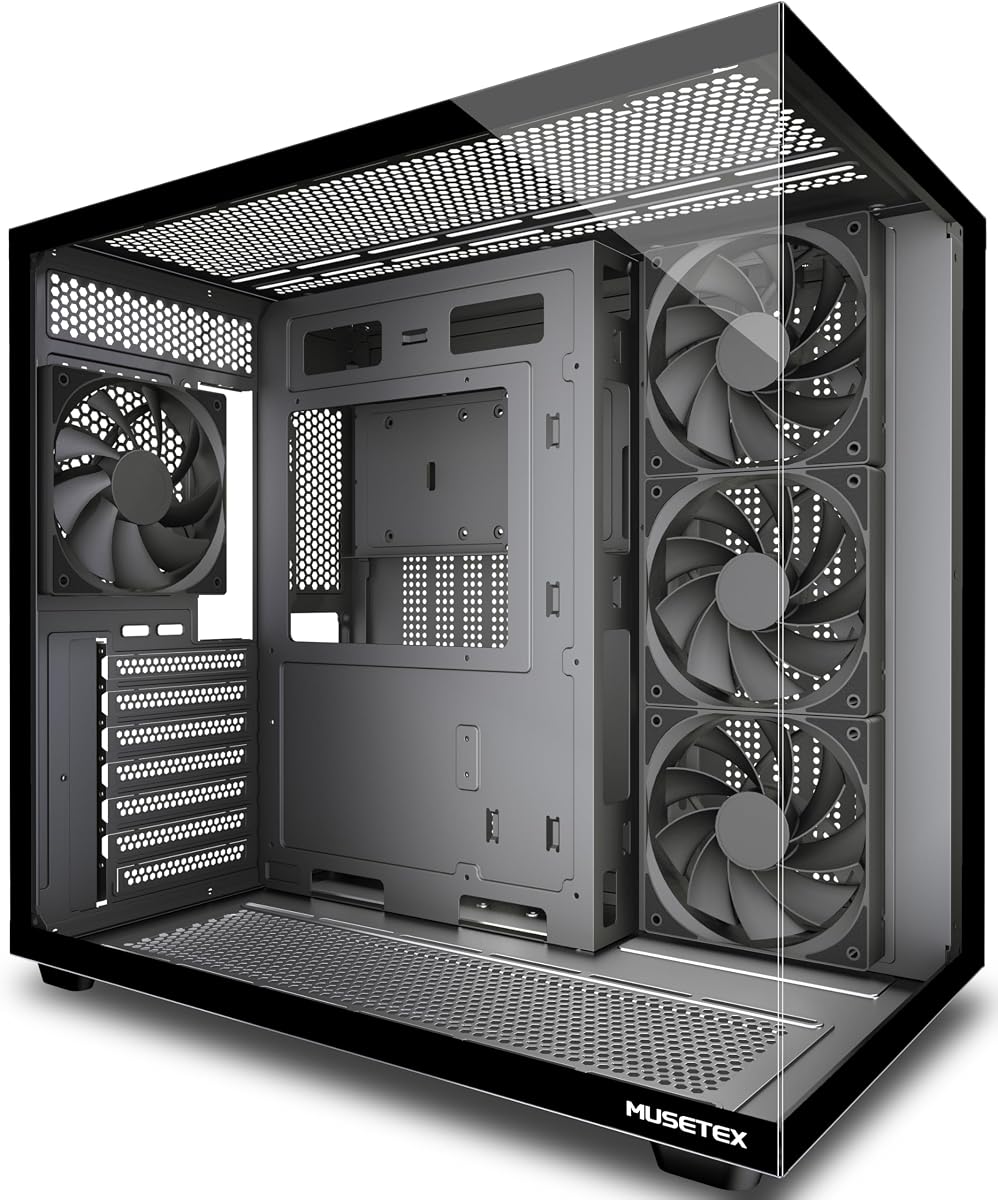
The MUSETEX Y6 Non-LED combines a 4.7 rating with four pre-installed fans and a wide 270-degree dual tempered-glass view. It is a compelling entry into inverted-style presentation for builders who want the hardware on display but prefer a restrained black appearance without synchronized lighting effects.
We may earn a commission when you buy through this link, at no additional cost to you.
The included cooling package contains three reverse fans along the side and one forward fan at the rear. A dual-chamber design separates the main components from the power-supply area, which has an independent ventilation channel. Magnetic dust filters at the top and bottom help limit debris without removing the open-air cooling paths that make the case effective for conventional tower positioning as well as rotated display use.
Compatibility is broad for an ATX chassis. It accepts ATX, Micro-ATX, and Mini-ITX motherboards, graphics cards up to 410mm, CPU coolers up to 160mm, power supplies up to 230mm, and a top-mounted 360mm radiator. Front connectivity includes Type-C, USB 3.0, USB 2.0, microphone, and audio connections.
The Y6 is the best budget-oriented recommendation in this list for buyers who want a visually open case with useful fans already supplied. Its compromises are the lack of lighting and the absence of a formal inversion mechanism, but it still provides a strong foundation for a horizontally arranged or simply display-focused build.
Four 120mm non-LED fans are already installed, with three reverse fans on the side and one rear intake. This gives a new build a usable airflow foundation without requiring the builder to choose and mount every fan immediately.
Two tempered-glass panels provide a 270-degree view of the hardware, while the power-supply compartment receives its own ventilation channel. Magnetic filters at the top and bottom help manage dust around the most exposed intake areas.
We may earn a commission when you buy through this link, at no additional cost to you.
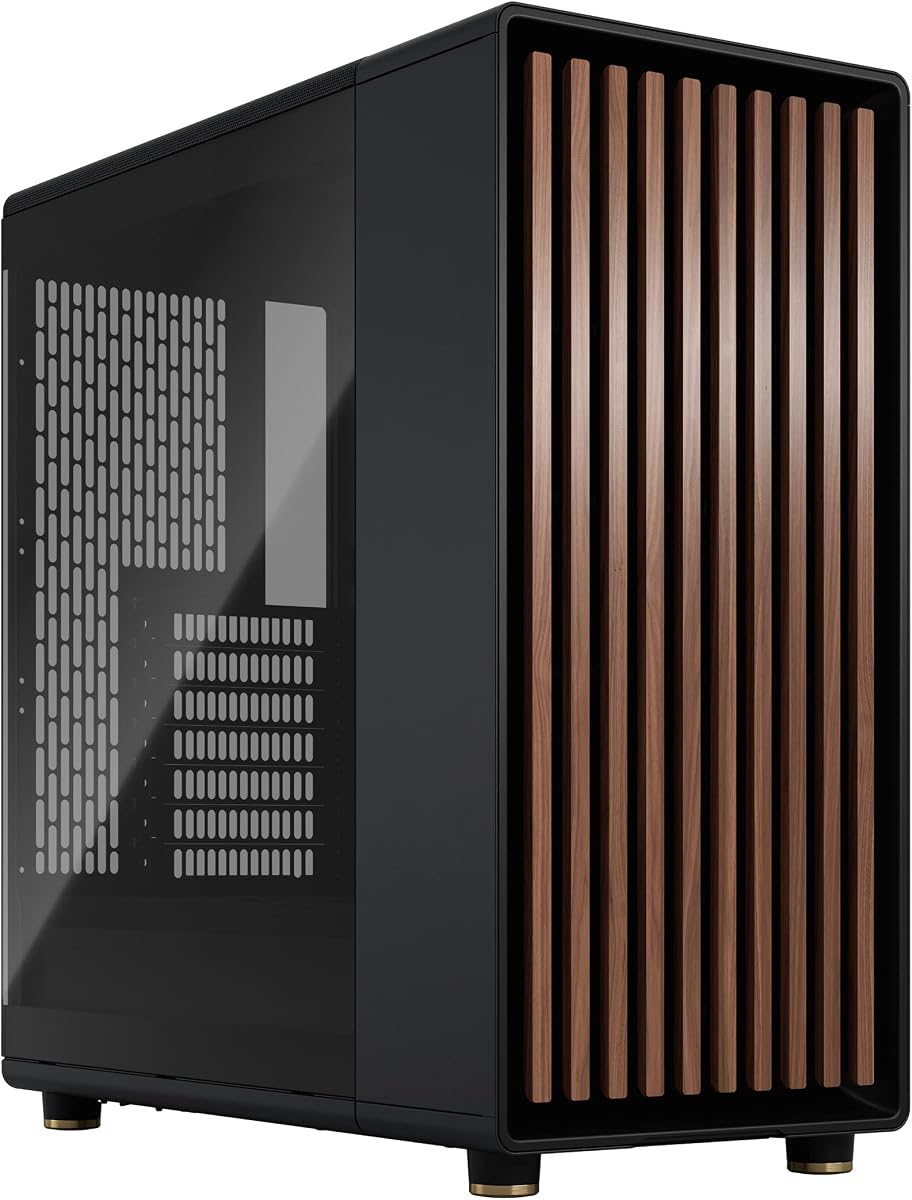
The Fractal Design North is an ATX mid-tower with a 4.7 rating and a warmer, furniture-inspired approach. Genuine walnut accents across the front distinguish it from the dark glass and industrial designs common in this category, while a tempered-glass side panel keeps the internal hardware visible for a display-oriented or rotated installation.
We may earn a commission when you buy through this link, at no additional cost to you.
Ventilation comes through an open front and integrated mesh, and two 140mm Aspect PWM fans are included. The case supports ATX, Micro-ATX, and Mini-ITX motherboards, with seven bridgeless expansion slots for customization. Four drive mounts are available from the outset: two combined 3.5-inch and 2.5-inch positions plus two dedicated 2.5-inch locations.
Graphics-card clearance is stated at up to 355mm, or 300mm when a 360mm radiator is installed at the front. CPU-cooler and radiator planning therefore requires more care than in cases with wider maximums, though the case remains capable for most standard builds. The front, top, and side panels are designed to come away with less tool friction for routine access.
The North is best for a builder who wants a PC that can function as part of a tasteful living-room or studio setup rather than a purely utilitarian tower. It is less directly suited to rapid inversion, but its open front, broad viewing window, and natural finish make it an attractive choice for an unconventional horizontal presentation.
The walnut front bars and open mesh create a more domestic appearance than a conventional all-metal gaming chassis. That makes the North especially suitable for a visible build in a living room, office, or shared workspace.
Natural ventilation through the open front reduces reliance on a sealed glass intake. Two 140mm PWM fans provide a strong starting airflow, while the removable top panel helps with installation and service.
We may earn a commission when you buy through this link, at no additional cost to you.
The MUSETEX Y6 Infinity Mirror is the lighting-focused version of the Y6, with seven pre-installed 120mm PWM ARGB fans and a 4.4 rating. Its fans use prism-style mirror surfaces to create continuous bands of light, giving a rotated or glass-forward build a more animated appearance than conventional ARGB fans.
We may earn a commission when you buy through this link, at no additional cost to you.
The enclosure retains the Y6's 270-degree dual tempered-glass design and broad compatibility. It supports ATX, Micro-ATX, and Mini-ITX motherboards, graphics cards up to 410mm, CPU coolers up to 160mm, power supplies up to 230mm, and a top 360mm radiator. Front I/O includes Type-C, USB 3.0, USB 2.0, microphone, and audio connections.
Seven fans are supplied, including three reverse side fans, three reverse bottom fans, and one forward rear fan. The lighting is controlled through motherboard software, and the stated anti-vortex blades are intended to preserve airflow. Because so many fans are included, builders should still check clearances around large CPU coolers, long graphics cards, and any added radiator before finalizing the layout.
This Y6 is best for a builder who wants an immediately colorful display and already knows the case will function as a conventional tower rotated for presentation rather than a quick-inversion system. Its broad feature set and strong included-fan count compensate for the lower customer rating, but careful clearance planning remains essential.
The Infinity Mirror fans create linked gradients rather than a set of isolated colored points. This effect is particularly noticeable through the dual glass panels and can give a horizontally positioned system a distinctive centerpiece quality.
Seven PWM ARGB fans cover the side, bottom, and rear from the factory. The arrangement provides substantial visual impact and usable cooling, although every large component must be checked against the occupied fan positions before installation.
We may earn a commission when you buy through this link, at no additional cost to you.
The NZXT H5 Flow is a compact ATX mid-tower with a 4.6 rating, two included 120mm fans, and a practical focus on airflow and cable management. It lacks the dramatic glass-centered design and formal inversion mechanism of several other cases, but it can still serve a neatly arranged or rotated display build when a smaller, restrained enclosure is preferred.
We may earn a commission when you buy through this link, at no additional cost to you.
Ultra-fine mesh across the top, front, and side panels supports airflow while filtering dust. The perforated power-supply shroud adds intake from both its side and lower surface, and two NZXT Quiet Airflow fans arrive installed at the front and rear. This makes the case more immediately usable than an empty enclosure that requires several fans before the first startup.
Liquid-cooling support includes a 360mm radiator at the front and a 240mm radiator at the top. Wide routing channels, hooks, and straps make it easier to conceal cables, which helps maintain a clean appearance even in a compact chassis. The stated position of the front radiator may also require careful clearance planning with long graphics cards and tall CPU coolers.
The H5 Flow is the best choice for builders who prioritize a smaller footprint, straightforward cooling, and tidy cable routing over a panoramic showcase. It is a sensible foundation for an understated inverted display, particularly when the case will sit beneath a desk and its external styling is intended to remain understated.
The H5 Flow provides a familiar ATX mid-tower layout without the footprint demanded by the largest cases in this guide. That makes it more practical under a desk or on a smaller shelf, where a display-oriented build can still rotate cleanly.
Wide channels, hooks, and straps allow cables to be routed behind the motherboard tray and out of sight. A cleaner interior is especially valuable when the case is visible through glass, positioned in a rotated layout, or placed where loose cables would interfere with the finished appearance.
We may earn a commission when you buy through this link, at no additional cost to you.
The right inverted or rotated case depends on how the system will be displayed, which components it contains, and how much cooling and service access the builder needs.
True inversion means the case can be physically turned without removing the components inside. The be quiet! Light Base 900 DX Black provides this capability through removable feet, while cases such as the SSUPD Xhuttle Black and MUSETEX Y6 use vertical or horizontal positioning options without presenting the same quick-change mechanism. Buyers should decide whether they need to change orientation frequently or merely want a case that looks good after a one-time placement.
Choose a true inversion system for rotating displays, under-desk arrangements, and builds that may be reconfigured. For a fixed showcase position, a well-designed horizontal or vertical layout can be simpler and more conventional.
Motherboard support ranges from Mini-ITX through EATX in many of the selected cases, but form-factor support alone does not guarantee a clean final appearance. ASUS BTF, MSI Project Zero, GIGABYTE STEALTH, and similar back-connect boards place sensitive terminations behind the motherboard, making them especially suitable for panoramic or rotated cases.
Check the board format, connector locations, and cable-routing requirements together. A case that supports ATX but forces visible cables across the display area may not suit the intended inverted presentation.
Graphics-card limits range from 300mm to 355mm in cases with front-radiator constraints, while several larger designs support 410mm to 427mm. A vertical GPU mount can make a card more prominent, but it may require a conversion bracket, extension cable, or different mounting arrangement. Measure the actual card, including its cooler and power connectors, rather than relying only on the nominal length.
For a vertical showcase, also account for the card's sag and support requirements. For a horizontal layout, verify that the card and adjacent fans will not interfere with one another.
Cooling capacity depends on the number of fan positions, radiator locations, and what is bundled. The selected cases range from two included 120mm fans in the NZXT H5 Flow to four in the non-LED MUSETEX Y6, seven illuminated fans in the Infinity Mirror model, and support for as many as thirteen optional positions in the JONSBO X400.
Match the case to the heat generated by the CPU and GPU. Include radiator size, thickness, and tube routing in the clearance check rather than focusing only on fan count.
Panoramic tempered glass, dual glass panels, and a continuous 270-degree curved window are central to many display-oriented cases. Wider glass improves the view but may add weight, make fingerprints more visible, and require careful handling. One-piece curved panels should be protected during installation and should not have their protective film removed until the build is complete.
Choose the viewing style that fits the room and the system. A restrained mesh-front design may blend into a workspace better, while extensive glass is likely to suit a dedicated display build.
CPU-cooler limits range from 160mm in the MUSETEX Y6 to 176mm in the JONSBO X400. Power-supply support generally ranges from 180mm to 230mm, and motherboard formats vary. These dimensions interact, especially when fans, radiators, and tubes occupy the same area, so the tallest component in each category should be checked against the case dimensions.
Make a short compatibility list before ordering. Include the motherboard, graphics card, power supply, CPU cooler, radiator, and any storage hardware that occupies a dedicated mounting area.
Dual-chamber layouts, dedicated cable channels, and hidden-connector motherboard support keep wiring away from the visible components. Removable panels, tool-free construction, and accessible fan or radiator brackets make the initial build and later maintenance more convenient. These features are especially important in an inverted system, where cable routing may be more difficult to reach.
Prioritize cases that keep the display side clear while still allowing panels to be removed without dismantling major components. A tidy build is easier to inspect, clean, and service.
Fine mesh panels and magnetic dust filters can reduce particle buildup around radiators, fans, and power supplies. Filter access should be considered separately from panel access because even a removable filter becomes inconvenient if it is buried behind fixed components. Reverse fans, removable brackets, and tool-free panels can also influence how easily a build can be serviced.
Choose accessible filters and a layout that allows routine cleaning without removing the graphics card. Long-term airflow depends on keeping those paths clear.
Before assembling the system, review the case manual, identify the intended orientation, and install the motherboard, power supply, storage, graphics card, and cooling hardware in an order that avoids trapped cables. If the case has removable feet, confirm that they lock securely in both the normal and inverted positions before moving it. For a fixed horizontal layout, verify that every panel remains accessible and that the graphics card has suitable clearance and support.
Connect front-panel switches and I/O connectors before closing the glass or mesh panels, and route power, data, and fan cables through the designated channels. Use the included fan and ARGB controllers where provided, but confirm motherboard compatibility for proprietary lighting or control features. Keep radiator tubes free from sharp bends and ensure that fans do not obstruct intake or exhaust paths after the case is rotated.
Clean the case with a dry, soft cloth and use compressed air or a soft brush to remove dust from filters, fan hubs, radiators, and vents. Do not spray cleaner directly onto glass, fan surfaces, or electronic components. Periodically check that the feet, panels, screws, and support brackets remain secure, especially if the case has been inverted or moved. The protective film on a curved glass panel should remain in place until installation is complete.
A true inverted case is designed to be physically turned while its components remain installed, often using removable feet or a specialized rotating base. A vertically orientable case may simply support a different hardware layout or can be placed horizontally, but it may not offer a quick inversion mechanism. The distinction matters most for builders who expect to change the case's position frequently.
Orientation alone does not normally damage a graphics card, but long cards can sag when mounted vertically without adequate support. The case should provide a suitable support bracket, and the card should be secured according to the graphics-card manufacturer's instructions. A horizontal installation may reduce this concern, but the chassis must still be stable on its intended surface.
They can produce a much cleaner visible area because power and data connectors are moved to the rear of the motherboard. This reduces cable clutter around components that would otherwise be on display. A builder must still confirm the exact board model, connector locations, and case support because back-connect compatibility varies by manufacturer and design.
The appropriate choice depends on the CPU, GPU, case dimensions, and desired fan configuration. A case with one 360mm radiator position may be sufficient for many builds, while enthusiasts may prefer separate top and side radiators. Always account for radiator thickness, fans, pump housing, tubing, and the clearance of nearby components.
More glass improves visibility, especially when the case is rotated or placed in a prominent location. It can also increase weight, show fingerprints, and make handling more difficult during installation. The best choice balances viewing appeal with removable panels, stable feet, adequate airflow, and convenient access to the components.
A purpose-built quick-inversion case may not require the internal components to be removed because its feet or support system allow the entire enclosure to rotate. With a conventional case, turning it usually requires removing the graphics card, power supply, cooler, and possibly other parts. Reviewing the manufacturer's instructions is essential before attempting any orientation change.
Remove the case from the powered system and unplug it before cleaning. Use a soft brush or compressed air around fans, radiators, filters, and vents, and wipe glass with a dry microfiber cloth. Avoid spraying liquid cleaner directly onto components, and make sure every filter and panel is fully reinstalled before returning the system to operation.
They can, but motherboard size, graphics-card length, CPU-cooler height, power-supply length, and radiator dimensions must all fit together. A compact case may also place radiators in positions that conflict with tall coolers or long graphics cards. Check the manufacturer's dimensional limits and the clearance of the exact components in the planned build.
The be quiet! Light Base 900 DX Black is the leading recommendation for genuine quick inversion, spacious component support, and extensive cooling options. The SSUPD Xhuttle Black is the strongest alternative for a vertical GPU showcase with included ARGB hardware, while the MUSETEX Y6 Non-LED offers a practical, restrained entry with four fans and broad dual-glass visibility.
The right choice depends on the display plan. Builders who repeatedly rotate the enclosure should prioritize secure removable feet and easy orientation changes, while those installing it once in a horizontal position can prioritize glass area, vertical GPU positioning, and clean cable presentation. Graphics-card clearance, radiator space, CPU-cooler height, and motherboard connector arrangement deserve equal attention.
Finally, confirm the current product details and listing before purchasing. Manufacturer revisions, accessory bundles, and component compatibility can change over time, so checking the official specifications and the exact hardware selected for the build will prevent costly fitment surprises.