
YesBes Cord Hider Kit
4.4Editor score
116-inch total raceway length
Six couplings and two elbows
Paintable, cuttable, tool-free design
UL94 V-0 flame rating
Best cable hider for wall mount TV guide comparing surface-mounted raceways and in-wall kits for capacity, installation, safety, cable access, and finish.
A wall-mounted television can look polished while the cables behind it undermine the entire installation. A well-fitted cable hider conceals loose HDMI, power, Ethernet, audio, and speaker wires, protects them from curious hands and pets, and keeps entertainment areas looking intentional. The right solution depends on cable capacity, installation method, wall type, and how discreet the finished route needs to be.
This guide compares ten cable-management options spanning paintable surface raceways, adhesive low-profile covers, and complete in-wall concealment systems. We evaluated the supplied specifications for dimensions, cable capacity, included fittings, installation requirements, access methods, safety certifications, and intended wall construction. The list also distinguishes between products designed to cover cables visibly and those that route them behind the wall.
Each pick highlights a particular reason it stands out, from broad household coverage to a compact under-TV solution or a more permanent concealed installation. Product ratings are shown as part of the supplied listings, while practical suitability ultimately depends on the cables and wall surface involved. Prices, promotions, and availability can change, so verify current listing details before purchasing.
4.4Editor score

4.6Editor score

4.7Editor score
The comparison below covers ten cable hiders based on installation style, internal capacity, available length, finishing options, and the degree of cable concealment each system provides.
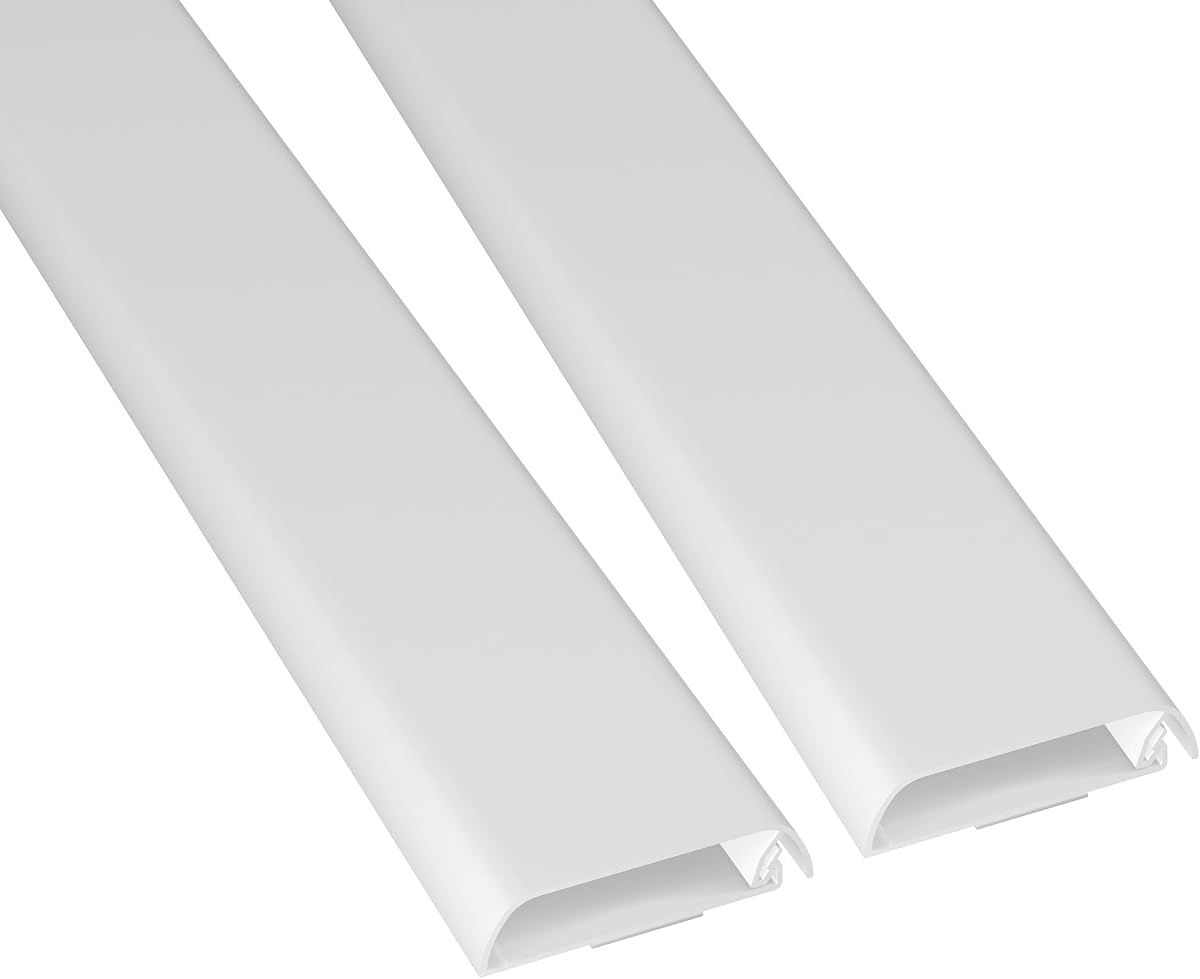


The YesBes Cord Hider Kit is a budget-friendly surface raceway for viewers who want to organize the visible cable run behind a wall-mounted television. Its 4.4 rating reflects a generally positive customer reception, while the 116-inch total length provides ample material for a common entertainment-wall route. The kit is particularly useful when drilling into the wall is undesirable or when a removable adhesive solution is preferred.
We may earn a commission when you buy through this link, at no additional cost to you.
The internal channel measures 0.96 inches wide by 0.57 inches high, providing useful capacity for the collection of power, HDMI, audio, or network leads commonly found near a television. Six couplings, two L-shaped elbows, one T-fitting, and instructions support turns and branch points. Installation is based on strong adhesive backing: position the raceway, peel the liner, press it onto a clean surface, then place cables inside the channel.
The surface-mounted design is the main compromise. Although the raceway is paintable and can be cut to length, it remains visible unless the finish closely matches the surrounding wall. The manufacturer also warns against using the included tape on textured walls, so smooth painted surfaces are the safer choice. Moving the route after installation may pull at the adhesive and potentially damage the wall finish.
This is a strong selection for renters, renters of difficult wall surfaces, and buyers who want a useful starter kit without committing to an in-wall installation. The included fittings make it more versatile than a simple straight cover, while the paintable finish and UL94 V-0 flame-rating claim add practical value. For those seeking a flexible adhesive solution, it is one of the most balanced options in this guide.
The included couplings and elbows allow the raceway to follow a television installation around corners instead of forcing cables into an awkward straight line. The T-fitting also creates a practical junction for cables that need to branch toward a nearby outlet, media shelf, or console.
Because the cover is cuttable and paintable, installers can shorten it to fit the available space and give it a finish closer to the wall. The result is less conspicuous than leaving black or white cables exposed, although careful surface preparation remains important.
We may earn a commission when you buy through this link, at no additional cost to you.
The D-Line TV Cord Hider is a purpose-designed surface cover for the short cable run often found between a wall-mounted television and a nearby outlet or media shelf. Its 4.3 rating indicates favorable customer feedback, and the product emphasizes visual neatness more than extensive coverage. Two 15.7-inch sections provide 31.4 inches of total length, making the kit best suited to a compact route rather than a whole-room cable system.
We may earn a commission when you buy through this link, at no additional cost to you.
The standout feature is the hidden flexible hinge, which allows the lid to open and close without creating an obvious raised seam. A click-lock mechanism helps keep the cover shut after the cables are placed inside. The raceway lies flat against the wall and uses self-adhesive backing, so installation generally involves cleaning the surface, removing the liner, pressing the channel into position, and then opening the lid to insert cables.
The stated 2.36-inch width and 0.59-inch height make the profile broad and shallow. That configuration can create a low visual profile, but the available length limits how many cables can be accommodated in a typical installation. The product data does not specify an internal cable count, so buyers should compare their cable bundle with the actual channel opening rather than assume it will handle several thick cords.
The D-Line is most appropriate when the television sits close to an outlet and only a short horizontal drop needs organizing. Its nearly seamless profile and paintable finish are especially attractive for minimalist rooms where a standard rectangular raceway might look conspicuous. Choose it for a focused, tidy TV connection rather than as a comprehensive household cable-management solution.
The concealed hinge allows the cover to open when cables need attention while preserving a smooth exterior when closed. This design is particularly useful for installations where the raceway is visible beside a television rather than tucked behind furniture.
The click-lock lid makes it straightforward to add or remove a lead without dismantling the entire route. That convenience is valuable when a device is replaced, an HDMI cable is upgraded, or the entertainment layout changes over time.
We may earn a commission when you buy through this link, at no additional cost to you.
The Delamu 157-Inch Cord Hider is a versatile surface-mounted option for organizing several cables along a wall. Its 4.5 rating makes it one of the stronger-rated products in the list, and its 157-inch total length gives installers more freedom than a short under-TV cover. The compact 0.95-inch-wide by 0.55-inch-high channel is intended for groups of two to four wires, depending on their diameter.
We may earn a commission when you buy through this link, at no additional cost to you.
The attach-and-snap structure allows the cover to be removed without taking the entire raceway off the wall. That is a meaningful advantage over fixed covers because cables can be added, replaced, or rerouted as equipment changes. The kit is pre-sectioned for splicing and includes matching connectors, while the channel can also be cut to fit a particular route. It can be painted to blend more closely with the surrounding decor.
Capacity is the primary consideration. Four slender cables may fit comfortably, but a power brick, multiple full-size HDMI leads, and several network cables can quickly fill the narrow channel. Its UL94 V-0 flammability rating adds a stated safety benefit, though that certification should not be confused with suitability for every in-wall electrical installation.
This Delamu kit is well suited to viewers who want substantial surface coverage without tackling the wall. It is particularly useful for living rooms, offices, and dorm spaces where cables travel horizontally or vertically around a mounted screen. Buyers who need easy ongoing access and a long, adaptable route will find it especially effective, provided the selected cables fit the available internal space.
The click-on lid opens after the raceway is secured, allowing cables to be added or removed without peeling the channel from the wall. This reduces disruption during upgrades and makes the installation more convenient for frequently changing electronics.
With 157 inches of total raceway, the kit can cover a television drop, a horizontal run, and a branch toward an entertainment shelf. Matching connectors allow separate sections to be joined when the layout requires a route beyond one continuous strip.
We may earn a commission when you buy through this link, at no additional cost to you.
The Delamu Large Cord Hider is designed for installations that carry more than one or two cables. Its 4.6 rating reflects strong customer reception, while the 1.18-inch internal width and 0.67-inch height provide a roomier channel than slim raceways. The kit contains six separate sections, making it a flexible choice for covering several groups of TV, audio, network, USB, and other wires.
We may earn a commission when you buy through this link, at no additional cost to you.
The manufacturer identifies the product as suitable for three or four cables, including HDMI, Cat6 Ethernet, optical, and USB leads. Installation uses a strong adhesive backing: clean the wall, position the section, apply it, place the wires inside, and close the cover. Its combined snap-on and slide-on construction makes the channel practical to open when a cable needs to be changed.
A warning is important: the tape is described as very sticky, so the route should be mapped and measured before installation. Removing a raceway later may pull against the wall and leave marks. Accessories are not included, which may limit branching and corner arrangements unless matching pieces are obtained separately. The cover can still be cut and painted for a cleaner finish.
This kit is an excellent match for a television with several connected devices and a visible cable run that needs to disappear. It also works for speaker wires, security-camera cables, lamp cords, and other home-office leads. Choose it when cable quantity is the priority, especially if the route includes more substantial connections than a narrow cover can hold.
The larger internal dimensions give HDMI, Ethernet, optical, and USB wires more room to coexist. That capacity is useful around modern televisions, where a power lead, streaming-device connection, and network cable often share the same small area.
Because the adhesive is designed to hold firmly, measuring the entire path first prevents unnecessary removal. Marking the wall and confirming that each section fits the intended corners can produce a neater result and reduce the chance of surface damage.
We may earn a commission when you buy through this link, at no additional cost to you.
The TV Wire Hider Kit is an in-wall cable-management solution for viewers who want the television's cables to disappear rather than remain inside a visible surface raceway. Its 4.8 rating is the highest supplied product rating in this guide. The kit is aimed at flat-panel televisions, gaming systems, entertainment consoles, and other devices that need a clean cable path behind a finished wall.
We may earn a commission when you buy through this link, at no additional cost to you.
The installation uses a hole saw drill attachment and two pass-through fittings. According to the supplied specifications, the system is intended for perforated walls between 12 and 18 millimeters thick, including plaster or wood-plank construction. The thicker drilling and fitting accessories are designed to create a close fit between the wall cutout and the grommet, helping the finished installation look more deliberate.
This is a more involved option than an adhesive raceway. Cutting a wall, choosing the correct attachment, and fitting pass-throughs require care, especially in a finished living space. The listed wall compatibility is narrower than that of dedicated drywall cable kits, so buyers should confirm the wall material and thickness before proceeding. The product is therefore less suitable for renters who cannot modify the wall.
For a permanent entertainment wall with compatible construction, however, it offers one of the cleanest visual results. The result places the cable path behind the television rather than leaving even a low-profile cover on display. It is best for homeowners or renovators who value maximum concealment and can plan the cutting locations before making permanent modifications.
Routing the leads behind the wall removes the visible raceway from the finished room. This produces a particularly clean appearance for a television positioned centrally on a feature wall or above a minimalist media console.
The stated compatibility range of 12 to 18 millimeters makes wall construction a decisive factor. Buyers should inspect the wall or obtain reliable construction information before ordering, since an unsuitable wall can make the included attachment ineffective.
We may earn a commission when you buy through this link, at no additional cost to you.
The ECHOGEAR In-Wall Cable Management Kit is a comprehensive solution for concealing both television power and low-voltage wiring behind a wall. Its 4.7 rating and ETL certification make it a strong choice for buyers who prioritize a professional-looking result and in-wall safety. The system includes upper and lower modules, a six-foot extension cord, a driver bit, and a drywall hole saw attachment.
We may earn a commission when you buy through this link, at no additional cost to you.
The modules measure 3.75 inches wide by 3.25 inches deep and are designed to accommodate up to four large HDMI cables, along with Ethernet and audio cords. Locking wings help secure the fittings within the wall cavity, while the grommets are paintable so the visible portions can blend with the surrounding surface. The supplied extension cord provides a ready-made power connection for a mounted television.
Installation requires a drill and wall modification, so this is not the simplest solution for temporary setups or rented rooms. The product data specifically presents it as an ETL-certified in-wall system, which is an important distinction from ordinary surface raceways. Buyers should still confirm local electrical rules, wall construction, cavity depth, and the suitability of the location before making any cut.
The ECHOGEAR kit suits homeowners creating a dedicated home-theater wall, builders, and anyone determined to eliminate visible power and AV leads. It is more comprehensive than a simple cord cover because the included components address the route through the wall, not just the short visible segment behind a screen. For a correctly sized installation, it offers the most complete premium package in this guide.
The kit includes the modules, extension cord, driver bit, and hole saw needed for the basic installation. Having those pieces together reduces the need to source separate accessories before beginning a project.
The stated capacity for four large HDMI cables plus Ethernet and audio wiring suits heavily connected entertainment centers. That makes the system more relevant than a narrow single-lead cover for modern gaming and home-cinema setups.
We may earn a commission when you buy through this link, at no additional cost to you.
The EVEO 306-Inch Cable Hider is the most extensive surface raceway in the comparison, with 306 inches arranged as twenty 16-inch sections. Its 4.6 rating indicates strong customer reception, and the extensive coverage makes it useful for more than one television. Buyers can also use the system around a home office, desk, entertainment console, or other cable-heavy room.
We may earn a commission when you buy through this link, at no additional cost to you.
Each section has an internal width of 0.95 inches and height of 0.5 inches, producing a low-profile channel for groups of standard leads. Installation can use tape or screws, offering more flexibility than systems limited to adhesive alone. The raceway is paintable, so a carefully finished installation can blend into the wall rather than reading as a separate white component.
The scale of the kit is both its chief advantage and its main limitation. A household with only one short television drop may have far more material than needed, while a bundle of several bulky power adapters or a large number of thick cords may still exceed the slim channel's practical capacity. The individual 16-inch sections are useful for complicated routes because they can be arranged and joined around corners.
This EVEO system is the strongest all-around choice for broad surface-mounted cable management. It combines high capacity by total length, adaptable installation methods, a discreet profile, and a paintable finish. Choose it when the goal is to organize cables throughout multiple areas or create a long, continuous television route without assembling a custom setup from separate raceway pieces.
Twenty short sections can cover a television wall, office desk, media shelf, and nearby speaker or lamp leads. That whole-home potential is the defining advantage of this kit compared with covers intended for a single short drop.
Using numerous 16-inch sections gives the installer flexibility around furniture, outlets, and corners. The low profile also helps the raceway remain visually unobtrusive where wall space is limited.
We may earn a commission when you buy through this link, at no additional cost to you.
The Mount-It In-Wall TV Cable Concealer is a complete plug-in system for organizing a wall-mounted television's power and low-voltage connections. Its 4.7 rating places it among the highest-rated options, and the kit combines a recessed triple outlet with a spacious cable route. The result is designed to produce a modern, uncluttered entertainment area with both power and signal connections hidden behind the wall.
We may earn a commission when you buy through this link, at no additional cost to you.
The package includes two wall plates, a nine-foot extension power cord, a drywall saw, a cutting template, pre-installed screws, and instructions. The larger plate measures 6.3 by 7.9 inches, while the smaller plate measures 4.5 inches. Low-voltage connections such as HDMI and Ethernet can pass through the recessed opening, while the power cord plugs into an existing outlet rather than requiring a hard-wired connection.
The pre-purchase checklist is essential. The large plate needs a cutout between studs and a minimum cavity depth of 2.4 inches, while standard walls are often 3.5 inches deep. These measurements should be checked carefully before cutting because the plate sizes and cavity requirements determine whether the kit can be installed as intended. The supplied ETL In-Wall Certified designation applies to the system as specified.
This concealer is ideal for a dedicated home theater, bedroom television, or modern living room where the visible finish is a top priority. It is more complete than a pass-through-only product because it also provides recessed power and a triple outlet. Buyers willing to modify the wall gain a polished, integrated result; those seeking a removable solution should look toward the surface-mounted options.
The recessed outlet provides a central connection point for multiple powered devices without leaving plugs and adapters visible beneath the television. Its nine-foot extension cord adds usable reach from an existing outlet.
The large wall plate requires a between-studs opening and at least 2.4 inches of cavity depth. Confirming the available space, identifying obstructions, and following the included template are essential before making a permanent cut.
We may earn a commission when you buy through this link, at no additional cost to you.
The Yecaye TV Cord Hider is a compact surface cover intended for short cable runs under a mounted television. Its 4.5 rating reflects positive customer reception, and the 42-inch total length makes it especially relevant when HDMI and network leads hang only a short distance below the screen. The product avoids the bulk of an in-wall installation while still providing a cleaner finished appearance.
We may earn a commission when you buy through this link, at no additional cost to you.
The stated external dimensions are 1.18 inches wide by 0.6 inches high, while the internal dimensions are 1.1 inches by 0.52 inches. The manufacturer says the channel can hold three or four wires depending on their size, including HDMI, television power, and Ethernet cables. Buyers should measure their own bundle because connector housings and thicker power leads can consume more room than the basic wire count suggests.
Installation uses pre-applied adhesive and is completed by peeling and sticking the raceway into place. It can be slid on or snapped on depending on the available room, which is helpful beneath a television where vertical clearance may be limited. Three sections can also be used separately or spliced together to create a seamless route.
The Yecaye is best for a small, specific installation rather than a room-wide cable system. It gives buyers an easy way to conceal the most visible drop beneath a screen without drilling, while still allowing access when cables need adjustment. Its relatively short length and modest capacity make it a specialist choice for simple TV connections and tight entertainment arrangements.
The ability to slide or snap the cover into place gives installers flexibility in narrow areas. This is useful when the television sits low, the route passes close to furniture, or a full-size hinged raceway would be inconvenient.
The 42-inch set can be divided into three 14-inch pieces for separate placements or joined to form one continuous cover. That makes it easier to match a short vertical drop and a small horizontal run without carrying excess material.
We may earn a commission when you buy through this link, at no additional cost to you.
The Large Cord Hider is an extra-wide surface raceway for installations that need more room than a standard TV cover can provide. Its 4.6 rating indicates strong customer feedback, while the 1.6-inch width and 0.8-inch height create enough internal space for up to four HDMI cables or five Cat6 Ethernet cables. That capacity makes it useful for entertainment centers with several connected devices.
We may earn a commission when you buy through this link, at no additional cost to you.
The kit contains three 15.7-inch sections for a combined length of 47 inches. Those sections can be spliced for a longer route or separated to cover different parts of a wall. The smooth, paintable surface is designed to blend with the surrounding decor, and the high-quality PVC construction also serves the broader goal of keeping exposed wires less accessible to children and pets.
The extra-wide profile is a trade-off. Although it offers excellent cable capacity, it is more noticeable than a narrow low-profile raceway and may require more space beneath the television or along a wall. The adhesive backing is strong, so the route should be planned before pressing it into place. The manufacturer also suggests gently heating the tape at low temperature when a stronger bond is needed.
This is a strong option for users who prioritize capacity over minimal visual bulk. It can conceal a larger collection of HDMI, power, and network wires around a television, computer, or charging area while remaining easier to access than a permanent in-wall system. Choose it when a slim channel would be too restrictive but a full concealed installation is unnecessary.
The wide internal channel can accommodate several HDMI cables or a larger group of network leads without forcing them into a tight opening. That is especially useful for home theaters, gaming stations, and desks with multiple connected devices.
The 47-inch kit is divided into three equal sections that can be connected or installed separately. This allows the cover to follow a television drop, an under-console run, and another nearby cable path while retaining a consistent profile.
We may earn a commission when you buy through this link, at no additional cost to you.
The most useful cable hider is one that fits the route, holds the actual cable bundle, matches the wall surface, and remains accessible when equipment changes. Compare installation permanence, internal capacity, and visibility before selecting a system.
Surface-mounted raceways conceal cables in a channel attached to the finished wall. They are generally simpler to add, often use adhesive, and can be painted to reduce visual distraction. In-wall systems route cables through a cut opening and use grommets, pass-throughs, or recessed power modules, producing a cleaner wall but requiring more planning, drilling, and construction knowledge. The Mount-It and ECHOGEAR systems provide integrated in-wall power, while the TV Wire Hider Kit focuses on pass-through routing.
In short, choose a surface cover for flexibility and choose an in-wall kit for maximum concealment.
Cable count alone does not guarantee a fit. A channel advertised for three or four wires may struggle with thick HDMI leads, bulky power connectors, Ethernet plugs, or adapters. Check the stated internal width and height, then compare them with the diameter and connector size of the real bundle. Extra-wide options such as the 1.6-inch-wide Large Cord Hider suit denser entertainment centers, while narrow covers work best for a few standard leads.
In short, measure the complete cable bundle and allow room for thicker connector ends.
The correct length depends on whether the cover runs down from the television, across toward a media shelf, or covers several rooms. Short kits are sufficient for a compact drop, while 116-inch, 157-inch, and 306-inch systems can handle broader routes. Numerous shorter sections also make corners and branching paths easier to arrange. However, the largest kits may be unnecessary for one screen and leave excess material after cutting.
In short, total length must match the planned route, and shorter sections improve layout flexibility.
Adhesive-backed raceways are convenient on smooth painted walls, but textured surfaces, wallpaper, and poorly prepared paint can reduce adhesion. The YesBes listing specifically warns against tape on textured walls. Other manufacturers also recommend planning the route in advance because strong tape may pull at the finish when removed. Clean the wall, avoid dust and residue, and consider screw-mounted sections when extra security is important.
In short, smooth clean walls support adhesive best, and the full route should be measured before installation.
White raceways look less conspicuous when they match a white or light wall, but a painted finish can improve integration with any color. Most listed surface covers are paintable, and the D-Line guide specifically recommends lightly keying the surface and applying two coats. A concealed hinge, smooth profile, and low-profile construction can also matter more than color when the raceway sits beside a visible television.
In short, select a paintable low-profile cover and test the finish on an inconspicuous section.
Adhesive kits need little more than cleaning, measuring, and pressing the channel into place. Some also support screw mounting, while others include elbows, couplings, or T-fittings. In-wall products require a drill, an appropriately sized hole saw or saw, a template, and confidence that the wall cavity is accessible. The ECHOGEAR and Mount-It kits include several necessary tools, but buyers still need to understand wall structure and electrical requirements.
In short, choose adhesive for simplicity and a complete in-wall kit only when permanent modification is realistic.
A cable cover can keep cords out of reach and reduce tripping or chewing hazards, but its fire rating and electrical design remain separate considerations. Several products state a UL94 V-0 plastics flammability rating, while the ECHOGEAR and Mount-It in-wall systems are described as ETL certified for in-wall use. These statements do not make every cover appropriate for every cable or installation. Local electrical requirements should govern in-wall work.
In short, distinguish material flammability ratings from certification for complete in-wall electrical systems.
Technology changes, and a television route may need a longer HDMI cable, another network lead, or a different connector arrangement. Snap-on, slide-on, hinged, and click-lock covers make future access easier than a permanently fixed channel. Surface systems with removable lids are particularly convenient for renters and for people who frequently move or upgrade devices. In-wall systems look cleaner but are less convenient once the wall is closed.
In short, choose a removable lid if the connected devices or cables are likely to change.
Begin by mapping the entire cable route before installing anything. Identify the television position, nearby outlet, media shelf, and the number and thickness of cables that need to travel between them. For an adhesive surface raceway, clean the wall thoroughly and mark the intended path. For an in-wall product, verify the wall type, cavity depth, stud location, and opening size before making a cut.
Install the raceway in the sequence recommended for its design. Open the lid where applicable, position the channel, and secure it with adhesive or the specified hardware. Arrange cables in a natural order, avoiding sharp bends and excessive force at connector housings. Do not place mains power wiring inside an ordinary low-voltage raceway unless the manufacturer explicitly permits it. Once the cables are seated, close the cover and check that it does not press against a plug or cable bend.
For ongoing care, wipe the exterior with a soft, slightly damp cloth and avoid harsh chemicals that could damage the finish. Inspect adhesive-mounted sections for lifting, particularly near furniture or in areas of frequent contact. Do not repeatedly peel and reattach a strongly adhered raceway, as doing so can damage paint or wallpaper. If a cable is replaced, open the cover carefully, preserve the cable order, and reseat the lid only after every lead is fully inside.
The best type depends on the installation. A surface raceway is easiest to add and works well in rented rooms, while an in-wall system provides the cleanest finish but requires cutting the wall. Choose based on permanence, wall construction, cable quantity, and how often you expect to change cables.
Most of the listed surface raceways are paintable. For the cleanest result, install and position the cover first, lightly prepare the surface if directed, and apply paint evenly. Allow the finish to cure before opening and closing the lid repeatedly, and test the paint on a small area if the manufacturer provides specific instructions.
Capacity varies by the channel's internal dimensions and the thickness of the actual wires. Some products are designed for two to four standard cables, while the extra-wide Large Cord Hider can hold up to four HDMI cables or five Cat6 Ethernet cables according to its listing. Measure the entire bundle, including connector housings, rather than relying only on the advertised cable count.
They work best on smooth, clean surfaces. The YesBes kit specifically warns against using its tape on textured walls, and strong adhesive can also damage wallpaper or poorly prepared paint. Test a small area when possible, and consider a screw-mounted raceway or an in-wall system if the surface is irregular.
A surface raceway may physically hold both power and HDMI leads, provided its capacity and the product instructions allow the intended combination. An in-wall system designed for both power and low-voltage wiring offers a more purpose-built solution. Never assume that a basic plastic raceway is approved for concealed mains wiring; check its instructions and applicable electrical codes.
Choose an in-wall system for a permanent, polished home-theater finish and when you are comfortable modifying the wall. Choose a surface raceway for faster installation, easier access, temporary setups, or rooms where the wall cannot be cut. Surface covers also need to be painted carefully if you want them to blend into the wall.
Clean the surface, remove dust or residue, and apply the channel with steady pressure along its full length. Avoid repeatedly removing and reinstalling the same section, and plan the route before adhering it. For walls where adhesive is unsuitable, select a product that supports screw mounting or use a permanently concealed system.
A removable lid makes it easier to add, replace, or reorganize cables after the raceway is installed. That is useful when a streaming device, gaming system, television, or cable arrangement changes. It also allows you to check the cable path without pulling the entire channel away from the wall.
The best overall approach depends on whether visual permanence outweighs installation convenience. The EVEO 306-inch system offers exceptional surface coverage, the ECHOGEAR kit provides a complete ETL-certified in-wall solution, and the YesBes kit delivers a capable, budget-friendly route with useful corner fittings. Each addresses cable concealment differently while remaining focused on wall-mounted television installations.
Before purchasing, measure the cable bundle, confirm the available route length, identify the wall surface, and decide how often the cables will need to be accessed. Pay particular attention to internal channel dimensions, connector clearance, adhesive compatibility, and the amount of wall modification involved. Those details matter more than a general cable-count claim once a television has several connected devices.
Finally, verify the current product details, customer feedback, included accessories, and price directly on the listing before buying. Cable-management systems vary in fit, wall construction requirements, and available finishes, and prices and promotions can change. Checking the latest listing helps ensure that the selected cable hider still matches your television, wall, cables, and installation plan.