
SOLPERK 20W 12V Solar Battery Charger Kit
4.5Editor score
Complete 20W charging kit
Included eight-amp controller
Adjustable mounting bracket
Marine solar panels vary in power, efficiency, weather resistance, and charging features, so this guide compares ten options for boats and other marine setups
Marine solar panels help boaters extend battery life, keep essential systems running, and reduce dependence on shore power. A suitable model must balance usable power with salt-air exposure, limited mounting space, weather resistance, and the electrical requirements of the vessel’s battery bank.
This guide compares ten solar panels using the specifications and product information supplied for each model. The list covers high-output rigid panels, flexible modules, anti-shading designs, compact N-Type options, and complete trickle-charging kits for maintaining 12V marine batteries.
Each review explains how the panel fits different boating needs, from lightweight installations on small craft to larger power systems for RVs and off-grid vessels. Ratings and product details reflect the supplied listings, while availability and pricing can change over time.
4.5Editor score

4.8Editor score
4.6Editor score
The table below compares the ten featured marine solar panels by capacity, cell technology, key protection, and primary use, making it easier to match a panel to a boat’s space, battery, and power requirements.


The Callsun 400W N-Type 16BB Bifacial Solar Panel is the most capable all-around option in this guide, earning a 4.8 rating in the supplied product data. It combines two 200W modules with N-Type monocrystalline cells, 16BB busbars, and a stated conversion efficiency of up to 25.6%. That combination makes it well suited to larger marine electrical demands where space and charging time both matter.
We may earn a commission when you buy through this link, at no additional cost to you.
The most unusual feature is the dual-module parallel design. Each 200W panel contains two independently operating sections, so partial shade on one section need not stop the other from producing power. This is particularly relevant on a boat with a mast, antenna, rail, canvas, or equipment mount that casts a narrow shadow. The bifacial transparent backsheet can also gather reflected and diffuse light from the rear, although the benefit depends on the installation and surroundings.
The two panels can be connected in series to create a 400W configuration rated at 47.48V Vmp and 54.62V Voc. That voltage profile is appropriate for many portable power stations with 60V-class solar inputs, but boaters should confirm their controller’s accepted voltage before connection. At 23.8 pounds per panel, the system is not especially lightweight, so reinforcement, safe routing, and secure mounting are necessary. Its low temperature coefficient of -0.30%/K also helps preserve output in hot conditions.
This is a strong choice for power cruisers, larger RVs, workboats, and off-grid systems that need meaningful charging capacity. The trade-off is complexity: installation requires more care than plugging in a small maintainer panel, and the stated 51.3-by-30.3-inch dimensions demand adequate unobstructed deck or roof area. For boaters who can accommodate two rigid modules and have a compatible 12V/24V charging setup, it offers an impressive blend of efficiency, shade resilience, and power density.
The parallel TwinCell design treats partial shade as a common boating condition rather than an unavoidable failure point. Splitting the modules into independent operating sections helps preserve useful production when a small obstruction blocks only part of the surface.
The transparent rear can capture reflected and diffuse light, but actual gains vary with mounting height, nearby surfaces, and exposure to the rear. Owners should avoid assuming a guaranteed increase and should preserve airflow around the modules.
We may earn a commission when you buy through this link, at no additional cost to you.
The SOLPERK Solar Panel Kit 20W is a practical entry point for maintaining a 12V battery aboard a boat, trailer, RV, or other vehicle. Its 4.5 rating reflects a straightforward package that combines a 20W monocrystalline panel, an eight-amp controller, mounting hardware, alligator clips, and an adjustable bracket. The included components make it easier for a first-time marine solar user than assembling a system from separate parts.
We may earn a commission when you buy through this link, at no additional cost to you.
The controller uses an intelligent three-stage charging process intended to prevent overcharging, over-voltage, and short circuits. The panel is described as drawing no power from the battery, and two indicator lights show charging status. Its low-iron tempered-glass surface and corrosion-resistant aluminum frame are also appropriate for outdoor installations, with stated resistance to sand, wind, thunderstorms, blizzards, and hail.
This product is most convincing as a maintenance panel. Twenty watts can help offset the draw from lighting, bilge pumps, instrumentation, or a deeply discharged 12V battery when sunlight is dependable, but it is not intended to replace a substantial house bank or support heavy household-style loads. The 20% to 30% efficiency claim refers to cell efficiency rather than guaranteed whole-system output, and the simple controller does not offer the tracking performance associated with MPPT equipment.
For boaters seeking an affordable, understandable system with a mounting bracket and controller already included, this kit remains a sensible choice. The angular bracket is useful for seasonal adjustment, while the pre-drilled holes and plug-style connections simplify installation. Just ensure the panel is securely fastened in a well-ventilated location and that the selected battery chemistry is compatible with the controller’s charging approach.
The included controller, bracket, clips, seals, and fasteners remove most of the guesswork from a basic installation. It is particularly useful for keeping a smaller 12V battery charged during storage or for offsetting predictable low-draw systems.
Low-iron glass, a corrosion-resistant frame, and stated wind and snow load ratings suit exposed installations. The adjustable bracket helps maintain a useful sun angle, while secure fasteners remain essential in a marine environment.
We may earn a commission when you buy through this link, at no additional cost to you.
The SUNER POWER 20W Waterproof MPPT Kit combines a compact panel with an integrated UltraSmart maximum power point controller. It holds a 4.4 rating in the supplied data and is designed for 12V batteries used in boats, cars, dump trailers, RVs, campers, trucks, and other marine or mobile applications. Its primary appeal is controller convenience rather than unusually high panel output.
We may earn a commission when you buy through this link, at no additional cost to you.
The stated tracking efficiency reaches as high as 99%, with peak conversion efficiency of 98%. A three-stage bulk, absorption, and float algorithm manages charging, while the controller automatically stops when the battery is full and resumes after discharge. Users can select standard 12V, 12V AGM, or 12V lithium modes, making the kit more versatile than a simple fixed-profile maintainer.
Safety is another central selling point. Listed protections include over-charge, over-discharge, over-voltage, over-current, over-load, short circuit, reverse polarity, and over-temperature. The charger is described as waterproof and spark-proof, and indicator lights display charge levels at 25%, 50%, 75%, and 100%. Pre-designed mounting holes and included suction cups make initial placement quick, although suction cups alone may not be sufficient in rough water or strong wind.
Choose this model when convenience, battery selection, and automatic operation matter more than maximum output. The 20W panel can maintain a 12V battery and support a modest trickle-charging setup, but users should not expect it to recharge a large bank quickly. Confirm the correct battery mode, protect the wiring from chafe, and use a secure retention method if the boat moves at speed or experiences heavy wake conditions.
Combining the MPPT controller with the panel reduces the number of separate components a boater must select and wire. The automatic bulk, absorption, and float behavior also makes the kit convenient for long-term maintenance.
The available standard, AGM, and lithium settings are valuable, but choosing the wrong profile can reduce charging performance or conflict with battery guidance. Verify the battery type before use and recheck settings after replacing a bank.
We may earn a commission when you buy through this link, at no additional cost to you.
The Renogy 100 Watt Solar Panel N-Type is a strong middle ground for vessels that need more charging capability than a small maintainer but have less room than a large rigid array. Its 4.7 supplied rating is among the highest in the list, and the panel uses N-Type cells with 16BB technology to achieve a stated 25% conversion efficiency.
We may earn a commission when you buy through this link, at no additional cost to you.
The 16BB arrangement is intended to improve photoelectric conversion while reducing hot spots and hidden cracks. A low temperature coefficient also helps limit output loss during hot weather, an important consideration for enclosed helm areas and sun-exposed upper decks. The panel carries an IP67 rating, with stated testing for 2,400Pa wind loads and 5,400Pa snow loads, while its low-iron tempered glass and corrosion-resistant aluminum frame support outdoor durability.
One point to clarify is that a solar module is not automatically a complete charger. Unless the purchase includes a compatible controller and wiring elsewhere, owners must ensure their vessel has an appropriate charge controller. The 100W rating is also not a promise of 100 watts at every moment; output changes with sun angle, temperature, shading, and electrical losses. A vessel with a modest 12V battery bank may find this a useful daytime supplement rather than a complete power solution.
The panel is well suited to small boats, pontoons, day cruisers, and RVs needing a manageable rigid module. Renogy’s stated degradation terms are no more than 1% in the first year and no more than 0.4% annually, supported by a 10-year material and workmanship commitment and a 25-year performance guarantee at 80% output. For buyers wanting efficient modern cells in a manageable format, it is a persuasive option.
The 100W rating and 25% stated cell efficiency offer useful production without requiring the footprint of a 200W or 400W installation. That balance is attractive on compact boats where every mounting inch matters.
This listing centers on the panel rather than a full battery-charging kit. Confirm whether your existing controller, wiring, fusing, and battery chemistry are suitable before installation.
We may earn a commission when you buy through this link, at no additional cost to you.
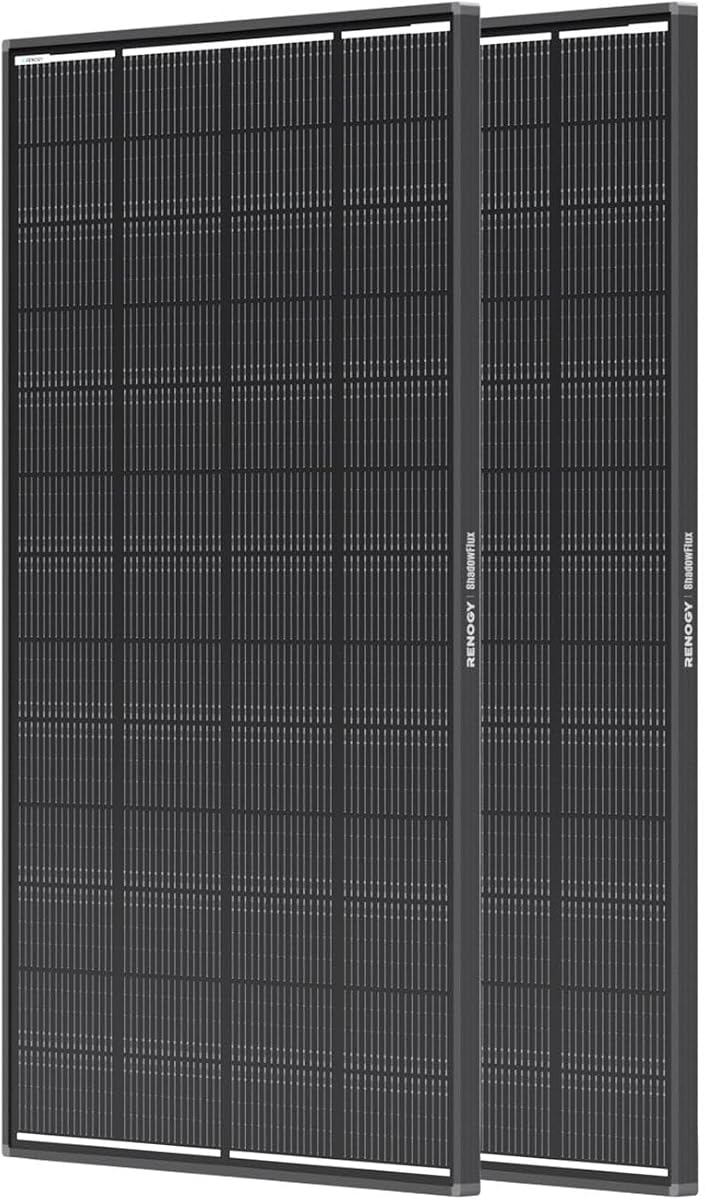
The Renogy ShadowFlux 200W Solar Panel offers a versatile combination of moderate-to-high output, modern cell construction, and attention to partial shading. Its 4.5 rating and N-Type 16BB design make it a logical choice for boats with recurring obstructions from antennas, light poles, trees, or structural supports.
We may earn a commission when you buy through this link, at no additional cost to you.
ShadowFlux technology is intended to reduce power loss and hot-spot risk when part of the module is shaded by buildings, plants, or stains. It does not eliminate the need for sensible siting, but it can make partially obstructed installations more productive than a conventional panel subjected to the same obstruction. The 16BB cells are also designed to support 25% efficiency and reduce microcrack risks.
Space efficiency is another advantage. According to the supplied information, the design is 7% smaller and 10% more compact than comparable PERC panels. Its encapsulation improves resistance to water vapor, and the stated IP67 protection is intended to handle rain, snow, dust, and small hail. These features are relevant to a vessel where the panel will encounter humidity, salt spray, and repeated weather changes.
The 200W tier makes this panel useful for small-to-medium battery banks, cabin lighting, electronics, ventilation, and other manageable loads. It is backed by a five-year output and material commitment plus a 25-year output warranty maintaining 80% power. It is a balanced recommendation for boaters who want more output than 100W, better shade behavior than many conventional designs, and a footprint that remains practical.
Marine installations rarely have an entirely unobstructed horizon. ShadowFlux offers a more resilient approach to the limited shade that is often unavoidable around masts, rails, and deck hardware.
At 200W, the module can meaningfully support a small marine system without requiring the larger footprint of a high-output array. Actual charging time still depends on battery capacity, sunlight, and system losses.
We may earn a commission when you buy through this link, at no additional cost to you.
The Renogy 200W Flexible Solar Panel is the leading choice in this guide for owners who cannot mount a conventional rigid frame. It has a 4.5 rating and uses a bendable design that can conform to curved surfaces within 240 degrees. That flexibility makes it useful on cabin roofs, curved bimini surfaces, inflatable structures, and other unusual contours.
We may earn a commission when you buy through this link, at no additional cost to you.
Its stated weight is only one-half that of a rigid panel, reducing the structural burden on a lightweight vessel. The all-black, glare-free finish also blends more discreetly into a boat’s design. Half-cut PERC cell technology is included to improve light capture and electrical performance, although this model does not offer the same 25% N-Type efficiency specification or ShadowFlux feature found in several rigid Renogy options.
The listed durability includes an IP67 waterproof junction box and solar connectors, 5,400Pa snow-load resistance, and 2,400Pa wind-load resistance. Pre-drilled mounting holes and a 27.6-inch 12 AWG solar connector cable help with installation. A smooth, clean surface is important, however. Repeated creasing, twisting, or bending around sharp edges can damage cells even when the panel is marketed as flexible.
This panel is best for owners who prioritize low weight and form-fitting installation over rigid-panel longevity or advanced shade mitigation. It can also serve as a portable module, although owners should protect the connection from bending stress and moisture. For a smooth, curved area with light obstruction, the Renogy flexible design offers an otherwise difficult mounting solution.
A flexible panel can eliminate the need for custom brackets or raised frames when the only suitable mounting surface is curved. The lower weight is particularly valuable on small boats and inflatable structures.
The panel should lie flat without sharp bends or concentrated stress. Marine-grade adhesive or compatible mounting hardware can secure it, and the connection should not carry cable weight.
We may earn a commission when you buy through this link, at no additional cost to you.
The Renogy ShadowFlux 120W Solar Panel is a compact option for vessels that need better output than a small trickle charger but lack room for a large rigid array. It has a 4.5 rating and combines N-Type cells, 16BB technology, and a stated 25% efficiency with Renogy’s ShadowFlux anti-shading design.
We may earn a commission when you buy through this link, at no additional cost to you.
The panel is described as 10% smaller and 10% more compact than PERC alternatives, making the 120W rating easier to accommodate on a smaller helm roof or cabin top. ShadowFlux is designed to maintain useful output when buildings, plants, or stains partially shade the surface, while the N-Type cells and 16BB construction are intended to limit hot spots and microcracks.
Environmental protection is centered on an IP67 rating, enhanced encapsulation, and resistance to water vapor. These characteristics suit outdoor use where humidity, rain, dust, and small hail are routine. The five-year materials and craftsmanship commitment and 25-year output warranty at 80% provide long-term coverage, though the actual output remains subject to placement, irradiance, and connected equipment.
A 120W panel is most appropriate for maintaining a modest battery bank or supporting limited daytime loads such as electronics, lighting, or instrumentation. It may take longer to restore a deeply discharged battery than a higher-output module. As with the other rigid Renogy panels in this list, the buyer should confirm controller compatibility, voltage requirements, fusing, and cable sizing. For a small boat seeking modern efficiency and some shade tolerance, it offers a balanced solution.
The 120W rating and stated 25% efficiency allow useful production from a relatively compact module. This can be more practical for smaller craft than installing a larger panel and accepting unused capacity.
ShadowFlux improves resilience to partial obstruction, but it cannot replace careful positioning. Keeping the panel clear of persistent shadows remains the simplest way to improve expected output.
We may earn a commission when you buy through this link, at no additional cost to you.
The Renogy 400W ShadowFlux Solar Panel is a premium high-output choice for larger boats, RVs, and off-grid systems where daily energy demand is substantial. Its 4.6 rating reflects a combination of 400 watts of rated power, N-Type 16BB cells, up to 25% cell efficiency, and an anti-shading architecture designed for partially obstructed environments.
We may earn a commission when you buy through this link, at no additional cost to you.
The panel is structured as two 200W sections in one 400W setup. ShadowFlux technology is intended to reduce power loss and hot-spot risk when trees, buildings, plants, or stains affect part of the surface. This is valuable on a large vessel because even a narrow shadow across a conventional high-output module can disproportionately reduce production.
Renogy states that the 400W design is 7% smaller and 10% more compact than traditional PERC panels of a comparable output class. An IP67 rating, advanced encapsulation, and water-vapor resistance are intended to protect it from rain, snow, dust, and small hail. The module is supported by a five-year material and workmanship warranty and a 25-year power-output warranty ensuring at least 80% rated output.
This is not a lightweight drop-in panel, and the listing does not indicate a complete controller-and-wiring kit. The owner must verify available deck or roof area, support, electrical architecture, and charge controller compatibility. Even so, for larger power systems that cannot be served by a single compact module, the Renogy 400W ShadowFlux stands out for efficient production, shade tolerance, and long-term coverage.
A 400W rating can support more meaningful daytime energy needs than the smaller rigid modules in this guide. It is better suited to larger battery banks and vessels with refrigeration, electronics, lighting, and other sustained loads.
High panel output should be matched to an appropriate controller, fusing, switching, and cable gauge. Confirm the vessel’s voltage architecture and avoid connecting the module to incompatible charge equipment.
We may earn a commission when you buy through this link, at no additional cost to you.
The SUNER POWER 50W Waterproof MPPT Kit provides a middle ground between lightweight trickle chargers and larger energy systems. It carries a 4.4 rating and combines a 50W panel with an integrated UltraSmart MPPT controller, making it suitable for maintaining and modestly replenishing compatible 12V batteries in boats, cars, trailers, campers, and RVs.
We may earn a commission when you buy through this link, at no additional cost to you.
The controller offers stated tracking efficiency of up to 99% and peak conversion efficiency of 98%. Its bulk, absorption, and float stages provide a structured charging cycle, while automatic shutdown and restart remove the need for continual supervision. Charge-level indicators show progress at 25%, 50%, 75%, and 100%, and the user can select standard 12V, AGM, or lithium charging modes.
Like the smaller SUNER POWER model, the kit includes protections for over-charge, over-discharge, over-voltage, over-current, over-load, short circuit, reverse polarity, and over-temperature. It is described as waterproof and spark-proof, with plug-and-play connections and pre-designed holes for the included suction cups. For a working boat, the suction cups should be treated as temporary assistance rather than the sole means of retention in rough conditions.
Fifty watts offers meaningful improvement over a small maintainer without requiring a large rigid module. It can support a moderate 12V battery setup and offset several low-draw systems, although it is not designed to power a large marine hotel load on its own. The integrated MPPT controller, selectable battery profiles, and automatic operation make this a convenient all-in-one choice for boaters who want more capability than a simple 20W kit.
The built-in tracking controller removes the need to match this kit with a separate charge controller. That integration is convenient for basic 12V maintenance systems where space and installation simplicity are priorities.
The output is sufficient for maintenance and light daytime support but remains modest compared with a 100W, 200W, or 400W panel. Boaters with substantial loads should size the full system rather than rely on this kit alone.
We may earn a commission when you buy through this link, at no additional cost to you.
The POWOXI 7.5W 12V Solar Battery Charger is the most compact and uncomplicated option in the guide. Its 4.4 rating reflects a product focused on preventing drain rather than providing substantial energy. It is designed for cars and is also listed for marine, motorcycle, tractor, ATV, farm-device, LiFePO4, lithium-ion, and other 12V battery applications.
We may earn a commission when you buy through this link, at no additional cost to you.
The panel’s controller includes smart fast charging and an internal protection system, while a blocking-diode structure is intended to guard against overvoltage and short-circuit conditions. The stated solar-silicon conversion efficiency is 25% to 30%, but that figure should not be interpreted as a guarantee of 7.5 watts in every location. A small panel produces less energy as available sunlight declines.
Installation is refreshingly simple. Owners can connect it through a 12V accessory socket or attach the included alligator clips directly to the battery. The ABS and PC frame is described as stronger than a flexible panel and less likely to damage painted surfaces. High-transparency, low-iron tempered glass provides impact and weather resistance, while red and green LEDs indicate sunlight reception and connection for charging.
This is best for a small start battery, a rarely used boat battery, or a vehicle stored for extended periods where the goal is preventing unnecessary discharge. It should not be expected to revive a deeply depleted large bank, operate a cabin load, or replace a proper charging system. Confirm polarity, keep the connection weatherproof, and place the panel where it can receive unobstructed sunlight. Within that narrower role, it is a convenient low-impact maintainer.
The socket-and-clip connection makes the kit attractive for maintaining a small battery during storage. It can reduce the need for periodic charger hookups when the panel receives consistent daylight.
Seven and a half watts is appropriate for a maintenance role, not sustained vessel loads. Larger batteries and deeper discharge conditions require a more capable panel and correctly matched charging system.
We may earn a commission when you buy through this link, at no additional cost to you.
Choosing a marine solar panel requires balancing available space, expected sunlight, battery architecture, environmental exposure, and the amount of energy the vessel actually needs. The most important first step is defining the role the panel will perform.
Begin by estimating the energy consumed by the equipment the panel must support. A battery maintainer needs only enough output to offset small parasitic loads, while a liveaboard or cruising vessel may need substantial production for refrigeration, lighting, electronics, ventilation, and battery recovery. Compare that requirement with available sunlight, the vessel’s battery capacity, and charging losses. A larger panel is not automatically better if it exceeds the boat’s practical space or electrical design, while an undersized panel can create a false sense of energy independence.
Marine electrical systems commonly use 12V or 24V batteries, but panel and controller requirements can differ from the nominal battery voltage. The Callsun 400W configuration, for example, is described as 47.48V Vmp and 54.62V Voc when its two modules are connected in series, making compatibility with a 60V-class power station input relevant. Check open-circuit voltage, maximum power voltage, current, polarity, and controller limits before connecting any panel. Proper fusing, grounding where required, and cable sizing are equally important for safety and low power loss.
Marine panels must fit without interfering with lines, hatches, antennas, sails, winches, emergency equipment, or safe movement around the deck. Rigid modules generally provide stronger long-term mounting options, while flexible panels can conform to curved surfaces and weigh less. Measure the usable area rather than relying on the panel’s nominal dimensions alone. Leave room for ventilation, cable routing, and access to connections. Strong winds and constant flexing make secure mounting hardware more important than saving a small amount of space.
Even partial shade can reduce conventional panel output, and boats frequently encounter obstructions that change throughout the day. Anti-shading designs such as Callsun’s dual-module parallel arrangement and Renogy ShadowFlux can lessen the effect of localized obstruction. No technology makes a heavily shaded panel equivalent to one receiving direct sun, so site the module where possible and remove avoidable shade. Also consider the sun’s changing position, nearby sails, reflective surfaces, and any future equipment additions that could interrupt the installation.
Cell efficiency can help when mounting area is limited because a more efficient module can deliver more power from the same surface. N-Type models in this guide carry stated efficiency ratings of 25% or 25.6%, while the flexible Renogy uses half-cut PERC cells. High temperatures reduce output, so a low temperature coefficient is valuable in hot climates and on sun-exposed decks. Compare efficiency with durability, shade behavior, weight, and system compatibility rather than treating the headline efficiency number as the only meaningful measure.
Look for low-iron tempered glass, corrosion-resistant frames, reliable junction boxes, and meaningful environmental protection. Ratings such as IP67 and IP68 describe specific levels of ingress protection, while stated wind and snow load figures indicate the testing applied to the module. Salt-laden air can accelerate corrosion around mounting points and connectors, so stainless hardware, isolated conductors, and sound sealing are valuable additions. A product’s warranty is also relevant because panel replacement on a remote vessel can be difficult and disruptive.
A bare solar panel generates electricity but does not necessarily regulate battery charging. Complete kits such as the SOLPERK 20W and SUNER POWER 20W or 50W packages include controllers, connectors, and sometimes mounting accessories. MPPT controllers can extract more available energy than simpler controllers, especially when conditions change, while integrated three-stage charging can simplify operation. If a vessel already has a correctly sized controller, a standalone high-efficiency panel may offer more flexibility. If not, a matched kit can reduce component-selection errors.
Rigid high-output panels are heavier and more difficult to handle aboard, especially during bad weather. Flexible modules can be easier to transport and install but require a smooth surface and careful cable management. For battery maintainers, a small panel and simple connection may be more appropriate than a permanently mounted array. Consider how the system will be inspected, cleaned, replaced, and secured during rough conditions. Salt residue and dirt should be removed according to the manufacturer’s care instructions, and connections deserve regular visual checks.
Before installation, identify the battery type, voltage, polarity, and existing charging equipment. Read the panel and controller instructions, confirm electrical limits, and install an appropriate fuse or circuit breaker where required. Use marine-rated cable, protect conductors from chafe and sharp edges, and provide strain relief so wind and vessel movement cannot pull against the connections.
Mount the panel in the clearest practical location and use compatible hardware or adhesive appropriate to the selected rigid or flexible design. Position the module to avoid persistent shade, and do not obstruct hatches, lines, antennas, emergency gear, or safe movement. For adjustable trickle chargers, orient the panel toward the sun and ensure the bracket or mounting surface can withstand repeated motion and weather exposure.
For care, inspect the glass and mounting points periodically, especially after severe weather. Clean with fresh water and a soft cloth rather than abrasive tools or harsh chemicals, and keep the junction box and connectors dry. Check charge indicators, battery voltage, wiring, corrosion, and attachment security. If output drops unexpectedly, test in direct sunlight, inspect for shade and dirt, and verify the controller mode before considering a fault.
The right size depends on the battery bank, daily energy use, available sunlight, and whether the panel is for maintenance or active charging. A small 7.5W or 20W panel can help maintain a modest 12V battery, while 100W to 200W modules are more useful for regular daytime loads. Boats with substantial power demands may need a larger array and a properly engineered charging system.
A solar panel should not be connected directly to a battery without appropriate charge control. A compatible controller regulates voltage and current, manages charging stages, and protects against overcharging. Complete kits include a controller, while standalone panels require the owner to confirm compatibility with the battery chemistry and system voltage.
Flexible panels can be useful on curved or weight-sensitive surfaces because they are lighter and conform to different shapes. They must still be mounted on a smooth, clean surface without sharp creases or concentrated stress. The cable connection also needs support so that movement does not pull on the panel.
Partial shade can substantially reduce output, especially with conventional cell layouts. Callsun’s dual-module parallel design and Renogy’s ShadowFlux products are intended to reduce the impact of localized shading, but no panel produces like an unobstructed module. Good placement remains the most effective way to preserve charging performance.
An MPPT controller tracks the panel’s maximum power point and converts the available solar energy into a charging profile suited to the connected battery. It can improve energy utilization as sunlight, temperature, and panel voltage change. The SUNER POWER 20W and 50W kits include integrated MPPT controllers for simplified 12V charging.
The selected mode should match the battery’s chemistry and manufacturer’s charging instructions. Standard 12V, AGM, and lithium profiles use different voltage and absorption behavior. If the battery is replaced, recheck the setting before continuing to use the charger, and consult the battery maker if the type is uncertain.
A small maintainer may bring a lightly discharged battery back to a healthy state over a prolonged period, but 7.5W or 20W is generally inadequate for rapidly recovering a deeply depleted battery bank. Inspect the battery for damage or sulfation and use a correctly sized charger when quick recovery is required.
Inspect the panel, mounting points, wiring, and connections before departure and periodically during extended trips. Salt spray, salt water, vibration, and wind can affect connections and hardware even when the panel itself is well protected. Cleaning with fresh water and checking charge indicators can help identify dirt, shading, or wiring problems early.
The Callsun 400W N-Type Bifacial Solar Panel stands out for high output, modern N-Type cells, bifacial construction, and a dual-module anti-shading approach. It is the strongest choice for larger marine power systems that can accommodate two rigid modules and compatible charging hardware. The SOLPERK 20W kit offers the most approachable maintenance setup, while the Renogy 400W ShadowFlux combines premium output with compact dimensions and partial-shade resilience.
For smaller needs, compare the Renogy 100W and 120W panels for efficient rigid installations, the Renogy 200W flexible model for curved surfaces, and the SUNER POWER kits for integrated MPPT control. A small-boat owner may receive more value from a well-mounted 100W module than from a larger panel that cannot be positioned properly. The most important priorities are usable space, direct sunlight, battery compatibility, secure mounting, and an honest estimate of daily energy use.
Check the current specification, warranty, component list, and price for the selected product before ordering, because listings and availability can change. Also confirm that your existing controller, wiring, fuses, and battery settings are suitable for the panel you choose. With a complete system and realistic expectations, marine solar can provide dependable charging, longer battery life, and greater independence from shore power.
