
12V 300Ah Two-Pack
5.0Editor score
Two matched 300Ah batteries
Integrated 200A BMS
Low-temperature protection
Flexible series-parallel expansion
Our 600Ah LiFePO4 Battery guide compares ten large-capacity options for energy density, BMS protection, cycle life, expandability, monitoring, and outdoor use.
A 600Ah LiFePO4 battery is a substantial energy-storage investment for off-grid living, RV upgrades, solar systems, marine equipment, and whole-home backup. The best unit balances usable capacity, continuous and peak power, safety electronics, physical weight, cycle life, and compatibility with the charging equipment already in your system.
We compared all ten products using the specifications supplied by their manufacturers. Our evaluation focuses on battery architecture, BMS ratings, protection features, temperature limits, expansion options, monitoring capabilities, cycle claims, physical weight, and intended applications rather than laboratory testing or personal experience.
Each review explains the strongest reasons to choose a particular model and the compromises worth considering. The list includes single 12V batteries, matched two-pack systems, a higher-capacity 640Ah option, and a 48V rack-scale configuration; prices and availability can change at any time.
5.0Editor score

5.0Editor score

4.4Editor score
The comparison covers nominal architecture, energy capacity, BMS approach, expansion potential, monitoring, and major use cases. Specifications are based on the supplied product information, and the final choice should also reflect your inverter, charger, available space, climate, and expected load profile.
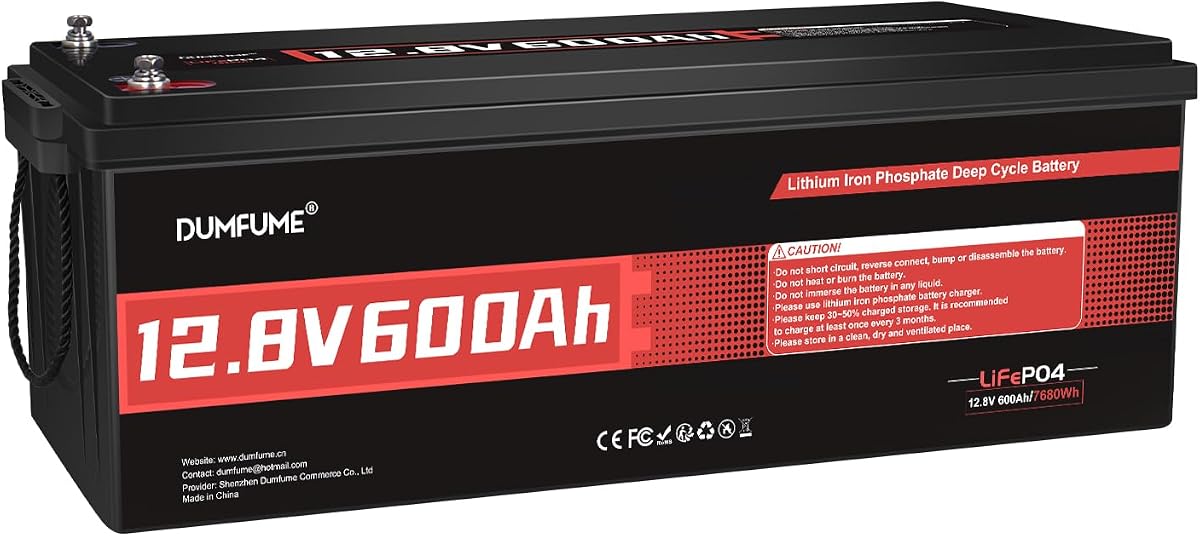


The DUMFUME 12V 600Ah LiFePO4 Lithium Battery Built-in 200A BMS holds 7.2kWh of nominal energy and carries a 4.4 rating. It is a conventional 12V deep-cycle unit designed for solar storage, RV travel, home backup, and other sustained loads rather than engine starting. Its defining feature is the balance between a substantial 600Ah capacity and a 200A integrated BMS.
We may earn a commission when you buy through this link, at no additional cost to you.
The battery protects against overcharging, over-discharge, overcurrent, overheating, and short circuits. Low-temperature cutoffs are particularly relevant for mobile and off-grid users because charging is automatically disabled below 0°C while discharging is blocked below -20°C. Manufacturer cycle claims reach 4,000 cycles at 100% depth of discharge, 6,000 at 80%, and 15,000 at 60%, indicating that operating within a moderate discharge range can extend service life.
One limitation is the absence of remote monitoring. Users cannot conveniently inspect state of charge, voltage, current, or cycle history through an app, so they must rely on compatible meters and the inverter or charge controller. The manufacturer also recommends recharging an idle battery every six months and notes that charging below 0°C is not covered by return shipping for cold-weather issues.
This DUMFUME is a good choice for buyers who want a large single 12V battery, dependable protection, and long cycle claims without moving into a more complex server-rack installation. It is especially suitable for a fixed solar or backup system where weight can be managed and remote telemetry is not essential. Ensure your charger supports 12V LiFePO4 charging and verify operating temperatures before installation.
A 7.2kWh nominal rating gives this battery substantially more endurance than typical smaller LiFePO4 units. That makes it useful for refrigerators, lighting, electronics, and other loads that would quickly deplete a portable power station. Actual usable energy depends on the inverter, wiring losses, temperature, and the depth to which the battery is regularly discharged.
Multiple identical batteries can be connected in series or parallel to raise system voltage or available capacity. Using matching units from the same product family is important because differences in age, charge, and internal resistance can create uneven current distribution when mixed batteries are connected.
We may earn a commission when you buy through this link, at no additional cost to you.
The 12V 600Ah Lithium LiFePO4 Battery (APP Monitoring & 300A BMS) combines 7.68kWh of nominal energy with one of the most capable monitoring systems in this group. Its 5.0 rating reflects a particularly attractive combination of capacity, protection, and remote visibility. It is a strong general-purpose choice for RV, marine, solar, and home backup installations.
We may earn a commission when you buy through this link, at no additional cost to you.
The upgraded 300A BMS protects against overcharging, over-discharge, overcurrent, short circuits, and unsafe temperatures. Grade A cells are specified, while the app reports voltage, current, power, state of charge, and cycle count. That information can help users identify abnormal consumption, confirm charging performance, and make better decisions about system load and maintenance.
System expansion is unusually flexible. The manufacturer describes configurations from 7.68kWh to 122.88kWh using 16 identical batteries arranged in a 4P4S setup, with stated power output ranging from 3.84kW to 61.44kW. Charging can come from solar, a generator, or a 14.6V 70A LiFePO4 charger, and the battery can reportedly be charged by a suitable 1,920W solar MPPT arrangement in about five hours.
The trade-offs are operational rather than fundamental. The product is not designed as a starter or golf-cart battery, and its advanced electronics require correct wiring and compatible charging equipment. Buyers should read the manual, account for high-temperature charging limits, and confirm that inverter communications or monitoring functions align with their system. For buyers who value visibility and headroom, it is the most complete overall option here.
Real-time state-of-charge and power data makes it easier to distinguish a genuine capacity shortage from an inefficient inverter, heavy phantom loads, or a charging problem. Cycle-count information also gives long-term owners a clearer picture of actual use instead of relying entirely on calendar-based replacement assumptions.
A 300A BMS gives this model more current-handling capability than the common 200A configuration found among the alternatives. The protection plate is described as disconnecting when discharge current exceeds 500A for 640 milliseconds, adding a meaningful layer of protection during severe overload events.
We may earn a commission when you buy through this link, at no additional cost to you.
This 12V 600Ah LiFePO4 Lithium Battery with 200A BMS offers 7.2kWh of energy and a 4.4 rating. Its basic proposition is straightforward: a large, relatively light deep-cycle battery for solar, RV, camper, and home backup use, with integrated protection against common electrical faults. It is aimed at buyers who value capacity and straightforward expansion more than remote telemetry.
We may earn a commission when you buy through this link, at no additional cost to you.
The 200A BMS includes protection for overcharge, over-discharge, short circuits, overheating, and excessive current. Dual cold-weather cutoffs prevent charging below 0°C and discharging below -20°F, reducing the risk of cell damage in unsuitable conditions. Rated cycle life reaches more than 4,000 cycles at 100% depth of discharge and more than 6,000 at an 80% depth.
At 107.81 pounds, the battery is lighter than many lead-acid banks of similar capacity. That makes handling and installation more manageable, although it remains a heavy object for one person. Users can connect identical units in series for 24V or 48V systems or in parallel for greater capacity, with the BMS assisting current coordination.
The absence of an app means users need an inverter display, battery meter, or other monitoring device to track operating data. It is also not intended for starting engines, powering jacks, or operating golf carts. For a straightforward solar or backup installation where remote data is optional, this model offers a capable core with fewer electronics to configure.
The combination of a 600Ah rating and a 107.81-pound weight is meaningful for stationary installations where every pound adds installation difficulty. It also makes battery replacement less burdensome, while still providing far more stored energy than common portable power-station batteries.
Overcurrent, thermal, short-circuit, and overcharge protections cover the electrical faults most likely to damage a lithium installation. The cold-weather lockouts should be treated as protective features rather than exact promises of usable winter performance, particularly when charging is involved.
We may earn a commission when you buy through this link, at no additional cost to you.
The DUMFUME 12V 600Ah LiFePO4 Battery With 200A BMS combines a 7.2kWh rating with dimensions of 24.09 by 9.64 by 8.86 inches, increasing to 25.19 inches with the handle. It weighs 107.81 pounds. With a 4.4 rating, it targets installers who need substantial storage without moving into a larger server-rack format.
We may earn a commission when you buy through this link, at no additional cost to you.
Its 200A BMS provides the usual core safeguards: overcharge, over-discharge, overcurrent, short-circuit, and overheating protection. A low-temperature lockout blocks charging below 0°C and discharging below -20°C. The manufacturer also highlights ultra-low self-discharge, which helps preserve capacity when a battery is stored for extended periods, although periodic recharging every six months is still recommended.
Cycle claims exceed 4,000 at 100% depth of discharge and 6,000 at 80%, providing a favorable long-term durability profile. Expansion is supported through configurations up to 4S4P, allowing identical units to form higher-voltage or higher-capacity systems. The internal BMS is stated to balance voltage and current across connected batteries.
This is not a monitored product, so users must provide their own status display or compatible inverter information. It is designed for deep-cycle storage and is not an engine-starting battery. For RV, solar, and off-grid users who understand the physical dimensions and can provide proper ventilation and secure mounting, it is a capable and space-conscious option.
The long but relatively narrow enclosure is intended to make a large battery easier to fit into battery compartments, equipment rooms, and storage cabinets. Buyers should measure both the case and handle before installation because handle-inclusive depth may determine whether the unit fits in a constrained space.
Low self-discharge helps preserve stored energy during periods when the system is lightly used. It does not eliminate maintenance requirements, so owners should still establish a recharge schedule and confirm the battery's state before returning it to seasonal service.
We may earn a commission when you buy through this link, at no additional cost to you.
The ECIENWELL Two-Pack consists of two 12V 300Ah batteries, providing a combined nominal capacity of 600Ah and 7.68kWh. It earns a 5.0 rating and stands out as a flexible way to obtain a large LiFePO4 reserve. The smaller individual modules may also be easier to handle, move, and replace than one monolithic 600Ah battery.
We may earn a commission when you buy through this link, at no additional cost to you.
Each module weighs 54.45 pounds and measures 15.12 by 7.64 by 10.03 inches. The listed IP65 waterproof rating broadens placement options for marine, RV, outdoor cabinet, and off-grid use. Cycle claims are 4,000 or more at 100% depth of discharge, 6,000 at 80%, and 15,000 at 60%, while the integrated 200A BMS covers overcharge, overdischarge, overload, voltage, current, heat, and short-circuit events.
The product information also identifies UL and CE certification, UN 38.3 and MSDS testing, more than a 10-year service-life claim, and substantial use of recycled battery materials. These are meaningful attributes for buyers considering environmental impact as well as electrical performance.
One practical limitation is that the package is not a single integrated 600Ah enclosure. It includes two separate batteries, so users need enough protected space and must wire them consistently. It also lacks app-based telemetry. Nevertheless, as a value-oriented way to reach 600Ah total capacity, this two-pack is difficult to overlook, particularly for trolling motors, boats, campers, and solar installations.
Two independent batteries can be arranged as a 24V pair or placed across separate positions as needed. This can be helpful where one very large case would be difficult to maneuver, although both units still need stable mounting, secure terminals, and appropriate weather protection.
The manufacturer identifies trolling motors, boats, RVs, trucks, kayaks, solar panels, off-grid systems, UPS units, fish finders, emergency lighting, and household backup as possible uses. That range makes it a practical option for mobile power users who may need to move or redistribute individual modules.
We may earn a commission when you buy through this link, at no additional cost to you.
The HumsiENK 12V 640Ah Two-Pack is the most capacity-focused conventional option in the group. It supplies 8,192Wh per 12V battery and 16.38kWh when two units are combined as a 24V system. The 4.4 rating reflects a premium configuration built around substantial energy, high-current output, matched batteries, and Bluetooth monitoring.
We may earn a commission when you buy through this link, at no additional cost to you.
Each battery uses a 250A BMS with six-layer protection for overcharging, over-discharge, overload, short circuits, and high or low temperatures. Peak discharge is listed at 600A, making the package relevant to demanding RV appliances, boat motors, and larger off-grid loads. The battery is specified at 111.88 pounds, with standard M8 terminals for easier integration into compatible systems.
Bluetooth connectivity reports state of charge, voltage, and temperature. Expansion follows a 4S4P architecture and can scale to 51.2V, 2,560Ah, and 131kWh. Charging is supported through chargers, solar panels, and generators, with a claimed full recharge in five hours under the appropriate 0.2C charging arrangement.
Cold conditions require careful attention. The battery may discharge down to -4°F but automatically disables charging below 32°F. Its size and total weight also make the two-pack less convenient than a single battery, and Bluetooth information may not be as comprehensive as a full smartphone app. Even so, users seeking maximum capacity and serious high-current capability will find this package compelling.
A 16.38kWh package offers a much larger reserve than a conventional 600Ah installation, making it useful for extended periods away from shore power. The added capacity also gives users flexibility when operating high-consumption appliances without depending on constant generator support.
Batch matching is especially helpful when batteries will be paralleled or series-connected. Closely matched production characteristics can reduce imbalance, although users still need correct cables, common fusing, compatible charge controllers, and a properly sized inverter for the intended system.
We may earn a commission when you buy through this link, at no additional cost to you.
The NebuQuic 12V 300Ah Two-Pack delivers 600Ah total capacity through two compact batteries and holds a 5.0 rating. It uses matched EV Grade A+ cells and an internal 4P4S arrangement, giving it a strong appeal for RV, truck, kayak, camper, solar, and trolling-motor applications where deep-cycle reliability matters.
We may earn a commission when you buy through this link, at no additional cost to you.
The integrated 200A BMS protects against overcharge, over-discharge, overload, excessive voltage, excessive current, overheating, and short circuits. Rated high-rate charging and discharging of 200A supports heavier-duty use, while low-temperature protection activates below -20°C to reduce cold damage. The battery is also described as approximately one-third the weight of equivalent lead-acid alternatives.
Cycle claims are 4,000 or more at 100% depth of discharge, 6,000 at 80%, and 15,000 at 60%, paired with a service-life claim of more than ten years. These figures demonstrate why depth of discharge and charging discipline should be considered when comparing long-term value with lead-acid systems.
The main compromise is the lack of connected monitoring. Buyers must use an inverter display or separate meter to check operating data. Two individual enclosures also mean more mounting and cable-planning work than a single large battery. For mobile users who need manageable modules and substantial cycle endurance, however, this package is a particularly coherent option.
Using EV Grade A+ prismatic cells focuses attention on consistent cell construction and energy density. That can help the batteries deliver predictable performance in demanding mobile applications, although actual system results still depend on matching, balancing, temperature, and charger compatibility.
The stated cycle profile is particularly useful for solar and backup systems that repeatedly charge and discharge the same battery. Operating at a shallower depth of discharge is associated with the highest claimed cycle counts, so system sizing should preserve reserve whenever practical.
We may earn a commission when you buy through this link, at no additional cost to you.
The Paoweric 12V 660Ah provides 7.68kWh of stored energy, slightly exceeding the nominal 600Ah target while remaining compatible with a nominal 12.8V architecture. Its 4.6 rating is the second highest among the listed products. The battery is positioned for RV, solar, yacht, emergency backup, and other outdoor energy-storage applications.
We may earn a commission when you buy through this link, at no additional cost to you.
A 250A BMS supplies overcharge, over-discharge, and overcurrent protection. The stated operating range is 0°C to 45°C for charging and -20°C to 60°C for discharge, giving users a clear view of acceptable conditions. The metal shell carries an IP65 waterproof and wear-resistant rating, a useful feature in marine, RV, and outdoor cabinet installations.
Manufacturer specifications state a load power of 3,200W and a cycle life of more than 10,000 cycles. The dimensions are 25.25 by 9.75 by 8.77 inches, while the weight is approximately 144 pounds, making this the heaviest large single battery among the directly comparable options. It is built from A-grade cells according to the product description.
The manufacturer recommends not exceeding six batteries in series or parallel and warns against mixing different brands. Its greater weight can complicate installation, and remote monitoring is not listed. For buyers who prioritize enclosure robustness, actual 660Ah capacity, and the higher 250A BMS rating, it is a strong alternative to standard 600Ah units.
The 660Ah rating provides a modest energy advantage over a conventional 600Ah battery without moving to a radically different architecture. That extra capacity can be valuable when the system must support loads longer or when additional usable reserve is needed for future expansion.
An IP65 shell improves resistance to dust and water exposure compared with an unprotected battery case. It does not make the product immune to weather, so terminals, ventilation, cable routing, and enclosure placement still require careful attention in damp or dusty environments.
We may earn a commission when you buy through this link, at no additional cost to you.
The HumsiENK 12V 640Ah is a single-battery solution that delivers 8.192kWh and carries a 5.0 rating. It offers a useful middle ground between a standard 600Ah battery and a large two-pack: more capacity than most 600Ah alternatives, but a simpler single-unit installation than the HumsiENK 640Ah duo.
We may earn a commission when you buy through this link, at no additional cost to you.
The 250A BMS monitors and protects against overcharging, over-discharge, overload, short circuits, and high or low temperatures. Bluetooth allows users to check state of charge, voltage, and temperature in real time. A peak discharge rating of 600A provides headroom for demanding equipment, including RV air conditioners and boat motors.
The battery can be charged using a compatible charger, solar panel, or generator, with the manufacturer citing 0.2C charging and a five-hour full recharge under suitable conditions. Expansion uses a 4S4P design and can reach a stated 51.2V, 2,560Ah, and 131kWh system. Standard M8 terminals support integration with compatible lead-acid-style installations.
The operating range extends from -4°F to 149°F for operation, but charging is disabled below 32°F. Bluetooth monitoring is convenient yet less detailed than the app-based telemetry offered by the top overall pick. Overall, this is a compelling choice for a single high-capacity installation that needs more than basic meter-based supervision.
A single 640Ah unit reduces the number of enclosures, interconnects, and battery-balancing concerns involved in a multi-battery installation. It also makes system expansion more incremental, allowing owners to add compatible capacity later if their load requirements grow.
Support for chargers, solar, and generator input makes the battery relevant to both grid-connected backup and off-grid systems. The stated recharge time depends on adequate input power and correct LiFePO4 charge settings, so the connected solar array or generator must meet those requirements.
We may earn a commission when you buy through this link, at no additional cost to you.
The AOUSK 48V 600Ah Six-Pack is a rack-scale system rather than another conventional 12V 600Ah battery. It includes six 48V 100Ah modules with a combined 30.72kWh capacity, following a 51.2V nominal architecture. Its 5.0 rating reflects strong integration features for professionally designed solar and backup installations.
We may earn a commission when you buy through this link, at no additional cost to you.
Each module uses 16 automotive Grade A prismatic cells and provides 5.12kWh, equivalent to four 12V 100Ah batteries in series. The full-metal enclosure fits standard 3U cabinets, supports vertical installation, and weighs 94.8 pounds per battery. The package also weighs enough that careful handling and rack support are essential.
CAN and RS485 communication allows the batteries to work with compatible all-in-one solar inverters. Bluetooth and a mobile app provide status monitoring, while the inverter can be used to configure cycle capacity. The 100A BMS protects against overcharge, over-discharge, overcurrent, and short circuits, with high- and low-temperature charging cutoffs. A 125A air switch and power switch add further system-level protection.
This package includes parallel wires, communication cables, grounding wires, terminal covers, screws, a manual, and installation resources. Up to 15 batteries can be connected in parallel. The key drawback is the lower 100A BMS rating compared with 200A and 250A alternatives, plus the need for a 48V inverter and compatible communications setup. It is best suited to installers comfortable with high-voltage battery systems.
CAN and RS485 support makes this package more attractive to users with compatible solar inverters that can exchange battery data and adjust operating settings. This communication can improve visibility into system behavior and allow charging parameters to be managed more precisely.
The standard 3U format makes the modules relatively straightforward to incorporate into a purpose-built battery cabinet. Included wiring and communication accessories reduce the need to source additional parts, but installers still need to verify rack loading, clearances, grounding, ventilation, and local electrical requirements.
We may earn a commission when you buy through this link, at no additional cost to you.
The most suitable battery is not determined by amp-hour capacity alone. Inverters, chargers, peak loads, climate, physical space, expansion plans, and monitoring preferences can all change which model is the right fit, so use the specifications below to narrow the field before purchasing.
Choose the architecture your equipment supports, not merely the one with the largest printed capacity.
Size the battery so essential loads retain reserve under realistic rather than theoretical conditions.
Match inverter output to continuous battery capability, not promotional peak figures.
Prioritize complete BMS protection, then build the surrounding electrical system safely.
Confirm cold-charge limits and local winter conditions before installing a lithium battery outdoors.
Compare cycle claims at the same depth of discharge for a meaningful comparison.
Choose richer monitoring when remote diagnosis and operating visibility are important to you.
Plan the physical installation and expansion limits before choosing a battery format.
Begin by reading the battery manual, identifying every terminal, and confirming that the inverter, charge controller, and charger are designed for the battery's nominal voltage and LiFePO4 profile. Use appropriately rated cables, fuses, disconnects, and protective grounding. Secure the battery firmly, provide ventilation, and keep conductive tools and debris away from the terminals. Before connecting loads, verify polarity and begin with a conservative charge and load test rather than assuming every parameter is already correct.
Charge only within the manufacturer-specified temperature range and use the correct charging voltage and current. Low-temperature cutoff protection may stop charging automatically, but users should not try to bypass it. For batteries that are stored without regular use, recharge at least every six months and verify state of charge periodically. Keep terminals clean and dry, inspect cables for looseness or damage, and avoid exposing the battery to standing water, excessive heat, or conductive debris.
Monitor state of charge, temperature, and current whenever the system includes an inverter display or remote telemetry. Prevent repeated deep discharge where practical, investigate unexpected standby consumption, and use the manufacturer's recommended settings for low state-of-charge cutoffs. When combining batteries, use matching units, appropriate fusing, balanced cable lengths, and the specified series or parallel arrangement. Retire any battery that appears swollen, mechanically damaged, unusually hot, or inconsistent with the rest of the bank, and contact the manufacturer for support.
At a nominal voltage near 12.8V, a 600Ah LiFePO4 battery stores about 7.68kWh of nominal energy. The amount available to AC-connected loads is lower because of inverter conversion losses, wiring losses, temperature, and the battery's discharge cutoff. Products labeled 640Ah or 660Ah provide modestly more nominal storage, while two-pack configurations can multiply the total.
Yes, identical batteries can normally be connected in parallel for more capacity or in series for a higher voltage, subject to the manufacturer's expansion limits. Do not mix brands, models, or batteries with substantially different ages or states of charge. Use correct cable sizing, fusing, and charge settings, and confirm that the inverter supports the resulting bank voltage.
Several products in this guide explicitly state that they are designed for deep-cycle energy storage rather than engine starting. A starter battery must deliver a very high burst current while retaining starting voltage, which is a different task from the sustained delivery expected from a 600Ah storage battery. Use a battery specifically rated and marketed for starting instead.
Most can be charged through compatible solar controllers, and several descriptions specifically mention solar charging. The controller must use a LiFePO4 charge profile and provide adequate array output. Charging time depends on solar conditions, controller size, battery temperature, and system losses, so the listed fast-charge figures generally require the manufacturer's recommended equipment and conditions.
Charging lithium cells below their approved temperature can create safety and cell-damage risks, so several models automatically disable charging around 0°C or 32°F. The battery may still have a stated discharge range, but ability to discharge does not mean charging is safe. Bring the battery into a suitable temperature or use a temperature-controlled charging environment when conditions fall below the charging limit.
The appropriate BMS rating depends on the inverter's continuous output, surge requirements, wiring, and expected loads. A higher rating provides more current headroom but does not automatically make a battery suitable for every system. The BMS, inverter, cables, fuses, and load profile must be sized together, with manufacturer guidance taking priority over generic comparisons.
They are generally maintenance-free in the flooded-battery sense, meaning they do not need electrolyte checks or water additions. They do still require sensible care, including periodic charging during storage, clean and secure terminals, compatible charging equipment, temperature awareness, and inspection of cables and system connections. A quality inverter display or monitoring system is also helpful.
Two matching 300Ah batteries can provide the same total capacity as one 600Ah battery while making each module lighter and easier to move. A single 600Ah case may require fewer interconnects and occupy a different amount of space, while a two-pack offers more placement flexibility. The best format depends on mounting constraints, handling preference, expansion plans, and the quality of the battery management system.
The ECIENWELL Two-Pack stands out as the best budget route to 600Ah total capacity, combining separate 300Ah modules, IP65 protection, and strong cycle claims. The app-monitored 300A BMS model is the strongest all-around choice for owners who want detailed telemetry and high-current headroom. The HumsiENK 640Ah Two-Pack is the premium option for buyers prioritizing maximum capacity, batch matching, and substantial peak output.
Before choosing, prioritize inverter compatibility, realistic load requirements, safe charging, cold-weather limits, and physical installation. Do not let nominal capacity obscure the need for appropriate cables, fuses, ventilation, and compatible charge profiles. For future expansion, choose a model with matching units available and a clearly stated series-parallel architecture rather than planning around unrelated batteries.
Finally, check current prices, availability, warranty terms, and the latest manufacturer instructions before ordering. Product configurations and technical details can change, and battery safety depends heavily on correct installation. Use the comparison to narrow the field, then verify every electrical specification against the equipment that will charge, monitor, and power the final system.


