ASUS Pro WS B850M-ACE SE
4.3Editor score
Compact Micro-ATX design
Onboard AST2600 BMC
Broad AMD processor support
This ASUS Server Motherboard guide compares 10 models for sockets, memory, PCIe expansion, networking, remote management, form factors, and workstation
An ASUS server motherboard must provide more than a CPU socket and a few memory slots. The best models combine dependable power delivery, enterprise-grade networking, remote management, flexible storage expansion, and compatibility with the processor and memory you intend to use. Form factor also matters because a capable workstation platform must fit its intended chassis.
This guide compares ten ASUS motherboards suited to workstations, servers, and professional computing environments. We evaluated processor support, ECC memory capacity, PCIe and M.2 expansion, wired and wireless networking, IPMI capabilities, power delivery, cooling, form factor, and the management features that matter outside a conventional desktop setup. The list includes AMD, Intel, ATX, E-ATX, CEB, EEB, and Micro-ATX options.
Each review identifies the strongest use for the featured model and explains its limitations. The top selections cover a broad range of needs, from compact business systems to high-end Threadripper and Xeon workstations. Product listings and technical details can change, so buyers should verify the current processor support, accessory requirements, and platform specifications before ordering.
4.3Editor score

5.0Editor score

4.0Editor score
The table below compares all ten boards by processor platform, expansion, networking, and management capabilities, making it easier to identify the right foundation for a compact workstation, dual-socket server, or specialized professional system.


The ASUS Pro WS WRX90E-SAGE SE is an EEB workstation motherboard built around AMD's sTR5 socket and Ryzen Threadripper PRO 7000 WX-series processors. Its listed rating is 3.7, but the hardware specification reveals an unusually ambitious platform: up to 96 CPU cores, seven PCIe 5.0 x16 slots, 2TB of ECC R-DIMM memory, and extensive storage connectivity. It is aimed at specialized workstations rather than ordinary office computers.
We may earn a commission when you buy through this link, at no additional cost to you.
Expansion is the board's defining attraction. Seven full-length PCIe 5.0 x16 slots can accommodate multiple high-bandwidth accelerators, professional graphics cards, capture devices, or storage controllers. Four M.2 positions, SlimSAS NVMe support, dual rear USB4 ports, dual 10Gb LAN, and 2.5Gb LAN make the platform appropriate for workloads that move substantial data between local and network storage.
Thermal and power provisions are correspondingly serious. A 32-stage power system uses two 8-pin CPU connectors, while large VRM, chipset, and M.2 heatsinks are supported by active cooling. A dedicated AST2600 BMC connection provides hardware-level remote management, and ASUS Control Center Express adds real-time monitoring. These features increase complexity, but they address the reliability needs of a continuously operating professional system.
The main limitation is physical scale. EEB is an exceptionally large form factor, so system builders must confirm chassis support, cooler clearance, and the number of power connections available. It is best for simulation, AI development, high-end rendering, multi-GPU computing, and other systems where a normal ATX motherboard would impose a hard expansion limit.
Seven PCIe 5.0 x16 slots make this one of the most flexible boards in the guide. The additional lanes can be used for multiple GPUs, high-speed network cards, professional capture hardware, or NVMe adapters, subject to the processor and chassis lane configuration.
The dedicated AST2600 BMC and ASUS Control Center Express distinguish this model from a consumer motherboard with basic remote functions. That combination is valuable when a workstation must be monitored, diagnosed, or managed after installation.
We may earn a commission when you buy through this link, at no additional cost to you.
The ASUS Pro WS W890E-SAGE SE combines Intel's LGA 4710-2 workstation platform with an extensive EEB layout. It supports Xeon 600-series workstation processors, ECC R-DIMM DDR5 memory, seven PCIe 5.0 x16 slots, four M.2 connectors, MCIO, SlimSAS, and multiple high-speed USB interfaces. Its 5.0 rating is the highest numerical score among the listed boards.
We may earn a commission when you buy through this link, at no additional cost to you.
Network performance and manageability are major strengths. Dual Intel E610-XAT2 10Gb LAN interfaces suit data-intensive workflows, while a separate AST2600 BMC connection allows server-grade monitoring through ASUS Control Center Express. The board therefore supports both fast local data movement and out-of-band administration, an important distinction for workstations deployed in studios, laboratories, or enterprise offices.
Its 16+(2+2)+1+2 power-stage design includes several CPU and PCIe power connectors, including provisions for dual power supplies. Active cooling is specified for the VRM, chipset, M.2, and memory areas. These details suggest a platform designed for sustained high-load operation, although the exact power-supply arrangement must be coordinated with the chosen EEB chassis.
This is an expensive, specialized foundation rather than a general-purpose family PC board. The EEB size, workstation memory, processor requirements, and cooling demands may exceed the needs of a small office. For a professional Xeon build that needs many accelerators, high-speed networking, ECC memory, and remote management, it is one of the most complete options in this roundup.
The combination of Xeon support, seven PCIe 5.0 x16 slots, ECC memory, and dual 10Gb networking provides a flexible foundation for AI development, high-resolution media, and large analytical datasets. It gives integrators room to add specialized accelerator and network hardware.
A dedicated BMC link provides a path to hardware and software monitoring even when the primary operating system is unavailable. That makes the board more practical for unattended professional systems than a conventional desktop platform.
We may earn a commission when you buy through this link, at no additional cost to you.
The ASUS Pro WS W890-SAGE is a CEB workstation motherboard for Intel Xeon 600-series processors. It retains the seven PCIe 5.0 x16 slots, four M.2 connectors, two SlimSAS positions, and high-speed USB found in high-end W890 platforms, but management is structured around support for an IPMI expansion card rather than a permanently dedicated BMC connection.
We may earn a commission when you buy through this link, at no additional cost to you.
The board supports ECC R-DIMM DDR5 memory in a 2DPC configuration, with NitroPath DRAM technology intended to improve memory performance. Storage and networking are equally well considered: Realtek 10Gb LAN, Intel 2.5Gb LAN, four M.2 slots, SlimSAS, USB4, and USB 20Gbps Type-C provide multiple paths for fast storage and peripherals.
Its 12+(2+2)+1+2 power stages and multiple CPU and PCIe connectors support demanding workstation loads, while dedicated VRM, chipset, and M.2 cooling helps manage sustained heat. The IPMI expansion-card option is less integrated than the dedicated BMC arrangement found on the W890E-SAGE SE, but it preserves flexibility for systems that need remote management.
This model is a strong candidate for engineers, content creators, and developers who need a Xeon-compatible board with abundant expansion but do not require a permanently connected management controller. Buyers should plan the optional IPMI card, confirm the case supports CEB, and verify all processor and memory compatibility before building.
Seven PCIe 5.0 x16 slots provide room for multiple GPUs, accelerators, high-speed NICs, and specialized capture equipment. The four M.2 connectors and SlimSAS support further improve flexibility for storage-heavy configurations.
The board is ready for an IPMI expansion card, allowing an integrator to add out-of-band control. This makes it a useful middle ground for deployments that need management but do not need every management function permanently integrated.
We may earn a commission when you buy through this link, at no additional cost to you.
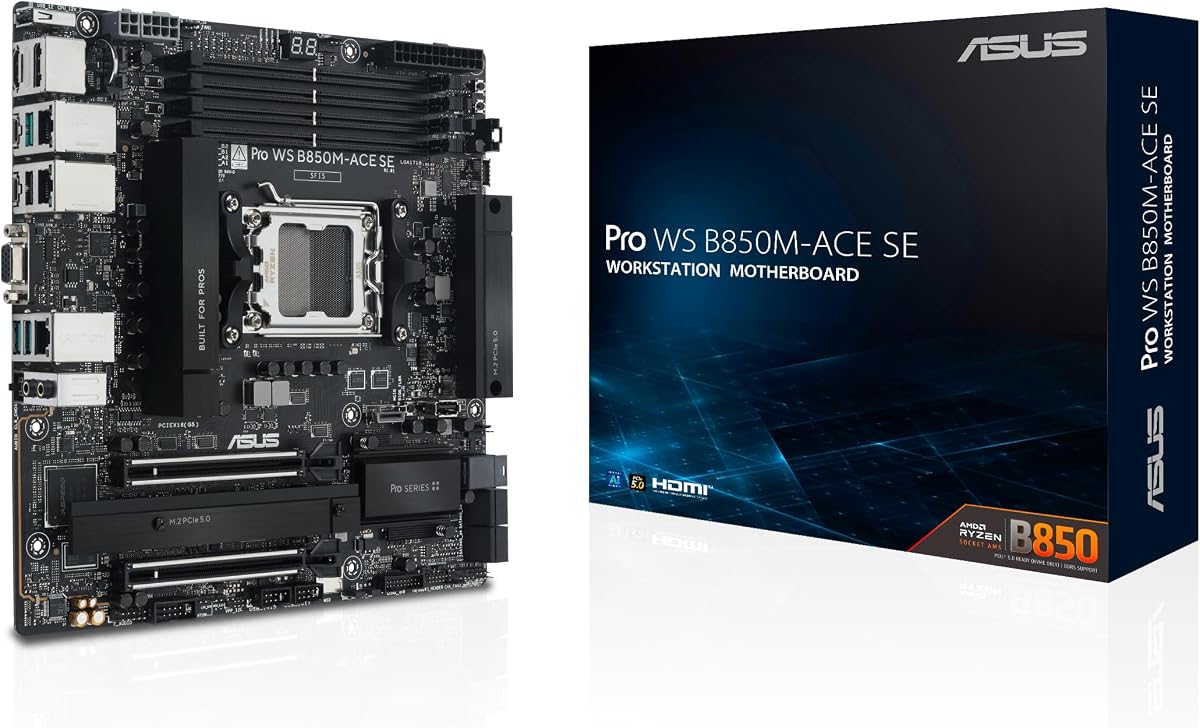
The ASUS Pro WS B850M-ACE SE is a compact business motherboard for AMD AM5 processors. Unlike the largest Threadripper and Xeon boards in the guide, it accepts mainstream Ryzen 9000, 8000, and 7000 series processors as well as AMD EPYC 4005 series processors. Its 4.3 rating and broad compatibility make it a practical entry point into managed workstation building.
We may earn a commission when you buy through this link, at no additional cost to you.
Although the board is small, its data connectivity is modern. It offers two PCIe 5.0/4.0 x16 slots, with one operating at x4, plus two PCIe 5.0 x4 M.2 connectors, MCIO NVMe support, and U.2 support. 10Gb and 2.5Gb LAN provide enterprise-class transport options, while front USB 20Gbps Type-C handles modern peripherals and docking solutions.
The onboard AST2600 BMC is the standout feature for a Micro-ATX board. Combined with ASUS Control Center Express, it provides real-time monitoring and remote management without requiring the motherboard to occupy a full ATX footprint. Extensive compatibility validation, a broad QVL, and 24/7 operation testing make this a credible option for managed business PCs, compact servers, and small professional workstations.
Its compromise is obvious: only two PCIe slots are listed, and one has reduced lanes. It cannot match the seven-slot expansion of CEB and EEB models, and system builders must select a Micro-ATX case with adequate airflow. For a compact managed build that prioritizes management, fast networking, and modern AMD compatibility, it is the most balanced entry in the list.
An onboard BMC gives the board enterprise-style monitoring without requiring a full-size workstation chassis. This is particularly useful for compact systems deployed in offices, studios, or edge-computing environments.
MCIO and U.2 support expands the board's usefulness for NVMe storage beyond the two onboard M.2 connectors. That makes the platform more appropriate for data-intensive builds than a small consumer board with a single storage option.
We may earn a commission when you buy through this link, at no additional cost to you.
The ASUS Pro WS TRX50-SAGE WIFI is a CEB motherboard for AMD Ryzen Threadripper PRO 7000 WX-series and Ryzen Threadripper 7000-series processors. It supports CPUs with as many as 96 cores and up to 1TB of ECC R-DIMM DDR5 memory in a 1DPC configuration. Its listed 3.6 rating should be considered alongside the scope of the platform, which is clearly designed for heavy professional compute.
We may earn a commission when you buy through this link, at no additional cost to you.
The most visually striking specification is its 36-stage power system. Two 8-pin CPU connectors, a large VRM heatsink, and dedicated chipset and M.2 cooling provide the power and thermal foundation expected from a Threadripper workstation. Three PCIe 5.0 x16 slots allow substantial graphics, accelerator, or network expansion, while multi-GPU support broadens the use case for rendering and compute systems.
Connectivity is equally comprehensive. WiFi 7, 10Gb LAN, and 2.5Gb LAN provide flexible networking, while three M.2 slots, SlimSAS NVMe, and front and rear USB 20Gbps Type-C support modern storage and peripherals. Remote management is provided through support for an ASUS IPMI expansion card and ASUS Control Center Express.
This board is a compelling option for Threadripper builders who want robust cooling, high power capacity, and wireless convenience without moving to the EEB WRX90E platform. Its limits are the CEB footprint, Threadripper cooling and memory costs, and the need to add an IPMI expansion card for remote administration. Verify the exact WiFi and accessory configuration with your reseller.
The 36-stage design and dual 8-pin CPU power connections are appropriate for high-core-count Threadripper processors. Large VRM and chipset cooling should help sustain performance during long rendering, simulation, and compilation workloads.
WiFi 7, 10Gb Ethernet, and 2.5Gb Ethernet cover everything from cable-free administration to high-bandwidth file access. Builders can choose the transport that best fits their storage and network infrastructure.
We may earn a commission when you buy through this link, at no additional cost to you.
The ASUS Pro WS TRX50-SAGE WiFi A is a high-end CEB Threadripper motherboard supporting Ryzen Threadripper PRO 9000 and 7000 WX-series processors as well as Ryzen Threadripper 9000 and 7000-series processors. It offers up to 1TB of ECC R-DIMM DDR5 memory and carries a 4.0 rating, making it one of the strongest balanced premium options in the roundup.
We may earn a commission when you buy through this link, at no additional cost to you.
Its 20-stage power design uses two 8-pin CPU connectors and is supported by large VRM, chipset, and M.2 heatsinks. Three PCIe 5.0 x16 slots and one PCIe 4.0 x16 slot provide room for multiple professional GPUs, accelerators, and high-speed adapters. Multi-GPU support extends the board's relevance to parallel compute and rendering environments.
Storage and peripherals receive premium attention. Four M.2 connectors, SlimSAS NVMe support, front USB 20Gbps Type-C, and two USB4 ports rated at 40Gbps create a modern high-bandwidth platform. Dual 10Gb and 2.5Gb Ethernet handles wired networking, while the WiFi A designation identifies the wireless-equipped version.
The trade-off is that IPMI is not presented as a fully integrated dedicated controller. The board supports ASUS IPMI expansion cards and Control Center Express, but a buyer who requires always-on out-of-band management should include the appropriate accessory. Otherwise, this is a refined and flexible Threadripper platform with strong expansion, storage, and networking.
Support for both Threadripper PRO 9000 and 7000 families broadens processor choice. That makes the board suitable for new builds as well as professional systems planned around supported 7000-series hardware.
Two 40Gbps USB4 ports, four M.2 connectors, and SlimSAS support give modern workstations room for fast NVMe storage, high-resolution displays, and demanding external equipment without falling back to slower legacy interfaces.
We may earn a commission when you buy through this link, at no additional cost to you.
The ASUS Pro WS W680-ACE IPMI is an ATX workstation motherboard for 13th and 12th Gen Intel Core processors, along with Pentium Gold and Celeron support. Its 4.4 rating is the second-highest numerical result in the guide. The board offers a practical middle ground between compact business boards and extremely large Threadripper or Xeon platforms.
We may earn a commission when you buy through this link, at no additional cost to you.
The platform uses DDR5 with ECC memory support and provides dual PCIe 5.0 SafeSlot connectors plus dual PCIe 3.0 slots. Three PCIe 4.0 M.2 positions and SlimSAS cover fast local storage, while dual Intel 2.5Gb Ethernet supplies reliable wired networking. A front-panel USB 3.2 Gen 2×2 Type-C connector and Thunderbolt 4 header support modern peripherals.
Management is particularly notable because an IPMI expansion card is bundled. Combined with ASUS Control Center Express, the board supports advanced security management, including USB port controls, software blacklisting, and Registry editing permissions. DrMOS power delivery, alloy chokes, durable capacitors, a large VRM heatsink, M.2 heatsinks, hybrid fan headers, and Fan Xpert 4 round out the platform.
Its main strategic limitation is the LGA 1700 platform itself. A buyer should purchase knowing the available processor generations and should not expect the same future socket path offered by newer workstation families. Even so, the board is well suited to a professional ATX build needing ECC memory, expansion, fast storage, and remote-management capability without moving to EEB dimensions.
The included IPMI expansion card is a meaningful advantage for a conventional workstation chassis. It provides a path to remote monitoring and control that many desktop-class boards do not offer.
Dual PCIe 5.0 slots, three M.2 positions, SlimSAS, and dual 2.5Gb Ethernet provide a sensible balance for a creative workstation or engineering system that needs professional features without an oversized platform.
We may earn a commission when you buy through this link, at no additional cost to you.
The ASUS P12R-M/10G-2T is a Micro-ATX server motherboard built around the Intel C252 chipset and LGA 1200 socket. It is intended for Intel Xeon E-2300 processors. This positions it as a compact server foundation for file services, virtualization hosts, small business infrastructure, and other systems where a server platform is more appropriate than a consumer motherboard.
We may earn a commission when you buy through this link, at no additional cost to you.
The defining advantage is its focused form factor. Micro-ATX allows more compact enclosures than full-size server boards while retaining enterprise-oriented features such as server memory support and networking. The product name's 10G-2T designation points toward dual 10Gb network functionality, making the board relevant to installations that need high-bandwidth data movement or redundant network paths.
Compared with the Pro WS products in this guide, the supplied information is limited. It identifies the chipset, socket, processor family, and form factor but does not provide a detailed list of memory slots, expansion connectors, storage interfaces, power connectors, or remote-management functions. Buyers should therefore consult the full ASUS technical documentation and chassis compatibility list before making a final decision.
The platform is most suitable for organizations that specifically want Xeon E-2300 support in a compact server. It is less appropriate for a new high-end workstation because the listed processor generation is older than Threadripper 9000 and Xeon 600 options in the guide. Its appeal lies in value-focused infrastructure tasks rather than maximum workstation expansion.
The Micro-ATX footprint can reduce the physical footprint of a server build without abandoning Intel's server-oriented chipset approach. It is a useful foundation for compact office servers, network-attached storage, and virtualized workloads.
Because the supplied listing information is brief, memory population rules, storage support, expansion, and management details should be confirmed from the official manual. This is especially important when redeploying an existing Xeon E-2300 configuration.
We may earn a commission when you buy through this link, at no additional cost to you.
The ASUS Z13PE-D16 is an E-ATX server motherboard designed around two Intel LGA 4677 processors from the fifth-generation Xeon platform. It supports processors with up to a 350W TDP and provides 16 DDR5 RDIMM positions for as much as 4TB of memory. This is clearly a capacity-oriented platform for virtualization, large databases, and consolidated enterprise workloads.
We may earn a commission when you buy through this link, at no additional cost to you.
Memory is the headline feature. Sixteen RDIMM slots allow very large configured capacities, while a single processor can operate with up to three PCIe cards. Two M.2 connectors provide PCIe 5.0 x4 bandwidth for operating-system boot and local storage, and dual Intel 10Gbps Ethernet ports include teaming support for higher aggregate bandwidth or redundancy.
Management is handled through ASUS Control Center and ASMB11-iKVM, providing infrastructure monitoring and remote console capabilities. These are important features for a system expected to operate as an enterprise server rather than a desktop. Dual processors also make board power delivery, memory population, cooling, and operating-system support significantly more involved.
The board's strongest use is centralized compute, not compact workstation construction. With no numerical rating supplied, customer feedback offers less guidance than for several Pro WS alternatives, so technical validation is particularly important. Organizations should confirm processor pairing, memory population rules, chassis support, PCIe card compatibility, and power-supply requirements before procurement.
Sixteen DDR5 RDIMM positions and support for up to 4TB make the Z13PE-D16 suitable for large virtual machines, in-memory analytics, and database servers. The board provides substantially more memory headroom than the compact and mainstream options in the guide.
Dual Intel 10Gbps Ethernet with teaming support offers the bandwidth and redundancy needed for enterprise data traffic. ASMB11-iKVM and ASUS Control Center improve administration compared with a conventional desktop board.
We may earn a commission when you buy through this link, at no additional cost to you.
The ASUS Pro WS W680-ACE IPMI is an ATX Intel W680 workstation motherboard for 13th and 12th Gen Intel Core processors, as well as Pentium Gold and Celeron processors. It includes dual PCIe 5.0 SafeSlot slots, two PCIe 3.0 slots, three PCIe 4.0 M.2 connectors, SlimSAS, SATA 6Gbps, and dual Intel 2.5Gb Ethernet. Its 2.6 rating is the lowest listed score, so platform fit deserves careful attention.
We may earn a commission when you buy through this link, at no additional cost to you.
The board's traditional workstation strengths are broad connectivity and broad operating-system support. HDMI, DisplayPort, and VGA outputs allow integrated display options, while USB 3.2 Gen 2×2 Type-C and a Thunderbolt 4 header support modern accessories. A TPM header and LPT header improve compatibility with specialized or legacy equipment.
DrMOS power delivery, alloy inductances, durable capacitors, a large VRM heatsink, M.2 heatsinks, hybrid fan headers, and Fan Xpert 4 form the power and cooling package. An IPMI expansion card is bundled, giving the system a dedicated Ethernet connection to the BMC controller and adding an important layer of remote system intelligence.
It is best suited to a conventional ATX workstation that values display flexibility, storage breadth, and management over maximum network speed. The main concerns are the low customer rating, the LGA 1700 platform's limited upgrade horizon, and the absence of 10Gb Ethernet. A buyer should compare the documented management and security features with newer W890 and TRX50 alternatives.
HDMI, DisplayPort, and VGA outputs distinguish this board from platforms that require dedicated graphics for every display task. The mix also supports professional monitors, diagnostic setups, and systems with varied display requirements.
Three PCIe 4.0 M.2 slots, SlimSAS, and SATA 6Gbps provide several paths for fast and mass-storage configurations. That range is useful when a workstation needs both high-speed scratch space and larger capacity drives.
We may earn a commission when you buy through this link, at no additional cost to you.
The correct ASUS motherboard depends on the processor, memory, expansion, chassis, storage, and management requirements of the finished system. Comparing those constraints before selecting a board prevents costly incompatibilities and leads to a more reliable build.
Start with the processor family rather than the model number. The selections in this guide cover AMD sTR5 for Threadripper, AMD AM5 for Ryzen and supported EPYC 4005 processors, Intel LGA 4710-2 for Xeon 600-series workstation processors, Intel LGA 1700 for supported Core and entry processors, Intel LGA 4677 for a dual-processor server, and Intel LGA 1200 for Xeon E-2300 systems. Socket compatibility determines the processor, chipset, memory generation, and often the intended workload.
Choose the socket and generation that match a realistic upgrade path. A newer platform may support more lanes, newer accelerators, and current enterprise management, while an established platform can be appropriate when reusing compatible components.
Professional and server boards commonly support ECC R-DIMM or RDIMM memory, but capacity varies dramatically. The WRX90E-SAGE SE supports as much as 2TB, the TRX50 boards support 1TB, the W890-SAGE uses a two-DIMM-per-channel configuration, and the Z13PE-D16 supports as much as 4TB across 16 RDIMM positions. These figures depend on the exact processor and memory configuration.
Check supported module types, population rules, channel layout, and maximum capacity before buying memory. A larger theoretical capacity does not guarantee that every module combination will be supported.
PCIe slot count is crucial for AI, rendering, simulation, professional graphics, high-speed networking, and storage. The two W890 boards and WRX90E-SAGE SE offer seven PCIe 5.0 x16 slots, while the TRX50-SAGE models provide three such slots. More compact or ATX choices offer fewer expansion positions, so add-in cards must be prioritized before the processor is selected.
Verify whether a slot is electrically x16 or x4, what lanes the processor provides, and whether multi-card configurations impose platform limitations. Physical slot count alone does not guarantee full bandwidth for every device.
Modern workloads may require more than onboard M.2 storage. The boards range from four M.2 connectors with SlimSAS to the B850M-ACE SE's combination of two PCIe 5.0 M.2 positions, MCIO, and U.2 support. The W680-ACE IPMI adds SATA 6Gbps for conventional drives, while the W890E-SAGE SE includes both MCIO and SlimSAS.
Choose based on the intended drive mix. NVMe-focused compute systems benefit from multiple M.2 and MCIO connections, while conventional servers may require SATA capacity. Confirm connector orientation, lane sharing, cooling coverage, and supported adapters.
Wired network speed and out-of-band management are separate considerations. Dual 10Gb LAN appears on the WRX90E-SAGE SE, W890E-SAGE SE, and Z13PE-D16, while other boards pair 10Gb with 2.5Gb or use dual 2.5Gb. Dedicated AST2600 BMC support appears on the WRX90E-SAGE SE, W890E-SAGE SE, and B850M-ACE SE. Other platforms may require an IPMI expansion card.
For unattended systems, confirm whether the BMC connection is integrated or optional. For data-intensive systems, prioritize sustained 10Gb networking and determine whether both ports support the intended switch, bonding, or redundancy configuration.
Motherboard size determines which cases and cooling solutions are possible. EEB is used by the WRX90E-SAGE SE, CEB by the W890-SAGE and TRX50-SAGE models, ATX by the two W680-ACE IPMI boards, Micro-ATX by the B850M-ACE SE and P12R-M/10G-2T, and E-ATX by the dual-socket Z13PE-D16. Larger boards generally provide more expansion but demand a correspondingly large enclosure.
Check case support, rear-panel clearance, CPU cooler height, GPU length, and the location of power connectors. A board that fits physically may still be difficult to cool if the case does not support its high power density.
High-core-count processors and multiple accelerators place heavy transient loads on a motherboard. The guide includes designs ranging from the TRX50-SAGE WiFi A's 20-stage system to the TRX50-SAGE WIFI's 36-stage design and the WRX90E-SAGE SE's 32 stages. VRM, chipset, M.2, and memory cooling are also explicitly addressed on the premium boards.
Match the board's power design to the processor and installed expansion cards, then ensure the chassis provides effective airflow around the VRM and storage. A high stage count alone is not a substitute for adequate case cooling and a correctly sized power supply.
A workstation motherboard may be used with professional operating systems, server operating systems, or a conventional desktop environment, but support should be confirmed. Threadripper and Xeon boards are natural choices for heavy compute, while AM5 business boards can serve managed engineering and office systems. The dual-socket Z13PE-D16 is intended for infrastructure roles such as virtualization and large databases.
Define the workload before choosing a board. GPU rendering, storage-heavy databases, remote-managed deployments, and compact office systems each value different combinations of lanes, memory, networking, management, and form factor.
Begin by confirming compatibility across the entire system. Match the processor, cooler, memory modules, operating system, chassis, power supply, graphics cards, network cards, and storage adapters to the motherboard manual. Install memory in the order recommended by ASUS, attach the processor cooler, and check that the CPU socket retention mechanism is properly secured before applying power.
During the first startup, update the firmware before installing a full operating system or many add-in devices. Enter the BIOS to confirm that the processor, memory, storage, and PCIe devices are detected correctly. Configure RAID or storage arrays if required, enable appropriate remote-management access, and set administrator passwords before connecting the system to a production network.
After deployment, monitor temperatures, fan speeds, storage health, and BMC alerts. Keep airflow unobstructed, use an appropriate dust-management schedule for the environment, and confirm that all high-power connectors are fully seated. For critical deployments, keep validated firmware and compatible component lists in mind, test replacement memory or accelerators before placing them into service, and document the hardware configuration.
A workstation motherboard can work well in a home server when it offers the management and connectivity you need. ASUS Control Center Express, an integrated BMC, ECC memory, and 10Gb networking can provide useful reliability and administration. However, consumer CPUs may lack the same ECC support as supported Xeon or EPYC processors, so the complete platform must be validated before purchase.
IPMI provides out-of-band system management through a dedicated baseboard management controller. An administrator can inspect hardware, view alerts, and often access the console even when the main processor or operating system is unavailable. Standard desktop boards generally depend on software running inside the operating system, so troubleshooting is less independent.
ECC support depends on the board, processor, and memory modules. The models in this guide advertise ECC-capable workstation memory, but a supported processor may require specific registered or unbuffered ECC module types. Verify the ASUS qualified vendor list and processor memory support before purchasing RAM.
Yes, the listed boards include PCIe expansion suitable for professional or consumer graphics hardware. High-end cards may require additional power connectors, sufficient chassis clearance, and enough space between expansion slots. Multi-GPU configurations also require compatible processors, lane routing, and possibly additional power supplies.
The ASUS Pro WS B850M-ACE SE is the most compact option with an onboard AST2600 BMC in this group. Its Micro-ATX design reduces enclosure requirements, while 10Gb and 2.5Gb networking and modern NVMe support suit professional small-form-factor systems. It is less appropriate when many full-length expansion cards are required.
Confirm that the case explicitly supports the board's exact form factor, rear-panel layout, and power-supply arrangement. CPU cooler clearance, GPU length, expansion slot spacing, and airflow are also critical. EEB and CEB systems often use multiple power connectors, so the selected power supply must provide all required connections.
It depends on the workload and storage environment. Dual 10Gb ports provide greater bandwidth and can support redundancy or aggregation, which is valuable for large file transfers and server virtualization. 2.5Gb networking may be sufficient for smaller workstations and is usually easier to integrate into conventional network infrastructure.
The correct amount depends on the models, datasets, number of virtual machines, and whether memory is shared with the host. Professional creators may need only a fraction of the maximum capacity, while large language models, in-memory databases, and dense virtual environments can benefit from the larger RDIMM configurations available on the Z13PE-D16 and WRX90E-SAGE SE.
The ASUS Pro WS W890E-SAGE SE stands out as the most complete premium workstation platform in the guide, with seven PCIe 5.0 x16 slots, dual 10Gb networking, and dedicated AST2600 management. The ASUS Pro WS B850M-ACE SE is the practical compact choice, bringing an onboard BMC and strong AMD compatibility into a Micro-ATX design. The ASUS Pro WS TRX50-SAGE WiFi A offers a premium Threadripper platform with extensive storage, USB4, and networking.
Prioritize processor and memory compatibility first, followed by the number and electrical width of PCIe slots. After that, assess the storage interfaces, management architecture, networking, chassis dimensions, cooling, and power requirements. A smaller board may be the better investment for a managed office system, while a CEB, EEB, or E-ATX model becomes worthwhile when multiple accelerators, large memory capacity, or dual-socket computing is essential.
Before ordering, confirm the latest processor support, memory population rules, accessory requirements, and chassis clearance in the current ASUS documentation. Listings, bundles, and market conditions can change, and a small compatibility check before purchase is far easier than replacing a mismatched component after the system has been assembled.
