
TempPro TempSync 1000FT Wireless Meat Thermometer
4.5Editor score
One-thousand-foot RF range
Four color-coded probes
No app required
Backlit multi-probe display
Our Bluetooth or WiFi meat thermometer guide compares range, probes, app controls, alerts, accuracy, battery life, and cleaning for grilling.
A Bluetooth or WiFi meat thermometer takes the uncertainty out of grilling, smoking, roasting, and air frying by showing internal temperatures without requiring you to open the cooking chamber. The right model can also send alerts, track multiple foods, record temperature changes, and help prevent overcooking.
We compared the ten thermometers in this guide on the features that separate useful wireless models from basic digital thermometers. The comparison covers connectivity, number and design of probes, temperature range, alert functions, app features, battery life, water resistance, cleaning, and how each product fits different cooking routines.
Each review explains the strongest reasons to choose a particular thermometer while also noting practical trade-offs. The list includes dedicated Bluetooth, hybrid Bluetooth and WiFi, and WiFi-focused designs, from two-probe units to multi-probe systems and premium smart hubs. Prices and availability can change, so check the current listing before buying.
4.5Editor score

4.4Editor score

4.3Editor score
The table below compares all ten thermometers by connectivity, probe capacity, monitoring features, and practical advantages, making it easier to identify the model that matches your cooking setup and need for remote access.




This four-probe wireless thermometer earns the top position because it combines three connection methods with a generous probe count. It can work over Bluetooth, connect through WiFi, or operate in local mode when a dependable network connection is unavailable. Its 4.4 rating reflects a balanced package aimed at both backyard cooks and people who want to monitor food from farther away.
We may earn a commission when you buy through this link, at no additional cost to you.
The four independently marked probes are the most useful feature for complete meals. You can monitor steak, chicken, pork, and fish simultaneously, or use multiple probes to watch different doneness levels. Each probe includes two sensors: one for the internal food temperature and one for the surrounding grill or oven temperature. That dual-sensor arrangement gives a more complete picture than a model that reports only the food reading.
The smart base adds a useful layer of control. It provides a high-definition, wide-angle screen, stepless brightness adjustment, and a magnetic mount for metal cooking surfaces. A quick 25-minute charge is stated to support a full day of monitoring, while the probes have IP67 protection and can be placed in the dishwasher. The app also retains 30 minutes of offline data and synchronizes it after reconnection, which is helpful if a signal briefly drops.
The main compromise is that a smart base is more involved than a simple display or app-only design. You also have to decide which connectivity mode best fits each cooking session. Even so, the combination of four probes, local operation, WiFi access, and offline storage makes this a strong all-around choice for households that cook several foods at once or want flexibility between indoor and outdoor use.
Bluetooth is convenient for a nearby phone, WiFi extends monitoring beyond the yard, and local mode keeps the base useful when the signal is weak. This flexibility reduces the chance that a dead zone will interrupt a long cook.
The independent probe markings make it easier to track a main protein, poultry, seafood, and a second temperature point. Internal and ambient readings from each probe also help distinguish food doneness from the cooking environment.
We may earn a commission when you buy through this link, at no additional cost to you.
The Meatmeet X Pro combines WiFi, Bluetooth, and a standalone smart base in a focused two-probe system. Its 4.8 rating is the highest among the listed thermometers, while the unusually dense sensor arrangement makes it attractive for cooks who want detailed internal readings rather than a basic temperature estimate.
We may earn a commission when you buy through this link, at no additional cost to you.
Each ultra-thin probe contains six sensors: five positioned for internal temperature measurement and one for ambient conditions. The stated accuracy reaches plus or minus 0.18 degrees Fahrenheit, and the probes independently support separate alerts. This configuration is especially useful when cooking two dishes to different doneness levels, such as a medium-rare steak alongside chicken that needs a different target.
The smart base gives the system more flexibility than a basic probe-and-phone arrangement. You can monitor through the Meatmeet app over WiFi, use Bluetooth, or read the temperatures directly on the base without involving the phone. A five-minute charge is stated to provide up to 10 hours of probe use, a 30-minute charge extends that to 30 hours, and the base can run for up to 36 hours.
Its main limitation is that only two probes are included, so it is less convenient for cooking four separate foods or tracking several temperature points. The stainless-steel probes have IP69 waterproofing, can be rinsed or placed in the dishwasher, and are supported by a one-year warranty. For shoppers who prioritize sensor density and flexible monitoring over probe count, this is a compelling high-end choice.
Multiple internal sensors can provide a more complete view of temperature distribution than a single sensing point. The ultra-thin shape also limits the puncture area, making the probes practical for steaks, roasts, and other foods where preserving juices matters.
The base is useful when you want a glanceable display without continuing to watch a phone screen. It also gives the system a central home for charging and status information during longer smoking sessions.
We may earn a commission when you buy through this link, at no additional cost to you.
This Govee model is built around the Govee Home app, making it a strong choice for cooks who value guided recipes, planning tools, and detailed cooking records. It has a 4.4 rating and supports remote monitoring through WiFi, while its stated temperature range of 32 to 572 degrees Fahrenheit suits both low-and-slow smoking and high-heat grilling.
We may earn a commission when you buy through this link, at no additional cost to you.
Its most distinctive benefit is the way software supports the entire cooking process. The app offers instant notifications, cooking-time estimates, recipes for different styles, and one-tap timers for tasks such as flipping, basting, or seasoning. It can monitor two cuts or different zones at once, making it possible to compare temperatures without crowding a grill with unnecessary equipment.
The app can also record and visualize up to 24 hours of temperature changes. Users can export those curves to refine future cooking profiles, share results, or revisit the progress of a cook. The battery is stated to last for as many as 120 four-hour barbecue sessions or 50 turkey roasts, offering a long service life between replacements.
This is primarily a software-led thermometer, and that distinction matters. Some users may prefer a physical base with several temperature readouts, while others will appreciate being able to manage alerts and timers from a phone. Its two-probe arrangement is sufficient for most family meals, but it cannot match the four-probe flexibility of several competitors. For app-based planning and analysis, it remains a persuasive option.
Cooking-time estimates and one-tap task timers extend the thermometer's value beyond a target-temperature alarm. These features are particularly useful when coordinating sides, resting times, and multiple stages of a longer barbecue meal.
Twenty-four-hour tracking and curve export turn each cook into a record that can guide the next one. That makes the app useful for learning as well as monitoring, particularly when refining methods for a particular cut or appliance.
We may earn a commission when you buy through this link, at no additional cost to you.
The TempPro TempSync 650 ft focuses on the core benefits of wireless monitoring without adding a separate base or demanding a complicated network setup. Its 4.4 rating and two-probe format make it a practical Bluetooth option for backyard grilling, smoking, and extended barbecue cooking.
We may earn a commission when you buy through this link, at no additional cost to you.
Its listed range of up to 650 feet provides ample room to move around a home, yard, or nearby outdoor area. The app uses an intuitive interface and requires no registration or WiFi tinkering, which reduces the setup burden. Users can customize target temperatures and pre-alarms, then receive notifications as the food approaches the desired result.
Both temperatures remain visible in real time, so you can check progress without repeatedly reaching for your phone. The probes cover a stated 14 to 572 degrees Fahrenheit and offer plus or minus 1.8-degree Fahrenheit accuracy. They can monitor separate foods or provide a food reading alongside the grill temperature, making the two-probe configuration more versatile than it initially appears.
The primary limitation is that this is a Bluetooth-only design, so it is not intended to provide the same extended remote access as WiFi. It also includes only two probes. Even so, the long range, uncomplicated setup, and clear display make this a sensible choice for anyone who wants wireless monitoring without a smart-hub ecosystem.
Keeping the system on Bluetooth means there is no need to connect it to a home network or configure WiFi credentials. That simplicity can be especially helpful for renters, beginners, and cooks who move between different grilling locations.
One probe can follow a piece of meat while the other checks the cooking chamber, or each can monitor a separate food. This setup covers many common barbecue needs without the bulk of a larger multi-probe system.
We may earn a commission when you buy through this link, at no additional cost to you.
The TempPro TempSync 1000FT delivers long-range monitoring without requiring an app or a WiFi network. Its 4.5 rating, four color-coded probes, and stated 1,000-foot range make it a strong choice for large outdoor cooking spaces and users who prefer a self-contained display.
We may earn a commission when you buy through this link, at no additional cost to you.
Advanced RF technology provides the connection instead of Bluetooth, which the manufacturer describes as more stable for this type of long-distance monitoring. There is no registration, app setup, or personal-information requirement. The thermometer can therefore be used directly after opening the package, reducing friction for new cooks or anyone who wants a straightforward device.
Four color-coded probes make it possible to track several meats, different doneness levels, or a mixture of food and ambient temperatures without constantly consulting labels. The base has a large backlit screen that shows current and target readings for all four probes. Ten USDA-recommended meat presets and multiple doneness levels reduce guesswork, while the smart alarm both beeps and flashes as temperatures approach the selected range.
Its limitation is that the system does not offer the recipes, time estimates, historical curves, or remote phone notifications available on app-driven models. The connection is proprietary RF rather than Bluetooth, which may matter if you want to integrate it with a particular phone app. Still, for dependable long-range monitoring, multiple probes, and minimal setup, this is one of the most practical options in the guide.
A dedicated RF link keeps the base operating independently of phone compatibility, WiFi coverage, and account setup. It is a useful approach for cooks who want dependable readings at the edge of a yard or around a larger outdoor area.
Color coding gives each probe an immediate visual identity. That organization matters during a busy cook, when you may need to identify the brisket, the poultry, and the ambient grill reading at a glance.
We may earn a commission when you buy through this link, at no additional cost to you.
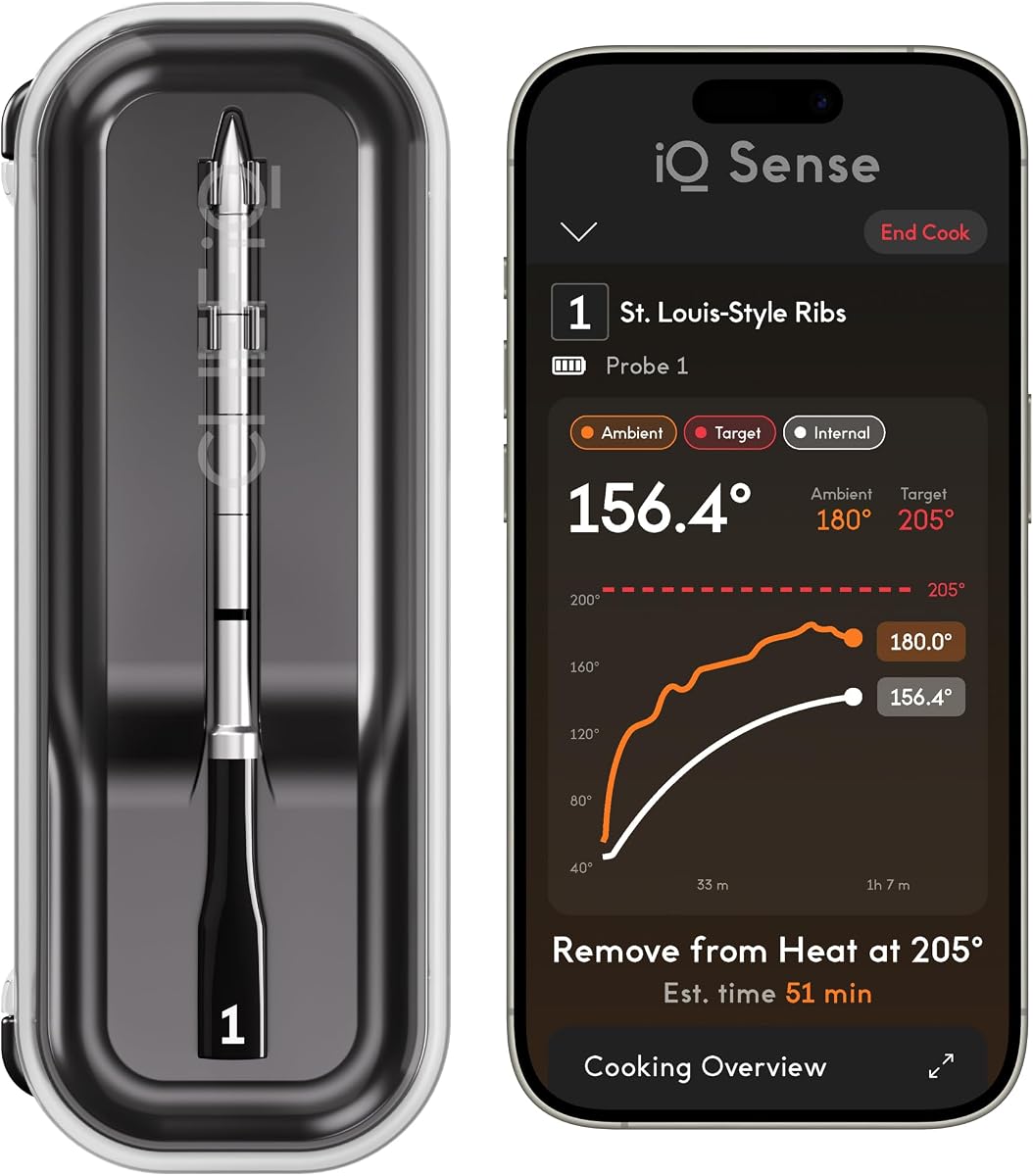
The single-probe CHEF iQ Sense Gen3 is a premium smart thermometer for cooks who want broad remote access, refined probe design, and a feature-rich app. Its 4.3 rating reflects a sophisticated system, and the included smart hub differentiates it from simpler probe-and-phone products.
We may earn a commission when you buy through this link, at no additional cost to you.
The ultra-thin probe includes four internal sensors and one ambient sensor, allowing it to monitor both the center of the food and the surrounding cooking environment. It is engineered to withstand heat up to 1,000 degrees Fahrenheit and is designed to reduce the impact of probing thicker cuts. WiFi provides effectively unlimited remote range for checking food from around the home, while Bluetooth supports local pairing.
The smart hub adds a speaker for audio notifications, and the CHEF iQ app supplies push notifications, hundreds of protein and doneness presets, estimated cooking times, flip reminders, rest timers, and video-guided recipes. A full charge is stated to provide up to 50 hours of use, which suits long smoking sessions, all-day barbecue cooking, and large roasts.
Only one probe is included, which is the clearest drawback for a multi-food meal. The smart hub and advanced feature set also place it in a higher tier than basic wireless thermometers. Nevertheless, for someone focused on one large cut, exceptional heat tolerance, guided instruction, and remote monitoring, this model offers a distinctive and polished package.
The thin profile minimizes the opening made in the food while five sensors provide a detailed view of temperature. This balance is particularly useful for thick steaks, roasts, and proteins where a large insertion hole can release juices.
The base charges the probe, displays status, and provides audible notifications, while the app extends those alerts to the phone. The stated 50-hour runtime reduces the likelihood of battery management interrupting a long cook.
We may earn a commission when you buy through this link, at no additional cost to you.
This three-probe version expands the CHEF iQ Sense Gen3 into a more complete household cooking system. It retains the premium sensors, smart hub, WiFi access, and app guidance of the single-probe model while allowing three foods or three doneness levels to be monitored at the same time.
We may earn a commission when you buy through this link, at no additional cost to you.
Each ultra-thin probe uses four internal sensors and one ambient sensor. The probes are rated to handle up to 1,000 degrees Fahrenheit, and their waterproof, dishwasher-safe construction simplifies cleanup. The hub can charge all three simultaneously, which is important for keeping the system ready for a meal involving multiple proteins or stages of doneness.
The CHEF iQ app provides real-time readings, flip reminders, rest timers, estimated cooking times, hundreds of presets, USDA doneness options, and video-guided recipes. The hub includes a speaker for audio notifications, while push notifications extend awareness to the phone. With up to 50 hours of stated battery life, the system is suited to oven-roasted turkey, all-day brisket, and long smoking sessions.
This is still a premium system with more features than a straightforward Bluetooth thermometer requires. The smart hub takes up space, and the app-based workflow may be more than necessary for a user who only wants an alert when a steak reaches a target. Even so, for a connected kitchen or a cook preparing several proteins together, the three-probe package is more versatile than the single-probe version.
Three independent probes make it possible to cook a medium-rare ribeye, well-done steak, and chicken simultaneously. The probes can also measure different areas of the same food, which is useful when thickness creates uneven cooking.
Video-guided recipes and preset programs reduce the need to search for suitable targets, while the hub's speaker and phone push notifications provide several ways to notice when a cook is approaching completion.
We may earn a commission when you buy through this link, at no additional cost to you.
The Govee WiFi Meat Thermometer with four probes combines broad remote access with a generous probe count. It has a 4.2 rating and is aimed at users who want to check several temperatures from a phone without carrying a separate base into the cooking area.
We may earn a commission when you buy through this link, at no additional cost to you.
Temperature alerts are sent through the Govee Home app and the digital thermometer when readings move outside selected presets. The app includes 28 USDA meat presets for beef, lamb, chicken, pork, turkey, and other foods. Multiple probes can be monitored at once, which makes the system useful for a complete barbecue spread or for comparing separate doneness levels.
The food-grade probes cover a stated 32 to 572 degrees Fahrenheit with plus or minus 1.8-degree Fahrenheit accuracy. That range supports low-temperature smoking, conventional grilling, roasting, and oven cooking. A rechargeable 3000mAh battery is stated to last up to 40 hours on a full charge, providing ample runtime for long cooks and regular outdoor use.
The product description notes that it does not support 5G and advises against exposing the probes to open flames or water immersion. That makes careful handling important when compared with models explicitly rated for rinsing or dishwasher cleaning. Still, the combination of four probes, WiFi notifications, and preset-based monitoring is compelling for cooks who want broad coverage without moving beyond the Govee ecosystem.
Four probes allow a smoker to handle a large meal without separate standalone thermometers. Because readings and alerts travel through WiFi, the cook can remain away from the grill while retaining awareness of every monitored food.
The 28 meat presets provide accessible starting points for common proteins. Custom alerts can still be used when following a particular recipe or personal preference, making the system approachable without limiting more experienced cooks.
We may earn a commission when you buy through this link, at no additional cost to you.
The HOPEPOP Wireless Bluetooth thermometer emphasizes speed, range, and flexible monitoring with a 4.8 rating. Its two ultra-thin probes use high-precision sensors with NIST-certified accuracy of plus or minus 0.5 degrees Fahrenheit and a stated response time of just 0.5 seconds.
We may earn a commission when you buy through this link, at no additional cost to you.
The system can be monitored through the app without registration or read directly from the base LCD, providing a useful option when you want to leave the phone elsewhere. Its stated range reaches 800 feet, which comfortably covers many homes and yards. Eight preset modes cover beef, turkey, lamb, pork, fish, duck, and hamburger, with custom targets available for other foods.
Both the base and smartphone can issue audio and app alerts, so the cook does not have to watch a screen continuously. The two probes are 0.6-inch stainless steel, resist heat up to 572 degrees Fahrenheit, and carry IP67 waterproofing with dishwasher-safe cleaning. They are suitable for grills, smokers, ovens, and air fryers.
A ten-minute charge is stated to provide 48 hours of continuous probe operation, while the base offers 120 hours of standby time. The main limitation is that it does not offer WiFi monitoring, so its remote reach is limited to the app's Bluetooth connection. Its two-probe count also restricts simultaneous tracking. For quick readings and near-immediate alerts, however, this is an efficient and polished package.
A half-second response time is especially helpful during searing or when a cook is nearing the target. Rapid feedback makes the thermometer more useful for final adjustments rather than only long, passive monitoring.
The base can stand alone, while the app adds remote awareness and custom alerts. Supporting both approaches means the system remains practical even if the phone is busy, charging, or out of Bluetooth range.
We may earn a commission when you buy through this link, at no additional cost to you.
The four-probe TempPro TempSync combines a 650-foot Bluetooth connection with color-coded organization and a backlit base display. Its 4.4 rating makes it a balanced option for cooks who need to monitor several items but do not want to manage a separate smart-hub ecosystem.
We may earn a commission when you buy through this link, at no additional cost to you.
The four colors help distinguish different meats, doneness levels, or food and ambient readings. A cooking-time estimator predicts the remaining time, while the pre-alarm can be set within 5, 10, or 15 degrees Fahrenheit of the target. Those features add useful warnings before the desired result is reached, reducing the chance of cooking past the intended doneness.
The stated measuring range is 14 to 572 degrees Fahrenheit with accuracy of plus or minus 1.8 degrees Fahrenheit, making the probes suitable for grilling, smoking, and extended barbecue cooking. The rechargeable system is stated to operate for up to eight months on a full charge, and the large backlit LCD can be read in different lighting conditions.
It includes nine preset meat temperatures and five doneness levels recommended by the USDA, along with the ability to reset targets to personal preferences. Connectivity is limited to Bluetooth rather than WiFi, and the software features are simpler than those of app-centric rivals. Nevertheless, the four-probe layout, long range, estimator, and organized display make this a capable choice for straightforward multi-food monitoring.
Color-coded probes reduce mistakes when several proteins share a grill or smoker. The distinct colors also make it easy to return each probe to the correct food after checking it near the end of cooking.
Selectable pre-alarm windows provide a margin before the target temperature, while the cooking-time estimator helps organize the rest of the meal. The stated eight-month battery life is especially useful for occasional cooks who do not want to recharge frequently.
We may earn a commission when you buy through this link, at no additional cost to you.
The best wireless meat thermometer should match the way you cook, the number of foods you monitor, and the amount of setup you want to manage. Range, sensor design, alerts, battery life, app usefulness, and cleaning requirements deserve close attention before choosing a model.
Bluetooth is ideal for nearby monitoring and generally offers simpler setup, while WiFi is better when you want to check food from indoors, across a home, or from a location beyond ordinary Bluetooth range. The 4-Probe APP Control Thermometer and Meatmeet X Pro support both approaches, whereas the TempPro TempSync 1000FT uses dedicated RF and does not require an app. Consider both your cooking area and your willingness to configure home networks.
In short, select Bluetooth for simplicity and WiFi for broader remote access, or consider a hybrid model when both are useful.
A single probe is suitable for one steak or roast, while two probes can track two foods or one food and the ambient cooking temperature. Three- and four-probe systems are better for complete meals, mixed doneness levels, or larger smoking sessions. Color coding and independent alerts improve organization as the number of probes increases.
In short, buy only as many probes as needed, but avoid a two-probe model if simultaneous multi-protein tracking is a regular requirement.
More sensors can provide a more complete view of internal temperature and reduce reliance on a single measurement point. The Meatmeet X Pro uses six sensors per probe and states accuracy of plus or minus 0.18 degrees Fahrenheit, while the HOPEPOP model states plus or minus 0.5 degrees Fahrenheit. Most other products list plus or minus 1.8 degrees Fahrenheit. Ultra-thin probes can also reduce the amount of juice lost from delicate cuts.
In short, prioritize credible accuracy claims and multiple sensing points when precise cooking or premium results matter most.
A useful app should make monitoring easier rather than add confusing steps to the process. Look for custom target temperatures, pre-alarms, push notifications, and clear temperature histories. Govee adds recipes, timers, time estimates, and curve export, while CHEF iQ offers guided recipes, rest timers, and flip reminders. The TempPro models with more than one probe are better if you prefer a base display with minimal app dependence.
In short, choose advanced software for planning and learning, or a base-focused system when straightforward readings and alarms are enough.
Advertised range provides a useful baseline, but walls, buildings, appliances, and other obstructions can affect the actual connection. Bluetooth models here reach stated distances from 650 to 800 feet, while the RF-based TempPro system claims 1,000 feet and the WiFi models provide effectively unlimited range through a connected network. Consider the distance from your grill to your phone or base, as well as the walls between them.
In short, compare range with the size and construction of your cooking area rather than relying on the largest advertised number alone.
Long cooks demand dependable runtime, while frequent use may make quick charging more important. The CHEF iQ Sense is stated to run for up to 50 hours, the Govee four-probe model for up to 40 hours, and the Meatmeet X Pro for up to 30 hours on a 30-minute probe charge. The Govee two-probe model also makes extensive use from a battery set. Check whether the base and probes charge independently and whether the base itself stays powered throughout a long session.
In short, prioritize adequate probe and base runtime, and favor fast charging if you regularly cook for many hours at a time.
Probe heat ratings indicate how the sensor handles demanding cooking environments, while water resistance determines how easily the probe can be cleaned. Most products cover the common barbecue range through 572 degrees Fahrenheit, while CHEF iQ states a 1,000-degree heat-safe design. IP67 and IP69 ratings support rinsing or dishwasher cleaning for the HOPEPOP, Meatmeet X Pro, and 4-Probe APP Control models. The Govee four-probe description specifically advises against water immersion.
In short, confirm both the maximum heat exposure and cleaning method before placing a probe in a dishwasher or under running water.
A physical base gives you glanceable readings, a larger display, audible alerts, and sometimes a place to charge probes. App-only designs can offer better remote access, historical data, and planning features but require a charged phone. Some systems support both, which is ideal when you want quick status checks near the grill and remote notifications while preparing food elsewhere.
In short, choose app-only for maximum software utility, base-first for simplicity, or a hybrid for the most flexible workflow.
Begin by fully charging the probes and base according to the product instructions, then pair the system with the compatible app or connect it to the selected wireless network. Update the app if an update is available, confirm that notifications are permitted, and test the connection with a short indoor cooking session before relying on it for a long smoke or roast.
Insert probes into the thickest part of each food without touching bone, fat, or the cooking surface. Set individual targets and pre-alarms for every probe, naming each one in a way that matches its color or physical mark. For ambient readings, place one probe away from direct heat in the cooking chamber, while keeping food probes where they can measure the center of the thickest portion.
After cooking, confirm the final internal temperature, switch off alerts, and remove each probe carefully. Clean according to the stated protection level, dry the contacts and probe shafts fully, and store the probes away from extreme heat. Check the battery periodically and use the app's export or history features to review successful cooks and refine future target temperatures.
Bluetooth is generally simpler and works well for monitoring from a nearby phone or base. WiFi is more suitable when you want to check food from inside the house or another area connected to the same network. Hybrid systems offer more flexibility, but they may involve more initial app and network setup.
It depends on the model. Bluetooth thermometers and dedicated RF systems can operate without WiFi, while products whose alerts and monitoring depend on an app may still require Bluetooth pairing or a phone. Read the connectivity requirements carefully before choosing a model for travel, outdoor cooking, or locations without dependable network coverage.
One probe works for a single cut, two probes handle two foods or a food-plus-ambient check, and three or four probes suit complete meals. More probes add flexibility but can also make it harder to identify each reading. Choose according to the number of foods and temperature points you realistically monitor during one cook.
Only use a probe in a cooking environment within its stated heat rating and placement instructions. Most models here support common grill, oven, smoker, and air-fryer temperatures, while CHEF iQ states heat resistance up to 1,000 degrees Fahrenheit. Avoid direct flames unless the manufacturer explicitly permits them, and keep the connection base outside the hot chamber.
They depend on the connection method, distance, and obstructions. Bluetooth and RF may be affected by walls and large outdoor structures, while WiFi generally works best when the router and cooking area have a strong connection. Testing the system in the actual cooking location before a long cook is the safest approach.
Only if the manufacturer states that the probes are dishwasher safe. The HOPEPOP, Meatmeet X Pro, 4-Probe APP Control Thermometer, and CHEF iQ models list dishwasher-safe or suitable waterproof protection. The Govee four-probe product specifically advises against water immersion, so its probes should be wiped clean instead.
A smart base usually provides a dedicated screen, probe charging, and audible alerts, while an app-only system relies on a phone for readings and notifications. Some hybrid products offer both modes, allowing quick local checks and remote monitoring. The best choice depends on whether you value glanceable information or maximum app-based planning.
Insert the probe into the thickest central part of the food, away from bone and direct contact with the cooking surface. Keep connections clean, maintain a strong wireless signal, and replace the battery when readings become unstable. For multiple cuts, placing separate probes in each item is more dependable than moving one probe repeatedly.
The 4-Probe APP Control Thermometer stands out for its three connection modes, four independent probes, dual sensors, and offline data storage. The Meatmeet X Pro is the premium option for shoppers who value dense sensor arrays, app and base monitoring, and a two-probe configuration, while the TempPro TempSync 1000FT delivers long-range, four-probe monitoring without requiring an app.
Prioritize the features that match your routine. Choose WiFi or Bluetooth based on where you need to monitor from, select enough probes for the number of foods you cook together, and look for alerts and app tools that simplify your workflow. Heat resistance, battery runtime, cleaning guidance, and probe thickness are equally important for long-term convenience and consistent results.
Ratings and technical specifications provide a useful starting point, but product availability and prices can change over time. Check the current Amazon listing, included accessories, connectivity requirements, and warranty information before making a final purchase so the thermometer best matches your cooking space and habits.