
150A Marine and RV Bus Bar
4.6Editor score
150A capacity rating
Compact 5.4-inch profile
Locking protective covers
1/4-inch studs included
A bus bar power distribution block gives 12-volt electrical systems a cleaner, more dependable way to organize battery cables and branch connections. The right unit balances usable capacity, stud size, conductor spacing, insulation, corrosion resistance, and the physical space available in your vehicle or vessel.
The products in this guide were compared using their stated current and voltage ratings, stud and screw arrangements, included hardware, protective features, mounting considerations, and intended applications. The list covers compact general-purpose blocks as well as heavier designs for marine, automotive, RV, off-road, and solar installations.
Each review explains where a particular bus bar fits best and where compromises may matter. Ratings and specifications can change over time, and prices fluctuate frequently, so verify the current listing, dimensions, accessories, and compatibility before making a final purchase.
4.6Editor score

4.8Editor score

4.8Editor score
As an Amazon Associate we earn from qualifying purchases.
The following comparison highlights the key differences among ten bus bar power distribution blocks, including their stated capacities, terminal sizes, included components, and practical strengths.


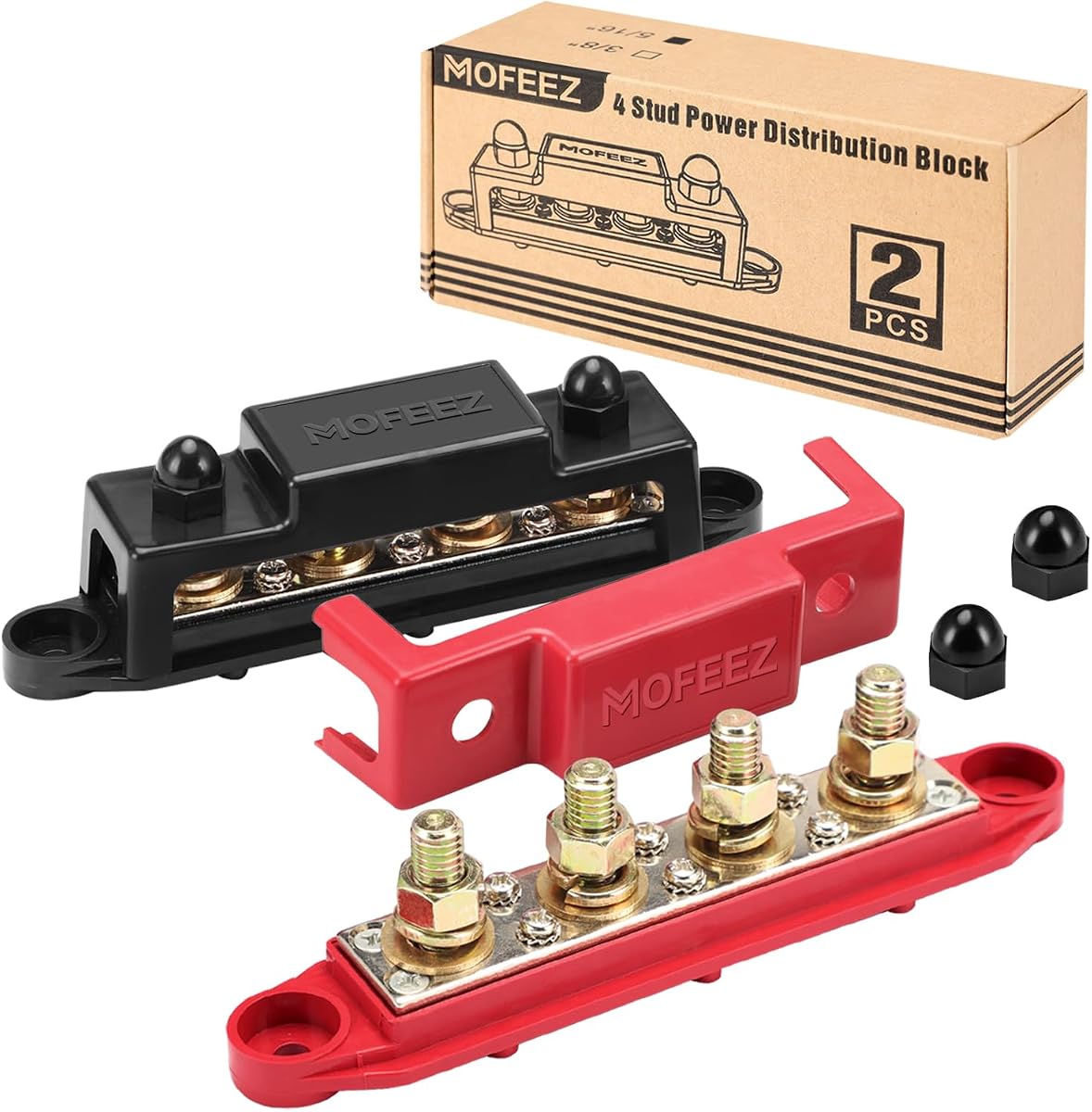

The MOFEEZ 250A Bus Bar is one of the most versatile options in this guide, combining a 4.8 rating with a practical collection of large stud and smaller screw connections. It is supplied as a red-and-black pair, which makes it straightforward to organize positive and ground distribution in a 12-volt installation.
We may earn a commission when you buy through this link, at no additional cost to you.
Its nickel-plated brass plates are designed to offer low resistance, good conductivity, and corrosion protection. Four 5/16-inch studs serve larger cables, while six #8 stainless steel terminal screws accommodate smaller branch connections. This mixture is especially useful in vehicles and vessels that need to feed accessories, lights, navigation equipment, and other circuits from one central location.
Safety and installation considerations are addressed with nylon nuts that help prevent accidental short circuits, an insulated flame-retardant base, and a removable nylon cover. One limitation is the stated 250A continuous rating for the entire connection; it is not a solution for installations requiring 500A. Users should also follow the stated limits and avoid treating the block as a substitute for a correctly engineered high-current distribution system.
This is a strong all-around recommendation for boat, car, RV, yacht, caravan, and ship wiring. It suits installers who want more connection flexibility than a compact two-stud design without moving to a larger premium block. Confirm available space, conductor size, and system requirements before installation.
The combination of four larger studs and six smaller terminal screws allows a installer to consolidate both primary feeds and secondary accessory circuits. That flexibility makes the block easier to adapt as an RV or marine system evolves.
The insulated base, nylon hardware, and removable cover reduce exposed metal and help keep the wiring organized. These features are especially valuable in confined compartments where vibration and accidental contact are concerns.
We may earn a commission when you buy through this link, at no additional cost to you.
The Joinfworld 250A Bus Bar combines a 4.7 rating with four substantial 3/8-inch studs, making it an appealing option for projects using large battery lugs. The red-and-black set is intended to serve as both a positive distribution block and a ground block within a 12-volt system.
We may earn a commission when you buy through this link, at no additional cost to you.
Its thickened copper plates are designed to accommodate a wider range of cable sizes. In addition to the four main studs, each block has three #8 screw terminals for smaller circuits, while the nylon bottom is secured by an M10 post to improve mechanical stability. Protective covers and nuts are included to shelter exposed areas and reduce the possibility of accidental contact.
The main trade-off is that only three small screw terminals are provided on each block. Installations with many low-current branches may require additional junction points or a model with more auxiliary connections. The 250A rating is also below what is offered by the dedicated 300A and 500A products, so it should not be used beyond its stated limits.
The Joinfworld is well suited to automotive, truck, marine, boat, and solar wiring where large conductors are priorities. Choose it when the cable lugs, mounting hardware, and enclosure space are designed around 3/8-inch studs and only a limited number of smaller circuits need to be connected.
The 3/8-inch stud format gives installers a direct option for large ring terminals. It can simplify cable routing when the existing harness uses this terminal size.
The M10 securing post adds support at the base of the nylon housing. This is useful in mobile installations where movement and vibration are expected.
We may earn a commission when you buy through this link, at no additional cost to you.
The Compact 150A Bus Bar is a cost-conscious pick for RVs, boats, trucks, and smaller 12-volt systems. It has a 4.6 rating, a 150A stated capacity, and a low-profile design listed at approximately 5.4 inches long with the cover, making physical fit easier to evaluate than with many large multi-stud blocks.
We may earn a commission when you buy through this link, at no additional cost to you.
Its solid tinned copper busbar is intended to provide low-resistance battery cable connections. The listing includes 1/4-inch studs and 12 terminals, offering a useful mixture of larger and smaller connection points. Snap-lock covers are designed to resist vibration, limit accidental contact, and protect the terminals during service or transport.
Its main limitation is the relatively small 1/4-inch stud size compared with the 5/16-inch and 3/8-inch options elsewhere in the guide. It is also rated to 150A rather than 250A or more, making it most appropriate for systems with a more modest current demand. Users should confirm both the base and cover dimensions before drilling or selecting mounting points.
This product is a strong choice when space is tight, the wiring uses 1/4-inch lugs, and several smaller accessory circuits need an organized termination point. It also works as a central block for fuse blocks, lighting, charging accessories, and other appropriately rated DC equipment.
The relatively low height and compact base are valuable in battery compartments where every centimeter matters. Its listed dimensions also make preliminary fit checks easier.
Snap-lock covers help retain the insulating shield during travel. That makes the block more practical for mobile electrical systems exposed to constant vibration.
We may earn a commission when you buy through this link, at no additional cost to you.
The RVMARINEPAT 250A Bus Bar offers six 5/16-inch M8 studs per block, giving it one of the denser connection layouts in this comparison. Its 4.8 rating and 250A maximum current rating make it appealing for marine, automotive, and solar systems with multiple substantial cable connections.
We may earn a commission when you buy through this link, at no additional cost to you.
A distinctive round-corner base is designed to improve stability and visual organization. The open cover design permits 180-degree wire-lug installation, which is useful when cables approach the block from different directions. Copper conductor plates and stainless steel terminals are specified for electrical performance and resistance to harsh conditions.
Unlike models that combine studs with smaller screw terminals, this design focuses entirely on large stud connections. That makes it less convenient for very small branch wires unless they are terminated through a ring lug on one of the studs. The number of studs also requires enough horizontal space for tools, cables, and protective covers.
The package includes red and black blocks, 12 copper ring lugs, and 12 heat-shrink tubes. It is a strong option for builders who prefer many main cable points and want the included ring terminals to make installation more cohesive.
Six studs provide ample separation for multiple main cables or ring-lug branch connections. This makes the block useful where every circuit needs a substantial mechanical termination.
The cover supports 180-degree lug installation, reducing restrictions on where cables can enter. That access can simplify harness routing in crowded installations.
We may earn a commission when you buy through this link, at no additional cost to you.
The DAIERTEK Mini 150A Bus Bar combines four 5/16-inch studs with a housing described as smaller than a normal 150A block. It carries a 4.7 rating and is designed for applications where a full-size high-current distribution unit would be difficult to accommodate.
We may earn a commission when you buy through this link, at no additional cost to you.
The construction uses tin-plated copper bars, stainless steel nuts and studs, a nylon base, and a polycarbonate cover. These materials are chosen for durability and electrical use. The stated operating limits include up to 48V DC and 300V AC, although users should still confirm that the full installation matches those specifications.
The four stud positions are spaced to support larger wire lugs, while side access allows cables to approach from up to 180 degrees. This is helpful where the block must be mounted near a bulkhead or between existing components. There are no auxiliary screw terminals, however, so very small accessory leads will need suitable ring-lug termination.
This mini block is a good fit for automotive, boat, and solar projects that need a 150A-rated distribution point with larger stud terminals. Its advantages are particularly apparent when enclosure space is restricted but a full four-stud layout remains necessary.
The compact form makes the block more approachable for installations with limited mounting area. It offers a middle ground between a two-stud terminal and a large premium distribution panel.
The stated limits cover common low-voltage DC systems and also list 300V AC. That broad specification can make the block useful in a broader range of planned installations.
We may earn a commission when you buy through this link, at no additional cost to you.
The MOFEEZ 250A Large-Stud Bus Bar is a close alternative to the editor's choice, but it uses four 3/8-inch posts rather than 5/16-inch studs. It earns a 4.7 rating and retains the useful combination of six #8 terminal screws for smaller connections.
We may earn a commission when you buy through this link, at no additional cost to you.
Like the other MOFEEZ design, it uses nickel-plated brass plates intended to offer low resistance, conductivity, and corrosion protection. Nylon nuts help prevent accidental contact between studs, while the removable cover adds another layer of insulation. The insulated nylon base is described as flame retardant.
Its listed dimensions are 6.7 inches long, 1.3 inches wide, and 2.1 inches high, so it is not the smallest option. The larger studs can simplify termination of heavy cable lugs, but all ring terminals and cable sizing must match. The entire connection is listed at 250A continuous and 48V maximum.
Choose this model when 3/8-inch hardware is already present in the harness or when larger lugs are desired alongside small accessory terminals. It is well suited to cars, RVs, boats, yachts, caravans, and ships where organized, multi-point DC distribution is the priority.
The four large studs can serve major feeds while the six #8 screws provide convenient points for smaller circuits. This dual-level layout supports a cleaner central harness.
Nickel-plated brass plates and stainless steel terminal screws are intended to resist corrosion. Those material choices are particularly relevant in marine and outdoor vehicle environments.
We may earn a commission when you buy through this link, at no additional cost to you.
The DaierTek 300A Bus Bar is the premium high-current selection in this guide. It holds a 4.8 rating and offers a stated 300A continuous capacity with six M10, or 3/8-inch, terminal studs on each positive and ground block.
We may earn a commission when you buy through this link, at no additional cost to you.
Its most notable feature is the open-sided cover design, which allows wire lug installation from up to 180 degrees. This reduces the awkward cable angles that can occur in a confined battery compartment. The round-corner base is intended to improve stability and give the assembly a distinct appearance.
The trade-off is physical bulk. Six large studs on two blocks require more space than a compact 150A design, and the absence of smaller screw terminals means every accessory lead needs an appropriately sized ring lug. Although the listing states maximum ratings of 300V AC and 48V DC, the 300A figure refers to continuous amperage and should be treated as a system limit rather than a target.
For automotive, marine, and other demanding DC installations, this block is best suited to builders who prioritize conductor capacity, large terminal hardware, and flexible cable access. It is less attractive for small systems that need only a few modest branches.
The stated 300A continuous capacity provides more headroom than the 150A and 250A options. It is a better fit for large battery banks and high-demand mobile electrical systems.
The open cover permits terminals to enter from multiple directions. This is especially useful where cables bend sharply or where access behind the block is restricted.
We may earn a commission when you buy through this link, at no additional cost to you.
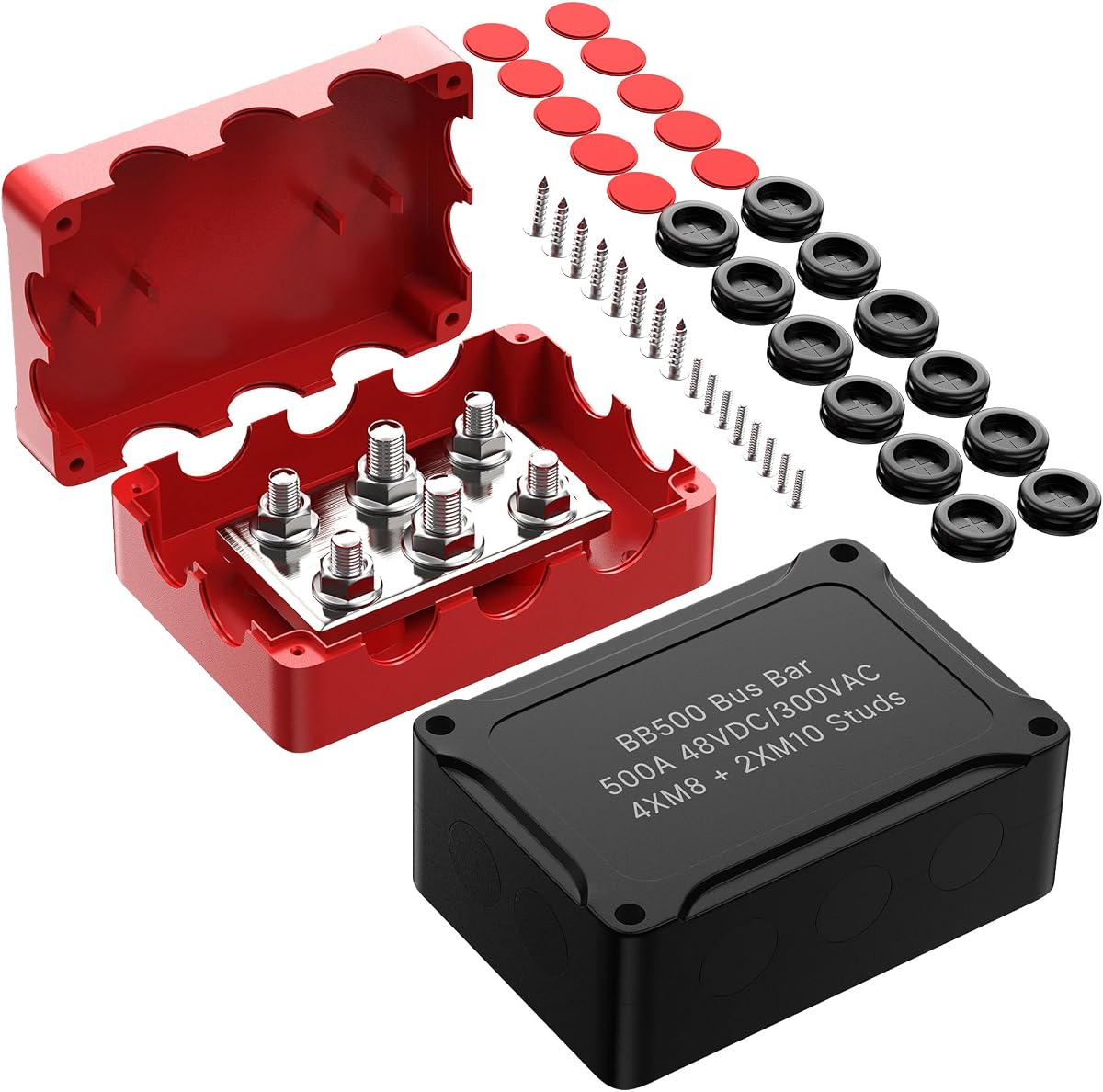
The Joinfworld 500A Bus Bar is the highest-capacity product featured, with a stated 500A rating and a maximum operating specification of 48V DC or 300V AC. It is intended for demanding automotive, truck, marine, boat, RV, and solar installations where heavy conductors and substantial battery banks are involved.
We may earn a commission when you buy through this link, at no additional cost to you.
Each bus bar combines two 3/8-inch M10 studs with four 5/16-inch M8 studs. This mixed arrangement allows a builder to match different cable and terminal sizes, and the listing specifically notes compatibility with 4/0-gauge wires and terminals. The copper plates are described as thicker than those of standard models.
A waterproof ring set is included to help seal connections, while removable plates allow cables and terminals to pass through more easily and help prevent short circuits. This design may be valuable in damp environments, but proper sealing, cable preparation, and workmanship remain essential. No customer rating is supplied for this listing, so the objective specifications are more useful than buyer feedback for this comparison.
This is a specialized choice for high-current systems rather than a general-purpose small-system block. Confirm enclosure clearance, cable bend radius, terminal compatibility, and the complete electrical design before selecting it.
Using both M10 and M8 studs gives the installer flexibility across different cable sizes. The arrangement is useful when a system combines very heavy feeds with slightly lighter branches.
Waterproof rings and removable sealing plates are intended to protect cable entries. These features may be particularly useful in exposed marine and automotive installations.
We may earn a commission when you buy through this link, at no additional cost to you.
The RVBOATPAT 250A Bus Bar offers a simple alternative for projects that need only one main incoming cable and one outgoing connection on each side. It carries a 4.6 rating and a stated maximum continuous current of 250A at up to 48V DC.
We may earn a commission when you buy through this link, at no additional cost to you.
Both studs measure 3/8-inch, or M10, and are made from 304 stainless steel for corrosion resistance. The package includes one positive block, one ground block, two 1/0 AWG copper lugs, and four 6 AWG copper lugs, providing useful starter termination hardware for appropriately sized conductors.
Its protective polycarbonate cover is designed for strength and durability while reducing the potential for short circuits. The two-stud format is easy to understand and can produce a clean installation, but it provides fewer branch options than the four- and six-stud designs. It also lacks smaller screw terminals for delicate accessory wiring.
This model suits boat, automotive, caravan, yacht, and solar systems where the wiring plan calls for one feed and one load per block. It is particularly attractive for users who value a simple layout, substantial studs, and included copper lugs over extensive connection capacity.
Two studs per block keep the wiring path direct and understandable. That simplicity can reduce installation complexity in a smaller or more narrowly defined circuit.
The 304 stainless steel studs are intended to withstand corrosive conditions. A durable polycarbonate cover adds mechanical protection to the terminal area.
We may earn a commission when you buy through this link, at no additional cost to you.
The RVBOATPAT 150A Bus Bar is designed around one larger 1/4-inch M6 stud and 12 smaller M4 terminal screws. It earns a 4.7 rating and offers a distinct approach for systems that need numerous smaller branch connections rather than several heavy main terminals.
We may earn a commission when you buy through this link, at no additional cost to you.
The block is rated for 150A continuous current and a maximum operating voltage of 48V DC. Its thick tinned copper plate is paired with an ABS base described as mechanically strong, insulated, heat resistant, and flame resistant. The included package contains positive and ground blocks, two covers, two 2 AWG copper lugs, and 24 terminals.
The main advantage is the density of small screw terminals, which can support accessory wiring in a tidy layout. Its limitation is that only one large stud is available on each block for the main cable. If a system requires multiple heavy feeds, one of the multi-stud designs would be more appropriate, and the 150A rating should not be exceeded.
This product works well for smaller boat, car, caravan, yacht, and solar electrical systems where a main cable feeds several lower-current circuits. It is a practical choice when branch variety matters more than high-current stud capacity.
Twelve M4 terminal screws create many organized termination points. This is helpful when lighting, pumps, electronics, and other accessory circuits need to be brought together.
The ABS housing is described as mechanically strong, heat resistant, and flame resistant. Those properties support its use as an insulated central termination point.
We may earn a commission when you buy through this link, at no additional cost to you.
Choosing a bus bar power distribution block requires matching conductor sizes, system demands, mounting constraints, and environmental conditions. The most important details are the current rating, terminal format, number of connections, and whether the design provides effective insulation.
Begin with the maximum current and voltage of the circuit, including any high-load equipment connected to the block. Products in this guide range from 150A to 500A, with several specifying a 48V DC maximum. A higher number does not automatically make a block better, because the entire installation must remain within the component ratings and the conductors must also be properly sized.
The block should be selected for the circuit's conditions, not merely for its nominal label. Review the stated continuous rating, voltage limit, conductor recommendations, and any applicable system requirements. When loads can surge, such as certain motors or compressors, confirm that the complete installation and protection scheme can handle those conditions.
Stud size determines which ring terminals and cable lugs can be used. The featured blocks use 1/4-inch M6, 5/16-inch M8, and 3/8-inch M10 studs, while several models add smaller #8 or M4 screw terminals. Larger studs are generally convenient for heavy cable, but the attached lug must match the stud diameter and be correctly rated for the conductor.
Choose a format already present in the harness when possible. If the project is new, compare the cable gauge, lug hole size, and physical space around each connection. A block with mixed terminal sizes can handle both primary and branch circuits more conveniently than a simple two-stud design.
Count the incoming cables, outgoing feeds, grounds, and accessory branches that must terminate at the block. Two-stud designs are easy to wire but limited, four-stud designs offer a useful balance, and six-stud blocks can eliminate unnecessary daisy chaining. Designs with numerous small screw terminals are valuable for lower-current accessories.
Avoid choosing solely by terminal count. Stud spacing, lug access, cover shape, and cable bend requirements can determine whether a block is practical. The ideal layout leaves enough room for tools, keeps lugs from contacting neighboring hardware, and supports a short, organized electrical path.
A high-current bus bar exposes conductive surfaces that can cause serious damage if they contact one another. Look for an insulated base, insulating washers or nuts, and a cover that shields the terminal area. Removable or open-sided covers improve service access, but they should still prevent accidental bridging between positive and ground hardware.
Protective components should match the environment. Polycarbonate and nylon are used across several products in this guide for their mechanical and electrical characteristics. A cover that locks or snaps into position is especially useful in moving vehicles and boats where vibration can gradually loosen an ordinary cap.
Copper or brass plates provide the conductive core of a bus bar, while plating helps resist corrosion and supports consistent electrical contact. The featured products use copper, brass, or plated conductors with stainless steel hardware in different combinations. Tinned copper and nickel-plated brass are common choices for marine and automotive use.
Material alone does not guarantee a long service life. Seal exposed hardware, avoid incompatible metals, maintain ring-lug surfaces, and protect the assembly from standing water. If the block is installed in a damp compartment, the cover, sealing rings, and surrounding enclosure should be considered together.
Physical fit is one of the easiest requirements to overlook. Review the base length, width, height, mounting positions, and clearance needed for the cover, cable bends, and ring lugs. The compact products are better suited to restricted battery compartments, while six-stud high-current blocks often need a larger protected area.
Measure the space before ordering and compare it with the installation drawing. Also consider whether cables can approach from the required direction, whether fasteners can be reached with a wrench, and whether a protective enclosure can be closed without pinching the harness. A block that is electrically suitable but poorly accessible can be frustrating to install and service.
Marine, RV, automotive, off-road, and solar installations can place different demands on vibration resistance, corrosion protection, and connection style. Some listings include copper ring lugs, heat-shrink tubing, or terminal pieces, while others require the installer to source compatible hardware separately. The included accessories can simplify assembly but should still be checked for size and suitability.
Match the product to the project rather than the label alone. A marine installation may benefit from corrosion-resistant studs, sealing rings, and protected wiring, while a trailer or RV may prioritize compact dimensions. Confirm that the block's positive and ground colors, accessories, and mounting method suit the planned system.
Plan the electrical layout before mounting the block. Identify each cable, its function, gauge, ring-lug size, and the terminal to which it will attach. A positive block and a ground block should remain clearly separated, and the number of connected branches should stay within the design limits. Confirm that each cable lug matches the corresponding stud or screw.
Mount the block on a clean, rigid, nonflammable surface with appropriate clearance from conductive objects. Use the supplied or correctly sized hardware, maintain the stated torque requirements for the application, and inspect every lug for full contact with its terminal. Route heavy cables without sharp bends, excessive tension, or movement against the housing.
Keep the protective cover installed whenever the installation permits, and use suitable sealing or corrosion-protection measures in exposed or damp locations. Periodically check for loose hardware, discoloration, damaged insulation, corrosion, or heat-related changes. If a connection shows heat damage, remove the load, investigate the cause, and replace damaged components before restoring service.
A bus bar power distribution block organizes several electrical connections around a shared conductive platform. It is commonly used to connect a battery or charging source to accessories, grounding systems, lighting, inverters, and other 12-volt equipment. Compared with stacking several ring terminals directly on a battery post, a properly selected block can produce a neater and easier-to-service arrangement.
No. A higher rating provides more current headroom, but it may also require a larger block, heavier hardware, and more mounting space. The best choice is one whose capacity, voltage limits, stud size, and connection layout match the actual circuit without exceeding the ratings of the cables, protection, and other components.
Positive and ground conductors should be routed to separate, clearly identified blocks or terminals. Many products in this guide are supplied as red-and-black pairs for that purpose. Separation reduces the chance of accidental contact, while protective covers and insulated bases help contain exposed conductive surfaces during installation and service.
Choose the stud size that matches the ring-lug hole and the cable gauge being used. The guide includes 1/4-inch, 5/16-inch, and 3/8-inch options. Do not force a mismatched lug onto a stud, and confirm that the lug, cable, and stud are appropriately rated for the intended current and environment.
Several products are specifically listed for marine, boat, yacht, and ship applications. Their corrosion-resistant components, protective covers, and suitable conductor connections make them relevant for wet environments, but proper sealing and enclosure are still important. The complete wiring system should also use marine-compatible cable, terminals, fusing, and grounding practices.
A bus bar organizes power but does not automatically protect every branch circuit. Appropriate overcurrent protection must be installed according to the wire sizes, loads, equipment instructions, and applicable electrical standards. The placement and rating of fuses or circuit breakers should be designed into the system rather than added casually after installation.
Start with compatible plated conductors and corrosion-resistant fasteners, and ensure lug surfaces are clean before tightening. Protect exposed areas with the supplied cover and use suitable sealing methods in damp or exposed compartments. Periodic inspection is important because corrosion, heat, or a loosened connection can develop before a system problem becomes obvious.
It depends on the device's current draw, startup behavior, continuous load, conductor size, and the block's stated limits. A 150A model may suit a smaller system, while higher-demand equipment may require a 250A, 300A, or 500A block. Check the manufacturer's load guidance and design the protection and cable path around the actual installation.
The MOFEEZ 250A Bus Bar stands out as the strongest all-around option because it combines large studs, smaller branch terminals, protective components, and broad vehicle and marine applicability. The Compact 150A Bus Bar is the practical budget selection when space and 1/4-inch terminals are priorities, while the DaierTek 300A Bus Bar offers the most premium capacity and largest stud configuration.
Prioritize the details that cannot be changed after installation: match the current and voltage limits, select the correct stud or screw size, count the necessary connections, and verify physical clearance. Marine and automotive users should give additional attention to corrosion resistance, vibration, insulation, and sealed cable entries rather than relying on capacity alone.
Ratings, dimensions, included accessories, and prices can change, so check the current product listing and manufacturer information before purchasing. A final compatibility review of the cables, lugs, protection devices, mounting surface, and enclosure will help ensure that the selected bus bar integrates cleanly into the electrical system.
