
4K Underwater Camera, 64MP 16FT Compact Waterproof Camera
4.6Editor score
16-foot waterproof rating
4K UHD and 64MP photos
Floating, travel-ready design
Our guide compares the best cheap waterproof digital cameras for underwater use, comparing depth ratings, resolution, zoom, screens, batteries, and features.
Cheap waterproof digital cameras for underwater use make it easier to capture swimming, snorkeling, surfing, and other aquatic adventures without carrying a separate protective housing. The most useful models combine a credible depth rating with autofocus, clear displays, adequate video resolution, simple controls, and enough battery life for a day at the beach or pool.
We compared ten purpose-built waterproof cameras using the specifications and feature descriptions supplied for each model. Our evaluation covers waterproof depth, shock and dust resistance, still-image resolution, video formats, zoom, display design, autofocus, battery capacity, storage support, lighting features, and the accessories included with the camera.
Each review identifies the strongest use case and the compromises a buyer should consider, helping the list range from straightforward snorkeling models to more advanced dual-screen and wireless options. Product prices and availability can change frequently, so confirm the current listing and camera specifications before making a purchase.
4.6Editor score

4.8Editor score

5.0Editor score
The comparison below places all ten models side by side, with particular attention to depth rating, imaging specifications, zoom, viewing screens, battery configuration, and features that matter around water.


The yellow KODAK PIXPRO WPZ2 combines a 16-megapixel backside-illuminated CMOS sensor with a 4X optical zoom and full HD 1080p video. It carries a 4.1 rating and stands out as a more conventional rugged point-and-shoot than many of the newer dual-screen models in this guide. Its waterproof, dustproof, and shock-resistant construction makes it suitable for trips where rain, sand, snow, or accidental drops are likely.
We may earn a commission when you buy through this link, at no additional cost to you.
One of its strongest advantages is the 15-meter waterproof rating, which provides more than enough margin for snorkeling, swimming, beach photography, kayaking, and other shallow-water activities. The 4X optical zoom is also meaningful underwater, where digital magnification can reduce fine detail. A rechargeable lithium-ion battery and compatibility with microSD and microSDHC cards help keep the kit simple for extended outings.
Built-in Wi-Fi adds practical value by allowing wireless transfers to a phone or tablet and phone-assisted remote control. That makes the WPZ2 useful for group shots and for quickly sharing vacation images. The compromises are its 1080p video ceiling and a 4.1 rating, both of which place it behind several models offering 4K or 5K recording and dual screens.
Choose the yellow WPZ2 if you prefer an established rugged-camera design, need optical zoom, or want one device for underwater and land adventures. It is a strong all-purpose option for beginners and families, although buyers who prioritize 4K video, larger selfie displays, or more advanced underwater-focused controls may prefer a newer alternative.
Its 15-meter waterproof rating, dustproof sealing, and two-meter drop protection make it suitable for swimming, beach outings, winter recreation, and dusty trails. The camera is intended to work without a separate waterproof housing, which simplifies packing and operation.
Built-in Wi-Fi supports quick image transfer to a phone or tablet and remote viewing for group compositions. This is particularly helpful when the camera is placed on a surface, held in a pool, or used for self-portraits around water.
We may earn a commission when you buy through this link, at no additional cost to you.
The blue KODAK PIXPRO WPZ2 is essentially the rugged yellow model in a different color, with the same 16-megapixel backside-illuminated sensor, 4X optical zoom, 15-meter waterproof rating, and 1080p video. It holds a 4.3 rating, slightly above the yellow listing, and offers the same mix of traditional point-and-shoot simplicity and adventure-ready construction.
We may earn a commission when you buy through this link, at no additional cost to you.
For underwater use, its 15-meter rating and optical zoom provide a more convincing foundation than a camera relying entirely on digital zoom. It is also dustproof and shockproof, extending its usefulness beyond the pool to beaches, trails, snow, and rain. The rechargeable battery avoids the need to carry spare disposable cells, while microSD and microSDHC support provides flexible storage.
The main limitation is that the WPZ2 does not offer the 4K or 5K video found among several newer competitors. It also lacks a dual-screen design, so self-portraits require more guesswork or a separate framing method. Nevertheless, the physical zoom and established rugged-camera format can be more valuable than headline megapixel counts when the goal is practical underwater photography.
This model is best for buyers who want a straightforward waterproof camera with optical zoom, wireless sharing, and a body prepared for rough conditions. It is less compelling than higher-resolution models for large prints or 4K editing, but it remains a versatile choice for family vacations, snorkeling, and mixed indoor-outdoor use.
A 4X optical lens gives this model a more useful way to frame distant reefs, fish, swimmers, and wider seascapes. It avoids relying entirely on digital cropping, although the stated waterproof depth still determines where the camera can safely operate.
Waterproof, shockproof, and dustproof protection lets the camera travel to the pool, beach, ski slope, or trail without an external housing. Its rechargeable battery and memory-card support further reduce the amount of gear needed for a day trip.
We may earn a commission when you buy through this link, at no additional cost to you.
This 48-megapixel underwater camera combines 4K Ultra HD video, autofocus, a dual-screen layout, and a 17-foot waterproof rating. It carries a 4.1 rating and includes a 32GB card, rechargeable battery, and floating strap. Those features make it an approachable option for snorkelers, younger users, and anyone who wants underwater selfies without carrying a separate camera.
We may earn a commission when you buy through this link, at no additional cost to you.
Autofocus is a meaningful advantage when visibility, movement, and distance make precise manual focusing difficult. A half-press of the shutter focuses the subject before the image is captured. The dual-screen configuration also allows the front-facing display to be used for underwater framing, while the 4K mode captures more detail than the standard 1080p alternatives in the guide.
The floating strap is a smart practical feature for pools, cruises, beaches, and snorkeling locations where recovering a dropped camera can be difficult. The product information also describes it as suitable for seawater and includes a neoprene exterior. The listed 1050mAh battery is described as supporting approximately three hours of use, though actual runtime will vary with video resolution, screen use, and shooting behavior.
This camera is a good match for beginners seeking autofocus, 4K, and easy underwater selfies. Buyers should still treat the stated depth as a limit, charge it before first use, and verify that all seals are properly closed. It is less specialized than rugged models with optical zoom but offers a notably rich feature set for casual underwater shooting.
Automatic focus reduces the difficulty of tracking moving fish or centering reef subjects in changing water. Users can half-press the shutter to establish focus, then complete the shot without navigating detailed manual-focus controls.
The included floating strap helps keep the camera near the surface if it slips from your hand. That feature is especially useful around crowded water parks, swimming pools, boat trips, and shallow snorkeling areas.
We may earn a commission when you buy through this link, at no additional cost to you.
The 48MP Waterproof Digital Camera with 32GB TF Card has a 5.0 rating, the highest in this roundup, and combines a 48MP CMOS sensor with a 6X optical zoom lens. Its waterproof protection extends to 10 meters, or 33 feet, while the 2.8-inch IPS screen and digital stabilization make it especially practical for general aquatic and travel photography.
We may earn a commission when you buy through this link, at no additional cost to you.
The 6X optical zoom is the standout feature in a category where many competing models offer only digital magnification. Optical zoom can produce cleaner framing of distant subjects and closer scenes without relying on aggressive cropping. Video recording reaches 2.7K, which remains detailed for everyday use even though it does not match the 4K and 5K ceilings advertised by several alternatives.
A 1700mAh lithium-ion battery and USB Type-C charging are designed for extended outings, while the included cloth bag, lanyard, cable, and user manual cover basic travel needs. Digital image stabilization can reduce visible shake during movement. The main compromises are the absence of a front-facing screen and the lower 2.7K video ceiling relative to the newest models.
This is the best premium-style option for a buyer who values a large rear display, real optical zoom, long-lasting battery, and a 33-foot depth rating. It is also well suited to mixed use at the beach, pool, or on land. Those who make frequent social videos may prefer a 4K dual-screen camera, but photographers will find this specification set unusually balanced.
The 6X lens is useful for both underwater and land photography. It gives the owner more control when framing fish, swimmers, landscapes, or distant travel subjects without depending entirely on the camera's digital zoom.
The 2.8-inch IPS display provides a generous viewing area and is intended to remain clear in bright outdoor settings. It is larger than the rear screens on many compact models, although selfie framing still depends on the screen or a separate device.
We may earn a commission when you buy through this link, at no additional cost to you.
The Nikon COOLPIX S33 is a simple, family-oriented waterproof camera with a 4.0 rating. It is waterproof to 32 feet, shockproof to five feet, and freezeproof down to 14 degrees Fahrenheit, making it suitable for swimming, snow, and general outdoor use. Its 13.2-megapixel sensor and 3X wide-angle NIKKOR glass zoom lens provide a modest but understandable imaging setup.
We may earn a commission when you buy through this link, at no additional cost to you.
Full HD 1080p video with stereo sound is another useful feature, particularly for family videos and travel memories. The oversized buttons and clear menus reduce the learning curve for children, older travelers, or anyone who wants a camera that can be operated quickly around a pool or on a trail. The rugged design also eliminates the need to carry a separate housing.
Compared with newer models, its 13.2-megapixel resolution and 1080p video are modest. It also does not offer a dual-screen selfie arrangement, Wi-Fi, or the very high resolution advertised by many modern underwater cameras. Nevertheless, simplicity can be an advantage: there is less configuration to manage when conditions change quickly.
The S33 is worth considering for buyers who value a recognized camera system, a deep waterproof rating, and simple physical controls. It is less appropriate for someone who wants 4K footage, high-resolution stills, or extensive wireless functions. For family trips and winter or water recreation, it remains a durable, approachable option.
Oversized buttons and easy menus make the camera approachable for children, older adults, and casual users. Fewer advanced controls can also be helpful at a pool or beach, where attention is likely focused on the activity rather than camera settings.
Shockproof, freezeproof, and waterproof construction makes the S33 useful across seasons. Its 32-foot rating is deeper than many competing compact models, although the stated limits should always be respected.
We may earn a commission when you buy through this link, at no additional cost to you.
The 4K Underwater Camera with 64MP photos, 4K UHD video, and a 16-foot IP68 rating combines strong specifications with a travel-friendly design. It has a 4.6 rating and is one of the most attractive budget choices in the guide, especially for swimmers, snorkelers, and casual vacation photographers who want more than basic resolution.
We may earn a commission when you buy through this link, at no additional cost to you.
Its floating construction is a practical advantage. If the camera is dropped into a pool, lake, or ocean, it can return to the surface where it is easier to locate. Autofocus supports quicker subject acquisition, the IPS HD screen is designed for clear outdoor viewing, and 16X digital zoom helps frame distant scenery or closer subjects.
The supplied 650mAh removable battery provides more than 70 minutes of continuous recording according to the product information. A 16GB memory card is included, with expansion support up to 256GB. At only 0.29 pound and measuring 3.9 by 2.5 by 1.2 inches, the camera is easy to carry, although its modest battery capacity is less ideal for uninterrupted all-day shooting.
This is the best budget pick for travelers who want 4K video, high-resolution photos, autofocus, and a floating body in an inexpensive package. Its digital zoom and shorter battery life are limitations, but the overall feature balance is difficult to overlook. It also includes useful modes such as flash, continuous shooting, self-timer, smile detection, and face detection.
The buoyant body is designed to return to the surface after an accidental drop. That makes the camera easier to retrieve in a swimming pool, lake, or snorkeling area and reduces the risk of losing it on the bottom.
The 64MP mode provides room for cropping and large-format printing, while 4K UHD video captures more detail than standard-definition or 1080p output. Buyers should remember that higher resolution can consume storage and may influence battery life.
We may earn a commission when you buy through this link, at no additional cost to you.
The 5K Underwater Camera with a 33-foot rating, 64MP photos, and dual IPS screens offers one of the strongest overall feature combinations in the guide. Its 4.6 rating reflects a well-rounded package for snorkelers, shallow divers, swimmers, and family travelers who want detailed stills, high-resolution video, and flexible self-framing.
We may earn a commission when you buy through this link, at no additional cost to you.
The camera floats, is dustproof, and can operate underwater to 33 feet. A 2.8-inch rear screen and 1.4-inch front screen make it easier to compose selfies, group shots, and underwater clips. Autofocus can begin from 3.97 inches, while 16X digital zoom provides an additional way to frame distant scenery and closer subjects.
The removable 1500mAh battery is listed as supporting up to 100 minutes of continuous 5K recording. A 32GB TF card is included, and cards up to 128GB are supported. One important operational note is that the camera does not support USB-C-to-USB-C charging cables; the supplied USB-C cable should be used according to the product instructions.
This camera is the strongest overall recommendation for buyers who want more than basic underwater capability without moving to a complex interchangeable-lens system. It combines a deep rating, strong resolution, two screens, a removable battery, and a floating body. The principal trade-offs are reliance on digital rather than optical zoom and the need to follow the camera's battery-door locking procedure before every underwater use.
The front screen supports convenient underwater selfies and group compositions, while the larger rear display provides clear control during normal shooting. Both are IPS HD screens designed to provide clear color and visibility in bright conditions.
A 33-foot rating supports snorkeling and shallow diving within the stated limit, while the floating body helps with recovery. Dustproofing adds value at beaches and other sandy environments where a conventional camera would be vulnerable to particles.
We may earn a commission when you buy through this link, at no additional cost to you.
The 4K Underwater Camera 16FT is a straightforward snorkeling camera offering 4K video, 64MP still images, autofocus, and front-and-rear screens. It carries a 4.1 rating and appears designed for beginners, children, water-park visits, and family vacations where ease of use matters as much as maximum depth.
We may earn a commission when you buy through this link, at no additional cost to you.
Autofocus is activated by half-pressing the shutter until the focus frame turns green. The dual-screen and floatable design helps with selfies, group photos, and recovery if the camera is dropped. Storage is flexible because a 32GB card is included and cards up to 128GB can be used, giving users room for both photos and longer video clips.
Its 1250mAh battery is described as delivering approximately 70 minutes of operation at 16 feet underwater. That is a meaningful limitation for long excursions and may require a spare battery or a charging break between sessions. The sealed battery compartment is central to waterproof protection, so the cover lock should be operated carefully and the cover fully seated before entering the water.
This camera is most appropriate for casual snorkelers, families, and children who need a simple dual-screen device for pools, beaches, and water parks. It offers capable 4K video and high-resolution stills, but buyers seeking deeper protection, longer recording, optical zoom, or wireless transfer will find stronger alternatives elsewhere in the roundup.
A visible focus frame gives clear feedback before the full press, helping users understand when the subject is sharp. This reduces reliance on menu settings and makes the camera approachable for younger or less experienced photographers.
Front and rear displays make it easier to include the photographer in selfies and keep everyone within the frame. The floatable construction also provides a useful safeguard around swimming pools and recreational water parks.
We may earn a commission when you buy through this link, at no additional cost to you.
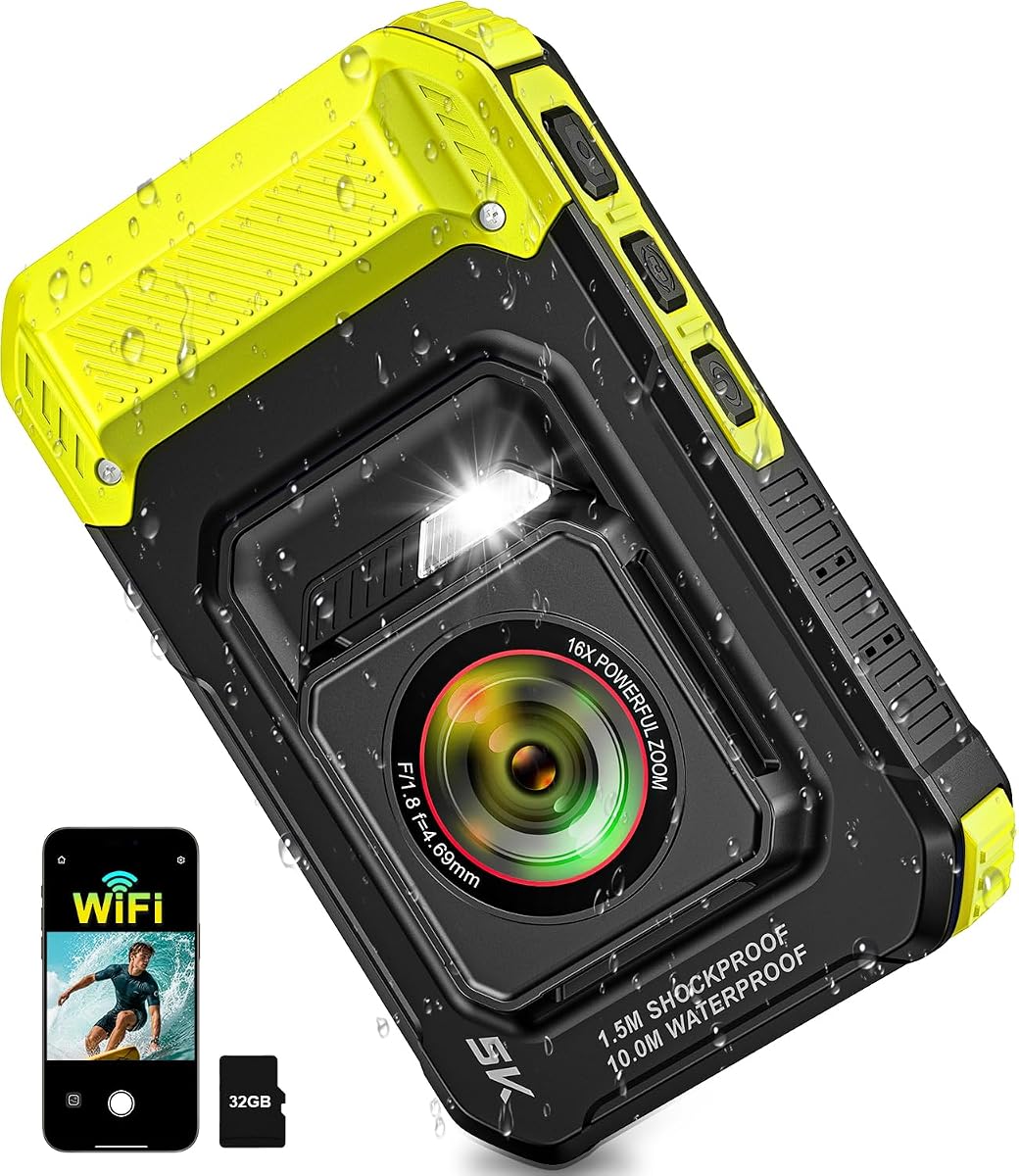
The 5K 33FT Underwater Camera with 96MP photos and Wi-Fi is built for users who want high-resolution stills, 5K video, wireless transfer, and a deep waterproof rating. It carries a 3.7 rating, the lowest among the ten products, but its specification set is among the most ambitious. It is especially relevant to travelers and vloggers who want to move images directly to a phone.
We may earn a commission when you buy through this link, at no additional cost to you.
Built-in Wi-Fi pairs with the Viipulse app for downloads, remote shooting, and previewing content on iOS or Android devices. The camera also has a front-and-rear dual-lens display, a built-in microphone, autofocus, 16X digital zoom, six-axis stabilization, a flashlight, and 60 filter effects. These features make it more versatile as a general travel camera than a basic underwater model.
It is rated to 33 feet, with five-foot drop protection and IP6X dustproofing. A double-lock battery door helps prevent accidental opening, and the package includes two batteries, a 32GB microSD card, a Type-C cable, a carrying bag, cleaning cloth, manual, and lanyard. Its lower rating may reflect mixed experiences, so buyers should consider the complete feature set and expected use rather than the resolution headline alone.
This is a practical choice for a vlogger or family traveler who values wireless sharing and a generous accessory bundle. It is less compelling for someone wanting the simplest possible underwater point-and-shoot, and the app-based workflow may be less desirable than direct camera-only operation. It also remains an adventurous electronics purchase, so sealing and battery-door checks are essential.
The Viipulse app supports quick downloads, remote shooting, and instant previews on iOS and Android devices. This reduces the need to remove the memory card and makes the camera more convenient for travel stories and short-form video.
Two batteries, stabilization, a flashlight, face detection, time-lapse, slow motion, and multiple filters extend the camera beyond underwater use. The package also includes a carry bag and cleaning cloth, reducing the need to source basic accessories separately.
We may earn a commission when you buy through this link, at no additional cost to you.
The blue Underwater Camera 4K 48MP has a 4.8 rating, the highest among the products in this roundup, and combines a 10.83-foot waterproof rating with 4K FHD video, 48MP photos, and two screens. It is compact, light, and designed for swimming, snorkeling, surfing, rafting, beach travel, and water-park activities.
We may earn a commission when you buy through this link, at no additional cost to you.
Its 3.0-inch rear screen and 2.0-inch front selfie screen make framing more convenient, especially for group shots and underwater portraits. A built-in fill light helps brighten low-light scenes, while anti-shake and 16X digital zoom support steadier footage and more flexible framing. The 1500mAh rechargeable battery is listed as supporting up to one hour of continuous underwater recording.
The 10.83-foot rating is shallower than several competing cameras, making it better suited to pools, calm coastal water, and surface-level snorkeling than deeper dives. The built-in battery is convenient because it eliminates compartment-opening concerns, but it cannot be swapped if it runs down. The product description notes expansion to 128GB microSD, although a card is not included despite the title referencing one.
Despite its depth limit, this is one of the strongest compact choices for casual underwater use. Its high rating, 4K video, 48MP images, fill light, dual-screen layout, and pocket-friendly proportions create a balanced package for families and vacation travelers. It is best suited to shallow-water exploration rather than serious diving or extended submerged recording.
The integrated fill light can brighten subjects and nearby details in low-light or cloudy underwater conditions. It adds a useful tool for snorkeling, pool visits, and evening beach outings without requiring a separate accessory.
The compact body is easier to carry than many rugged cameras, while separate rear and front displays improve both standard operation and self-framing. The sealed battery compartment and included wrist strap add everyday handling protection.
We may earn a commission when you buy through this link, at no additional cost to you.
The right inexpensive underwater camera depends on how deep you plan to go, how you will frame shots, and whether video, selfies, optical zoom, or long battery life matter most. Compare the following factors before choosing a model.
Start with the maximum depth stated by the manufacturer and compare it with the activities you actually expect to undertake. Ratings across this roundup range from 10 feet to 33 feet, so a camera adequate for a calm pool may not be appropriate for the same activity as a model intended for snorkeling or shallow diving. The rating is a maximum limit rather than a target, and factors such as water temperature, seals, and impacts can affect real-world performance. Always close and lock the battery compartment, rinse the camera as directed, and avoid exceeding the published depth.
Choose a rating with comfortable margin above your expected use. For pools and casual surface photography, a 10- to 16-foot camera may suffice, while frequent snorkeling or shallow diving is better served by a 32- or 33-foot model.
Underwater scenes change quickly as swimmers, fish, bubbles, and suspended particles move through the frame. Autofocus can therefore be more useful than a long list of manual settings, especially for beginners and action-oriented shooting. Several models use a half-press of the shutter to establish focus, while some offer macro focusing from a short distance. Check the stated minimum focusing distance when photographing small reef details or close subjects. A focus indicator can also make it easier to know when the camera is ready.
Favor a model with clear autofocus behavior and a visible confirmation signal. This makes the camera easier for children and casual users and reduces missed shots when the subject is moving.
The list includes cameras recording at 1080p, 2.7K, 4K, and 5K, with several models also offering stabilization. Higher resolution can retain more detail and provide more flexibility when editing, but it consumes more storage and can shorten recording time. Digital stabilization may reduce visible shake, although it cannot eliminate motion blur caused by a slow shutter or low underwater light. Users planning to share clips with family or on social platforms will find 4K and 5K convenient, while 1080p remains sufficient for simpler viewing.
Prioritize resolution if you intend to crop or reframe footage. If your main goal is uncomplicated family clips, stabilization and easy controls may be more valuable than the highest advertised resolution.
Optical zoom physically changes the lens magnification and generally preserves more detail than digital zoom, which crops and enlarges the captured image. Only the KODAK PIXPRO WPZ2 models and the 48MP Waterproof Digital Camera in this list advertise optical zoom. Most others use 16X digital zoom, which is useful for fitting distant scenery into the frame but can produce lower-quality results when heavily magnified. Underwater visibility is often limited anyway, so a wide view may be more useful than aggressive magnification for many snorkelers.
Choose optical zoom when distant subjects or detail-oriented photography matter. For wide reef scenes, swimmers, and general vacation recording, digital zoom can still provide convenience when the camera is used within reasonable limits.
A rear screen is essential for reviewing settings and composing standard shots, while a front screen simplifies selfies and group pictures. The guide includes several dual-screen models with different screen sizes, from compact arrangements to larger 2.8-inch rear displays paired with front-facing panels. A larger screen is convenient for children and older users, while a front display is valuable when the camera cannot be turned toward the subject. Brightness and IPS technology can also improve visibility in sunlight or near reflective water.
Pick a dual-screen model if underwater selfies and group photos are important. If you rarely photograph yourself, a single large rear display may provide a simpler and more affordable design.
Underwater cameras are often used during vacations and day trips, so battery endurance should match the length of the activity. Listed capacities range from 650mAh to 1700mAh, and stated continuous recording times range from about 70 minutes to 100 minutes at higher resolutions, with one product describing approximately three hours of general use. Removable batteries are convenient for swapping in a charged spare, while built-in batteries reduce openings and sealing risks. Charging standards also matter: one model explicitly does not support USB-C-to-USB-C cables, and others include a Type-C cable.
Consider how long you will record continuously and whether you can carry a spare battery. For extended outings, a removable high-capacity battery or a convenient charging plan is valuable, but correct sealing instructions remain essential.
Memory-card support determines how many photos and videos you can record, while included cards reduce the need for an immediate purchase. Several cameras arrive with 16GB, 32GB, or a 48MP model listing a 32GB card, while at least one description states that the card is not included. Maximum supported capacities range from 128GB to 256GB. Accessories such as wrist straps, lanyards, floating straps, carrying bags, cleaning cloths, and cables can improve convenience, but they should not replace careful handling.
Check what is actually in the box before ordering another memory card. For travel, a floating strap and compact carry bag are particularly useful, while regular backups remain important for valuable footage.
A built-in fill light can help nearby subjects appear brighter in dim water, while a flashlight may illuminate low-light scenes on land. Wi-Fi enables direct transfer to a phone, remote control, and faster sharing, but it adds setup requirements and an app dependency. Protection features also differ: some models are merely waterproof, while others add shock resistance, dustproof sealing, and floating construction. Review these claims together because a deep rating alone does not tell the entire story about handling in sand, at a water park, or on a boat.
For the most complete outdoor package, look for useful lighting, fast wireless transfer when needed, and physical protection matched to your activities. Accessories are helpful, but the sealed body should be treated as the main defense.
Before the first outing, fully charge the camera, install the memory card, and confirm that the battery door and every other seal are properly closed and locked. Read the product's waterproof instructions, particularly the opening procedure for the battery compartment, and never assume the visual appearance of a cover means it is sealed. Keep the camera within its stated depth rating, avoid opening any compartment underwater, and do not operate it in water unless the included ports and covers are properly installed.
For sharper results, clean the lens with a soft cloth before entering the water and use the autofocus rather than placing a finger over the lens. Hold the camera steady, keep subjects within the stated minimum focusing distance, and use the fill light or flash when the scene is dim. The rear and front screens can help with framing, but avoid extending the camera farther than is necessary because a longer reach reduces stability and increases the chance of an accidental drop.
After use, switch the camera off, remove excess water and sand, and follow the manufacturer's instructions for rinsing, drying, and storage. Pay particular attention to salt residue, which can damage contacts if left to dry. Keep the battery compartment dry until the camera has been cleaned and fully dried, and do not charge it while moisture remains. Store the device in a dry environment away from direct heat, and use a protective bag during transport to prevent scratches or pressure on the seals.
Most pool and casual snorkeling activities are covered by cameras rated to 10 or 16 feet. If you regularly snorkel farther down, travel to deeper coastal sites, or take the camera below recreational surface levels, a model rated to 32 or 33 feet provides more suitable headroom. Always treat the published rating as a maximum and avoid diving beyond it.
Some cameras in this guide are rated for shallow diving or underwater use to 33 feet, but that does not make every one appropriate for scuba diving. Scuba equipment, pressure changes, currents, and the need for reliable controls call for greater confidence and often a dedicated underwater housing. Check the manufacturer's exact depth, operating, and care instructions before taking any compact model below recreational snorkeling depths.
A higher megapixel count can provide more detail and more room for cropping, but it does not guarantee a better result underwater. Light, focus, motion, water clarity, and the camera's processing can have a greater effect on the final image. For ordinary travel use, 48MP or 64MP provides ample detail, while lens quality and stabilization may matter more for serious photography.
The products featured here are described as operating underwater without a separate protective housing, although their stated depth ratings still apply. A housing can be useful if the camera will be taken deeper than its rating or used in demanding conditions, but it adds bulk and may introduce leaks of its own. Follow the specific instructions supplied with the camera and housing.
Optical zoom changes the magnification produced by the lens and generally retains more detail. Digital zoom crops and enlarges the image, making distant subjects easier to frame but reducing effective detail and potentially amplifying noise. The WPZ2 models and the 48MP Waterproof Digital Camera offer optical zoom, while most of the other models rely on digital magnification.
A front screen makes it much easier to compose selfies and group photos because you can see yourself and other subjects in the frame. However, a second screen does not improve the camera's waterproof depth, battery life, or lens performance. Choose a dual-screen model when framing is a priority, and consider depth and stabilization when the camera will be used in rough water.
Turn it off, remove loose sand and saltwater, and follow the manufacturer's rinsing and drying procedure. Do not open the battery compartment or card cover while the camera is wet, and avoid charging until every part is dry. Salt should be removed carefully because crystallized residue can scratch surfaces and interfere with buttons, doors, and charging contacts.
Higher-resolution video produces larger files, so a larger card is helpful for longer recordings. The cameras in this guide vary in included storage and maximum supported capacity, with several supporting cards up to 128GB and one listed up to 256GB. Confirm the camera's card specifications and format the card according to its instructions before recording an important trip.
The blue 4K 48MP Underwater Camera stands out as the strongest overall compact option because of its 4.8 rating, dual screens, fill light, 4K recording, and straightforward travel design. The 4K Underwater Camera with 64MP photos is the best budget selection, offering a 16-foot rating, a floating body, autofocus, and high-resolution capture. For a more premium specification set, the 48MP Waterproof Digital Camera provides a 33-foot rating, 6X optical zoom, and a large IPS display.
Prioritize the features that match the intended activity. Shallow swimmers and vacation travelers may be well served by a compact 10- to 16-foot model, while snorkelers should consider the KODAK PIXPRO WPZ2, Nikon COOLPIX S33, or other cameras with deeper ratings. Optical zoom is worth seeking for detailed subjects, and removable batteries help during long days, but the simplest choice is often the one with understandable controls, dependable sealing, and enough depth margin for your plans.
Before ordering, compare the current product listing with the specifications summarized in this guide, because camera availability and pricing can change. Check the exact waterproof depth, included memory card, charging cable, battery design, and sealing instructions. With those details confirmed, an inexpensive waterproof camera can provide a convenient way to preserve vacations, pool outings, and underwater discoveries without a complex housing system.