
Garmin dēzlCam OTR725
4.2Editor score
Seven-inch truck navigator
Integrated 1080P camera
Truck-aware routing
PrePass notifications
Looking for Dash Cams for Semi Truck? Compare the best models for front, rear, side, night, parking, GPS, and multi-camera coverage before buying.
A dash cam for a semi truck must do more than record the road ahead. It needs dependable power, readable nighttime footage, secure storage, and enough camera coverage to document blind spots, loading maneuvers, and unexpected events. The right system should also withstand long operating hours and integrate cleanly with a large commercial cab.
We compared the listed dash cams by examining resolution, front, rear, cabin, and side coverage, low-light performance, GPS capabilities, parking options, storage support, installation requirements, and specialized truck features. The guide includes three-camera commercial systems, dual-camera highway setups, and GPS navigators with integrated recording for different fleet and owner-operator needs.
Each review explains where the product stands out, where its trade-offs matter, and which type of semi-truck operator may benefit most from it. Ratings and product details reflect the supplied information, while availability, included accessories, and pricing can change. Always confirm fit, power compatibility, and installation requirements before purchasing.
4.2Editor score

4.5Editor score

4.3Editor score
The table below compares the ten systems by camera layout, resolution, low-light capability, navigation, and recording features. Three-camera commercial systems provide the broadest perimeter coverage, while dual-camera and integrated-navigator options may suit operators who want simpler installation or truck-specific routing.



The ROVE R2-4K Dual is a balanced two-camera system for long-haul drivers who want more detail than a basic single-camera recorder without moving to a larger three-camera installation. It carries a 4.5 rating and records the front at 2.5K with intelligent upscaling to 2160P, while the rear records at 1080P. The front uses a Sony STARVIS 2 IMX675 sensor, a wide F1.5 aperture, and HDR, giving it stronger credentials for nighttime and low-light highway footage.
We may earn a commission when you buy through this link, at no additional cost to you.
Several practical features make it especially useful in a commercial cab. Dual-band WiFi supports transfer speeds of up to 20 MB/s through the ROVE app, so an owner-operator can move clips to a phone without removing the memory card. Built-in GPS records routes, locations, and speed stamps, while the three-inch IPS screen displays live speed and compass direction. A 128GB card is included, and the system supports cards up to 1TB, reducing the need for an immediate storage purchase.
The main qualification is that the advertised 4K front image is upscaled rather than native 4K. That distinction matters to buyers comparing frame-level detail, but the IMX675 sensor, QHD source recording, HDR, and generous storage capacity still produce a capable highway setup. Parking surveillance is another consideration: the three modes cover time-lapse, motion detection, and collision detection, but an appropriately rated hardwire kit must be installed separately.
This is an attractive recommendation for an owner-operator who wants front and rear evidence, phone access, GPS information, and an included card in a relatively streamlined package. It is less suited to a fleet manager who specifically needs side blind-spot cameras or cabin monitoring. For those requirements, one of the three-channel systems in this guide is a better functional match.
The Sony STARVIS 2 IMX675 sensor, F1.5 front aperture, and HDR processing are central to the ROVE R2-4K Dual's low-light proposition. They are particularly relevant during dusk, dawn, tunnels, and unlit highway stretches where a basic sensor may produce noisy or poorly balanced images.
Dual-band WiFi and transfer speeds of up to 20 MB/s make phone-based review more convenient. Drivers can preview, download, and share recordings while retaining GPS speed, location, and route information for later analysis.
We may earn a commission when you buy through this link, at no additional cost to you.
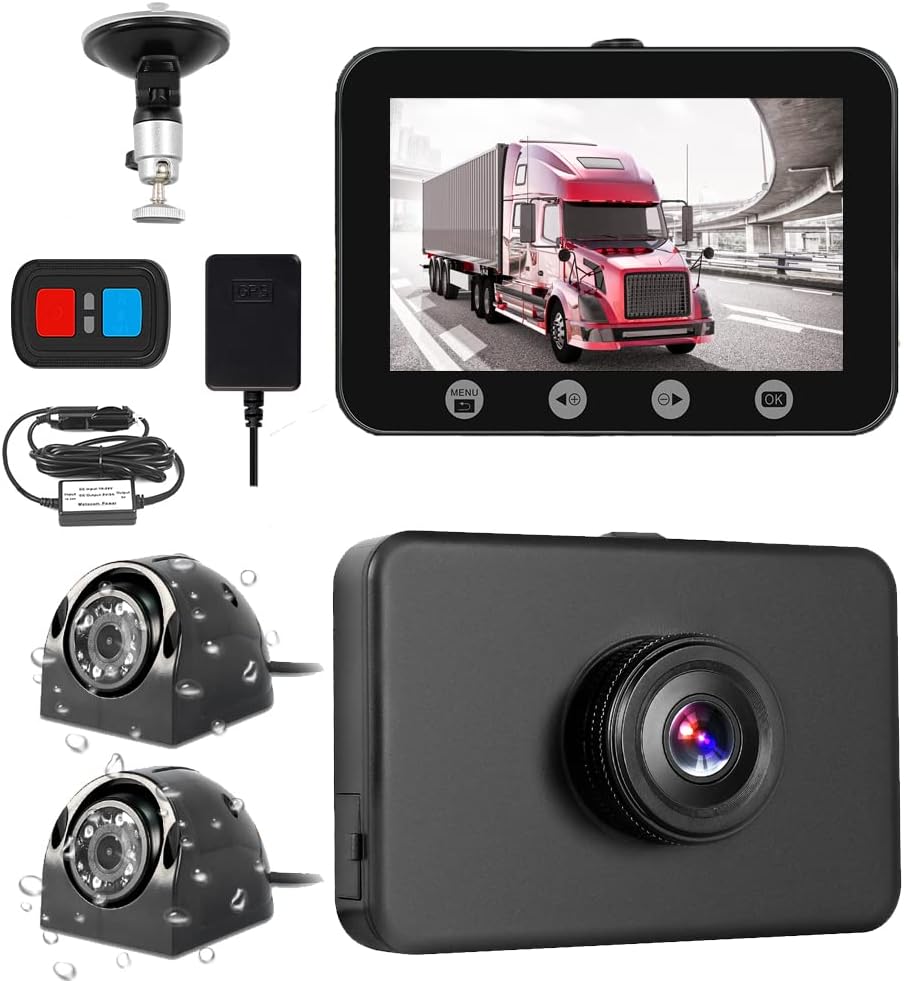
The VSYSTO 3CH WiFi Truck system is designed around the coverage demands of larger commercial vehicles. It records three angles at once through a 1080P front camera and two 720P cameras that can cover the sides or rear. The four-and-a-half-inch screen can present the feeds together, while a 4.0 rating indicates generally favorable user reception despite the system's more specialized design.
We may earn a commission when you buy through this link, at no additional cost to you.
Its most useful truck-specific feature is automatic turn-signal switching. When the yellow lead is connected to the appropriate 12V turn-signal circuit, the display can change to the camera associated with that side. This helps a driver check the trailer or lane before committing to a maneuver. Separate cameras with waterproof construction and infrared night vision also support low-light and adverse-weather monitoring, while the included screen makes the system less dependent on a phone for basic operation.
Power and file management are handled thoughtfully for commercial use. The unit can continue recording after power is switched off for a selectable two, four, eight, or twelve hours, although the manufacturer recommends low-voltage protection when using that feature. Loop recording can be set to one, two, three, or five-minute files, and the G-sensor protects emergency clips from ordinary overwriting. A smartphone can connect through the VSYSTO app for viewing, downloading, editing, and sharing.
This system is a strong candidate for drivers who need side or rear visibility more than maximum resolution on every channel. The 720P auxiliary cameras are adequate for situational awareness and incident context, but they are not the best choice when distant fine details must be resolved from the flanks. Proper waterproof routing and trigger-wire installation are essential to realize its full value.
The automatic display change is particularly helpful during lane changes, parking, and dock approaches. It reduces the need for the driver to manually select a camera at exactly the moment attention should remain on traffic and clearance.
Configurable loop lengths, collision-locked emergency files, and selectable post-shutdown recording give operators more control over continuous coverage. Low-voltage protection remains important when the system draws power after ignition is switched off.
We may earn a commission when you buy through this link, at no additional cost to you.
The REDTIGER F7NP pairs native 4K front recording with a 1080P rear camera, giving semi-truck drivers a high-detail view of the highway and a useful record of what follows the vehicle. Its 4.1 rating reflects a solid overall proposition, and the front STARVIS 2 sensor, F1.5 aperture, six-layer optical lens, WDR, and HDR collectively support clear, balanced footage across changing light conditions.
We may earn a commission when you buy through this link, at no additional cost to you.
The 170-degree front lens captures a broad road perspective, while the 140-degree rear lens covers the lane behind. Built-in 5.8GHz WiFi allows phone transfers of up to 20 MB/s through the Redtiger Cam app. The app is also used for previews, playback, GPS route and speed information, and settings. A free memory card is included, and the system uses seamless loop recording while protecting event files from ordinary overwriting.
This model also includes a supercapacitor rather than a lithium battery, which improves heat resistance and supports longer parked operation. Time-lapse and G-sensor parking modes are available, but the hardwire kit is not included. As with any high-resolution setup, users should use the original or officially recommended charging accessories and avoid prolonged exposure to excessive heat.
The F7NP is best for drivers who prioritize the detail of their forward highway view and want rear coverage without moving to a three-camera commercial arrangement. It lacks the side or cabin perspectives supplied by the VSYSTO and REDTIGER F17 systems, but the front camera's higher native resolution can be more valuable when reading signs or identifying vehicles at a distance.
Recording 4K natively gives the F7NP a measurable distinction from systems that upscale a lower-resolution source. That extra detail can improve the readability of distant vehicles, signs, and lane markings during daylight highway travel.
The built-in supercapacitor is a meaningful advantage for a dash cam exposed to a hot commercial cab. It also provides the energy behavior needed for time-lapse and incident-based parking recording.
We may earn a commission when you buy through this link, at no additional cost to you.
The REDTIGER F17 4K 3CH is a flexible three-camera system aimed at drivers who want a forward highway view plus cabin and rear coverage. It has a 4.4 rating, the highest among the dedicated multi-camera dash cams in this roundup. The front channel uses a STARVIS 2 IMX675 sensor and records at 4K, while the cabin and rear channels record at 1080P with wide viewing angles.
We may earn a commission when you buy through this link, at no additional cost to you.
A key advantage is the choice between operating modes. With the inside camera active, the system supports 2.5K dual-channel recording, maintaining front detail while adding cabin coverage. Turning off the inside channel enables 4K front and 1080P rear recording for maximum forward and rear resolution. This lets an owner-operator prioritize detail when needed or use the extra channel for broader situational awareness during other trips.
The F17 includes 5GHz and 2.4GHz WiFi, built-in GPS, and a REDTIGER app for playback, route information, video metrics, and settings. A 64GB card is included. Its supercapacitor is intended to perform reliably in changing temperatures, and the product carries an 18-month guarantee with round-the-clock customer support. Time-lapse and collision-detection parking modes require an extra hardwire kit.
This is a good middle ground between a two-camera road system and a side-view commercial system. Its cabin camera is useful for monitoring drivers, passengers, or loads, while the rear channel records following traffic. It does not provide the dedicated side blind-spot views of the VSYSTO systems, so operators who need both flanks covered should investigate those options instead.
The F17 can shift between a front-and-cabin configuration at 2.5K and a front-and-rear configuration at 4K. That flexibility lets drivers tailor recording to the most important views on a particular route.
Built-in GPS records route and speed information, while 5GHz WiFi provides faster phone access than a 2.4GHz-only connection. This is useful for reviewing long drives and sharing time-sensitive clips without constantly handling the card.
We may earn a commission when you buy through this link, at no additional cost to you.
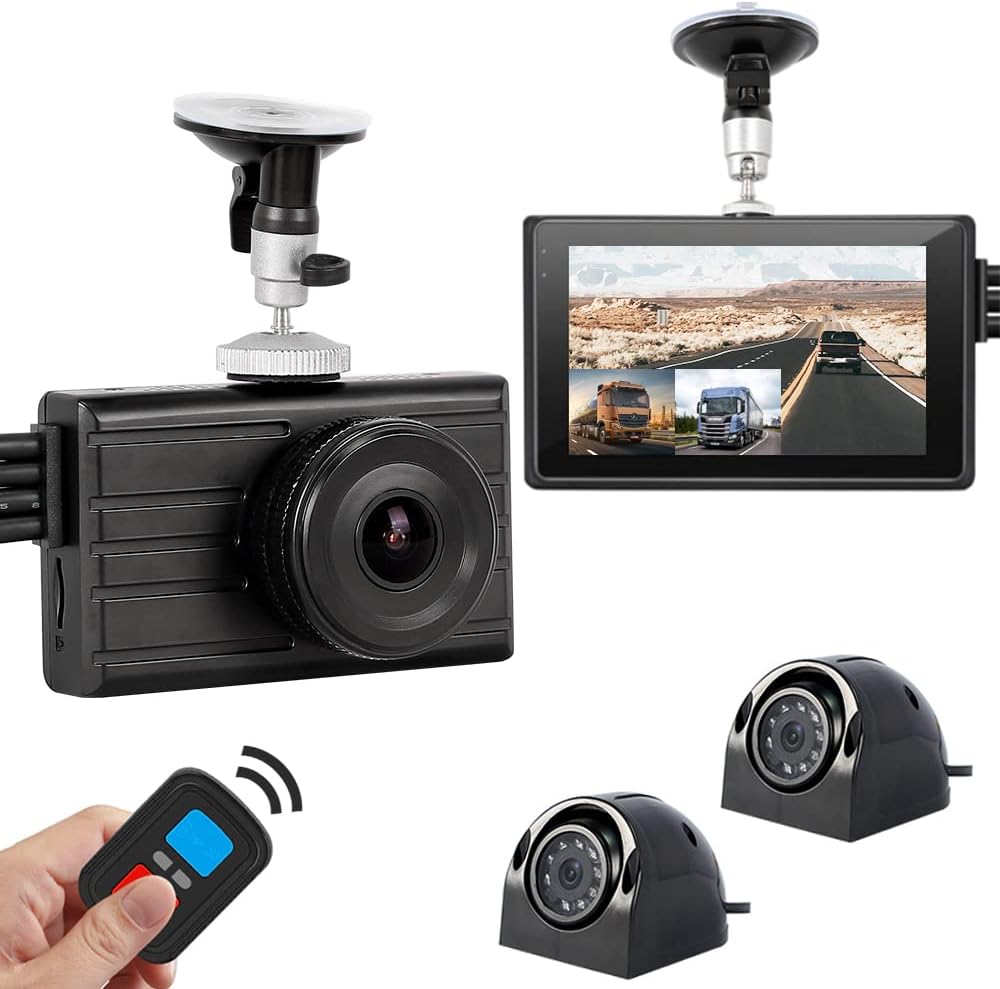
The VSYSTO Semi Truck 3CH is built for broad side visibility, with separate front, left, and right cameras rather than a cabin-oriented third channel. It carries a 3.4 rating, but its feature set directly addresses common commercial-vehicle concerns: blind spots, trailer clearance, long cable runs, wide operating voltage, and weather-resistant exterior cameras.
We may earn a commission when you buy through this link, at no additional cost to you.
The front camera records at 1080P, while the two side cameras use 720P CMOS sensors with infrared night vision. Each external camera has an IPX7 waterproof rating and an adjustable lens mount. Cable lengths of 6.6, 19.7, and 19.7 feet provide practical installation flexibility across a tractor or trailer configuration. A four-and-a-half-inch HD monitor supports full or split-screen viewing inside the cab.
Several convenience features support daily use. Connecting the trigger wire to the vehicle's turn-signal wiring automatically displays the corresponding camera, while a 2.4G remote changes views manually. The included GPS tracker provides speed, battery voltage, coordinates, atmospheric pressure, and route playback. The system supports microSD cards up to 256GB, uses loop recording, and locks files when the G-sensor detects a collision.
Its broad 12-to-30V compatibility makes it suitable for many 12V and 24V commercial vehicles, including semis, vans, trailers, and RVs. The main reason for caution is the 3.4 rating, which suggests mixed experiences among users. The specialized three-angle design may still be the right choice for an operator whose priority is seeing both sides of a long rig, but installation quality and the lower-resolution auxiliary channels should be considered.
Separate left and right cameras are easier to aim at trailer edges, loading areas, and lane-adjacent hazards than a compact cabin camera. Long cables also allow the installer to place each lens where it offers the most useful perspective.
A 12-to-30V range and IPX7 external cameras suit a broad range of commercial vehicles and exposed mounting positions. The system is intended to tolerate weather while maintaining separate side and front views.
We may earn a commission when you buy through this link, at no additional cost to you.
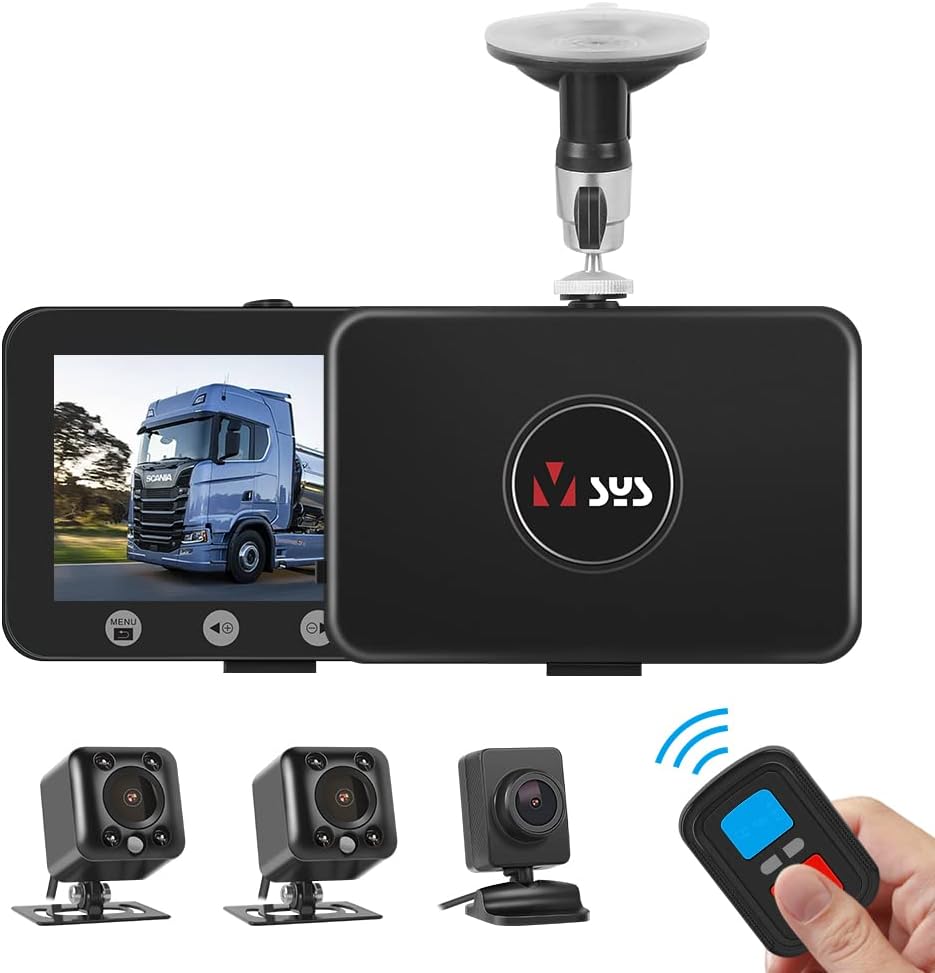
The VSYSTO Upgrade 3CH delivers simultaneous front, side, and rear recording in a compact package intended for semis, trailers, vans, RVs, and other large vehicles. Its 3.7 rating places it behind the stronger-rated dual and premium systems, yet the core coverage remains appropriate for operators who need to reduce blind spots around a long vehicle.
We may earn a commission when you buy through this link, at no additional cost to you.
The front channel records at 1080P and the two auxiliary channels at 720P. IP67 waterproof lenses and built-in infrared LEDs support operation in low-light and wet conditions. A three-inch monitor can show a single camera or a split screen with as many as three views. Drivers can also connect the yellow lead to turning or reverse trigger wiring so the relevant camera appears automatically.
The DVR is designed for straightforward installation. Its included power arrangement draws from a vehicle's cigarette-lighter socket and converts a 9-to-24V DC source to 5V/2A. The 2.4GHz wireless remote provides manual display control, while built-in WiFi and the accompanying app allow phone-based viewing without removing the card. Loop recording can use one-, three-, or five-minute files, and the G-sensor protects emergency recordings from normal overwriting.
This system is most practical for a driver who values compactness and simple power over a large cab display. The three-inch screen may be less convenient for extended multi-camera review than the four-and-a-half-inch VSYSTO model, and the 720P side or rear views provide less detail than native 4K systems. Even so, it covers the essential need for exterior situational awareness in a relatively compact installation.
Turn and reverse trigger wiring allows the screen to show the most relevant view as the driver changes direction. This reduces manual switching during exactly the maneuvers where blind spots become most consequential.
The included power solution accepts a broad vehicle DC input and supplies the recorder through its cigarette-lighter connection. It simplifies setup for operators who want a dedicated multi-camera system without a complex hardwire.
We may earn a commission when you buy through this link, at no additional cost to you.
The ROVE R2-4K is a straightforward single-camera solution for a semi-truck driver who wants a clear forward highway record without a multi-camera installation. It records native 2160P Ultra HD video through an eight-megapixel Sony IMX415 sensor and carries a 4.3 rating. A 150-degree lens, F1.5 aperture, and six-glass-lens night-vision design support broad and low-light coverage.
We may earn a commission when you buy through this link, at no additional cost to you.
Built-in GPS records the route, location, and speed, making the footage more useful for long trips and incident review. WiFi 6 connects through the ROVE app for live viewing, management, and phone downloads at up to 6 MB/s. The system also supports parking mode, motion detection, time-lapse capture, G-sensor event locking, and loop recording. A built-in supercapacitor is used instead of a conventional lithium battery.
The important purchasing consideration is that no memory card is included. A Class 10 or U3 microSD card is required, with support stated up to 512GB. ROVE recommends its own PRO, Ultimate, or Industrial cards, which is sensible because a card must sustain continuous high-resolution writing and remain reliable in a hot cab. Owners should also confirm that a hardwire kit is available if they want parking surveillance.
This is the best budget-oriented pick in the roundup for an owner-operator seeking one strong road-facing camera. It cannot document the rear, trailer sides, or cabin, and its phone transfer speed is lower than the newest dual-band systems. Even so, the native 4K sensor, GPS, night-vision design, and uncomplicated form make it a practical core camera for many highway routes.
The R2-4K records 2160P directly rather than upscaling a lower-resolution feed. That makes it a practical one-camera choice for drivers whose principal concern is detailed forward evidence.
Built-in GPS adds location and speed information without requiring a separate tracker. Route playback through the app or GPS Player helps connect footage to a specific journey and roadway.
We may earn a commission when you buy through this link, at no additional cost to you.
The renewed Garmin dēzlCam OTR725 combines truck navigation and forward video recording in a single seven-inch unit. It records 1080P HD footage across a 140-degree field of view and automatically saves incident video to the pre-installed memory card. Its 3.4 rating is lower than the standard OTR725's, so renewed-condition buyers should inspect the device and packaging carefully.
We may earn a commission when you buy through this link, at no additional cost to you.
Its strongest feature is truck-aware navigation rather than camera flexibility. Custom routes account for truck size and weight, while alerts identify bridge heights and sharp curves. BirdsEye Direct satellite imagery helps drivers visualize loading docks, gates, and entrances, and the companion dēzl ecosystem can surface community-rated truck parking. The device also displays wind speed information and provides nearby CAT Scale information in the United States and Canada.
Recording is integrated into the same device as navigation, eliminating the need for a separate forward camera if a driver already relies on Garmin's commercial routing. The seven-inch high-resolution screen is easy to consult from the driver's seat, although it occupies more dashboard space than a compact camera. The 140-degree view provides useful environmental context, although it does not match the front resolution of the 4K models in this guide.
This renewed unit is most appropriate for a driver who values large-screen navigation and truck-specific guidance and accepts a single-camera recording setup. It is not the leading choice for broad blind-spot coverage, and the lower rating should encourage a careful condition check. Confirm that the included memory card functions, the screen is free of defects, and all touch and mounting features work as expected.
Custom routing based on vehicle size and weight, bridge-height alerts, and turn warnings help a professional driver avoid unsuitable roads. These navigation functions are more valuable than high-resolution side cameras for drivers whose priority is route efficiency.
The built-in 1080P recorder automatically stores incident footage to its pre-installed card. Integrated recording can simplify the cab, although it does not provide the rear and side coverage of a dedicated multi-camera system.
We may earn a commission when you buy through this link, at no additional cost to you.
The standard Garmin dēzlCam OTR725 is the premium navigation choice in this guide, combining a large seven-inch truck navigator with a built-in 1080P dash camera. It carries a 4.2 rating and targets professional drivers who want a capable GPS navigator with evidence recording in one device. The built-in camera has a wide 140-degree field of view and automatically saves incident footage to the pre-installed memory card.
We may earn a commission when you buy through this link, at no additional cost to you.
Truck-specific navigation is a major advantage. Custom routing considers the vehicle's size and weight, with alerts for bridge heights, sharp curves, and other potential restrictions. Drivers can use satellite imagery to inspect loading docks, truck entrances, and security gates before arrival. Community information helps locate and rate truck parking, while the Truck and Trailer Services directory supports searches for amenities such as showers and specific brands.
The OTR725 also adds built-in PrePass notifications, subject to an active PrePass account and a compatible smartphone connected through Bluetooth. CAT Scale searches can help a driver verify legal weight before reaching a scale, and wind-speed overlays add context about potentially hazardous conditions. These features extend the device beyond video capture into route and operational planning.
This is an excellent premium pick for an owner-operator who wants a professional navigation platform and accepts only forward 1080P recording. It is not suitable for a driver requiring side, rear, or cabin cameras. For that broader evidence, a three-camera DVR is the better route. Here, the strength of the OTR725 is the combination of a large display, truck-aware guidance, and a clean integrated recorder.
Truck parking discovery, loading-dock imagery, CAT Scale searches, service directories, and PrePass notifications turn the OTR725 into a broader operational tool. These capabilities can be as valuable as improved video resolution to drivers who spend most of their time on the road.
A 140-degree field of view captures a substantial area ahead of the truck, while automatic incident saving helps preserve important clips. The integration keeps the cab uncluttered by avoiding a separate forward camera and navigation display.
We may earn a commission when you buy through this link, at no additional cost to you.
The VIOFO A229 Pro is a premium dual-camera dash cam built around two STARVIS 2 sensors. The front camera uses IMX678 to record 2160P, while the rear uses IMX675 at 1440P. With a 4.2 rating, it offers strong image specifications, HDR processing, and a refined feature set, but it is not designed to provide the broad side or cabin coverage of a commercial three-camera system.
We may earn a commission when you buy through this link, at no additional cost to you.
Image quality is the defining attraction. HDR is applied to both front and rear recordings to balance bright and dark areas, while the sensors are positioned to support license-plate reading and detail capture in high-speed or low-light conditions. A circular polarizing lens is included on the front camera to reduce reflections and glare from windshields and wet roads, improving contrast in challenging lighting.
The A229 Pro also offers sophisticated parking behavior. Its buffering function records 15 seconds before and 30 seconds after a detected moving object, providing context around a parking event. Auto event detection, low-bitrate recording, and time-lapse are the three available parking modes. Voice commands cover common tasks such as taking photos, locking video, toggling WiFi or audio, and switching the displayed camera. A quad-mode GPS module supports GPS, BEIDOU, GALILEO, and GLONASS.
A 5GHz WiFi connection provides app-based preview, configuration, and sharing, and the included six-meter rear cable simplifies installation in many vehicles. The built-in supercapacitor is designed for reliable operation in extreme temperatures. A memory card and suitable hardwire kit are not included, so buyers should budget for both. This is a compelling premium road-facing system for drivers who prioritize image quality, but it is not the best match for a blind-spot monitoring requirement.
Separate flagship sensors give the front and rear cameras distinct high-resolution roles. The result is 4K forward footage and 2K rear footage with HDR designed to preserve detail under difficult lighting conditions.
The parking buffer retains 15 seconds before and 30 seconds after a detected event. That context is more useful than a clip triggered only after movement because it shows what happened immediately before the incident.
We may earn a commission when you buy through this link, at no additional cost to you.
The right semi-truck dash cam depends on how you drive, where you park, and what evidence you need. Resolution, camera placement, power, storage, night visibility, and reliable mounting should be evaluated together rather than treating one specification as decisive.
A single front camera is the simplest choice and works well when the main concern is the roadway ahead. A dual system adds the view behind the truck, which can be essential for documenting following vehicles, a reversing incident, or a parking event. Three-channel commercial systems are more useful when the driver needs to see both sides of a long tractor-trailer, monitor the cabin, or eliminate blind spots during lane changes. Select camera positions around the actual vehicle combination, including the trailer length and typical parking locations.
Resolution influences how much fine detail survives when footage is enlarged. Native 4K front recording is valuable for distant signs, vehicles, and lane markings, but it consumes storage quickly and can expose performance limitations of the memory card. Upscaled 4K should not be evaluated as identical to native 4K. Consider the front resolution, rear resolution, frame rate, and sensor together. A lower-resolution side camera may still meet a practical need if its purpose is to reveal an object beside the trailer rather than identify a distant license plate.
Semis frequently operate at night, in tunnels, and through rain or fog. STARVIS 2 sensors, HDR, WDR, wide apertures, and infrared illumination can improve low-light visibility. Infrared cameras are particularly useful for side or rear views that face dark loading areas, while HDR helps balance headlights against darker roadside surroundings. Test placement carefully because reflective surfaces, hoods, and windshields can create glare. A supplied polarizing filter, as found on the VIOFO A229 Pro, may improve daytime contrast but must be installed correctly.
A semi-truck dash cam may remain connected for long periods, especially in summer. Supercapacitor-based designs are generally better suited to continuous parking surveillance than systems relying on a lithium battery. Hardwired parking mode requires a vehicle-appropriate hardwire kit, which is not included with several models in this guide. Also verify low-voltage protection so an aftermarket camera does not drain the commercial vehicle's battery. If the recorder is powered through a cigarette-lighter socket, confirm that the adapter and the vehicle's power socket can sustain the required draw.
High-resolution and multi-channel recording require a dependable high-endurance microSD card. Some products include a card, while the ROVE R2-4K and VIOFO A229 Pro do not. Capacity affects how much footage can remain before loop recording replaces older files. Emergency locking is important because an incident should not disappear when ordinary footage is overwritten. Check supported card formats, maximum capacity, minimum speed class, and manufacturer compatibility recommendations. Format the card in the camera or according to its instructions and inspect it periodically for errors.
GPS can add speed, location, and route information to recorded clips, helping establish when and where a drive occurred. This is useful for long-haul operators and incident review even when a separate navigation device is already present. Integrated truck navigators offer a different advantage: truck-aware routing, bridge-height warnings, loading-dock imagery, and truck parking information. Decide whether the cab needs a recording system alone, a navigation-first tool, or both. A separate GPS-enabled camera usually offers more flexibility than a tightly integrated navigator.
A phone app should make recordings easy to locate, preview, download, and share without frequent card removal. Dual-band or 5GHz WiFi can provide faster transfers, but app quality, signal stability, and phone compatibility still matter. Larger dashboard screens are useful for split-screen side-camera monitoring, whereas compact screens preserve cab space. Voice control can reduce physical interaction, but its value depends on the available commands and the driver's willingness to use natural-language prompts. Check that controls are understandable and that the device does not obstruct required sightlines.
Semi-truck installation requires secure brackets, long-enough cables, clean routing, and careful sealing around the cab and trailer. Adjustable lenses and long leads are useful on multi-camera systems, but every exposed connection should be protected from vibration, water, and road debris. Verify that the monitor, camera cables, and power leads do not interfere with steering, controls, airbags, curtains, or the driver's movement. Professional installation is sensible when complex side-camera routing, multiple trigger wires, or integrated navigation placement is involved.
Begin by identifying the purpose of each camera and mounting it where the lens can see the intended area without excessive hood, visor, or trailer obstruction. Clean the glass or mounting surface, attach the bracket securely, and route cables away from sharp edges and moving components. For systems with turn-signal or reverse triggers, identify the correct 12V circuit and use the supplied or manufacturer-recommended wiring. Avoid connecting the signal lead to a higher-power circuit.
Format a compatible microSD card in the dash cam, confirm that the camera recognizes it, and test front, rear, side, GPS, audio, and display functions before a long trip. Learn the app and trigger behavior while parked. Review a short sample drive to confirm the view is level, the date and time are correct, and recordings appear in the expected folders. Test parking mode and low-voltage shutdown only where safe, and install a rated hardwire kit if the product requires one.
Regular maintenance protects both the recordings and the electronics. Inspect the lens, mounts, cables, connectors, and power source for looseness, cracks, heat damage, or contamination. Clean the lens with an appropriate cloth, check the memory card for errors, and format it on the established schedule. Keep the cameras and recorder within their specified operating conditions, and do not leave an overheated unit connected. After reviewing files, back up important clips and confirm that the system continues to overwrite ordinary footage without locking the card.
It depends on the routes and parking situations. A front-and-rear setup can document the road and traffic behind the vehicle, but dedicated side cameras help reveal pedestrians, vehicles, or obstacles beside a long trailer. Drivers who regularly navigate narrow docks, city streets, or crowded truck stops gain more from three-channel coverage. Those who mainly travel open highways may prioritize higher front resolution and night performance instead.
It can be useful, but resolution is only one part of a useful recording. The sensor, HDR balance, lens, exposure, memory-card speed, and file management all influence the result. Native 4K may help with distant road details, while a 1080P commercial multi-camera system may provide more valuable side coverage. Compare the actual camera layout and operating conditions rather than choosing on resolution alone.
Use a compatible high-endurance microSD card that meets the dash cam manufacturer's speed and capacity requirements. Continuous 4K and multi-channel recording place heavier demands on a card than ordinary consumer use. Some products include a suitable card, while others require one to be purchased separately. Format the card regularly and replace it if the camera reports read, write, or compatibility errors.
A passenger-car model can record the road, but it may not provide suitable mounting space, long cables, multi-camera coverage, commercial-voltage compatibility, or a durable parking power solution. A truck-specific system is more likely to offer side views, waterproof exterior cameras, longer leads, 12-to-30V support, and vehicle-aware displays. Check the installer's clearance and the recorder's power requirements before using a compact car system.
A properly configured hardwired installation with low-voltage protection should minimize the risk, but the draw still matters, especially during long storage periods. A supercapacitor-based camera is generally well suited to parking surveillance. Do not leave a non-hardwired system powered indefinitely, and test the cutoff behavior before relying on it for extended parking coverage. Battery concerns are especially important for owner-operators who may park for weeks.
It is convenient but not essential to the basic act of recording. WiFi makes it easier to preview channels, download clips, change settings, and share evidence from a phone. Faster 5GHz or dual-band connections help when moving large 4K files. A wired monitor and card reader can provide alternatives, so evaluate app compatibility and connection reliability as well as nominal transfer speed.
An integrated navigator is convenient when truck-aware routing, bridge-height warnings, loading-dock imagery, and truck parking information are priorities. A separate GPS-enabled dash cam often provides better camera placement and more flexible recording controls. Drivers who want both can select a compact dual-camera system with built-in GPS and continue using their preferred navigation device.
Mount each camera where it can see the relevant side or blind spot, while keeping the lens clear of reflective surfaces and obstructions. Secure the bracket to a stable surface, route the cable away from sharp edges, and protect exposed connections from moisture. Use a supplied trigger lead for automatic turn-signal switching if desired, and verify the view from the cab before driving.
The ROVE R2-4K Dual stands out as the most balanced dedicated dash cam for highway use, pairing front and rear recording with a STARVIS 2 sensor, GPS, an included card, and quick app transfers. The VSYSTO 3CH WiFi Truck is the stronger choice when three-angle visibility, infrared side coverage, and turn-signal switching matter, while the REDTIGER F17 offers flexible front, cabin, and rear recording for drivers who want more control over channel resolution.
Your priorities should determine the system: select a simple native 4K front camera for an uncluttered installation, a commercial three-camera system for blind spots and side visibility, or the Garmin dēzlCam OTR725 when professional navigation is as important as forward recording. Before buying, verify card compatibility, power requirements, cable length, mounting space, trigger wiring, and whether parking-mode accessories are included. These details determine whether an otherwise capable camera will work well in a real semi-truck cab.
Product availability, package contents, ratings, and prices can change over time, so confirm the current listing before purchasing. Review the supplied specifications and instructions, compare the camera layout with the coverage you actually need, and use a secure installation that does not obstruct the driver. With those checks completed, you can select a dash cam that provides dependable evidence without adding unnecessary complexity to the cab.