
FZONE P4 In-Ear Monitor Amplifier
4.5Editor score
Switchable mono and stereo
Locking XLR and TRS input
Twelve-hour AAA battery life
This Earc Amplifier guide compares ten options for hearing, in-ear monitoring, home audio, streaming, and high-resolution headphone use.
An earc amplifier can take many forms, from a personal device designed to make conversations easier to hear to a high-resolution headphone amplifier for musicians or audiophiles. The right model depends on the source, listening environment, earbuds or headphones, and the level of control you need.
We compared the ten products using their stated amplification features, connectivity, supported audio formats, portability, compatibility, and practical specializations. The list covers personal hearing amplifiers, portable in-ear monitor amplifiers, streaming amplifiers, and desktop or premium hi-fi units.
Each pick reveals what it does best, whether that is strengthening television dialogue, supporting live performers, driving passive speakers, or providing a sophisticated digital signal path. Prices and configurations can change, so verify the current listing and accessories before buying.
4.5Editor score
4.6Editor score

4.8Editor score
The comparison highlights major differences in intended use, signal support, connectivity, portability, and amplification features, from personal hearing devices to sophisticated home and studio equipment.




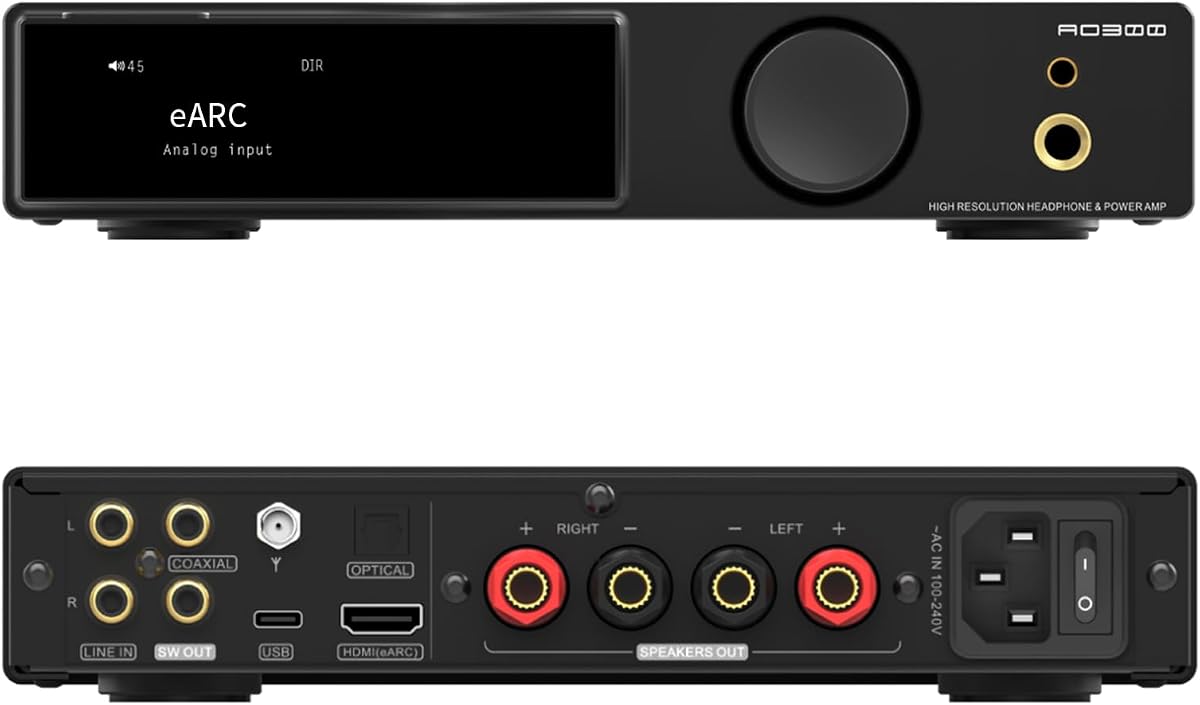
The SMSL AO300 PRO is a desktop-oriented DAC amplifier with a 4.6 rating, combining digital conversion, stereo power amplification, and headphone output in one enclosure. Its standout quality is versatility: the unit can serve a pair of powered or passive speakers, connected headphones, a television through HDMI eARC, and several traditional and digital source components.
We may earn a commission when you buy through this link, at no additional cost to you.
At the core is a CS43131 DAC paired with an XMOS XU-316 interface. The supplied specifications support PCM up to 32-bit and 768kHz, DSD256, and USB MQA decoding, while the electronic volume control is specified at 0.003% distortion. The MA5332MS power stage provides 165 watts per channel at four ohms and 85 watts per channel at eight ohms, giving it considerably more authority than a typical headphone-only device.
The connection options are unusually broad for a compact integrated system. USB, coaxial, optical, and RCA inputs cover computers, disc players, televisions, and conventional stereo components. A 4.4mm balanced output and 6.35mm headphone jack support different listening priorities, while 2.1-channel expansion can add a subwoofer. Eight EQ modes, five filters, a remote, and HDMI eARC control expand the unit's usefulness further.
This is a strong recommendation for someone who wants one component to organize a desktop or modest home system without assembling a separate DAC, power amplifier, and headphone stage. It is less suitable for a musician who needs a belt-worn monitor amplifier or a listener whose only goal is making nearby conversation easier to hear. For a flexible hi-fi hub with both speaker and headphone outputs, the AO300 PRO is among the most convincing choices in this guide.
The mix of USB, optical, coaxial, RCA, and HDMI eARC makes the AO300 PRO adaptable to nearly any home listening chain. Its source switching and remote control reduce the need for separate desktop components.
The 4.4mm balanced output can suit compatible high-performance headphones, while the 6.35mm jack remains useful for common full-size and studio models. Having both avoids choosing a single headphone connection style.
We may earn a commission when you buy through this link, at no additional cost to you.
The WiiM Amp Ultra is a network-capable stereo amplifier with a 4.6 rating. Unlike a personal hearing amplifier or a portable in-ear monitor booster, it is designed to become the control center of a connected home listening system while driving as many as four speakers.
We may earn a commission when you buy through this link, at no additional cost to you.
Its stated output is 100 watts, while dual TI TPA3255 amplifier chips, an ESS SABRE DAC, and PFFB technology form the signal chain. The included RoomFit calibration system is a major feature: it analyzes the room and speakers, then adjusts the response for a more balanced presentation. A 3.5-inch glass-covered display provides control and album-art information directly on the unit.
Connectivity is equally substantial. Wi-Fi 6, Bluetooth 5.3 with LE Audio, and HDMI ARC support local and network listening. Spotify, TIDAL, Qobuz, Amazon Music, Roon Ready, and Chromecast are among the named services, with support stated for resolutions up to 24-bit and 192kHz. Multiroom operation, Alexa, Google speakers, app control, and the included voice remote broaden the options.
The most important limitation is explicit: this amplifier is incompatible with AirPlay and cannot act as an AirPlay receiver. That makes it less suitable for households built around an AirPlay-centric ecosystem. For listeners who prioritize broad streaming services, automatic room correction, flexible speaker deployment, and convenient control, however, the Amp Ultra is a sophisticated and highly practical centerpiece.
RoomFit offers an automated alternative to spending hours adjusting tone controls for furniture placement, speaker distance, and room acoustics. It is particularly useful for users who want a more consistent result across different rooms.
The touchscreen, mobile app, voice remote, and smart-speaker integration provide several ways to operate the amplifier. This flexibility is useful for households where different listeners prefer different control methods.
We may earn a commission when you buy through this link, at no additional cost to you.
The Arcam A25+ is a conventional-looking integrated amplifier that combines traditional hi-fi connectivity with modern digital and wireless features. Its 5.0 rating is the highest among the ten listed products, making it an attractive candidate for listeners who want a serious home amplifier rather than a personal hearing device.
We may earn a commission when you buy through this link, at no additional cost to you.
Its Class G amplifier delivers 100 watts per channel into eight ohms and 165 watts per channel into four ohms. An enhanced power supply and ESS ES9018 DAC are intended to provide low noise and low distortion. The input selection is extensive: three analog RCA pairs, a moving-magnet phono stage, USB-C, two coaxial inputs, two optical inputs, and HDMI eARC.
Bluetooth 5.4 with Snapdragon Sound and Auracast adds wireless playback, including support for wireless headphone compatibility. The tuned moving-magnet phono section is particularly useful for listeners who still own records and want the amplifier to handle the source directly without a separate phono preamp.
A notable trade-off is that the supplied information does not mention a dedicated headphone amplifier or headphone jack. Buyers whose main goal is personal earc or headphone amplification should not assume that an integrated speaker amplifier provides the same experience. For driving passive speakers through a broad mix of analog, digital, wireless, and television sources, the A25+ is a well-equipped and highly rated option.
The A25+ can serve as the central component in a mixed-source system, accepting turntables, traditional stereo gear, computers, and optical or coaxial sources. Its input variety reduces the need for additional switching equipment.
Class G amplification is designed to balance efficient operation with useful power for home speakers. The stated 100-watt output at eight ohms should suit a wide range of bookshelf and floor-standing speaker configurations.
We may earn a commission when you buy through this link, at no additional cost to you.
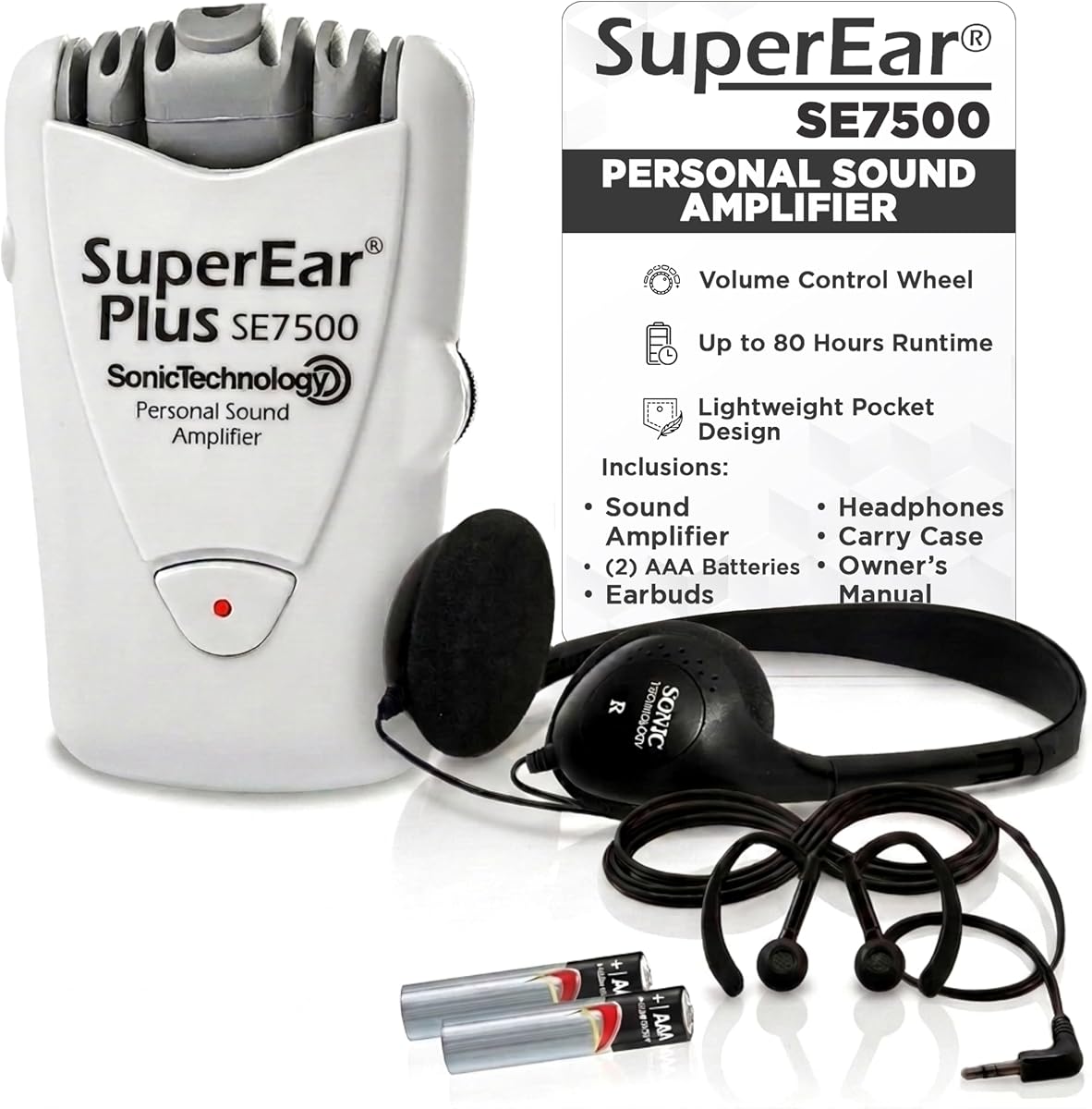
The SuperEar SE7500 is a personal sound amplifier intended to make nearby environmental sound easier to perceive. With a 4.1 rating, it belongs to a completely different category from the powered speaker amplifiers and studio monitor boosters: its microphone collects surrounding sound so users can hear conversations, television dialogue, lectures, worship, and outdoor activity more clearly.
We may earn a commission when you buy through this link, at no additional cost to you.
The supplied specifications state up to 50+ dB of ambient sound gain, adjustable through a tactile volume wheel. A redesigned microphone is intended to minimize carry noise, which is important because a microphone placed close to clothing can introduce distracting handling sounds. The unit includes lightweight earbuds, over-ear headphones, two AAA batteries, a carry case with belt clip, and an owner’s manual.
Its portability is a major advantage. The earbuds offer a discreet option in public, while the belt clip supports hands-free carrying. The advertised battery life of up to 80 hours and automatic shutoff make it practical for regular use around the home or while traveling. Compatibility is also stated for disposable ear pad covers and the SuperEar extension cable.
This is not intended to replace a hearing aid, and users with significant hearing concerns should consult an appropriate healthcare professional. It is also not a high-fidelity headphone amplifier for music. For someone seeking straightforward assistance hearing nearby speech without turning up the television or surrounding speakers, the SE7500 is purpose-built, portable, and comparatively complete.
By amplifying sound picked up near the television, the SE7500 can make dialogue easier to follow without requiring everyone else to raise the television volume. The included headphones and earbuds let the user select a comfortable listening style.
The compact body, belt clip, carry case, and long battery life support use in meetings, restaurants, places of worship, and outdoors. Automatic shutoff helps conserve power when the amplifier is inadvertently left on.
We may earn a commission when you buy through this link, at no additional cost to you.
The WiiM Amp is a compact network amplifier with a 4.6 rating, designed to bring streaming, television audio, and multiroom functions to passive speakers. It provides 60 watts per channel at eight ohms and 120 watts per channel at four ohms, making it suitable for bookshelf, floor-standing, architectural, and outdoor speaker applications.
We may earn a commission when you buy through this link, at no additional cost to you.
A broad selection of services is supported, including Spotify, Amazon Music, TIDAL, Qobuz, and local libraries, with stated support for 24-bit and 192kHz playback. The WiiM Home App handles room-by-room management, volume, favorites, alarms, EQ, and synchronized speakers. Voice control through Alexa, Google Assistant, or Siri adds another operating method, while HDMI ARC provides a simple path for television sound.
Advanced room correction and independent EQ settings are useful for adapting the amplifier to different spaces. It can also join a multiroom system with AirPlay 2 speakers, Amazon Echo, Google Home, and other WiiM devices. A powered subwoofer can be added when deeper low-frequency impact is desired.
The important ecosystem limitation is that this model receives AirPlay streams but cannot transmit AirPlay to other AirPlay-enabled devices. It is therefore less flexible than a full transmitter within an AirPlay-heavy home. For a smaller system needing compact power, extensive streaming support, and straightforward speaker setup, the WiiM Amp remains an attractive, highly rated option.
The amplifier adds wireless source selection, app control, room correction, and multiroom functions to existing passive speakers. This can extend the useful life of a speaker pair without replacing the speakers themselves.
HDMI ARC provides a familiar route for television audio while maintaining a compact component footprint. A powered subwoofer can supplement the stereo output when deeper bass is wanted.
We may earn a commission when you buy through this link, at no additional cost to you.
The SuperEar SE5000 is a handheld personal sound amplifier with a 4.2 rating. It captures and amplifies nearby ambient sounds for television viewing, family conversations, and everyday activities. The key distinction is that it is designed to sit near a television and collect its sound acoustically rather than connect to the set by cable or wireless.
We may earn a commission when you buy through this link, at no additional cost to you.
The amplifier provides up to 50+ dB of stereo ambient sound gain, controlled with a tactile volume wheel. Its swivel microphone allows the user to direct pickup toward the relevant sound source, which is helpful in rooms where the intended voice is not directly in front of the device. Surface-mount microelectronics are specified for the amplification stage.
The package is comprehensive for a personal amplifier. It includes deluxe stereo headphones, discreet stereo earbuds, one AAA battery, a belt clip, and a screw. Disposable earpad covers and SuperEar headphone extension cables are also stated as compatible accessories. The compact, lightweight enclosure is designed to fit in a pocket or attach securely with the stainless steel belt clip.
The stated battery life is up to 30 hours under moderate to heavy use, shorter than the SE7500's stated figure. The lack of direct or wireless television connectivity is another limitation for users who want a more integrated system. Even so, the SE5000 provides a straightforward way to improve audibility in common situations, and it is particularly attractive for buyers who want both headphones and earbuds in the box.
The swivel microphone gives the user some control over which nearby sound receives emphasis. Pointing it toward a television, speaker, or conversation can make the difference between picking up useful detail and capturing unwanted room noise.
Both full-size headphones and discreet earbuds are included, allowing the user to choose private, comfortable listening in different settings. The belt clip supports hands-free carrying during travel or daily activities.
We may earn a commission when you buy through this link, at no additional cost to you.
The SuperEar SE10 is a personal sound amplifier with a 4.1 rating and a notably specialized design. Rather than relying only on a microphone mounted in the user's body, it can operate as a two-in-one remote microphone and television audio transmitter, allowing sound to travel wirelessly to compatible SuperEar SE10 earbuds.
We may earn a commission when you buy through this link, at no additional cost to you.
The remote-mic option is designed for clearer voice pickup in busy places such as family gatherings, restaurants, and homes with significant background noise. It supports ultra-low latency of 16 milliseconds and a stated wireless range of up to 65 feet. For television viewing, the transmitter connects to a 3.5mm television audio output, providing a more direct route for dialogue than acoustic pickup near a television speaker.
Digital processing is stated to reduce background noise by up to 16dB. Five adjustable tone levels provide control over bass and treble response, helping users tune the balance for speech, television dialogue, and multimedia. The battery can provide up to six hours of use after a ten-minute charge, while a full cycle lasting approximately 50 minutes is stated to deliver up to 24 hours.
Compatibility is the decisive constraint. The SE10 is designed exclusively for SuperEar SE10 earbuds and compatible accessories, so it cannot be paired with third-party earbuds, headphones, or unrelated devices. Buyers who already own compatible SE10 equipment may find this an ideal extension; everyone else must confirm that the included or separately available listening solution meets their needs.
Placing the remote microphone near the person speaking can provide a closer signal than a microphone carried on the listener. This makes the system useful in restaurants, family gatherings, and other settings where background sound competes with conversation.
The 3.5mm television connection gives the transmitter a defined audio input instead of relying on nearby acoustic pickup. Low stated latency supports a more natural relationship between on-screen action and dialogue.
We may earn a commission when you buy through this link, at no additional cost to you.
The LEKATO P30 is a portable in-ear monitor amplifier with a 4.2 rating, aimed at vocalists, drummers, keyboardists, guitarists, and bassists. It sits on the waist during performances or rehearsals, receives a microphone or console feed, and drives the user's in-ear monitors through a 3.5mm output.
We may earn a commission when you buy through this link, at no additional cost to you.
Its primary attraction is endurance. A built-in 1000mAh lithium battery is specified for up to 16 hours of continuous use, eliminating frequent battery changes during a rehearsal, performance, or travel day. An LED indicator gives a quick status reference: red below 20% and green above 20%. The amplifier is also designed for low noise, high fidelity, and strong signal amplification without excessive distortion.
Input flexibility is important for stage use. The locking combo jack accepts XLR, 1/4-inch, or 6.35mm connections, helping prevent accidental cable disconnection. A stereo and mono switch allows the unit to work with either a stereo headphone output or a mono auxiliary send from a mixing console. The reinforced belt clip has undergone deformation testing, while the stated dimensions of 40 by 31.5 by 130 millimeters and weight of approximately 180 grams keep it manageable.
The fixed 3.5mm TRS output is a limitation for listeners who require larger or balanced connections, but it is a familiar standard for compact in-ear systems. The P30 is best suited to a performer who values battery life, a secure cable connection, and the ability to accommodate both mono and stereo feeds rather than seeking a domestic headphone amplifier.
The stated 16-hour battery life suits performers who do not want to carry spare cells or interrupt a rehearsal to replace them. The LED status indicator helps prevent an unexpected loss of monitoring.
The locking input helps guard against accidental disconnections, while the reinforced belt clip keeps the unit stable during movement. Together, these details address the physical demands of live performance.
We may earn a commission when you buy through this link, at no additional cost to you.
The FZONE P4 is a portable in-ear monitor amplifier with a 4.5 rating and a performer-focused feature set. It is a practical option for musicians who need a direct connection from a mixing console or other audio source and want more control over the volume delivered to their in-ear monitors.
We may earn a commission when you buy through this link, at no additional cost to you.
Its defining features are an XLR and TRS locking input mechanism, a switchable mono and stereo mode, and a volume control function. The locking connection helps prevent a stage cable from pulling free, while mono and stereo operation allows the amplifier to accept a balanced stereo feed or a mono auxiliary send. The standard 3.5mm stereo output provides a familiar connection for personal in-ear monitors.
Power comes from two included AAA batteries, providing up to 12 hours of operation. That figure is shorter than the LEKATO P30's stated rechargeable endurance, but it may suit musicians who prefer the availability and interchangeability of disposable cells. The upgraded battery cover is designed to keep cells secure and maintain consistent contact, addressing a common weakness in portable monitor boosters.
The belt clip was specially reinforced and subjected to deformation testing, which is reassuring for drummers, keyboardists, and other performers who move energetically. The P4 is the best budget-oriented choice here for a musician who values a locking connection, flexible feed selection, and straightforward operation. It lacks the rechargeability and extended battery life of the P30, but it remains a focused and convenient way to build a personal monitoring setup.
The locking XLR and TRS mechanism is more appropriate for a stage environment than a loose standard connection. It helps maintain a stable monitor feed while cables are moved or performers shift position.
The mono and stereo switch lets the amplifier follow the source rather than forcing a particular operating mode. This is useful in rehearsal spaces and live venues that use different console outputs.
We may earn a commission when you buy through this link, at no additional cost to you.
The Eversolo DAC Z10 is a high-resolution DAC, preamplifier, and headphone amplifier with a 4.8 rating. It is the most technically elaborate product in this guide, designed for listeners who want exacting digital conversion, a balanced analog path, and a dedicated headphone stage rather than a simple personal or portable booster.
We may earn a commission when you buy through this link, at no additional cost to you.
Its Fully Isolated Architecture separates the digital and analog domains, while dual independent AK4191 and AK4499 DAC modules serve the left and right channels. The supplied specifications list 130dB dynamic range and 0.00008% THD+N. Three independent toroidal transformers provide separate support for the left channel, right channel, and system power, with the goal of maintaining low noise and stable operation.
Timing accuracy receives similarly detailed attention. An OCXO temperature-controlled crystal oscillator, PLL correction, a built-in FPGA, and support for an external high-precision clock work together to reconstruct the digital signal accurately. The fully balanced preamplifier accepts XLR and RCA inputs with gain of up to 10dB, while an R2R resistor-array volume control manages the analog signal.
The dedicated 6.35mm headphone module automatically detects headphone impedance and adjusts gain, with high, medium, and low settings available. Digital connectivity includes coaxial, optical, IIS, USB audio, HDMI, and AES/EBU inputs. This is a desktop-class system for a serious headphone setup, and it is understandably more complex than the portable performers' devices or personal hearing amplifiers. For listeners seeking a premium signal path and automatic headphone matching, the Z10 is the most ambitious choice in the group.
Independent left- and right-channel DAC modules support a fully balanced conversion path. The stated dynamic range and distortion figures indicate a design intended to reveal low-level detail without adding unnecessary signal coloration.
Automatic impedance detection allows the headphone stage to choose an appropriate operating range instead of relying entirely on a fixed gain setting. Manual high, medium, and low choices provide further control for different headphones and preferences.
We may earn a commission when you buy through this link, at no additional cost to you.
The phrase earc amplifier can describe personal hearing devices, portable in-ear monitor amplifiers, and sophisticated headphone or speaker amplifiers. Start with the signal path and listening environment before comparing individual specifications.
A personal hearing amplifier uses a microphone to collect environmental sound, amplify it, and send the result through included earbuds or headphones. A portable in-ear monitor amplifier receives an existing audio feed through XLR, TRS, or another connector and drives the musician's personal monitors. A home or desktop headphone amplifier instead receives music from a source component and provides headphone output, sometimes alongside the power to drive passive speakers.
Choose the category that matches the problem you need to solve. Personal hearing devices prioritize speech pickup and long battery life. Stage monitor amplifiers prioritize locking connections, mono and stereo flexibility, and secure belt mounting. Desktop and home amplifiers prioritize source compatibility, signal quality, and output control.
Check every connection at both ends of the intended system. The SuperEar SE5000, for example, amplifies sound picked up near a television and does not connect directly to it, while the SuperEar SE10 accepts a 3.5mm television output. In-ear monitor amplifiers need a compatible source output and a connection to the user's in-ear monitors. Headphone amplifiers should match the jack size and balanced or single-ended requirement of the chosen headphones.
A single-ended 3.5mm output is common for portable stage equipment, while a home headphone system may benefit from 6.35mm, 4.4mm balanced, or full-size XLR connections. Confirm that the supplied cable or adapter is included before assuming the amplifier will work with existing equipment.
The amount of useful gain depends on the source, the headphones, and the environment. Personal hearing amplifiers may advertise amplification of 50+ dB because they are intended to make nearby voices and television dialogue easier to hear. Stage amplifiers must provide enough output for personal monitors without introducing excessive noise. High-end headphone amplifiers emphasize low noise, impedance matching, and finely controlled attenuation rather than extreme volume.
Look for a usable volume control or gain structure. A tactile wheel is helpful for a personal hearing device, while an app, remote, front-panel control, or motorized control is more appropriate for a home system. Automatic headphone gain can simplify the premium desktop category.
Low background noise matters when an amplifier makes quiet speech audible or when sensitive headphones reveal electronic hiss. The Eversolo DAC Z10 specifies 130dB dynamic range and 0.00008% THD+N, while the SMSL AO300 PRO states 0.003% distortion. These figures are not directly comparable across different device types, but they show how technically oriented some of the hi-fi options are.
The SuperEar SE10 adds digital background-noise reduction of up to 16dB and a remote microphone designed to capture voices more closely. For personal devices, microphone direction and wind or carry noise may be as important as the stated gain. In every category, a clear source and controlled connection produce a better foundation than raw amplification alone.
A device for television dialogue at home should be comfortable, simple to operate, and able to run for many hours. A stage amplifier needs a durable belt clip, locking cable, and battery status you can check without interrupting a performance. A living-room system benefits from network streaming, room correction, and stable speaker power. A reference headphone setup benefits from a balanced signal path, precise digital conversion, and reliable gain adjustment.
Avoid choosing solely on the largest specification. A 100-watt network amplifier is unnecessary for private earbud listening, while a highly engineered desktop DAC may be excessive when the main goal is to hear a nearby voice. Environment, convenience, and source compatibility usually determine satisfaction more than a single headline number.
Portable products use different power systems. The SuperEar SE7500 uses two AAA batteries and advertises up to 80 hours of use, while the SE5000 uses one AAA battery with an advertised 30-hour figure. The FZONE P4 uses two included AAA cells for up to 12 hours. The LEKATO P30 uses a rechargeable 1000mAh lithium battery and states up to 16 hours of continuous operation.
Select the power approach that suits the setting. Disposable cells are convenient for occasional travel and easy to replace. A rechargeable battery is more suitable for frequent rehearsal or performance use when charging is predictable. Automatic shutoff is a useful additional safeguard for personal hearing devices that may remain switched on accidentally.
Digital room correction can help a speaker amplifier compensate for placement, furnishings, and room boundaries. The WiiM Amp Ultra includes automatic RoomFit calibration, while the WiiM Amp offers advanced room correction and independent EQ. The SMSL AO300 PRO provides eight EQ modes and five filters for tone and source adjustments. The SuperEar SE10 provides five adjustable tone levels for bass and treble.
These tools are not interchangeable. Speaker amplifiers adjust the room response around the loudspeakers, while personal and in-ear devices shape the sound delivered directly to the listener. A useful process is to start with a neutral setting, make one adjustment at a time, and keep the overall level low enough to listen for changes rather than simply turning up the volume.
Included earbuds, headphones, batteries, cables, clips, and cases can determine whether a device is ready to use immediately. The SuperEar SE7500 includes both earbuds and headphones, as does the SE5000. The SuperEar SE10 works only with compatible SuperEar SE10 earbuds and related accessories. Remote controls and mobile apps are also more useful when the appropriate phone, television, or network is already available.
Platform restrictions deserve equal attention. The WiiM Amp Ultra is explicitly incompatible with AirPlay, whereas the WiiM Amp can receive AirPlay but cannot transmit it. Check ecosystem requirements, remote compatibility, and included parts before ordering so the amplifier integrates cleanly with the rest of your setup.
Begin by identifying the amplifier's role and connecting it according to its intended function. Personal hearing amplifiers should be worn or positioned with the microphone facing the relevant sound source. Stage monitor amplifiers require the input cable to reach the appropriate console or source output, followed by a secure connection to the in-ear monitors. Desktop headphone and speaker amplifiers should be connected to the source first and the headphones or speakers second.
Set the listening level conservatively, especially with personal amplifiers, high-gain headphone stages, and devices capable of substantial ambient amplification. Increase it gradually while maintaining a comfortable balance. For a studio monitor amplifier, select stereo or mono according to the feed, and secure the belt clip before rehearsing or performing. For a home amplifier, use room correction or EQ cautiously and compare changes at a consistent volume.
Good care extends battery life and protects connections. Keep personal and portable amplifiers dry, clean the microphone and headphone sockets gently, and replace disposable batteries on a regular schedule. Stage devices benefit from periodic inspection of the belt clip, locking jack, and output cable. Desktop units should have adequate ventilation and stable support, while premium digital components should be powered down when not in use according to their manuals and kept away from moisture or direct impact.
A personal sound amplifier is designed to make nearby television dialogue and conversation easier to hear. The SuperEar SE5000 picks up sound acoustically near the television, while the SuperEar SE10 can accept a 3.5mm television output and transmit it to compatible earbuds. The direct connection is usually more predictable, but the compatible-earbud requirement is an important limitation.
A personal sound amplifier is not a hearing aid and is not designed to diagnose, treat, or correct hearing loss. It can make environmental sound more accessible for some users, but people with significant or persistent hearing difficulty should consult an audiologist or other qualified healthcare professional.
A hearing amplifier uses a microphone to capture nearby environmental sound and increases its level for personal listening. A headphone amplifier receives an audio signal from a music or media source and drives headphones with greater control, lower noise, or improved compatibility. The products in this guide cover both purposes as well as portable in-ear monitoring.
The LEKATO P30 is best suited to performers who prioritize rechargeability and long operating time, while the FZONE P4 offers a more budget-oriented approach with AAA batteries. Both support stereo and mono sources, locking inputs, and belt-clip operation. The right choice depends on the console output, earphone connection, and preferred battery routine.
A balanced output can be beneficial when used with compatible headphones, cables, and source equipment, but it is not automatically superior in every setup. The SMSL AO300 PRO includes both 4.4mm balanced and 6.35mm single-ended outputs, while the Eversolo DAC Z10 provides a dedicated 6.35mm headphone module. Match the amplifier to the headphones you already own or intend to buy.
Some integrated speaker amplifiers include headphone outputs, but the supplied information for the Arcam A25+ does not identify one. A dedicated headphone stage may provide more appropriate gain, impedance support, and lower noise for demanding headphones. Verify the exact model's connections and specifications before treating a speaker amplifier as a headphone amplifier.
The supplied product information explicitly states that the WiiM Amp Ultra is incompatible with AirPlay and cannot function as an AirPlay receiver. The standard WiiM Amp has a different capability: it can receive AirPlay 2 streams, although it cannot transmit those streams to other AirPlay-enabled speakers. Check the current listing to confirm platform support for the exact model.
Confirm whether the device captures sound acoustically or accepts a wired television input, and check the compatibility of its earbuds or headphones. Consider included accessories, battery life, volume control, noise reduction, and whether a remote microphone would improve use in a particularly noisy environment. Personal amplification should always begin at a low level.
The strongest general-purpose choice is the SMSL AO300 PRO because it combines a capable DAC, speaker amplification, balanced and single-ended headphone outputs, extensive source selection, and useful tone controls. The FZONE P4 is the most approachable option for a musician, while the Eversolo DAC Z10 is the most advanced headphone and digital system for listeners willing to build a dedicated desktop setup.
Prioritize the connection and function you need rather than treating every amplifier as interchangeable. Personal hearing users should focus on microphone placement, included earbuds, battery life, and ease of control. Performers should prioritize locking inputs, mono and stereo support, and belt-clip stability. Home listeners should examine source compatibility, room correction, and the speakers that need to be driven.
Before ordering, verify the current listing, regional availability, included cables, and accessory compatibility. Product configurations, firmware behavior, and prices can change, so the live listing remains the most reliable source for the final purchasing decision.