
VEVOR 1500W PTC Grow Tent Heater
4.4Editor score
1500W PTC heating
Three-speed adjustment
Heating and ventilation modes
Portable tilting design
Our Greenhouse Heater guide compares heaters by thermostat control, heating power, circulation, safety, coverage, and portability for indoor growers and
A greenhouse heater can protect tender plants from cold, improve air movement, and make enclosed growing spaces more comfortable. The right model balances useful heat output, dependable temperature control, moisture resistance, safety features, and a footprint that suits the area being heated.
This guide compares ten electric greenhouse heaters listed at 1,500 watts. We evaluated the available information on thermostat design, heating elements, ventilation modes, area coverage, splash or water protection, overheat safeguards, portability, and intended greenhouse applications.
Each review identifies the features that distinguish a particular model, along with practical trade-offs to consider. The selections range from portable basic heaters to feature-rich units with digital remotes, external probes, and Wi-Fi control. Prices and availability can change, so check the current listing before purchasing.
4.4Editor score

4.8Editor score

4.9Editor score
The table below compares all ten heaters by their core heating approach, temperature-control system, environmental protections, and portability. These differences help separate basic warmers from models better suited to automated or remotely managed growing environments.


The BioGreen PALMA combines a 1,500-watt greenhouse heater with a fan and digital thermostat, earning a 4.0 rating. Its most distinctive feature is the separation between heating and circulation: two heating elements can deliver either 750 or 1,500 watts, while the circulation mode moves air without relying on the heater running continuously.
We may earn a commission when you buy through this link, at no additional cost to you.
The stated airflow of 5,800 cubic feet per hour is particularly useful in a greenhouse where warm air can collect near the roof and colder pockets develop around plants. The fan can distribute that air more evenly, potentially reducing localized heat buildup. Its stainless-steel body and IPX4 splash-proof design also make it appropriate for damp rooms where occasional rain or irrigation moisture may be present.
There are trade-offs. The IPX4 rating is intended to withstand splashes rather than direct exposure to rain, so the unit still needs sensible weather protection. It also has a 4.0 rating, which is respectable but not the strongest in this list, and its controls are less sophisticated than those found on digital or Wi-Fi-enabled competitors.
This is a strong choice for a grower who wants meaningful fan output alongside flexible heating power. It suits rooms up to 120 square feet and is particularly attractive when plants need both warmth and moving air. For users seeking remote monitoring or app-based scheduling, one of the digital thermostat models may be easier to manage.
The dedicated circulation mode can move up to 5,800 cubic feet of air per hour. That capability may be more valuable than maximum heat output in a crowded greenhouse where the goal is to prevent warm air from pooling and distribute conditions more consistently.
The two independently adjustable elements let the user choose 750 or 1,500 watts. A lower setting can provide gentler warmth or reduce unnecessary operation when conditions do not require full output.
We may earn a commission when you buy through this link, at no additional cost to you.
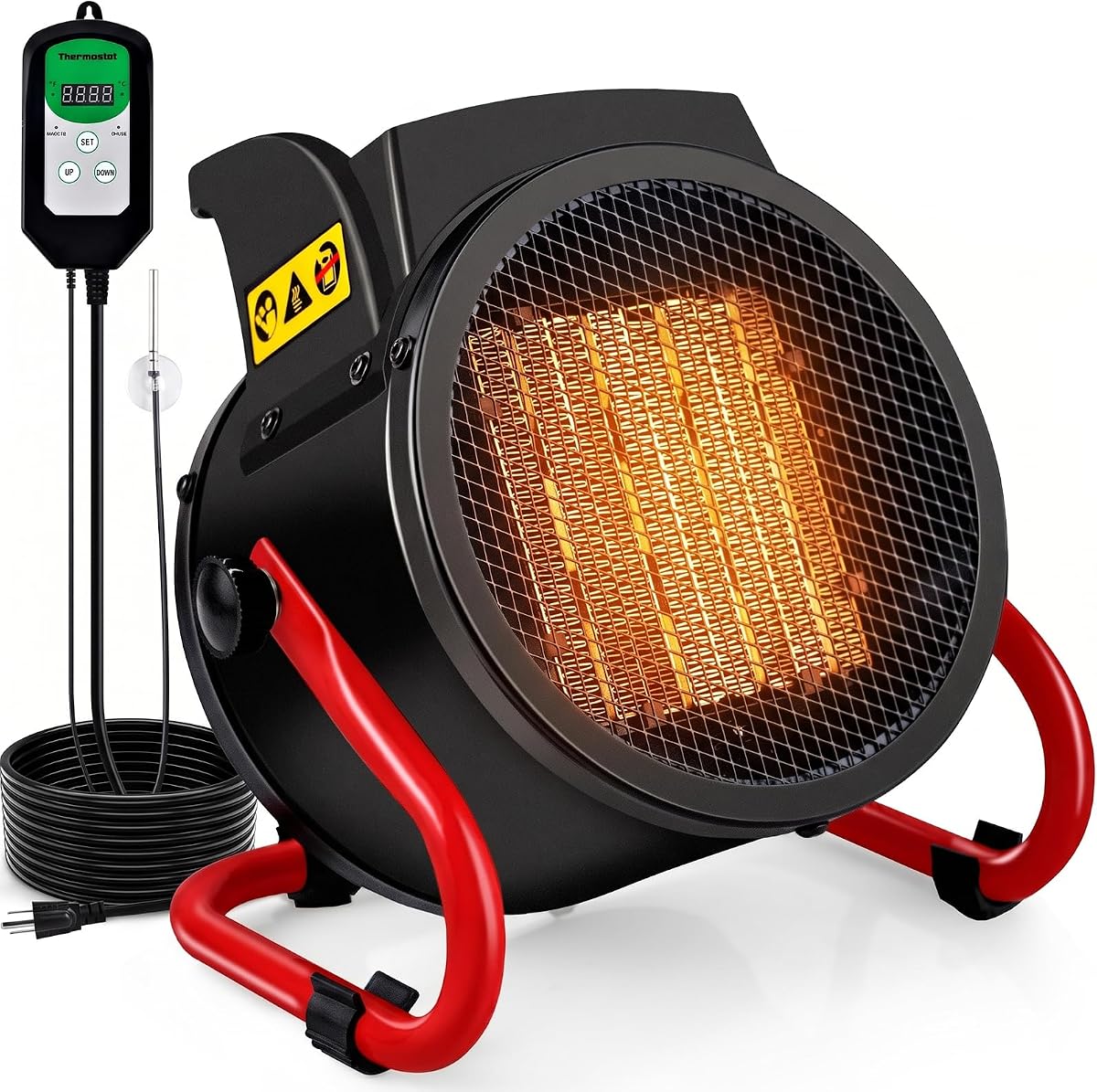
This VEVOR greenhouse heater pairs 1,500-watt PTC heating with an independent thermostat and three speed settings, giving it a 4.2 rating. The listed 6,800 BTU output is among the strongest figures in the group, while hot and cold modes allow the fan to circulate air during warmer periods.
We may earn a commission when you buy through this link, at no additional cost to you.
Its thermostat is designed to monitor conditions and maintain a selected target, which is important for seedling rooms and other spaces where temperature consistency matters. The product also provides overheat protection and an ETL certification, making its safety package more clearly documented than that of many competing heaters.
The main limitation is its IP20 protection rating. IP20 addresses solid foreign-object intrusion but does not offer the splash resistance associated with IPX4 or IPX5. Because a greenhouse can become wet through irrigation or condensation, this model is better suited to a protected, drier corner than an area exposed to routine watering.
The heater is still a compelling option for plant tents, flower rooms, chick brooding areas, workshops, and drying spaces. Its portability, low-noise operation, three-speed control, and heating-and-fan versatility make it a flexible choice for users who want more than a basic cold-weather supplement.
The fan-only function makes this more than a seasonal heater. It can support air movement in a plant tent or flower room when warmth is unnecessary but improved circulation would still be helpful.
A separate thermostat can make the target easier to read and adjust than on a unit with basic knobs. Its real-time temperature-monitoring claim also supports more controlled growing conditions.
We may earn a commission when you buy through this link, at no additional cost to you.
The Digital Thermostat Greenhouse Heater combines a 1,500-watt output with an adjustable 41–108°F range and has a 4.8 rating. It offers one of the strongest combinations of straightforward operation, environmental suitability, and customer feedback among the heaters reviewed.
We may earn a commission when you buy through this link, at no additional cost to you.
Its digital thermostat cycles the heater on and off around the selected temperature, reducing the need for constant manual adjustment. The stated coverage of up to 160 square feet makes it suitable for a modest greenhouse, seedling area, or grow tent, while the 41–108°F range addresses many common plant and workspace heating needs.
Safety is a clear strength. The flame-resistant body, automatic overheat shutoff, and IPX4 splash resistance are all appropriate attributes for a humid growing environment. The lack of Wi-Fi or remote control may disappoint technologically minded growers, but the core controls are direct and should be easier to operate without an app.
This heater is a versatile recommendation for anyone seeking automated temperature control without a complicated setup. It can also serve as a grow-tent heater, brooder heater, garage warmer, covered-patio heater, or drying-area heater. For balanced functionality, it is one of the most approachable options in this guide.
The digital thermostat turns the unit on and off according to the chosen setting. This automatic cycling is the main advantage over basic heat-only models, particularly when maintaining a relatively stable growing environment.
The IPX4-rated body is designed to tolerate splashes, which makes the heater a more natural fit for a damp greenhouse than a model with an IP20 rating. It should still be protected from direct rain and heavy irrigation streams.
We may earn a commission when you buy through this link, at no additional cost to you.
The VEVOR Adjustable-Angle Space Heater offers 1,500 watts of heating, a thermostat, fan mode, and a 25-degree tilting base. Its 3.9 rating places it near the lower end of the group, but the physical design remains useful for growers who need to redirect heat toward a particular part of a grow tent.
We may earn a commission when you buy through this link, at no additional cost to you.
A larger air outlet is intended to spread warmth over a wider area, while the flame-retardant polypropylene housing and automatic overheat shutoff provide basic safety protections. The IPX4 rating also makes it better suited to occasional splashes than heaters carrying only an IP20 designation.
Compared with the digital thermostat models, its controls are less advanced. It offers two temperature settings rather than a fine, continuously adjustable digital range, so it is best suited to users who need straightforward warming rather than tightly controlled propagation schedules. The 3.9 rating also suggests more mixed customer experiences.
This heater makes the most sense for a flower room, grow tent, home office, or workshop where portability and adjustable direction matter more than sophisticated automation. It can provide useful supplemental heat and summer air movement, but growers seeking precise remote climate management should favor a digital or Wi-Fi model.
The 25-degree adjustment lets the user aim the outlet toward a propagation bench, plant cluster, or work surface. That targeted positioning can be more useful in an irregularly shaped greenhouse than a fixed-orientation heater.
A built-in handle, lightweight format, and stable grippy base make the unit easy to carry between a greenhouse, flower room, or office. Its uncomplicated controls also reduce the learning curve for first-time users.
We may earn a commission when you buy through this link, at no additional cost to you.
This green 1,500-watt greenhouse heater uses PTC ceramic heating and a digital thermostat, earning a 4.6 rating. Its three power settings—20 watts for standby or fan-only operation, 750 watts for gentler heat, and 1,500 watts for stronger warming—give it one of the clearest power-level selections in the guide.
We may earn a commission when you buy through this link, at no additional cost to you.
The thermostat operates from 41–108°F and automatically cycles the heater to stabilize ambient temperature. Its stated 5,120 BTU capacity and coverage of up to 160 square feet make it appropriate for greenhouses, indoor gardens, grow tents, workshops, garages, covered patios, and spaces housing plants or reptiles.
Its safety features include an IPX4 water-resistant enclosure and automatic overheat protection, both appropriate for humid conditions. A limitation is that the information does not mention a formal electrical certification such as ETL or UL. Buyers who place particular importance on independent certification may wish to verify the current documentation.
The heater is a strong all-around choice for a grower who wants three heat levels, digital temperature control, and fan-only operation in a compact unit. It does not offer remote monitoring, but its automatic cycling should reduce the need to supervise the target temperature continuously.
The 20-watt, 750-watt, and 1,500-watt settings let the user match output to conditions. This is helpful during mild weather or when full power is unnecessary, while the top level provides stronger heat for colder spaces.
PTC ceramic heating operates without oxygen consumption and does not create combustion gases. The heater can therefore support routine warming without the venting requirements associated with fuel-burning patio heaters.
We may earn a commission when you buy through this link, at no additional cost to you.
This fast-heating greenhouse heater has a 4.4 rating and an IPX5 waterproof rating, making its environmental protection one of its most persuasive features. The 1,500-watt PTC ceramic element pairs with an integrated fan, and an independent digital thermostat switches the heater on and off around the chosen temperature.
We may earn a commission when you buy through this link, at no additional cost to you.
Three power levels—20, 750, and 1,500 watts—cover fan-only or standby use, moderate warming, and stronger heating. Stated coverage reaches 120 square feet, which is adequate for a compact grow tent, flower room, garage, workshop, or covered patio. The thickened power cord is also listed as a support for prolonged operation.
Its IPX5 performance should not be interpreted as permission to leave the heater fully exposed to every weather condition. Nevertheless, it offers stronger stated protection against water than the IPX4 and IP20 alternatives in this guide. The flame-retardant materials and dedicated overheat protection add further reassurance.
This model is a good fit for users who prioritize moisture resistance, simple three-level power, and automatic temperature control without needing an app. Its 120-square-foot coverage is the main constraint, so it is less appropriate for a large greenhouse or an open workspace without supplemental heating.
The IPX5 rating distinguishes this heater from models limited to IPX4 or IP20 protection. That makes it a compelling option in a greenhouse where condensation, dampness, or occasional irrigation spray is likely.
The 20-watt setting supports low-output or fan-only operation, while the two higher settings provide progressively stronger warmth. This flexibility helps the heater avoid unnecessary full-power operation when the room is only mildly cold.
We may earn a commission when you buy through this link, at no additional cost to you.
The SEEYANG-branded heater in the supplied listing combines 1,500-watt heating, a digital thermostat, and a waterproof external temperature probe. Its 5.0 rating is the highest in the guide, and its claimed coverage of up to 200 square feet is also the broadest among the reviewed models.
We may earn a commission when you buy through this link, at no additional cost to you.
The probe is a meaningful control upgrade because it can sense air temperature away from the heater's immediate outlet area. Users can place it near plants, equipment, or a work zone where representative readings matter. A 40–108°F adjustable range and automatic power control support both greenhouse and workshop applications.
Safety features include flame-retardant materials, automatic overheat shutdown, and a restart function after cooling. The stainless-steel shell, non-slip base, and 7.5-foot power cord also support dependable placement, though the operating modes are limited to a 25-watt pure fan setting and 1,500-watt heating.
This is an attractive recommendation for a medium greenhouse where broader coverage is the priority. It is particularly useful for users who want a remote probe without committing to Wi-Fi. The lack of intermediate power levels and a remote-control option means it is less flexible than several digital models in the guide.
The waterproof probe can monitor the temperature that matters to the user rather than only measuring the hottest air directly beside the heater. Its placement can therefore be tailored to a plant bench, equipment area, or other important location.
A stated capacity of 200 square feet gives this model an advantage in medium-sized greenhouses. It may also serve garages and workshops where the heater is placed away from the work area.
We may earn a commission when you buy through this link, at no additional cost to you.
This automatic power-control heater includes a digital thermostat with a temperature display, giving users a clear view of the selected condition. It produces 1,500 watts of heat, covers up to 120 square feet, and has a 4.7 rating, placing it among the strongest models in the roundup.
We may earn a commission when you buy through this link, at no additional cost to you.
The thermostat monitors temperature and switches the heater on and off at the target setting. The heater's stated three-second warm-up claim is useful during sudden temperature changes, while adjustable temperature and wind-speed settings offer more control than a simple two-position unit.
Safety features include fireproof materials and independent overheat protection. The included controller is rated for 15 amps, which is designed for reliable operation with the heater. However, the product information does not state an IPX water-resistance rating, so placement in a very damp greenhouse requires more care.
The heater is well suited to greenhouses, grow tents, garages, kitchens, living rooms, workshops, and basements, as well as patios. It is a strong choice for users who value a visible digital display and automatic operation without the complexity or network dependence of a Wi-Fi system.
The digital display makes the target easier to inspect than a mechanical dial. That convenience is valuable when the heater is positioned across a greenhouse rather than directly beside the user.
Ventilation settings provide useful warm-season flexibility. The fan can move air when additional heating is unnecessary, helping the same unit serve a greenhouse throughout more of the year.
We may earn a commission when you buy through this link, at no additional cost to you.
The VEVOR 1500W PTC heater is a compact, portable option for small grow tents, flower rooms, workplaces, brooders, and drying areas. It carries a 4.4 rating and relies on a three-level speed knob rather than a digital thermostat, making it one of the more mechanically straightforward heaters in the guide.
We may earn a commission when you buy through this link, at no additional cost to you.
Its PTC element is described as heating within three seconds, and the unit produces 5,100 BTU. Heating and ventilation modes extend its usefulness beyond winter, while the 25-degree tilting base and portable handle allow the user to redirect or relocate it as needed.
The alloy-steel body, overheat protection, and ETL certification are useful selling points. However, its IP20 rating does not provide the splash resistance found on several IPX4 or IPX5 competitors. In a humid greenhouse, it should be placed where it will not receive irrigation water or condensation-driven dampness.
This model is best for a small space or a user who values a low-complexity heater that moves easily. It weighs less than five pounds and has a stable anti-slip base, but those same basic characteristics explain why it lacks the digital temperature automation available in higher-ranked alternatives.
PTC technology provides rapid heat, while the sub-five-pound weight makes the unit easy to reposition. This combination suits temporary warming stations and small areas that change throughout the growing season.
The three-level knob gives direct control without requiring an app or digital interface. It is a practical option for users who prefer uncomplicated settings and want the heater to operate without programming.
We may earn a commission when you buy through this link, at no additional cost to you.
The Pasapair WiFi PTC Heater is the most feature-rich model in this guide, combining 1,500-watt heating with Smart Life app control, an external probe, a wired digital thermostat, a remote control, and a seven-day schedule. Its 4.9 rating is the second highest among the ten products.
We may earn a commission when you buy through this link, at no additional cost to you.
Remote operation allows the grower to monitor real-time probe temperature, change targets, switch modes, and turn the heater on or off. The schedule can distinguish daytime, nighttime, work, and plant-growth periods, while a 24-hour countdown provides an additional automatic shutoff option.
The external probe is a major advantage over heaters that sense only the air immediately around the unit. It can sit near plants, equipment, or a work area for a more representative reading. The heater also offers Eco, Fan Only, Low, and High modes, a 90-degree tilting body, and overheat shutdown at 167°F.
Its advanced features carry some trade-offs. Smart Life control requires a 2.4 GHz Wi-Fi network and does not support 5 GHz Wi-Fi. The heater should also be placed on a level surface away from flammable materials, rain, and direct water exposure. For users comfortable with smart-home setup, it offers the most sophisticated control package in the roundup.
The seven-day routine can assign different temperatures to daytime, nighttime, work, and growth stages. This automation reduces daily manual intervention and makes it easier to maintain a planned temperature rhythm.
The onboard panel, included remote, wired digital thermostat, and Smart Life app provide several ways to operate the heater. That redundancy is useful when a phone is unavailable or when quick local adjustments are needed.
The wired probe can be positioned where temperature accuracy is most important, such as near seedlings or sensitive equipment. The clear display reports probe temperature and operating status, helping the user confirm that the selected target is being maintained.
We may earn a commission when you buy through this link, at no additional cost to you.
Choosing a greenhouse heater involves balancing heat capacity, control accuracy, moisture exposure, safety, and the physical needs of the growing area. The most important starting point is the size and conditions of the space rather than the largest advertised wattage.
A heater's stated area provides a useful starting point, but it should not be treated as a guarantee for every structure. Greenhouses lose heat through glazing, walls, doors, and ventilation, while drafts and unusually cold weather can increase demand. Models in this guide cover approximately 120 to 200 square feet, with outputs ranging from 5,100 to 6,800 BTU.
Choose a model whose stated coverage comfortably exceeds the area you intend to warm. That margin provides more flexibility if the greenhouse is poorly insulated, frequently opened, or used for sensitive seedlings. Match the heater to the space rather than assuming a higher wattage always creates better growing conditions.
A thermostat determines how consistently the heater maintains its target. Digital controls provide easier setpoint adjustment and can show the current temperature, while independent controllers may allow the probe to be positioned away from the unit. Units with automatic cycling can also avoid leaving the heater on continuously once the target is reached.
For valuable or temperature-sensitive plants, prioritize precise digital control, automatic switching, and a probe that can measure near the growing area. Basic knob-based models are simpler and may be adequate for occasional supplemental warmth or less demanding workspaces.
Greenhouse environments are commonly damp, and irrigation can create splash exposure. IPX4 and IPX5 models provide stronger stated protection against water than IP20 units, which are primarily protected against solid foreign objects. Higher ratings do not make any heater suitable for direct rain or heavy water exposure, however.
Position the heater above splash zones and away from watering lines where possible. Even an IPX5 model should be protected from severe weather and never placed where it can be submerged. In a very dry greenhouse or enclosed workshop, an IP20 model may still be sufficient.
Automatic overheat protection is one of the most important safety features for a portable electric heater. Flame-retardant materials, stable bases, properly rated power cords, and relevant certifications such as ETL or UL add further protection. A thermostat controller with an appropriate amperage rating is important when it controls a 1,500-watt device.
Look for a heater with a stable base and multiple thermal safeguards, then inspect the power cord and plug for damage. Never use a heater with a compromised electrical connection, and keep it away from flammable materials, plant debris, and direct water exposure.
A dedicated fan can prevent warm air from collecting near the roof and can improve circulation around plants. Models with 20- or 25-watt fan-only settings, adjustable fan speed, or ventilation modes can therefore be useful outside the coldest months. Some heaters also offer intermediate 750-watt heating levels for milder conditions.
Choose a model with a fan if the greenhouse is enclosed, densely planted, or prone to stagnant air. Extra fan settings add convenience, but heater buyers should still prioritize thermostat accuracy, safety, and suitable environmental protection if those are more important to the growing setup.
Wi-Fi control can be valuable when a grower cannot remain beside the greenhouse or wants different temperatures during day and night. App scheduling, remote shutdown, and status monitoring are particularly helpful for propagation rooms, workshops, and spaces that need warming before arrival.
Remote features are optional rather than essential. They introduce network requirements and a more complex setup. Check the supported Wi-Fi band before purchasing, and make sure the product retains local controls so the heater can still be adjusted if the network or phone is unavailable.
A heater's onboard sensor measures conditions close to the unit, which may not represent the plants, tools, or equipment farther away. A wired external probe can be placed near a plant bench, floor, or equipment area to provide a more useful reading for climate decisions.
A probe is especially valuable in larger or irregularly shaped spaces. Place it where you actually need the temperature measured, not directly in front of the outlet. Follow the manufacturer's placement guidance and protect the wire from moisture, abrasion, and accidental damage.
Portable heaters are valuable when seasonal conditions change or when several spaces share one heating unit. A carry handle, stable base, and tilting body make the heater easier to move and aim. Models weighing around four pounds may be especially convenient for frequent repositioning.
Prioritize a stable base and a direction that matches the target area. Portability is less helpful if the heater must be moved constantly to keep it out of splashes, so plan its location before running it at high output for extended periods.
Before using the heater, read the supplied instructions and inspect the unit, plug, cord, and thermostat. Place it on a stable, level surface with its outlet directed toward the area that needs warmth. Keep it away from flammable materials, plant debris, irrigation lines, doors that may swing into it, and direct water exposure.
Set the thermostat to the required temperature and choose an appropriate heating or fan mode. When using an external probe, position it near the plants or equipment whose conditions matter most. For scheduled or remote operation, connect the device to the required network and confirm the program before leaving it to run unattended.
During routine care, unplug the heater and let it cool before cleaning. Wipe the housing and air openings with a dry or slightly damp cloth as directed, and keep the vents free from dust, leaves, and insects. Inspect the cord regularly, remove the heater from wet areas during watering, and allow damaged components to be professionally evaluated before reuse.
Choose a heater whose stated area coverage comfortably exceeds the greenhouse's usable floor area. Many of the reviewed models list coverage around 120 square feet, while broader models reach 200 square feet. Insulation, drafts, door use, and local winter conditions can increase the heat required, so a modest margin is sensible.
Yes, many of the reviewed heaters are specifically suitable for grow tents and seedling rooms. Choose a model with an appropriate area rating, stable base, and power cord long enough to reach a safe outlet. Allow adequate ventilation and follow the tent manufacturer's safety guidance.
IPX4 indicates resistance to splashing water, making it more appropriate for a damp greenhouse than an IP20 model. It does not mean the heater can be soaked, left in direct rain, or placed under a watering stream. Position it away from irrigation and follow the manufacturer's placement instructions.
A thermostat is highly useful because it turns the heater on and off around a selected temperature rather than requiring continuous supervision. Digital or probe-based controls can be especially useful for sensitive seedlings and variable conditions. Basic knob models are simpler, but they may provide less precise temperature management.
Many models include a fan-only or ventilation mode in addition to heating. This can help distribute air and reduce warm-air buildup near the roof. A dedicated fan is especially useful in enclosed or densely planted greenhouses where stagnant air can affect plant conditions.
Both ratings indicate a higher level of water protection than IP20, but IPX5 represents stronger stated resistance to water jets. Neither rating makes direct rain or deliberate water exposure appropriate. The heater should still be placed on a stable surface, protected from heavy moisture, and handled according to its instructions.
Wi-Fi is not necessary for basic heating, but it can improve monitoring, scheduling, and remote adjustment. It is useful when the grower is away during cold periods or wants different daytime and nighttime temperatures. Check that the app and phone are compatible and that the heater supports the available 2.4 GHz network when applicable.
Place the heater on a level, stable surface near the area that needs heat, while keeping it clear of plants, paper, chemicals, extension cords, and other flammable materials. Aim the outlet toward the intended area, avoid direct irrigation, and do not block the intake or exhaust openings.
The Digital Thermostat Greenhouse Heater offers the strongest overall balance of digital control, splash resistance, automatic cycling, and strong customer feedback. The VEVOR 1500W PTC Heater is a more compact, mechanically simple option for small spaces, while the Pasapair WiFi PTC Heater stands apart for external probe monitoring, app control, and seven-day scheduling.
Prioritize the conditions of your space: stable temperature for seedlings, air movement in a crowded greenhouse, moisture resistance near irrigation, or remote management in an unattended area. Also consider the area coverage, power-cord length, controls, and safety protections, and avoid choosing solely by advertised wattage.
Product specifications, availability, and prices can change over time, so verify the current Amazon listing and manufacturer guidance before purchasing. Comparing the heater's protection rating, thermostat design, and intended area with your actual greenhouse needs will lead to the most practical choice.