
M-AUDIO M-Track Duo
4.4Editor score
Two combo XLR instrument inputs
Direct zero-latency monitoring
Portable USB desktop design
Compare the best Guitar to Mac Interfaces for clean recording, flexible monitoring, guitar-friendly inputs, and dependable Mac connectivity in this practical
A Guitar to Mac interface turns an instrument into a dependable recording source for a Mac-based studio. The right model should capture clean guitar tones, offer usable monitoring, connect without unnecessary setup, and provide enough gain and headroom for your playing style and recording chain.
We compared all 10 products using the supplied specifications, focusing on instrument inputs, Mac and USB-C compatibility, monitoring options, converter resolution, preamp performance, bundled software, portability, and direct-versus-software monitoring. The list includes desktop and mobile-friendly designs across several project types and budgets.
The selections show which interfaces suit focused home recording, mobile practice, amp-capture workflows, podcasting, and more advanced studio setups. Product ratings and technical details reflect the information available in November 2026, while prices and availability can change, so check the current listing before buying.
4.4Editor score
4.6Editor score
4.4Editor score
This side-by-side comparison highlights each interface's strongest characteristics, including guitar input support, Mac connectivity, monitoring methods, recording resolution, and workflow flexibility.



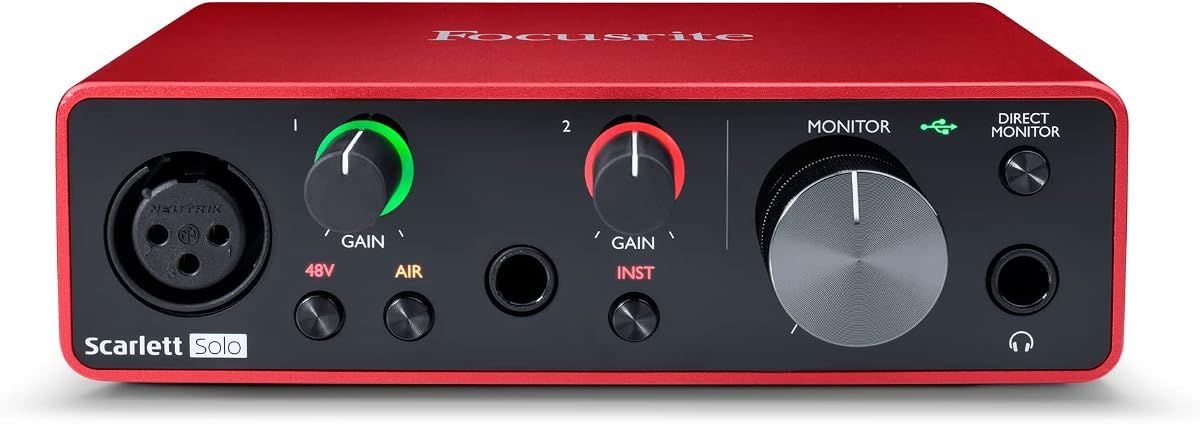
The Focusrite Scarlett Solo 3rd Gen is a strong all-around choice for recording a guitar directly into a Mac. Its supplied rating is 4.6, and the specification set balances two instrument-capable inputs, high-performance conversion, flexible output connections, and a polished home-studio feature set. It is particularly appealing when the plan is to capture a guitar and another source without moving to a larger interface.
We may earn a commission when you buy through this link, at no additional cost to you.
Two high-headroom instrument inputs are the standout feature for players. They allow a guitar or bass to be connected directly, while the Gain Halos help the user see when levels are approaching a problematic range. The switchable Air mode adds brightness and clarity that can benefit quieter acoustic instruments. For digital recording, the stated 24-bit/192kHz converters provide ample resolution for polished takes, and the pair of low-noise balanced outputs supports clean playback through studio monitors.
The tradeoff is that this is still a compact Solo interface rather than a multichannel production console. Its two-input arrangement may eventually feel limited if you plan to record guitar, vocals, drums, and an external audio source simultaneously. Air mode is also a deliberate tonal choice rather than a universally neutral setting, and users who want perfectly flat captures can leave it off. Neither issue is a serious flaw for a typical guitar-centered home studio.
This interface is a particularly good recommendation for a Mac owner who wants one box to handle direct guitar recording, vocals, and everyday monitoring. The included Pro Tools Intro+, Ableton Live Lite, Cubase LE, and Hitmaker Expansion also provide several paths into music production. Choose the Scarlett Solo 3rd Gen when flexible instrument inputs, clean conversion, useful software, and a proven home-studio format matter more than maximum channel count.
The high-headroom instrument inputs are designed to accommodate guitar or bass sources without forcing the recording chain into distortion. Air mode adds clarity to acoustic recordings, while the Gain Halos provide a quick visual indication of signal level.
The bundled production tools span several popular recording environments. That makes the interface easier to evaluate as a complete starting system rather than as an isolated box requiring immediate additional purchases.
We may earn a commission when you buy through this link, at no additional cost to you.
The M-AUDIO M-Track Duo is a value-focused desktop interface with enough flexibility to handle more than just a single guitar. Its supplied rating is 4.4, and the most useful feature for guitarists is the pair of combo XLR, line, and instrument inputs. That makes it possible to record an amplified guitar through an amplifier or pedal rig while also capturing vocals or a second instrument.
We may earn a commission when you buy through this link, at no additional cost to you.
The USB/Direct switch is a practical feature for a laptop-based workflow. It provides a path to zero-latency monitoring, letting the player hear the incoming signal while recording instead of waiting on software monitoring. Headphone and stereo 1/4-inch outputs give the user some control over the monitoring setup, while phantom power expands the range of compatible condenser microphones for vocal or acoustic recording.
Its main limitation is the stated 48kHz resolution, which is lower than the 96kHz offered by the iRig HD 2 and the 192kHz capabilities of several desktop choices. The Duo also lacks the larger channel counts, digital expansion, and extensive control features found in professional studio models. Those limitations matter when producing demanding album work, but they are less important for lessons, demos, podcasts, and straightforward home recordings.
The M-Track Duo is a strong pick for a budget-conscious Mac musician who wants more than a single-input guitar adapter. It provides a practical way to connect an instrument, microphone, and another source while retaining direct monitoring. The included MPC Beats software gives new users essential production tools, making this an accessible option for building a home-studio workflow without committing to a complex interface.
The two combo inputs accept instrument, line, or microphone signals. This versatility supports a compact setup in which a guitar is recorded alongside vocals or another instrument without moving to a larger desktop interface.
The USB/Direct switch gives performers a straightforward route to direct monitoring. It is especially useful for tracking guitar parts where immediate feedback makes playing and overdubbing more comfortable.
We may earn a commission when you buy through this link, at no additional cost to you.
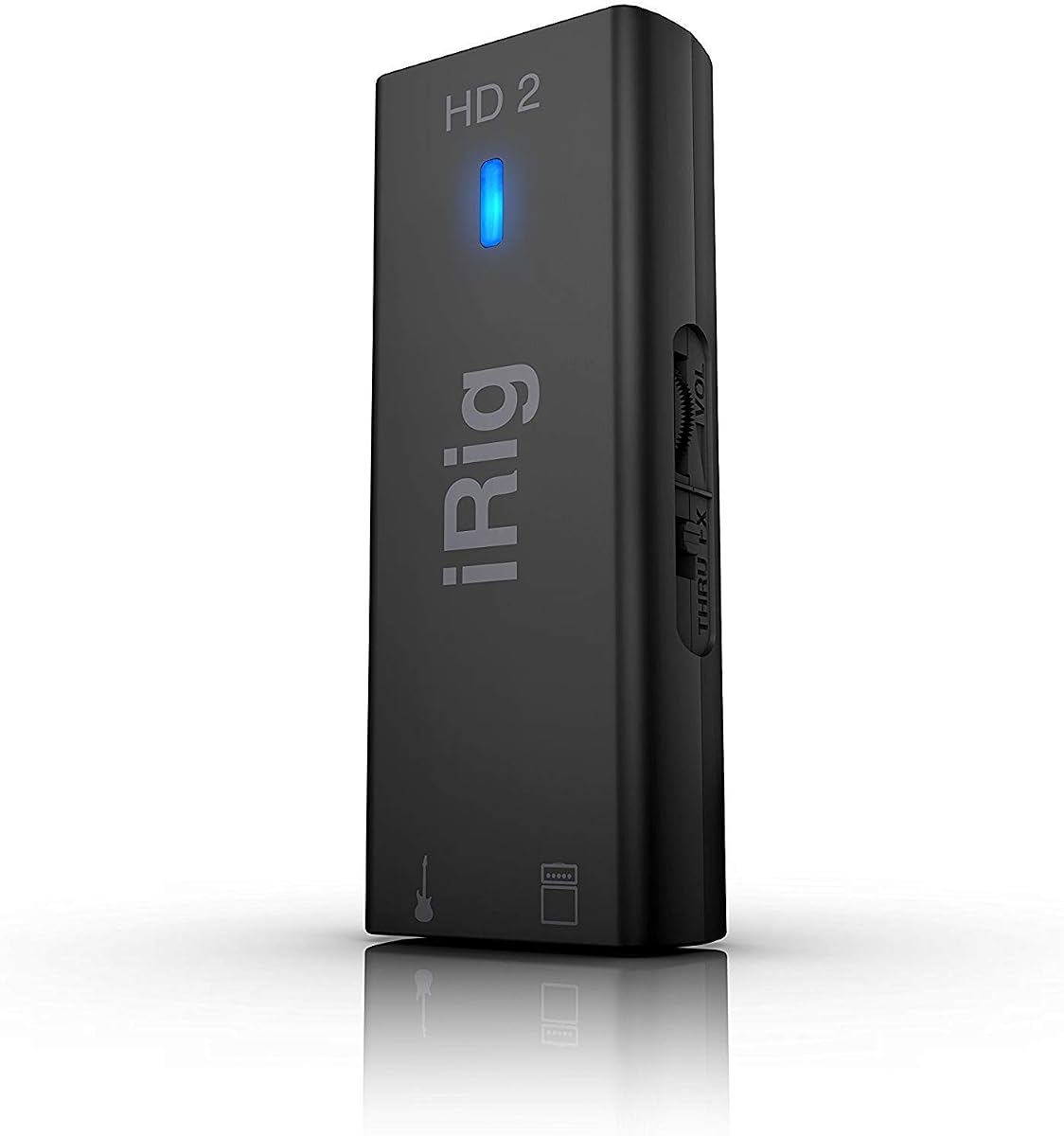
The IK Multimedia iRig HD 2 is the most mobile guitar-focused option in the list while still delivering a useful feature set for Mac recording. Its supplied rating is 4.4. The interface supports iPhone, iPad, Mac, iOS, and PC, includes USB-C, Lightning, and USB cables, and can sit beside a laptop or travel in a small bag without becoming a burden.
We may earn a commission when you buy through this link, at no additional cost to you.
Its instrument-level 1/4-inch Hi-Z input is the main attraction for guitarists. An adjustable input preamp gives players direct control over the incoming level, while the stated 24-bit/96kHz recording capability provides higher resolution than many entry interfaces. The headphone output includes its own preamp and level control, making silent practice and mobile recording more convenient without depending entirely on the connected device's audio controls.
The Amp Out jack adds flexibility for users who want to connect to an amplifier, pedal rig, or line-level equipment. Its switchable FX and Thru settings can support both processed and direct signals. Although the product is optimized around guitar, the line-level option broadens its usefulness. The limitation is that it is not a general-purpose two-channel desktop interface: recording a guitar and microphone at the same time will require a different solution.
This is an excellent recommendation for a guitarist who records across a Mac, tablet, or phone and values portability. It is also appealing for silent practice, mobile riff capture, and traveling between rehearsal spaces. The iRig HD 2 fits best when one guitar at a time is the priority. Users building a wider recording desk with multiple simultaneous sources should focus on the larger combo-input interfaces in this guide.
Mac, iOS, and PC support broaden the possible uses of the same interface. The included cable options also reduce the need to identify a compatible connection before a rehearsal or recording session.
The 96kHz recording specification and guitar-level preamp make the interface useful for more than casual note capture. It suits players who want detailed direct recordings while working away from a permanent studio desk.
We may earn a commission when you buy through this link, at no additional cost to you.
The JOYO MOMIX CAB is a highly compact direct-monitoring adapter for a guitar, phone, or connected Mac workflow. It has a supplied rating of 4.2 and distinguishes itself with a clip-on housing, a 6.35mm guitar input, a 3.5mm headphone output, and included USB-C and Lightning connectivity. The goal is straightforward: record a clean guitar signal while hearing it without software latency.
We may earn a commission when you buy through this link, at no additional cost to you.
Direct monitoring is the central feature. The clean guitar signal passes to the headphones while also going to the connected device for recording, which can be useful for dry guitar takes, backing-track practice, and live performance video. The signal indicator changes from green to red when the input is too hot, giving a player immediate guidance about reducing the guitar volume.
It does not support real-time software amplifier simulation or effects processing, and the dry signal cannot be muted in the headphones. Those are meaningful limitations for a Mac user expecting amp-model plugins. Android compatibility is also conditional because OTG must be enabled, while the supplied information notes that compatibility varies by device. The instruction to use the included USB-C cable adds another compatibility variable with third-party cables.
The MOMIX CAB suits a guitarist who wants a pocket-sized box for song ideas, rehearsal capture, or mobile recording. It can also connect to a Mac for basic direct recording, although its broader identity is a phone-first adapter. Choose it only when an unprocessed guitar signal and minimal setup are more important than software effects, flexible input routing, or a full desktop control surface.
The interface carries the guitar's direct signal to the headphone output while sending it to the connected device. This makes it practical for dry tracking, practice, and performance-oriented mobile capture.
No charging, batteries, drivers, or software installation are required. The clip-on format can be attached to a pocket, belt, or guitar strap for very compact use.
We may earn a commission when you buy through this link, at no additional cost to you.
The PIYONE Q28 combines a two-input desktop layout with class-compliant USB-C connectivity and a stated 24-bit/192kHz conversion specification. Its supplied rating is 4.4. For guitarists who want high-resolution capture and more than one input, it offers a useful middle ground between simple mobile adapters and larger professional interfaces.
We may earn a commission when you buy through this link, at no additional cost to you.
The two XLR/TRS combo inputs provide flexibility for an instrument cable, line-level source, or microphone. One input can handle a guitar through its Hi-Z capability, while the second can accept a vocal or another source. Integrated 48V phantom power supports compatible condenser microphones, and the illuminated gain rings make the control panel easier to read in a dim workspace.
Direct monitoring is included, as is a monitor mix or loopback function for routing playback into software. The USB-C connection handles data and bus power, so an external power supply is unnecessary. A 3.5mm headphone connection adds convenience, although users with a more serious monitoring system may eventually want larger, more balanced outputs. As a relatively new model, it also has less established long-term user history than several older selections.
The Q28 is best for a Mac user who wants two sources, high-resolution conversion, and straightforward direct monitoring without moving into a large professional interface. It also suits mobile creators because the product information identifies iOS support. Buyers should check the latest software compatibility and current user feedback, particularly if they depend on a specific recording application or unusual peripheral configuration.
The advertised 192kHz conversion sets a useful technical ceiling for projects that benefit from high-resolution capture. Actual results still depend on the recording application, Mac, and workflow.
The class-compliant USB-C connection provides data and power through the same cable. This keeps the setup compact and removes the need for a separate external power supply.
We may earn a commission when you buy through this link, at no additional cost to you.
The Motu M2 is a compact two-channel interface built around high-quality conversion. Its supplied rating is 4.6, and the supplied specifications focus on the ESS Sabre32 DAC, 120 dB dynamic range on outputs, -129 dBu equivalent input noise on microphone inputs, and an ESS-driven headphone output. These figures make it attractive to users who care about preserving subtle dynamics in guitar recordings.
We may earn a commission when you buy through this link, at no additional cost to you.
The converter technology is presented as the same class of technology used in interfaces costing substantially more. For a player, that means monitoring and playback can retain low-level detail, clean transients, and a broad tonal range. The headphone output is also ESS-driven, which helps maintain consistency between recording and private playback rather than relying on a less capable auxiliary output.
The supplied information does not detail every input control, instrument specification, or included application, so the headline conversion performance is the clearest basis for comparison. It is also a two-channel model, making it more appropriate for a focused guitar-plus-microphone setup than for large ensembles or simultaneous tracking of several sources. Buyers who need extensive digital expansion should investigate a model with clearly documented additional I/O.
The Motu M2 is a compelling choice for a Mac guitarist who prioritizes monitoring quality and wants a compact, high-performance interface. It can also serve as a straightforward recording front end for vocals or another instrument. The choice is strongest for projects where clean playback, low noise, and useful dynamic range matter, and where two channels are sufficient for the intended workflow.
The ESS Sabre32 DAC is the defining feature in the supplied specification list. It supports users who want clean monitoring with enough resolution to hear picking dynamics, string noise, and subtle differences between takes.
A measured -129 dBu equivalent input noise and 120 dB output dynamic range point toward a low-noise signal path. Those attributes are useful when recording a quiet acoustic guitar or working with low-level sources.
We may earn a commission when you buy through this link, at no additional cost to you.
The PreSonus Quantum ES 2 is built for musicians who want a polished desktop recording path with a particular emphasis on guitar and bass. Its supplied rating is 4.2. The standout collaboration with Fender engineers produced a dedicated instrument input, while the wider interface adds MAX-HD preamps, low-latency drivers, Auto Gain, mobile control, and a perpetual Studio One Pro license.
We may earn a commission when you buy through this link, at no additional cost to you.
The instrument input is the most relevant detail for a guitarist. It was co-developed with Fender engineers specifically for guitar and bass, signaling careful attention to the impedance, signal behavior, or tonal expectations of electric instruments. The two MAX-HD preamps provide up to 75 dB of gain and are described as transparent, low-noise, and digitally controlled. Auto Gain can set a suitable level for microphones and instruments, reducing the need to adjust gain manually for every take.
The custom low-latency driver is intended to keep monitoring responsive during tracking. Two balanced 1/4-inch TRS outputs and a high-power headphone output support different monitoring arrangements, while LED meters help a solo user keep an eye on levels. The trade-off is that this remains a two-channel interface. It is excellent for a focused recording setup, but it will not cover a fast-expanding project with many simultaneous inputs without additional hardware.
This model is a strong recommendation for a guitarist who wants a high-quality Mac interface and a complete production environment. The included perpetual Studio One Pro license adds significant value for recording, editing, and mixing, while the Universal Control app provides remote access from supported devices. Choose the Quantum ES 2 when a purpose-built instrument input, automatic gain staging, and integrated professional software matter more than minimalism.
Working with Fender engineers gives the instrument path a clear musical focus. That design attention is particularly relevant for players who want reliable behavior without repeatedly hunting for the right interface setting.
The Auto Gain button can set input levels for connected microphones and instruments. This is especially useful for a solo producer who needs to keep attention on performance rather than repeatedly checking preamp gain.
We may earn a commission when you buy through this link, at no additional cost to you.
The Fender Quantum HD 2 is the most expandable interface in the guide and the clearest option for a serious project that may outgrow two channels. Its product information describes an ultrahigh-fidelity 20 x 24 USB-C interface with 32-bit/192kHz converters, MAX-HD mic preamps, front-facing guitar and bass inputs, digital expansion, and multiple workflow features.
We may earn a commission when you buy through this link, at no additional cost to you.
Front-facing instrument inputs are optimized for transparent guitar and bass recording, while Auto Gain helps establish recording levels quickly. The most distinctive feature is the pair of re-amp outputs. These let a player send previously recorded guitar into an amplifier, pedal, or other external gear, making it easier to revisit tone without replacing the original interface in the signal chain.
ADAT and S/PDIF connections add sixteen digital inputs for studio growth. A DSP monitor mixer, loopback routing, a headphone amp, and remote control through Fender Studio Pro or the Universal Control app support monitoring, streaming, and podcast workflows. The included perpetual Fender Studio Pro license adds a full recording, mixing, mastering, and performance suite, while the Fender Amp & FX Pack provides amplifier models and effects.
This is the best choice for a guitarist building a serious, expandable Mac studio. It is overkill for someone who only needs to capture a clean riff into a laptop, but it rewards users who want multichannel recording, external digital sources, amp re-recording, and advanced software integration. No customer rating was supplied for this model, so its inclusion here rests on the documented specifications and workflow rather than a rating comparison.
Twenty-four output channels and ADAT plus S/PDIF expansion create room for a multichannel project. The interface can serve as the center of a desk that grows through external preamps, converters, and digital equipment.
Dual re-amp outputs allow existing guitar tracks to return through an amplifier or pedal rig. This makes it possible to experiment with amp, cabinet, and effects choices after the original performance has been captured.
We may earn a commission when you buy through this link, at no additional cost to you.
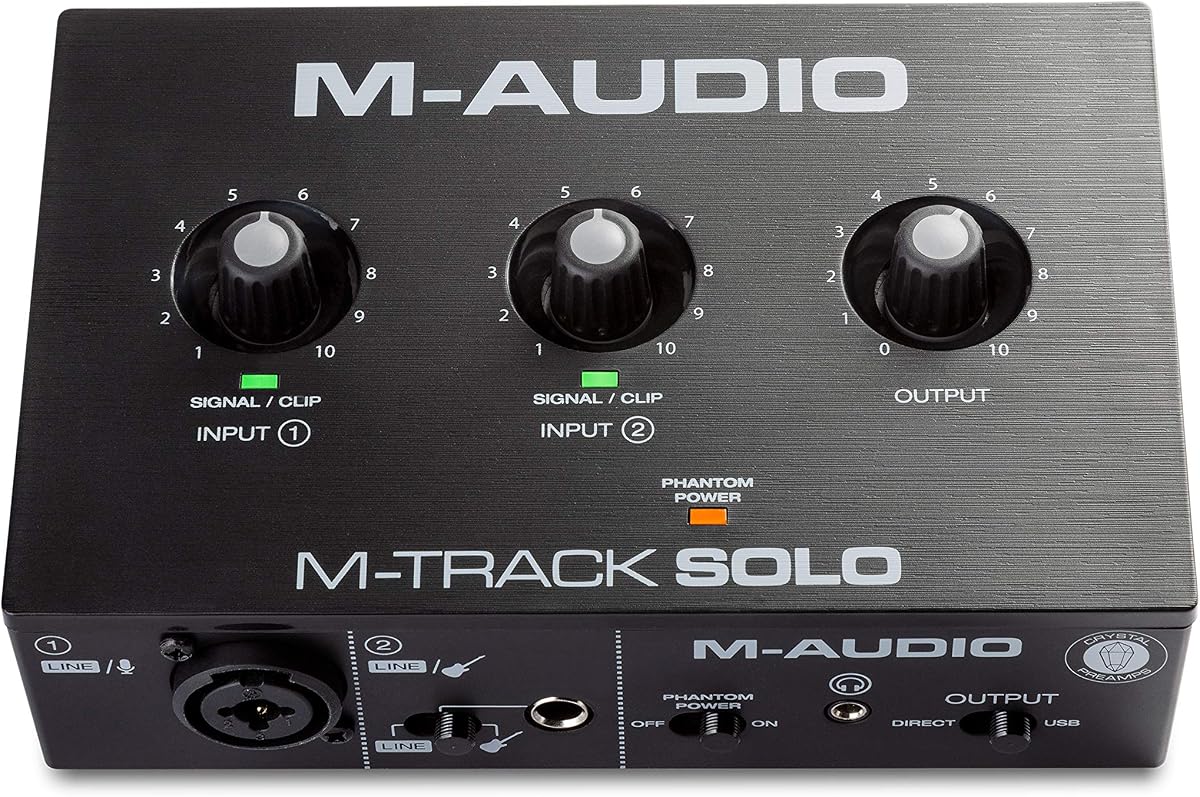
The M-AUDIO M-Track Solo is a straightforward USB interface for recording one guitar, one vocal, or another basic source on a Mac. It has a supplied rating of 4.3 and keeps the signal path understandable: one combo XLR and line input, one line and instrument input, 48kHz recording resolution, and a direct-monitoring switch.
We may earn a commission when you buy through this link, at no additional cost to you.
The dedicated instrument input gives a guitarist an immediate path into the interface. The combo input can accept a microphone, and the supplied phantom-power support broadens compatibility with condenser microphones. A USB/Direct switch enables zero-latency monitoring, while 1/8-inch headphone and stereo RCA outputs provide basic monitoring choices. The result is a functional desktop setup for practice, demos, lessons, and simple recordings.
Compared with the M-Track Duo, the Solo provides fewer simultaneous inputs. It is therefore most appropriate for a musician who records one source at a time rather than a guitar and a vocalist together. The 48kHz resolution also sits below the 96kHz and 192kHz figures offered elsewhere in the guide, and the small headphone connection may eventually seem limiting with professional studio headphones.
The M-Track Solo is a sensible match for a beginner or a guitarist who wants a simple, portable box with direct monitoring and minimal setup. MPC Beats supplies essential production tools for arranging, editing, and learning a basic workflow. It is less suitable for collaborative sessions or projects that require microphone and instrument recording at the same time, but it remains a focused and approachable Mac interface.
The dedicated line and instrument input makes it easy to connect a guitar without routing it through additional hardware. This direct approach suits songwriters who want to capture ideas quickly.
MPC Beats provides essential production tools alongside the hardware. It offers a practical starting point for a new user building a first Mac recording workflow around guitar.
We may earn a commission when you buy through this link, at no additional cost to you.
The IK Multimedia iRig USB is a compact guitar interface designed for straightforward recording with a Mac, PC, or compatible iPad. Its supplied rating is 4.3. It uses a 24-bit/48kHz recording specification, includes a USB-C cable, and provides direct monitoring plus an Amp Out with selectable FX and Thru modes.
We may earn a commission when you buy through this link, at no additional cost to you.
The included connection cable simplifies setup for users with a USB-C computer. Guitarists can record through the interface, monitor silently through headphones, and use the amp output to connect to a pedal rig or amplifier. The FX setting can provide a processed sound, while Thru offers a direct path. This makes the interface more flexible than a recording-only adapter, even though the supplied information does not describe the exact processing options.
The 48kHz resolution is suitable for many practical recording projects but does not match the higher specifications of the iRig HD 2, Q28, Scarlett Solo 3rd Gen, or Quantum HD 2. It also will not work properly with a Lightning cable. The interface is optimized for a single guitar, so a producer recording simultaneous vocals and instruments will need a more conventional two-channel desktop model.
The iRig USB is a good entry point for a guitarist who wants a simple Mac connection, direct practice monitoring, and the option to connect an external rig. Its portability makes it useful for rehearsals and traveling, while bundled recording software and plug-ins provide a starting point for new projects. It is best for focused guitar work rather than a broad, multichannel studio.
The Amp Out can send either an FX-processed or direct Thru signal to an external setup. This lets users choose between a ready-made sound and a clean signal for pedals or amplifiers.
The compact enclosure and included USB-C cable support a mobile guitar-recording setup. It is particularly useful for practices, rehearsals, and recording ideas away from a permanent desk.
We may earn a commission when you buy through this link, at no additional cost to you.
The right Guitar to Mac interface depends on the number of sources, type of recording, monitoring requirements, software, and degree of portability. Use the following factors to narrow the choices before comparing final details.
A guitar interface should provide a proper Hi-Z instrument input with enough gain and headroom for passive and active pickups. The input must be suitable for direct guitar recording, while a clean preamp helps prevent unwanted clipping. Models such as the Focusrite Scarlett Solo 3rd Gen, PreSonus Quantum ES 2, and Fender Quantum HD 2 put particular emphasis on instrument performance, but every shortlisted product includes a route for electric guitar capture.
Most modern Mac-based interfaces use USB-C, but the supplied details reveal important differences in broader support. The iRig HD 2 works with Mac, iOS, and PC and includes several cable types, while the JOYO MOMIX CAB supports a more limited mobile-oriented workflow. Some products advertise iOS support without including every possible connection, so confirm the included cable, connector type, and current operating-system requirements before purchasing.
Resolution can influence the amount of detail retained during capture and the demands placed on the rest of the system. The Q28 and Scarlett Solo 3rd Gen support up to 192kHz, the Quantum HD 2 uses 32-bit/192kHz converters, and the iRig HD 2 reaches 96kHz. The M-AUDIO models and iRig USB operate at 48kHz, which remains perfectly usable for many songs, demos, and podcast projects.
Direct monitoring reduces the delay between playing and hearing the signal, which can help a guitarist perform and overdub with greater comfort. The M-Track Duo, M-Track Solo, and MOTU M2 include a direct or USB monitoring path, while the JOYO MOMIX CAB is built specifically around zero-latency direct monitoring. Software-based effects introduce their own latency, so a hardware direct path is especially useful for players who dislike delayed monitoring.
The number of simultaneous sources should match the intended recording style. One-input devices suit focused guitar work, while two-input interfaces can capture a guitar and microphone together. The Quantum HD 2 goes much further with 20 x 24 channels and ADAT plus S/PDIF expansion. Buying more channels than needed adds complexity, but too few can restrict a project as the number of musicians or sound sources grows.
Balanced outputs are valuable for connecting studio monitors through a balanced signal path, while headphone output is essential for tracking without disturbing others. The Scarlett Solo includes low-noise balanced outputs, the Quantum ES 2 provides balanced 1/4-inch TRS outputs and a high-power headphone output, and the MOTU M2 uses an ESS-driven headphone stage. Smaller adapters often rely on 3.5mm or 1/8-inch connections, which can be less convenient with studio equipment.
The included software can determine how quickly the hardware becomes useful. The Scarlett Solo offers Pro Tools Intro+, Ableton Live Lite, Cubase LE, and Hitmaker Expansion; the Quantum ES 2 includes Studio One Pro; and the Quantum HD 2 includes Fender Studio Pro plus an amp and effects pack. Some basic guitar adapters deliberately avoid real-time effects, so decide whether software modeling is central to the intended recording process.
A permanently installed studio can favor a full desktop interface with balanced outputs and multiple controls. A traveling guitarist may prefer the iRig HD 2 or iRig USB, while the MOMIX CAB is even smaller and designed to clip onto clothing or a strap. Consider not only the interface's size but also cable bulk, power requirements, mounting options, and whether the controls remain easy to use in a rehearsal environment.
Begin by confirming that the interface is compatible with the Mac and recording application. Connect the supplied or approved cable, install any required driver or control software, and choose the interface as the system input and output. Attach the guitar through its instrument input, reduce the guitar and interface gain before making a sound, and raise levels gradually while watching meters and the signal indicator.
For the cleanest direct recording, use a standard instrument cable, unplug other devices, and avoid placing the interface beside a noisy power supply or high-output speaker. If using direct monitoring, listen for feedback or an unexpectedly hot signal before enabling software effects. When monitoring through software instead, record a short test and check the reported latency so the timing remains comfortable.
To protect the hardware, unplug the guitar and headphones before moving the interface, and do not leave a connection strained by a dangling cable. Keep the input free of moisture and dust, avoid using incompatible third-party cables, and follow the manufacturer's setup instructions. Save the working signal chain, keep a copy of the project, and update the relevant Mac software or firmware when a reliable version is available.
The best choice depends on the recording situation rather than one universal model. The Scarlett Solo 3rd Gen is a versatile all-around option, the M-Track Duo provides two inputs at a value-focused level, and the iRig HD 2 is ideal when portability and cross-device use matter. Consider input count, monitoring, bundled software, and whether you need to record vocals at the same time.
A guitar-specific input is strongly recommended because it provides the appropriate Hi-Z impedance and gain behavior for instrument-level signals. Many general audio interfaces include an instrument-capable combo or TRS input that works perfectly well. The main difference is the focus of the controls, software, and workflow rather than a requirement to own a box branded exclusively for guitar.
Yes, but the interface needs at least one input for the guitar and another for the microphone. The M-Track Duo, Q28, Scarlett Solo 3rd Gen, Quantum ES 2, and MOTU M2 are all two-channel options, although the exact input arrangement varies. One-input adapters and single-instrument interfaces are better suited to recording one source at a time.
Direct monitoring sends the incoming guitar signal to the headphones without waiting for it to travel through the recording software. This reduces perceived delay and can make practice and overdubbing feel more natural. Some interfaces blend direct and software playback, so check the control labels to understand exactly what the monitoring mode contains.
A 48kHz interface is suitable for many guitar recordings, podcasts, and demos, while 96kHz or 192kHz specifications can be beneficial for detailed work and high-resolution production. Higher settings may consume more storage and processing power, so they do not automatically produce a better finished song. The musical performance, microphone choice, room, and signal chain are more important to final quality.
Yes, provided the interface supports the necessary low-latency monitoring and the recording application includes compatible amp software. The iRig HD 2, iRig USB, Quantum HD 2, and bundled software with the Scarlett Solo support relevant creative workflows. The JOYO MOMIX CAB is different because it provides direct monitoring and explicitly does not support real-time software amp simulation or effects.
Most models in the guide directly support modern USB-C connections, including the Scarlett Solo 3rd Gen, M-Track Duo, MOTU M2, Quantum ES 2, Quantum HD 2, and iRig USB. The iRig HD 2 includes USB-C among several supplied connections. For adapters with narrower compatibility, use the included cable and confirm that the connected device and recording application support the required data protocol.
Start with the guitar volume and interface gain low, then raise them gradually while watching recording meters and any signal indicator. Keep the guitar cable intact, use a proper instrument input, and avoid boosting the recording software heavily if the captured file already clips. Balanced outputs and clean gain staging also help maintain a noise-free monitoring path.
The Focusrite Scarlett Solo 3rd Gen is the strongest all-around selection, combining two instrument-capable inputs, high-resolution conversion, balanced outputs, and a broad software bundle. The M-AUDIO M-Track Duo stands out for value-conscious two-channel recording, while the IK Multimedia iRig HD 2 offers the strongest combination of guitar-focused features and cross-device portability among the top selections.
Prioritize the factors that affect your actual sessions. Choose a simple one-input adapter for focused guitar tracking, a two-input desktop interface for guitar plus vocals, and an expandable professional model for a growing studio. Direct monitoring matters for responsive playing, while amp modeling, included software, balanced outputs, and digital expansion should be evaluated according to how you plan to record.
Before ordering, confirm the current connection requirements, operating-system support, included accessories, and feedback for your preferred recording application. Product details, ratings, and prices can change, so check the latest listing and manufacturer guidance. The right Guitar to Mac interface is the one that fits your instrument, workflow, and level of production without adding unnecessary complexity.