
SE ELECTRONICS sE8 Small Diaphragm Condenser Microphone, Matched Pair
4.4Editor score
Class-A circuitry with low noise
Switchable pads and filters
Handcrafted gold-sputtered capsules
Complete mounting accessory set
Explore the best matched pair microphones for stereo recording, comparing sound, features, accessories, noise, polar patterns, and ideal recording applications
Matched pair microphones give producers a balanced foundation for stereo recording by combining two closely related microphones with closely related specifications. They are especially useful for drum overheads, acoustic instruments, choirs, ensembles, and room captures where a stable, symmetrical image matters.
This guide compares ten matched pair microphone options on capsule type, polar pattern, self-noise, maximum SPL, frequency response, controls, included accessories, and likely recording applications. It also considers the convenience of bundled stereo bars, stands, cables, and windscreens while keeping price changes in mind.
Each review identifies the strongest feature and the most important limitation of the microphone. The top selections represent different priorities, including a versatile all-in-one bundle, a feature-rich small-diaphragm pair, and a premium handcrafted option, and availability can change over time.
4.4Editor score
4.9Editor score

4.6Editor score
The comparison below covers the microphone pair, available pattern or sound modes, included recording accessories, and the source types best aligned with each set. Specifications are summarized to make the practical differences easier to compare.




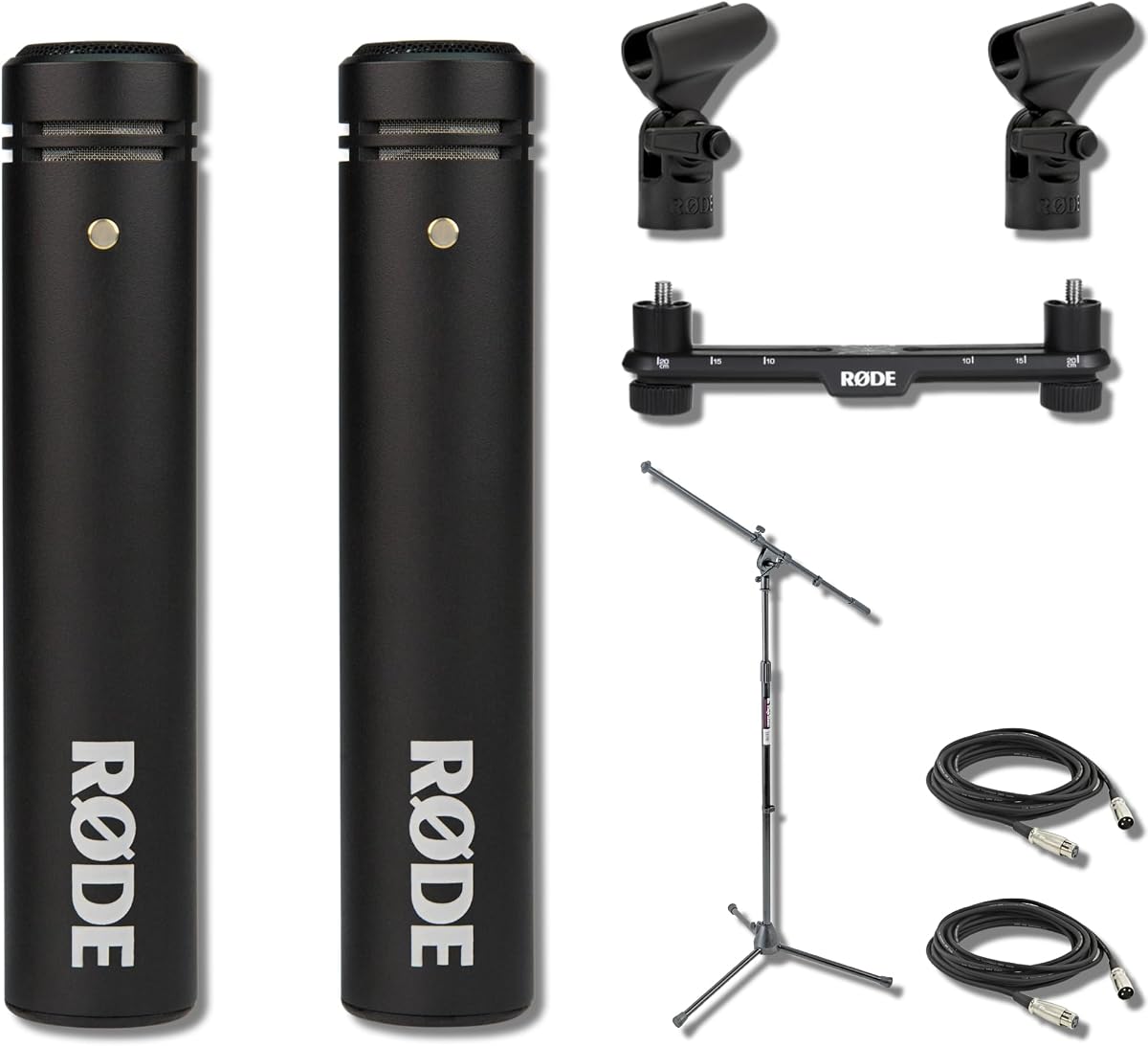
The Rode M5-MP Complete Bundle is the most immediately usable option in this guide, earning a 4.9 rating for its combination of matched small-diaphragm condensers and a full set of recording accessories. It arrives with the microphones, an SB20 stereo bar, a heavy-duty tripod boom stand, two 20-foot XLR cables, two WS5 windshields, and two stand mounts. That completeness makes it particularly attractive to a recordist who wants to begin stereo recording without separately sourcing the basic infrastructure.
We may earn a commission when you buy through this link, at no additional cost to you.
The two M5 microphones are factory matched within 1 dB sensitivity tolerance, which is the core technical benefit of a matched pair. Their one-half-inch true condenser capsules provide a stated 20Hz to 20kHz response, while the cardioid pattern keeps the pickup relatively directional. The self-noise specification of 20 dB is favorable for quiet rooms, and the maximum SPL of 140 dB gives the pair useful headroom for cymbals, snares, and other percussive sources when the recording position is sensible.
The SB20 bar is especially useful because it allows repeatable placement in spaced-pair, ORTF, or XY-style arrangements. The included boom stand and long XLR cables remove several common setup obstacles, although the entire stand adds bulk and requires enough space around the kit. The microphones themselves are compact and should be positioned carefully: a small-diaphragm condenser can capture excellent detail, but it cannot replace sensible gain staging, source placement, or room control.
This bundle is the strongest recommendation for a home studio, project room, or small live setup that needs a complete matched stereo package. Drummers can use the bar over the kit, while a guitarist or keyboard player can benefit from its repeatable geometry. It is less compelling for someone who already owns a good stereo bar, stand, and cables, but for a first matched-pair system, the convenience is difficult to overstate.
The SB20 bar gives both microphones a shared reference point, reducing the chance that a useful stereo image shifts when the stand is moved. Its pre-marked ORTF and XY positions also make it easier to reproduce a preferred configuration instead of relying entirely on visual guesswork.
A stated 20 dB self-noise and broad frequency response make the pair suitable for acoustic guitar, piano, choir, and ensemble work where a noisy microphone floor could obscure quiet details. Placement and acoustic treatment remain important, but the electrical specification provides a useful starting point.
We may earn a commission when you buy through this link, at no additional cost to you.
The Rode M5-MP with SB20 carries a 5.0 rating and presents a focused alternative to the larger M5 bundle. It includes two factory-matched M5 microphones and the SB20 bar, but it does not include a stand, XLR cables, windshields, or mounting hardware. That distinction makes this package especially attractive to a user who already has a dependable recording setup and only needs a matched microphone pair with a useful stereo mounting tool.
We may earn a commission when you buy through this link, at no additional cost to you.
The M5 uses a one-half-inch gold-sputtered capsule and an end-address cardioid design. The pair is hand-selected to fall within 1 dB in sensitivity, providing a more consistent starting point than two unrelated microphones placed on either side of a source. Its 19 dB-A self-noise figure is appropriate for clean captures of acoustic instruments and ensembles, while the 140 dB maximum SPL allows the pair to handle drum overheads without leaving much concern about peak overload.
The SB20 provides more than a simple support bracket. Its top markings indicate ORTF and XY angles, and the body includes a spacing scale extending to 7.8 inches. The microphones attach through standard three-eighth-inch threads, while the bar mounts to a standard stand. This makes repositioning straightforward, although the accessory is still designed around conventional stand placement rather than every unconventional recording configuration.
This is the top choice for a user who values a compact, high-performing matched pair without needing a full bundle. It works particularly well for drum overheads, acoustic guitar, piano, and choir recording. The principal drawback is the need to buy or supply the stand, cables, and wind protection separately, but the core microphone-and-bar package is focused and well suited to immediate use.
A one-decibel sensitivity tolerance helps the left and right microphones behave more predictably across a stereo field. That consistency is especially helpful with critical XY and ORTF configurations, where a large sensitivity difference could shift the perceived center or change tonal balance.
The compact end-address capsules can provide a natural combination of detail and reach, making them effective across cymbals, strings, piano, and voice. Their small format also means they can be positioned relatively close to a source, so careful gain and distance control remain essential.
We may earn a commission when you buy through this link, at no additional cost to you.
The Rode NT5 Matched Pair is a premium small-diaphragm condenser option with a 4.3 rating. It sits above the M5 range in the supplied lineup and is intended for users who want a finely detailed, accurate pair for serious studio or live applications. Its one-half-inch gold-sputtered cardioid capsule and very low self-noise are the central attractions.
We may earn a commission when you buy through this link, at no additional cost to you.
A matched pair is more useful when each microphone is treated as a system rather than two independent pickups. Matching reduces sensitivity differences that can affect level balance, spectral consistency, and the perceived location of sounds in a stereo image. That can matter on drum overheads, where a kit extends across the stereo field, and on ensembles, where a stable image helps maintain the sense that the performers occupy a coherent space.
The NT5's cardioid pattern provides directional focus, and the wide frequency response supports detailed acoustic capture. The product data specifically emphasizes accurate off-axis behavior and low self-noise, both meaningful strengths in a small-diaphragm condenser. Its matched configuration provides the consistency needed for critical listening, editing, and stereo mastering decisions.
This pair is a good choice for a project studio or established production room that prioritizes capsule quality and low noise over a bundled package. The ten-year warranty also provides added confidence in long-term ownership. The main limitation is that the supplied listing does not include a stereo bar, stand, cables, or case, so buyers should account for those accessories when planning the system.
The specified accurate cardioid response and wide bandwidth make the NT5 pair appropriate when the goal is a faithful capture rather than a heavily processed studio sound. It is well suited to acoustic sources whose natural transients and harmonic detail should remain visible in the recording.
A ten-year warranty sets the NT5 apart from many entry-oriented microphone sets described in this guide. For a permanent studio tool, that coverage can be a meaningful part of the ownership decision alongside sound, noise, and build characteristics.
We may earn a commission when you buy through this link, at no additional cost to you.
The BEHRINGER C-2 is the value-oriented choice in this guide, holding a 4.6 rating while providing two matched condenser microphones for stereo studio and live applications. Its simplicity makes it accessible to musicians who want a functional pair without investing in a large accessory ecosystem before learning which recording approach suits them.
We may earn a commission when you buy through this link, at no additional cost to you.
The microphones use a cardioid pickup pattern, which is useful in live environments because it focuses on the intended source and helps reduce feedback compared with an omnidirectional design. Their low-mass diaphragm is specified for a wide frequency response and faithful reproduction. Switchable low-frequency roll-off and input attenuation add useful control over rumble, proximity effect, and signal level.
Matching also matters in a live pair, not only in a studio. Two closely related microphones can produce a more even left-right image when used over a drum kit, in front of a stereo source, or across a stage. The exact degree of matching is not detailed in the supplied product information, so the strongest buying case rests on the pair concept, cardioid pattern, broad response, and useful switches.
The C-2 is recommended for a home studio, rehearsal room, church, or small stage where two dependable directional condensers are needed at an approachable cost. It may not offer the same extensive accessories or published noise specifications as some premium sets, but it covers the essential requirements: matched operation, focused pickup, broad response, and source-level controls.
The switchable low-frequency roll-off can help reduce mechanical rumble or unwanted proximity buildup, while input attenuation provides headroom for louder sources. These controls make the pair easier to adapt when moving between acoustic instruments, drums, and amplified instruments.
A cardioid pattern is a practical middle ground for many recording rooms and stages. It can isolate a source in front of the microphone and reduce pickup from the sides, although it will not isolate the microphone from sound arriving directly behind it.
We may earn a commission when you buy through this link, at no additional cost to you.
The sE Electronics sE7 Matched Pair is a compact stereo set with a 4.5 rating and unusually clear technical specifications in the supplied data. It covers 20Hz to 20kHz, has a sensitivity of 19mV/Pa, operates on 48-volt phantom power, and offers a maximum SPL specification of 136 or 156 dB depending on the operating mode.
We may earn a commission when you buy through this link, at no additional cost to you.
Those figures help distinguish the sE7 from a purely promotional microphone description. A 19mV/Pa sensitivity is conventional for a condenser and should work with a wide range of modern preamps, while the impedance below 200 ohms is compatible with balanced XLR signal paths. The frequency range covers the full audible spectrum, and the 136 dB maximum without the pad gives it useful range for overheads and moderately close acoustic sources.
Because this listing is for a factory-matched pair, the microphones should be deployed as a stereo system rather than split across unrelated applications. A matched pair can make a drum overhead image more stable and provide a more even capture across a piano lid, guitar pair, or ensemble. The listing does not state a numerical matching tolerance, however, so the degree of consistency should not be inferred beyond the factory-matched description.
The sE7 is a strong choice for a recordist who values explicit electrical specifications and wants a versatile small-diaphragm pair. It lacks the listed pad and low-cut controls found in some competing models, so users recording very loud or rumble-prone sources may need to manage those conditions through placement and preamp settings. Otherwise, it remains a focused and capable matched pair.
The stated 20Hz–20kHz range provides a broad canvas for recording drums, strings, voice, and acoustic instruments. As with any small-diaphragm condenser, actual room response and source placement will influence the final sound more substantially than the printed endpoints alone.
A sensitivity of 19mV/Pa and impedance below 200 ohms are conventional values that should integrate smoothly with quality XLR preamps. This makes the pair less likely to present an unusual load when comparing it with other studio microphones.
We may earn a commission when you buy through this link, at no additional cost to you.
The sE Electronics sE7 Complete Bundle has a 5.0 rating and combines the matched sE7 pair with touch fastener straps, two 20-foot XLR cables, and two pop filters. Those additions are especially useful for a compact recording setup because they address several common mounting and cable-management needs without requiring every accessory to be sourced separately.
We may earn a commission when you buy through this link, at no additional cost to you.
The microphones use transformerless circuitry and offer a selectable 20 dB pad along with a selectable 80Hz low-cut filter. The pad provides additional headroom for loud sources, while the low-cut can reduce low-frequency energy from handling, vibration, air movement, or close placement. Their cardioid pattern supports focused stereo recording, drum overhead work, and piano capture.
Unlike the simpler sE7 listing, this version provides the cables and pop filters, making it more convenient for a new project. The supplied touch fastener straps can help secure the pencil microphones to a suitable mounting structure. There is no stereo bar in the listed bundle, so users seeking repeatable XY or ORTF geometry still need a compatible bar or another dependable mounting method.
This bundle is best for a home studio, rehearsal room, or mobile session where the recorder wants a matched condenser pair, long balanced cables, and basic pop protection in one package. Its standout specifications are the 20 dB pad and 80Hz filter, which make the microphones more adaptable to a broader range of sources than a basic fixed-gain pair.
The 20 dB pad is valuable when a source produces peaks beyond the normal operating range of the microphone. It does not change the capsule's acoustic character, but it helps the electronics remain in a healthier signal range and reduces the need to rely entirely on extremely low preamp gain.
The long XLR cables and included pop filters make the bundle easier to deploy in a temporary room or rehearsal space. The straps also support repeatable positioning, although a proper stereo bar and stand remain important for maintaining a stable angle between the two microphones.
We may earn a commission when you buy through this link, at no additional cost to you.
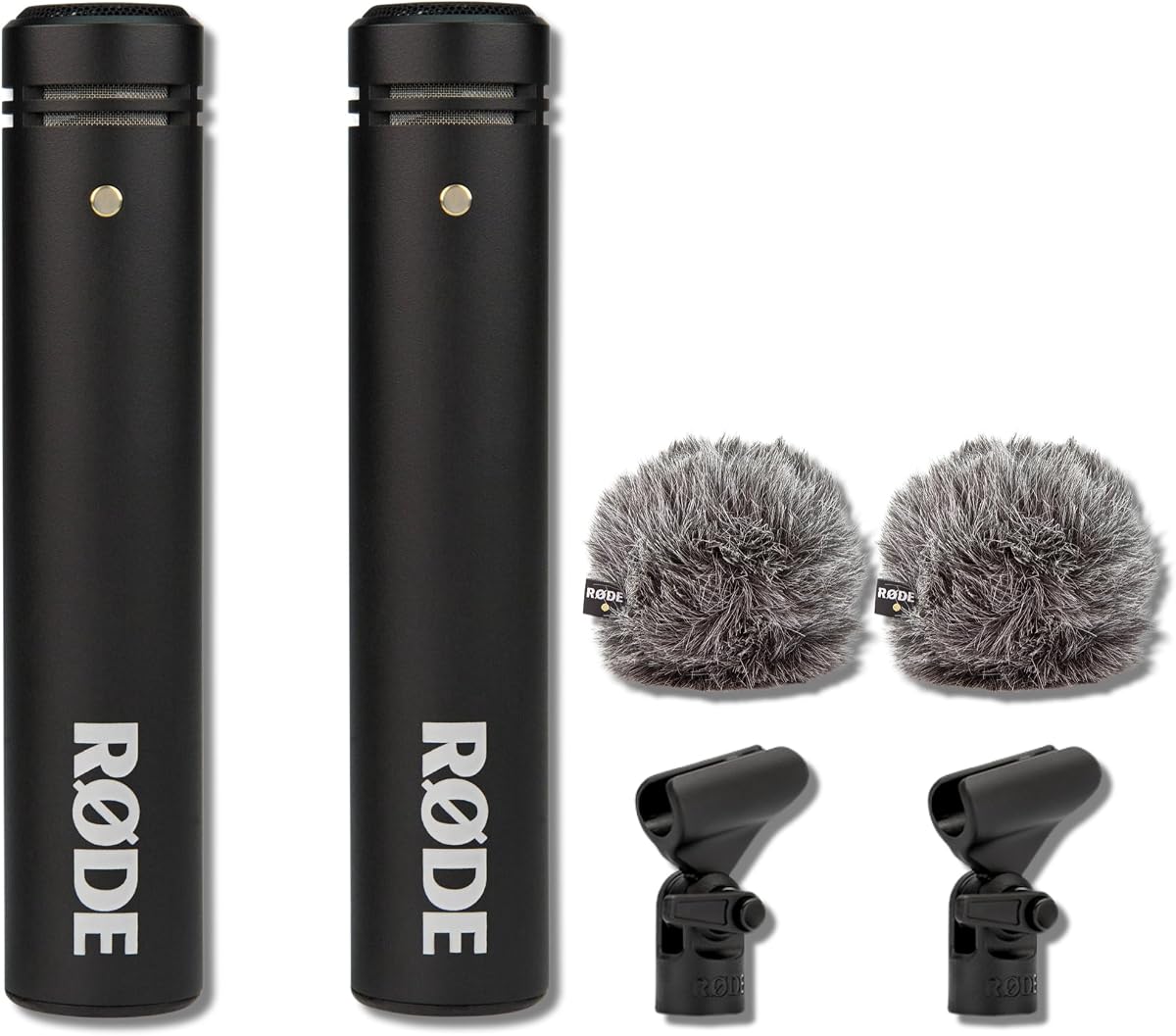
The Rode M5 with WS8 windscreens is the most location-oriented matched pair in the guide, holding a 5.0 rating. It includes two M5 microphones and two WS8 deluxe windshields, each built with dual-layer faux fur, open-cell foam, and a molded rubber base ring. That protection is especially relevant to field recording, outdoor ensemble capture, and any session where moving air might otherwise disturb the microphones.
We may earn a commission when you buy through this link, at no additional cost to you.
The M5 pair is factory matched within 1 dB sensitivity and uses a gold-sputtered capsule platform associated with the NT5 design family. Its stated 19 dB-A self-noise is suitable for clean recording of quieter sources, while the 140 dB maximum SPL and 121 dB usable dynamic range support louder material such as cymbals and percussion. The cardioid pattern maintains a useful balance of directionality and placement flexibility.
The WS8 is more than a thin layer of foam. Its outer faux fur is intended to diffuse turbulent airflow, the inner foam absorbs residual energy, and the sealed rubber base helps prevent wind from entering behind the capsule. The listed weight of 18 grams per windscreen is low enough to avoid meaningful strain on a stereo bar, though the visual and physical bulk can still matter in tight overhead positions.
This is the best choice for a mobile recordist, outdoor choir, acoustic ensemble, or drummer working in an uncontrolled environment. It does not include a stereo bar or XLR cables, so the user must supply those components. In return, it provides a well-matched core with serious wind protection, making it a focused solution for location work.
The combination of outer fur, inner foam, and a sealed base addresses several wind-related failure modes. It cannot guarantee clean recordings in extreme weather, but it offers substantially more protection than an uncovered small-diaphragm condenser in a breeze.
The one-decibel matching tolerance supports stable level balance between left and right channels, while 19 dB-A self-noise leaves room for quieter environmental recordings. Together, those characteristics make the pair suitable for natural ambience and detailed location work when used with careful gain control.
We may earn a commission when you buy through this link, at no additional cost to you.
The sE Electronics sE8 Matched Pair is the premium recommendation, carrying a 4.4 rating and a feature set aimed at professional studio and live workflows. Each microphone is described as handcrafted, with a gold-sputtered capsule, a three-micron diaphragm, and a sophisticated backplate. The all-metal chassis and gold-plated XLR connector reinforce its premium construction and durability.
We may earn a commission when you buy through this link, at no additional cost to you.
Its Class-A circuitry and ultra-low self-noise are particularly relevant to critical acoustic and percussion recording. Two switchable pads and low-cut filters offer practical control for loud sources, close placements, and unwanted low-frequency buildup. The supplied accessory set includes a mounting bar, windscreens, clips, and a durable carrying case, giving the pair a more complete ownership package than several simpler matched sets.
The sE8 is also designed to work with optional capsules. The product data notes compatibility with an Omni capsule for ambient, ensemble, or measurement roles and a Supercardioid capsule for more focused off-axis rejection. Those capsules are sold separately, so they represent optional expansion rather than included features. The matched pair itself is well suited to drum overheads, acoustic sources, and detailed studio work.
This pair is best for a serious project studio, established live production, or a recordist who wants a durable metal body, very low noise, and multiple controls. The main trade-off is the premium financial commitment, and the exact factory matching tolerance is not stated in the supplied information. Even so, the complete accessory package and flexible capsule ecosystem justify consideration for long-term use.
The handcrafted gold-sputtered capsule, three-micron diaphragm, and metal housing indicate attention to both acoustic consistency and physical longevity. A robust body can be valuable in mobile and stage work, where microphones are repeatedly mounted, handled, and transported.
Optional Omni and Supercardioid capsules broaden the pair's application beyond a fixed cardioid configuration. The ability to move from focused pickup to ambient or measurement-style capture makes the sE8 more versatile than a conventional matched pair with a single fixed pattern.
We may earn a commission when you buy through this link, at no additional cost to you.
The LEWITT LCT-140-AIR Stereo Matched Pair has a 4.6 rating and stands apart through its switchable AIR and FLAT sound characteristics. That gives the user two tonal approaches from the same matched pair, which is useful when a source needs either a more open presence or a balanced, straightforward presentation.
We may earn a commission when you buy through this link, at no additional cost to you.
The microphones are small-diaphragm condensers with an emphasis on transient response and instrument flexibility. A matched stereo configuration is particularly relevant to drum overheads, acoustic guitar, piano, and ensemble work, where maintaining a balanced left-right relationship helps the final mix feel coherent. Switching both microphones to the same mode is important because mismatched settings would undermine the purpose of a matched pair.
The CNC-machined aluminum housing makes the microphones durable without making them unnecessarily heavy. The package includes two snap-in clips, a transport bag with two pockets, and two windscreens. These accessories support mobile use and help protect the microphones during storage, although the data does not list a stereo bar, so a suitable mounting arrangement must be added separately.
The LCT-140-AIR is best for a recordist who wants to shape the basic character of the microphones after installation. It is also attractive for live and project work because the lightweight body is easy to position. The lack of published frequency-response, self-noise, and maximum-SPL figures makes direct technical comparisons less precise, so listeners should consider the AIR and FLAT modes against the sound they need.
The AIR setting offers a different sonic option from the FLAT mode, allowing a recording engineer to respond to different sources or mixes without changing microphones. Because each microphone has a switch, both units should be set identically to preserve matching and tonal symmetry.
The lightweight CNC-machined aluminum housing supports fast setup and reduces strain on a stereo mount. Snap-in clips, windscreens, and a two-pocket transport bag make the pair easier to organize for rehearsals, sessions away from a permanent studio, and regularly changing recording rooms.
We may earn a commission when you buy through this link, at no additional cost to you.
The beyerdynamic MC 930 Stereo Set is the specialist professional option in this guide. It consists of two cardioid true-condenser small-diaphragm microphones designed for guitars, piano, overheads, choirs, vocals, and orchestras. No user rating is supplied for this listing, so its selection here is based strictly on the documented technical features rather than a customer-rating comparison.
We may earn a commission when you buy through this link, at no additional cost to you.
Its 30mV/Pa sensitivity is the highest figure listed among the products reviewed, potentially reducing the amount of preamp gain needed for a typical condenser source. The product information connects this output with lower noise, greater headroom, and a clean signal, although actual results still depend on the preamp, gain structure, acoustics, and cable quality used in the session.
The switchable negative-15 dB pad adds substantial level headroom for loud sources, while the six-decibel-per-octave low-cut at 250Hz can reduce proximity buildup and unwanted low-frequency energy. The microphones also have a largely linear frequency response and outstanding transient response, characteristics that favor detailed acoustic capture and fast percussion attacks.
Each microphone is individually measured and supplied with its frequency response curve, adding useful documentation for setup and critical recording work. The in-house capsule production and handmade German construction point toward long-term reliability. This set is best for a professional studio or advanced project environment where sensitivity, transient behavior, build quality, and individual measurement matter more than minimizing the investment.
A sensitivity of 30mV/Pa can be useful in studios where lower preamp gain helps preserve headroom and minimize the contribution of the preamplifier's noise floor. It also makes the pair practical for quiet sources that might otherwise require more gain than the recording chain comfortably provides.
Supplying a frequency response curve for every microphone provides a useful record of its measured behavior. That documentation can assist critical setup and gives owners a baseline for understanding how each capsule performs in a particular signal chain.
We may earn a commission when you buy through this link, at no additional cost to you.
A good matched pair should combine stable left-right behavior with an appropriate capsule, pattern, output level, accessory set, and recording purpose. The following factors help narrow the field before you spend time comparing features that will not affect your recordings.
In short, select the pair for the source and acoustic environment before selecting for the rest of the specification list.
In short, matched sensitivity and frequency behavior help produce a more convincing stereo image, but exact tolerances vary by model.
In short, cardioid suits most focused applications, while interchangeable capsules offer more flexibility across different recording spaces.
In short, favor low self-noise for quiet detail and a comfortable maximum SPL for loud percussion, while using realistic preamp gain.
In short, consider tonal controls and transient character alongside frequency limits, because the most useful specification depends on your mixing approach.
In short, verify 48-volt phantom power, balanced XLR routing, and adequate preamp headroom before recording.
In short, buy the accessories you actually lack, and avoid paying for duplicate stands, cables, or wind protection you already own.
In short, use a stable stereo bar and choose a repeatable spacing method suited to the width and focus you need.
Begin by identifying the sound you want to capture and choosing a stable microphone position. Mount both microphones on a compatible stereo bar or stand, confirm that their capsules face the intended source, and set them to the same operating mode. If a model includes a low-cut filter or pad, engage those settings only after checking the source level and listening for low-frequency buildup or excessive peaks. Keep both microphones equidistant from the source unless the recording design deliberately calls for a different balance.
Route both XLR cables into suitable balanced inputs with 48-volt phantom power. Begin with moderate preamp gain and avoid clipping the preamp or interface. Listen in mono as well as stereo during setup; a pair that sounds balanced in stereo can still hide a problematic level difference or unwanted off-axis sound. Record a short test with the room, then adjust the angle, height, and distance rather than trying to repair a poor microphone position entirely in post-production.
For storage and transport, detach the microphones gently, coil the cables without sharp bends, and protect the capsules from impact and moisture. The included cases, clips, windscreens, and bags can make this process more reliable. Do not leave a foam windscreen permanently on a capsule unless it is designed for that use, because trapped moisture can be harmful. Keep the microphones away from extreme heat, direct sunlight, and liquids, and allow them to acclimate after transport if they have been exposed to a large temperature change.
Matched pair microphones are two microphones selected and tested to behave as closely as possible to one another. The matching may cover sensitivity, frequency response, phase, or several characteristics at once. This consistency helps maintain a stable stereo image when the microphones are placed in a fixed configuration such as XY or ORTF. It does not mean the two microphones should be used on entirely unrelated sources at widely different distances.
A matched pair is usually better when both microphones will capture the same source or ensemble from nearby positions. Close consistency can improve level balance, tonal symmetry, and stereo coherence. Two unrelated microphones can still work well, particularly for different sources, but their differences may become more obvious in a stereo mix. For a critical pair, ask the manufacturer which parameters are matched and whether a numerical tolerance is available.
XY places two cardioid capsules very close together with their axes crossed, usually at 90 degrees. It creates a narrow, focused image with strong center placement and is straightforward to keep consistent. ORTF uses a wider spacing and an angle of approximately 110 degrees, producing a more spacious natural stereo field. The included SB20 helps set both arrangements, making it easier to compare the two methods with the same source.
Yes, especially for overhead cymbals, room drums, and detailed ensemble capture. Their compact size makes them easy to position and their transient response can capture fast attacks well. Placement is critical because a close small-diaphragm condenser may emphasize a single drum or cymbal more than the kit as a whole. Many of the featured models specify maximum SPL levels suited to percussion, but the recording should also avoid excessive gain.
The condenser microphones in this guide are XLR models and generally require 48-volt phantom power. The sE7 explicitly states 48-volt operation, and the Rode M5 bundle also identifies +48V phantom power. Check the interface or mixer specifications before connecting, and never send phantom power to incompatible microphones. Balanced XLR routing and suitable preamplifier headroom are also important.
Technically, you can use either microphone independently, but doing so sacrifices some of the reason for choosing a matched pair. The closer performance of the two units will matter most when they share a source, room, or ensemble. If one microphone is used elsewhere, it may be better to treat the setup as two separate microphones and use a stereo bar for the remaining one when practical.
At minimum, you normally need a compatible stand, a stable mounting bar or clips, balanced XLR cables, and an interface or mixer with 48-volt phantom power. Windshields are important outdoors, while pop filters can help with vocals or close acoustic sources. Some bundles include these items, and others include only the microphones or a limited accessory set, so check the exact contents before completing the setup.
A tighter tolerance generally means the microphones are more alike in the characteristic being measured, which can make left-right balance easier. However, the stated tolerance is only meaningful when the manufacturer defines what was matched and how it was measured. Numerical details are not provided for every pair, so placement quality, room acoustics, gain consistency, and cable routing remain essential parts of producing a balanced stereo recording.
The Rode M5-MP Complete Bundle is the most convenient all-around choice because it combines matched small-diaphragm condensers with a stereo bar, stand, cables, windshields, and mounts. The Rode M5-MP with SB20 offers the same core microphone precision in a more focused package for users who already own their supporting equipment. For a simpler entry, the BEHRINGER C-2 provides matched cardioid condensers, broad response, and practical filter and attenuation controls.
Prioritize the source and room before the accessory list. Low self-noise and tight matching suit quiet acoustic and ensemble work, while high maximum SPL, pads, and low-cut filters help with drums and other loud sources. A stable bar, identical microphone settings, balanced routing, and deliberate placement can influence the final stereo image more than any single specification. The sE8 and MC 930 serve buyers seeking more specialized construction, low-noise performance, or professional features.
Before purchasing, verify the current listing details, included accessories, manufacturer support, and current prices for the exact model. Product bundles and configurations can change, and availability may vary. With those checks completed, choose the pair that matches your sources and recording environment rather than simply choosing the model with the longest feature list.
