
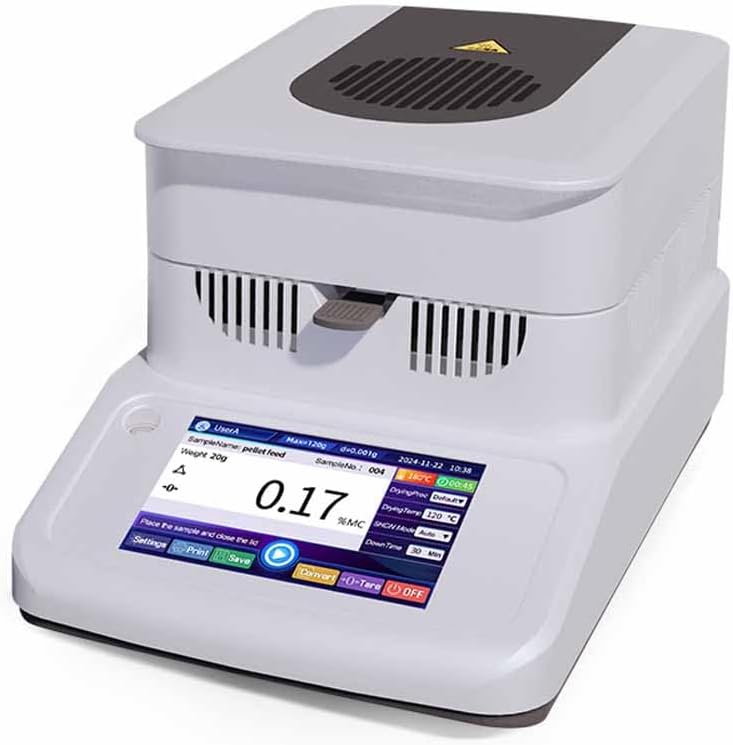
FLB Halogen Moisture Analyzer Halogen Heating Balance RS232 110V 110g0.001g
4.7Editor score
110 gram sample capacity
0.001 gram readability
Thirty-four stored programs
Moisture Balance Analyzer 2 instruments combine rapid halogen heating with continuous weight measurement to determine how much moisture a sample contains. A useful analyzer balances capacity, readability, programmable controls, readable results, and dependable data handling for food, grain, chemical, agricultural, and construction-material testing.
The ten products in this guide were compared using the information supplied for each model, with particular attention to weighing capacity, moisture readability, heating range, drying modes, calibration, touchscreen usability, stored methods, and communication ports. The list includes compact instruments for routine work and higher-resolution models intended for demanding laboratory analysis.
Each review explains the most useful capabilities, practical trade-offs, and likely buyer profile for its product. The top selections represent strong options for different priorities, while the full comparison makes it easier to identify the right method-storage system, temperature range, sample capacity, or data connection for a particular workflow. Prices and availability can change.
4.7Editor score

4.1Editor score

As an Amazon Associate we earn from qualifying purchases.
This side-by-side comparison covers the essential differences in sample capacity, measurement resolution, heating range, controls, and data management. It highlights where each instrument is most practical without treating every specification as equally important for every material or laboratory.




The GS110 Portable Halogen Moisture Meter combines a 110 g capacity with 10 mg readability and a 40–160°C drying range. Its supplied rating is 5.0, and its strongest qualities are the variety of materials it can handle, rapid halogen heating, adjustable temperature and duration, and practical inclusion of both data storage and printer output.
We may earn a commission when you buy through this link, at no additional cost to you.
The operating workflow is straightforward. An operator places a sample on the weighing pan, chooses a temperature in 1°C increments, selects a heating duration from 1 to 99 minutes, and starts the cycle. The instrument monitors weight loss as moisture evaporates and displays the calculated moisture content. Its stated applications include food, plants, grains, minerals, chemicals, soil, wood, paper, and textiles, making it useful when one instrument must cover several departments.
The main compromise is resolution. A 10 mg readability specification and 20 historical records are less ambitious than the finest sensors and larger databases found among the higher-end choices. The storage limit may also be restrictive for a busy laboratory that wants to retain every run for audit or trending purposes, although the printer interface helps transfer or document results.
This GS110 is a good fit for routine quality checks, teaching, agricultural work, and mixed-material facilities that value broad compatibility and fast results more than laboratory-grade finesse. It is particularly attractive when the included wind cover, tray handle, twenty aluminum pans, calibration weight, and compact package reduce the need for separate accessories.
The halogen lamp heats samples quickly while the processor follows real-time weight changes. This approach shortens the wait compared with conventional oven drying and makes the instrument practical for frequent checks involving food, soil, wood, paper, textiles, and other samples.
Up to 20 sets of historical data can be retained, and the printer interface supports adjustable baud rates. The combination is useful when operators need visible results during testing as well as printable records for batch review or quality documentation.
We may earn a commission when you buy through this link, at no additional cost to you.
The U.S. Solid 110g Halogen Moisture Analyzer offers 110 g capacity, 5 mg readability, and moisture measurement to 0.1%. Its supplied rating is 4.1. The instrument stands out for a 40–199°C heating range, three drying modes, multiple result displays, manual calibration, and a generous package of 50 sample dishes.
We may earn a commission when you buy through this link, at no additional cost to you.
Its 450 W halogen lamp can be tuned through standard, fast, and soft drying programs. That selection is valuable when a facility moves between dense grains, delicate materials, plastics, textiles, food, and chemicals. The digital display can report moisture percentage, dry weight, or dry-weight percentage, helping operators use the instrument for more than a single standard specification.
Fifteen preset method groups support repeated testing, while an RS-232 connection permits output to a computer or printer. The trade-offs are a smaller method library than many newer models and a supplied rating below the strongest options in this list. Buyers should also note the 110V 60Hz power requirement and plan for the physical footprint of a 90 mm pan.
Despite those limitations, this analyzer is a credible choice for general laboratory and production testing. It is best suited to operators who want flexible heating, clear output choices, and many replacement pans without moving to the larger displays or storage systems found in premium instruments.
Standard, fast, and soft programs let operators balance turnaround against sample sensitivity. This is especially useful when the same instrument handles heavy or free-flowing products and materials that should experience gentler thermal treatment.
Moisture percentage, dry weight, and dry-weight percentage give operators three ways to interpret each run. The RS-232 port adds a straightforward route for sending data to a computer or printer when records need to be retained outside the instrument.
We may earn a commission when you buy through this link, at no additional cost to you.
The FLB Halogen Moisture Analyzer delivers 110 g capacity with weight readability to 0.001 g and moisture readability to 0.01%. Its supplied rating is 4.7, placing it among the strongest-reviewed instruments here. The five-inch touchscreen, 34 stored programs, and 40–180°C range create a balanced package for routine and research-oriented work.
We may earn a commission when you buy through this link, at no additional cost to you.
Three operating modes—manual, automatic, and timed—give operators control over how a test ends. The instrument can alternate between gentler and faster drying behavior, which helps it adapt to samples with different thermal sensitivity. Its menu supports English, Spanish, and German, adding flexibility for international teams, while a standard RS-232 interface supports computer and printer connections.
The product is described as CE certified, pre-calibrated, and tested before shipment. These are positive quality-control indicators, although buyers should still verify their own calibration and validate settings for the specific material being measured. Thirty-four stored groups are fewer than the 100 or 200 offered by some competitors, but the library remains substantial for most repeated testing schedules.
This FLB model is a strong all-around recommendation for food, agricultural, chemical, pharmaceutical, and production quality inspections. It is especially suitable when a buyer wants a relatively compact interface, meaningful resolution, multilingual operation, and programmable workflows without moving to the most specialized premium analyzer.
The five-inch display provides a clear place to set operating modes, drying behavior, and result parameters. Three ending modes support different levels of operator involvement, reducing the need to rebuild a procedure for every sample category.
With 34 programmable groups, a laboratory can retain commonly used procedures for multiple products. The multilingual menu and RS-232 connection also make the analyzer more convenient for shared international facilities and centralized recordkeeping.
We may earn a commission when you buy through this link, at no additional cost to you.
The U.S. Solid 5-inch Moisture Analyzer combines 110 g capacity with 0.005 g readability and 0.05% moisture readability. Its supplied rating is 4.4. The instrument offers a 250 W halogen lamp, standard, fast, and soft drying modes, a color touchscreen, and a fast preheat function.
We may earn a commission when you buy through this link, at no additional cost to you.
Automatic, manual, and timing ending modes allow the operator to choose how each test concludes. Results can be shown as moisture percentage, dry weight, or dry-weight percentage, and manual calibration uses a 100 g weight. The 20 stored test methods are useful for stable routines, while the RS-232 port can export results to a computer or printer.
Its 40–160°C range does not reach the 199°C or 200°C maximum available from some alternatives. That could matter for materials requiring more intense thermal treatment, though the upper range is still broad for many food, grain, plastic, textile, and chemical applications. The 20-method library is another modest point compared with larger internal databases.
The U.S. Solid model is a sensible selection for a lab that values an approachable color interface, rapid preheating, and a complete accessory package. Buyers who need broader temperature selection or extensive method archiving may prefer one of the models with 100 or 200 stored programs.
The built-in preheat function can reduce waiting before testing begins. That convenience is valuable when an operator runs multiple samples in succession and needs the halogen system ready without a separate warm-up routine.
A color touchscreen, three drying choices, and three ending modes provide a balanced control set. The included 50 pans reduce preparation friction for high-volume or multi-user laboratory work.
We may earn a commission when you buy through this link, at no additional cost to you.
The 120g/1mg Halogen Moisture Analyzer combines a 120 g capacity with 1 mg weight readability and 0.01% moisture readability. No customer rating was supplied for this listing. Its main attractions are the broad selection of drying and ending modes, a touchscreen capable of storing 100 records, and support for grain, wood, food, and other production applications.
We may earn a commission when you buy through this link, at no additional cost to you.
Standard, fast, slow, and soft drying profiles give the instrument more thermal choices than many competitors. The touchscreen shows sample temperature, time, moisture content, solid content, and dry weight, providing a live view of the test rather than only a final number. A stated repeatability error of 0.6% should be considered when comparing precision claims.
The principal drawback is the absence of a visible customer rating in the supplied data, making it harder to gauge owner satisfaction. Although the listed 1 mg capacity variant is more precise than the related 2 mg version, it may still fall short of laboratories requiring sub-milligram or point-one-milligram readings. Its storage and display functions are nevertheless generous for routine work.
This model is best for facilities that regularly test larger samples or need many stored results but do not require research-grade electromagnetic force measurement. It is also a logical choice for grain and wood operations because of the 120 g capacity, 0.01% moisture readability, and multiple drying profiles.
The four available profiles support different heating intensities and run times. This makes it easier to develop a repeatable procedure for grain, wood, food, agricultural, chemical, or medicinal samples without forcing every material into the same thermal profile.
Displaying temperature, elapsed time, moisture, solids, and dry weight together gives the operator useful context during a run. The 100-record capacity and RS-232 printer connection support more intensive documentation than a basic single-result display.
We may earn a commission when you buy through this link, at no additional cost to you.
The USB 110g Halogen Moisture Analyzer features a seven-inch high-definition color touchscreen, a stated capacity of 112 g, and a 40–162°C heating range. No customer rating was supplied. It is designed for operators who want a large control surface, quick setup, and the ability to transfer current or historical results to a printer or computer.
We may earn a commission when you buy through this link, at no additional cost to you.
Automatic and timing modes cover the two principal ways an operator might end a test, while standard, fast, and soft drying modes accommodate different samples. Up to 20 methods can be preset and stored. Two calibration modes and a one-touch preheat function simplify preparation, and the large screen makes the instrument suitable for granular, sheet-like, and non-volatile liquid materials.
The listing calls the connection RS234, which appears to refer to the commonly used RS-232 interface but should be confirmed before purchase. No customer rating is available, and the supplied information does not state a specific weight or moisture readability. Buyers who require exact resolution specifications should obtain confirmation before committing.
The instrument is most appropriate for food, agriculture, and chemical operations that favor a large display and accessible controls. Its 112 g capacity is generous, and the method library should serve many repeated procedures, but facilities whose main priority is documented measurement resolution may prefer a model with a clearly stated precision.
The color touchscreen provides a generous area for operating modes, temperatures, timers, and results. That makes the analyzer easier to use in a busy laboratory or when several operators with different levels of familiarity share the same instrument.
The stated printer and computer connection allows current and historical results to be exported. Combined with 20 stored methods, two calibration modes, and one-touch preheating, it offers a practical workflow for organizations that repeat standardized tests.
We may earn a commission when you buy through this link, at no additional cost to you.
The 120g/0.002g Halogen Moisture Analyzer provides 120 g capacity, weight readability to 0.002 g, and moisture readability to 0.01%. No customer rating was supplied. It earns the budget recommendation because it combines a five-inch color touchscreen, four drying programs, 100 stored records, and a 40–180°C range in one feature-rich configuration.
We may earn a commission when you buy through this link, at no additional cost to you.
A PT-100 temperature sensor supports the halogen heating system, while standard, mild, fast, and slow programs allow operators to tailor drying behavior. Automatic-stop, timed, and manual modes offer three ways to conclude a test. The internal database can save up to 100 records and convert results into moisture, solid-content, or moisture-regain formats.
The chemical-resistant stainless steel construction is a meaningful consideration for industrial and laboratory environments, and the package includes a calibration weight, sample tray, tripod stand, tray bracket, windproof cover, power cord, stylus, and manual. Only one sample tray is listed, however, so frequent users may need additional compatible pans. There is also no customer rating to provide a visible measure of owner satisfaction.
This analyzer is a strong fit for buyers seeking a capable instrument without the feature set and specification emphasis of a premium research balance. It suits industrial labs, quality-control teams, and educational programs that want accurate readability, flexible drying methods, a useful database, and RS-232 output in a 110V instrument.
The 120 g capacity handles larger samples than many 110 g alternatives, while 0.002 g readability supports more detailed analysis. Together, these specifications are useful for quality-control work where both sample representativeness and fine mass changes matter.
Storing up to 100 records helps operators maintain an internal history of sample conditions and outcomes. Moisture, solid-content, and moisture-regain conversions broaden the ways the same measurement can be reported.
We may earn a commission when you buy through this link, at no additional cost to you.
The U.S. Solid 0.0001g Moisture Analyzer offers 110 g capacity, 0.1 mg weight readability, and 0.001% moisture readability. No customer rating was supplied. It is the premium selection because its electromagnetic force transducer, point-one-milligram resolution, automatic calibration, 200-method library, and real-time drying curve exceed the capabilities of most products in this guide.
We may earn a commission when you buy through this link, at no additional cost to you.
A 450 W halogen lamp reaches 200°C and offers standard, fast, soft, and step drying modes. The seven-inch color touchscreen displays the live curve and final results, while automatic, manual, and timing ending modes provide control over test termination. An automatic touch-operated door and user authentication add convenience and procedural discipline for shared research instruments.
The main limitation is that this level of instrumentation is overkill for many routine food, grain, and field applications. No customer rating is available, and the supplied information does not describe the footprint or noise level. Buyers should verify bench space, electrical requirements, installation expectations, and their organization's validation procedures before committing to a high-resolution laboratory system.
The analyzer is best suited to research and development, advanced materials work, chemical testing, and laboratories that need the finest stated measurement resolution in this roundup. For organizations performing standard production checks, a 0.002 g or 0.005 g model may deliver more practical value.
The electromagnetic force sensor and 0.0001 g readability allow very small mass changes to be resolved. For R&D workflows involving traceable mass loss, delicate samples, or tightly controlled formulations, that extra sensitivity can be more meaningful than a larger sample capacity.
The live drying curve, 200 stored methods, internal automatic calibration, authentication, and automatic door create a controlled environment for shared instruments. These features support repeatability, traceable setup, and efficient review of test behavior.
We may earn a commission when you buy through this link, at no additional cost to you.
The GS110 110g Halogen Moisture Analyzer combines 110 g capacity with 5 mg readability across a 40–160°C heating range. Its supplied rating is 5.0. The instrument is aimed at rapid moisture determination in food, plants, construction materials, and other mixed sample types, with a straightforward setup centered on temperature and heating duration.
We may earn a commission when you buy through this link, at no additional cost to you.
Operators select temperature in 1°C increments and a cycle from 1 to 99 minutes. A halogen lamp evaporates moisture while the processor tracks weight changes in real time, allowing the unit to calculate and display moisture content in minutes. The analyzer can store up to 20 historical data sets and supports printer output with adjustable baud rates.
Its main limitation is the modest 20-record storage capacity. Unlike several newer competitors, the supplied information does not describe a large library of programmable test methods, so users may need to re-enter parameters more often or rely on printed and computer-based records. The 160°C maximum also trails the most capable high-temperature models.
The GS110 is a good match for quality-control teams, agricultural operations, educational laboratories, and construction-material testers that need a capable balance and quick throughput. It is especially attractive for users who appreciate simple parameter selection, broad material compatibility, and the included set of 20 aluminum pans and 100 g calibration weight.
Temperature and duration are the central controls, with adjustments made in clear increments and times spanning 1 to 99 minutes. This approach supports repeatable procedures without requiring a large stored-program library.
Real-time weight monitoring and rapid halogen drying help operators move between foods, plants, soil, wood, paper, textiles, grains, minerals, and chemicals. The 110 g capacity and 5 mg readability provide a practical middle ground for production and lab checks.
We may earn a commission when you buy through this link, at no additional cost to you.
The 120g/2mg Halogen Moisture Analyzer provides 120 g sample capacity, 2 mg weight readability, and 0.01% moisture readability. No customer rating was supplied. It shares the same general feature set as the closely related 1 mg listing but gives buyers a slightly less precise configuration while retaining four drying modes and 100 stored records.
We may earn a commission when you buy through this link, at no additional cost to you.
The touchscreen shows sample temperature, elapsed time, moisture content, solid content, and dry weight. Automatic, timed, and manual ending modes are supported, along with standard, fast, slow, and soft drying. RS-232 connectivity can send reports to a printer, and the stated repeatability error is 0.6%.
Compared with the 1 mg version, the 2 mg model trades some weight-reading resolution for a lower-cost position. No customer rating is available, so owner satisfaction cannot be assessed from the supplied listing information. The stated repeatability figure should also be compared with the laboratory's own tolerance requirements rather than treated as a universal measure of accuracy.
This instrument suits grain, wood, food, agricultural, chemical, and medicine-related quality monitoring where large samples, multiple parameters, and an extensive internal record system are priorities. It is a practical alternative for buyers who do not need sub-2 mg resolution but want the feature set of a more elaborate touchscreen analyzer.
A 120 g capacity allows operators to test samples larger than those handled by many 110 g units. That can improve workflow efficiency in grain, wood, and food testing when larger representative portions are important to the procedure.
The combination of live parameters and 100 stored records gives users a clear view of each run and a useful internal history. RS-232 printer support provides a practical path for producing standardized reports.
We may earn a commission when you buy through this link, at no additional cost to you.
The right halogen moisture analyzer depends on the material being tested, the resolution your protocol requires, the heating behavior it tolerates, and the level of recordkeeping expected. Use the specifications below to separate essential features from options that only matter in specialized workflows.
Capacity determines the maximum mass the balance can handle, while pan size affects how the sample is spread and removed. Most products in this roundup sit between 110 g and 120 g, which covers many laboratory and production samples. Larger-capacity models can be convenient when operators need to test representative portions of grain, wood, food, or granular material without repeatedly dividing a sample.
Choose a capacity that matches the method, not merely the largest available figure. Check the physical pan diameter, especially the 90 mm pan associated with the U.S. Solid 110g model, and confirm that included dishes or trays fit your workflow.
Readability is the smallest weight change the instrument can display, while moisture readability expresses the corresponding measurement detail. The list ranges from 10 mg on the GS110 listing to 0.0001 g on the electromagnetic-force model, with several options around 0.001 g, 0.002 g, 0.005 g, or 2 mg. Greater resolution can be valuable for R&D, but it is not automatically necessary for broad quality-control work.
Match resolution to the smallest difference your acceptance criteria require. Also review stated repeatability where available, because resolution and repeatability describe different aspects of performance and should not be treated as interchangeable.
The maximum temperature defines the thermal envelope available for drying a sample, while the lower setting influences gentler procedures. Options range from 40–160°C to 40–200°C. Standard, fast, soft, mild, slow, and step modes give operators more control over heat delivery, especially when a facility tests materials with different sensitivities.
Select a model whose range and programs cover validated methods for the material. A higher maximum is not automatically better, because the correct temperature depends on the sample and established procedure.
Automatic, timed, and manual ending modes determine how much judgment the operator must apply to each run. Automatic operation can improve consistency by applying a stored criterion, while manual mode helps with unusual samples or developing a new method. Timed operation provides a middle ground for repeatable schedules.
Favor the combination that supports your team's experience level. If multiple operators will use the instrument, a clear touchscreen and stored procedures can reduce the likelihood of inconsistent setup.
Method storage preserves temperature, timing, and operating choices for repeated products, while historical records support review and traceability. Storage ranges from 20 sets to 200 methods or records, and some models convert results into moisture, solids, or moisture-regain formats. A larger library is valuable in facilities testing many formulations or running several departments.
Choose based on the number of recurring methods and the need for internal audit trails. If storage is modest, check whether RS-232 output or printer compatibility can move results into a centralized system.
Calibration features help verify that the balance responds correctly before a test. Some models use manual calibration with a 100 g weight, others provide internal or automatic calibration, and the premium U.S. Solid instrument includes automatic internal calibration. The FLB model is described as pre-calibrated and tested before shipment.
Check whether the included calibration weight and software workflow match your laboratory's quality system. A calibration routine is only useful when it is performed consistently and when method validation remains the responsibility of the operator.
RS-232 is the dominant connection across the roundup, allowing results to move to a computer or printer. Some listings also reference USB in the product name, but the supplied details for that model mention RS-234, which should be confirmed. Connection capability can improve traceability, but it is only useful when compatible software, cables, and reporting procedures are available.
Prioritize straightforward export if records must be shared electronically. Otherwise, a built-in database or printer interface may be enough for routine documentation.
Display size influences how easily operators configure parameters and interpret results. The list includes five-inch and seven-inch color touchscreens, with some models adding live drying curves and more detailed process information. Larger displays can be useful in shared laboratories, but interface clarity, menu language, and accessible controls matter more than size alone.
Consider who will use the analyzer, how often, and whether operators need multilingual menus. Touchscreens with stored methods can streamline repeated work, while a simple parameter-based model may be easier for occasional users.
Begin by confirming that the instrument is level, connected to the appropriate electrical supply, and operating in a stable environment away from vibration, drafts, and direct sunlight. Clean the weighing pan and check that it is properly seated. Before testing a new material, use the supplied calibration weight according to the manual and verify that the balance is reading consistently.
Prepare a representative sample using the sampling procedure established for that material. Avoid adding or removing material with fingers, because moisture loss and contamination can affect the result. Place the sample on the pan, select a validated temperature, drying profile, and ending mode, then start the test. Record the sample identity and method because a correct numerical result is only useful when it can be connected to the material and procedure that produced it.
After each run, allow the instrument to cool as directed and remove the pan only when it is safe to handle. Clear residual material with a dry, nonabrasive tool and clean the chamber and pan without introducing moisture. Protect the halogen lamp, sensor, touchscreen, ports, calibration weights, and sample dishes from impact, residue, and liquid. Periodically inspect the pan, wiring, fan area, and stored methods, and arrange calibration or service when readings drift or results no longer agree with reference procedures.
A halogen moisture balance analyzer determines the moisture content of a sample by heating it and measuring the resulting loss of mass. It is commonly used with food, grain, soil, wood, paper, textiles, chemicals, plastics, and agricultural materials. The technique is especially useful for routine quality control because it can produce a result in minutes while recording several related measurements.
Readability is the smallest change the instrument can display or resolve, while repeatability describes how closely repeated results agree under specified conditions. A highly readable balance can still be affected by sample preparation, heating behavior, airflow, or calibration. Buyers should therefore examine both the resolution specification and the method used to validate results for their own material.
Most laboratory methods fit comfortably within the 110 g to 120 g capacities offered in this roundup. The correct choice depends on the sample's expected mass and the procedure's required test portion. A larger capacity helps when testing bulk grain, wood, or food samples, while smaller runs may be sufficient for powdered chemicals, pharmaceuticals, or other controlled laboratory materials.
No. The appropriate temperature depends on the material and the validated method. Some samples require stronger heating to release bound or trapped moisture, while others may change chemically or lose non-water components at excessive temperatures. The models offering multiple drying modes help operators match heat treatment to the sample instead of applying one setting universally.
Most models in this guide include an RS-232 connection for exporting results to a computer or printer. The connection must be supported by compatible cables and receiving software or a suitable printer. One listing refers to RS-234 in its description despite RS-232 appearing elsewhere, so buyers should confirm the exact interface before ordering.
A pre-calibration or factory test provides an initial baseline, but it does not eliminate routine verification. Handling, environmental changes, residue, impact, and normal wear can affect performance over time. Follow the manufacturer's recommended check schedule, use the appropriate calibration weight, and incorporate reference samples into the laboratory's quality-control plan.
The answer depends on how many recurring products, recipes, formulations, or sample types the instrument handles. Twenty methods may be sufficient for a focused application, while 100 or 200 can simplify a multi-product laboratory. If the storage limit is low, check whether exported records and standardized printouts can provide the necessary traceability.
They are primarily laboratory instruments and require a stable bench, reliable power, appropriate sample preparation, and careful cleaning. Some compact models are easier to transport, but none should be assumed suitable for outdoor or field conditions without confirming environmental limits, power requirements, and protection against impact or moisture.
The FLB 110g model is the most balanced overall choice in this roundup, combining 0.001 g readability, a five-inch touchscreen, 34 programmed groups, three operating modes, and a useful RS-232 connection. The GS110 models offer approachable routine analysis with broad material compatibility, while the 120g analyzers are attractive when large sample capacity, 100 stored records, or more drying modes matter.
Prioritize the requirements that affect validity rather than choosing solely on the finest number. Confirm capacity, readability, heating range, calibration procedure, method storage, and data export against your validated workflow. Research and development users may favor the U.S. Solid 0.0001 g analyzer, while production labs can often meet their needs with the 0.002 g, 0.005 g, 1 mg, 2 mg, 5 mg, or 10 mg options.
Before making a final purchase, verify the manufacturer's current specifications, included accessories, electrical requirements, warranty terms, and support details. Prices, promotions, ratings, and availability can change, so compare the latest listing and current cost with the value each configuration provides for your own samples and operating environment.