
ABLEWE RCA to HDMI Converter
4.4Editor score
720P and 1080P output
Wide legacy device support
USB power included
Our Ntsc to Pal Video Converter guide compares 10 options for signal compatibility, connection types, supported formats, video quality, setup, and portability.
An Ntsc to Pal Video Converter makes otherwise incompatible television signals work together, allowing PAL and NTSC equipment to connect to displays, projectors, and legacy media devices. The right model depends on connection direction, supported television standards, source resolution, and whether analog or HDMI equipment is involved.
We compared all ten products by examining their conversion direction, supported input and output formats, connector types, resolution claims, installation needs, and stated device compatibility. The list includes dedicated system converters, HDMI-to-RCA adapters, RCA-to-HMI converters, and a hardware-based analog video recorder.
Each review explains the strongest use case, practical limitations, and setup considerations, helping readers distinguish between a true television-system converter and a simple signal adapter. Product availability and pricing can change, so shoppers should verify current details and compatibility before ordering.
4.4Editor score

4.1Editor score

The comparison below covers dedicated television-system converters, signal adapters, and one hardware video recorder, with each entry showing its most relevant format, connection, and output characteristics.



The PAL to NTSC/NTSC to PAL Mutual Conversion TV System Converter is a compact two-way solution for connecting mismatched television standards. Its 3.3 rating reflects a mixed customer experience, but the stated feature set makes it relevant for travelers, collectors, and users with older playback equipment. Gold-plated ports are a notable construction detail for a product intended to travel between different systems.
We may earn a commission when you buy through this link, at no additional cost to you.
The main strength is flexibility. According to the supplied product information, it works with computers, set-top boxes, cameras, and gaming systems while feeding televisions, monitors, and projectors through standard AV connections. Bidirectional PAL and NTSC support also means it can serve more than one setup, rather than locking the buyer into a single conversion direction.
The trade-offs are equally important. The product description does not provide a detailed list of supported subformats, specific output resolutions, or confirmation of modern digital audio handling. Its average rating also suggests that buyers should pay close attention to connector layout and device requirements, since a converter can only solve the mismatch if the source and display expose compatible signals.
This converter makes the most sense for a simple analog installation in which a compact unit, reversible operation, and broad device compatibility matter more than sophisticated tuner features. It is also a practical travel option. Buyers should confirm that their source uses compatible composite connections and that their display can accept the resulting analog output before purchasing.
Mutual conversion lets the same unit serve PAL-to-NTSC and NTSC-to-PAL arrangements. That is especially useful for people who switch between region-specific consoles, disc players, and television equipment.
The stated support for computers, set-top boxes, cameras, consoles, monitors, and projectors makes this a general-purpose analog adapter rather than a narrowly specialized accessory.
We may earn a commission when you buy through this link, at no additional cost to you.
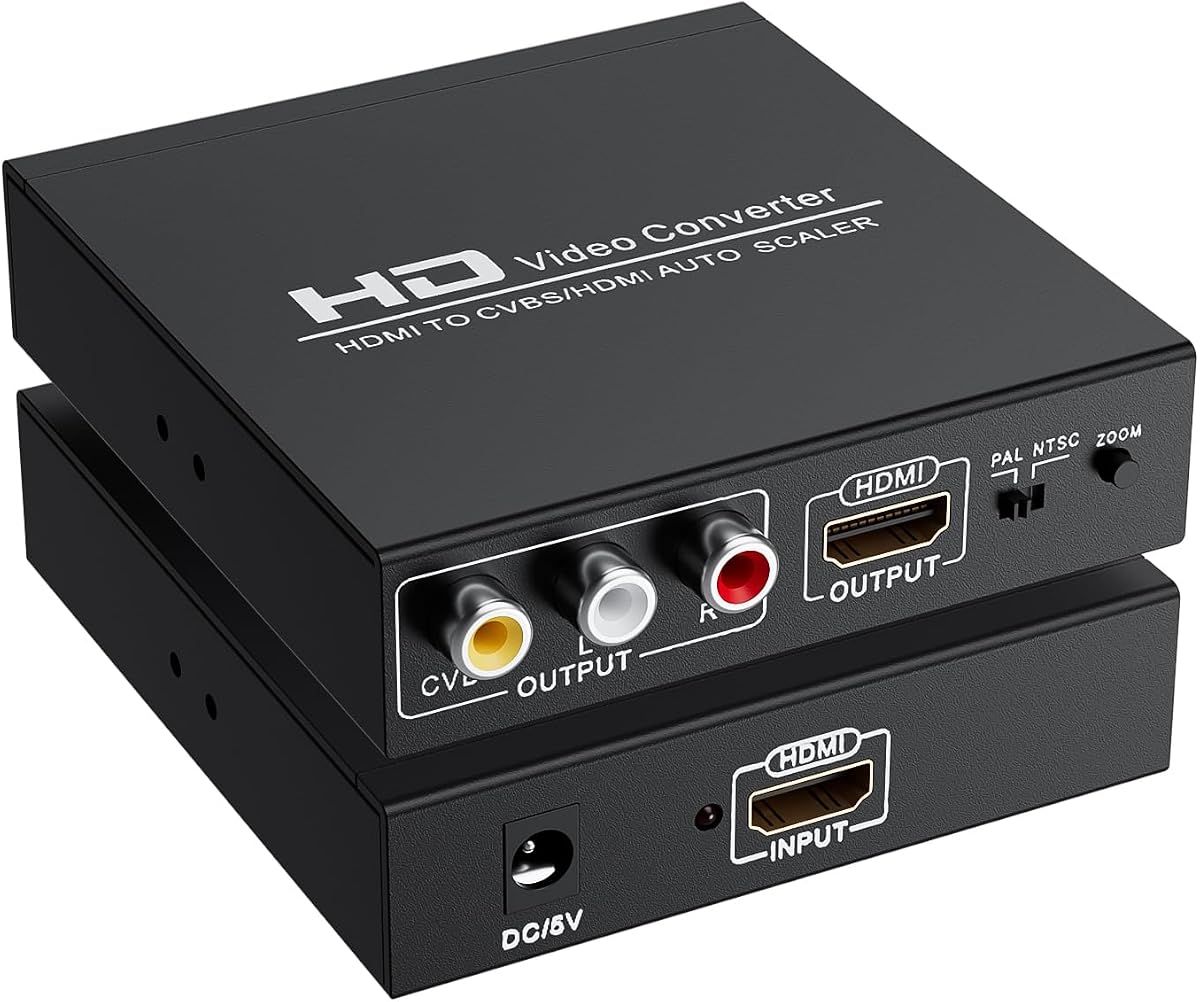
The HDMI to RCA Converter is designed for users who need to send one HDMI source to both a modern display and a legacy analog screen. It has a 4.2 rating and a useful one-input, two-output arrangement. The product translates a digital HDMI source into 3RCA composite video and stereo audio while continuing to pass the source through HDMI.
We may earn a commission when you buy through this link, at no additional cost to you.
Its input capabilities are more generous than its composite output. HDMI input can accept 1080P at 60Hz and several lower resolutions, while the RCA path reaches up to 576i. PAL and NTSC output support broadens its relevance for older televisions and regional equipment. It also supports HDCP and needs no installed driver, making it approachable for media cabinets and temporary event setups.
The main limitation is inherent to the conversion direction. This is not an RCA-to-HDMI device, so it cannot bring a purely analog source into an HDMI-only television. The analog branch also cannot retain the source's full 1080P resolution, and simultaneous output may not behave identically on every connected display. Users should set the input resolution to automatic if no signal appears, as the product guidance recommends.
Choose this converter when a single modern source must feed both HDMI and RCA displays, such as a console connected to a television and a projector. It is less suitable for archiving old VHS tapes in analog-only form or for converting an RCA source into HDMI. For those situations, an RCA-to-HDMI model is the better match.
The converter simultaneously provides HDMI and 3RCA outputs, allowing a laptop, game console, or disc player to serve two displays without a second source device.
This unit converts HDMI toward composite video and cannot convert RCA toward HDMI. Matching the direction of the signal before buying prevents an otherwise compatible-looking box from becoming useless.
We may earn a commission when you buy through this link, at no additional cost to you.
The NTSC to PAL Converter Kit is a bi-directional analog system adapter aimed at television, disc-player, and game-console users. Its 2.8 rating is the lowest among the listed products, so buyers should treat it as a compatibility-focused kit rather than a premium processing solution. The supplied information nevertheless describes a broad range of supported source equipment and straightforward plug-and-play operation.
We may earn a commission when you buy through this link, at no additional cost to you.
The adapter accepts PAL, NTSC, and SECAM inputs and produces PAL or NTSC output. Its compatibility list includes DVD and VCD equipment, cameras, VCRs, DVRs, PS2, PS3, Xbox consoles, televisions, projectors, satellite receivers, and video monitors. The package includes the converter, a mini USB cable, and two RCA cables, making it more self-contained than many competing adapters.
Its main weakness is the absence of specific output-resolution information in the supplied description. There is also no indication of advanced HDMI support, surround-sound handling, or a tuner. A 2.8 rating suggests that some users may have encountered setup, compatibility, or performance limitations. Consumers with modern HDMI-only displays should confirm that they have an appropriate source-side AV output before relying on this kit.
This kit is best for owners of region-specific game consoles and legacy media players who need to change the television system at the output signal level. It is less attractive for people seeking archival digitization, high-resolution processing, or bidirectional conversion between old analog and modern HDMI equipment. The included cables and broad console support make it a practical choice for a dedicated retro media setup.
Explicit support for PS2, PS3, and Xbox consoles makes the kit useful for players using region-specific hardware on a display with a different television standard.
The product changes output standards rather than converting recorded discs or tapes. Source equipment must remain responsible for producing the original video and audio.
We may earn a commission when you buy through this link, at no additional cost to you.
THE CIMPLE CO PAL to NTSC Converter Kit is a bidirectional television-system adapter with a 3.8 rating. It is intended for people bringing DVD players, VCRs, game systems, receivers, and streaming components into a home setup with a different regional television standard. Its clearest benefit is the straightforward kit format, which includes the necessary cables and avoids driver-based setup.
We may earn a commission when you buy through this link, at no additional cost to you.
The product information emphasizes compatibility with home-theater receivers, satellite equipment, televisions, sound bars, preamplifiers, disc players, high-definition players, consoles, and streaming services. Solid internal wiring is also claimed to reduce interference and support clean audio and video. This broad positioning makes the converter relevant to collectors building mixed analog and modern systems.
The crucial limitation is explicitly stated: it converts only the output signal from a player or console, not actual DVD discs, VHS tapes, or their recorded content. It also does not advertise a particular output resolution or support for modern digital input standards. A buyer expecting a box that digitizes tapes or turns analog RCA into HDMI should choose a different category of device.
This is a sound pick for simple PAL and NTSC output matching, particularly when the source already uses analog connections and the display accepts the appropriate standard. The 3.8 rating is more encouraging than that of the lowest-rated kit, while the clear included-cable and plug-and-play claims make setup straightforward. It is not an archival converter or a universal signal bridge.
The kit is built for a source whose output can be routed through standard analog connections and then matched to a television or other display using the opposite television standard.
Neither DVDs nor VHS cassettes are altered. The adapter only changes the live output signal from compatible playback and source equipment.
We may earn a commission when you buy through this link, at no additional cost to you.
The JTLB 1080P HD TV Video System Converter is a portable adapter designed to make single-format video devices usable with a wider range of television displays. Its 3.2 rating is moderate, but its input list is unusually broad. The supplied information names PAL, NTSC3.58, NTSC4.43, SECAM, PAL/M, and PAL/N as supported input formats.
We may earn a commission when you buy through this link, at no additional cost to you.
Output is limited to the two most widely needed standards, PAL and NTSC, which makes the device practical for common home systems. The product claims advanced processing intended to improve color, resolution, and detail. Its plug-and-play design requires no drivers, and its portable form factor suits people who need to move between television standards rather than install a permanent conversion system.
There is little detail about included cables, exact connector types, or the precise meaning of the 1080P designation in the supplied description. The moderate rating means buyers should not assume that every combination of source, converter, and display will be completely trouble-free. It is also important to distinguish supported television systems from a guarantee of native high-resolution detail from an analog source.
Choose this converter for older or unusual equipment using NTSC3.58, NTSC4.43, SECAM, or regional PAL variants. It works best when the objective is simply matching a source's television standard to a compatible display. Users seeking a defined input connector, modern HDMI workflow, or proven archival performance should consider a more specialized option.
Support for NTSC3.58, NTSC4.43, SECAM, PAL/M, and PAL/N covers several common variations encountered in older consoles, video recorders, and television equipment.
The compact plug-and-play format is useful for temporary arrangements, travel, and testing whether changing the source's television standard resolves a display problem.
We may earn a commission when you buy through this link, at no additional cost to you.
The Wenter RCA to HDMI Converter has a 4.4 rating and is a practical option for reconnecting legacy composite equipment to a modern television, monitor, or projector. It accepts yellow, white, and red RCA signals and produces HDMI output at either 720P or 1080P, 60Hz. A physical resolution switch gives users some control over display compatibility.
We may earn a commission when you buy through this link, at no additional cost to you.
The package includes separate RCA, HDMI, and Micro USB cables. A suitable 5V, 1A USB power source is required, but an AC adapter is not included. Compatibility extends across VCRs, VHS players, DVD players, set-top boxes, karaoke systems, and multiple generations of PlayStation, Xbox, Nintendo, and Super Nintendo equipment. The source format list includes PAL, NTSC3.58, NTSC4.43, SECAM, PAL/M, and PAL/N.
The product changes the connection format but cannot improve the native detail of VHS or old console graphics. Users should also plan for the required USB power connection and ensure their display accepts the selected resolution. It is specifically an RCA-to-HDMI converter and cannot be reversed to turn an HDMI source into RCA.
This is an excellent match for a living-room setup with several legacy consoles or a VHS player and only one HDMI display. Its included cable set, broad format support, and selectable output make it especially approachable. It is less relevant for users whose sources are already HDMI or whose primary goal is recording and digitizing analog media.
Composite RCA output from older players and consoles becomes easier to use on current flat-panel displays through the converter's HDMI output.
A built-in switch selects 720P or 1080P at 60Hz, providing a straightforward way to match a converter to a television or monitor.
We may earn a commission when you buy through this link, at no additional cost to you.
The WIBRF1080P Professional Pal to NTSC Video Converter is the most feature-rich premium option in this guide. It has no available customer rating in the supplied data, so its value is best assessed from its specifications. The standout feature is an integrated television tuner for PAL B/G, D/K, I, SECAM, and related tuner standards.
We may earn a commission when you buy through this link, at no additional cost to you.
Its input selection is extensive, covering RF tuner, RCA, component, and HDMI connections. The product converts PAL and SECAM signals to NTSC and can up-convert to 1080P HDMI output. A stated 240Hz video processor is intended to produce smoother motion, particularly on larger displays, while digital direct conversion is claimed to avoid signal loss.
Because no customer feedback is available, buyers should not interpret the specifications as a guarantee of flawless performance with every source. Up-conversion also does not manufacture detail that was absent from an analog recording. The tuner standards and supported input modes need to match the user's region and equipment, and the larger feature set may be unnecessary for a basic two-device installation.
This converter is suited to serious collectors, retro-gaming rooms, and installations combining broadcast tuner reception with multiple analog sources. It is the premium choice when an integrated tuner, varied inputs, and 1080P HDMI output are priorities. For a simpler console-and-projector arrangement, one of the compact RCA-to-HDMI or dedicated system converters is likely easier to manage.
The built-in tuner separates this model from simple signal adapters and allows it to serve as a more centralized home video hub.
RF, RCA, component, and HDMI inputs provide more ways to connect older broadcast equipment, disc players, and modern sources.
We may earn a commission when you buy through this link, at no additional cost to you.
The ABLEWE RCA to HDMI Converter combines a 4.4 rating with a compact, uncomplicated design. It converts analog composite video and stereo audio from yellow, white, and red RCA connectors into HDMI at 720P or 1080P, 60Hz. It is particularly useful for a budget setup involving a VHS player, older console, set-top box, or composite-output disc player.
We may earn a commission when you buy through this link, at no additional cost to you.
The converter supports PAL, NTSC3.58, NTSC4.43, SECAM, PAL/M, and PAL/N inputs. Its stated compatibility includes PS2, PS3, Xbox, N64, Wii, STB, VHS, VCR, and DVD equipment. It requires no additional drivers, and the included USB power cable keeps the operating process simple. A USB power adapter is not included, so the user must have an appropriate 5V source available.
Its limits are straightforward. It only converts RCA toward HDMI, cannot play or record media independently, and does not upgrade the native resolution of a VHS recording. Some displays may also require a compatible input setting or a change to the converter's output mode. The provided user manual helps, but users should still verify connector orientation before installation.
Among the products in this roundup, the ABLEWE model is a strong budget selection for a basic legacy-to-modern display connection. Its 4.4 rating provides a solid customer signal, while the mini format and broad source support make it versatile. Choose it when the goal is to place older RCA equipment onto an HDMI television, not when a full television-system or recording device is required.
The converter gives older composite sources a practical path to an HDMI-only television or monitor without requiring a more complex multi-input system.
Explicit support for several PlayStation, Xbox, and Nintendo systems makes the device useful for retro gaming collections and casual multiplayer setups.
We may earn a commission when you buy through this link, at no additional cost to you.
The Portta VHS to Digital Converter is a standalone video recorder designed to digitize analog sources rather than change television standards between screens. Its 4.5 rating is the highest among the available customer ratings in this list. The device records video and audio without requiring a computer, software installation, or a driver, making it approachable for preserving tapes and old recordings.
We may earn a commission when you buy through this link, at no additional cost to you.
It supports CVBS and left-right RCA audio, S-Video, and 3.5mm AUX input. Recordings can be stored in MP4 format on a USB drive or TF card, while the built-in 3-inch LCD and speaker support preview and playback. Video can be captured at up to 1080P, 30Hz, although actual results depend on the original source and selected input.
There are important distinctions between a recorder and a converter. This product cannot play VHS tapes or DVDs independently, and the compatible players are not included. Input volume settings must be correctly configured, and the storage device may need its own power when handling high-capacity media. It also records supported standards rather than providing the same two-way live television-system matching as several dedicated converters.
This is the best choice for users who want to capture VHS, VCR, DVR, DVD, Hi8, Mini DV, camcorder, and retro-console output into digital files. Its standalone design is especially useful for people who do not want to manage a computer capture setup. For live PAL-to-NTSC display matching, however, a dedicated system converter would be more direct.
A self-contained recorder can save analog media without requiring a computer, capture card, editing program, or driver during recording.
The integrated LCD, speaker, and remote control let users preview recordings, check the source, and review saved files directly on the unit.
We may earn a commission when you buy through this link, at no additional cost to you.
The Mini PAL NTSC SECAM to NTSC PAL 1080P TV Video System Converter is the most balanced dedicated converter in the roundup. Its 4.1 rating reflects generally favorable customer feedback, while its broad input list and bidirectional PAL-to-NTSC and NTSC-to-PAL operation cover the core needs of this product category.
We may earn a commission when you buy through this link, at no additional cost to you.
Supported inputs include PAL, NTSC3.58, NTSC4.43, SECAM, PAL/M, and PAL/N. The device can output PAL and NTSC and is described as providing 1080P output with advanced processing for color, resolution, and detail. It requires no drivers or additional software, and its portable mini enclosure suits permanent installations as well as changing locations.
The description does not specify every connector, included cable, or the exact conditions under which 1080P output is available. As with all analog converters, output resolution should not be confused with new native detail in the source. The product also changes live signals rather than converting recorded discs, tapes, or other files.
This is the best overall option for a user seeking a straightforward, portable, two-way television-system converter. It offers a more useful input range than basic PAL/NTSC-only boxes and avoids the directional limitations of HDMI-to-RCA or RCA-to-HDMI adapters. Confirm the physical connection layout, source compatibility, and required cables before completing the setup.
Supporting both PAL and NTSC output lets the same compact unit handle more than one regional arrangement without changing its conversion direction.
The stated high-definition output and advanced processing provide a modern presentation when connected to a suitable television, although original detail remains limited by the source.
We may earn a commission when you buy through this link, at no additional cost to you.
The right choice begins with the direction and type of signal entering the converter. After that, format coverage, connectors, resolution, power requirements, and intended use will determine whether a compact adapter or a more capable system is appropriate.
Signal direction is the first and most important filter. A PAL-to-NTSC converter accepts PAL output from a player, console, or tuner and produces NTSC for a compatible display. An NTSC-to-PAL converter performs the reverse. Bidirectional boxes can serve both arrangements, while HDMI-to-RCA and RCA-to-HDMI adapters each perform only one physical conversion. Buying a device that runs against the signal path will prevent any setup from working.
Choose the direction based on your source and display, not on the product title alone. Identify the connectors on both devices, confirm which television standard each uses, and then select a converter that accepts the source output and delivers the standard required by the display.
PAL and NTSC are broad labels, and older equipment may use variations such as NTSC3.58, NTSC4.43, PAL/M, or PAL/N. SECAM support can also matter for vintage European television equipment. A converter that lists only PAL and NTSC may handle the most common cases, while one that names each variation offers more confidence for unusual consoles, VCRs, and broadcast sources.
Match the list to the exact source equipment. For mainstream modern or retro devices, standard PAL and NTSC support may be sufficient. For imported hardware or specialist media, verify the regional television variant before ordering.
The connector determines whether a converter can physically join your components. Composite RCA video uses a yellow connector, while white and red RCA plugs carry left and right analog audio. HDMI provides digital video and audio, and component video uses several color-coded connectors. A converter cannot bridge connections that are absent from either the source or the destination equipment.
Inspect every cable and socket before buying. Determine whether you need analog video, HDMI, component video, tuner input, or a combination. Also check whether the output provides the connector type required by the television, projector, or monitor rather than assuming that any video adapter will fit.
Output resolution describes the maximum signal the converter can present, but it does not improve the source's original detail. A VHS recording can be converted to an HDMI output labeled 1080P while still containing the same softness and noise visible in the original tape. Genuine modern sources may look sharper, but display quality also depends on the source, cables, and television.
Choose a converter that provides an output mode matching your display. Models with a 720P or 1080P selector offer useful flexibility. For dedicated television-system conversion, verify that PAL or NTSC output—not only HDMI resolution—is included in the specifications.
Video conversion alone is not enough for a complete viewing experience. Composite adapters normally carry left and right audio through the white and red RCA sockets, while HDMI carries both signals digitally. Check whether the source has an audio output, whether the converter includes the necessary cable, and whether the destination display can play the resulting channel.
Some very small or tuner-based units may prioritize video and provide fewer audio options. If audio is important, use a model with explicit RCA audio or AUX support and confirm that the selected input is unmuted and configured correctly.
Many compact HDMI converters require continuous USB power and do not include a wall adapter. The Wenter and ABLEWE models both include USB power cables, while the HDMI-to-RCA model should have its power cable connected before use. A dedicated system converter may also need reliable power even if the product description does not emphasize it. Having the correct cable available prevents a frustrating setup delay.
Plug-and-play means no software or driver, not necessarily no power supply. Read the included instructions, connect power early, and use the recommended voltage. Keep analog connections as short and secure as practical to reduce interference.
A converter cannot compensate for a source that lacks a usable output or a display that cannot accept the converted format. Legacy consoles may use RCA, while newer systems are often HDMI-only. Televisions may include tuner and regional standards that differ from the equipment being connected. The product's stated compatibility list is a useful starting point, but it does not replace checking the actual ports.
Make a simple connection diagram before purchasing. Label the source, converter, and display, then identify the required input, output, power, and audio paths. This prevents confusing a one-way adapter with a full system converter.
A television-system converter adjusts a live signal so equipment can display it. A video recorder captures analog audio and video into digital files. The Portta model belongs to the latter category and cannot play tapes or discs independently. Users seeking preservation should choose a recorder, while users watching live output should choose a converter.
Decide whether the goal is compatibility, restoration, or both. A setup that requires both may need two separate devices because most of the converters in this guide are designed to pass or transform live signals rather than create editable digital files.
Begin by identifying the source output, the display input, and the television standard required by each side. Connect the converter in the correct direction, use shielded RCA or HDMI cables of suitable length, and attach the required USB power lead before switching on the source. If the product has a manual output selector, choose 720P or 1080P only when that option is listed and the display supports it.
Select the appropriate input or television mode on the television, projector, or monitor. If there is no picture, check every connector and make sure the source resolution is set to automatic where the manufacturer recommends it. Confirm that the audio input is unmuted on devices with separate volume controls, and test with a familiar source before moving the installation.
For long-term use, keep the converter ventilated and away from moisture, direct heat, and heavy impact. Avoid tightly coiling analog video cables, and do not leave an externally powered converter connected to an unattended outlet unless appropriate. Clean the enclosure with a dry or lightly damp cloth, keep liquids away from the ports, and periodically inspect plug retention and power connections.
No. A dedicated television-system converter changes the live output signal from a player or other source; it does not rewrite the content of a tape or disc. Digitizing physical media requires a video capture or recording device, and the original player remains part of the setup.
An RCA-to-HDMI adapter changes the physical connection type from analog composite to digital HDMI, while also accepting relevant television standards. A PAL-to-NTSC converter changes the television encoding standard used by the video signal. Depending on the model, it may still use RCA connections, so connector type and format conversion are separate considerations.
No. An 1080P output describes the format and resolution of the converter's output, not the detail present in the original recording. The picture remains limited by the tape, player, cables, and display, although a modern screen can make the available image look cleaner than an older CRT.
Usually not. The HDMI-to-RCA model in this guide accepts HDMI and provides HDMI plus composite output, so it cannot take an RCA source and produce HDMI. For that direction, choose a dedicated RCA-to-HDMI converter and ensure it receives the required USB power.
Some models do, including the JTLB, Mini PAL NTSC SECAM, NTSC to PAL Converter Kit, Wenter, and ABLEWE products listed here. Support should still be verified for the specific source and output arrangement, since accepting a SECAM input does not necessarily mean every PAL or NTSC output mode is available.
The most common causes are an incorrect conversion direction, a loose cable, a missing power connection, an unsupported source resolution, or the wrong television input mode. Check the signal path first, connect power before testing, set the source to automatic resolution where recommended, and confirm that the display is set to the expected HDMI or RCA input.
It depends on the direction of the converter. A composite-to-HDMI model can feed an HDMI-only display, while an HDMI-to-composite model cannot unless the television also accepts the required analog input. Dedicated system converters may require the source to provide the correct RCA or component output.
The Portta Video to Digital Recorder is designed to work without a computer, software, or drivers. It saves recordings to a USB drive or TF card and includes a preview display for monitoring. By contrast, the live television-system converters in this guide are not archival recorders.
The Mini PAL NTSC SECAM to NTSC PAL 1080P TV Video System Converter is the best overall choice for a compact, two-way, dedicated format converter. The ABLEWE RCA to HDMI Converter stands out as the best budget option for bringing composite sources into an HDMI display, while the WIBRF1080P Professional Converter offers the most comprehensive premium feature set with its built-in tuner and multiple inputs.
Prioritize signal direction before considering resolution or processing claims. Match the converter to the source connector, the display connector, the required television standard, and the power arrangement. Users who want to preserve tapes should look toward a standalone recorder, while viewers trying to display live signals should focus on PAL/NTSC compatibility and the correct adapter direction.
Finally, check the current product listing, included accessories, compatibility notes, and available customer feedback before ordering. Converter capabilities can vary by hardware revision, and prices or promotions can change. Confirming the source and display in advance will make the selected product far more useful.