
AFERIY Nomad800
4.0Editor score
512Wh battery capacity
800W continuous output
10ms UPS transfer
Only 14.3 pounds
Our Portable Power Station for Cpap guide compares 10 options for capacity, runtime, UPS support, charging speed, portability, and backup power.
A portable power station can keep a CPAP machine running during outages, camping trips, travel, and unreliable utility power. A useful model needs enough stored energy, a pure sine wave AC output, and a UPS function that transfers quickly when mains electricity disappears.
We compared ten portable power stations using their stated capacity, output, battery chemistry, charging options, UPS behavior, number of outlets, weight, and intended use. The list includes compact units for occasional travel, larger systems for extended outages, and high-capacity models for running several household essentials.
Each review explains the features that matter most for CPAP use and the compromises that may affect other buyers. Ratings and specifications reflect the supplied product information, while prices and availability can change, so confirm the latest listing details before purchasing.
4.0Editor score
4.4Editor score

4.7Editor score
The comparison below highlights the major differences in energy capacity, inverter output, UPS response, charging flexibility, portability, and outlet selection for CPAP users and other travelers.


The Jackery Explorer 1000 v2 combines a 1,070Wh battery with 1,500W of continuous AC output and a 4.8 rating, making it a strong all-purpose option for CPAP backup. Its relatively manageable 23.8-pound weight also separates it from many larger home-reserve systems, while three pure sine wave AC outlets provide flexibility for a CPAP machine, humidifier, and essential electronics.
We may earn a commission when you buy through this link, at no additional cost to you.
Charging is one of this model's strongest features. Jackery states that the unit can move from empty to full in one hour when emergency charging is enabled through the Jackery App, while the normal setting takes 1.7 hours. It also includes 100W USB-C charging, a USB-A port, a 12-volt car port, LED lighting, and app-controlled charging modes for quieter operation and reduced energy use.
The tradeoff is that the optional one-hour mode is not automatic; users must enable emergency charging before each session, and the default setting is deliberately gentler on battery health. Solar charging also requires compatible Jackery solar panels because the unit does not support third-party solar panels. For a CPAP-focused buyer who mostly recharges from a wall or vehicle, these limitations are manageable.
This is a compelling choice for campers, road travelers, and households seeking a balance of usable capacity and portability. The 1,070Wh reserve can cover many CPAP sessions, although exact runtime depends on machine settings, humidifier use, battery losses, and the age of the cells. It is our most balanced recommendation for buyers who do not need a large home system.
The 1,070Wh capacity provides meaningful overnight reserve while keeping the station lighter than most two-kilowatt-hour alternatives. A CPAP machine with a heated humidifier consumes more energy than a basic setup, so extra headroom is valuable.
Three pure sine wave AC outlets reduce concern about connecting sensitive electronics to a modified waveform. USB-C, USB-A, car, and DC connections also let the station serve phones, routers, lights, and other low-power essentials.
We may earn a commission when you buy through this link, at no additional cost to you.
The UDPOWER S1200 stands out with 1,190Wh of capacity, 1,800W of continuous output, and a listed UPS response of less than 0.01 seconds. That near-instant changeover is particularly relevant to CPAP users who want the machine to remain running when wall power fails, although the device still requires a suitable UPS mode and compatible placement.
We may earn a commission when you buy through this link, at no additional cost to you.
Its port selection is unusually extensive for a unit in this category. The specification lists five AC outlets, two 100W USB-C ports, four USB-A ports, a car outlet, and two DC5521 connections. A 120W folding solar panel is part of the product offering, though the supplied information explicitly states that the panel and power station are shipped separately.
Battery longevity and power management are additional strengths. The LiFePO4 battery is rated for more than 4,000 cycles with 80% capacity retention, while EMS technology is said to reduce standby loss and auto-sleep can extend battery life. On the other hand, the 4.1 rating is lower than those of most competing models, so buyers should pay particular attention to warranty coverage, support, and verified performance.
The S1200 makes sense for buyers who want both substantial port capacity and a folding solar option. Its many sockets are useful for travel groups or a campsite where the power station must support more than a CPAP machine. Confirm shipment contents carefully because the station and solar panel arrive separately, and verify device compatibility before relying on the extremely fast UPS transfer for critical equipment.
The advertised sub-0.01-second UPS response is among the quickest transitions in this list. That can minimize disruption to a CPAP machine and other supported electronics when the station is configured and connected correctly.
The included 120W folding panel and broad outlet array support off-grid use. Because the panel and unit ship separately, buyers should confirm the full package and delivery timeline before relying on immediate solar operation.
We may earn a commission when you buy through this link, at no additional cost to you.
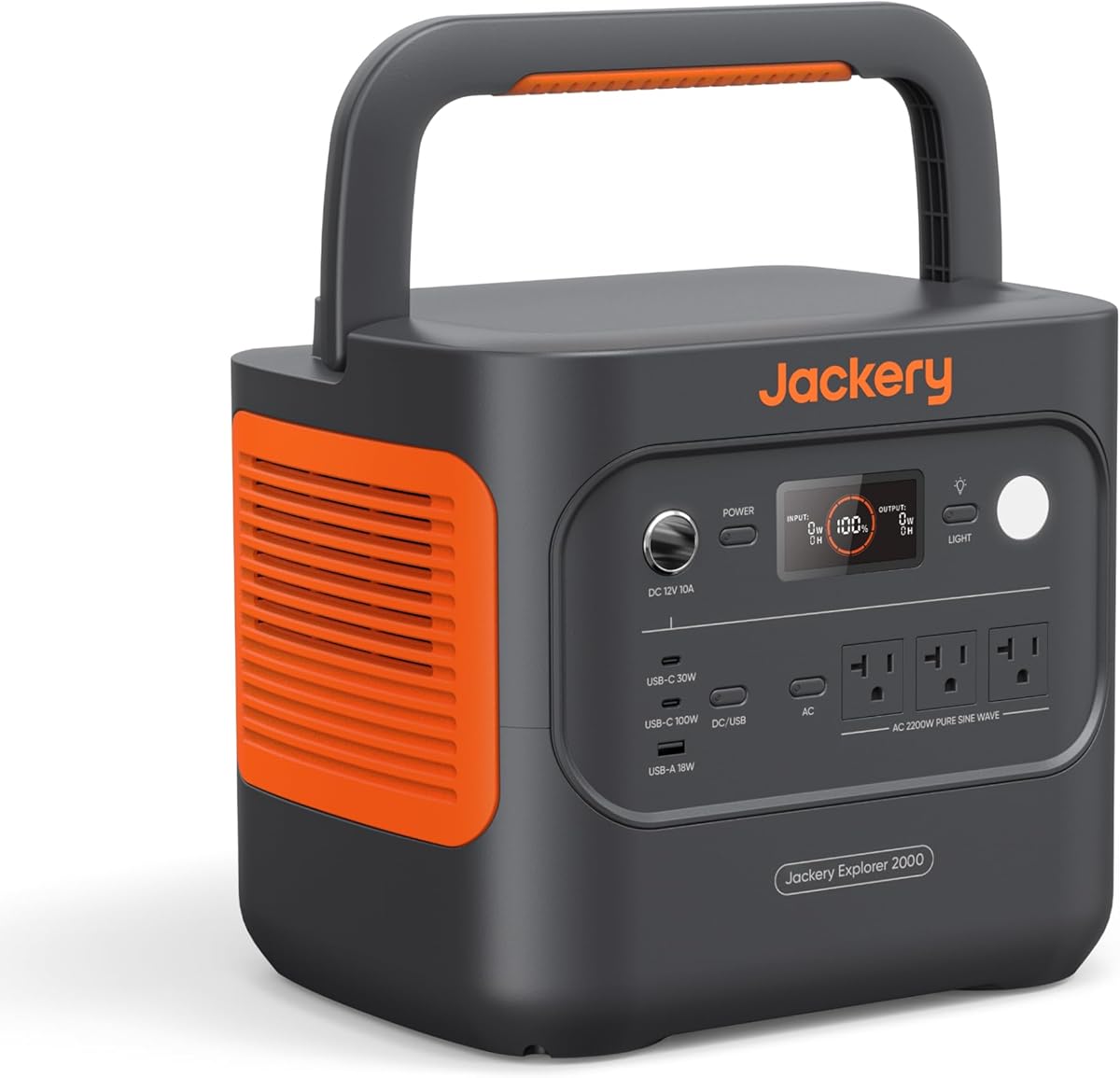
The Jackery Explorer 2000 v2 is a strong all-round CPAP power station because it combines 2,042Wh of capacity with 2,200W of AC output and a 4.4 rating. It is large enough to support a CPAP setup and several essential devices through an outage, yet the stated 39.5-pound weight remains practical for some road trips and camping setups.
We may earn a commission when you buy through this link, at no additional cost to you.
Its 20ms UPS switching is designed to transfer connected devices to stored power when utility power fails. Three AC outlets reduce the need for extension boxes, while a 100W USB-C port handles compatible phones, tablets, and other electronics. Jackery also advertises an 80% recharge in 66 minutes through AC fast charging and a full recharge in 102 minutes using the app-controlled emergency mode.
Operation and charging can be discreet. Silent Charging Mode is listed at less than 30dB, and a smart temperature system adjusts fan speed to limit noise. The main compromises are weight and solar compatibility: at 39.5 pounds, it is not truly lightweight, and Jackery specifies compatibility only with its own solar panels, which are not included in the listed box.
This model best balances CPAP runtime, output quality, fast charging, and manageable size. It is especially attractive for households that want more overnight reserve than a one-kilowatt-hour unit without moving to a three-kilowatt-hour home system. Buyers needing maximum portability should consider smaller alternatives, while those prioritizing fewer nights of backup may find the HomePower models more appropriate.
The 2,042Wh battery offers generous room for a CPAP machine, heated humidifier, router, lighting, and other essentials. Capacity alone does not determine runtime, but it provides a better margin than compact travel stations.
A 66-minute charge to 80% is useful before anticipated outages, while the advertised quiet mode helps limit noise around sleeping areas. Enabling emergency charging through the app is necessary to use the fastest schedule.
We may earn a commission when you buy through this link, at no additional cost to you.
The AFERIY Nomad800 is designed for portability, with a 512Wh battery, 800W continuous output, and a weight of only 14.3 pounds. Its title and supplied features explicitly identify CPAP and emergency use, making it one of the most direct fits in this roundup for travelers who prioritize a low carrying burden.
We may earn a commission when you buy through this link, at no additional cost to you.
The power station uses a pure sine wave output and includes a UPS that changes over within 10ms during an interruption. It offers one AC outlet, two USB QC3.0 ports, three Type-C connections rated at 100W or 20W, a DC6530 connection, and a car charging outlet. A bidirectional inverter accepts up to 400W through the appropriate charging method.
Charging specifications are ambitious for the size: the listing states that a full charge can be completed within 60 minutes using AC and a solar panel charger. It also accepts up to 400W of AC input, up to 200W of solar input, or a 120W cigarette-lighter connection. The 512Wh capacity is nevertheless the key limitation, making it more suitable for one or several shorter sessions than prolonged whole-house backup.
For campers, road travelers, and apartment dwellers wanting a compact reserve, the Nomad800 is a practical budget-oriented choice. Buyers who regularly use a heated humidifier or need a full night of margin should move up to a larger battery. Check the CPAP machine's power requirements and use the manufacturer's guidance to estimate consumption before purchasing.
At 14.3 pounds, the Nomad800 is substantially easier to carry than high-capacity models. It is a sensible option for a small travel kit, bedside emergency reserve, or campsite where carrying extra battery weight would be inconvenient.
The 10ms transfer time and pure sine wave output support sensitive connected equipment. Capacity remains the deciding factor, so users should reserve room for the CPAP machine's actual power draw and optional humidifier.
We may earn a commission when you buy through this link, at no additional cost to you.
The EcoFlow DELTA 3 offers 1,024Wh of capacity, 1,800W of output, and a 4.7 rating. Its most notable benefit for CPAP users is fast replenishment: EcoFlow states that the station can recharge fully in 56 minutes when combining 500W solar input with up to 1,500W AC input, while reaching 80% in 30 minutes.
We may earn a commission when you buy through this link, at no additional cost to you.
The unit supports 13 appliances simultaneously, providing more connection flexibility than a basic travel station. It also has a clear expansion path, working with DELTA 3, DELTA Pro 3, and DELTA 2 Max battery packs to reach as much as 5kWh. That makes it useful for buyers who want a compact present-day system with the option to expand later.
The LiFePO4 cells are rated for 4,000 cycles to 80% capacity, and the product information describes a 10-year service life for daily use. The expansion battery also carries an IP65 rating for splash, dust, and oil protection. Buyers should not expect a power station to reach its full stated runtime in every environment, particularly when using a heated humidifier or operating near temperature limits.
The DELTA 3 is a strong choice for someone who values fast charging, modular growth, and a relatively compact one-kilowatt-hour platform. It is less suitable for buyers who need maximum capacity immediately, since full expansion requires separate battery hardware. For most CPAP applications, however, the base capacity is practical, and the high rating and rapid recharge improve its overall appeal.
A short recharge cycle can restore reserve power when an outage begins without warning. The 30-minute 80% figure is particularly useful for overnight preparation, provided the station is connected to suitable charging inputs.
Compatibility with several EcoFlow battery models allows a buyer to increase stored energy over time. Expansion batteries are separate purchases, so buyers should compare the complete system cost with the cost of a larger standalone station.
We may earn a commission when you buy through this link, at no additional cost to you.
The GRECELL Portable Power Station 2400W combines 1,843.2Wh of capacity with a 2,400W continuous inverter and 4,800W surge capability. It carries a 4.3 rating and is aimed at households that want to keep CPAP equipment, refrigeration, communications, and other essentials running during extended disruptions.
We may earn a commission when you buy through this link, at no additional cost to you.
Its UPS mode transfers to battery power within 10ms when a blackout, voltage sag, or surge occurs. The system is designed for connected loads below 1,800W during UPS use, comfortably encompassing typical CPAP equipment, routers, lights, and several small household electronics. Four AC outlets and a mixture of DC, USB-C, USB-A, and car connections support up to 11 devices at once.
Recharging is flexible, with up to 1,200W household AC input, solar charging through MPPT, and vehicle charging supported. The specifications state a full AC recharge in roughly 1.6 to 2 hours, while the battery is rated for more than 3,500 cycles. An LCD provides information about current, voltage, power, temperature, and charging status, which is useful for managing remaining reserve.
This is more of a home-emergency system than an ultralight travel companion. For a CPAP user, its high output and large battery provide a comfortable safety margin, particularly when powering a heated humidifier. The absence of a clearly listed solar panel in the package and its physical size make it more appropriate for fixed locations than for frequent travel.
The 1,843.2Wh capacity leaves meaningful room beyond a single CPAP setup. It can also support a router, medical refrigerator, lighting, and selected appliances, although runtime changes with every additional load.
The display reports real-time electrical and charging information, helping users judge remaining energy more accurately. Periodic checks are still important, especially when the station is not connected to a charger.
We may earn a commission when you buy through this link, at no additional cost to you.
The EBL Acc2400 provides 1,843.2Wh of storage and 2,400W of maximum output, with a 4.4 rating. It is clearly aimed at home emergencies and group use rather than lightweight travel, but those qualities make it useful for keeping CPAP equipment, communications, lighting, and other essential loads running.
We may earn a commission when you buy through this link, at no additional cost to you.
The emergency mode switches to battery power in 0.1 seconds after a blackout. That is slower than the 10-to-20ms transfers advertised by several competing models, although a 100ms interruption may still be acceptable for many devices. Buyers who depend on uninterrupted operation should confirm how their specific CPAP machine and any medical equipment react to a brief transfer.
The connection array supports up to 12 devices through four AC outlets, two USB-A ports, two fast USB-C ports, one car port, two DC ports, and a wireless charging panel. A clear display shows remaining battery and operating status, while a four-mode LED light serves as an emergency source. The LiFePO4 battery is described as supporting more than 3,500 cycles and a service life exceeding ten years.
The major disadvantage is portability: the unit weighs 55 pounds and measures 16.9 by 11.8 by 11 inches. Dual-side handles help, but two people may still be needed for longer moves. It is best viewed as a stationary emergency appliance. Its large capacity and broad outlet selection make it a good fit for households that want a CPAP-focused reserve alongside many other essentials.
With 1,843.2Wh available, the EBL can serve more than a CPAP machine and a few chargers. It gives users room to retain power for networking, lighting, refrigeration, and other chosen essentials during a longer outage.
USB-C fast charging, USB-A, DC, automotive, AC, and wireless charging options simplify packing a mixed device kit. Users should still check whether the CPAP power brick draws more than a single USB port can provide.
We may earn a commission when you buy through this link, at no additional cost to you.
The Anker SOLIX C2000 Gen 2 pairs 2,048Wh of capacity with 2,400W rated output and a strong 4.7 rating. It offers enough energy for CPAP use and a broad selection of household electronics, while its expansion capability can raise total storage to 4kWh for buyers who want extended outage coverage.
We may earn a commission when you buy through this link, at no additional cost to you.
Efficiency is a central selling point. The product data states that the unit uses only 9W in standby, and an expansion battery can increase the listed dual-door refrigerator runtime from 32 hours to 64 hours. A CPAP setup is far less demanding than a refrigerator, so the efficient standby design helps preserve stored energy when the station is not actively operating.
The station supports six recharge methods, and the supplied information states that a full charge takes 58 minutes with AC and solar. An 800W alternator charging option can recharge it from a vehicle to full in three hours. At 41.7 pounds, it is not lightweight, but its stated size is smaller and lighter than many similarly capable systems.
This is a premium choice for buyers who want fast replenishment, expandable capacity, and strong efficiency in one package. One gap in the provided information is an explicit UPS transfer time, so buyers who require automatic uninterrupted transfer should verify that function and its compatibility with their CPAP equipment before purchase. For planned outages and portable power, the specification set remains impressive.
The listed nine-watt standby draw helps limit energy loss while the station waits for an outage. This matters for a backup product that may sit beside a CPAP setup for weeks before it is needed.
Adding an expansion battery increases available storage, while AC, solar, and 800W alternator charging provide several ways to replenish the system. Each expansion or charging accessory should be considered when comparing the complete setup.
We may earn a commission when you buy through this link, at no additional cost to you.
The Jackery HomePower 3600 Plus is the largest and most capable system in this guide, offering 3,584Wh of capacity, 3,600W of output, and 7,200W in parallel operation. Its scale makes it appropriate for households that view a power station as a serious source of emergency electricity rather than merely a portable CPAP battery.
We may earn a commission when you buy through this link, at no additional cost to you.
The product supports 120V and 240V in parallel, allowing it to serve a wider range of equipment when configured with the appropriate Jackery MTS system. Capacity can expand to 21kWh per unit or 43kWh with multiple units. A CPAP machine would use only a small part of this reserve, leaving considerable energy for refrigeration, communications, pumps, heating, and other selected loads.
The battery uses high-temperature-resistant ceramic membrane cells tested at 302 degrees Fahrenheit and is rated for 6,000 cycles and a 10-year lifespan. Recharging options include hybrid AC and DC, AC, solar, and a gas generator. The stated full-recharge time ranges from two hours with hybrid charging to four hours with solar, depending on the method and conditions.
Portability is relative for a unit of this class. Jackery describes it as the lightest 3.6kWh LFP power station, and the luggage-style chassis includes wheels and a telescoping handle, but it is still a substantial stationary system. It is best for owners seeking multi-day resilience and broader household coverage rather than a small travel companion.
A 3,584Wh battery gives a CPAP user an exceptionally large safety margin. It also allows the owner to prioritize other essential equipment without quickly depleting the reserve.
Dual 120V and 240V support and high parallel output distinguish this model from compact camping stations. The required MTS and any expansion equipment should be included when calculating the full cost and setup complexity.
We may earn a commission when you buy through this link, at no additional cost to you.
The Jackery HomePower 3000 combines 3,072Wh of capacity with 3,600W of continuous output and a 4.5 rating. It is a capable home-reserve system for CPAP users who also want to maintain a router, security cameras, lighting, pet feeders, refrigeration, and other important equipment.
We may earn a commission when you buy through this link, at no additional cost to you.
Its UL-certified UPS switches within 20 milliseconds, providing a brief and generally well-controlled transition when utility power fails. The output section includes AC, dual 100W USB-C, USB-A, and DC connections, plus a TT-30 RV port. The product information states that a household can be supplied for up to 15 hours and a refrigerator can remain running for one to two days, depending on the load and operating conditions.
Charging is flexible. A hybrid AC and DC setup can fully recharge the unit in 1.7 hours, AC charging takes 2.2 hours, and pairing it with two 200W SolarSaga panels can reach 80% in nine hours. A 12-volt car charger and gas-generator input offer additional options when conventional electricity is unavailable.
The 4,000-cycle LiFePO4 battery retains 70% capacity under the stated test conditions. ChargeShield 2.0 and integrated PV and inverter design are intended to improve charging and reliability. This is an excellent choice for a fixed home backup system, but buyers wanting routine travel should look at the Explorer models because this unit is much larger and heavier.
The stated UPS use cases include medical refrigerators, security cameras, and remote communications. CPAP equipment fits comfortably within that home-reserve role, provided the unit is configured for the intended load.
Hybrid charging is especially useful for preparing a full reserve before a storm or expected outage. Solar and vehicle charging provide useful alternatives when the station is away from a wall outlet.
We may earn a commission when you buy through this link, at no additional cost to you.
The right CPAP power station depends on expected runtime, portability, transfer behavior, charging access, and the amount of equipment that must remain online. Use the following factors to narrow the choices before making a purchase.
Begin with the CPAP machine's average power draw and how long it must run without wall power. A heated humidifier, heated hose, battery-powered machine, and high-pressure setting can all change consumption, so calculate a realistic energy budget rather than relying on a single wattage figure. Add expected inverter losses, device age, and a safety margin when estimating the capacity needed for one night or several nights.
The stated capacity alone does not determine runtime. A 512Wh unit may be ideal for short trips, while a 1,000Wh to 2,000Wh station offers safer overnight coverage. Larger systems are preferable when the power station must also run a router, lighting, medical refrigerator, or other essential equipment.
A pure sine wave inverter is the most appropriate waveform for sensitive electronics and should be preferred when the choice is available. UPS mode allows the station to sit between the wall outlet and CPAP machine, then take over after a failure. Transfer times range from less than 0.01 seconds to 0.1 seconds across the listed products, and the manufacturer should explain whether the CPAP machine can remain powered during the switch.
Choose a short transfer time when uninterrupted operation is important. UPS rating, supported load level, and whether the device can be configured for standby use should all be checked. A large inverter is unnecessary for a CPAP machine alone, but it may be valuable if the same station supports other household equipment.
Portable power stations become less portable as battery capacity and inverter output rise. The AFERIY Nomad800 weighs 14.3 pounds, while the Jackery Explorer 1000 v2 is listed at 23.8 pounds. Larger models weigh roughly 40 to 55 pounds, making them more suitable for a vehicle, garage, or prepared home space than a carry-on travel kit.
For frequent road trips, favor a unit with a foldable handle, manageable weight, and enough capacity for the planned overnight use. For outages lasting multiple days, larger capacity and expansion may matter more than carrying convenience. Decide where the station will live before choosing its size.
Consider how quickly the power station can be restored before and during an outage. Several products advertise full charging in roughly 56 to 58 minutes, while others take between 1.6 and several hours. Faster charging is useful when a storm is approaching, but repeated emergency charging can affect long-term battery management and should follow the manufacturer's instructions.
Wall charging, vehicle charging, and solar input provide different levels of independence. Check the maximum accepted wattage, required adapter or cable, and whether a panel is included. Jackery Explorer models are stated to work only with compatible Jackery solar panels, so buyers should not assume any third-party panel will be accepted.
Lithium iron phosphate, or LiFePO4, chemistry is used across the list and is generally associated with thermal stability, a cycle life in the thousands, and a lower risk of thermal runaway than conventional lithium-ion chemistry. Published cycle figures still depend on charge depth, temperature, charging rate, and the capacity threshold used by the manufacturer.
A unit rated for 4,000 or more cycles is a strong option for frequent use. Look for battery-management features, temperature regulation, overcharge protection, and clear warranty terms. Long cycle life matters most when the station remains plugged in as a permanent emergency reserve rather than serving only as a travel accessory.
Most CPAP machines use a proprietary AC adapter with a standard wall plug, making a grounded-looking AC outlet the primary requirement. Additional outlets, USB-C charging, DC ports, automotive sockets, and wireless charging are helpful for surrounding essentials, but they should not distract from verifying the CPAP power brick's input requirements and whether the station's pure sine wave output is suitable.
Review the package carefully. The UDPOWER listing includes a 120W panel in the offering but states that the station and panel ship separately. Other models include an AC cable only, while solar panels and expansion batteries may require separate purchases. A complete-package comparison is more meaningful than comparing battery specifications alone.
A small station can preserve CPAP operation during a short outage, but sustained outages require enough capacity for medical equipment, communications, lighting, and food preservation. Large home systems also consume more space and are harder to relocate. Matching capacity to the realistic duration of an outage helps prevent spending on unnecessary capacity while avoiding a reserve that empties too quickly.
For a CPAP-only emergency kit, a unit from 512Wh to around 1,100Wh may be sufficient for selected travel scenarios. For overnight coverage with a heated humidifier, consider 2,000Wh or more. Homes preparing for multi-day disruptions should evaluate 3,000Wh-class systems and carefully consider expansion.
A clear display showing remaining capacity, output, temperature, and charging status helps avoid over-discharging the battery. LED lighting is valuable during outages, and app-controlled modes can provide quiet charging, energy-saving operation, or emergency fast charging. These features are conveniences rather than substitutes for adequate capacity or correct UPS configuration.
Check whether the controls can be understood without an app and whether the display remains legible in bright daylight. For frequent camping or travel, a simple interface and physical status lights may be more useful than advanced software features.
Before relying on a power station for sleep therapy, fully charge it and confirm that the CPAP machine starts normally from the station's AC outlet. Review the CPAP manufacturer's instructions, the power station manual, and the output requirements of the machine's adapter. Avoid adapters or extension arrangements that the equipment manufacturer does not support.
For UPS use, place the power station between the wall outlet and the CPAP machine, then enable the documented UPS setting. Verify the transfer by briefly interrupting the appropriate input in a safe, controlled manner. Check displayed remaining capacity regularly, preserve a reserve for the full expected night, and keep the station in a ventilated, dry location away from direct heat and combustible materials.
Recharge according to the manufacturer's instructions and avoid leaving a deeply discharged battery stored for long periods. Use compatible charging cables and solar equipment, monitor temperature during charging, and keep liquids and moisture away from the unit. Periodically inspect the case, outlets, cables, and cooling vents, and contact the manufacturer if there is swelling, unusual odor, leakage, or physical damage.
Runtime depends on battery capacity, the CPAP's power draw, humidifier heat, machine settings, and inverter efficiency. A small 512Wh station may suit short or moderate-duty trips, while a 1,000Wh to 2,000Wh unit provides more overnight margin. Calculate the CPAP's average consumption and reserve extra capacity for a heated humidifier and real-world losses.
UPS mode is highly useful if the station should take over automatically when wall power fails. It is especially valuable during outages because the machine can continue without manual intervention. Verify the advertised transfer time, connect the CPAP through the correct outlet, and test the setup before an emergency.
Pure sine wave output is generally preferable for sensitive AC-powered electronics because it provides a cleaner waveform than modified or square-wave alternatives. A CPAP power brick may also perform acceptably with other outputs, but the CPAP manufacturer and power station instructions should guide the decision. When possible, choose pure sine wave for greater compatibility.
It depends on the operating-temperature range stated in the product manual. Cold can temporarily reduce battery performance and charging speed even when the unit is not damaged. Keep the station away from moisture, allow it to reach a suitable temperature before charging, and avoid using it outside the manufacturer's recommended conditions.
Some models support charging modes or smart charging designed for periods connected to wall power, while others may use energy in standby. Review the manual and select the appropriate storage or maintenance mode rather than assuming every model behaves identically. Periodic checks ensure the battery remains charged and the display shows no fault.
They usually increase energy consumption because the humidifier heats water throughout the night. A station with more capacity or a higher conversion efficiency is therefore preferable. If a heated setup is unnecessary, using a cool-air configuration can reduce consumption, but only if the CPAP manufacturer says it is safe and appropriate for the user's prescribed therapy.
Yes, if its output and capacity can handle the combined load. Routers, lights, phones, medical refrigerators, and small appliances are common additions, while heaters and other high-draw equipment can consume the reserve quickly. Check continuous and surge requirements and monitor energy use rather than judging only by the number of outlets.
Solar charging improves independence but is not essential for every use case. Check the panel's wattage, the station's maximum solar input, connector type, and manufacturer compatibility. Jackery Explorer models are specified as compatible only with Jackery solar panels, and some other packages include or exclude panels depending on the listing.
The Jackery Explorer 2000 v2 is the strongest all-around choice because it combines a 2,042Wh battery, 2,200W output, 20ms UPS switching, fast charging, and manageable weight. The AFERIY Nomad800 is the most travel-friendly selection, while the Anker SOLIX C2000 Gen 2 is the premium pick for efficiency, fast recharging, and expansion.
Prioritize usable energy capacity, inverter quality, and verified UPS behavior before considering extra ports or maximum output. Smaller buyers may comfortably use a compact station for a planned night, but homes facing extended outages should consider a larger unit and reserve capacity for essential equipment beyond the CPAP machine.
Finally, check the current listing, warranty, included accessories, and compatibility information before ordering. Product specifications, promotions, and availability can change over time, and the most suitable power station ultimately depends on the CPAP's power draw, your travel or outage plans, and the amount of equipment you intend to keep running.