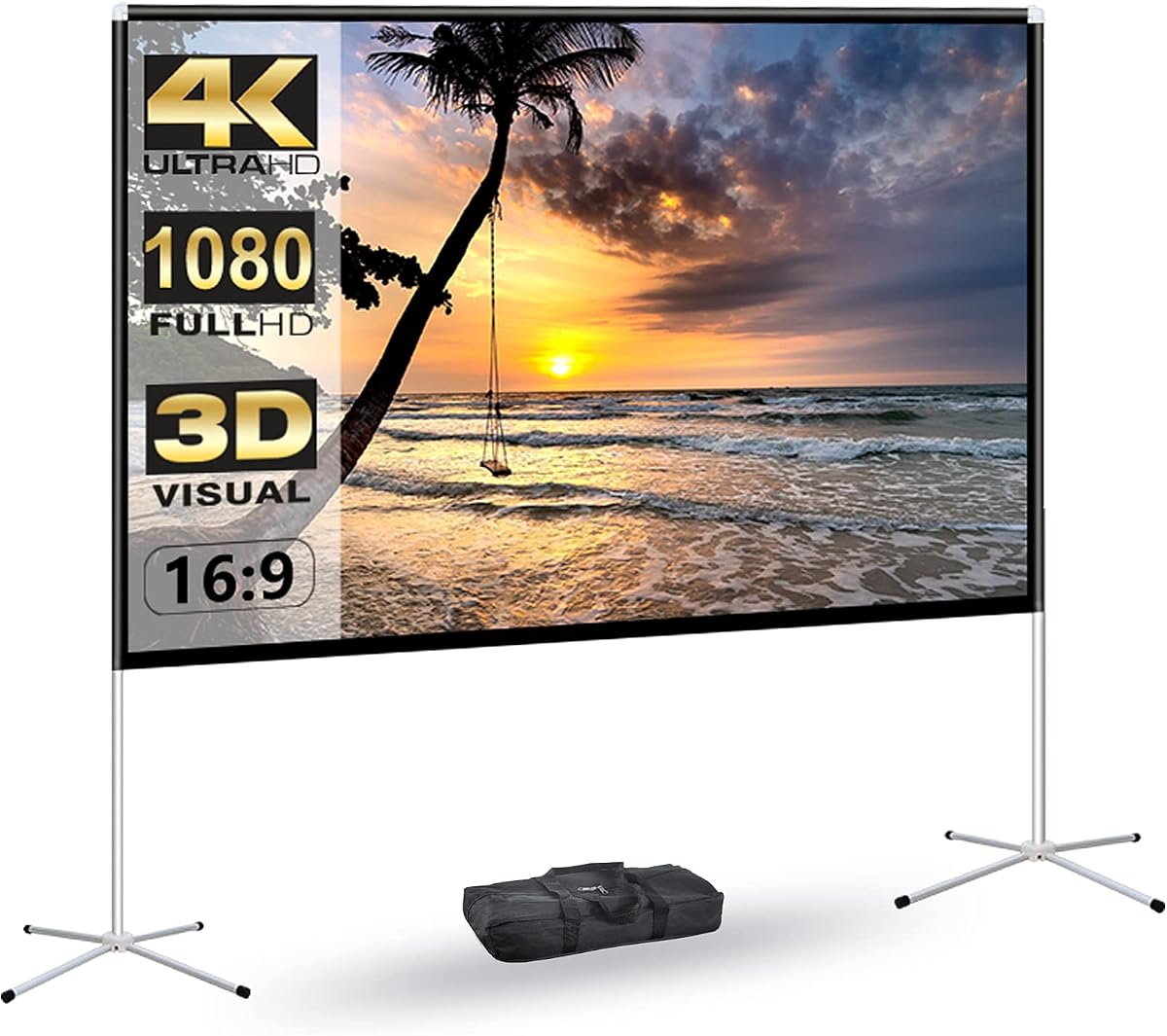
80-Inch Outdoor Projection Screen
4.4Editor score
Tool-free folding frame
Washable polyester surface
Padded carry bag
160-degree viewing angle
This guide compares 10 portable projector screen with stand options for size, stability, portability, image quality, setup, and outdoor versatility.
A portable projector screen with stand can turn a blank wall, backyard, campsite, or temporary presentation space into a much more convincing viewing area. The right model balances screen size, image surface, frame stability, carrying convenience, and resistance to wrinkles, while the accessories can determine whether it remains upright outdoors.
We compared all ten products by their stated dimensions, aspect ratios, viewing angles, materials, setup systems, carrying solutions, and outdoor support accessories. The list covers small travel-oriented screens, mid-size garage and backyard options, and large home-cinema frames for buyers with adequate space.
Each review identifies the strongest use for the product while noting practical limitations involving size, weight, wind resistance, or required room dimensions. Ratings and availability can change, and current prices fluctuate, so readers should confirm the latest listing details and fit before purchasing.
4.4Editor score

4.3Editor score

4.3Editor score
The comparison below makes it easier to distinguish compact travel screens from backyard and home-theater models using stated screen dimensions, aspect ratios, materials, setup methods, and outdoor stabilization features.


The 50-Inch Retractable Stand Screen is the most compact model in this guide and is designed for buyers who want a dedicated projection surface without carrying a large theater frame. Its standout qualities are a 2.5-kilogram net weight, a folding structure, a lifting handle, and a tension-based system that can be opened and closed without tools or permanent installation.
We may earn a commission when you buy through this link, at no additional cost to you.
The screen uses a high-gain fiberglass surface described as flat and wrinkle-resistant. A stated 160-degree viewing angle and 1.2 gain make it appealing for compact living rooms, dorms, classrooms, and presentations where seats are relatively close to the screen. Opening the legs, positioning them at 90 degrees, and engaging the locks provides a more controlled setup than a loose fabric sheet hung from a wall.
There is an important specification inconsistency: the product title calls it 50-inch 4:3, while the supplied operating information gives a 40.16-by-29.92-inch projection area and describes the screen as 16:9. Buyers should compare the actual dimensions rather than relying on the nominal size label, particularly when projector placement and image scaling depend on exact aspect ratio.
This screen makes the most sense for indoor users, travelers, and anyone who values a small stored footprint over a cinematic display size. It is not the strongest choice for a large backyard audience because its light frame and modest dimensions cannot offer the visual scale or anchoring capability of the 100-, 120-, and 150-inch models. For a small room or temporary indoor presentation, however, it is remarkably convenient.
The retractable frame, auto-lock mechanism, and folding legs remove the need for wall mounting. That makes the screen useful in rented rooms, classrooms, offices, and homes where installation is inconvenient or prohibited.
At a stated 2.5 kilograms, the screen is easier to carry than the large steel-framed alternatives. Its compact folded dimensions also make storage more practical for users with limited closet or trunk space.
We may earn a commission when you buy through this link, at no additional cost to you.
The 120-Inch Reinforced Outdoor Screen is the strongest all-around choice for buyers who want one screen for backyard movies, camping, indoor entertainment, and large gatherings. It combines an extended reinforced base with steel support pieces, a washable milk-silk surface, a 160-degree viewing angle, and one of the most complete outdoor stabilization kits in the list.
We may earn a commission when you buy through this link, at no additional cost to you.
Its stability package is particularly useful. The included four ground stakes, two ropes, and two sandbags give the user several ways to secure the screen rather than relying on its base alone. The steel accessories are described as resistant to bending and breaking, and the fabric is positioned to reduce edge wrinkles. Front and rear projection support also broadens the placement possibilities when the projector cannot sit directly in front of the audience.
This is still a large product, so the carry bag, folding structure, and tool-free assembly are what make it practical. The screen can be used in a living room, backyard, or campsite, but a 120-inch image demands adequate viewing distance and a space without obstructions. Even with the reinforced base, no portable screen should be treated as a permanent structure, and the windproof accessories must be used appropriately.
Recommended for households that regularly host outdoor movies or want a screen capable of serving a sizeable audience, this model balances image scale, stability, and portability better than the smaller alternatives. It is also a safer recommendation for buyers who value a complete anchoring kit over buying optional accessories separately.
A widened base, strong support frame, ground stakes, ropes, and sandbags create a layered approach to stability. That system is more convincing for a backyard movie night than an unweighted frame placed directly on the ground.
Support for front and rear projection means the projector can be placed in different positions. This is useful in constrained rooms where the audience or equipment would otherwise interfere with a conventional front-facing setup.
We may earn a commission when you buy through this link, at no additional cost to you.
The 80-Inch Outdoor Projection Screen is an approachable middle ground for buyers who want more screen than a wall or compact travel model but do not need the bulk of a 120- or 150-inch frame. It uses lightweight aluminum tubing, a polyester projection surface, a 16:9 format, and a stated 160-degree viewing angle.
We may earn a commission when you buy through this link, at no additional cost to you.
Tool-free assembly is one of its most useful features. The frame can be unfolded, fitted together, and disassembled without specialized tools, then placed into the included padded bag when the event ends. The fabric can be washed after becoming dirty, which is valuable for outdoor use where dust, splashes, and smoke can reach the surface.
Its outdoor accessories include a matching rope, hanging hook, and water bag, although the stabilization package is less comprehensive than those offered by the 120-inch reinforced model. The stated one-hand lifting weight of 5.62 pounds reinforces that this is designed for convenient transport, but the complete assembled package may feel heavier than that isolated figure implies.
This screen is recommended for couples, families, campers, and small gatherings that value convenience over maximum image dimensions. It can work in a backyard, living room, or campsite and can also support sports, games, and casual presentations. Choose it when moderate screen size, easy packing, and a relatively modest frame are more important than a true home-theater scale.
The aluminum construction and padded bag make this model practical for spontaneous movie nights. It folds down after use and avoids the heavier bulk associated with the largest steel-framed alternatives.
Washable polyester is a practical advantage in outdoor environments. Keeping the surface clean helps preserve image clarity, while the stated wrinkle-free treatment supports an even presentation after the frame has been tightened.
We may earn a commission when you buy through this link, at no additional cost to you.
The 150-Inch Foldable Cinema Screen delivers an unusually large image for a portable frame and is intended for dedicated backyard, event, and presentation areas. Its 16:9 format, polyester surface, iron support frame, carry bag, ground nails, and rigging ropes form a complete package for buyers who want a theatrical display rather than a compact travel accessory.
We may earn a commission when you buy through this link, at no additional cost to you.
The fabric is described as thick, opaque, and resistant to creasing even after folding or compression. That makes it more reassuring for owners who expect the screen to be transported repeatedly. The frame can be assembled in minutes without tools, and its folding components fit inside the included heavy-duty carrying bag.
The principal drawback is the practical burden of a 150-inch structure. It needs a wide room, a broad outdoor clearing, and enough distance between the screen and viewers to make the image comfortable. Although ground nails and ropes improve stability, the product does not offer the detailed reinforced-base system seen on some 120-inch competitors.
Best for families with a large backyard, community event organizers, and users creating an outdoor cinema area, this model balances scale with portability. It is less appropriate for small rooms, apartments, or casual users who only need a screen for a few viewers. Ensure the full assembly area is clear and that the surface is tensioned evenly for the best result.
A 150-inch diagonal creates a much more theatrical presence than an 80- or 100-inch screen. The wide format is well suited to films, sports, gaming, and public gatherings where a large audience is the priority.
Although large when assembled, the screen folds into a carry bag rather than remaining a permanently rigid structure. That balance makes it practical for event-based use and recurring backyard movie nights.
We may earn a commission when you buy through this link, at no additional cost to you.
The 120-Inch STWUI Outdoor Screen focuses on a more stable chassis and a material system designed for both indoor and outdoor projection. It has a lengthened, weighted support structure, holes for customized ground nails, an all-iron bracket, a washable milk-silk surface, and a stated 160-degree viewing angle.
We may earn a commission when you buy through this link, at no additional cost to you.
The removable beam and tool-free assembly simplify construction, while the iron components are intended to improve durability compared with plastic-heavy frames. The screen supports front and rear projection, and its elastic fabric is described as foldable and washable. These properties make it suitable for family movie nights, schools, offices, weddings, churches, and camping.
Although the product information mentions a nine-minute setup, the process still involves assembling a large frame, stretching the material over it, and securing the structure. The stated storage-bag dimensions also suggest that users should consider the screen a semi-portable event frame rather than a casual one-handed accessory.
Recommended for buyers who want a substantial 120-inch image and prioritize an improved metal chassis, it is a solid alternative to the reinforced 120-inch model. Its most compelling use is a planned event or recurring backyard gathering where setup time is less important than a stable display once the frame is assembled.
The weighted, lengthened frame is intended to address the instability common in lightweight outdoor screens. Ground nails can pass through the chassis holes, creating a firmer connection between the screen and the ground.
The washable milk-silk surface can be maintained after outdoor use and supports either front or rear projection. That flexibility is useful for different room layouts and event arrangements.
We may earn a commission when you buy through this link, at no additional cost to you.
The 150-Inch Towond Projection Screen is the most comprehensive premium package in the comparison. It combines a large diagonal display, a 160-degree viewing angle, front and rear projection, a natural polyester surface, five crossbars, six ground nails, six ropes, two brackets, and a storage bag.
We may earn a commission when you buy through this link, at no additional cost to you.
Its assembly system is designed to be unusually quick for a frame of this size. The user unfolds the stand, and elastic cords inside connect the sections automatically without tools. The manufacturer states that installation can be completed in about five minutes. The thick, anti-crease material is intended to remain relatively flat once tensioned.
The trade-off is weight and space. The supplied information lists 11.5 pounds for the screen and carry bag, making it the heaviest stated option here. A 150-inch screen also needs a room wider than 140 inches for indoor use, as the listing specifically warns. Buyers must be willing to handle a large frame even though it folds for transport.
This premium model is recommended for dedicated home-theater owners, large backyard venues, event professionals, and anyone who values a complete accessory package and rapid setup. It is less suitable for renters, small apartments, or casual viewers who plan to move the screen frequently. The included anchoring components make it particularly relevant to buyers planning frequent outdoor screenings.
Five crossbars, multiple ground nails, ropes, brackets, and a carry bag cover the main needs of assembly, transport, and anchoring. The breadth of the package reduces the need to search for compatible extras.
Support for both 16:9 and 1:1 presentation gives users more flexibility than a fixed-format screen. The front-and-rear projection option also expands placement options for large rooms and outdoor layouts.
We may earn a commission when you buy through this link, at no additional cost to you.
The 100-Inch Double-Sided Screen sits neatly between compact travel models and large outdoor cinema frames. Its 100-inch 16:10 format, natural polyester fabric, aluminum alloy floor bracket, and 160-degree viewing angle make it a versatile option for movies, presentations, education, and backyard gatherings.
We may earn a commission when you buy through this link, at no additional cost to you.
The screen can be set up in about five minutes without tools. Ropes, nails, and water bags are included for outdoor stability, while a carry bag simplifies transport and storage. The polyester surface is described as transparent, wrinkle-resistant, curl-resistant, and suitable for double-sided projection, which adds useful placement flexibility.
The 16:10 aspect ratio deserves attention because most home video content is 16:9. A projector may therefore display small bars or require image scaling depending on its menu settings. That is not necessarily a flaw for computer presentations or casual viewing, but users expecting a perfectly filled cinema image should account for the difference.
Recommended for buyers who want a middle-sized screen without moving to the largest frame, this product suits medium backyards, living rooms, classrooms, and offices. It is also a practical travel choice for road trips because the 100-inch format offers more impact than the smaller screens without requiring the storage volume of a 150-inch model.
The 16:10 ratio can be advantageous for presentations, web content, and some gaming displays. Movie viewers should verify their projector's native and scaling options because 16:9 footage may not fill the entire surface.
A foldable design, carry bag, quick assembly, and outdoor hardware make this screen useful in more than one setting. It is especially practical for owners who need a capable display but do not want the size and weight of a 150-inch frame.
We may earn a commission when you buy through this link, at no additional cost to you.
The 80-Inch Foldable Travel Screen emphasizes low weight and quick assembly. It uses lightweight but sturdy aluminum tubing, a natural polyester surface, a 16:9 format, and a stated 160-degree viewing angle. The supplied information also highlights an updated material treatment intended to improve sturdiness and durability.
We may earn a commission when you buy through this link, at no additional cost to you.
Setup involves connecting short tubes to fasten the screen flat to the frame. This approach avoids a complex collection of separate parts and allows the screen to be assembled in a few minutes. A soft padded bag protects the folded unit during transport and makes it easier to place in a car trunk for family trips, camping, or a backyard movie night.
The aluminum construction contributes to portability but also means the frame should not be expected to handle strong wind without securing it to the ground. The product information mentions fixing the scaffold when wind is present, yet does not describe a kit as comprehensive as the stakes, ropes, and sandbags offered by the larger reinforced models.
Recommended for travelers, couples, and casual families, this screen is a good match for an 80-inch portable projector setup. It is also appropriate for schools, offices, churches, weddings, and presentations where a modest temporary display is enough. The result is a practical travel screen rather than a permanent outdoor installation.
Short tubes allow the support structure to be connected quickly and laid out flat. This reduces setup time and helps users move from unpacking to a usable screen with less assembly than a large multi-piece frame.
The soft padded bag helps protect the screen and frame in a vehicle. It also reinforces the product's travel orientation, making recurring use away from home more realistic.
We may earn a commission when you buy through this link, at no additional cost to you.
The 60-Inch Tripod Travel Screen is built for small spaces and genuine mobility rather than large audiences. Its 60-inch diagonal is intended for RVs, dorms, bedrooms, office use, and casual camping, while a 242-gram elastic surface and aluminum tripod keep the overall package unusually light.
We may earn a commission when you buy through this link, at no additional cost to you.
Installation uses an updated hook system instead of the Velcro straps mentioned in some older printed manuals. Once the tripod is extended, hooks and rubber caps secure the screen without tools. The stand is height-adjustable, and a drawstring pouch, hooks, rubber caps, and sandbag are included for a complete entry-level kit.
The fabric is elastic and folds tightly, so initial creases are normal. Stretching it onto the frame can reduce them, and low heat may be used if needed. Outdoor stability is the main concern: the manufacturer specifically recommends the sandbag and advises indoor or wind-free outdoor use rather than presenting the tripod as a heavy-duty fixed installation.
Recommended for travelers, students, renters, and families wanting a very small temporary screen, this model prioritizes convenience over image scale and wind resistance. It is less appropriate for large gatherings, exposed campsites, or buyers seeking a premium home-cinema surface. The included sandbag should still be filled for the most stable outdoor use.
The compact 60-inch diagonal and foldable fabric suit locations where an 80- or 100-inch screen would not fit. It is a useful alternative to projecting directly onto a wall in a dorm, camper, or small bedroom.
The revised hook-based attachment avoids the need for hook-and-loop straps. Buyers should follow the current instructions in the package because some printed manuals may still describe an earlier installation method.
We may earn a commission when you buy through this link, at no additional cost to you.
The 120-Inch Stake-Down Outdoor Screen is built around an anchoring concept that distinguishes it from many portable competitors. Its widened and thickened base plate has holes through which ground stakes can be inserted into soil, while a steel bracket, four stakes, and two ropes add further wind resistance.
We may earn a commission when you buy through this link, at no additional cost to you.
The high-density woven milk-silk surface is described as thick, elastic, and wrinkle-resistant, with support for vivid color and both front and rear projection. A 16:9 ratio and 160-degree viewing angle make it suitable for a large mixed audience. Modular splicing tubes and hook-and-loop straps allow the screen to be pulled flat and attached without tools.
The main limitation is environmental. The stake-down base is most natural in a backyard, campsite, garden, or other area where stakes can enter the ground. Although the screen can also be used indoors, the base design and assembly complexity are less attractive for users with only smooth flooring. The claimed eight-minute setup should be treated as an approximate assembly estimate rather than a guarantee for every user.
Recommended for outdoor movie regulars who want a robust base and strong surface, this model is particularly useful where sandbags are inconvenient and soil is available for anchoring. It is less suitable for small apartments, smooth indoor floors, or anyone wanting the simplest possible setup. Proper stake placement and tensioning are essential to achieving the advertised stability.
Ground stakes pass through dedicated holes in the weighted base, fixing it to the soil rather than relying on surface weight alone. This approach reduces the need to carry heavy sandbags for many outdoor installations.
The woven milk-silk material, 16:9 format, and 160-degree viewing angle are designed to produce a large, bright presentation for a sizeable group. Front and rear projection support also improves placement flexibility.
We may earn a commission when you buy through this link, at no additional cost to you.
Screen size, aspect ratio, frame stability, surface material, carrying weight, and anchoring system should be considered together. The best choice is the one that fits the intended space and can be supported reliably at that size.
A screen's diagonal size determines how much visual impact it creates, but a large nominal measurement can be misleading if the usable projection area is smaller. Compare the stated width and height whenever those measurements are provided, and account for the distance between the projector, screen, and audience. A 60-inch screen works well in intimate rooms, while 80- and 100-inch models suit family viewing. A 120- or 150-inch screen can feel cinematic but demands substantial space and appropriate throw distance.
Choose a size that fits the venue and audience rather than automatically selecting the largest model. A huge screen in a small room can actually reduce usability because viewers must turn their heads or sit too close. In summary, balance nominal size with usable dimensions, room width, and viewing distance.
The aspect ratio determines the shape of the projected image. Most home movies are 16:9, making that the safest general-purpose format. The 16:10 option in this guide can be useful for presentations and some computer content, although 16:9 video may not fill the surface without black bars or projector-based scaling. One product in this comparison also presents conflicting 4:3 and 16:9 information, so buyers should verify the actual usable area.
If the projector has keystone correction, it can alter the image dimensions, but correction may also reduce usable resolution or brightness. Check the projector's native aspect ratio and supported output settings before ordering. In short, choose 16:9 for most movies and verify unusual formats before purchase.
Stability depends on the frame material, base width, joint design, and outdoor accessories. Aluminum tubing is useful for portability, while steel frames and weighted bases generally offer more rigidity for large screens. A wide base can still shift on hard surfaces, and a lightweight frame may need ground stakes, ropes, water bags, or sandbags. The 120-inch stake-down model is designed for soil, whereas the reinforced 120-inch model offers a broader accessory package for mixed surfaces.
For outdoor use, use every stability feature the manufacturer provides and anchor the screen according to the instructions. In short, prioritize a rigid frame, a broad base, and appropriate ground restraints rather than relying on screen size alone.
Outdoor projection screens catch wind like a sail, so a portable frame should never be treated as a permanent outdoor wall. Ground stakes, ropes, sandbags, water bags, and weighted base plates each help limit movement. Even with those accessories, extreme wind can damage the screen or cause it to collapse, so checking weather conditions is essential. The safest approach is to postpone the screening when conditions are poor rather than increasing the number of random anchors.
Lightweight 60- and 80-inch models are best suited to calm conditions or sheltered spaces, while 120- and 150-inch frames need the most robust anchoring. The short version is simple: use the supplied wind kit correctly and never leave a large screen exposed to strong gusts.
Polyester, milk-silk material, and fiberglass offer different balances of flexibility, weight, opacity, and wrinkle resistance. A high-gain surface can improve brightness in ambient light, but it may also narrow the optimal viewing angle and reveal surface imperfections. Washable or moisture-treated material is useful for outdoor use because it can be cleaned after dust, food, or moisture exposure. Elastic fabrics may develop temporary creases when folded tightly.
Look for a surface described as opaque, wrinkle-resistant, and suitable for the projection method you plan to use. If rear projection matters, verify that the fabric supports it. As a summary, prioritize a flat, cleanable, low-crease material appropriate to the viewing environment.
A wide viewing angle allows more guests to see the picture without severe brightness or color loss from the sides. A stated 160-degree viewing angle appears throughout the list, making it a common feature rather than a meaningful differentiator between many models. Gain influences how much light the screen reflects and can help in a room with some ambient illumination, although the ideal gain depends on the projector and control of surrounding light.
For large or offset seating, test alignment carefully and avoid placing viewers at extreme angles. In brief, prefer a broad viewing angle, and treat gain as a supporting specification rather than the sole measure of image quality.
Portable does not necessarily mean light. The 50-inch retractable model is listed at 2.5 kilograms, while the 150-inch Towond package is listed at 11.5 pounds with its bag. Larger frames require longer arms, more space, and multiple packing steps. Carry bags, folding structures, and removable beams determine whether the screen can move between a home, vehicle, and outdoor venue without excessive effort.
Consider who will carry the product, how often it will be transported, and where it will be stored. Choose a compact model for frequent travel or a larger one for occasional events. The practical rule is to select the smallest screen that still meets the audience and image-size requirements.
A screen advertised as easy to assemble may still require stretching fabric, locking joints, aligning bars, and installing anchors. Tool-free assembly is convenient, but large frames can take several minutes even when no screwdriver is needed. Users should leave enough time to erect and tension the screen before guests arrive. The storage process also matters: a disassembled frame can be manageable, while a tightly folded elastic surface may retain creases until stretched.
Read the included instructions and compare the complete kit with the parts list before setting up. In short, prioritize a simple frame connection, clear included accessories, and a storage method you can realistically manage.
Choose a clear, level location and inspect the frame, fabric, hinges, and support pieces before use. Confirm that the screen dimensions and aspect ratio suit the projector, then connect the frame sections in the order shown in the product instructions. Place the screen where it will not block doors, walkways, power cables, or emergency exits.
Install the complete base and anchoring system before stretching the projection surface. For outdoor use, drive stakes into suitable soil and add the supplied ropes, sandbags, or water bags according to the manufacturer's guidance. Secure the fabric evenly so that tension is distributed across the frame without forcing the corners. Position the projector and perform focus, keystone, and alignment adjustments before inviting viewers.
After the event, disconnect power, remove stakes carefully, and let the screen dry if it has been exposed to moisture. Fold or roll the material according to its instructions, avoid leaving the fabric under pressure for long periods, and clean it with the recommended method for its material. Inspect the frame for bent sections, then store everything in the carry bag in a dry location.
An 80- or 100-inch screen works well for many family gatherings, while 120- and 150-inch models suit larger audiences and dedicated outdoor viewing areas. The best size also depends on the depth of the yard, projector throw distance, and number of seats. Choose the largest screen that can be anchored safely without crowding the audience.
No. A larger screen creates a more cinematic image, but it requires more space, stronger support, and usually a longer viewing distance. In a small bedroom or RV, a 60-inch model may be more comfortable than an 80- or 100-inch alternative. Match the screen to the room and audience rather than size alone.
Yes, but the frame and weather conditions matter. Outdoor models include or support ground stakes, ropes, sandbags, water bags, or weighted bases, and those components should be used as directed. Do not leave a large screen exposed to strong winds, and allow the material to dry before packing it if it becomes wet.
A 16:9 screen is the most straightforward choice for common widescreen movies, streaming content, and many games. A 16:10 surface may suit computer use but can leave bars or unused space with 16:9 video. Always check the projector's native aspect ratio and image-scaling controls.
Start with a level surface and a fully opened frame, then use every anchoring accessory appropriate to the ground. Stakes work best in soil, while sandbags or water bags can help on many surfaces. Tighten the fabric evenly and check the anchors before guests arrive, but still avoid strong or gusty weather.
Do not pull hard on a small area of the fabric, because that can damage the material or distort the frame. Let the screen hang under even tension and stretch it gently toward the corners. Elastic fabrics may retain light folding creases; follow the manufacturer's cleaning and care instructions if further smoothing is needed.
Yes. Several models are explicitly suitable for offices, schools, conferences, churches, and public displays. For text-heavy presentations, prioritize a flat surface, correct aspect ratio, and enough brightness, and test the projector beforehand to ensure the image fills the usable area without unwanted cropping.
It depends on the model. Many options in this guide include a carry bag, while outdoor hardware varies from basic ropes to complete sets of stakes, ropes, and sandbags or water bags. Check the included-components list carefully, especially if you plan regular outdoor use or transport the screen between different locations.
The 120-Inch Reinforced Outdoor Screen is the strongest all-around recommendation because its large format, steel support system, dual-sided projection, carry bag, and complete wind kit work together for both backyard and indoor use. The 80-Inch Outdoor Projection Screen offers the best balance of value and convenience, while the 150-Inch Towond Projection Screen is the premium choice for buyers who prioritize scale, a complete accessory package, and rapid setup.
Prioritize the intended location before choosing a diagonal size. A 60-inch tripod screen serves intimate spaces, 80- and 100-inch models fit more typical family settings, and 120- or 150-inch frames need dedicated rooms or broad outdoor areas. After selecting the size, ensure that the base, materials, aspect ratio, carrying weight, and available anchoring accessories suit the way the screen will actually be used.
Current prices and listing details can change, so check the latest product information before ordering. Also verify the actual projection dimensions, especially when a listing presents conflicting aspect-ratio information. Measuring the viewing area, checking the projector settings, and reviewing the full included-accessory list will help prevent an otherwise suitable screen from becoming a disappointing purchase.