
Jackery HomePower 3000
4.5Editor score
3600W continuous output
3072Wh battery capacity
20ms UPS switching
Compare the best Power Station with 3000W Output, including battery capacity, runtime, charging speed, UPS performance, portability, and expandability options.
A power station with 3000W output is designed to run demanding household appliances, power tools, RV equipment, and essential electronics without the noise and fumes associated with conventional fuel generators. The most useful models combine strong inverter output, substantial battery capacity, rapid recharging, and dependable backup-power switching.
This guide compares ten portable power stations using the specifications and features supplied for each product. The comparison covers continuous and surge output, usable capacity, charging methods, UPS behavior, port selection, physical portability, battery longevity, and expansion options, helping readers distinguish basic 3000W models from whole-home systems.
Each review reveals a different balance of capacity, power, and convenience. Some products emphasize nearly instantaneous backup transfer and app-based control, while others focus on affordability, solar compatibility, or the ability to expand into a larger energy system. Product availability and pricing can change, so readers should confirm current details before purchasing.
4.5Editor score

4.6Editor score

4.1Editor score
The table below compares all ten models by output, battery capacity, backup capability, and other defining specifications, making it easier to identify the right balance of power, portability, and flexibility.




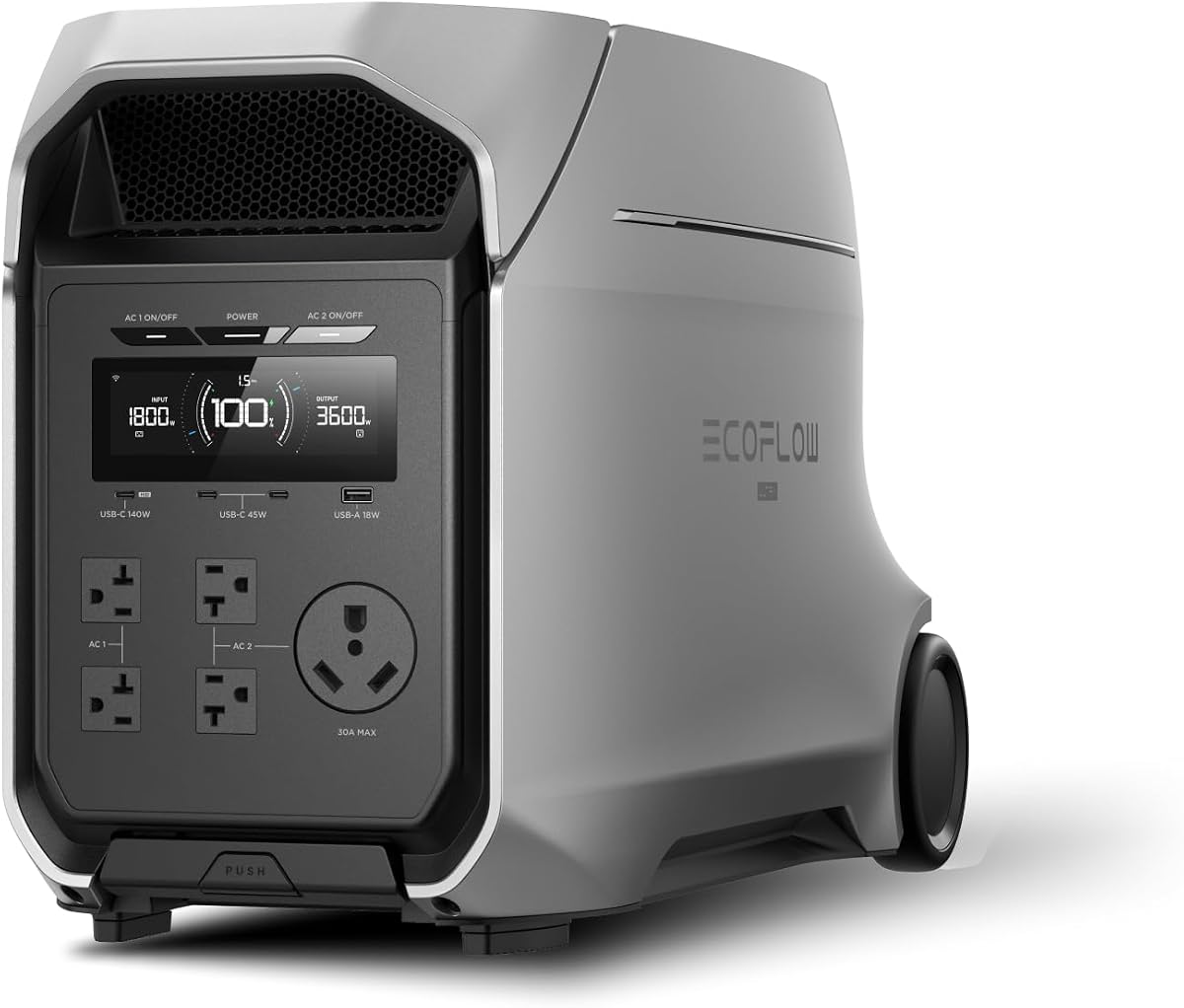
The EcoFlow DELTA 3 Max Plus is a 2048Wh portable power station with a rated 3000W output and a 4.6 rating. It stands out in this category because it combines 3800W X-Boost capability with an under-10ms transfer time, allowing the unit to assume power within ten milliseconds when an outage occurs. That speed is especially relevant for computers, routers, medical equipment, and other devices that can be disrupted by a brief interruption.
We may earn a commission when you buy through this link, at no additional cost to you.
Its strongest advantages extend beyond raw inverter power. The supplied information identifies five charging routes: an AC wall outlet, solar panels, a car connection, a Smart Generator, and combined PV plus car charging. The battery can reach 80% capacity in 43 minutes, while EcoFlow extra batteries can expand the system from roughly 2kWh to as much as 10kWh. Wi-Fi app support adds battery monitoring, scheduling, output priorities, and remote settings adjustment.
The principal compromise is the starting capacity. A 3000W inverter can handle many demanding appliances, but the 2048Wh base battery will not sustain several high-wattage loads for long. The advertised 3800W X-Boost figure is useful for operating compatible appliances, yet it should not be treated as equivalent to 3800W of continuous output. Buyers also need to consider the physical size of a unit designed for both home backup and mobile use.
This is the strongest general recommendation for someone who prioritizes responsive backup, flexible recharging, app control, and future expansion. It is particularly suitable for RV owners, campers, and households that need to keep communications and essential electronics running during a short or medium-length outage. For those who need more than 3000W of continuous output, one of the 3600W models may be a better match.
The under-10ms transfer is a major advantage over systems that pause briefly during failover. It helps preserve continuous operation for sensitive electronics while also making the station practical as an uninterruptible power supply during short grid disruptions.
Adding compatible EcoFlow batteries can grow storage toward 10kWh, turning the compact base unit into a more capable RV or outage system. Wall, solar, car, generator, and combined charging options also make it easier to replenish energy under different circumstances.
We may earn a commission when you buy through this link, at no additional cost to you.
The Jackery HomePower 3000 combines a 3072Wh battery with 3600W of continuous AC output, 7200W of surge capability, and a 4.5 rating. It is a premium choice for buyers who want more headroom than a nominal 3000W system provides. The extra capacity is meaningful during outages because it offers more usable energy without requiring the user to add an external battery immediately.
We may earn a commission when you buy through this link, at no additional cost to you.
Its UL-certified UPS changes to battery power within 20 milliseconds, a figure suited to keeping refrigerators, security cameras, internet equipment, pet feeders, and communications devices running. Output is distributed across AC, USB-C, USB-A, and DC connections, including two 100W Power Delivery USB-C ports and a built-in TT-30 RV outlet. The supplied claims also indicate the station can keep a refrigerator operating for one to two days and support a household of essentials for up to 15 hours.
Recharging is similarly versatile. The unit can replenish fully in 1.7 hours using hybrid AC and DC input, or in 2.2 hours through AC. With two 200W SolarSaga panels, it can reach 80% in nine hours, while a 12V car charger and gas generator are also supported. ChargeShield 2.0 manages charging, and the LiFePO4 battery is stated to retain 70% capacity through 4,000 cycles.
The trade-offs involve portability and charging speed. A 3kWh-class system with a large inverter will be heavier and more substantial than a compact camping station, and solar replenishment is considerably slower than wall charging. Even so, the combination of 3600W output, 3072Wh capacity, UPS protection, and useful ports makes this an excellent premium option for home essentials, RV travel, and buyers who want one station to cover several use cases.
A 3072Wh battery and 3600W inverter create enough margin for refrigerators, fans, routers, lighting, and selected heavier appliances. The output headroom also means users are less likely to approach the inverter's limit when several essentials operate concurrently.
CTB technology is designed to improve space efficiency and structural integration. Jackery describes the HomePower 3000 as smaller and lighter than comparable 3kWh models, although buyers should still consider its weight when planning to move it between rooms or take it outdoors.
We may earn a commission when you buy through this link, at no additional cost to you.
The UDPOWER S2400 is a budget-oriented alternative for shoppers seeking a capable power station without moving to a premium 3kWh system. It has a 4.1 rating, a 2083Wh battery, 2400W rated output, and 3000W peak output. That distinction matters: the advertised 3000W figure is a transient peak rather than the unit's continuous inverter rating.
We may earn a commission when you buy through this link, at no additional cost to you.
Its port selection is unusually generous for the category. Six AC outlets, two USB-C ports, four USB-A ports, two DC5521 outputs, one car socket, and a solar input allow up to 15 devices to be connected at once. Automatic backup switching occurs within 0.01 seconds, matching the near-instant responsiveness sought by buyers with sensitive electronics. The LiFePO4 battery is stated to support more than 4,000 cycles and up to 15 years of use.
Recharging and portability further distinguish the S2400. A 1600W AC input can take the battery from empty to full in 1.3 hours, while solar charging is supported up to 440W and works with the UDPOWER 210W panel. At 15.8 by 9.5 by 10.1 inches and 41 pounds, the unit remains more manageable than many larger systems, and dual handles simplify lifting.
Its limitation is clear: buyers specifically seeking a full 3000W of continuous output should look elsewhere. Even so, the S2400 can support microwaves, coffee equipment, and other loads within its 2400W rating, while its 3000W peak can help with startup surges. It is best suited to budget-conscious households, campers, and users who prioritize many ports, fast charging, and portability over maximum inverter output.
Fifteen-device support and the mix of AC, USB, DC, and automotive connections make the S2400 useful for campsites, tailgates, and busy work areas. A single station can serve several classes of equipment without requiring a collection of wall adapters.
The 1600W AC input enables a full recharge in 1.3 hours under the stated conditions. This quick recovery is valuable when a user discovers the unit is low on energy shortly before a planned trip or an approaching storm.
We may earn a commission when you buy through this link, at no additional cost to you.
The Jackery HomePower 3600 Plus is one of the most capable systems in this comparison, combining 3584Wh of storage with 3600W of continuous output and a 4.6 rating. It is aimed at users who need more than occasional appliance support, offering dual 120V and 240V output in parallel and up to 7200W when configured appropriately. The design is better suited to a dedicated home or RV setup than to carrying into remote locations.
We may earn a commission when you buy through this link, at no additional cost to you.
Its scale creates meaningful advantages. Jackery states that the battery can be expanded to 21kWh per unit or 43kWh with multiple units, while a separate Smart Generator can add further flexibility. Pumps, heaters, and dryers are among the heavy loads identified in the supplied information. The plug-and-play approach is straightforward: connect the supported equipment, press the power control, and begin operating without a complex installation.
The battery system uses ceramic membrane cells tested at 302 degrees Fahrenheit and is rated for 6,000 cycles with a stated 10-year lifespan. The unit can recharge fully through hybrid AC and DC input in two hours, through AC in two and a half hours, through solar in four hours, or through a gas generator in two and a half hours. These multiple routes help keep a larger battery ready without tying the user to one replenishment method.
Portability is the chief compromise. Although automotive-grade CTB technology and a luggage-style enclosure make the unit more manageable for its class, it remains a 3.6kWh system. The rolling handle and wheels are useful indoors but do not make it a lightweight hiking product. Buyers wanting a stationary home backup solution with substantial expansion potential will find this configuration persuasive.
At 3584Wh, the HomePower 3600 Plus holds considerably more energy than compact camping stations. That extra reserve allows essential household equipment to operate for longer stretches and reduces the need to add batteries immediately after installation.
Expansion to 21kWh per unit and 43kWh with multiple units creates a practical route toward whole-home resilience. Compatibility with a gas generator also provides a fallback for prolonged events that exceed the rechargeable battery's normal operating window.
We may earn a commission when you buy through this link, at no additional cost to you.
The UDPOWER S2400 Solar Bundle pairs the S2400 power station with a 210W solar panel, offering a more complete starting package for off-grid users. The station shares the base model's 2083Wh capacity, 2400W rated output, 3000W peak output, and 4.1 rating. Buyers who do not already own compatible panels may find the bundled arrangement more useful than the standalone configuration.
We may earn a commission when you buy through this link, at no additional cost to you.
The included panel makes solar recharging available without a separate purchase, which is especially convenient for campers, van-life users, and buyers creating a portable emergency kit. The station can accept solar input up to 440W and is compatible with the UDPOWER 210W panel. Wall recharging remains the quickest option, with a stated full recharge in 1.3 hours through the 1600W AC input.
The feature set is broad for a compact unit. Six AC outlets, two USB-C ports, four USB-A ports, two DC5521 ports, a car socket, and solar input allow the station to serve numerous devices simultaneously. Backup transfer occurs within 0.01 seconds, and the LiFePO4 cells are stated to offer more than 4,000 cycles and up to 15 years of service. The dual-handle enclosure also helps with moving the 41-pound station.
The bundle should not be mistaken for a continuous 3000W system. Its rated inverter output is 2400W, while 3000W is the peak capability. Actual solar charging time will vary with sunlight, panel orientation, temperature, and the station's remaining capacity. Within those boundaries, this is an approachable package for buyers who value included solar equipment, fast wall charging, and portability.
Including a 210W panel removes the need to determine panel compatibility before assembling a solar setup. It also provides a straightforward way to maintain the battery away from mains power, provided sunlight conditions are favorable.
At 41 pounds, the S2400 is lighter than many 3kWh systems, while its dual handles improve control during loading. It is a practical middle ground for short camping trips, mobile work, and emergency use around the house.
We may earn a commission when you buy through this link, at no additional cost to you.
The EcoFlow DELTA Pro delivers 3600Wh of capacity, 3600W of standard AC output, and a 4.6 rating. It is designed for buyers who want a full-featured home backup platform rather than a temporary camping solution. Compatibility with extra batteries and Smart Generators allows its storage to expand from 3.6kWh to as much as 25kWh, making it one of the most flexible configurations in this guide.
We may earn a commission when you buy through this link, at no additional cost to you.
Output control is a major strength. A single unit offers 3600W, X-Boost can raise the compatible output to 4500W, and two units can be paired for 7200W. Fifteen output methods include five AC outlets, two 100W USB-C ports, multiple USB-A connections, DC outlets, a car power socket, and an Anderson port. This wide selection supports diverse equipment without requiring several separate power boxes.
The DELTA Pro also provides extensive replenishment choices. EcoFlow states that it can recharge from compatible 240V outlets in 1.8 hours, 1800W wall outlets in 2.7 hours, or four 400W solar panels in 2.8 hours. Additional options include EV stations, car outlets, solar, standard wall power, and a Smart Generator. The app provides Wi-Fi or Bluetooth access to battery level, temperature, charge time, discharge time, and customizable power settings.
Its size and energy weight are the main limitations. A 3600Wh system is best treated as a substantial home or RV power hub rather than something routinely carried on foot. The premium feature set is still compelling for owners planning extended outages, RV travel, workshop use, or future battery expansion, especially when the ability to connect multiple units and charging sources is a priority.
Extra batteries and Smart Generators extend the DELTA Pro far beyond its original 3.6kWh capacity. This makes it a sensible platform for households that want to start with one unit and increase resilience as their energy needs evolve.
Fifteen output methods cover AC, USB, DC, automotive, and high-power USB-C equipment. Charging from EVs, wall outlets, solar panels, cars, and generators gives users multiple ways to keep the battery ready during extended disruptions.
We may earn a commission when you buy through this link, at no additional cost to you.
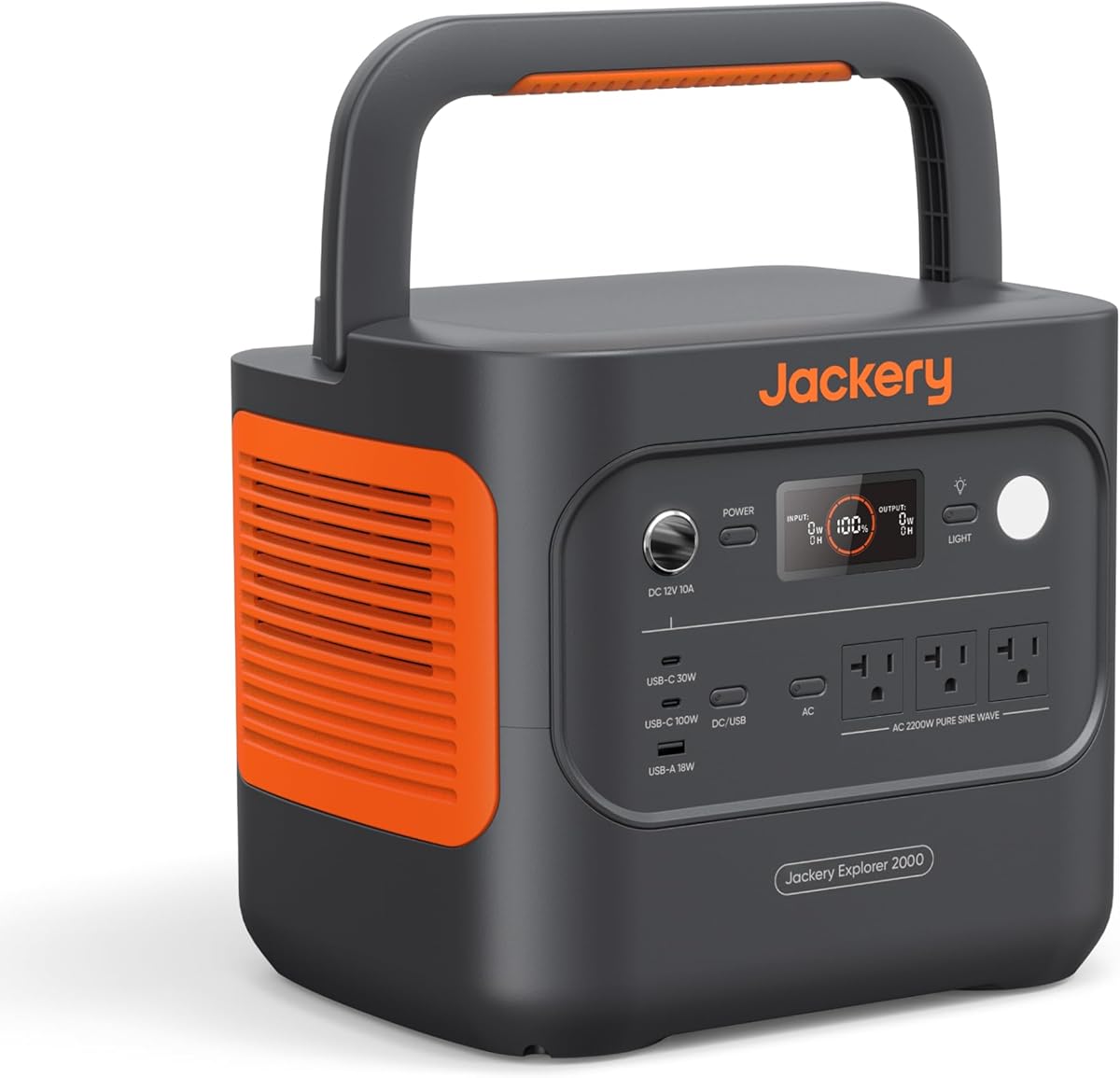
The Jackery Explorer 2000 v2 is a 2042Wh portable station with 2200W of AC output and a 4.4 rating. Although it does not reach 3000W continuously, it provides a notably compact and lightweight alternative for buyers whose real needs center on essential home equipment, electronics, camping loads, and small-business tools rather than household heating or other major appliances.
We may earn a commission when you buy through this link, at no additional cost to you.
Its most impressive physical feature is efficiency. At 39.5 pounds, Jackery describes it as 41% lighter and 34% smaller than typical 2kWh LiFePO4 power stations. CTB technology integrates the cells into the body structure to improve space usage and stability. It also includes a 100W USB-C port for direct charging of compatible phones, tablets, and other devices without a separate adapter.
Charging and noise management are additional strengths. The unit can move from zero to 80% through AC fast charging in 66 minutes, or complete a full charge in 102 minutes through Emergency Super Charging mode in the app. Solar charging can take as little as six hours with 400W panels, and Silent Charging Mode reaches a full charge in five hours at a stated 30dB. Its UPS switches within 20 milliseconds and carries UL1778 test certification for uninterruptible power systems.
The limitation is straightforward: 2200W is below the 3000W threshold many shoppers may have in mind, and a 2042Wh battery will be consumed quickly by sustained high-wattage equipment. For a lightweight camping station or compact outage kit focused on routers, lighting, refrigeration on a modest duty cycle, and charging, the trade-off is worthwhile. Buyers with heating, tools, or other sustained high-demand appliances should consider a larger model.
Three AC outlets totaling 2200W are backed by a 2042Wh battery, giving the Explorer 2000 v2 a useful mix of power and storage for its 39.5-pound weight. The 100W USB-C port adds further charging flexibility for modern devices.
Silent Charging Mode operates at a stated 30dB, making the unit less disruptive during nighttime outages or indoor work. Smart temperature control adjusts fan speed, which is useful for balancing low noise with safe thermal management.
We may earn a commission when you buy through this link, at no additional cost to you.
The EGO POWER+ PST3042 is a portable inverter station that includes two 56V 7.5Ah batteries and a charger. It carries a 4.4 rating and is designed around the same high-power battery platform used with EGO outdoor equipment. Its headline 3000W figure represents peak output, while continuous AC output is 2000W, so shoppers should distinguish between starting power and sustained power.
We may earn a commission when you buy through this link, at no additional cost to you.
The output configuration is straightforward. Three 120V AC outlets cover conventional household tools and appliances, and four USB ports handle smaller electronics. A bright LED display shows the estimated runtime, helping users decide which loads to activate. Robust steel handles support portability, while the weather-resistant construction is useful for outdoor work environments and camping.
A major benefit is seamless integration with the broader EGO battery system. The included batteries allow the unit to function as a portable power source without requiring a conventional fuel generator, making it particularly convenient for users who already own compatible EGO tools. It provides quiet, clean power suitable for indoor and outdoor use, where exhaust and operating noise would otherwise be disadvantages.
The main limitation is limited energy storage compared with the larger lithium-iron-phosphate systems in this roundup. A pair of relatively compact 7.5Ah batteries will not provide the same prolonged runtime as a 2kWh or 3kWh station, and the 2000W continuous rating limits heavier appliances. It is best viewed as a convenient tool-battery power hub, emergency outlet, or campsite companion for owners already committed to EGO equipment.
The included 56V batteries make the station immediately useful to EGO tool owners. It extends familiar battery power beyond the jobsite into household backup, outdoor use, and locations where fuel storage or exhaust would be inconvenient.
Three AC outlets and four USB ports cover a useful mix of conventional and modern devices. The LED runtime display helps prioritize loads, while the steel handles make the unit easier to carry between indoor and outdoor locations.
We may earn a commission when you buy through this link, at no additional cost to you.
The Jackery HomePower 3000 Solar Bundle combines the 3072Wh HomePower 3000 with two 200W solar panels. It carries a 4.5 rating and retains the base station's 3600W continuous output, 7200W surge capability, and 20ms UPS response. The package is aimed at buyers who want more energy independence than a wall-charged unit can offer without needing to select panels separately.
We may earn a commission when you buy through this link, at no additional cost to you.
The station itself is well suited to home essentials and RV travel. It can support refrigerators, fans, Wi-Fi routers, and lights, with the supplied information stating that a refrigerator may run for one to two days. AC, USB-C, USB-A, and DC outputs keep everyday devices connected, while dual 100W Power Delivery ports serve modern electronics and the integrated TT-30 outlet simplifies RV use.
The bundle broadens the available solar configuration. When paired with the included 2x200W SolarSaga panels, the station can reach 80% capacity in nine hours under the stated conditions. Wall charging is faster, with full recharge in 2.2 hours through AC or 1.7 hours using hybrid AC and DC. A 12V car charger and gas generator provide additional replenishment options, while the LiFePO4 battery is rated for 4,000 cycles at 70% retained capacity.
The obvious trade-off is logistics. Two folding panels take more space than a single unit, and solar charging remains dependent on suitable weather and positioning. Buyers may prefer the standalone power station if they already own compatible panels. For those starting from scratch, however, this bundle delivers a coherent power station and renewable charging solution in one purchase.
Two 200W panels provide a substantial renewable input without requiring buyers to research panel specifications and connectors. The stated 80% recharge in nine hours makes the package practical for extended trips when ample sunlight is available.
The 3072Wh battery and 3600W output cover essential household loads, while the TT-30 port adds RV convenience. The same station can therefore serve an emergency kit at home, a mobile power hub during travel, and a charging source for a broad collection of devices.
We may earn a commission when you buy through this link, at no additional cost to you.
The EcoFlow DELTA 3 Ultra Plus combines 3072Wh of storage with 3600W of continuous output, 7200W of surge capacity, and a 4.4 rating. It offers a 3072Wh base capacity that can expand to 11kWh, positioning it as a capable home backup and RV system. Its strongest distinguishing features are the under-10ms UPS response, a stated 25dB operating level, and extensive app-based control.
We may earn a commission when you buy through this link, at no additional cost to you.
Fast failover helps protect computers, medical equipment, and routers during sudden outages. The 3600W inverter is strong enough for household appliances, power tools, and RV essentials, while the surge rating provides additional starting headroom for compatible equipment. Expansion to 11kWh allows buyers to extend runtime and scale the installation as their energy requirements grow.
Six charging routes are available: home outlets, solar panels, car chargers, EV stations, generators, and the EcoFlow Smart Generator. The supplied information states that X-Stream charging can reach 80% in under an hour under compatible conditions. The advanced LiFePO4 battery, EV-grade CTC construction, and 24/7 smart battery management are intended to support long service and protection against extreme temperatures or heavy loads.
This model may offer more capability than some buyers need, and its substantial battery capacity means it should be viewed as a durable power hub rather than lightweight picnic accessory. Quiet operation nevertheless makes it useful indoors, during overnight outages, and in occupied RV spaces. The app adds scheduling, priority settings, and energy-use controls, making this an attractive choice for technically minded users who value monitoring and customization.
The under-10ms transfer is particularly useful for computers, medical equipment, and network devices. Because backup begins so quickly, sensitive electronics have less opportunity to react to a loss of mains power.
A stated 25dB operating level under load supports indoor and nighttime use. The EcoFlow app lets users monitor the battery, schedule charging, prioritize outputs, and adjust settings without remaining next to the unit.
We may earn a commission when you buy through this link, at no additional cost to you.
Choosing a 3000W-class power station requires balancing inverter output, battery capacity, recharge speed, portability, and the type of equipment you intend to run. The most useful purchase is the one that meets both your surge requirements and your expected runtime without exceeding your handling or storage limitations.
The most important distinction is between continuous and peak inverter output. A station advertised around 3000W may deliver 3000W continuously, 2400W continuously with a 3000W peak, or use a boost mode that temporarily increases output for compatible loads. Buyers should identify the continuous rating because refrigerators, heaters, tools, and other sustained appliances consume power continuously. Peak output matters primarily during motor startup, compressor activation, or other brief events that create a temporary surge.
Choose the continuous rating based on the largest equipment you expect to operate, then add enough margin for simultaneous loads. If several appliances may run together, summing their running watts is more useful than comparing one product with a headline number. Also check how the manufacturer defines boost or X-Boost modes, because these features may reduce speed, exclude certain appliance types, or be intended only for resistive heating loads.
Wattage tells you how quickly a station can deliver power; watt-hours tell you how much energy it stores. A 3000W inverter paired with a 2kWh battery is powerful but may run out quickly when powering a refrigerator, microwave, heater, or several electronics. A larger 3kWh battery offers more useful runtime at a 3600W output level. For an overnight outage, calculate the combined energy demand of essential loads and compare it with the station's capacity, while recognizing that inverter losses, temperature, and battery age affect real-world results.
Users should also examine the list of appliances they intend to support. A router, lighting, phone charger, and fan require far less energy than a full-size refrigerator, pump, dryer, or space heater. Whole-home users may want expansion compatibility, while campers may prioritize a smaller battery that is easier to transport. Capacity should be selected around realistic energy needs rather than output alone.
A power station used as an uninterruptible power supply should transfer to battery quickly enough to keep sensitive electronics operating. Products in this comparison advertise switching times ranging from under 10 milliseconds to 20 milliseconds, with some specifically certified for UPS use. Faster transfer is generally advantageous for computers, network equipment, medical refrigerators, and security systems, but users should still confirm that the relevant UPS mode is enabled and supported by the device being powered.
A fast transfer time does not guarantee that every appliance will remain stable. Motor-driven equipment can attempt to restart after power returns and cause a surge or power-quality event. The best practice is to test important loads before an emergency and understand the manufacturer's recommendations for UPS-compatible equipment.
Recharging speed determines how quickly the station can recover after use. Wall charging is usually the fastest method, while solar charging depends on panel size, sunlight, weather, and orientation. Several products also accept car charging, generator charging, EV charging, or combined AC and DC input. Buyers who depend on solar should calculate from the stated charging time and the battery capacity rather than comparing a headline charge percentage across different conditions.
Multiple input methods offer resilience. Solar is useful when grid power is unavailable, car charging supports road trips, and generator or EV input can provide an emergency replenishment route. Fast charging is particularly valuable before a forecast storm, while flexible inputs reduce the chance that a prolonged event leaves the battery empty with no compatible way to recharge it.
AC outlets are essential for conventional appliances, but modern power stations also use USB-C, USB-A, DC barrel, and automotive ports. A 100W USB-C port can charge compatible laptops, tablets, and phones much faster than a low-power USB-A connection. DC and car sockets are useful for portable electronics, while a dedicated RV outlet can simplify travel setups. Count both the type and quantity of ports, especially if several devices must operate simultaneously.
Users should also confirm voltage, frequency, connector format, and supported charging protocols. The port count shown by a manufacturer does not guarantee that every connected device will receive its preferred power level. Check the manual for maximum per-port and combined output limits, and avoid using undersized cables for high-wattage equipment.
A power station with roughly 2kWh to 3kWh of storage is substantial, and adding high-output inverters can increase weight further. Weight matters more if the unit will move between rooms, load into a vehicle, or travel in an RV. Handles, wheels, and a telescopic handle can make a large system easier to move, but true backpack portability requires a much smaller capacity. Measure storage areas, doorways, and vehicle cargo space before selecting a model.
Design features also affect usability. A clear runtime display helps users manage consumption, while app-based monitoring reduces the need to inspect the unit in difficult locations. Quiet cooling and low-decibel operation are valuable indoors, particularly for bedrooms, offices, and RV living. Buyers who intend to use the station indoors should prioritize low noise, clean operation, and appropriate ventilation.
Most modern options use lithium iron phosphate, or LiFePO4, cells, which are known for thermal stability and long service potential. The supplied products make different cycle-life claims, ranging from approximately 4,000 cycles to 6,000 cycles, with stated battery lifespans of up to 10 or 15 years depending on model and usage assumptions. Review the retention threshold because cycle count alone does not indicate how much usable capacity remains at the end of that period.
Also look for battery management, temperature control, overcharge protection, and physical safety construction. These systems are particularly important in hot vehicles, cold environments, and prolonged high-load use. A longer warranty can also provide useful protection, but buyers should understand the terms, required documentation, and coverage for battery capacity degradation.
Expansion turns a portable station into a scalable home or RV energy system. Some models support additional battery packs, parallel units, high-voltage output, or Smart Generators. Larger capacity can extend outage coverage, while parallel operation can increase available power for demanding equipment. Expansion usually requires compatible branded batteries or approved accessories, and a larger installation may be better suited to a garage, utility room, or other permanent location.
Before purchasing accessories, verify the maximum supported capacity, connection method, and compatibility requirements. Also consider the available charging inputs and whether a generator can serve as a fallback. Buyers should estimate future needs rather than buying maximum expansion immediately, but choosing a platform with expansion support can prevent the need to replace the entire station later.
Before using the station, read the included manual, identify each output and input, and confirm the electrical requirements of every appliance you plan to connect. Check that each load remains within the inverter's continuous rating and that startup surges do not exceed its peak capability. For outage use, enable UPS mode if the manufacturer supports it, but test the configuration in advance with the specific devices that matter most.
Charge the battery fully before a planned trip or storm and use an appropriate wall outlet or supported alternative input. Keep the unit in a dry, ventilated location away from direct heat, combustible materials, and temperature extremes. Do not operate it in a sealed enclosure unless the manual explicitly permits that arrangement. Allow the required airflow around cooling components, especially during high-wattage charging or output operation.
For long-term care, use the manufacturer's app or display to monitor battery level, temperature, and active outputs. Avoid routinely draining the battery completely when a partial recharge will suffice, and do not leave the station stored fully depleted for extended periods. Clean vents with care, inspect cables for damage, and keep expansion batteries and accessories compatible with the base unit. Periodically test the UPS function and essential loads so the system is familiar before an emergency.
It depends on the appliances involved. A router, lights, fans, and many refrigerators can operate below 3000W, while heaters, dryers, pumps, and some power tools may require substantially more. List each device's running wattage, add likely simultaneous loads, and leave room for motor startup surges. Also consider runtime, since a high-output inverter paired with a small battery may not support those appliances for long.
Watts describe instantaneous power, while watt-hours describe stored energy. A 3000W inverter can deliver 3000 watts for a short period, but a 2048Wh battery provides less than one full hour at that load before accounting for losses. A larger 3072Wh or 3600Wh battery can run the same output for longer. Buyers should evaluate both values because high power without sufficient energy creates a system that operates aggressively but ends quickly.
Usually, yes, because most refrigerators use considerably less than 3000W while running. A larger model with at least 2kWh of capacity is better suited to overnight or multiday refrigeration because it stores more energy. Check the refrigerator's compressor start surge, ensure the load remains within the continuous rating, and use a properly grounded outlet. Actual runtime depends on duty cycle, ambient temperature, battery condition, and inverter efficiency.
A faster transfer is generally helpful because sensitive electronics have less time to react to an interruption. Models with sub-10ms or 20ms UPS response are better suited to computers, routers, security cameras, and medical refrigerators than systems with noticeable pauses. However, the complete power path, device behavior, and supported UPS modes also matter. Test important equipment in advance rather than relying solely on the stated transfer figure.
Yes. Unlike fuel generators, battery power stations produce no combustion fumes and are suitable for indoor backup use when operated according to the manufacturer's instructions. Keep the station ventilated, place it on a stable surface away from heat and moisture, and observe any clearance requirements. Silent or low-noise modes can make it easier to operate in occupied rooms, though noise may increase when the cooling system works hard.
The appropriate panel capacity depends on the station's battery size, charging time, available sunlight, and whether the goal is maintenance charging or rapid recovery. A 210W panel may suit a roughly 2kWh station for regular solar replenishment, while two 200W panels provide a stronger starting configuration for a 3kWh unit. Charging results vary with sunlight, panel orientation, temperature, and system efficiency, so compare realistic daily energy collection rather than peak panel output alone.
Many models support additional batteries, and some can operate in parallel to increase available power. The expansion limits vary by product, and only compatible branded batteries or approved accessories should be used. Buyers should verify the maximum unit capacity, connection procedure, charging behavior, and ventilation requirements. Expansion can greatly extend runtime, but it also increases cost, weight, and the space required for charging and storage.
The correct charging practice depends on the model and its battery-management system. Leaving a unit connected to a suitable wall outlet may be supported for maintenance charging, but users should follow the manual regarding full-charge storage and any energy-management settings. For long-term storage, many manufacturers recommend a partial charge and periodic topping-up. Do not use damaged cables or an unsuitable charger, and avoid leaving the battery exposed to severe heat or freezing conditions.
The EcoFlow DELTA 3 Max Plus is the most balanced overall recommendation because it combines 3000W output, an under-10ms transfer, flexible charging, smart controls, and expansion toward 10kWh. The Jackery HomePower 3000 is the premium all-round option, offering 3600W output, 3072Wh capacity, useful ports, and a compact 3kWh design. For value-focused buyers, the UDPOWER S2400 provides 2083Wh, many connections, fast wall charging, and a 3000W peak at the cost of lower continuous output.
Prioritize continuous inverter output, usable battery capacity, and realistic runtime rather than choosing on headline wattage alone. Fast UPS transfer is essential for electronics, while wall and solar input options determine how quickly the system can recover. Larger systems are better for extended home backup and RV use; smaller models are easier to carry. Expansion support, low noise, app control, and physical design should be matched to the environment in which the station will be used.
Ratings, configurations, and product details can evolve, and prices change over time. Before buying, verify the current listing, output ratings, battery capacity, included accessories, warranty terms, and compatibility requirements. For a complete purchase decision, compare the devices you actually intend to power against both the station's continuous output and its stored energy, then read the manufacturer's instructions before relying on it during an outage.
