
Leather Sole Edge Stamping Machine
Interchangeable pattern rollers
Bearing-supported roller system
Heavy-duty steel frame
Discover the best Shoe Sole Press Machine options, comparing manual edge presses, embossing tools, compact rollers, and workshop equipment for shoemakers.
A shoe sole press machine shapes, flattens, and finishes stitched edges after a sole has been attached to an upper. A useful model should provide controlled pressure, accommodate the material being worked, and fit naturally into a repair bench or compact leathercraft workspace.
We compared ten products by examining their intended jobs, operating method, adjustability, construction, material compatibility, maximum sole thickness, mounting requirements, and suitability for repairers, custom shoemakers, and serious leathercraft hobbyists. The list covers bench-mounted presses, manual rolling tools, edge stampers, and related finishing equipment.
Each review highlights the feature that makes its product most useful and also explains where it is less appropriate. Ratings are included only when supplied with a numeric score, while availability and retail pricing can change, so readers should confirm current product details before purchasing.

The following comparison highlights each tool's primary operation, construction, adjustability, and best use so buyers can distinguish true edge-flattening presses from stampers, rolling tools, and shoe-care equipment.


The Manual Shoe Sole Edge Press is the most complete dedicated edge-flattening option in this guide. It has no supplied numeric rating, but its specification is especially relevant for handmade shoemaking: an adjustable pressure mechanism, a focused 5.5cm pressing plate, and compatibility with sole and leather assemblies up to 15mm thick. It is built specifically for compressing stitched sole edges and welts rather than for general leatherwork.
We may earn a commission when you buy through this link, at no additional cost to you.
Its strongest feature is the combination of a small, concentrated plate and a separate pressure control. A broad platen can flatten a large area but may not provide the focused contact wanted along a welt or stitched edge. Here, the operator can regulate force according to the leather, layer count, and construction of the repair. The lever mechanism transfers hand force smoothly, which should make repeated work more consistent than pressing each section with an improvised hand tool.
Construction details also support regular workshop use. The 304 stainless steel shaft and disc resist routine wear, the wear-resistant POM roller supports smooth movement, and the coated metal frame is designed for bench-top installation. Mounting holes allow the machine to be secured where a repairer can use both hands and control the workpiece. That requirement is less convenient than a completely portable tool, but it is a sensible trade-off for consistent repeated work.
This is the strongest recommendation for a cobbler, custom shoemaker, or advanced hobbyist whose priority is genuine sole-edge flattening. It is less suitable for someone who needs a lightweight handheld roller or a decorative pattern stamp. The product is also unsuitable where workspace cannot accommodate a securely mounted bench press.
The 5.5cm plate concentrates pressure where a stitched welt or sole edge needs compression. Adjusting the pressure setting allows the user to work progressively rather than forcing a single setting across different leathers and thicknesses.
Bench-mounting holes help prevent movement while the lever is used. That stability is valuable for edge finishing because even, controlled contact improves consistency across a long welt or around a complete shoe.
We may earn a commission when you buy through this link, at no additional cost to you.
The Leather Sole Edge Stamping Machine is the premium selection because it expands the category beyond simple flattening. It uses a bearing-supported roller system to create patterns along shoe soles, and it includes interchangeable Single-Eye, double-eye, 2mm, and 3mm roller options. No numeric rating was supplied, so the assessment rests on its documented capabilities and construction.
We may earn a commission when you buy through this link, at no additional cost to you.
Interchangeable rollers make this machine especially interesting for custom footwear. A repair shop may need a restrained single-eye border, while a maker creating more decorative shoes could select a double-eye design or a millimeter-width pattern. The rotating roller reduces repetitive carving work by doing the pattern work during a controlled pass along the edge. Its steel frame and precision embossing rollers make it better aligned with workshop production than simple hand stamping.
The product is not just limited to formal shoes. It is listed for leather, rubber, and EVA soles, plus selected leather goods such as belts and bags. That flexibility can justify the investment for a specialist who works across footwear and accessories. However, it does not replace a flattening press when the primary requirement is to compress an uneven stitched edge into a smooth profile.
Buy this machine for decorative finishing and repeatable edge patterns, especially if interchangeable tooling is important. A first-time repairer who only wants to flatten a welt will find the dedicated presses in this guide more direct. The key trade-off is specialization: this model stamps and decorates exceptionally well within its stated purpose, but it is not the universal answer for every sole-shaping task.
The supplied roller choices cover several visual scales, from eye motifs to narrow linear patterns. Changing rollers allows one machine to support different footwear styles and repair or decorative jobs without relying on separate stamp blocks.
Bearing support helps the pattern roller rotate smoothly while the manual press supplies force. Combined with the steel frame, this design is intended for repeated operation in repair areas, custom production spaces, and leather studios.
We may earn a commission when you buy through this link, at no additional cost to you.
The Adjustable-Thickness Sole Press is the budget choice for someone who needs a dedicated leather crimping and sole-flattening tool without buying a larger bench system. No numeric rating was provided, but the stated features directly address the central needs of a home repair bench: controlled compression, smooth movement, and a compact frame.
We may earn a commission when you buy through this link, at no additional cost to you.
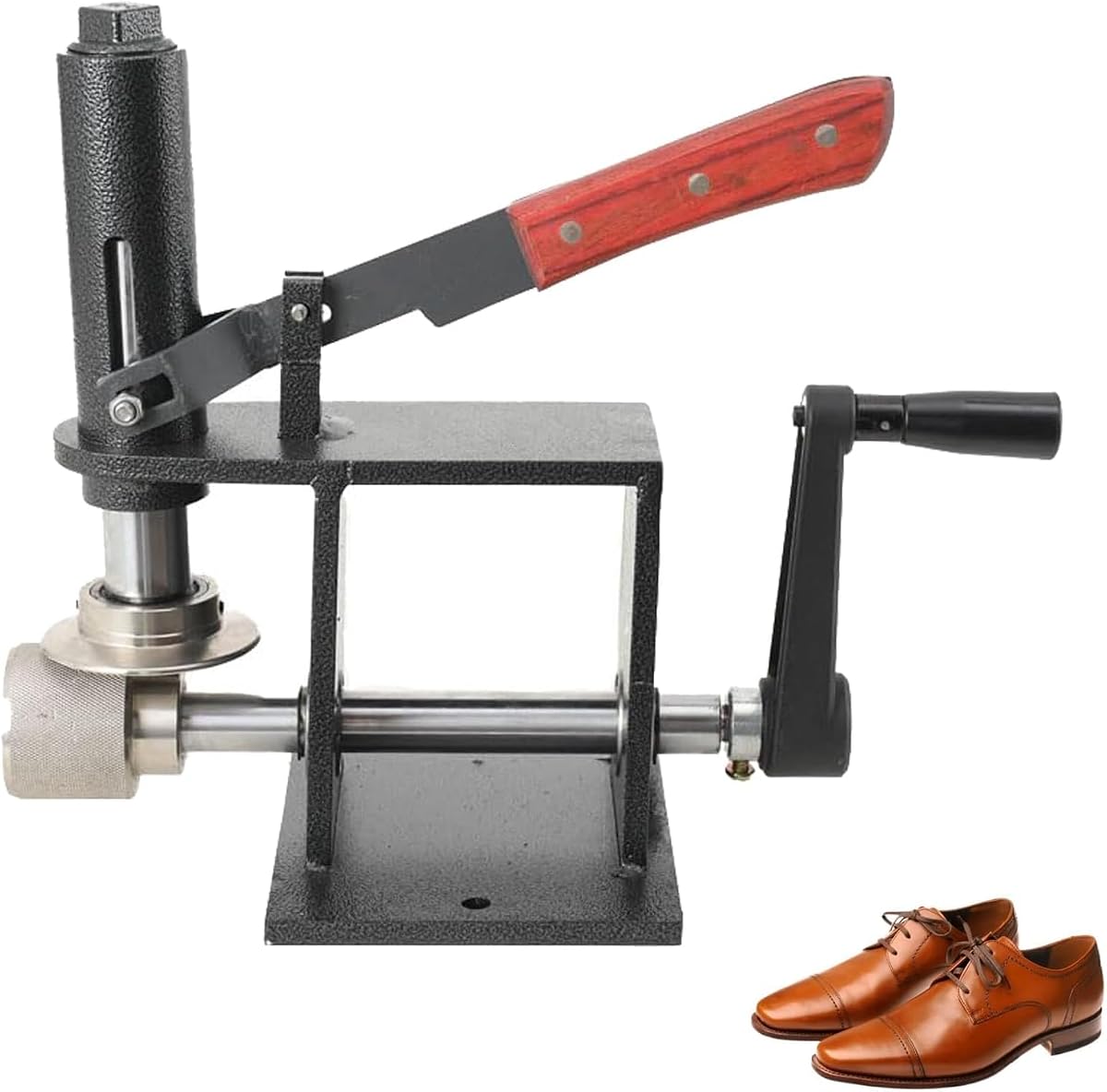
The wooden handle raises the pressing column so the operator can position the edge, while the rotating handwheel permits controlled movement as pressure is applied. A top screw changes the distance between the pressing surfaces. That adjustment is important because shoe trims vary in thickness, and a fixed gap would either leave thicker assemblies loose or risk excessive compression on thin material.
The machine is designed to flatten sewn leather trim and reduce uneven edges. It is also described as versatile across shoe styles and materials, which makes it a practical general-purpose addition to a shoemaking workspace. Its compact design is also convenient for storage, and the manual mechanism avoids electrical setup or recurring power requirements.
This is the most accessible recommendation for DIY shoe repair, small leathercraft work, and experienced hobbyists who understand basic edge-pressing technique. It may not offer the same focused plate design or mounting stability as the leading bench press, and manual positioning takes practice. Even so, it addresses the core task with fewer parts and a straightforward operating system.
The top screw makes it possible to adapt the opening to different trim and sole thicknesses. Users can begin with a wider setting, position the workpiece, and then bring the press surfaces into controlled contact.
A rotating handwheel supports smoother movement along an edge. This is useful for maintaining steady contact across a long section rather than pressing the same small point repeatedly.
We may earn a commission when you buy through this link, at no additional cost to you.
The Steel Shoe Sole Press is a practical, general-purpose machine for flattening uneven edges after sewing and crimping leather strips. It has no supplied numeric rating. Its appeal lies in a clearly described manual system, durable steel construction, and a stated capacity for soles up to 15mm thick.
We may earn a commission when you buy through this link, at no additional cost to you.
The wooden handle lifts the press column to create access for inserting the shoe edge. An adjustment screw changes the pressing spacing, allowing the tool to conform to different workpieces. Because the drive is manual, the operator can pause, reposition, or change pressure without waiting for an automatic cycle. That level of feedback is valuable when working around curves or layered edges where a fixed setting might be inappropriate.
Its compact construction should be practical for home use and storage, while the steel frame is intended to withstand daily work. Low mechanical complexity also makes the tool approachable for repairers and hobbyists. The machine does not offer specialized plate geometry or interchangeable decorative tooling, so users seeking those features should look to the first or second products in the list.
Choose this press when the core requirement is straightforward edge flattening and leather crimping with adjustable spacing. It is well matched to DIY shoe repair, handmade footwear, and general leathercraft tasks. For shops that need maximum material capacity, secure bench mounting, or decorative patterns, a more specialized machine will be a better fit.
The manual method gives immediate control over force and placement. A repairer can stop at a difficult curve, reposition the edge, and continue without relying on a powered stroke.
Support for assemblies up to 15mm thick broadens the range of repair work. The opening should still be adjusted carefully for the actual material rather than set automatically to its maximum.
We may earn a commission when you buy through this link, at no additional cost to you.
The Lounsweer Automatic Electric Shoe Polishing Machine has a supplied rating of 4.2 and is included to clarify a common category distinction. It is a shoe-care machine, not a machine for pressing or flattening a sole edge. Its dual brushes remove dust and polish footwear, while automatic sensing activates the unit when a shoe approaches.
We may earn a commission when you buy through this link, at no additional cost to you.
Its standout quality is the combination of touch-free operation and controlled oil delivery. The machine releases polish when the bottom is touched, and the oil output is designed to remain moderate and leak-free. It also switches off after 45 seconds of inactivity, reducing unnecessary operation in homes, offices, hotels, and entryways where several pairs may be cleaned in succession.
The black stiff-bristle brush targets dust, while the brown soft-bristle brush is intended for polishing. A copper coil motor is specified for stronger performance and lower noise than traditional polishing machines. These are convenient features for routine maintenance, but they do not compress stitched welts, flatten uneven edges, or shape a newly attached sole.
Buy this product if your priority is cleaning and polishing finished shoes in a convenient standing position. Do not choose it for a sole press project. Shoemakers and repairers seeking edge-finishing capability should instead consider one of the manual presses or the rolling rod elsewhere in this guide.
Automatic sensing starts the machine when a shoe moves near the lower contact area. This makes routine polishing faster and allows the user to remain upright rather than repeatedly operating a switch.
The stiff black brush handles dust removal, while the softer brown brush supports polishing. The two-brush arrangement separates routine cleaning from finishing within one machine.
We may earn a commission when you buy through this link, at no additional cost to you.
The Manual Hand Sewing Machine carries a supplied rating of 3.8 and belongs in this guide as an upstream repair tool. It does not flatten a sole edge; it sews shoes, bags, clothing, quilts, coats, and trousers. A proper sole-edge repair may begin with stitching, followed by pressing, so it is relevant to the broader workshop process.
We may earn a commission when you buy through this link, at no additional cost to you.
The latest version emphasizes smoother operation. Its main shaft has a revised curvature intended to reduce friction, and the spindle shape was changed to improve appearance and performance. The manufacturer also states that bearing-related roughness and jamming problems were addressed. Ten axes can be switched freely, providing different orientations for varied materials and stitch patterns.
Maximum sewing thickness is listed as 0.48 inches, and the machine can be matched with a motor to improve efficiency. Nylon line is included. One important disclosure is that it is handmade by a master blacksmith, so the finish may contain visible marks and will not be as smooth as a molded machine. That characteristic may matter to a specialist comparing factory-finished industrial equipment.
Choose this machine for the stitching stage of shoe repair or for broad leathercraft and textile work. It is not a substitute for a dedicated sole press, and a buyer who requires flawless industrial finish consistency may prefer a molded alternative. For home repairers and crafters wanting one manual machine across several projects, however, its versatility is compelling.
Switching among ten axes gives the operator multiple working orientations. This is useful when a project involves seams, edges, or material layers that would be awkward to reach with a single fixed axis.
The revised shaft and spindle are designed to reduce friction and resistance. Smoother movement can make long sewing tasks more comfortable and may also help reduce the chance of the jamming issues mentioned in earlier versions.
We may earn a commission when you buy through this link, at no additional cost to you.
The 15mm Handmade Sole Press is designed around a clear finishing task: flattening uneven cowhide edges after sewing. It has no supplied numeric rating, but it shares a stated 15mm maximum with the other dedicated steel press in the list. That makes it relevant to repairers handling substantial sole and edge assemblies.
We may earn a commission when you buy through this link, at no additional cost to you.
The wooden handle lifts the press column so the edge can be inserted. Users then twist the screw to change the spacing, allowing the machine to conform to the workpiece. Manual pressure control lets the operator vary the amount of force applied and pause whenever the leather requires a different approach.
The robust steel construction is intended for everyday home use, and the compact design supports space-efficient storage. Low-maintenance operation is another advantage over more complicated powered equipment. It is also suitable for flattening leather strips, so its capabilities extend beyond complete shoes into useful leathercraft finishing tasks.
This is a sensible selection for handmade footwear enthusiasts, cobblers, and repairers who regularly flatten stitched edges. Its main limitation is that the manual controls require more attention and physical effort than automated systems. A buyer who prioritizes maximum material capacity will appreciate the 15mm specification, but should confirm that the assembled shoe falls within the stated limit.
The stated 15mm capacity makes the press suitable for thick assembled edges. Adjusting the gap to the actual workpiece helps the user use that capacity effectively without forcing the mechanism beyond its intended range.
A compact frame reduces the space required for a dedicated finishing tool. This is helpful for home workshops where a larger industrial machine would be impractical to store.
We may earn a commission when you buy through this link, at no additional cost to you.
The Manual Shoe Edge Press offers direct control over the finishing process, and no numeric rating was supplied. Its stated strengths include a hand-operated pressure system, an adjustable pressing column, and a heavy-duty steel frame. It is designed to smooth uneven welt and sole edges following stitching or assembly.
We may earn a commission when you buy through this link, at no additional cost to you.
Manual operation allows the user to apply pressure gradually instead of committing to a fixed automatic stroke. The adjustable column accommodates different edge and sole thicknesses: the material can be positioned, the screw adjusted, and the desired gap established before the press is lowered.
The steel frame provides stable support for repeated pressing, while the compact footprint suits a workbench in a repair shop, leather studio, or home craft area. Because there is no electrical connection and no complicated control system, setup and maintenance are straightforward. That simplicity is valuable for users who prefer dependable mechanical tools.
Choose this press for manual welt and sole-edge finishing when direct feedback and compact storage matter most. It is less appropriate for high-volume production that would benefit from powered automation, and it may be physically demanding on thick edges. For a custom maker or repairer who works at a measured pace, the uncomplicated design is an advantage rather than a limitation.
Hand operation lets the user feel how the material responds and increase pressure in stages. This is especially useful for delicate leather or edges that do not need the force required for a thick welt.
The press has no power connection or electronic controls, so routine care is limited to the mechanical parts and work area. Its straightforward design also makes it easy to integrate into an existing repair bench.
We may earn a commission when you buy through this link, at no additional cost to you.
The Sole Pressure Bonding Device is a manual press intended for flattening sewn trim, bonding sole layers, and improving hem and edge finishes. Its title also refers to shoe stretching and expansion, but the documented operating features focus on controlled compression and moving the shoe edge through the pressing area. No numeric rating was supplied.
We may earn a commission when you buy through this link, at no additional cost to you.
The top screw adjusts the distance between the pressing surfaces, allowing compression to suit the shoe and material. A wooden handle lifts the column for placement, and a rotating handwheel lets the shoe move along while pressure is maintained. Those controls support the goal of securing the sole attachment and producing a smooth, even edge.
The tool is described as adaptable to various shoe styles and materials. That makes it a candidate for men’s and women’s footwear, Martin boots, and broader shoemaking work. Its efficient manual design aims to reduce repetitive effort and support productivity without the need for electricity.
Choose this device when you want an adaptable manual press for edge bonding and flattening across different footwear types. The broad product description may leave some buyers uncertain about its exact limits, so checking dimensions and the opening before purchase is important. It is less specialized than the focused 5.5cm plate machine and may not provide the same edge-focused control.
Adjusting the top screw changes the gap between the pressing surfaces. This lets the operator work with more than one sole thickness while maintaining controlled contact along the edge.
The handwheel supports movement of the shoe during the pressing operation. Moving along the edge can produce a more uniform result than applying force to one isolated location.
We may earn a commission when you buy through this link, at no additional cost to you.
The Sole Roll-Out Rolling Rod is the most portable option in the guide. Instead of a bench press, it uses a steel and brass rolling tool with an unpainted hardwood handle. The package includes one rolling rod, and no numeric rating was supplied. Its listed total length is 42cm, with a 20cm rod and an 11cm handle on each side.
We may earn a commission when you buy through this link, at no additional cost to you.
The tool is intended to flatten a shoe sole and help secure the sole firmly after stitching. Rolling pressure is gentler than striking the edge with a hammer, which can help avoid visible impact marks that affect appearance. It may therefore be particularly useful for final shaping after the sole has been assembled and the main stitching is complete.
Its listed weight of 620g balances portability with enough heft for controlled use. The hardwood handles offer a natural grip, while the compact rod design requires no mounting, electrical connection, or setup. Users can position it wherever the workpiece is supported, although consistent pressure and speed still depend on the operator.
Buy this rolling rod for portable sole finishing, especially if you want to avoid hammer marks or do not have space for a bench-mounted press. It offers less controlled pressure than an adjustable mechanical press and cannot create embossed patterns. It is best viewed as a complementary hand-finishing tool rather than a complete substitute for every dedicated shoe sole press.
Rolling distributes contact along the sole edge and can reduce the impact marks left by hammering. It is a useful finishing method after stitching when appearance and edge consistency are priorities.
At 42cm overall with hardwood handles, the rod can be carried between work areas or stored in a small tool drawer. Its simple construction means there are no setup steps between finishing jobs.
We may earn a commission when you buy through this link, at no additional cost to you.
The right sole press depends on the finishing stage, material thickness, available bench space, and whether you need flattening, decorative stamping, or portable rolling. Review these factors before choosing a machine.
A sole press is not always used for the same operation. A dedicated edge press compresses stitched welts and smooths uneven transitions, while an embossing machine transfers decorative patterns to the edge. A rolling rod applies localized pressure manually and can be useful for final shaping. Confirm that the machine performs the operation in your workflow rather than selecting it solely because its title includes sole pressing.
Shoes combine leather, rubber, EVA, welts, adhesives, and multiple stitched layers. A machine intended for one specific material may not be appropriate for another. Several presses in this guide support assemblies up to 15mm, but the stated maximum is not the same as a recommended operating setting. Compare your typical sole and edge thickness, then leave enough room for positioning the workpiece safely.
Adjustable pressure is crucial because leather, rubber, and EVA respond differently under compression. A top screw or pressure mechanism allows the operator to set a controlled gap, while a fixed press may be suitable only for uniform workpieces. Gradual control is particularly helpful around curves, at seam ends, and on thin leather where excessive force could distort the shape.
Bench-mounted models can provide stability during repeated work, while compact hand tools suit small workspaces and occasional repairs. Consider where the shoe will be supported, whether both hands are needed to position it, and whether the tool can be stored when inactive. A smaller footprint is not automatically better if it makes the workpiece difficult to control.
Most dedicated sole-edge presses are manual, which provides direct feedback and avoids electrical setup. That can be ideal for custom work, prototypes, and repair jobs. Powered polishing machines serve a different purpose and automate surface care rather than edge compression. Choose power only when the machine's automated function directly supports your intended task and you are comfortable with its electrical and maintenance requirements.
Steel frames, stainless steel shafts, brass components, and wear-resistant rollers can affect durability in regular service. A bearing-supported roller may roll more smoothly than a simple free-spinning cylinder. Also examine the adjustment screw, handle attachment, and contact surfaces because these are the parts most likely to influence daily reliability. The listing should clearly identify the main materials before purchase.
If appearance matters as much as flattening, examine the available pattern rollers or decorative tooling. Interchangeable rollers allow one press to produce several motifs and border scales. A plain press is usually more appropriate when the goal is a smooth, functional edge. Buyers should avoid paying for decorative capability they will not use and should verify that the pattern system suits the target sole materials.
Sole pressing often follows stitching, bonding, trimming, and inspection. A hand sewing machine may be required for the preparation stage, while a separate tool handles decorative patterns or final surface polishing. Consider the full sequence rather than expecting one product to stitch, flatten, emboss, and polish. Buying tools for separate stages can create a more efficient and less frustrating workshop.
Begin by securing the shoe or leather assembly in a stable position and inspecting the edge for loose stitches, excess adhesive, burrs, or uneven protrusions. A press concentrates force, so those irregularities should be corrected before applying pressure. For a bench model, fasten the frame according to its mounting instructions and confirm that the moving column and adjustment mechanism operate freely.
Place the edge between the pressing surfaces and adjust the gap conservatively. Turn the relevant screw or pressure control gradually, then operate the lever or handwheel while keeping the shoe supported. Work in short sections, checking the profile and surface frequently. Repeated, even passes are generally more controlled than trying to correct the entire edge in one aggressive movement.
After use, wipe away leather oils, adhesive residue, and loose particles from the plate, rollers, guide surfaces, and adjustment threads. Keep the tool dry and protect steel components from persistent moisture. Retighten or service loose handles and screws, and follow the manufacturer’s guidance for bearing-supported rollers or any included lubricant. Periodically check that the frame remains stable and that the pressure system holds its setting.
A shoe sole press machine is primarily used to compress and flatten the edge of a sole or welt after stitching and assembly. Depending on the design, it may also help bond layers, improve edge conformity, or apply decorative patterns. It is a finishing tool rather than a machine for cutting soles or sewing them together.
Some models are designed for several materials, including leather, rubber, and EVA, but not every press is universal. Check the listed applications and adjust the pressure conservatively. Harder rubber and foamed EVA can require different settings from leather, and very thick or unusual constructions should be tested on a less visible section first.
A manual press often gives better tactile feedback for edge shaping because the operator controls the force and can stop immediately. Electric equipment is more relevant when its automated function matches the task, as with automatic shoe polishing. For individual repairs and custom footwear work, the simplicity and control of a manual mechanism are often valuable.
Several products in this guide are rated for assemblies up to 15mm thick. Actual capacity depends on the construction, and a maximum specification should not be treated as a constant working setting. Measure the assembled edge and allow room to position the shoe without forcing the press.
A sole press is often useful because stitching alone may leave the edge raised, uneven, or difficult to bond smoothly. Rolling or pressing can improve the profile and help the layers sit together. The correct sequence varies with the construction, so adhesive curing and the maker's process should be considered before applying heavy pressure.
Sole flattening uses pressure to smooth and compress a stitched or bonded edge. Edge stamping uses a patterned roller to transfer a repeatable decorative design into the material. A machine with interchangeable rollers can perform a stamping function, but it may not be the best tool for achieving a smooth functional edge.
A rolling rod can be effective for portable flattening and gentle final finishing, especially when avoiding hammer marks. It offers less mechanical control than a mounted press and depends on consistent hand speed and pressure. A bench press is generally more suitable for repeated work, wider edge profiles, and jobs requiring a stable adjustable gap.
Clean the contact surfaces after each job and remove debris from adjustment threads, rollers, and moving columns. Keep the mechanism dry, check handle and screw tightness, and inspect the frame for loosening. Bearing-supported models may need periodic lubrication according to the manufacturer's instructions, while simpler mechanisms usually require only careful cleaning and mechanical inspection.
The Manual Shoe Sole Edge Press is the strongest all-around choice because it combines a focused 5.5cm plate, adjustable pressure, support for assemblies up to 15mm, and a bench-mountable frame. The Leather Sole Edge Stamping Machine leads for decorative work, while the Adjustable-Thickness Sole Press provides a straightforward and economical option for basic edge flattening and crimping.
Prioritize the operation your workshop actually needs. Choose controlled pressure and secure mounting for repeated repairs, interchangeable rollers for decorative edging, and a portable rolling rod for occasional hand finishing. Also consider the shoe construction, available bench space, and whether the tool will be used for complete shoes or individual leather strips before making a final selection.
Product specifications and retail pricing can change, and availability may also vary. Confirm the current listing, dimensions, included components, and material limitations before ordering. Reviewing the machine beside the actual edge you intend to press will help ensure that the opening, plate size, and operating method fit the job.
