
Vaonis Vespera Pro 2
5.0Editor score
12.5 MP square sensor
50 MP mosaic imaging
Full manual astrophotography controls
Smartphone for astrophotography setups range from fully automated smart telescopes to lightweight adapters that connect an existing phone to a telescope. The right choice depends on whether you want guided deep-sky imaging, simple Moon photography, or a flexible system for wildlife and other distant targets.
This guide compares ten smart telescopes, phone adapters, entry-level refractors, and electronic eyepieces based on the supplied specifications, features, compatibility, portability, and customer ratings. It covers products for beginners, travelers, conventional telescope owners, and advanced users who want more manual control.
Each review explains the product's strongest capabilities, practical limitations, and ideal audience. The Seestar S30 Pro and Vespera Pro 2 represent the automated smart-telescope end of the market, while the remaining options show how a phone can work with ordinary optics. Prices and availability can change, so confirm current details before buying.
5.0Editor score

4.4Editor score
4.3Editor score
As an Amazon Associate we earn from qualifying purchases.
The comparison below separates all-in-one smart telescopes from phone adapters, complete entry-level refractors, and a digital eyepiece. Product type, imaging method, required equipment, and control level matter more than the word smartphone alone because not every product places a phone camera over an eyepiece.



The ZWO Seestar S30 Pro is an all-in-one smart telescope for people who want astrophotography results without learning a traditional mount, camera, and guiding workflow. Its 4.4 rating reflects a balance of capable automation, portability, and accessible imaging modes. The defining feature is the app-controlled experience: power it on, connect through the app, select an object, and let the telescope acquire and track it.
We may earn a commission when you buy through this link, at no additional cost to you.
The dual-camera system captures 4K-quality imagery, while automatic mosaic stitching expands the captured field for broad scenes. One-tap modes cover targets such as the Milky Way, nebulae, galaxies, the Moon, the Sun, and star trails. Built-in light-pollution filters and apochromatic optics are particularly relevant for observers under suburban or urban skies, where lower contrast can otherwise limit faint targets.
AI processing reduces noise and separates sky and foreground to create more balanced night-sky images. That automation is a major advantage, although it also means the result depends on the device's internal processing rather than giving the photographer complete control over every acquisition parameter. The listed weight of 3.64 pounds and long-session support make it more practical than a bulky stationary system, while anti-dew protection adds resilience during damp nights.
This is the strongest recommendation for beginners, families, travelers, and anyone who wants to photograph the night sky with minimal setup. It is not the right choice for planetary observation, and deep-sky sessions require the device to remain stationary for stable tracking. Subject to those limitations, it provides the most approachable balance of automation, portability, and image-oriented features in this guide.
Automatic GOTO targeting, tracking, stacking, mosaics, and AI noise reduction let a new user begin with a target selection rather than a complicated alignment sequence. The smartphone app serves as the control center and live viewing platform.
A built-in light-pollution filter, apochromatic optics, portable weight, and anti-dew protection make the system more practical for city observing and trips. The internal light-pollution filter is especially useful where a dark sky is difficult to find.
We may earn a commission when you buy through this link, at no additional cost to you.
The Tridaptor Universal Phone Scope is a dedicated digiscoping adapter for photographers who already own a telescope, spotting scope, monocular, binocular, or microscope and want to add phone photography. Its 4.4 rating indicates that buyers appreciate its flexible compatibility and precise construction. Unlike a complete smart telescope, it is an accessory designed to make a phone camera usable with an optical eyepiece.
We may earn a commission when you buy through this link, at no additional cost to you.
Its three-axis adjustment system moves the phone left, right, up, down, and forward or backward so the phone camera can be aligned with the eyepiece. The Z-axis movement is particularly useful because it helps position the camera at the correct eye relief, reducing dark borders and vignetting. Rigid aluminum construction gives the holder more support than a lightweight plastic adapter, while rubber pads protect the phone and eyepiece from scratches.
The included Bluetooth remote allows photos and videos to be triggered without touching the phone, which helps prevent vibration from softening an image. It fits most iPhone and Android phones measuring 2.36 to 3.44 inches wide, and the advertised eyepiece range spans 22 to 61 millimeters. Compatibility also extends to many standard eyepieces from established optical brands, although short eyepieces may not be suitable.
Choose the Tridaptor if you want one adaptable mounting solution for astronomy, wildlife, distant scenery, and other eyepiece-based activities. It provides none of the automated tracking or image stacking offered by smart telescopes, so those tasks still require a suitable mount. For its stated purpose, however, it offers a particularly flexible and rigid way to connect a smartphone to existing optics.
Camera alignment can be the most difficult part of eyepiece photography, particularly when the phone camera sits at the wrong distance. Independent X, Y, and Z adjustments help center the image and eliminate the dark edge caused by misalignment.
The Tridaptor is not limited to astronomical targets. It can also be used for birding, wildlife, landscapes, and other activities involving a compatible eyepiece, making it a broader digiscoping tool.
We may earn a commission when you buy through this link, at no additional cost to you.
The Celestron Basic Telescope Eyepiece Smartphone Adapter provides a straightforward way to photograph through an existing telescope, spotting scope, binocular, monocular, or microscope. Its 4.0 rating reflects a simple design that prioritizes accessibility over sophisticated alignment. Users place the phone over the eyepiece, center the camera, and tighten the adapter's knobs.
We may earn a commission when you buy through this link, at no additional cost to you.
The adapter supports a wide range of smartphones, including current iPhone, Samsung Galaxy, and Google Pixel models, and can accommodate many phones while their cases remain installed. Its metal frame and polymer body are designed to remain stable in the field, while the compact shape makes it easy to carry to dark-sky locations or group observing events.
Eyepiece compatibility is a key strength. The listed range covers eyepieces from 29 to 45 millimeters in diameter, including most telescopes using 1.25-inch eyepieces. The trade-off is that this simpler design does not offer the more extensive X, Y, and Z adjustment found on premium adapters, nor does it include a remote shutter.
This is a sensible choice for casual users who want a reliable phone cradle and do not require advanced framing controls. It is particularly appropriate for Moon photography and simple views of bright targets. Buy it when straightforward operation and broad compatibility matter more than fine mechanical adjustment or remote triggering.
The basic positioning process does not demand a separate alignment accessory or complicated setup. Centering the phone camera over the eyepiece and securing the knobs is sufficient for a straightforward first digiscoping setup.
The broad eyepiece range, support for common phone models, and included-case compatibility simplify planning. Celestron also provides a two-year US warranty and support from its US-based expert team.
We may earn a commission when you buy through this link, at no additional cost to you.
This ZWO Seestar S30 Pro listing emphasizes 128GB of storage, long battery life, and a travel-ready bundle. Unlike the other Seestar listing in this guide, it has no numerical customer rating in the supplied data, so its assessment depends on its specifications rather than a comparable score. It is designed for deep-sky targets, the Moon, and the Sun, but explicitly not for viewing planets.
We may earn a commission when you buy through this link, at no additional cost to you.
The dual-camera system produces high-resolution space photographs, and automatic object finding and tracking reduce the amount of manual setup. Intelligent modes handle functions such as auto alignment, image stacking, time-lapse, video, AI noise reduction, and mosaics. Users can select a target through the built-in sky map, while raw files can be retained for custom processing in astrophotography software.
The 128GB capacity is the distinguishing feature. It provides room for a large collection of images and makes the system more self-contained when a user wants to save, organize, and share results. A built-in light-pollution filter, anti-dew protection, and a stated battery life of up to six hours support longer sessions and travel. The package includes the telescope, tripod, carry case, solar filter, USB-C cable, quick guide, safety guidelines, and sticker pack.
This version is well suited to users who value storage and portability and who want automated imaging without a conventional camera-and-mount setup. It requires a smartphone or tablet for the Seestar app, does not accept eyepieces, and cannot be recommended for planetary observation. Subject to those clear limits, it is a capable all-in-one package for deep-sky imaging and casual astronomical photography.
Large onboard storage reduces the need to transfer every image immediately after a session. It also gives users more room to retain raw files for later stacking, editing, and sharing through the app.
The included tripod, carry case, solar filter, cable, and quick guide cover the core needs for taking the system to a darker location. Its stated 3.6-pound weight keeps it within the practical range for portable observing.
We may earn a commission when you buy through this link, at no additional cost to you.
The Celestron NexYZ DX is a smartphone adapter for telescope and eyepiece photography with a particular emphasis on shake-free, hands-free capture. Its 4.1 rating reflects a well-rounded feature set centered on stable construction, precise framing, and remote operation. The included Bluetooth shutter lets users start recordings or take photos without touching the phone and introducing movement.
We may earn a commission when you buy through this link, at no additional cost to you.
Three directional adjustment knobs provide X-, Y-, and Z-axis positioning. The Z-axis control helps bring the phone camera into proper alignment with the eyepiece, which is often the difference between a centered image and one with dark edges. A spring-loaded slider makes phone changes convenient, while tension adjustments help support heavier devices.
The adapter works with telescopes, spotting scopes, binoculars, monoculars, and microscopes. Its listed eyepiece range is 35 to 60 millimeters, encompassing common 1.25-inch and 2-inch telescope eyepieces, and two microscope adapters are included. The rigid metal frame and polymer body are designed for field use and repeated setup changes.
The NexYZ DX is a good choice for an astrophotography beginner who already owns a telescope and wants steadier phone photos without touching the device. It remains an adapter rather than a tracking mount or imaging camera, so it will not perform the automated stacking and mosaic functions of a smart telescope. Its strongest value lies in making conventional eyepiece photography more precise and convenient.
Touching a phone mounted above an eyepiece can transmit movement to the optical system. The Bluetooth shutter creates a distance between the photographer and the device, making long-exposure and video capture more consistent.
The three-axis controls and broad device support make the adapter useful with different phone sizes and many common eyepieces. Included microscope adapters extend the same system beyond astronomy.
We may earn a commission when you buy through this link, at no additional cost to you.
The Celestron NexYZ 3-Axis is a precision phone adapter that combines an adjustable three-axis mechanism with a strong, compact frame. Its 4.2 rating suggests that its main strengths—alignment, stability, and broad compatibility—sit close to what buyers want from a digiscoping accessory. It can be used with a telescope, spotting scope, binocular, monocular, or microscope.
We may earn a commission when you buy through this link, at no additional cost to you.
Independent X-, Y-, and Z-axis knobs allow the user to center the phone camera over the eyepiece and adjust the viewing distance. This is important because a visually centered phone is not necessarily aligned with the camera lens, particularly on models with offset camera arrangements. The spring-loaded slider allows frequent phone changes, and tension adjustments hold even heavier phones firmly.
It fits eyepieces from 35 to 60 millimeters, including those on telescopes using 1.25-inch and 2-inch formats. Two adapters for microscopes are also supplied. The metal frame and polymer body are designed for stable field use, while the compact form makes the adapter manageable in a gear bag.
The NexYZ 3-Axis is a strong choice for users who value precise control but do not need remote shutter operation. It works best for the Moon, bright planets for quick phone photos, and other targets visible through compatible eyepieces, although the scope itself provides no motorized tracking. For conventional telescope owners, it offers a durable and adaptable way to put smartphone imaging into the observing setup.
Modern phones may place their rear cameras off-center on the back panel. Three-axis adjustment lets users align the actual lens with the eyepiece rather than relying on the visual center of the phone.
The spring-loaded slider and tension-based grip make the adapter easy to adapt to different phones. That convenience is useful for households or photographers who switch between mobile devices.
We may earn a commission when you buy through this link, at no additional cost to you.
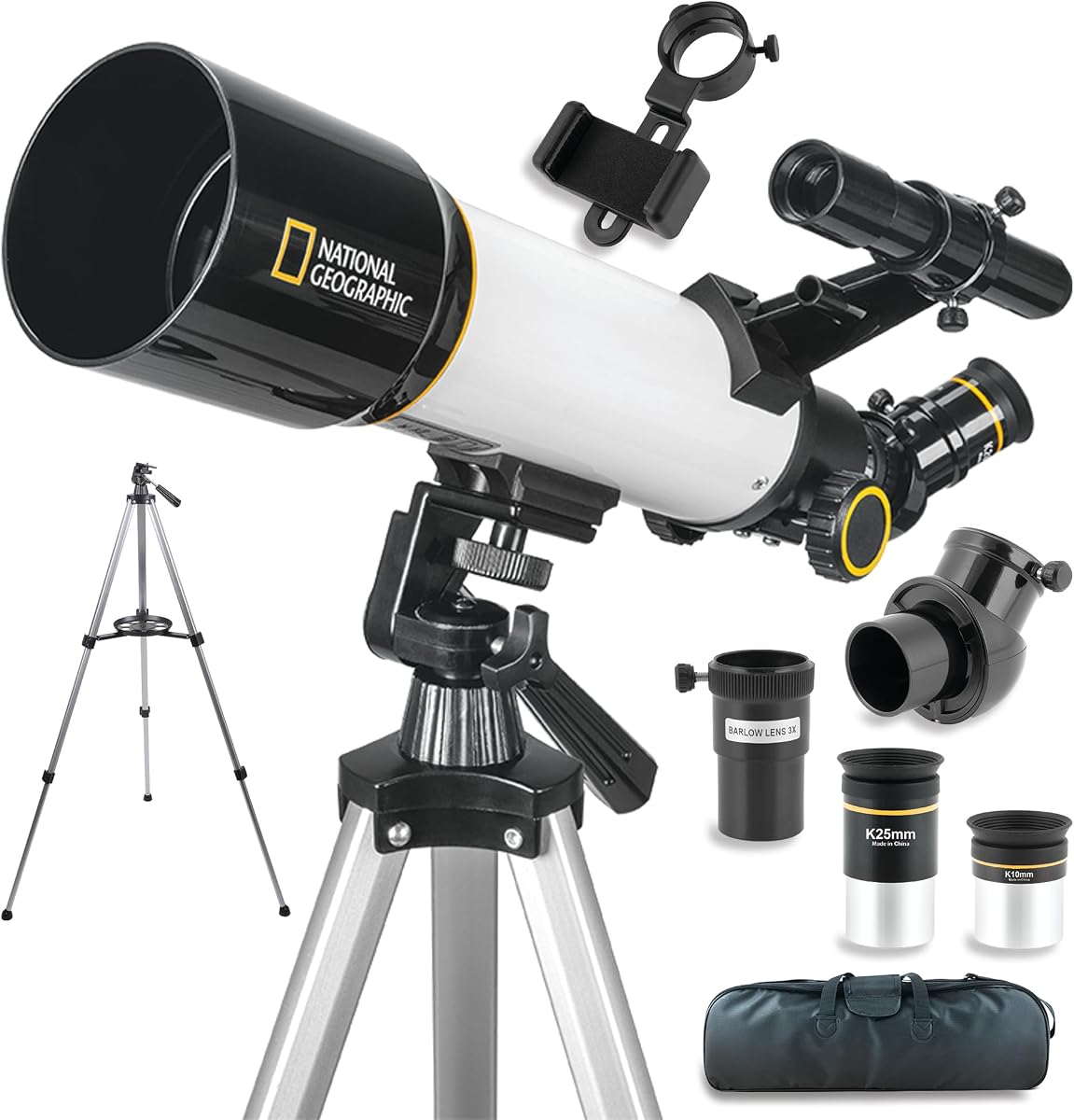
The National Geographic Sky View 70mm is a complete refractor telescope package for beginners who want a conventional observing setup and a way to photograph through it with a phone. Its 3.8 rating is the lowest among the rated products in this guide, so it should be viewed as an accessible general-purpose telescope rather than a specialist imaging platform. The included adapter makes smartphone use possible without buying a separate cradle.
We may earn a commission when you buy through this link, at no additional cost to you.
Its 70mm aperture and 400mm focal length provide enough capability to explore the Moon, planets, and some bright deep-sky objects such as nebulae and star clusters. Two interchangeable eyepieces and a 3x Barlow lens provide listed magnifications of 16x, 40x, 48x, and 120x. A straight-through viewfinder helps locate objects and align the telescope.
The panhandle alt-azimuth mount, diagonal, adjustable tripod, and accessory tray create a ready-to-use observing system. The diagonal supports a comfortable viewing angle, and the accessory tray keeps the eyepieces and Barlow close at hand. The smartphone adapter specifically supports Moon and other target photography, although it does not provide the precision controls of a three-axis adapter.
This telescope makes sense for a family, student, or casual observer who wants one package that supports both visual astronomy and simple phone photography. The 120x option can produce a high-magnification impression, but its practical usefulness depends on atmospheric conditions and the mount's ability to hold the target steady. It offers a traditional alternative to app-driven smart telescopes.
The telescope, mount, tripod, diagonal, finder, eyepieces, Barlow lens, and phone adapter provide the core equipment needed for a first observing session. It avoids the need to assemble a basic telescope system piecemeal.
The included adapter makes phone photography accessible for targets such as the Moon. A steadier tripod and careful alignment remain important, and the manual panhandle mount offers none of the automatic tracking of a smart telescope.
We may earn a commission when you buy through this link, at no additional cost to you.
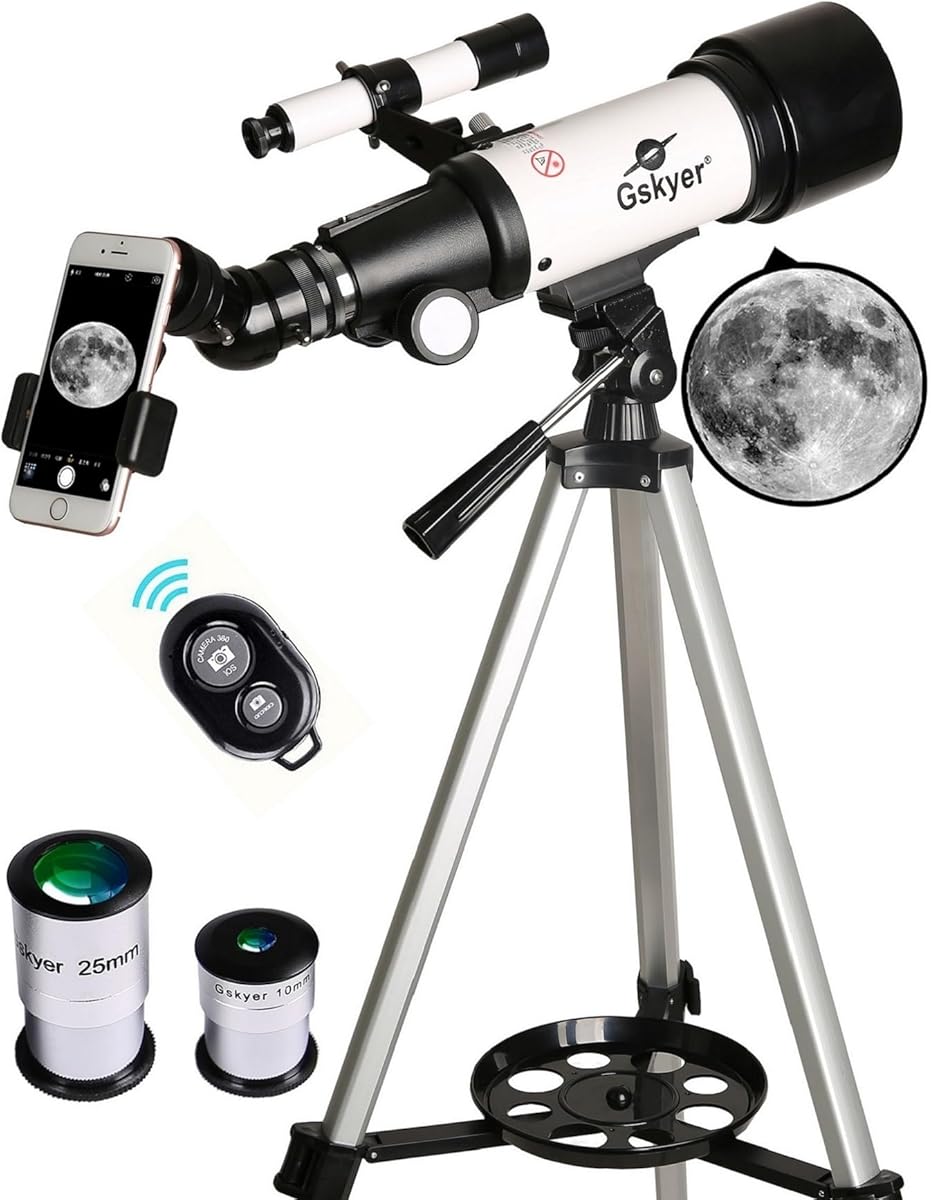
The Gskyer 70mm refractor is an entry-level telescope package designed for kids, beginners, and travelers who want visual observing plus a basic path into phone astrophotography. Its 4.3 rating is stronger than that of most products in this guide and helps offset the limitations inherent in a conventional beginner telescope. A phone adapter and wireless camera remote are included, creating a more direct imaging package than a basic visual scope.
We may earn a commission when you buy through this link, at no additional cost to you.
The 70mm aperture and 400mm focal length are paired with fully coated optics for transmission and eye protection. Two replaceable eyepieces and a 3x Barlow provide multiple magnification levels, while a 5×24 finder scope with crosshairs assists target location. The system's aluminum tripod can be adjusted for different observing positions.
A major practical detail is the included carry bag. The telescope and tripod fit inside for storage and travel, which makes the system easier to bring to parks, campsites, and darker observing locations. The wireless remote enables image capture without touching the phone, helping reduce movement during an exposure.
This is the best budget selection for a buyer who wants a complete telescope, phone adapter, and remote in one package. It is not suitable for advanced deep-sky workflows because the alt-azimuth mount is manual and the system has no automated stacking or mosaics. For Moon photography, bright targets, and learning the fundamentals, however, it offers a practical and well-rated starting point.
The supplied phone adapter and wireless remote remove the need to purchase basic digiscoping equipment separately. That makes the package more useful for beginners who want to try astrophotography during their first observing sessions.
Many worthwhile targets are easier to see away from city glow, and the included carry bag makes transport easier. A usable carrying system can therefore have a greater effect on real-world astrophotography than adding another accessory to a kit kept at home.
We may earn a commission when you buy through this link, at no additional cost to you.
The Andoer WiFi Electronic Eyepiece is a compact digital viewing and recording device that connects to a smartphone or tablet over WiFi. Its 3.4 rating is the lowest among the scored products here, indicating that buyers should examine the fit, connection experience, and image quality expectations carefully. It offers a fundamentally different approach from adapters that place a phone camera over an eyepiece.
We may earn a commission when you buy through this link, at no additional cost to you.
The eyepiece camera fits a telescope with a 1.25-inch barrel and provides live viewing, image capture, and video recording through the phone or tablet. Because the optical sensor is part of the eyepiece, there is no need to align a phone camera with a lens opening. Its 4K video capability and WiFi connection are useful for casual astrophotography, bird watching, and portable observation.
A built-in 1600mAh lithium battery supports extended use and recharges through the included Type-C cable. Its compact, lightweight construction makes it suitable for travel, hiking, and carrying in a backpack. It therefore serves as a portable electronic eyepiece rather than a complete telescope package.
The Andoer is a practical option for someone who wants to view, capture, and record through a compatible telescope without buying a new phone or struggling with a phone-camera adapter. It does not provide advanced stacking, mosaic generation, or manual calibration controls, and the lower rating suggests caution for demanding imagers. For casual users, its wireless workflow and portable format are the main attractions.
The sensor captures the view directly inside the eyepiece, so users do not need to position a phone camera over the glass. This simplifies the physical setup and removes one common source of dark edges and shake.
The rechargeable internal battery, compact housing, and wireless connection make the eyepiece convenient to carry. It can serve as a lightweight observing and recording tool for astronomy or birding.
We may earn a commission when you buy through this link, at no additional cost to you.
The Vaonis Vespera Pro 2 is the most technically advanced smart telescope in this guide and is the best premium option for astrophotographers who want both automation and substantial manual control. Its 5.0 rating is the highest among the listed products. At the center of the system is a 12.5-megapixel square IMX676 sensor with 1.6 arcseconds per pixel and a stated limiting magnitude of 16.
We may earn a commission when you buy through this link, at no additional cost to you.
Its flat-field apochromatic quadruplet and stray-light baffles are intended to produce sharp deep-sky images with controlled optical artifacts. The BalENS signal enhancement automatically boosts faint targets and reduces sky gradients, while an automatic master-dark calibration can be applied repeatedly. These features reduce some of the work normally required for clean data without eliminating the importance of image processing.
The 50-megapixel mosaic mode covers a stated 4.18-by-4.18-degree field, and the system can stack images across dozens of hours and multiple nights. Users can either automate the sequence through the Singularity app or take control with exposure settings from 1 to 30 seconds and gain from 0 to 30 dB. FITS and TIFF export allows images to enter advanced workflows such as PixInsight or Siril.
The package includes an aluminum tripod and hard case, while a 225GB storage capacity and stated 11-hour battery support portable, extended operation. The app supports iOS and Android, offers LumENS AI assistance, and can manage 30 simultaneous projects. This is the strongest recommendation for experienced or ambitious deep-sky imagers, but beginners may find the manual settings unnecessary. The advanced sensor, optics, mosaic tools, and export options justify a premium position in this guide.
The 12.5-megapixel square sensor, 1.6-arcsecond pixel scale, apochromatic quadruplet, and stray-light baffles form a high-resolution imaging system. Its square format also provides a useful balance between magnification and the field needed for mosaics.
The Singularity app can automate acquisitions, while exposure, gain, dark calibration, and export controls provide access to a more deliberate workflow. This combination accommodates both one-tap imaging and multi-night projects.
The included tripod, hard case, 225GB storage, and stated 11-hour battery support imaging away from a fixed desk or observatory. Multi-night stacking also makes it possible to build a deeper image over several sessions.
We may earn a commission when you buy through this link, at no additional cost to you.
The best smartphone for astrophotography depends on the optical system, control level, target, and amount of setup you want to manage. All-in-one smart telescopes automate the experience, while adapters and electronic eyepieces require compatible equipment and offer more traditional control.
An all-in-one smart telescope contains its own optics, camera, tracking system, and app-driven acquisition. The Seestar S30 Pro and Vespera Pro 2 are designed to be placed under the sky, connected to a phone, and guided through a target. This is the simplest route for beginners or anyone without a telescope, but it also places a limit on manual optical control compared with a traditional imaging train.
A phone adapter is a different proposition. It requires your own telescope, spotting scope, monocular, or other compatible optical device, and it records through the phone camera. Electronic eyepieces replace the visual eyepiece with a digital sensor and transmit the view to a phone or tablet. A complete entry-level refractor includes the optical system, mount, and basic phone adapter, making it a convenient all-around package.
Deep-sky nebulae, galaxies, and star clusters generally benefit from a camera that can gather longer exposures, track a target, and stack multiple frames. The Seestar S30 Pro automates those functions, while the Vespera Pro 2 adds a larger sensor, mosaic imaging, multi-night stacking, and manual controls. The Moon and brighter objects are much more accessible through a beginner refractor and a basic smartphone adapter.
A conventional phone setup may also be used for the Sun only with a certified solar filter and strict safety procedures. Never point an unfiltered telescope or phone adapter at the Sun. The smart-telescope listings identify solar imaging among their modes, and the 128GB package includes a solar filter, but safe solar use still depends on following the supplied guidance exactly.
Eyepiece photography is sensitive to alignment because the phone lens must sit directly over the small exit-pupil area. The Tridaptor and Celestron NexYZ adapters use three-axis controls, including forward-and-back Z-axis movement, to make this adjustment easier. The Celestron Basic adapter has a more straightforward design and may be sufficient for a casual Moon photo, but it offers less mechanical precision.
Stability matters just as much as alignment. Rigid aluminum or metal frames are preferable to flexible plastic, and rubber pads can prevent scratches. A Bluetooth or wireless shutter avoids the vibration caused by touching the phone. Even with these features, the telescope should be well settled and the mount should hold the target steadily before the exposure begins.
Phone adapters should be checked against both the phone dimensions and the eyepiece diameter. The Tridaptor lists support for phones from 60 to 87.5 millimeters wide and eyepieces from 22 to 61 millimeters, while the Celestron NexYZ products support 35- to 60-millimeter eyepieces. The Basic Celestron adapter lists a 29- to 45-millimeter range. Users should also consider whether a protective phone case prevents the camera lens from sitting flush.
Eyepiece shape and eye relief can matter as much as diameter. Some short eyepieces are not suitable for certain adapters, and the Tridaptor explicitly advises measuring before purchase. For electronic eyepieces, the barrel interface must match the telescope; the Andoer model is designed for a 1.25-inch barrel. Compatibility is the first thing to verify because an otherwise capable adapter is useless if it cannot be mounted correctly.
Beginners often benefit more from automatic targeting, tracking, stacking, and AI noise reduction than from raw exposure control. The Seestar S30 Pro provides all of these through an app-centered workflow, including one-tap modes and automatic mosaics. This reduces the number of settings that must be understood during the first session.
More experienced imagers may want finer control over exposure, gain, calibration, file format, and session duration. The Vespera Pro 2 supports both approaches: automated projects in the Singularity app and manual exposure and gain settings. FITS and TIFF export provides a route into dedicated processing software, making it more suitable for a developing astrophotography workflow.
Portability depends on more than the stated weight. Consider the size of the complete assembly, the tripod, cables, filters, and storage needs. The Seestar S30 Pro is advertised at approximately 3.6 pounds and includes anti-dew protection, while the Gskyer package includes a carry bag for the telescope and tripod. The Vespera Pro 2 ships with an aluminum tripod and hard case.
Battery capacity is another important factor. The 128GB Seestar listing states up to six hours of battery life, and the Vespera Pro 2 states up to 11 hours. The Andoer electronic eyepiece uses a built-in 1600mAh battery and included Type-C charging cable. Choose a power setup that safely covers the intended session without leaving essential tracking or camera equipment without a reliable charge.
Smart telescopes can reduce noise, combine frames, and create mosaics automatically, while conventional phone adapters generally deliver a single phone-camera image for later editing. The Vespera Pro 2 also supports long multi-night stacking and export into PixInsight or Siril, offering a path from automated capture to advanced processing. The Seestar can save raw files for custom editing according to its product description.
Storage should be evaluated separately from cloud convenience. The 128GB Seestar version provides substantial onboard capacity, while the Vespera Pro 2 includes 225GB. A phone adapter relies primarily on the phone's available storage, which can limit long sessions. Larger files are useful for stacking and editing, but buyers should also consider transfer time, device storage limits, and how images will be backed up.
A smartphone or smart telescope does not remove the importance of observing conditions. Artificial light can reduce contrast, atmospheric turbulence can blur high-magnification images, and moving or vibrating equipment can create trails. The built-in light-pollution filters in the Seestar listings help mitigate urban sky glow, but observing from a darker location remains a major practical advantage. Planning sessions around local sky conditions can be as important as selecting a product.
Weather, moisture, and solar safety also need attention. Use the supplied anti-dew features where available, keep equipment protected during humid nights, and never improvise an unapproved solar filter. Read the included manual, particularly the software settings and deep-sky imaging instructions supplied with the Seestar, and use the safety guidelines provided with the 128GB package.
Begin with a dark, safe location and assemble the complete system before it is fully dark. Balance a conventional telescope on its tripod, attach the phone adapter, and center the camera over the eyepiece. For a smart telescope, set the device on stable ground, connect through its app, and allow the alignment and targeting process to finish. Check that the included filter, where applicable, is installed according to the manual.
For eyepiece imaging, adjust the X, Y, and Z controls gradually until the circular view is centered and bright edges are minimized. Set the phone to manual exposure when the app permits, use a supported image format, and trigger the image with the included remote or shutter rather than touching the phone. A short test exposure can reveal shake, poor alignment, or light contamination before a full session begins. Keep the telescope stationary during any deep-sky exposure that depends on tracking.
After the session, disconnect power before removing a phone, and detach the adapter gently rather than pulling against the eyepiece. Wipe lens surfaces with a clean microfiber cloth, clear condensation from optical surfaces, and let moisture evaporate before closing a case. Store batteries and electronics in a dry environment, periodically check cables and connectors, and keep firmware and acquisition apps updated when the manufacturer provides new versions.
An all-in-one smart telescope is generally the easiest option because it combines the optics, camera, mount, and guided acquisition software. The Seestar S30 Pro can find and track targets after a simple app connection. If you already own a telescope, a three-axis phone adapter such as the Tridaptor or Celestron NexYZ can turn the phone into an eyepiece camera with very little setup.
It depends on the product. The Seestar S30 Pro and Vespera Pro 2 are complete smart telescopes and do not require separate optics. The Tridaptor, Celestron adapters, National Geographic refractor, Gskyer refractor, and Andoer electronic eyepiece require compatible optical equipment or a telescope, depending on the specific product.
The Seestar listings explicitly state that the smart telescope is designed for deep-sky targets and is not intended for planetary observation. The other products can be used with compatible optics, but their performance on planets depends heavily on eyepiece quality, magnification, atmospheric stability, alignment, and the phone or electronic sensor. Keep in mind that long exposures are not automatically beneficial for planetary imaging.
A phone adapter uses the phone's own camera and may offer familiar image processing and storage, but it requires careful alignment. An electronic eyepiece contains its own sensor, removes the need to align a phone camera, and can transmit live video wirelessly. The best choice depends on the telescope interface, the importance of simplicity, and the desired image workflow.
Check the outside diameter of the eyepiece rather than the telescope's aperture or focal length. The Tridaptor supports a stated 22- to 61-millimeter range, the Basic Celestron adapter supports 29 to 45 millimeters, and the NexYZ models support 35 to 60 millimeters. Also confirm the phone dimensions, case clearance, eyepiece shape, and whether the manufacturer warns against shorter eyepieces.
Use a rigid mount, allow the telescope to settle, and trigger the phone with a remote instead of touching it. Align the camera carefully to avoid vignetting, use a fast shutter speed when the phone allows it, and record a short test before making a longer exposure. For tracking targets, keep the device stationary and confirm that the mount is not being bumped.
Only with a proper solar filter installed in front of the telescope and with the manufacturer's safety instructions followed exactly. The 128GB Seestar package includes a solar filter, while the other Seestar listing also identifies a one-tap Sun mode. An unfiltered phone or telescope pointed at the Sun can cause immediate and serious eye or equipment damage.
The listed smart telescopes are designed around app control and require a compatible smartphone or tablet to use the Seestar or Singularity experience. Their automation simplifies targeting and imaging, but the mobile device remains the main interface. Adapters work in the opposite direction, using the phone as the camera and requiring a separate telescope or eyepiece.
The ZWO Seestar S30 Pro is the most approachable overall choice for astrophotography because it combines automatic finding, tracking, stacking, mosaics, and AI processing in a portable package. The Vaonis Vespera Pro 2 is the premium option for imagers who want a larger square sensor, extensive automation, multi-night stacking, manual control, and professional export options.
Budget-conscious buyers should consider the Gskyer 70mm refractor, which includes a phone adapter, wireless remote, and carry bag, or a dedicated Celestron adapter if they already own suitable optics. Prioritize compatibility, alignment stability, the targets you want to photograph, and the amount of automation you genuinely need before choosing extra features.
Ratings, configurations, app functions, and prices can change over time, so verify the current product listing and included accessories before ordering. For solar observing, use only the specified protective equipment and instructions, and never rely on an improvised filter.