
HUGEROCK X70 Rugged Tablet
3.2Editor score
2600-nit sunlight-visible screen
External antenna navigation support
Motorcycle DC charging compatibility
Choosing a tablet for Onx Offroad navigation means balancing screen visibility, satellite positioning, battery endurance, physical protection, and the ability to run mapping tools away from reliable cell service. A large display is helpful for reviewing complex routes, but mounting space, glove operation, and vehicle power also matter. The best choice depends on whether you ride a truck, UTV, motorcycle, or overland expedition.
We compared the ten products using their published specifications, including operating system, display size and brightness, GPS support, ruggedness ratings, storage, connectivity, battery capacity, and specialized features such as external antennas or motorcycle charging. The list includes the onX Offroad app itself along with nine tablets designed to support off-road mapping, route planning, field work, and remote exploration.
Each review explains how the product fits into an off-road workflow rather than simply repeating its specifications. The top picks show the strongest combinations of navigation capability, rugged construction, usable screen size, and practical power management. Product details and availability can change, so readers should confirm current specifications, carrier compatibility, app support, and prices before purchasing.
3.2Editor score

4.5Editor score

4.3Editor score
As an Amazon Associate we earn from qualifying purchases.
This side-by-side comparison highlights each option's display, positioning system, rugged protection, and practical connectivity. It also shows how the dedicated onX Offroad membership differs from the tablets that can run third-party mapping and navigation apps.





The onX Offroad App is not a tablet, but it is the central navigation service for anyone searching specifically for a tablet for Onx Offroad use. It earns a 4.1 rating and provides a large database of off-road roads and trails across all 50 states. The subscription can be used on a phone, tablet, or computer, allowing riders to plan at a desk and carry the route into the field.
We may earn a commission when you buy through this link, at no additional cost to you.
Its strongest feature is the combination of satellite imagery, detailed topographic and base maps, trail difficulty information, vehicle compatibility filters, and real-time open or closed status. That information helps riders distinguish a legal, drivable route from a visually interesting but unsuitable road. Waypoint, track, and route markup tools support reconnaissance, while offline map downloads preserve navigation when cellular service disappears.
The tradeoff is that the service does not itself provide a screen, battery, vehicle mount, or physical protection. It also works best as part of a broader setup: one device for planning and another rugged tablet for visibility, mounting, and field durability. The app may also need to be checked against current vehicle, trail, and regulatory information because community reports and status data can change.
This is the best pick for the navigation experience itself and an essential companion for every tablet-based trail setup. Riders who want the trail intelligence of onX should pair the membership with a device offering bright sunlight visibility, reliable GPS, offline storage, and secure mounting. It is particularly useful for overlanders, Jeep and 4×4 drivers, and UTV riders comparing several possible routes before departure.
Satellite imagery, difficulty ratings, and compatibility filters make it easier to evaluate obstacles before committing to a route. The resulting plan is more informed than a basic road map and is better suited to legal off-road travel.
Offline map downloads are essential when service becomes unreliable in forests, canyons, and remote backcountry terrain. They allow riders to retain navigation information without depending on a live cellular connection.
We may earn a commission when you buy through this link, at no additional cost to you.
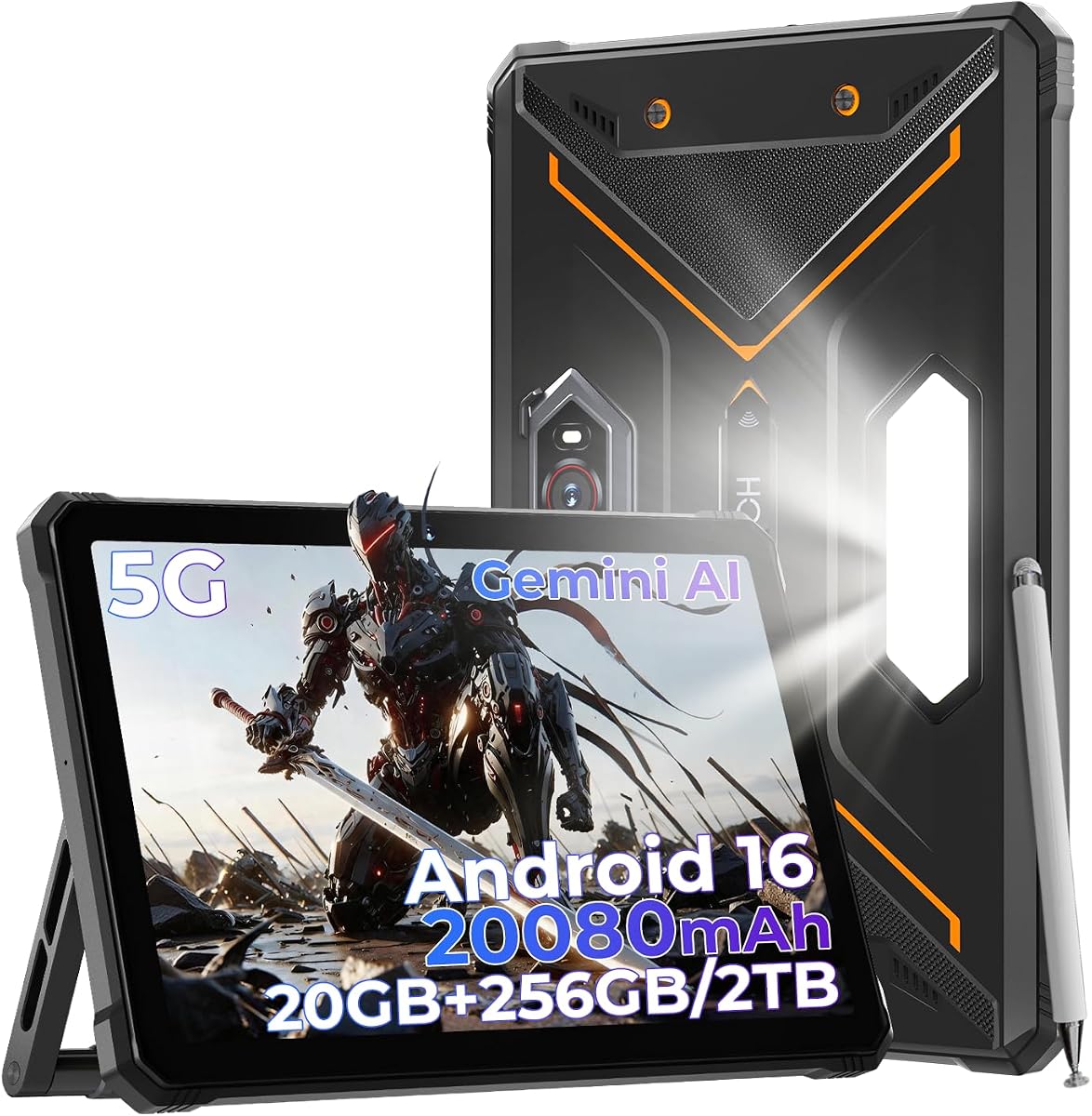
The T5 Pro 5G Rugged Tablet offers the most balanced overall package for a tablet for Onx Offroad navigation. Its 4.5 rating, 11-inch 1920-by-1200 IPS display, 120Hz refresh rate, and 450-nit brightness provide enough room for route review without making the device excessively compact. The 20080mAh battery is particularly well suited to long days beyond an outlet.
We may earn a commission when you buy through this link, at no additional cost to you.
Positioning is handled through GPS, GLONASS, Galileo, and BeiDou, giving riders a broad selection of satellite systems. It also includes 5G dual-SIM connectivity, 256GB of internal storage, and microSD expansion, so downloaded maps and route files can remain on the device. The 6nm UNISOC T8200 processor and up to 32GB of combined memory support navigation, communication, and field applications together.
Physical protection is a major strength. IP68 and IP69K ratings cover dust and water exposure, while MIL-STD-810H protection includes drop testing up to 1.2 meters. The integrated 380-lumen lamp offers ambient and flashing SOS modes, while Glove Mode improves operation in cold conditions. The main compromises are carrier restrictions and the bulk of an 11-inch device. It is listed as compatible with T-Mobile, Mint Mobile, Google Fi, and Metro by T-Mobile, but not AT&T, Cricket, or Verizon.
This is the strongest recommendation for riders who want one device to handle route planning, offline mapping, communication, photography, and general travel use. It is particularly well matched to UTVs, overland vehicles, and trucks with adequate mounting space. Buyers should verify their mobile carrier and confirm that their preferred navigation apps remain available through the Google Play route before committing.
The 11-inch high-resolution screen gives trails, satellite imagery, and written instructions more visual room than a small phone. A 120Hz refresh rate also makes map panning and menu transitions feel responsive during route planning.
A 20080mAh battery reduces charging stops on long rides, while 33W USB-C charging helps restore power during breaks. Reverse charging can also support compatible phones, cameras, watches, and other devices.
We may earn a commission when you buy through this link, at no additional cost to you.
The AGM PAD P2 Active is a compelling value-oriented rugged tablet for riders who need a large, bright display and dependable physical protection. It carries a 4.3 rating and uses an 11-inch Full HD IPS panel with 480 nits of brightness, a 90Hz refresh rate, and enough resolution to examine road names and trail details comfortably.
We may earn a commission when you buy through this link, at no additional cost to you.
The MediaTek Helio G99 octa-core processor is designed for responsive everyday performance, while 16GB of combined memory and 256GB of storage provide room for downloaded maps, media, and offline documents. Storage can be expanded by up to 2TB with a microSD card. GPS, a compass, and OTG support add practical value, although the published specifications do not explicitly describe cellular connectivity.
Its rugged specifications are particularly relevant off the pavement. The tablet has IP68 and IP69K water resistance, 360-degree dust protection, and a stated 1.8-meter drop resistance. The 8000mAh battery is smaller than those in several competing models, so riders planning multi-day expeditions should consider their power consumption and carry a charging solution. A 50MP rear camera and 8MP front camera support trip documentation and video calls.
This is the best value choice for users who prioritize screen size, brightness, storage, and physical resilience without needing every advanced connectivity feature. It works well for trail scouting, field documentation, and running offline mapping software. Before buying, confirm the exact cellular and application options needed for the intended setup, since network support is not detailed in the supplied product information.
At 480 nits, the display is better suited to direct outdoor viewing than many conventional tablets. The 11-inch canvas makes it easier to inspect terrain imagery, road labels, and route instructions while remaining in a vehicle.
The 256GB internal storage and 2TB expansion capability provide ample room for map regions, track files, photographs, and documents. That makes it easier to prepare for areas where downloading or updating content may be difficult.
We may earn a commission when you buy through this link, at no additional cost to you.
The HUGEROCK X70 is built around a specialized use case: motorcycle and off-road navigation. It has a 3.2 rating, the lowest among these products, but several features directly address the demands of riding in bright daylight, dusty conditions, and remote areas where radio reception may be difficult.
We may earn a commission when you buy through this link, at no additional cost to you.
Its 7-inch Full HD display produces 2600 nits of brightness, making it the most sunlight-focused screen in the group. A full-shell design provides IP67 waterproof protection and MIL-STD-810G drop protection, while ordinary glove operation helps riders interact with the device without specialized gloves. The compact proportions also make it more plausible for a motorcycle handlebar or compact UTV mount.
Navigation is the key premium feature. The built-in high-precision module is described as sub-meter accurate, and an external SMA antenna can improve reception in forests and canyons. The device also offers dual nano-SIM slots, WiFi 5 or 4, Bluetooth 5.0, and microSD expansion. A 10000mAh battery, magnetic charging, and a DC 12V/RS232 interface simplify long-ride power planning.
The compromises are its relatively small screen, Android 13 platform, and 8GB of physical memory, which is modest by comparison. Its 3.2 rating also warrants more caution than the higher-rated options. It is best for riders who prioritize sunlight visibility, external antenna support, and motorcycle integration over maximum screen area or the newest operating system.
The 2600-nit display is the defining advantage in this roundup. It gives riders a clear view of routes in open desert, exposed trails, and other environments where a standard tablet screen can become difficult to read.
The external SMA antenna connection can be valuable in dense trees and steep canyons. It offers more flexibility than a tablet that relies exclusively on its internal navigation hardware and built-in cellular antennas.
We may earn a commission when you buy through this link, at no additional cost to you.
The OUKITEL RT11 combines a 5.0 rating with a compact 8-inch form factor, making it a practical middle ground for off-road navigation. It is smaller than the 10- and 11-inch alternatives but still large enough to display maps, routes, and service information without becoming difficult to handle around a vehicle.
We may earn a commission when you buy through this link, at no additional cost to you.
Its 800-by-1280 HD IPS display reaches up to 500 nits, which offers reasonable outdoor visibility. Internally, a 6nm UNISOC T760 octa-core processor, 24GB of combined memory, and 128GB of internal storage support navigation and work applications. A compatible microSD or TF card can expand storage by up to 1TB, but it uses the second SIM slot, meaning users may need to choose between extra storage and dual-SIM operation.
The 10000mAh battery is rated for up to 12 hours of video playback or 36 hours of calling, with 18W wired charging and reverse charging for compatible devices. GPS, GLONASS, Galileo, and BeiDou support fleet routes and field inspections. IP68 and IP69K protection and MIL-STD-810H design add durability, while testing reportedly includes repeated drops from up to 1.2 meters under specified conditions.
This is a strong option for technicians, delivery drivers, and riders who want cellular connectivity in a smaller device. The trade-off is a lower-resolution screen than larger competitors and limited simultaneous use of both SIM slots and expandable storage. It is a good fit for dashboards, mobile work, and navigation where portability matters more than maximum display detail.
The 8-inch format balances route visibility with easier carrying and mounting. Multi-system GPS support and 5G connectivity make it a credible choice for mixed work and recreational use.
The 10000mAh battery is sized for vehicle navigation, inspections, and service routes. Reverse charging adds a backup function for a phone or camera when an outlet is not readily available.
We may earn a commission when you buy through this link, at no additional cost to you.
The HOTWAV R9 PRO MAX is an 11-inch 5G rugged tablet built around long workdays and off-grid travel. Its 4.3 rating and 20080mAh battery make it one of the strongest choices for riders who need more endurance than a standard vehicle tablet can offer.
We may earn a commission when you buy through this link, at no additional cost to you.
The 1920-by-1200 FHD display runs at 120Hz, providing a large and smooth surface for mapping, route review, and glove-friendly operation. The published feature list identifies 5G connectivity and multi-system GPS but does not state the exact satellite constellations, so buyers should check that detail against their requirements. Dual-SIM support allows separate work and personal lines when a compatible carrier and plan are available.
Its physical construction includes IP68 and IP69K protection and MIL-STD-810H-grade durability. A 64MP main camera and separate 20MP night-vision camera support daytime trail documentation and low-light work. The device includes 20W fast charging, OTG reverse charging, 8GB physical memory with up to 12GB extended memory, and 256GB internal storage. A bracket and stylus broaden its usefulness for vehicle use and detailed screen input.
The main trade-off is that the stated 20W charging speed is modest relative to some 33W competitors, although battery capacity helps offset slower replenishment. Night-vision and 5G features also depend on the environment. This is an excellent expedition-oriented choice for large-screen mapping, media, photography, and work in remote settings.
The 20080mAh capacity is especially useful on multi-day trips where charging opportunities are unpredictable. It also provides a reserve for demanding navigation, communication, and camera use.
The dedicated 20MP night-vision camera gives the tablet a purpose beyond standard off-road navigation. It can help document camps, obstacles, vehicle condition, or work tasks in low-light environments.
We may earn a commission when you buy through this link, at no additional cost to you.
The ORCATAB WT1 Pro combines a sharp 11-inch 2K display, Android 16, 5G, and a 20080mAh battery. Its 4.4 rating places it near the top of the group, and its feature set is particularly complete for engineers, surveyors, campers, and travelers who use their tablet for more than route viewing.
We may earn a commission when you buy through this link, at no additional cost to you.
The 1200-by-1920 panel operates at 120Hz and has 450 nits of brightness. While the T5 Pro shares a similar brightness level, the WT1 Pro's resolution specification gives map labels, satellite imagery, and documents a potentially crisper presentation. The 6nm UNISOC T8200 octa-core processor, 8GB physical memory with 24GB virtual memory, and 256GB storage support navigation, data loggers, and office applications. MicroSD expansion reaches up to 2TB.
For positioning, the tablet supports BeiDou, GLONASS, Galileo, and GPS. It has IP68, IP69K, and MIL-STD-810H certification, with the listed drop resistance extending to 1.5 meters. A 380-lumen integrated light offers work, ambient, and emergency functions. The included 64MP, 20MP night-vision, and 16MP front cameras also make it suitable for field documentation.
The WT1 Pro supports dual SIM but is listed as compatible with T-Mobile rather than AT&T, Cricket, or Verizon. Its size and weight may make secure mounting essential, and 33W charging helps recover power between stops. It is a strong all-around recommendation when a crisp screen, long battery life, and extensive outdoor hardware matter more than minimum weight.
The 2K-class 11-inch screen offers a detailed view for satellite imagery, topographic maps, route notes, and field documents. The 120Hz refresh rate also supports smooth map interaction during planning.
Multi-system GPS, a large battery, fast charging, and a 380-lumen lamp form a practical support system for remote assignments. Reverse charging can provide emergency power to a phone, GPS receiver, or headlamp.
We may earn a commission when you buy through this link, at no additional cost to you.
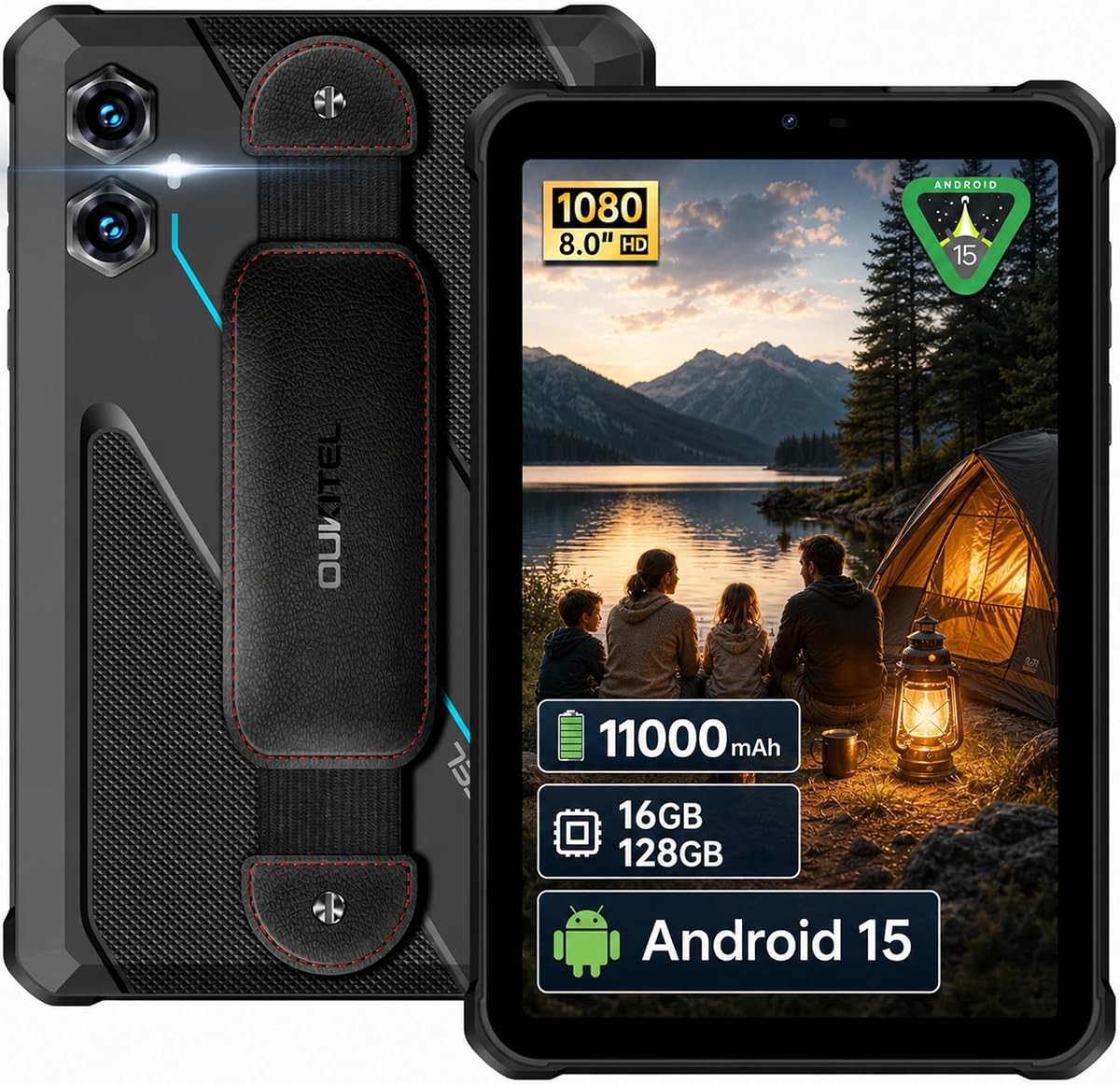
The black OUKITEL RT3 Plus is a compact, highly rated 8-inch Android 15 tablet. It is designed for riders and field users who want more protection and endurance than a conventional tablet without carrying a large 11-inch device. Its 5.0 rating reflects a strong customer reception among the products compared.
We may earn a commission when you buy through this link, at no additional cost to you.
The 1280-by-800 IPS panel operates at 60Hz and reaches 420 nits, offering a practical compromise between size, clarity, and outdoor visibility. A MediaTek G81 octa-core processor is paired with 16GB of combined memory, comprising 4GB physical RAM and 12GB extended memory. Storage begins at 128GB and can expand by up to 1TB. The published specifications do not state 5G, but 4G dual-SIM connectivity is listed.
The 11000mAh battery is rated for 66 days of standby and 45 hours of continuous calling. OTG reverse charging can replenish compatible phones, drones, and other devices. GPS, GLONASS, BeiDou, and Galileo provide multi-system positioning, while a wrist strap helps prevent drops during active use. IP68 and IP69K ratings add water and dust resistance for trips beyond the pavement.
This is a strong value pick for compact navigation, especially where mount space is limited or the tablet will also be carried on foot. The 60Hz display and 420-nit brightness are less impressive than the premium alternatives, and actual navigation smoothness depends on the installed applications. It is best for riders who prioritize capacity, handling, and everyday durability.
The slim 8-inch design is easier to fit in a backpack, handbag, or compact vehicle mount. The included anti-slip wrist strap adds control when the tablet is used away from a dashboard or stand.
Support for GPS, GLONASS, BeiDou, and Galileo gives the device a broad satellite foundation. That is useful in varied terrain, although actual accuracy still depends on the navigation application and signal conditions.
We may earn a commission when you buy through this link, at no additional cost to you.
The blue OUKITEL RT3 Plus shares the core hardware of the black version and likewise carries a 5.0 rating. It is a compact 8-inch Android 15 tablet built around endurance, portability, and useful outdoor extras. It is a practical alternative for buyers who prefer the different finish or have found this specific listing more suitable for their needs.
We may earn a commission when you buy through this link, at no additional cost to you.
Its 1280-by-800 IPS screen has 420 nits of brightness and a 60Hz refresh rate. The MediaTek G81 octa-core processor works with 16GB of combined memory and 128GB of internal storage that can be expanded by up to 1TB. A 11000mAh battery, 4G dual-SIM support, Bluetooth 5.0, OTG, and NFC provide a well-rounded set of connectivity options.
Positioning support includes GPS, GLONASS, BeiDou, and Galileo, making it appropriate for trail maps and basic field navigation. The 16MP rear camera and 8MP front camera handle documentation and video calls. A pair of 100-decibel speakers can deliver navigation prompts or music clearly in an open environment, while Face ID provides a convenient authentication method.
Its limitations mirror those of the black RT3 Plus: the 60Hz panel is less fluid than 90Hz and 120Hz alternatives, and 420 nits may be less comfortable in severe midday sun. The best route is to compare the exact listing, included accessories, warranty terms, and color preference. It remains a capable compact navigator for everyday trail use.
The 8-inch format keeps the device manageable in a vehicle or on foot, while the 11000mAh battery supports extended use. It is a sensible middle ground for riders who do not need a large entertainment-style display.
The unusually high-volume speaker specification can help audible navigation prompts in an open cabin. NFC and Face ID also make the tablet more convenient for communication and routine secure access.
We may earn a commission when you buy through this link, at no additional cost to you.
The OUKITEL RT9 is a 10.1-inch rugged tablet that delivers a large full-HD display, substantial battery capacity, and a 5.0 rating. It occupies an interesting middle ground between compact 8-inch devices and the larger 11-inch models, offering more map space without moving into the largest chassis in the comparison.
We may earn a commission when you buy through this link, at no additional cost to you.
The display provides 1920-by-1200 resolution for viewing maps, documents, photographs, and video. A Unisoc T606 octa-core processor supports everyday browsing, streaming, navigation, gaming, and work applications. Memory is listed at up to 24GB with 18GB described as expanded memory, while 256GB of internal storage provides ample room for downloaded map regions and media.
The 11000mAh battery is designed for situations where an outlet is not always available. Dual-SIM support, a glove-friendly design, and a 93-decibel speaker add practical value in cold-weather activities, workshops, and outdoor vehicles. A 16MP camera can document route conditions, job sites, documents, and everyday trips. The enclosure is described as waterproof, dustproof, and shock-resistant, but no specific IP or military certification is listed.
The RT9 is best for buyers who want a large display and generous storage at the lower end of this roundup. Its omissions are meaningful: there is no stated 5G, no precise ingress-rating number, and no battery fast-charging figure. It is therefore most appropriate for riders who value screen area, storage, and battery capacity more than premium connectivity or formally documented protection standards.
The 10.1-inch full-HD screen provides a generous area for satellite imagery, route instructions, and saved tracks. It is particularly useful for comparing multiple plans before a trip.
Glove-friendly operation and a 93-decibel speaker suit outdoor environments where users may have cold hands or need navigation prompts to be audible. Dual-SIM support adds another layer of everyday flexibility.
We may earn a commission when you buy through this link, at no additional cost to you.
The most useful off-road tablet is one that remains readable, protected, and navigable in the conditions where the ride actually happens. Reviewing display, positioning, power, connectivity, mounting, and app compatibility together prevents an expensive mismatch.
Screen size determines how much of a route, satellite layer, or trail map can be reviewed at once. Eight-inch tablets are easier to carry and mount, while 10.1- and 11-inch models provide more space for detailed maps and trip documents. Brightness matters at least as much as resolution: the HUGEROCK X70 leads this list with 2600 nits, while the AGM PAD P2 Active reaches 480 nits and the 8-inch OUKITEL models use 420 nits. A high refresh rate also improves panning and menu response, although it does not directly improve map accuracy.
A tablet with GPS can provide a basic position estimate, but multi-system support is more useful when the ride crosses forests, canyons, mountains, or open desert. The T5 Pro, WT1 Pro, AGM PAD P2 Active, OUKITEL RT11, and both RT3 Plus models list support for several satellite systems. The HUGEROCK X70 goes further with a sub-meter navigation module and an external SMA antenna connection, which can be valuable in difficult signal conditions. A compass is also useful for orientation, but every rider should still carry a separate compass and understand the limitations of consumer electronics.
Off-road navigation often means no reliable cell service, so route preparation must happen before departure. The onX Offroad App supports offline map downloads, while the tablets provide storage ranging from 128GB to 256GB, with several offering microSD expansion. Expanded RAM can improve multitasking, but offline maps and route files consume actual storage. Riders should also verify whether a card slot shares a SIM slot, because the OUKITEL RT11 specification states that microSD expansion uses the second SIM position.
Battery capacity is a major differentiator on remote routes. The T5 Pro, HOTWAV R9 PRO MAX, and ORCATAB WT1 Pro each list 20080mAh cells, while several 8-inch models use 10000- or 11000mAh batteries. Actual runtime depends heavily on screen brightness, 5G use, navigation, camera activity, and signal searching. Fast charging can shorten stops, and OTG reverse charging can provide backup power for a phone or GPS unit. Vehicle-specific charging is especially relevant for motorcycles, where the X70's DC 12V/RS232 interface stands out.
A tablet that survives dust, water, vibration, and drops is more useful in an off-road vehicle than a thin consumer model. IP68 and IP69K appear repeatedly in this group, while the AGM PAD P2 Active lists 1.8-meter drop resistance and the ORCATAB WT1 Pro lists 1.5-meter protection. The HUGEROCK X70 uses IP67 and MIL-STD-810G, and the OUKITEL RT11 offers IP68, IP69K, and MIL-STD-810H protection. Ratings describe controlled conditions, so a case, secure mount, and screen protector remain sensible even on rugged devices.
5G and 4G can provide live traffic, communications, and map updates when a signal exists, but cellular support is only useful with a compatible carrier and service plan. The T5 Pro and ORCATAB WT1 Pro are listed as compatible with T-Mobile, Mint Mobile, Google Fi, and Metro by T-Mobile, but not AT&T, Cricket, or Verizon. The AGM PAD P2 Active does not clearly specify cellular capability in the supplied information. Dual-SIM can be convenient for work and personal numbers, although some models trade a SIM slot for microSD expansion.
A large display is difficult to use safely if it rocks, blocks sightlines, or cannot be reached from the driver's position. Eight-inch models are easier to mount in compact vehicles and on motorcycles, while 10.1- and 11-inch screens suit dashboards with more room. Glove-friendly operation helps riders in cold weather, and included kickstands can support hands-free use. The HUGEROCK X70 and WT1 Pro include stands, while the X70 and R9 Pro Max include mounting-related accessories. Always confirm cradle dimensions, viewing angle, cable reach, and whether charging remains accessible.
The onX Offroad App is designed for phone, tablet, and computer use, but a buyer should confirm that its tablet interface, offline downloads, and required services function on the selected device. Android versions range from Android 13 to Android 16 in this comparison. Accessories such as an SMA antenna, dual-SIM support, OTG, microSD expansion, NFC, reverse charging, and 3.5-millimeter connections can add value, but they are only helpful if they match the planned workflow. A stylus is useful for marking routes, while a wrist strap helps with handheld use.
Begin at home by creating your onX Offroad account, selecting suitable map layers, and downloading every region needed for the trip. Install any additional offline navigation or topographic applications, test them in airplane mode, and save backup route files locally. Charge the tablet fully, update the operating system and apps, verify that the date, time, and location services are set correctly, and insert a fresh microSD card only if the device's slot-sharing arrangement supports your plan.
In the vehicle, mount the tablet in a stable cradle within easy reach without blocking the driver's view. Connect a secure power lead or vehicle adapter, organize cables so they cannot interfere with pedals or controls, and enable glove mode when conditions are cold. Open the route before moving, set the vehicle and route options correctly, and download any remaining map tiles while service is available. Review open or closed trail status before departure and carry an independent paper map, compass, and charged phone.
During the ride, keep the tablet protected from direct impact, excessive heat, and water beyond its stated rating. Use a screen protector and case, clean the charging port after dusty or muddy travel, and avoid leaving the device in a hot vehicle. After returning, back up important tracks and photographs, inspect the mount and charging cable, and clean the exterior with a soft damp cloth. Check for firmware updates and verify that offline maps remain available before the next trip.
The T5 Pro, HOTWAV R9 PRO MAX, and ORCATAB WT1 Pro are the strongest general options because they combine large displays, substantial batteries, and rugged protection. The smaller OUKITEL models may be easier to mount, while the HUGEROCK X70 offers the best sunlight visibility and external antenna support. Confirm that the app and its offline features are available on the specific Android version before purchasing.
No, because 5G is not available in every remote area and satellite-based navigation is the primary positioning method. Cellular service is useful for communications and map updates when a signal exists, but riders should download offline maps before leaving. A 4G model can still be effective when paired with properly downloaded offline navigation data.
For open-country riding, brightness may be more important because a large but unreadable display offers little advantage. For route planning and detailed navigation, screen area and resolution become more useful. The best compromise depends on the vehicle, mounting space, typical weather, and how often the display must be viewed in direct sunlight.
Several models explicitly support glove-friendly operation, including the T5 Pro, HUGEROCK X70, HOTWAV R9 PRO MAX, and OUKITEL RT9. Sensitivity can still vary by glove thickness and operating system settings, so testing the touchscreen before the trip is important. A stylus or physical controls may provide a useful backup.
Storage needs depend on the map provider, region, imagery level, and number of downloaded routes. The 128GB and 256GB configurations in this roundup offer substantial room, while microSD expansion adds flexibility. Avoid filling the tablet completely, and test the downloaded map regions in airplane mode before departure.
A rigid, adjustable mount that locks the tablet and keeps the charging cable secure is preferable to an adhesive-only holder. Test the viewing angle and ensure the device does not block mirrors, controls, airbags, or the driver's sightline. A lanyard or secondary restraint can reduce the risk of the tablet moving during severe vibration.
Yes, electronics can lose power, suffer interference, become damaged, or fail to update a route. A paper map, baseplate compass, charged phone, and power bank provide useful redundancy. Offline onX maps improve the electronic experience, but they should complement rather than replace basic backup navigation tools.
No. The T5 Pro and ORCATAB WT1 Pro are specifically listed as compatible with T-Mobile, Mint Mobile, Google Fi, and Metro by T-Mobile, and not with AT&T, Cricket, or Verizon. Other models mention 4G or 5G without equally detailed compatibility lists. Check the exact product listing, supported bands, SIM format, and local coverage before activating service.
The T5 Pro 5G Rugged Tablet is the best overall choice for most riders because it balances an 11-inch 120Hz display, 20080mAh battery, multi-system GPS, 5G, and extensive rugged protection. The HUGEROCK X70 stands out for motorcycle and bright-sun environments with its 2600-nit display, external antenna, and vehicle charging, while the AGM PAD P2 Active delivers the strongest balance of value, screen size, brightness, and durability.
Prioritize the conditions you actually face. Choose brightness for exposed terrain, screen size for complex route review, multi-system positioning for remote regions, storage for offline maps, and capacity for long days away from an outlet. Compact 8-inch models are easier to carry and mount, while larger tablets are better for extensive map inspection. Carrier compatibility and app availability should be verified before checkout.
Current specifications, bundle contents, carrier support, and prices can change over time, so review the latest listing before buying. Most importantly, prepare the complete route at home, download the required offline maps, test airplane mode, and carry independent navigation backup. A properly chosen and configured tablet can make onX trail research, route review, and remote navigation much more convenient.