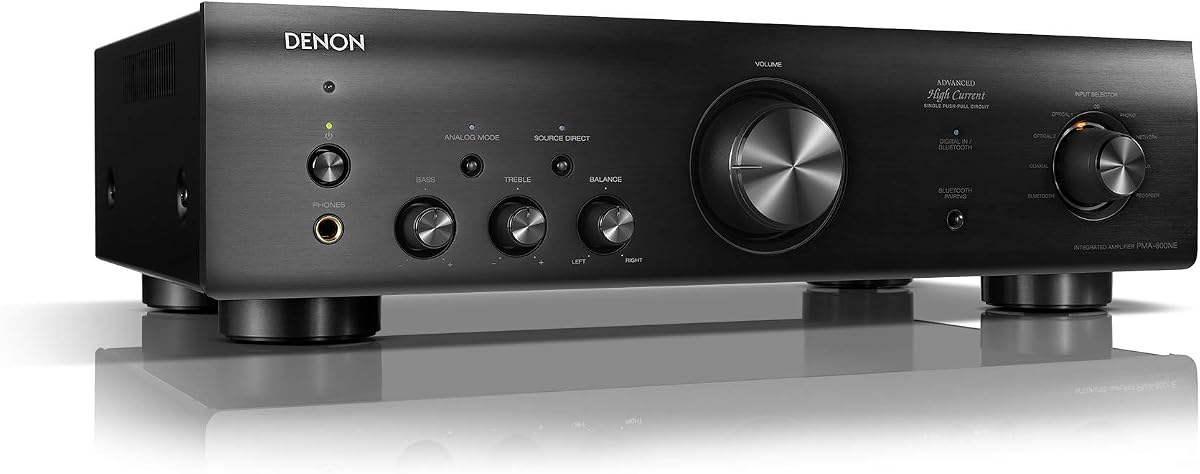
Denon PMA-600NE
4.6Editor score
70 watts into 4 ohms
Separated digital analog circuitry
Bluetooth and three digital inputs
Explore the best Hi End Amplifier for Audiophiles and compare 10 premium integrated amplifiers, preamps, and network models for sound and connectivity.
A hi-end amplifier can reveal the scale, texture, and emotional weight of recorded music, but the most capable unit is not automatically the right one for every listener. Audiophiles should balance circuit design, speaker compatibility, source support, phono performance, streaming convenience, and build quality.
This guide compares ten distinguished models from Marantz, Denon, Advance Paris, Yamaha, and FLYINSKY. The list includes traditional integrated amplifiers, compact streaming units, network receivers, and a dedicated balanced vacuum-tube preamplifier, allowing readers to compare power, connectivity, and listening priorities.
Each selection highlights the features supported by the available product information, with particular attention to high-current amplification, high-resolution audio, analog purity, and system flexibility. Ratings and prices can change, so readers should verify current product details, availability, and retailer terms before purchasing.
The resulting recommendations show that serious listening can take several forms. Some listeners prioritize refined power and expansive connectivity, while others want an uncluttered analog path, built-in network playback, or the nuanced presentation of a tube preamplifier.
Rather than treating every feature as equally important, this guide organizes the products by practical use. You can start with the quick comparison, then move to the individual reviews to understand each amplifier's strongest technical qualities and compromises.
Remember that amplifier selection also depends on the speakers, room, source components, and desired degree of control. A powerful model may suit large or low-impedance speakers, whereas a smaller system may gain more from a compact design or a carefully balanced analog connection.
4.6Editor score

4.8Editor score

4.8Editor score
The table below compares all ten featured products across amplifier type, output power, major connectivity, and distinguishing technical features. It makes it easy to narrow the field whether the priority is pure analog playback, high-resolution streaming, balanced control, or straightforward speaker driving.


The Marantz Model 50 earns its place at the top of this guide because it combines a focused analog architecture with the flexibility expected of a serious stereo centerpiece. Its 4.8 rating reflects an exceptionally strong reception, while its defining qualities are clarity of signal path, substantial current capability, and six dedicated analog inputs.
We may earn a commission when you buy through this link, at no additional cost to you.
The absence of digital circuitry is central to the design rather than an accidental limitation. The pure analog path is intended to avoid interference associated with digital sections, allowing the amplifier to function as a clean center for a turntable, CD player, tuner, streamer with its own DAC, or any other line-level source. Marantz's HDAM SA-3 discrete modules form the foundation of the amplification stage.
Its high-current Class A/B architecture is designed to drive demanding speaker loads with authority, while the built-in MM phono stage uses JFET input circuitry to accommodate vinyl playback without requiring an external box. Expansion is unusually well considered: stereo preamp outputs, a subwoofer output, power-amp input, and speaker A/B switching allow the system to grow without immediately replacing the core component.
The trade-off is equally clear. Buyers who want built-in Wi-Fi streaming, Bluetooth, television control, or a DAC must add an external streamer, television, or DAC. For listeners who value a clean, controllable analog chain more than maximum integration, however, that limitation is reasonable, and the Model 50 offers one of the most compelling combinations of musical intent and practical audiophile features in the list.
Choose the Model 50 when the amplifier will be the dedicated heart of a two-channel system and your sources already provide the conversion you need. It is particularly well suited to vinyl and other analog sources, but it also integrates easily with an external network streamer. For those priorities, it is the most balanced and expandable recommendation here.
By excluding digital circuitry, the Model 50 keeps the playback path conceptually straightforward. That makes it easier to pair the amplifier with high-quality external source components and preserves the design's emphasis on analog signal integrity.
High-current Class A/B amplification addresses speaker control, while preamp outputs, power-amp input, subwoofer connection, and A/B switching create multiple paths for building or refining a stereo system.
We may earn a commission when you buy through this link, at no additional cost to you.
The Advance Paris A12 Classic is the most forceful premium integrated amplifier in the group, with up to 190 watts per channel into 8 ohms and 280 watts into 4 ohms. Its 4.8 rating and distinctive dual VU meters make it visually memorable, but its practical appeal rests on power, connectivity, and a hybrid Class A/AB design.
We may earn a commission when you buy through this link, at no additional cost to you.
Balanced XLR inputs distinguish it from several integrated amplifiers that offer only unbalanced line connections, while multiple RCA inputs, optical, coaxial, and USB-B digital inputs allow it to serve as the hub for a varied system. A high-quality phono stage expands vinyl support, and oversized toroidal transformers are included to promote stable, low-noise power delivery.
The dual Class A/AB architecture is intended to combine the warmth and natural character associated with analog amplification with the operating benefits of a more efficient design. The substantial output capability should be particularly relevant to large floorstanding speakers, lower-impedance loads, or listeners who want confident control without investing in a separate power amplifier.
Its size and visual presence are meaningful compromises. A component this large may be difficult to position near listening-room walls, and the VU meters add a more conspicuous aesthetic than the understated faces found on several Marantz models. A stereo purist who wants no digital section may also overlook parts of the extensive connectivity.
The A12 Classic is recommended for audiophiles whose speakers benefit from generous power and whose system includes several source types, especially balanced equipment. It is especially compelling when a single integrated unit should combine analog authority, digital convenience, vinyl playback, and room-filling capability without requiring several separate components.
The specified 190-watt 8-ohm and 280-watt 4-ohm output positions the A12 Classic for speakers that need more current and control than a modest integrated amplifier may provide, subject to the system's impedance and manufacturer guidance.
XLR, RCA, optical, coaxial, USB-B, and phono connections make this a flexible centerpiece, although the digital section is unnecessary for listeners who deliberately want a wholly analog chain.
We may earn a commission when you buy through this link, at no additional cost to you.
The Marantz PM6007 is a refined, compact integrated amplifier that brings Marantz HDAM-SA3 amplification, a high-resolution DAC, and a broad selection of inputs into a relatively slim enclosure. Its 4.3 rating reflects a well-regarded approach to value and versatility rather than an attempt to maximize output power.
We may earn a commission when you buy through this link, at no additional cost to you.
The AK4490 DAC supports resolutions up to 192kHz/24-bit and offers two selectable digital filter modes, allowing listeners to compare subtle tonal options. Five analog inputs, one coaxial connection, and two optical inputs make it easy to combine digital and analog sources. A built-in MM phono stage adds vinyl utility, while speaker A/B switching and a subwoofer output broaden the system's options.
Its 45-watt rating is the central limitation. It is most persuasive with efficient speakers or in a room where the amplifier is not required to produce high volume levels continuously. The high-current power supply and thermal compensation help it manage demanding speakers, but buyers with large, low-impedance systems should consider an amplifier with a substantially higher output specification.
The lack of built-in Wi-Fi streaming is another limitation in a modern listening room, although a separate streamer can fill that role. In exchange, the PM6007 offers a straightforward integrated design, discrete Marantz amplifier modules, a substantial DAC, and useful physical features in a slim package.
This model is best for compact or secondary systems, listeners beginning to assemble a high-quality stereo setup, and anyone wanting Marantz circuitry without moving to a larger or more expensive chassis. It provides more source flexibility than a basic analog integrated amplifier and should be paired with speakers whose requirements remain comfortably within its power envelope.
The reference-class AK4490 converter and selectable digital filters make the PM6007 useful with multiple digital sources. It can also accept analog components without requiring separate digital and analog hubs.
Its slim enclosure and 45-watt specification suit efficient speakers and modest rooms. Larger or less forgiving loads are better served by a model with greater rated output.
We may earn a commission when you buy through this link, at no additional cost to you.
The Denon PMA-600NE offers one of the most approachable ways to assemble a serious two-channel system, combining 70 watts at 4 ohms with extensive source support. Its 4.6 rating is among the strongest in the group, and the divided-circuit design allows Bluetooth and other digital functions to be disengaged for a more direct analog listening experience.
We may earn a commission when you buy through this link, at no additional cost to you.
Digital connectivity includes two optical inputs, one coaxial connection, Bluetooth, and a built-in DAC, while a phono input supports a turntable. Denon's Advanced High Current push-pull circuit is the main technical foundation, designed to balance power with the retention of musical detail rather than treating output as the only measure of quality.
The analog-disengagement function is the feature most likely to appeal to traditional audiophiles. It reduces the influence of digital circuitry during analog playback, making the PMA-600NE a practical middle ground for someone who wants wireless convenience but does not want digital sections active in every listening mode. Its slim, vibration-resistant enclosure also helps it fit comfortably into a two-channel room.
Limitations include the lack of built-in Wi-Fi and its comparatively modest power figure. It will not satisfy listeners who require effortless control over large, low-impedance speakers, and those who want lossless network services will need a separate streamer. The 4-ohm rating should also be considered carefully when matching it to demanding loads.
For listeners seeking strong traditional performance, multiple inputs, and a manageable path into high-fidelity ownership, the PMA-600NE is a convincing choice. It is especially suitable for efficient bookshelf speakers, secondary listening rooms, and systems that value a mix of wired, wireless, and phono sources over maximum power or integrated network control.
The separated circuit structure allows digital functions to be switched away for analog listening. This gives wireless and digital users a practical entry point without requiring every source to pass through the same circuitry.
Advanced High Current amplification is designed to combine useful output with clean, detailed reproduction. The 70-watt specification remains best matched to speakers that do not demand extreme power reserves.
We may earn a commission when you buy through this link, at no additional cost to you.
The Marantz Model M1 is designed for listeners who want serious amplification and extensive network convenience in a compact package. It delivers 100 watts per channel and integrates HEOS, Bluetooth, AirPlay 2, Spotify Connect, USB, and high-resolution network playback, all within a small chassis that can be discreetly placed.
We may earn a commission when you buy through this link, at no additional cost to you.
Streaming support extends to 24-bit/192kHz PCM and DSD through streaming services, the network, or USB. Marantz Musical Digital Filtering is included to preserve warmth, detail, and spaciousness, while the subwoofer output makes it easy to construct a 2.1 system for music or film. Its HDMI eARC and Dolby Digital Plus decoding also allow it to improve television sound using the TV's remote.
The 100-watt output gives it more than enough authority for many mainstream audiophile speakers, although it still cannot substitute for a high-power specialist amplifier when driving very large or demanding loads. Its 2.1 output is convenient, but the Model 1 is fundamentally designed around music and flexible lifestyle listening rather than a complex multichannel home theater environment.
The chief compromise is the limited emphasis on traditional line-level connectivity in the supplied information. A buyer whose sources are all external analog components may find that a conventional integrated amplifier offers more direct control. Those who stream, use AirPlay, watch television, and want a small footprint will see a more compelling proposition.
The Model M1 is recommended as a modern hub for streaming-oriented audiophiles, particularly those in smaller spaces or multi-room households. It combines genuinely useful output power with Marantz tuning, high-resolution network support, wireless platforms, and television functionality in a design that prioritizes convenience without discarding serious amplification.
HEOS, AirPlay 2, Spotify Connect, Bluetooth, USB, and high-resolution network playback allow the amplifier to operate as the system's primary source and control point.
The combination of 100 watts per channel, 2.1 output, eARC television control, and a compact enclosure makes the Model M1 unusually flexible for a lifestyle-oriented audiophile amplifier.
We may earn a commission when you buy through this link, at no additional cost to you.
The Yamaha R-N2000A in silver is a network-focused hi-fi receiver that places high-resolution conversion and streaming at the center of the listening experience. Its 4.4 rating indicates a favorable reception, while the ESS SABRE ES9026PRO Ultra DAC and support for exceptionally high-resolution files distinguish it from conventional stereo amplifiers.
We may earn a commission when you buy through this link, at no additional cost to you.
Its USB DAC function supports native DSD 11.2MHz playback and files up to 384kHz, giving compatible source material ample resolution headroom. MusicCast provides access to network streaming services, while the toroidal power transformer is intended to support stable operation and a spacious presentation. The receiver format also permits the integration of television and other home entertainment sources.
Because the supplied specifications do not provide a clear power rating, it is difficult to compare the R-N2000A directly with the 70-, 100-, and 190-watt integrated amplifiers in this guide. That makes careful speaker matching especially important. Its emphasis on DAC performance and network operation should be a priority for listeners whose sources are digital and who want a comprehensive home hub.
Some audiophiles may hesitate over the receiver category because they prefer a dedicated two-channel amplifier with a purer signal path. The R-N2000A is also a substantial, premium component, and a buyer focused only on analog stereo may find a more specialized integrated amplifier more direct. Those who use high-resolution files and MusicCast will gain considerably more from the model's broader integration.
This model is well suited to audiophiles who treat digital playback and streaming as central parts of listening. It is also attractive for mixed-use rooms where music shares space with television and other media. Its major appeal lies in pairing a serious DAC with network functionality rather than emphasizing a specified power figure.
The ESS SABRE ES9026PRO Ultra DAC and support for DSD 11.2MHz and 384kHz playback position the R-N2000A for listeners with extensive high-resolution libraries and compatible source hardware.
MusicCast streaming and receiver functionality allow the unit to anchor a mixed-use room. Its appeal is strongest when the listener values digital convenience as much as traditional stereo performance.
We may earn a commission when you buy through this link, at no additional cost to you.
The Marantz Model 60n combines the company's HDAM amplification approach with a modern network amplifier feature set. Its 4.4 rating reflects a well-received balance of musical design and connectivity, while support for high-resolution audio, Roon Ready operation, and HEOS makes it relevant to contemporary audiophile systems.
We may earn a commission when you buy through this link, at no additional cost to you.
The amplifier supports content up to 24-bit/192kHz and can stream through HEOS over Wi-Fi. AirPlay 2 and Bluetooth broaden the wireless options, while its 2.1-channel output allows a subwoofer to supplement the main loudspeakers. Vinyl and CD remain part of the equation, indicating that the Model 60n is not limited to network-only listening.
The main uncertainty in the supplied information is the absence of a clear power figure. That makes it more difficult to judge how comfortably the unit will drive particular speakers or fill a large room. The Marantz circuitry and integrated stereo format remain attractive, but careful matching with the intended loudspeakers and listening space is advisable.
Compared with the Model 50, the 60n offers a more convenient path into streaming and high-resolution network audio. Compared with the Model M1, it presents as a more traditional network integrated amplifier rather than a compact lifestyle model. The difference in approach may appeal to listeners who want familiar Marantz stereo design with a more extensive digital feature set.
The Model 60n is a strong recommendation for an existing HEOS or Roon ecosystem, particularly when a turntable, streamer, and television all need to coexist. It is best suited to listeners who want the brand's HDAM presentation and 2.1 flexibility without giving up high-resolution streaming.
HEOS, Wi-Fi, AirPlay 2, Bluetooth, Roon Ready support, and 24-bit/192kHz playback provide a modern digital foundation while preserving the familiar form of an integrated stereo amplifier.
The 2.1-channel output allows a subwoofer to supplement the main speakers, making the Model 60n useful for listeners who want more low-frequency support in a compact stereo arrangement.
We may earn a commission when you buy through this link, at no additional cost to you.
The black Yamaha R-N2000A offers the same high-resolution network receiver platform as the silver edition, wrapped in an alternative finish for systems where visual coordination matters. Its 4.5 rating is slightly higher than the silver version's 4.4, making this listing an attractive choice for listeners who prefer the darker presentation.
We may earn a commission when you buy through this link, at no additional cost to you.
At its core is the ESS SABRE ES9026PRO Ultra DAC, supported by a USB DAC function capable of DSD 11.2MHz and 384kHz playback. MusicCast enables network streaming, while the receiver architecture also provides phono and multichannel functionality. The toroidal power transformer supports the intent of stable, immersive music reproduction.
The absence of an output-power figure in the product information makes direct speaker matching difficult. Audiophiles should therefore give particular attention to the manufacturer's current specifications and the sensitivity of their chosen speakers. A network receiver with extensive processing may also be less attractive than a dedicated integrated amplifier to someone committed to a two-channel-only analog chain.
Because the underlying model shares its major technical characteristics with the silver R-N2000A, the choice between them comes down to finish, available configuration, and current product conditions rather than a clear difference in core performance. The black model is likely to pair naturally with dark furniture, speaker grilles, and other understated components.
For a listener seeking high-resolution streaming, a premium DAC, and a receiver that can support both music and home entertainment, this is a strong option. It is most appropriate when the available power and channel configuration match the intended speakers and room.
The ESS SABRE ES9026PRO Ultra DAC and high-resolution playback support make the receiver particularly relevant to listeners with large digital libraries and compatible source equipment.
The black chassis offers the same core feature set as the silver model. Selection should therefore account for aesthetics, current availability, and the specific configuration offered for each listing.
We may earn a commission when you buy through this link, at no additional cost to you.
The FLYINSKY PRT13A-BAL is a remote-controlled, fully balanced vacuum-tube preamplifier built for listeners who want to shape the front end of a serious stereo system. Its 5.0 rating is the highest among the listed products, although it is important to recognize that it is a preamplifier rather than a complete amplifier.
We may earn a commission when you buy through this link, at no additional cost to you.
The circuit is based on a classic balanced topology and uses two ECC82 6N11 tubes. A customized 50VA pure copper tape-shielded R-Core transformer supplies the main energy, while independent left- and right-channel filament stabilization is intended to maintain separation and reduce crosstalk. Audiophile resistor-and-capacitor assemblies and an aluminum chassis support the product's high-end presentation.
Its high-voltage power supply uses a capacitor array and a high-voltage MOS regulator. The stated aim is lower internal resistance, stronger transient behavior, and reduced noise without the disruptive characteristics associated with conventional tube rectification and stabilization. A separate remote control is appropriate for a preamp intended to sit near the listening position and be adjusted away from the equipment rack.
Because it has no power-amplification stage, buyers need a compatible stereo power amplifier. They must also account for the space, cost, and maintenance implications of adding another major component. A conventional integrated amplifier offers a more direct and economical route to the speakers for many audiophiles.
The PRT13A-BAL is recommended specifically for listeners who already own a capable power amplifier and want to add a distinctive, balanced tube front end. Its high rating and careful power-supply design make it a compelling specialist component, but it is not a substitute for a complete integrated amplifier.
The fully balanced tube topology and dual ECC82 6N11 implementation distinguish the PRT13A-BAL from general-purpose preamplifiers. It is intended for listeners who deliberately value the front-end architecture.
The capacitor-array high-voltage supply, MOS regulation, large shielded transformer, and independently stabilized filaments are designed to improve transient behavior, noise performance, and channel separation.
We may earn a commission when you buy through this link, at no additional cost to you.
The Advance Paris A10 Classic delivers 130 watts per channel into 8 ohms and 190 watts into 4 ohms, placing it between the Denon PMA-600NE and the more powerful A12 Classic. Its 4.5 rating indicates a favorable reception, while the hybrid Class A/D design and broad connection set make it a versatile audiophile amplifier.
We may earn a commission when you buy through this link, at no additional cost to you.
Class A amplification is combined with Class D efficiency in a design intended to preserve analog warmth and precision. Two toroidal transformers support stable operation, and the internal components are positioned as audiophile-grade choices. The brushed aluminum front panel and retro-inspired VU meters give the amplifier a distinctive identity that is likely to appeal to listeners who enjoy both technical ambition and visual character.
Connectivity includes RCA and balanced XLR analog inputs alongside optical, coaxial, and USB-B digital connections. A built-in phono stage allows it to serve turntables directly, reducing the need for an additional component. This makes the A10 Classic a natural centerpiece for a mixed source system that includes both analog and digital components.
Its primary limitation relative to the A12 Classic is power: 130 watts at 8 ohms and 190 watts at 4 ohms still represent substantial output, but the larger model offers more headroom. Buyers seeking the absolute minimum path from source to speakers may also prefer a model with fewer processing and connectivity options. The visible meters, meanwhile, will not suit every setup.
The A10 Classic is recommended for audiophiles who want substantial output, balanced connectivity, digital flexibility, and phono support in a single integrated design. It is an excellent middle ground for medium-sized or larger rooms, particularly when a power amplifier would be excessive and a lower-powered integrated unit would be insufficient.
The Class A and Class D combination is designed to deliver analog character with efficient operation. It gives the A10 Classic a distinctive technical identity without removing modern source flexibility.
RCA, XLR, optical, coaxial, USB-B, and phono connections make the amplifier suitable for a varied system. Its 130-watt output adds useful authority without reaching the A12 Classic's more extreme power specification.
We may earn a commission when you buy through this link, at no additional cost to you.
The right amplifier depends on your speakers, room, source components, and listening priorities. Rather than chasing headline specifications, audiophiles should evaluate power requirements, signal-path priorities, source connectivity, control features, and practical fit.
Start with the speakers rather than the amplifier's most impressive number. Large floorstanding models, low-impedance designs, or rooms with substantial listening distances usually benefit from a high-current amplifier, while efficient bookshelf speakers may sound excellent with a more modest unit. The listed products range from the Marantz PM6007's 45-watt rating to the Advance Paris A12 Classic's specified 190 watts per channel at 8 ohms. These figures are not directly interchangeable because load ratings, test methods, and channel behavior can differ.
Choose an amplifier with enough clean output for normal listening levels without constantly pushing it toward its limits, but avoid paying for unnecessary power if your speakers and room do not require it.
A conventional integrated amplifier usually provides a purer and more flexible analog centerpiece, but it may require an external streamer, DAC, or tuner. Network models such as the Marantz Model M1, Marantz Model 60n, and Yamaha R-N2000A reduce the number of boxes by adding wireless streaming and high-resolution conversion. If your sources are already active network components, a streamlined integrated amplifier may be more appropriate than another conversion device.
Prioritize a model that matches how you actually listen. Built-in streaming is an advantage when convenience matters; external sources may offer better control over the signal chain.
Audiophiles often differ over whether digital sections should be active during analog playback. The Marantz Model 50 deliberately omits digital circuitry, while the Denon PMA-600NE provides divided circuitry so Bluetooth and digital functions can be disengaged. Models with USB, optical, coaxial, and network sections are more flexible, but their architecture should reflect the listener's wish for separation between source types.
For a dedicated analog chain, prioritize a clean path and a suitable phono stage. For a digitally active system, focus on the quality and supported formats of the internal DAC.
A built-in MM phono stage can simplify a turntable setup and reduce the need for an external box. The Marantz PM6007 and Model 50, Denon PMA-600NE, and both Advance Paris integrated amplifiers include phono functionality according to their product information. The Marantz Model 50 specifically uses a high-performance MM stage with JFET input circuitry, while the Advance Paris models are described as including high-quality phono stages. Confirm MM versus moving-magnet and moving-coil compatibility before connecting a cartridge.
If you use a moving-coil cartridge or require precise cartridge and loading adjustments, a dedicated external phono stage may offer more control than a basic integrated phono section.
High-resolution specifications show whether an amplifier or network model can accept modern digital files at their native rates. The Marantz PM6007 includes an AK4490 DAC with support up to 192kHz/24-bit, the Model M1 supports high-resolution PCM and DSD, and the Model 60n supports 24-bit/192kHz content. The Yamaha R-N2000A goes further with native DSD 11.2MHz and 384kHz USB playback. These capabilities are useful only when the source, files, and playback software support them.
Choose the converter based on the formats you own or realistically expect to use, not on the largest number printed on the box.
Balanced XLR inputs can be valuable in a carefully matched system because they offer a fully balanced connection from compatible source components. The Advance Paris A12 Classic and A10 Classic both provide XLR alongside RCA and digital inputs, while the FLYINSKY PRT13A-BAL is itself a balanced tube preamplifier. Using one side of a balanced connection without the other does not create the full benefit, so the source must also support the appropriate connection.
Treat balanced connectivity as one part of a complete system design rather than an automatic upgrade over a well-configured single-ended path.
A useful amplifier should make daily operation comfortable. Speaker A/B switching, subwoofer output, preamp outputs, power-amp input, and remote volume can all improve long-term usability. The Marantz Model 50 offers a particularly expandable arrangement, while the Model M1 adds television control through HDMI eARC and Dolby Digital Plus decoding. The Yamaha network receiver is aimed at mixed music and home-entertainment use.
List the functions you will use regularly and avoid paying for complexity that will remain disconnected. A simpler amplifier often creates a more satisfying system when it performs the essential jobs exceptionally well.
Audiophile equipment should also fit the room physically and visually. The Advance Paris models use large brushed aluminum chassis and VU meters, the Marantz Model M1 and PM6007 emphasize compactness, and the Yamaha R-N2000A is available in silver and black. Large components can be difficult to place near walls, while compact models may be better suited to furniture placement. Thermal clearance, ventilation, and accessible controls are practical requirements rather than cosmetic preferences.
Choose a design you will want to live with and operate. Placement convenience and repeatable access to controls can be as important as the feature list on the rear panel.
Begin by checking the amplifier's manual for ventilation requirements, speaker impedance limits, input compatibility, and safe startup procedures. Place the unit on a stable surface with unobstructed airflow, connect speakers with powered-off or correctly configured binding posts, and select the appropriate input before turning up the volume. For network amplifiers, complete the wireless setup and confirm that the intended source appears at the expected quality setting.
Match source levels sensibly. Begin with the amplifier volume low, bring the source to a moderate level, and then adjust the amplifier. This reduces the likelihood of an abrupt volume increase when a source changes. Use the correct phono input for a turntable, and confirm grounding when required. Owners of tube-based equipment should also follow the maker's warm-up, cooldown, and tube-handling guidance.
Keep the amplifier ventilated, protect it from moisture and direct sunlight, and avoid placing objects over cooling openings. Use high-quality cables appropriate to the system, clean connectors gently, and inspect them periodically for corrosion or looseness. Do not open a powered unit, and consult qualified service personnel for internal adjustments, fault diagnosis, or repairs.
Often, yes, because large or low-impedance speakers may require more current and voltage to maintain clean control at higher listening levels. The Advance Paris A12 Classic offers the highest specified output in this list, while the A10 Classic provides a strong middle option. Even a powerful amplifier should be matched to the speaker manufacturer's recommendations, because raw power does not replace correct impedance handling or compatible crossover design.
An integrated amplifier is often better for a dedicated two-channel analog system because it emphasizes source control and speaker amplification with fewer processing features. A network receiver is more convenient when streaming, television, high-resolution USB playback, and mixed entertainment are central. The right choice depends less on the label than on the sources, listening habits, and features you expect to use.
A balanced XLR connection can reduce susceptibility to interference when used with compatible source equipment and a properly implemented balanced signal path. It may be especially useful in larger installations or with sensitive components. The benefit comes from using the full balanced connection rather than treating XLR as a more durable version of an ordinary single-ended plug.
Only if you intend to use digital sources through it. A built-in DAC simplifies the system by accepting USB, optical, coaxial, or network audio and converting it to analog for the power stage. If you already own a high-quality streamer or DAC with a variable output, a cleaner analog integrated amplifier may be preferable. A fixed-output DAC can also be paired with an amplifier that has no volume control.
A built-in MM phono stage is sufficient for many turntables fitted with moving-magnet cartridges and can simplify a system considerably. It will not automatically suit every cartridge, particularly moving-coil designs that may require additional gain or a different loading approach. Verify cartridge type, gain requirements, grounding, and the manufacturer's phono specifications before connecting a turntable.
It means the amplifier's internal conversion section can accept digital files at the stated sampling rate and bit depth, provided the source device, connection, and playback software also support those formats. Support for 24-bit/192kHz, DSD, or 384kHz does not guarantee that the recording or the audible result will be superior. File quality, mastering, system matching, and the listening environment remain equally important.
They require more deliberate ownership than a conventional solid-state preamp because the tubes may need replacement and may require warm-up time. The FLYINSKY PRT13A-BAL also requires a separate power amplifier, adding another component and another level of system planning. A tube preamp is most appropriate for listeners who value its architecture and character and are prepared to include it in long-term maintenance.
Consider speaker sensitivity, room dimensions, furnishings, listening distance, and the levels at which you normally listen. A more powerful amplifier provides additional headroom in a large or reflective room, but it does not automatically sound better at low levels. Proper placement, speaker positioning, source quality, and room treatment can influence the final result as substantially as the choice between two well-executed amplifiers.
The Marantz Model 50 stands out as the most focused audiophile choice because it combines a pure analog path, 70-watt high-current amplification, a capable MM phono stage, and unusually useful expansion options. The Advance Paris A12 Classic is the stronger choice for maximum power and extensive balanced and digital connectivity, while the Denon PMA-600NE provides the most approachable combination of traditional amplification, separated digital circuits, and useful source options.
The remaining models demonstrate that there is no single ideal architecture. The Marantz PM6007 and Model M1 prioritize compact flexibility, the Yamaha R-N2000A emphasizes high-resolution conversion and network playback, the Model 60n combines Marantz HDAM design with HEOS and Roon Ready support, and the FLYINSKY PRT13A-BAL serves as a specialist balanced tube front end. Speakers, room, sources, and listening habits should guide the final decision.
Finally, verify current specifications, compatibility, warranty terms, ratings, and prices before ordering. Product availability and retailer pricing can change, and the right amplifier should be evaluated as part of a complete system rather than as an isolated component. Use the comparison and reviews to narrow the field, then confirm every connection and electrical requirement with the manufacturer.