Estes 0689 Celestial Explorer
4.1Editor score
Compact beginner rocket design
Quick one-hour assembly
Projected 1,000-foot altitude
This DIY Model Rocket Kit guide compares 10 beginner, intermediate, and advanced options for building, launching, and recovering model rockets safely.
A DIY Model Rocket Kit combines hands-on construction with the excitement of outdoor launch day, making it an engaging STEM activity for children, families, educators, and new rocketeers. The best kits balance approachable assembly, durable components, straightforward instructions, and a launch system that supports a rewarding first flight or a deeper engineering challenge.
This guide compares 10 Estes kits across build experience, rocket size, included equipment, engine compatibility, projected altitude, recovery method, and launch requirements. It includes beginner models, prebuilt alternatives, intermediate designs, and an advanced option so readers can find a kit that matches both their interests and experience level.
Each review explains the kit's standout features, practical trade-offs, and ideal owner, while the comparison table offers a quick side-by-side view. Listed ratings reflect the supplied product information, and prices can change, so readers should confirm current pricing, availability, engine requirements, and local launch regulations before purchasing.
4.1Editor score

4.5Editor score

4.7Editor score
This side-by-side comparison highlights the major differences in experience level, included launch equipment, assembly time, altitude, and engine needs, helping readers identify the most suitable DIY model rocket kit for their goals.


The Estes 1469 Tandem X combines two beginner rockets, recovery gear, a Porta Pad II launch pad, and an Electron Beam launch controller in one comprehensive set. Its supplied rating is 4.5, and the most appealing feature is variety: families can build and fly both a large Amazon model and a streamlined Crossfire ISX rather than getting only one design to learn with.
We may earn a commission when you buy through this link, at no additional cost to you.
The Amazon rocket measures 30 inches and has a projected altitude of 600 feet with a C6-5 engine, while the 15.6-inch Crossfire ISX is listed at 1,150 feet with a C6-7. That contrast gives the set educational range without making the experience overly complicated. The Amazon model uses plastic fins, self-stick graphics, and an approximately one-hour build, whereas the Crossfire ISX uses laser-cut wood fins, self-stick decals, and aerodynamic components.
Engine compatibility is broad for a beginner set. The Amazon model accepts B4-2, B4-4, B6-2, B6-3, B6-4, C5-3, and C6-3 engines, while the Crossfire ISX supports A8-3, B4-4, B6-4, and C6-5 engines, according to the supplied information. This allows careful beginners to begin with less powerful options and progress as they become comfortable, although engines, starters, recovery wadding, and four AA alkaline batteries must be obtained separately.
The Tandem X is most suitable for families who want a two-rocket experience, siblings who can share a construction session, or a first-time rocketeer interested in comparing different airframes. The included launch equipment reduces setup shopping, while the beginner-friendly construction keeps the project approachable. Its main compromise is the need to plan a complete engine-and-consumables purchase before launch day; otherwise, it is a versatile and satisfying all-in-one introduction to model rocketry.
The included Amazon and Crossfire ISX models offer meaningfully different shapes, sizes, and flight characteristics. Comparing their assembly methods and projected performance gives a new builder more than one launch-day option without requiring two separate complete kits.
The bundled Porta Pad II and Electron Beam controller make the set more convenient for a first launch. Users still need compatible engines, starters, recovery wadding, and four AA alkaline batteries, so those accessories should be planned before heading outdoors.
We may earn a commission when you buy through this link, at no additional cost to you.
The Estes 1427 Alpha III is a straightforward entry into DIY model rocketry. The kit includes rocket parts, an engine mount, decals, a parachute, instructions, a Porta-Pad II launch pad, and an Electron Beam launch controller. With a supplied rating of 4.4, it appeals to first-time builders who want the construction process without the added complexity of multiple rockets or advanced recovery systems.
We may earn a commission when you buy through this link, at no additional cost to you.
Its approximately one-hour assembly is especially useful for children ages 10 and up, parents seeking a manageable weekend project, and educators introducing rocketry as a practical STEM activity. The included parachute gives the rocket a conventional recovery method, while the launch system means users do not need to assemble a separate basic launch setup.
Performance options are a major strength. The Alpha III has a projected altitude of 1,150 feet with a C6-7 engine and is compatible with 1/2A6-2, A8-3, A8-5, B4-4, B6-4, B6-6, C6-5, or C6-7 Estes engines. Beginners can select an appropriate level, while the broad list creates a path toward more ambitious flights as skills improve.
This kit is best for a new builder who wants one recognizable rocket, a complete launch bundle, and a clear learning experience. The trade-off is that a single-rocket package offers less variety than the Tandem X, Rascal and Hijinks, or Pathfinder. Nevertheless, its familiar design, manageable build, and included equipment make it one of the most balanced beginner choices for a first launch.
The Alpha III can be assembled in about an hour and includes the major construction and recovery components. That makes it practical for a first family build or classroom session where the objective is to learn the stages of model-rocket construction.
Compatibility with numerous A-, B-, and C-series engines gives the kit more developmental potential than a basic single-use setup. The appropriate engine still depends on the instructions, local conditions, and the user's experience level.
We may earn a commission when you buy through this link, at no additional cost to you.
The Estes 2452 Athena is a prebuilt beginner rocket for anyone who wants the launch experience without spending time assembling a model. It arrives fully prepared with a parachute and needs only about 15 minutes of preparation. Its supplied rating is 4.5, making it a compelling option for gift-givers, younger interested rocketeers, or anyone whose priority is flying rather than construction.
We may earn a commission when you buy through this link, at no additional cost to you.
The Athena uses a bright 12-inch parachute for recovery and has a projected altitude of 1,125 feet when launched with a C6-7 engine. It can also use A8-3, B4-4, B6-4, and C6-5 engines. This flexibility allows the user to select an engine that matches their preparation and experience while still keeping the rocket itself straightforward.
Unlike many kits in this guide, the Athena does not include a launch pad or controller. The supplied information notes compatibility with a Porta Pad II and Electron Beam controller, both sold separately. Engines, starters, recovery wadding, and four AA alkaline batteries are also required for launch. That separation makes the package less convenient for immediate use, but it also gives buyers flexibility to use launch equipment they already own.
The Athena is best for a first event centered on a memorable launch rather than a build-and-launch project. It removes assembly from the equation and offers a short, manageable preparation period. The trade-off is that it provides less hands-on learning than a true DIY kit. For buyers seeking a true construction experience, the Alpha III, Journey, or Celestial Explorer may be better; for a fast, uncomplicated introduction to flight, the Athena is an excellent choice.
Because the rocket is already assembled, preparation takes approximately 15 minutes. This is ideal for families with little build time, surprise gifts, or anyone who would rather spend the launch day focusing on safety and operation.
The included 12-inch parachute supports a conventional recovery sequence. Users should still inspect the parachute, wadding, and rocket before each flight and plan a suitable recovery area.
We may earn a commission when you buy through this link, at no additional cost to you.
The Estes 1441 Journey is a beginner kit built around a complete first-launch experience. It includes rocket parts, decals, a parachute, a launch pad, a launch controller, and instructions. The supplied rating is 4.5, and the approximately one-hour assembly time makes it well suited to families, educators, and clubs seeking a satisfying weekend project.
We may earn a commission when you buy through this link, at no additional cost to you.
The package pairs the construction project with the practical hardware needed for a launch. That convenience matters for new rocketeers, who may not yet understand the relationship between a portable pad, a remotely operated controller, and a safe launch sequence. Users still need to obtain engines, starters, recovery wadding, and four AA alkaline batteries before flying.
The Journey reaches a projected 1,100 feet with a C6-7 engine and is also compatible with A8-3, B4-4, B6-4, and C6-5 engines. As a beginner model, it offers a clear progression without the complex staging or substantial construction demands associated with the Mean Machine. The included parachute completes the standard recovery system.
This is a strong recommendation for anyone who wants a traditional DIY model rocket kit rather than a prebuilt model and does not want to assemble a separate basic launch system. Its one design limits the variety offered by multi-rocket sets, but it concentrates the experience into a coherent and approachable package. A family that values completeness, clear construction, and a substantial first flight will likely find the Journey especially satisfying.
Rocket construction, recovery parachute, launch pad, controller, and instructions are all part of the set. This reduces uncertainty for first-time builders while leaving only propulsion components and batteries to be selected separately.
A projected altitude of 1,100 feet provides a meaningful ascent without moving into the construction demands of an advanced kit. Actual results can vary with engine choice and conditions, so the stated figure should be treated as a planning reference.
We may earn a commission when you buy through this link, at no additional cost to you.
The Estes 0689 Celestial Explorer is a compact beginner model-rocket kit designed to be educational without requiring an advanced build. It includes rocket parts, design decals, a recovery parachute, and instructions. The supplied rating of 4.1 is the lowest among the featured kits, but the product still presents a focused way to learn the basic stages of construction and flight.
We may earn a commission when you buy through this link, at no additional cost to you.
Its sleek, elongated body and precision-cut fins are designed to support stable flight. The rocket has a projected altitude of 1,000 feet with a C6-5 engine and is also compatible with A8-3 and B6-4 engines. The smaller engine range gives users fewer choices than several other kits, although it still provides a sensible entry point and room to move beyond the lowest-power option.
Assembly takes approximately one hour or less. Unlike the Alpha III, Journey, and several other bundles, the Celestial Explorer does not include a launch pad or controller. It must be paired with an Estes Porta-Pad II and Electron Beam controller, both sold separately, and it also requires engines, starters, recovery wadding, and four AA alkaline batteries.
The Celestial Explorer is best for a new builder who prefers one carefully designed beginner rocket and is comfortable assembling the additional launch equipment. Its lighter travel and storage demands may also appeal to families with limited space. The main trade-offs are the need for separate accessories and a lower supplied rating, but the core design remains a clear, approachable STEM project for ages 10 and up.
The elongated body and precision-cut fins introduce basic aerodynamic thinking without the advanced assembly demands found in larger kits. It is a straightforward way to begin learning how airframe shape relates to stable flight.
A Porta-Pad II and Electron Beam controller are not included. Adding those components, along with the required engines and consumables, is essential before treating the kit as a complete launch setup.
We may earn a commission when you buy through this link, at no additional cost to you.
The Estes 1499 Rascal and Hijinks set delivers two fully assembled beginner rockets, parachutes, a launch pad, and a launch controller. Its supplied rating is 4.5, and its strongest appeal is convenience: buyers can focus on propulsion, safety, and launch day rather than completing a construction project. The package is aimed at kids ages 10 and up and is especially suitable for a shared flying event.
We may earn a commission when you buy through this link, at no additional cost to you.
Both rockets are decorated and ready to fly, eliminating the assembly step while preserving the excitement of a paired launch. The included Porta Pad II and Electron Beam controller make the set operationally complete, subject to the separately sold propulsion items and batteries. Engines, starters, recovery wadding, and four AA alkaline batteries are required for launch use.
The set has a listed projected altitude of 1,100 feet when used with a C6-7 engine. It is also compatible with A8-3, B4-4, B6-4, C6-5, or A10-3T engines. The range offers room to select an engine appropriate to the experience level, though the A10-3T option should be used only when the launcher's instructions and local experience guidance support it.
This set is ideal for a gift, a school demonstration, or a family event centered on multiple launches. It is less appropriate for someone who specifically wants to learn assembly, because both models arrive ready to fly. The trade-off is straightforward: less construction time in exchange for fewer opportunities to develop model-building skills. For immediate flying fun, however, the two-rocket format is an attractive and well-equipped choice.
Two ready-to-fly rockets create a more varied event than a single launch and can be helpful for siblings, friends, or classroom groups. Each rocket should still be inspected, prepared, and launched according to its instructions.
The included pad and controller reduce the need to assemble a separate launch setup. Propulsion supplies and four AA alkaline batteries remain additional launch-day requirements.
We may earn a commission when you buy through this link, at no additional cost to you.
The Estes 1948 Big Bertha is an intermediate model-rocket kit that emphasizes a traditional build and a visually substantial launch. It includes a durable body tube, molded nose cone, laser-cut balsa fins, decals, and an 18-inch recovery parachute. Its supplied rating of 4.6 makes it one of the highest-rated products in the guide, while the approximately one-hour assembly makes it accessible to a young learner moving beyond the simplest kits.
We may earn a commission when you buy through this link, at no additional cost to you.
The Big Bertha offers a slower, realistic liftoff and a projected altitude of 500 feet with a C6-5 engine. It can also use B4-2, B4-4, B6-2, or B6-4 engines. These options allow the builder to select a level of thrust while keeping the experience centered on one established intermediate design.
The kit does not include a launch system, so a Porta-Pad II, Electron Beam controller, engines, starters, recovery wadding, and four AA alkaline batteries must be arranged separately. Although that makes the set less convenient than beginner bundles, it also permits people who already own compatible equipment to extend the value of their existing collection.
The Big Bertha is best for someone who wants to assemble a recognizable, durable model rather than fly a prebuilt rocket. Its 18-inch parachute and laser-cut balsa fins provide a satisfying construction experience, while the lower projected altitude makes it less demanding than several high-altitude models. Buyers should prioritize the kit's familiar design and hands-on process rather than choosing it for maximum altitude.
Laser-cut balsa fins, a molded nose cone, and a full-size body tube give the project more physical presence than a very basic beginner design. The approximately one-hour assembly still makes it manageable for a young rocketeer with adult guidance.
The included 18-inch parachute is sized to suit the model and provides a clear recovery component. It should be carefully inspected and packed with the appropriate recovery wadding before each launch.
We may earn a commission when you buy through this link, at no additional cost to you.
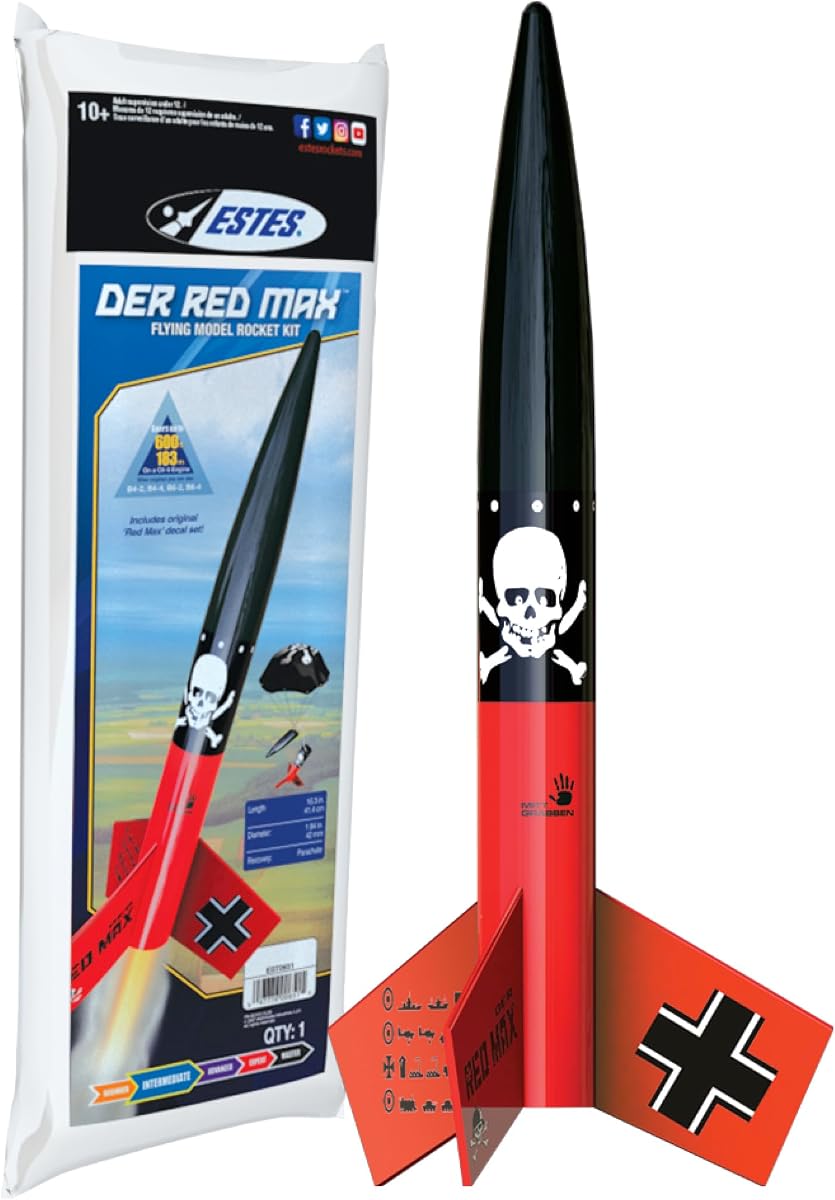
The Estes 0651 Der Red Max combines a classic model-rocket design with a more involved intermediate assembly. The kit includes rocket parts, design decals, recovery parachutes, and instructions. Its supplied rating of 4.6 reflects a strong overall reception, and its larger, stable design gives the project a more purposeful feel than a compact first rocket.
We may earn a commission when you buy through this link, at no additional cost to you.
The rocket is 16 inches tall and uses laser-cut wooden fins for improved performance. It has a projected altitude of 600 feet with a C6-5 engine and is also compatible with B4-2, B4-4, B6-2, and B6-4 engines. This range gives the builder a selection of power levels while maintaining a stable design intended to be predictable on the launch field.
Assembly takes about two hours, longer than the typical one-hour beginner project. That additional time is the main appeal for someone who wants a meaningful construction challenge rather than a quick gift project. The trade-off is that it requires more patience and careful organization, making adult assistance especially useful for younger builders.
A launch pad and controller are not included. Users also need engines, starters, recovery wadding, and four AA alkaline batteries. A compatible Porta-Pad II and Electron Beam controller are appropriate when purchased separately. The Der Red Max is best for a rocketeer ready to spend more time at the workbench and learn how larger airframes, fins, and recovery components fit together.
The large, stable airframe and laser-cut wooden fins create a design centered on dependable flight characteristics. This makes the kit attractive to builders who want a recognizable model with clearly defined structural components.
The longer assembly time provides a more involved introduction to model construction. It remains reasonable for ages 10 and up with adult support, particularly for anyone moving up from a simple beginner rocket.
We may earn a commission when you buy through this link, at no additional cost to you.
The Estes 3238 Pathfinder is a beginner kit that pairs two flying model rockets with the equipment needed for a launch set. The package contains two rockets with parts, design decals, recovery parachutes, a launch pad system, and instructions. Its supplied rating is 4.3, and the dual-rocket format makes it a versatile choice for siblings, clubs, or anyone who wants more than one launch option.
We may earn a commission when you buy through this link, at no additional cost to you.
Both rockets can reach a projected altitude of 1,000 feet with a C6-5 engine and are also compatible with A8-3 and B6-4 engines. The set can be completed in approximately one hour or less, which helps preserve the beginner positioning. Included parachutes and the Porta-Pad II and Electron Beam controller make the package more comprehensive than kits that require separate launch hardware.
As with the other multi-rocket sets, propulsion items are not included. Engines, starters, recovery wadding, and four AA alkaline batteries must be purchased separately, and users should follow the instructions for each rocket and engine combination. The limited three-engine compatibility list should also guide the selection of additional components.
The Pathfinder is best for a new rocketeer who wants the building experience of a true DIY kit plus the variety of two rockets. It is less focused than a single-rocket set and carries a lower supplied rating than several alternatives, but it offers a clear balance of buildability, launch hardware, recovery gear, and flight value. It is particularly suitable for a family that plans to share a launch day and wants both rockets ready to go afterward.
Building and flying two rockets gives a new hobbyist a fuller introduction than a single model. The paired format also provides opportunities to compare preparation, stability, recovery, and launch outcomes.
The included pad and controller support a straightforward launch setup. Engines, starters, recovery wadding, and batteries remain necessary, so the accessory list should be finalized before the first scheduled flight.
We may earn a commission when you buy through this link, at no additional cost to you.
The Estes 1295 Mean Machine is the advanced option in this guide, built around an 80-inch-tall rocket that offers a much more ambitious construction project than the beginner kits. It includes rocket parts, design decals, a 24-inch preassembled parachute, a twist-lock connector, and instructions. With a supplied rating of 4.7, it is the highest-rated product featured.
We may earn a commission when you buy through this link, at no additional cost to you.
The kit requires advanced building skills and three or more hours of assembly. That requirement is not a flaw; it is the central reason to choose the Mean Machine. A builder can work with a full-length airframe, a substantial recovery system, and a configuration intended to feel more like a serious model-rocket project than a simple first flight.
The supplied information lists a projected altitude of 700 feet with an E12-6 engine, while the title and product summary also identify a 900-foot figure. Compatible engines include D12-3, D12-5, and E12-4, in addition to the E12-6 referenced in the flight details. Because the supplied information contains both altitude figures, buyers should consult the current product instructions and engine chart before flight.
Unlike the smaller launch systems used by most kits here, the Mean Machine requires a Porta-Pad E launch pad, an E launch controller, and a launch rod. Engines, starters, recovery wadding, and six AA alkaline batteries are also required. This is a substantial package with a substantial setup, so it suits experienced builders and enthusiasts rather than someone seeking a simple first launch. For a dedicated rocketeer ready to invest time in a technically demanding build, it is the most ambitious and distinctive option in the collection.
At 80 inches tall, the Mean Machine demands close attention to alignment, assembly sequence, and recovery connections. The three-plus-hour build rewards patience and gives experienced builders a more substantial project than a standard beginner kit.
The rocket is designed to launch with a Porta-Pad E, E launch controller, and launch rod. These components are sold separately, and the larger system requires careful setup in accordance with the current instructions.
We may earn a commission when you buy through this link, at no additional cost to you.
The right DIY model rocket kit depends on the buyer's construction experience, desired flight characteristics, available equipment, and willingness to learn launch safety. These factors help separate quick beginner packages from more involved intermediate and advanced projects.
Beginner kits generally use straightforward components, familiar assembly techniques, and a short build that can be completed in roughly an hour. Intermediate kits add more demanding construction, larger airframes, and longer assembly sessions, while advanced models such as the Mean Machine require greater attention to multiple sections and recovery connections. Choosing the level that matches the builder's patience is more important than choosing the most technically ambitious model.
For a first experience, favor a beginner kit with clear instructions, simple adhesive work, and a construction time near one hour. Builders seeking a meaningful challenge can consider an intermediate or advanced model only after confirming that they have time, adult guidance when needed, and the required launch equipment.
A true DIY kit provides the educational satisfaction of assembling fins, nose cones, body sections, engine mounts, and recovery components. A prebuilt set removes that process and places more emphasis on preparation and launch. This distinction matters for gift-givers: a child who loves construction may find a prebuilt rocket less engaging, while someone eager for an event may prefer immediate flight preparation.
Choose a build-to-fly kit when learning through construction is central to the experience. Choose a prebuilt model when convenience, a short setup, and a launch-centered event matter more. Prebuilt does not mean launch-ready without any additional items, because propulsion supplies, batteries, and sometimes launch hardware are still required.
Some kits include a launch pad and controller, while others require them to be purchased separately. The Alpha III, Journey, Tandem X, Rascal and Hijinks, and Pathfinder include the basic launch system described in their product information. The Athena, Celestial Explorer, Big Bertha, Der Red Max, and Mean Machine do not include all of that hardware, and the advanced Mean Machine specifically calls for a Porta-Pad E, E launch controller, and launch rod.
Compare the full accessory list before buying. Even when a launch system is included, engines, starters, recovery wadding, and batteries usually need to be acquired separately. A comprehensive bundle can be more convenient, while a rocket-only kit may offer better flexibility if suitable equipment is already owned.
A flying model rocket cannot be launched with the construction kit alone. Every option requires compatible Estes rocket engines, starters, recovery wadding, and the specified alkaline batteries. Some kits offer a wide engine range, such as the Alpha III, while others list fewer compatible choices. The Mean Machine operates in a different class and requires its own launch pad, controller, launch rod, and six AA batteries.
Use the supplied engine compatibility list and the manufacturer's current instructions to make a matched selection. Do not assume that a more powerful engine improves the experience. Engine choice should be appropriate for the model, the launch equipment, the launcher's knowledge, and local safety guidance. A compatible starter and correct amount of recovery wadding are just as important as the engine itself.
Projected altitude offers a useful comparison between kits, but it should not be treated as a guaranteed result. Several beginner models are listed near 1,000 to 1,150 feet, while the Big Bertha and Der Red Max have lower projections that suit their intermediate identities. The Mean Machine is a large advanced design, yet its meaningful attraction is the build and flight system rather than the highest altitude in the guide.
Think about the intended experience. A compact, lower-altitude model can be easier to manage in a constrained recovery area, while a high-performance design may demand more attention to range and landing-zone planning. Always follow the launch instructions and local regulations rather than selecting an engine solely for maximum altitude.
Recovery equipment determines how the rocket returns after ascent. The Athena includes a 12-inch parachute, the Big Bertha has an 18-inch parachute, and the Mean Machine uses a 24-inch preassembled parachute with a twist-lock connector. The Tandem X, Journey, Celestial Explorer, Rascal and Hijinks, Pathfinder, and Der Red Max also include recovery components, with the supplied information referring to parachutes for those sets.
Inspect the parachute, shroud lines, attachment points, and recovery wadding before every launch. Pack the wadding correctly and confirm that the parachute is not obstructed. A suitable open recovery area and responsible adult supervision remain essential regardless of the kit's included hardware.
Rocket dimensions affect everything from workbench space to vehicle transport. The tandem X includes a 30-inch Amazon model and a 15.6-inch Crossfire ISX, while the Mean Machine reaches 80 inches. Intermediate kits such as the 16-inch Der Red Max are more compact, but a full-size body tube can still require dedicated storage and careful transport.
Measure available workspace and transport capacity before choosing. Longer rockets can need additional support during assembly, and fragile fins or nose cones should not be forced into a crowded vehicle. A sturdy storage area that keeps components visible and protected makes repeated launches and inspections easier.
Every featured Estes rocket is designed for use with the National Association of Rocketry model-rocket safety code. The supplied information repeatedly advises using an appropriate launch site, standing at least 15 feet away, inserting the safety key, and conducting a countdown. Those basic steps should be reinforced at every launch rather than treated as a one-time setup detail.
Check local rules, landowner permission, weather, recovery-zone size, and fire restrictions before flying. Adults should supervise young builders and launchers, and inexperienced users should follow the launch controller instructions carefully. No kit, engine, or included score compensates for launching in an unsafe location.
Begin by sorting the components, reading the full instructions, and checking every part against the parts list before applying adhesive. Work on a clean, dry surface with the rocket supported in a stable position. Attach decals before assembly when the instructions specify that sequence, and allow every glued or cemented joint to cure fully before fitting the engine or handling the rocket aggressively.
Prepare the recovery system according to the instructions by installing the parachute, attaching its lines securely, and adding the required amount of recovery wadding. Install only the engine specified by the instructions and compatible with the model. Check the launch pad, controller, safety key, and batteries, and make sure the launch area is clear, the recovery zone is open, and the weather is suitable.
After flight, allow the rocket to cool, disconnect the engine according to the manufacturer's guidance, inspect the airframe and recovery components, and replace any damaged or weakened parts. Store the rocket, engine, and launch accessories dry and organized. Before subsequent flights, repeat the full prelaunch inspection rather than assuming the previous successful flight guarantees the next one will be safe.
The Alpha III, Journey, and Celestial Explorer are strong beginner choices because their listed assembly time is about one hour. The Alpha III and Journey include a launch pad and controller, while the Celestial Explorer is more compact but requires separate launch hardware. The best choice depends on whether included equipment, compactness, or a lower-intensity first experience matters most.
No engine, starter, recovery wadding, or required battery is included in the featured launch sets. Engines, starters, and recovery wadding are sold separately, and every launch needs the specified alkaline batteries. The Mean Machine requires six AA batteries, while the other featured launch configurations call for four AA alkaline batteries.
Beginner kits generally use simpler construction, take about an hour to assemble, and emphasize an approachable first launch. Intermediate kits often have larger airframes, more involved fin installation, and longer assembly times. The Big Bertha takes about an hour, while the Der Red Max takes about two hours and presents a more substantial construction challenge.
The listed configurations call for a compatible Estes launch pad, controller, and appropriate launch rod, so a complete compatible launch setup is necessary. Several kits include the pad and controller, but others require separate purchase. A standard kit's pad is also not automatically appropriate for the advanced Mean Machine, which calls for a Porta-Pad E and E launch controller.
The Mean Machine provides the most advanced and time-intensive build in the guide. It is 80 inches tall, requires advanced skills and three or more hours of assembly, and includes a 24-inch preassembled parachute and twist-lock connector. It is better suited to an enthusiast prepared for the larger construction and launch system than to someone seeking a simple first project.
No. Projected altitude is a planning estimate associated with a particular rocket and engine combination, and actual results can vary. Engine selection, construction quality, environmental conditions, and other factors can affect flight. Users should follow the current instructions, use only listed compatible engines, and avoid treating the stated figure as a guarantee.
The Athena, Rascal and Hijinks, and related prebuilt sets are labeled for ages 10 and up, but supervision is still essential. Children should not handle engines, modify the rocket, or operate a launch controller without close adult guidance. A prebuilt rocket removes assembly work but does not remove the need for careful preparation or safe supervision.
Store the rocket dry, undamaged, and away from excessive heat, moisture, and crushing pressure. Keep fins, nose cones, parachutes, and launch hardware organized so parts can be inspected before every flight. If a component shows cracking, warping, damaged adhesive, or weakened recovery lines, repair or replace it according to the manufacturer's guidance before launching again.
The Estes 1469 Tandem X is the most versatile overall pick because it combines two distinct beginner rockets with a complete launch system. The Alpha III is a strong alternative for buyers who prefer one classic model, while the Celestial Explorer offers a compact, focused build for anyone comfortable sourcing launch hardware separately. For prebuilt fun, the Athena and Rascal and Hijinks remove assembly from the experience.
Intermediate builders can look to the Big Bertha for a familiar, faster project or the Der Red Max for a longer and more substantial build. The Pathfinder offers two beginner rockets and a full launch set, while the Mean Machine stands apart as the advanced engineering choice with its 80-inch design and specialized launch requirements. Prioritize the right challenge level, launch hardware, engine compatibility, and recovery needs rather than choosing solely by altitude.
Before purchasing, confirm the current contents, engine options, assembly requirements, launch-site rules, and accessory availability. Prices and product configurations can change, and the manufacturer or retailer listing should be checked for the latest details. With suitable equipment, responsible supervision, and a safe outdoor launch area, any of these kits can provide a memorable introduction to model rocketry.