
Outohome Portable Camping Air Conditioner
4.0Editor score
5200 BTU cooling capacity
Sub-400W power use
Four operating modes
24-hour timer
Single-handle portability
Our expert guide compares the best low wattage portable air conditioners, evaluating cooling capacity, power draw, noise, portability, and tent suitability.
Low wattage portable air conditioners bring compressor-based cooling to tents, RVs, vans, small bedrooms, and other spaces where conventional air conditioning is impractical. A capable unit must do more than move room-temperature air: it needs effective cooling, restrained power consumption, manageable noise, dependable ventilation, and a form factor that can be carried between locations.
We compared ten models using their stated cooling capacity, rated operating power, room or tent coverage, operating modes, sleep-mode noise, drainage requirements, power-source compatibility, dimensions, and portability. The list includes compact 2700 BTU models for close quarters, mid-size 3400 and 4000 BTU options, and higher-output 5000 and 5200 BTU units for larger camping setups.
Each review highlights the product's most useful benefits and the compromises that may affect a particular buyer. The top selections represent the strongest options for overall performance, premium cooling capability, and value-conscious use, while the remaining models provide alternatives for different space and power needs. Product details and availability can change, so confirm the current listing before purchasing.
4.0Editor score

5.0Editor score

The table below compares all ten units by cooling capacity, rated power, physical footprint, and primary use case, making it easier to identify the model that fits a particular tent, vehicle, room, or power system.

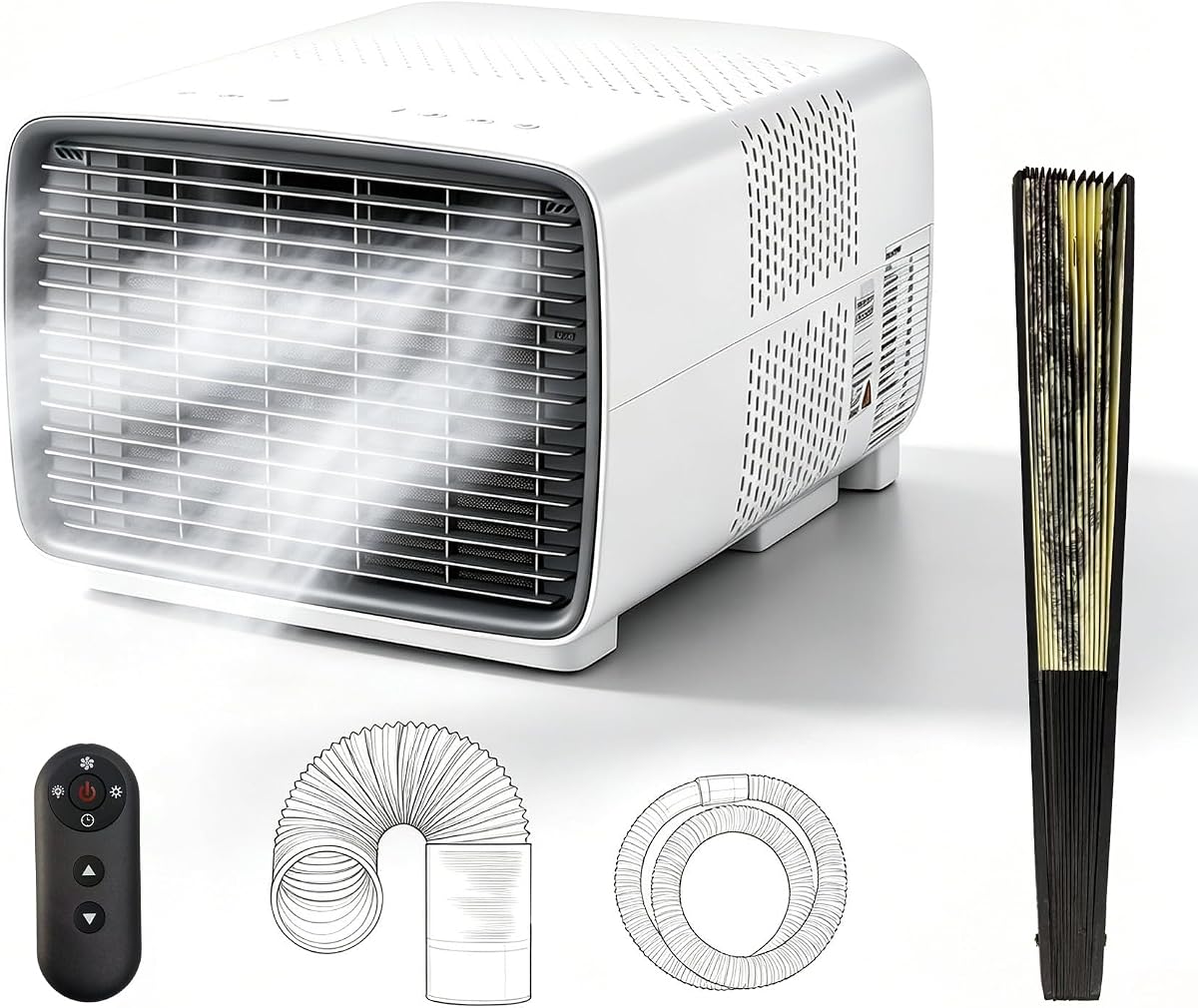


The 5200 BTU Portable Camping Air Conditioner stands out as the most complete low-wattage option in this guide. It pairs a high-output compressor with a 400W rated power draw, creating a useful balance for campers who need more cooling than a personal unit can deliver. Its stated coverage of up to 130 square feet, four operating modes, 24-hour timer, and 45dB sleep mode make it suitable for tents, RVs, vans, trucks, garages, and compact rooms.
We may earn a commission when you buy through this link, at no additional cost to you.
The dual-loop water-cooling system is one of its most distinctive features. According to the product information, the system cools the condenser with water to improve heat dissipation and can produce airflow that is 3.6 degrees Fahrenheit colder than standard portable air conditioners. The 5200 BTU compressor is also stated to lower the temperature by 18 degrees in five minutes within a 60 to 88-degree Fahrenheit control range, giving this model an advantage when fast temperature reduction matters.
Its 75-degree vertical oscillation helps direct cooled air across a wider area, while external duct mode is designed to reduce internal negative pressure and improve cooling efficiency by more than 30% based on the cited FO-KOKO Lab data. The unit also works without manual drainage when humidity remains below 70%. Power compatibility is broad, including 110V AC, suitable 1500W-or-higher power stations, and EV V2L connections, although the necessary adapters are not included.
This is the strongest all-around recommendation because it combines meaningful cooling capacity with restrained power use and a feature set tailored to camping. The 12.8 by 10.6 by 22.8-inch body is larger and heavier than many personal-size alternatives, so buyers with very limited storage or carrying capacity should account for that. Even so, for a larger tent, RV, van, garage, or small room, this model's 5200 BTU compressor and 400W rating offer one of the most convincing combinations in the roundup.
The 5200 BTU compressor provides considerably more cooling capacity than the 2700 BTU models in this guide, while the listed 400W rating remains low for a unit of this output. That balance makes the appliance better suited to tents and compact rooms where a personal cooler would struggle to move enough heat.
A carry handle, drain-free operation below 70% humidity, multiple power options, a 24-hour timer, and remote-friendly modes make the unit more practical for extended camping trips. The external duct option can also improve performance when properly installed, although campers must plan for the appropriate setup.
We may earn a commission when you buy through this link, at no additional cost to you.
The Mini Portable Air Conditioner is a compact 2700 BTU model aimed at small rooms, tents, RVs, dorms, and personal cooling zones. Its headline advantage is a listed 280W operating power, placing it among the most power-conscious products here. The unit combines cooling, dehumidification, and fan modes, includes an exhaust hose, and offers a 1-to-12-hour timer for more controlled overnight use.
We may earn a commission when you buy through this link, at no additional cost to you.
The product information states that the compressor can lower the temperature by 11 degrees in minutes in spaces up to 108 square feet, with a stated operating range of 60 to 90 degrees Fahrenheit. It is also described as using approximately 2 kWh over an eight-hour night. Compatibility with both 110V and 220V sources adds flexibility for RV, generator, and off-grid power arrangements, though the correct power configuration remains essential.
A 45dB operating level and sleep mode make the Mini Portable Air Conditioner appealing for bedrooms and quiet camping setups. Touch-panel and remote controls let users adjust settings without approaching the unit, while the exhaust-hose format and compact body simplify installation compared with a window unit. The trade-off is cooling capacity: 2700 BTU is intended for confined areas rather than wide rooms or large occupied tents.
This is a sensible choice for a student, van-life user, or camper who wants genuine compressor cooling without drawing substantial power. Buyers should verify the supplied exhaust arrangement and confirm that the space is within the stated coverage. Its low rated consumption, timer, and quiet operation make it more versatile than a basic evaporative cooler, while the absence of a published rating means its long-term customer feedback cannot be weighed here.
At 280W, this model uses less rated power than the 3400, 4000, 490W, and 1000W alternatives. That makes it attractive for power stations, RV circuits, and off-grid arrangements where preserving usable battery capacity is a priority.
Unlike evaporative coolers that need frequent water replenishment, this is a compressor-based unit with an exhaust hose. The fan, cooling, and dehumidification modes give it more flexibility for a dorm, compact bedroom, vehicle, or small tent.
We may earn a commission when you buy through this link, at no additional cost to you.
The Portable Tent Air Conditioner is built around a 2700 BTU compressor and a 280W rated power draw, making it one of the most compact and energy-conscious products in the lineup. Its stated coverage is up to 54 square feet, a focused target for a small tent, van seating area, dorm corner, or other confined personal zone. It is less suitable for large rooms than the 5000 and 5200 BTU models.
We may earn a commission when you buy through this link, at no additional cost to you.
The product offers cooling, dehumidification, and fan modes, along with a remote control, a control panel, and a timer adjustable from one to 12 hours. The listed 45dB operating level and sleep-oriented design are useful for quiet overnight use. Its 110V and 220V compatibility also makes it versatile for generators, RVs, and suitable off-grid supplies.
Portability is another major strength. At 19.8 pounds and measuring 15.7 by 11.8 by 10 inches, it is the lightest model listed here and smaller than the larger 5200 BTU camping units. That makes loading and repositioning more manageable, particularly for travelers who need to divide their gear between a vehicle and the campsite.
The limited 54-square-foot coverage is the key consideration. This unit is most appropriate for one or two people close to the cooling outlet or for a small, well-insulated enclosure with proper hot-air exhaust. It is a compelling low-power option for campers who value mobility and quietness over broad room coverage, but those needing stronger cooling for a larger tent should move up to a higher-BTU model.
At just 19.8 pounds, the unit is substantially easier to carry than the 31-, 33-, and 29-pound alternatives. Its smaller footprint also allows it to sit beside a bed, desk, or tent entrance without consuming as much space as a full-size camping unit.
The 280W rating and stated 45dB operation make this model a practical companion for campers using portable power and sensitive to sleep disruption. A 12-hour timer allows the user to schedule cooling without leaving the unit operating unnecessarily.
We may earn a commission when you buy through this link, at no additional cost to you.
The Small RV Air Conditioner combines a 2700 BTU compressor with a 280W rated power draw, giving it one of the strongest efficiency profiles in the guide. It is designed for pop-up campers, small RVs, indoor dorms, bedrooms, and travel locations where the goal is personal-zone cooling rather than whole-room climate control. The stated temperature adjustment covers 60 to 88 degrees Fahrenheit.
We may earn a commission when you buy through this link, at no additional cost to you.
Three-in-one operation gives the user cooling, dehumidification, and fan functions. A 45dB sleep mode, touch controls, remote control, and 1-to-12-hour timer make nighttime operation straightforward. The product information also states approximately 2 kWh consumption over an eight-hour night and identifies 110V and 220V compatibility for off-grid use.
The unit's compact format allows it to fit beside beds, desks, sofas, tent entrances, or RV seating areas. That flexibility is more useful than a fixed installation for mobile users, who may need to move cooling between locations as conditions change. Since it uses a real compressor, no ice or water tank is required, avoiding the refilling and spill concerns associated with many basic portable coolers.
This model is best for travelers who need quiet, compressor-based cooling in a small defined area and who want to preserve power-station capacity. Its 2700 BTU output will not equal the rapid temperature reduction claimed by the 5200 BTU products in a broad area. Even so, the combination of low power, quiet sleep operation, and flexible placement makes it a strong fit for a compact RV, dorm, or personal tent zone.
The 2700 BTU output is most effective where users spend time in a limited zone, such as a bed area, desk, or RV seating section. Positioning the unit near the area that needs relief can make the difference between a comfortable personal environment and an underpowered attempt to cool an entire room.
A 280W rated draw, low-noise sleep operation, and a timer give travelers useful control over overnight energy use. The listed 110V and 220V compatibility also broadens the range of generators, outlets, and power supplies that may be used.
We may earn a commission when you buy through this link, at no additional cost to you.
The Outohome Portable Camping Air Conditioner delivers 5200 BTU of cooling while keeping rated power consumption below 400W. It is a premium-oriented choice for campers who want high output, a polished metal finish, four operating modes, and enough capacity for larger tents, RVs, vans, semi-trucks, apartments, or compact rooms. The listed control range is 60 to 88 degrees Fahrenheit.
We may earn a commission when you buy through this link, at no additional cost to you.
Cooling performance is stated to reduce ambient temperature by 18 degrees within five minutes in cooling mode. The product includes Cool, Dry, Sleep, and Fan modes, along with a 24-hour automatic shutoff timer. Sleep operation is rated at 46 to 50dB, which makes the model quieter than many portable alternatives but slightly above the 45dB units elsewhere in the guide.
Drainage is not required in cooling mode when humidity remains below 70%. For more humid conditions, a drain pipe is included. That distinction matters because the drainage-free claim has a clear environmental limit; travelers camping in consistently damp locations should not assume the unit can ignore condensate indefinitely.
At 22.4 by 11.2 by 13.8 inches and 31 pounds, the unit is portable but noticeably bulkier than the 19.8-pound personal model. The sturdy grip improves one-handed handling, and the 5200 BTU output makes that extra bulk worthwhile for buyers who need serious cooling rather than a personal breeze. The lower 4.0 published rating tempers the recommendation, but the specification set and feature balance justify a premium placement.
The metallic finish and integrated grip give the unit a more travel-oriented appearance than a basic box-style cooler. More importantly, the 5200 BTU compressor provides the capacity required for larger camping spaces and compact indoor rooms where lower-output units would lose effectiveness.
The unit can operate without manual drainage below 70% humidity, reducing campsite maintenance in drier conditions. A supplied drain pipe handles higher-humidity environments, while the dedicated Dry mode adds another option for reducing moisture rather than simply lowering temperature.
We may earn a commission when you buy through this link, at no additional cost to you.
The 5000 BTU Camping Air Conditioner is the only product in the guide with a stated heating function, giving it year-round relevance for campers, road-trippers, and van users. Its cooling output is substantial enough for spaces up to 150 square feet, the largest stated coverage in this roundup. It also combines cooling, heating, fan, dehumidification, air circulation, and sleep modes in one enclosure.
We may earn a commission when you buy through this link, at no additional cost to you.
The 5000 BTU compressor operates at a listed 490W, making it the highest rated-power product here even though it remains within the low-wattage category. This tradeoff is reasonable for buyers who want the ability to warm a space as well as cool it. The broader six-function design can reduce the need to carry separate climate devices during trips that span hot days and cooler nights.
There is no water tank to refill, so the unit avoids the spills and maintenance associated with evaporative coolers. Its compressor-based approach is controlled through a built-in handle and is intended for tents, RVs, trucks, vans, cars, small warehouses, and even pet houses. The product information does not give a sleep-mode noise figure, which makes it harder to compare directly with models that specify 45 to 50dB operation.
This unit makes the most sense for buyers who genuinely require both heating and cooling, especially in shoulder seasons or cool evenings. It is less compelling for someone focused strictly on minimizing energy use because its rated draw is higher than the 280W, 400W, and sub-400W models. The 3.7 rating also supports a more measured recommendation, but the unique heating capability and stated 150-square-foot reach are meaningful advantages.
A dedicated heating mode makes this unit more versatile than cooling-only products. It can provide added warmth during cool mornings or evenings, although actual heating performance will depend on ambient temperature, insulation, power availability, and the space being heated.
The stated capacity for spaces up to 150 square feet is the broadest coverage among the listed products. That makes the unit more appropriate for a large tent, van living area, small workshop, or garage than the 2700 BTU personal models.
We may earn a commission when you buy through this link, at no additional cost to you.
The 5200 BTU Portable Tent Air Conditioner combines high cooling output with a 400W rated power draw and a published rating of 4.6. It is suited to camping, picnics, outdoor barbecues, trucks, RVs, vans, kitchens, apartments, and small rooms where a wall-mounted unit cannot be installed. Its 5200 BTU capacity represents one of the strongest output figures in the guide.
We may earn a commission when you buy through this link, at no additional cost to you.
The unit is described as capable of lowering the temperature by 18 degrees within five minutes in cooling mode, with coverage up to 108 square feet. Cool, Dry, Sleep, and Fan modes give users several ways to manage comfort, while a 24-hour timer handles automatic shutoff. Sleep mode produces 46 to 50dB according to the product information.
Portability is supported by an integrated handle, although the 33-pound weight is the highest listed among the portable products. That weight can be noticeable during a long carry from a vehicle to a campsite. The product also does not require drainage in cooling mode below 70% humidity, but a drain must be managed when humidity rises beyond that level.
The 4.6 rating makes this one of the most proven choices in the roundup and a compelling alternative to the top-ranked model. Buyers comparing the two should examine their required coverage, power connections, ventilation arrangement, and carrying tolerance. This product is especially attractive for users who prioritize customer feedback and 5200 BTU performance while remaining within a 400W rated draw.
A 4.6 rating provides stronger customer-history context than most products in the guide. Combined with 5200 BTU output and a 400W rating, it presents a convincing balance for buyers who want meaningful cooling without moving to the 490W or 1000W alternatives.
Cooling and Dry modes cover active comfort needs, while Fan and Sleep modes suit lighter conditions and nighttime use. The 24-hour timer and remote control reduce the need to approach the unit when changing schedules or settings.
We may earn a commission when you buy through this link, at no additional cost to you.
The Outohome 4-in-1 Portable AC is a high-output camping unit designed for tents, picnics, outdoor barbecues, semi-trucks, RVs, vans, kitchens, apartments, and compact rooms. Its 5200 BTU compressor and sub-400W rated consumption provide a useful combination for users who need more capacity than a personal cooler but remain conscious of power use.
We may earn a commission when you buy through this link, at no additional cost to you.
Cooling, dehumidifying, sleep, and fan modes can be controlled by remote, and a 24-hour timer supports automatic shutdown. The listed sleep-mode range is 46 to 50dB. The unit is also said to reduce ambient temperature by 18 degrees within five minutes, with an adjustable range from 60 to 88 degrees Fahrenheit.
The product measures 22.4 by 11.2 by 13.8 inches and weighs 31 pounds. A metal spray finish and built-in grip help it fit into a mobile camping setup, though it remains substantially larger than the 2700 BTU models. Drainage-free cooling applies below 70% humidity; a drain pipe is supplied for more humid conditions.
Its specifications align closely with the other Outohome 5200 BTU model in this guide, which creates an important buyer decision. The lower 3.2 rating is the principal reason not to recommend it more strongly, and prospective buyers should inspect current customer feedback. For users who value the same high capacity, four-mode design, and low rated consumption, it remains technically capable for camping and vehicle applications.
The unit is designed for everything from a tent and picnic area to an RV, van, semi-truck, kitchen, or apartment. Its four-in-one control scheme and remote operation make it easy to adapt as a camping trip transitions between daytime activity and evening rest.
Maintaining rated consumption below 400W while delivering 5200 BTU is the product's primary attraction. That relationship makes it a practical middle ground for higher-output camping systems, though actual power availability and ventilation remain essential to a successful installation.
We may earn a commission when you buy through this link, at no additional cost to you.
The 3400 BTU Compact AC Unit is designed for two-person tents, trucks, cars, RVs, van life, outdoor pet care, and small rooms. Its 3400 BTU compressor delivers more capacity than the 2700 BTU personal models, while its stated 1000W rating is the highest in this guide. It should therefore be considered a compact unit for adequately powered sites rather than one of the most energy-frugal choices.
We may earn a commission when you buy through this link, at no additional cost to you.
The product supports three power methods: a standard 110V/60Hz outlet, a power station with at least 1000W output, or an electric vehicle through an EV discharger. The discharger is not included, and campers need an appropriate electrical hookup. This broad connection support is particularly useful for van-life users, though it is paired with a higher power requirement than most competing products.
Its airflow design is claimed to send cool air as far as 10 feet, with a perforated duct intended to extend the stream. A Panasonic compressor, adjustable 60-to-88-degree Fahrenheit range, turbo mode, remote, built-in panel, and 24-hour timer round out the controls. Moisture from the evaporator is recycled through the condenser and expelled by the fan, although manual draining is still required before moving the unit or using dehumidifier mode.
The 3.8 rating reflects a less established customer track record than the 4.6-rated 5200 BTU alternative. Nevertheless, this model offers a distinctive package: 45dB sleep operation, R290 refrigerant, three power options, and a thoughtfully designed airflow path. It is best for buyers who prioritize connection flexibility and a mid-size cooling capacity over achieving the lowest possible rated draw.
Standard AC, a sufficiently rated power station, and EV power provide more flexibility than models limited to conventional outlets. Because the unit draws up to 1000W, users should verify that the selected source can start and sustain the compressor.
The perforated duct is designed to carry cool air farther into a tent or personal area, while the 10-foot stated reach makes placement more forgiving. Reusing evaporator moisture through the condenser reduces routine drainage, though the unit still needs attention before movement and in dehumidifier mode.
We may earn a commission when you buy through this link, at no additional cost to you.
The Compact Mini AC Unit combines a stated 4000 BTU cooling capacity with rated consumption of less than 400W, making it one of the strongest value-oriented combinations in the guide. It is positioned for small rooms, tents, RVs, patios, cabins, kitchens, and road trips, with a 29-pound body that can be carried using its ergonomic handle.
We may earn a commission when you buy through this link, at no additional cost to you.
The compressor is described as capable of reducing temperature by up to 18 degrees. A 60-to-88-degree Fahrenheit control range, 46dB sleep mode, remote control, and Cool, Dry, and Fan modes cover the basic comfort needs of a bedroom or compact camping area. Unlike an evaporative cooler, it does not require a water tank, reducing refills, spills, and maintenance.
Drainage-free operation applies when ambient humidity is below 70%. A drain pipe is included for especially humid conditions, so the unit can still be managed rather than abandoned in damp weather. Its size and weight are lower than many of the 5200 BTU products, although it remains a substantial appliance rather than a lightweight personal cooler.
This is the best-value pick because it delivers more cooling capacity than the 2700 BTU models without moving into the 490W or 1000W power ranges. Its lack of a published rating means buyers cannot rely on a customer score in this comparison, and its three-mode control set is less extensive than the four-mode alternatives. Even so, the 4000 BTU, under-400W, 29-pound combination is compelling for a budget-conscious camper or small-room user.
The 4000 BTU output is particularly useful in this guide because it sits above the personal-size models while remaining below the maximum rated power of the 490W and 1000W alternatives. That middle position gives buyers more cooling headroom without accepting the highest energy demand.
Cool, Dry, and Fan modes cover the essential functions, while remote operation, a sleep mode, and a 29-pound handle-equipped body make the unit easy to incorporate into a tent, RV, van, or small bedroom. Drainage-free operation below 70% humidity further reduces routine campsite maintenance.
We may earn a commission when you buy through this link, at no additional cost to you.
The right low wattage portable air conditioner depends on space size, available electrical capacity, ventilation, humidity, noise sensitivity, and how often the unit must be moved. Use the specifications below to identify the features that matter most before choosing a model.
Cooling capacity is the first feature to match to the space. The 2700 BTU products in this guide are intended for tightly defined personal zones, such as a small tent, dorm corner, or vehicle seating area. The 3400 and 4000 BTU models provide more headroom for a two-person tent or compact room, while the 5000 and 5200 BTU units are better suited to larger tents, RVs, vans, garages, and small living areas. A larger unit is not automatically better in a very small enclosure, because it may be difficult to position and ventilate effectively.
Choose capacity according to the occupied area and the amount of heat entering it. For a compact personal zone, the lower-output models can be more efficient and easier to carry. For a family tent or camper living area, higher BTU output reduces the chance that the unit will struggle to maintain a comfortable temperature. Always check the manufacturer's stated coverage and keep ventilation requirements in mind.
Rated power indicates how much electrical demand the unit places on a power source. The three 2700 BTU models operate at 280W, many 5200 BTU models use 400W or less, the heating-and-cooling model lists 490W, and the 3400 BTU model lists 1000W. A lower draw is attractive for battery-powered camping, but the correct power station must also handle compressor startup and the unit's maximum demand.
Check the required outlet type, voltage, frequency, and continuous-output rating before purchasing. Some products support 110V and 220V sources, while others specify standard 110V AC, a minimum power-station capacity, or EV V2L. Required adapters and EV dischargers may not be included, so treat them as additional required accessories rather than assuming every connection works out of the box.
Compressor-based portable air conditioners move heat out of the room, so proper ventilation is essential. The lower-capacity model explicitly includes an exhaust hose, and another product calls out an external duct option. Other listings emphasize that hot air must be expelled but provide less detail about the supplied hose or connection process. Buyers should verify the included parts before leaving for a trip.
A portable unit is not a sealed-room replacement for a conventional split system or properly installed window unit. The exhaust path should remain unobstructed, and the intake area needs clearance. In a tent, use manufacturer-supported openings and take care not to compromise weather protection. Correct setup often affects real-world cooling more than small differences between advertised specifications.
Noise matters most in bedrooms and tents occupied at night. Several models specify a 45dB operating level, while others list 46 to 50dB in sleep mode. These figures make the units quieter than many compressor appliances, but they still add audible airflow to a very quiet room. Sleep mode generally reduces operating demand and noise compared with maximum cooling.
A remote control and timer make a noisy unit more manageable overnight. The 2700 BTU models offer timers up to 12 hours, while several 5000 and 5200 BTU products support 24-hour scheduling. If the appliance will run beside a sleeper, check both the published sound figure and the mode in which that figure applies.
Drainage-free operation is convenient, but it is not the same as having no moisture to manage. Most products state that they can operate without a drain below 70% ambient humidity and include a drain pipe for more humid conditions. One model explains that evaporator moisture is reused through the condenser, while still requiring manual draining before movement or when using dehumidifier mode.
Consider the climate of the trip and the level of humidity in the space. A drain line routed outside can be useful in a tent or RV, but it must be secured and kept from creating a trip or water hazard. For indoor use, plan where condensation will go and how often the collection point or hose needs attention. The Dry mode provides additional control but does not eliminate humidity management.
Portability is more than a matter of weight. The smallest and lightest option listed is 19.8 pounds, while other compact units weigh 29, 31, or 33 pounds. The 5200 BTU products are taller and deeper, requiring more cargo space, but their handles and larger cooling output serve a different purpose. Buyers should consider the full packed dimensions rather than comparing weight alone.
Also think about how the unit will move after installation. A handle, recessed controls, and a manageable shape make it easier to reposition between a tent and vehicle. A heavier unit can still be practical if the campsite is close to parking, but it may be tiring during a long carry. If space is tight, measure the sleeping area, RV opening, tent entrance, and storage location before ordering.
Cooling is the core function, but the additional modes determine how versatile the unit is day to night. Most products include Dry and Fan modes, while the 5000 BTU model also offers heating, air circulation, and sleep mode. Four-mode systems give users a broader choice for balancing comfort, moisture removal, and sound.
Remote controls and built-in panels are common, but their usefulness depends on the installation. A remote is valuable when the unit is already running and the controls are difficult to reach. Touch panels and programmable timers improve convenience around bedtime. Confirm whether controls operate every mode, particularly for heating, dehumidification, and automatic shutoff.
The physical heat-rejection system influences efficiency and cooling consistency. The top-ranked 5200 BTU model uses a dual-loop water-cooling system to cool the condenser and is stated to improve airflow temperature and efficiency. The 3400 BTU model uses a perforated air duct intended to project cool air farther into a room or tent. These claims are most useful when they are matched to a proper exhaust and intake arrangement.
Do not equate BTU with the only measure of performance. Airflow pattern, compressor design, condenser temperature, ambient heat, insulation, and ventilation all affect the result. A unit with a longer stated air throw may be preferable in a long tent, while a model with advanced condenser cooling may perform better in hot outdoor conditions. Check the full specification rather than focusing on one headline number.
Before first use, read the included instructions, inspect the unit and exhaust components, and confirm that the power source matches the required voltage and wattage. Place the appliance on a stable, level surface with clearance around its intake and outlet. Connect the required exhaust hose or duct in a way that directs hot air outside the occupied space without creating a kink, blockage, or unsafe routing.
Allow the unit to settle upright before operating it, especially after transport. Select the appropriate mode, set the desired temperature, and use the timer to match the cooling period to the time it is needed. If the installation uses a power station, confirm that the station has sufficient continuous output and that any required adapter is compatible. Avoid leaving the unit unattended in conditions where moisture could reach electrical connections.
For maintenance, follow the manufacturer's cleaning schedule for filters, vents, and the condensate system. Empty collected water before moving the appliance and inspect drain connections in humid conditions. Keep the intake clean and the exhaust path open, and allow the unit to cool down before cleaning or packing it. If unusual vibration, drainage, noise, or power draw appears, stop operation and consult the product support resources.
The most important specification is the balance between BTU cooling capacity and rated power. A unit with too little BTU for the space may run continuously without creating a comfortable environment, while a high-draw model can overburden a small power station. Match the stated room coverage to the area and confirm that the electrical source can support the unit.
Many models in this guide are designed for compatible power stations, but the requirements differ. Some specify 110V and 220V compatibility, while the 3400 BTU model requires a source with at least 1000W output and the top-rated 5200 BTU model points to 1500W-or-higher stations. Check startup requirements, continuous output, connector type, and whether an adapter is included.
Yes, but they require proper ventilation and are generally intended for compatible tents rather than every weather configuration. The hot air produced by the condenser must be expelled through a supported exhaust setup, and the intake should remain unobstructed. Follow the manufacturer's instructions and avoid blocking required tent openings or creating unsafe hose routing.
A 45dB rating is relatively quiet for a compressor-based portable unit and is generally more suitable for sleeping than louder alternatives. Actual sound varies by mode, airflow, background noise, and the surface on which the unit operates. Sleep mode, a timer, and remote control can reduce the need to approach the appliance after settling in.
For most of these products, drainage-free cooling applies when ambient humidity remains below 70%. The unit handles condensation internally, but a drain pipe is still required in more humid conditions. One product also advises manual draining before moving the unit or when using dehumidifier mode, so the operating manual should be consulted before packing.
No. Higher BTU models cool larger spaces more effectively, but they may be larger, heavier, and more demanding on electrical systems. A 2700 BTU unit can be the better choice for a personal zone or small tent, while a 5000 or 5200 BTU model is more appropriate for a larger tent, RV living area, van, or compact room.
Most products in this roundup are designed for cooling, dehumidification, and fan operation. The 5000 BTU Portable Camping Air Conditioner is the exception because its specification includes a heating mode. Heating performance will depend on ambient conditions, insulation, and power availability, so it should not be evaluated in the same way as the cooling-focused alternatives.
Choose the 2700 BTU model for a small, confined personal area where low power draw and light weight are priorities. Choose the 5200 BTU model for a larger tent, RV, van, garage, or compact room where faster and broader cooling is needed. In both cases, proper exhaust, adequate power, and realistic room coverage are essential.
The 5200 BTU Portable Camping Air Conditioner is the strongest overall choice because it pairs high cooling capacity with a 400W rated draw, a 45dB sleep mode, multiple operating modes, and useful power compatibility. The Outohome Portable Camping Air Conditioner is the premium alternative for its polished design, strong 5200 BTU output, sub-400W consumption, and comprehensive camping-focused control set.
The Compact Mini AC Unit delivers the best value, offering 4000 BTU output, under-400W rated consumption, a 29-pound body, and a 46dB sleep mode. Buyers seeking the lowest power draw should examine the 2700 BTU models, while those needing broader coverage should focus on the 5000 and 5200 BTU options. Regardless of capacity, ventilation and power compatibility deserve careful attention.
Before making a final choice, confirm the current specifications, included accessories, operating instructions, and customer feedback on the product page. Product listings and availability can change, and actual results depend heavily on room size, insulation, ambient temperature, humidity, exhaust setup, and the power source. Use those details to select the unit that best matches your space and travel habits.