
QINLIANF 5 Outlet Extender with 4 USB Ports
4.7Editor score
Five widely spaced outlets
Four USB charging ports
Flush wall-mount design
Explore the best surge protector for kitchen counter options, comparing outlets, USB charging, surge capacity, safety features, and counter-friendly designs.
A kitchen counter rarely has as many open outlets as it has appliances, chargers, and countertop appliances. The best surge protector for kitchen counter use must combine convenient access, safe power distribution, and a low-profile design that does not crowd prep space or interfere with large plugs.
We compared ten surge protectors and outlet extenders based on outlet count, surge-protection capacity, grounded three-prong construction, USB charging options, cord length, mounting flexibility, and practical space-saving features. The guide includes wall taps, rotating plug designs, short extension cords, and a heavy-duty appliance power strip.
Each review identifies the features that distinguish one option from another, from broad outlet spacing to useful USB-A and USB-C connections. Ratings reflect the supplied customer feedback, while availability and prices can change, so compare the current listing details before making a final kitchen setup decision.
4.7Editor score

4.7Editor score

4.7Editor score
The comparison below highlights the outlet count, surge capacity, charging options, and physical design of each kitchen surge protector, helping you identify the model that best matches your available wall space and countertop equipment.




The Belkin 6-Outlet Surge Protector Power Strip has a 4.7 rating and stands out as the most balanced choice for a kitchen counter. It turns one wall receptacle into six protected AC outlets while adding one USB-A port and one USB-C port, creating a centralized power point for countertop appliances, phones, tablets, and other frequently used devices.
We may earn a commission when you buy through this link, at no additional cost to you.
Its direct-to-wall format is particularly valuable at a kitchen counter because it avoids a loose extension cable crossing the work area. The 1,680-joule protection rating, grounded three-outlet configuration, safety indicator, and extensive protection system make it more reassuring than a basic unpowered splitter. Its slim, modern housing also helps preserve open counter space.
The main compromise is that the plug does not rotate, so the body has a fixed position relative to the wall receptacle. That can matter when the receptacle is close to a backsplash, cabinet, or another obstruction. Belkin also does not state the USB-C wattage in the supplied information, so buyers wanting very fast laptop charging should verify that requirement separately.
This is the most broadly useful pick for readers who want one unit to handle several countertop tasks. Choose it when outlet quantity, useful charging integration, low-profile wall mounting, and established surge protection matter more than a rotating plug or a high-wattage appliance cord.
The six AC outlets can serve small appliances while the USB ports handle cables that would otherwise occupy valuable receptacle space. This makes the Belkin especially useful for charging stations, kitchen tablets, smart displays, and countertop gadgets without extending several separate adapters across the backsplash.
Because this model plugs directly into the wall, it reduces the need for a visible cable between the receptacle and the power hub. The 1,680-joule rating, indicator light, and listed safety protections also make it a stronger fit for sensitive electronics than a standard multi-plug adapter.
We may earn a commission when you buy through this link, at no additional cost to you.
This Outlet Extender with Rotating Plug carries a 4.7 rating and offers one of the most adaptable formats for a kitchen wall receptacle. Its plug rotates through 90 degrees, giving the six-outlet body more freedom to sit in a comfortable position when a receptacle is crowded, recessed, or located near a counter edge.
We may earn a commission when you buy through this link, at no additional cost to you.
The extender includes 1,800 joules of surge protection, a grounded indicator, three USB charging ports, and a three-sided outlet arrangement designed to accommodate bulky plugs. That combination makes it a practical upgrade over an ordinary splitter, particularly for users who need both grounded appliance outlets and convenient charging connections in one compact unit.
Its USB-C port supplies up to 3A at 5V according to the supplied information, so it is best viewed as a convenient everyday charging port rather than a solution for every modern fast-charging protocol. The product description also uses unusually technical response-speed and energy-absorption language; consumers should understand that 1,800 joules represents an overall protection rating, not a guarantee against every possible power event.
Buy this model if a rotating plug and generous spacing between large adapters are your main priorities. It is especially suitable for a busy counter where the outlet position may need to change as appliances, mixers, or charging stands are rearranged.
The rotating plug is the defining advantage in tight kitchen layouts. Instead of keeping the entire extender in one fixed plane, you can turn the body left or right to create clearance for plugs, a backsplash, or an adjacent cabinet.
Three-sided outlet placement and wide spacing reduce the chance that one large transformer will block neighboring sockets. This is helpful for kitchen appliances that use substantial wall adapters rather than slim two-prong chargers.
We may earn a commission when you buy through this link, at no additional cost to you.
The Appliance Power Strip has a 4.6 rating and is the most explicitly heavy-duty product in this guide. A 14-gauge, two-foot extension cord, eight AC outlets, and a maximum 1,875-watt capacity make it suitable for power distribution in a kitchen, workshop, or garage where several substantial appliances may need access to one receptacle.
We may earn a commission when you buy through this link, at no additional cost to you.
Its connection mix is unusually extensive: eight AC outlets are joined by three USB-A and three USB-C ports, allowing as many as 14 devices to connect at once. The USB system can auto-detect attached devices, while the short, low-profile cord is designed to stay close to workbenches, counters, walls, or floors. Mounting tabs also provide a way to secure the unit rather than leave it loose.
The listing contains inconsistent surge-energy wording, including references to both 1,080 and 1,800 joules in different bullets. For comparison purposes, this guide uses the clearly identified 1,080-joule safety-protection specification. Buyers should also check whether the intended microwave and other appliances can share the total 1,875-watt limit rather than assuming every connected appliance receives full capacity.
This strip is best for users with several countertop appliances and a nearby receptacle that can accommodate a short cord. It is less attractive for a minimalist counter where a wall tap would be preferable, but it offers far more flexibility when the appliances genuinely need to be spread across the work surface.
The 14-gauge conductors and 1,875-watt maximum rating give this strip a more substantial foundation than a lightweight travel power strip. That makes it a sensible center for several countertop appliances, provided their combined draw remains within the stated electrical limit.
At two feet, the extension reaches beyond the receptacle without creating the long cable loop associated with full-length extension cords. The low-profile shape and mounting tabs give you options for keeping the power hub close to a counter, wall, or workbench.
We may earn a commission when you buy through this link, at no additional cost to you.
The QINLIANF 5 Outlet Extender has a 4.7 rating and provides a space-conscious way to expand one wall receptacle. Five AC outlets are distributed across three sides, while four USB ports create a dedicated charging area for phones, tablets, Kindles, and other compatible devices.
We may earn a commission when you buy through this link, at no additional cost to you.
Its strongest kitchen-counter feature is the back groove and central mounting screw. When the unit is secured to a compatible duplex receptacle, it stays firmly positioned and can create a small charging station above or beside the counter. Outlet spacing of approximately 2.1 inches gives bulky plugs more room than a conventional narrow multi-tap.
The product is not universal. The supplied instructions say it is designed for duplex outlets and cannot be secured in the same way to GFCI receptacles or configurations with more than two parallel sockets. Its USB-C port is limited to 5V and 3A and is not compatible with devices that require 9V to 22V for fast charging, so it should be treated as a standard charging port rather than a universal modern charger.
This is an attractive choice for a counter charging station, especially when cord management and compact installation matter. It is less suitable for high-load appliances, and its four USB outputs should be evaluated against the charging demands of your specific devices.
The flush wall-mounted format keeps phones, speakers, and kitchen accessories close to an existing receptacle without spreading a long strip across the worktop. The central screw helps prevent accidental unplugging when a cable is pulled.
Four USB ports reduce the need for separate wall chargers. The USB-A outputs are listed at up to 2.4A, while the USB-C output reaches 3A at 5V, making the unit convenient for many standard accessories.
We may earn a commission when you buy through this link, at no additional cost to you.
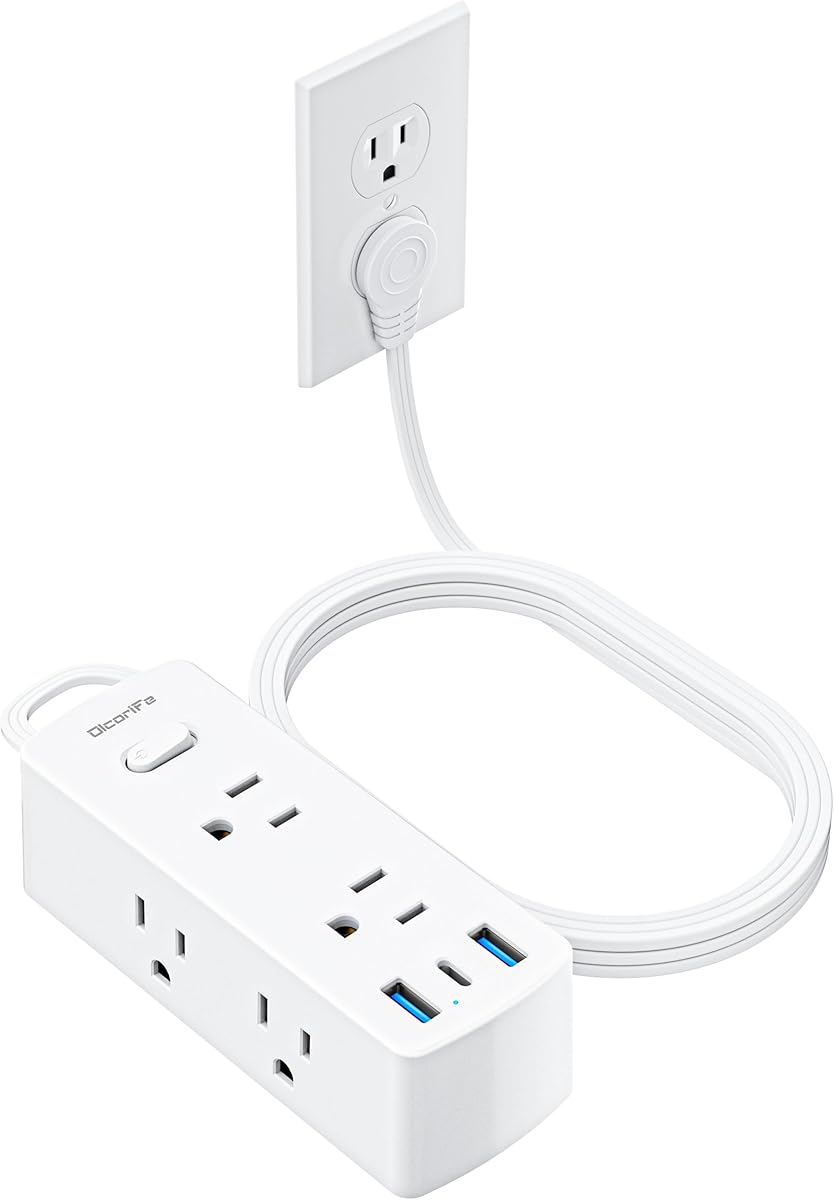
The Olcorife Flat Plug Power Strip has a 4.7 rating and is built for kitchens where the wall outlet is inconveniently close to a counter edge or hidden behind equipment. Its 0.27-inch flat plug slides into tight spaces, while the five-foot cord provides enough reach to place the main body where it is easier to access.
We may earn a commission when you buy through this link, at no additional cost to you.
The three-sided body presents six AC outlets with space between them, along with two USB-A ports and one USB-C port. That arrangement can support several countertop appliances and charging leads at once. A built-in circuit breaker cuts power if the connected load exceeds the rated level, adding an important layer of protection for busy kitchen setups.
The supplied information does not provide a surge-energy capacity in joules, so this model should not be compared as though it offers the same disclosed surge rating as the 900-, 1,080-, 1,200-, 1,680-, or 1,800-joule alternatives. It also does not clearly state the USB output ratings. Those limitations make it best suited to users who prioritize portability, thin-plug clearance, and outlet quantity over extensive technical specifications.
Choose this power strip when the receptacle location prevents a wall tap from being used comfortably. It is also a sensible travel-oriented option due to its relatively compact, lightweight design, although the cord should be coiled rather than left tangled near kitchen preparation areas.
The five-foot cord solves the problem of a receptacle trapped behind an appliance or cabinet. It lets you bring a six-outlet hub to an accessible portion of the counter without requiring a permanently visible wall-mounted unit.
Its ultra-thin plug can fit where a standard transformer-style plug may not, making the unit useful behind compact equipment. The low-profile head also reduces the chance of accidental unplugging during everyday kitchen use.
We may earn a commission when you buy through this link, at no additional cost to you.
The Philips 6-Outlet Extender has a 4.7 rating and delivers a straightforward, premium-style wall tap for kitchen counters. It converts one grounded duplex outlet into six grounded three-prong outlets while fitting low against the wall, preserving more counter and backsplash space than a conventional power strip.
We may earn a commission when you buy through this link, at no additional cost to you.
Its 900-joule protection rating, LED protection indicator, and clearly stated 125-volt, 15-amp, 1,875-watt electrical limits give shoppers useful information without excessive promotional complexity. ETL certification and a limited lifetime replacement plan add further value, while the absence of a cord removes clutter and the need to route a cable across the counter.
The 900-joule figure is lower than several competing models in this guide, and the Philips lacks USB charging. It is therefore not the strongest choice for a combined appliance and charging hub, nor does it offer the same disclosed surge capacity as the 1,680- and 1,800-joule options. It remains a refined solution for users who only need more grounded outlets in a compact form.
This extender is ideal when a permanent, low-profile outlet expansion is the priority. It works particularly well behind countertop appliances, under cabinets, or wherever a conspicuous power strip would interfere with cleaning and food preparation.
The wall-tap design is among the cleanest solutions for a frequently used kitchen counter. Once installed, the outlets remain accessible without a cable crossing the surface or hanging down the cabinet face.
All six outlets are grounded three-prong receptacles, supporting grounded countertop equipment rather than limiting the hub to older two-prong accessories. The LED provides a quick visual check of whether protection remains active.
We may earn a commission when you buy through this link, at no additional cost to you.
The Fosmon Refrigerator Surge Protector 2 Pack has a 4.7 rating and is tailored to larger kitchen appliances such as a refrigerator, microwave, or washer. Each adapter provides three grounded outlets, 1,200 joules of surge protection, and a maximum load of 1,875 watts at 125 volts and 15 amps.
We may earn a commission when you buy through this link, at no additional cost to you.
Receiving two units is useful for a broader appliance plan. One can serve the refrigerator while the other handles the microwave or another high-draw device, creating separate protected points around the kitchen. The compact three-way format is also more appropriate for a dedicated appliance receptacle than a large strip intended to support numerous personal devices.
The supplied information does not describe a separate high-wattage branch circuit for the microwave, so users should verify their electrical setup and the appliance manufacturer’s requirements. A surge protector adds powered-device protection, but it is not a substitute for correct circuit sizing or grounding. The three-outlet limit also makes this a poor match for a charging station requiring numerous USB connections.
This two-pack is a strong choice for households wanting to protect more than one major appliance without buying a separate adapter for each. It is less relevant for readers whose main goal is to consolidate phone chargers and small countertop electronics.
The two-pack makes it easy to place one protected outlet near the refrigerator and another near a second appliance. This separation can be more practical than forcing several large adapters into a crowded multi-tap.
At only three outlets, the adapter is easier to position behind or beside a single appliance than a long power strip. Grounded three-prong construction and visible indicators make its operating status easy to identify.
We may earn a commission when you buy through this link, at no additional cost to you.
The Wall Outlet Extender with Shelf has a 4.5 rating and solves a distinctly kitchen-specific problem: where to place a phone, speaker, small appliance, or personal item while it is charging. Its removable shelf supports lightweight devices and household accessories above six AC outlets and three USB charging ports.
We may earn a commission when you buy through this link, at no additional cost to you.
The direct-to-wall installation keeps the counter uncluttered, and the shelf gives charging phones or small speakers a stable landing place. A USB-C port and two USB-A ports are integrated for accessories that can charge through a cable, while the AC outlets support standard countertop electronics and small appliances.
Its 490-joule surge-protection rating is the lowest among the products in this guide. That does not automatically make it unsuitable, but it is an important distinction when comparing sensitive or expensive electronics. The shelf also projects into the room and may not work beneath a deeply recessed cabinet. The listing also asks buyers to confirm their outlet type when using the product in a kitchen or bathroom.
Choose this model when a dedicated shelf would eliminate counter clutter and you need moderate outlet expansion. For a more technical electronics setup, a model with a higher stated joule rating and documented USB output may be a better match.
The shelf keeps a phone or small speaker from sitting directly on a wet or cluttered food-preparation surface. Because it is removable, you can adapt the setup when the shelf is not needed.
Six outlets and three USB ports cover a broad mix of countertop devices, while the shelf consolidates accessories around the wall location. This can make a small kitchen feel more organized without adding another freestanding charging block.
We may earn a commission when you buy through this link, at no additional cost to you.
The Surge Protector Rotating Plug Extender has a 4.7 rating and combines six AC outlets, four USB ports, and a 1,800-joule protection rating in a compact wall format. Its plug rotates left and right through 90 degrees, allowing the outlet body to move away from nearby cabinets and appliances.
We may earn a commission when you buy through this link, at no additional cost to you.
The USB configuration includes two USB-C and two USB-A connections, with a total DC output listed at 5V and 3.1A. That makes it a convenient single-source charging hub for a combination of phones, tablets, and smaller accessories. The three-sided body places outlets on multiple faces and provides enough separation for larger transformer plugs.
The shared USB output means four devices connected at once will not each receive the maximum output of a dedicated charger. The product should also never exceed its stated 1,875-watt or 15-amp capacity, and users should read the manual before use. For high-power countertop appliances, a unit with a heavier cord and more explicit appliance-use specifications may be easier to assess.
This extender is a good middle ground between a basic rotating tap and a full-featured charging station. It fits buyers who want flexible placement, numerous ports, and a high disclosed surge rating without adding a cord across the counter.
The addition of two USB-C ports reduces adapter dependence for compatible devices. Combined with two USB-A ports, the unit supports a varied collection of phones, earbuds, watches, and other everyday charging accessories.
The 1,800-joule rating sits among the highest disclosed figures in this comparison. ETL certification, a fire-resistant shell, and multiple electrical safeguards reinforce its suitability as a protected multi-outlet device.
We may earn a commission when you buy through this link, at no additional cost to you.
The TESSAN Short Extension Cord has a 4.7 rating and is designed to add a modest amount of power capacity immediately beside an existing receptacle. Its half-foot cord, roughly 5.5 inches in length, provides just enough separation to move a flat plug away from a crowded wall or make a low-profile outlet body more accessible.
We may earn a commission when you buy through this link, at no additional cost to you.
Four AC outlets are arranged across a three-sided design, and three USB ports provide one USB-C and two USB-A connections. The flat wall plug measures approximately 0.34 inches thick, allowing it to fit behind a cabinet, desk, sofa, or other tight location. Overcurrent, overvoltage, and short-circuit safeguards add practical protection for connected electronics.
The USB-C port is listed at a maximum of 15W, while each USB-A port reaches 12W, so this is primarily a convenient standard-charging solution. Four AC outlets are also fewer than most competing options. Users needing numerous appliance connections may find that one additional wall receptacle remains necessary, and the very short cord offers little flexibility if the main body must sit farther away.
This model is best for a compact charging nook, under-cabinet setup, or a small kitchen area where keeping cords exceptionally tidy matters most. Choose it when modest expansion and a near-zero-footprint cord are more important than a large outlet count.
The half-foot lead eliminates the long loop often created by full-size extension cords. It is particularly useful behind appliances or inside cabinets where a longer cable would be difficult to conceal or manage.
Four AC outlets and three USB ports are enough for a focused station with a few appliances and personal devices. The three-sided layout helps large adapters occupy different faces instead of interfering with one another.
We may earn a commission when you buy through this link, at no additional cost to you.
The right kitchen surge protector depends on outlet availability, appliance load, charging habits, and the amount of counter space you are willing to surrender. These factors help narrow the design and electrical specifications that matter most.
Summary: Choose enough outlets for your equipment, and prioritize generous spacing when you use large adapters.
Summary: Compare joule ratings, but also verify grounding, safety certification, and protection indicators.
Summary: Match cord gauge and wattage to the total appliance load, and never exceed the stated rating.
Summary: Choose ports that match your devices, and verify wattage and voltage requirements before buying.
Summary: Measure the wall area and check plug direction before choosing between a wall tap, rotating plug, or short cord.
Summary: Prefer secure wall mounting, useful storage, and a layout that keeps frequently used items within reach.
Summary: Prioritize grounded construction, recognized safety certification, overload protection, and a clear status light.
Begin by confirming that the wall receptacle is grounded and in good condition, then connect the protector without exceeding its listed ampere and wattage limits. Place the unit where plugged-in cords can reach the appliance without crossing wet preparation areas or creating a trip hazard. For models with a shelf, keep the surface dry and use it only for lightweight items.
Arrange frequently used plugs first, taking advantage of the three-sided or widely spaced outlets. Connect higher-power appliances directly and distribute their load when possible. Do not use a surge protector to power a microwave, heater, or other very high-draw appliance unless the manufacturer explicitly permits that use and the combined load remains within the protector’s rating.
Inspect the body, plug, and cords periodically for heat, discoloration, pin damage, or loose connections. Unplug it before cleaning and keep liquids away from the receptacle. If the protection light goes out, the breaker trips repeatedly, or the unit has been damaged, stop using it and have the outlet and protector checked.
A surge protector can be appropriate for many countertop appliances when its voltage, ampere, and wattage ratings match the combined load. High-heat or high-power appliances may have manufacturer restrictions, so check the appliance manual before connecting it. Never exceed the protector’s capacity, and never use it to conceal damaged wiring or an overloaded circuit.
GFCI protection is especially relevant around sinks because it helps interrupt power when a current imbalance suggests a ground fault. A surge protector does not replace GFCI protection, and not every model listed here is intended to be mounted directly on a GFCI receptacle. Follow the product instructions and have a qualified electrician evaluate uncertain installations.
A regular outlet extender mainly provides additional receptacles, while a surge protector also includes components intended to divert or absorb transient voltage spikes. A power strip can also be only an extender if no surge-protection rating is stated. In this guide, surge protection is identified by a disclosed joule figure or explicit protection specifications.
Count each appliance, wall charger, speaker, tablet, and other powered device that will operate simultaneously. Four outlets may be enough for a small charging station, while six or eight offer more flexibility for a busy prep area. Also allow room for bulky power adapters, because the nominal outlet count does not guarantee that every plug can be inserted simultaneously.
Only if the appliance manufacturer allows it and the surge protector’s total rating safely accommodates the microwave and every other connected device. The heavy-duty model in this guide describes microwave use, but its 1,875-watt maximum still represents a shared limit. A microwave may also require a dedicated circuit depending on its power and local electrical requirements.
No. A higher joule rating is one consideration, but grounding, certification, overload protection, build quality, outlet spacing, and fit also affect usefulness. A 900-joule model may be ideal for a simple low-risk charging station, while a 1,800-joule model may offer more headroom for valuable electronics. Match the protector to the actual devices and installation.
A direct wall-tap model is the cleanest option because it has no long extension cord. A rotating plug helps where clearance is limited, while a half-foot or two-foot cord allows the main body to move into a better position without creating extensive cable loops. Mount the unit under a cabinet or beside the backsplash when appropriate, and keep cords away from water and food-preparation areas.
Treat the protector as no longer offering reliable surge protection and stop relying on it for sensitive electronics. Unplug it, inspect it for damage, and check the connected circuit and outlet. Replace or test the unit according to the manufacturer’s guidance rather than continuing normal use and assuming protection is still active.
The Belkin 6-Outlet Surge Protector is the strongest all-around recommendation because it combines six protected outlets, USB-A and USB-C charging, a direct wall-mounted format, and 1,680 joules of protection. The QINLIANF 5 Outlet Extender stands out as a budget-minded wall-mounted charging hub, while the Philips 6-Outlet Extender offers a particularly clean, low-profile premium-style design.
Your priority should determine the best alternative. Choose a rotating plug for awkward wall positions, a heavy-duty short cord for several high-wattage countertop appliances, a short cord for maximum tidiness, or a shelf-equipped unit when keeping small devices off the work surface matters most. Check the combined appliance load, USB requirements, outlet dimensions, and safety certification before purchasing.
Ratings, product availability, and prices can change over time, so review the current listing before ordering. Also confirm the final cord length, plug clearance, outlet spacing, and connection requirements in your specific kitchen rather than relying only on the product category.