
Askar 71F Flat-Field Telescope
4.9Editor score
71mm quadruplet APO optics
Self-flattened imaging design
Compact 2.5kg optical tube
Discover the best apochromatic refractors for astrophotography and visual observing, with ten options compared for optics, portability, and performance.
Apochromatic refractors use carefully selected low-dispersion glass and multi-element lens designs to control chromatic aberration, preserve contrast, and deliver sharp views and images. A strong apochromatic refractor can serve both visual observers and astrophotographers, but aperture, focal ratio, weight, and included accessories all affect which model fits a particular setup.
This guide compares ten apochromatic refractor optical tube assemblies and kits using their supplied specifications, including optical design, aperture, focal length, coatings, focusers, weight, field flatteners, reducers, guide scopes, and cameras. It covers portable 71mm, 80mm, and 102mm options as well as larger 122mm systems, without claiming firsthand testing.
The leading choices include a well-equipped 80mm triplet bundle, a versatile 71mm quadruplet, and a 122mm imaging package with a reducer and flattener. Each review explains who benefits most from the product, while the buying guide shows how to prioritize the features that matter most. Availability and current costs can change, so verify the listing before buying.
4.9Editor score

5.0Editor score
5.0Editor score
The comparison below highlights the major differences among ten apochromatic refractors, from compact quadruplets to large triplets and accessory bundles. It focuses on the specifications that affect portability, optical versatility, and astrophotography performance.


The SVBONY SV550 AP0 is an 80mm triplet apochromatic optical tube assembly with a 4.5 rating and a straightforward F/6 design. Its one-piece S-FPL51 low-dispersion element and two correction lenses form the basis of a tightly controlled optical system designed to improve blue-edge chromatic aberration, especially noticeable when single-ED designs are used for imaging.
We may earn a commission when you buy through this link, at no additional cost to you.
Two strengths make this model particularly versatile. Its air-spaced triplet construction is intended to virtually eliminate chromatic aberration, while multiple light barriers inside the focusing seat and lens barrel help suppress stray illumination. The 2.5-inch magnesium alloy dual-speed focuser provides a 1:10 adjustment ratio and is designed to reduce vignetting with full-frame cameras, all while keeping the supporting structure relatively light.
There are some practical compromises. This listing focuses on the optical tube assembly rather than a complete imaging ecosystem, so a field flattener, camera, filter, mount, and guiding solution may need to be sourced separately. An 80mm aperture also offers less light gathering than the 102mm and 122mm alternatives in this list, making the scope most compelling when portability and optical refinement matter as much as reaching the faintest targets.
This is the strongest general recommendation for observers and astrophotographers who want a conventional 80mm apochromat without a large mounting burden. It is particularly suitable for Messier targets, the Moon, planets, M42, M45, and moderately demanding deep-sky imaging. Buyers who need a matched flattener can also consider the SV550 80mm bundle, while those wanting more gathering power may prefer the SV503 102mm.
The S-FPL51 ED element and triplet arrangement improve color correction around bright stars, while the air-spaced construction supports the stated goal of virtually eliminating chromatic aberration. This combination favors high-contrast planetary views and cleaner astrophotos than a basic single-element achromat.
The dual-speed 1:10 magnesium alloy focuser offers finer adjustments for delicate focus, and its stated vignetting reduction is useful for full-frame camera systems. Internal light barriers also help the OTA perform cleanly in imaging environments with nearby artificial light.
We may earn a commission when you buy through this link, at no additional cost to you.
The Explore Scientific ED80 Essential Series carries a 4.2 rating and combines an 80mm aperture with a 480mm focal length and F/6 focal ratio. Its air-spaced triplet design uses genuine FCD1 HOYA extra-low-dispersion glass, while enhanced multi-layer coatings on the optical surfaces are intended to improve transmission, contrast, and the appearance of fine detail.
We may earn a commission when you buy through this link, at no additional cost to you.
Portability is a central strength. The compact optical tube can be carried to a dark observing site without the mass of a larger imaging refractor, and the retractable dew shield offers practical protection from moisture and stray light. Its 480mm focal length also allows it to serve as a guide scope on a larger telescope, separating guiding from imaging duties when the rig requires that added flexibility.
The front cell includes push-pull collimation adjustments intended to help users align the optics precisely. That is a meaningful feature for an imaging refractor, where small alignment errors can affect sharpness across the frame. The trade-off is that this model does not include a reducer or flattener in the supplied information, so wide-field and edge-of-frame plans may require additional equipment and careful spacing.
The ED80 is a sensible choice for a portable system that must handle both visual sessions and astrophotography. It suits photographers who appreciate specified premium glass and collimation controls, as well as visual observers who want manageable weight. It is less compelling than bundled alternatives for buyers seeking a ready-made deep-sky imaging combination, but its portability and dual-use potential remain persuasive.
Using genuine FCD1 HOYA ED glass in a triplet arrangement gives this model a clearly defined optical foundation. The stated chromatic-aberration control is particularly relevant for bright targets, where color fringing can undermine fine planetary detail.
Push-pull front-cell adjustments help users make controlled corrections without a more complicated collimation workflow. For an astrograph or refractor intended for extended imaging sessions, that precision-oriented design is a meaningful advantage.
We may earn a commission when you buy through this link, at no additional cost to you.
This SVBONY SV550 bundle has a 5.0 rating and combines the 80mm F6 triplet optical tube with an SV209 1.0X field flattener. It is one of the most complete options in the guide because the flattener is specified for the scope rather than left as a separate compatibility question, making it easier to build a wide-field deep-sky imaging system around a single purchase.
We may earn a commission when you buy through this link, at no additional cost to you.
The flattener package includes an M63 extension tube and M48 adapter ring to establish the conventional 55mm back focal length. Its effective field of view supports a 45mm imaging target and accommodates both half-frame and full-frame cameras. On the optical tube, the magnesium alloy focusing seat is designed to reduce weight by more than 20% compared with an aluminum equivalent of the same specification, while the hollow 180mm dovetail plate helps reduce assembly mass and provides accessory flexibility.
The trade-off is that the bundle still leaves out several essential imaging components, including a camera, filter, mount, and guiding arrangement. Its 1.0X flattener corrects field curvature but does not widen the field in the way a focal reducer would. Buyers seeking more dramatic framing should compare the 122mm SV550 bundle with its 0.8X reducer and field flattener.
This package is an excellent starting point for an astrophotographer who wants the optical tube and field corrector coordinated from the outset. It is also attractive to visual observers because the same apochromatic triplet can be used for observing when a diagonal and suitable eyepieces are added. For deep-sky work, the matched flattener reduces one of the most important setup variables.
A matched 1.0X flattener is more useful than a generic close-focus adapter because it is designed around the optics it accompanies. The supplied spacing hardware and supported 45mm target area simplify camera placement for both half-frame and full-frame sensors.
The magnesium alloy focuser and hollow dovetail plate reduce the burden on a travel mount. These details do not change the optical result, but they can make a long night of imaging more manageable.
We may earn a commission when you buy through this link, at no additional cost to you.
This SV550 122mm bundle pairs a large-aperture apochromatic refractor with a 203mm SV211 dovetail base and a convenient carrying handle. Its 122mm aperture, F/7 focal ratio, and 854mm focal length give it substantially more light-gathering capability than the 71mm, 80mm, and 102mm models in the guide, potentially opening fainter deep-sky targets.
We may earn a commission when you buy through this link, at no additional cost to you.
The optical tube uses an FPL-51 triplet structure containing one ED element and two correction lenses. According to the supplied details, this arrangement reduces chromatic aberration and improves clarity and sharpness. The dovetail-base bundle adds a finder-scope mounting bracket, two M6 mounting screws, four M4 set screws, and an M5 wrench, providing a more complete mounting solution than a bare optical tube.
Its clear limitation is weight. At 6.44kg, or 14.18lb, this is not the lightest instrument in the comparison, even though the supplied description calls it a travel telescope. The carrying handle and fitted base make movement more manageable, but users still need a mount capable of handling a large optical tube plus camera and guiding equipment. A matching guide scope, camera, and other imaging accessories are also not included.
This bundle is best for visual observers who want a large, sharp triplet and can tolerate a heavier instrument, or for imagers who prioritize gathering power over a very small payload. It is especially relevant to observers targeting fainter deep-sky objects. Those who need the full imaging chain in one coordinated package may find the SV550 imaging system more convenient.
The 122mm aperture provides a meaningful gathering-power increase over the smaller triplets. That makes the scope relevant for visual observers who want to detect fainter deep-sky detail and for imagers seeking improved signal without moving to a much longer focal length.
The SV211 base, finder-scope bracket, and carrying handle address the practical problem of transporting a large optical tube. These accessories simplify setup, although the instrument remains heavier than every compact option in this roundup.
We may earn a commission when you buy through this link, at no additional cost to you.
The Askar 71F has a 4.9 rating and stands apart with its air-spaced quadruplet construction, 71mm aperture, F6.9 focal ratio, and self-flattened optical design. Rather than relying on a separate flattener, it is described as a versatile flat-field OTA, giving it a straightforward appeal for deep-sky astrophotography and visual astronomy.
We may earn a commission when you buy through this link, at no additional cost to you.
Portability is the model's strongest distinguishing feature. The optical tube weighs only 2.5kg, or 5.51lb, and the total is listed at 3kg, or 6.61lb, when including the hoop and dovetail plate. A 230mm Vixen-style dovetail supports standard mounting arrangements, while CNC-machined construction and a matte-painted interior reduce the chance of stray-light reflections degrading the image.
The focus can rotate through 360 degrees after loosening the relevant screws, allowing camera orientation to change without rotating the entire optical tube. That is especially convenient for framing landscape or portrait compositions and for switching among visual and photographic configurations. The model can also be used for daytime observation of birds and scenery, extending its usefulness beyond astronomical work.
Its main limitation is the modest 71mm aperture, which gathers less light than every other scope in the guide. It also does not include a focal reducer, so users seeking an exceptionally wide field need to add compatible equipment. Even so, the combination of low weight, self-flattened optics, and a compact quadruplet design makes the Askar 71F an excellent match for mobile imagers and observers who value simplicity over maximum aperture.
The self-flattened quadruplet design is the Askar 71F's most useful feature for astrophotographers. It avoids the need to source a matched flattener, reducing both the number of accessories and the risk of incorrect spacing.
At just 5.51lb for the optical tube, this model is light enough for a simple travel mount or a small observatory setup. Its compact dimensions make it particularly attractive for observers who need to move between locations frequently.
We may earn a commission when you buy through this link, at no additional cost to you.
The SVBONY SV503 combines a 102mm aperture with a 714mm focal length and F/7 focal ratio, and it carries a 4.8 rating. It occupies a useful middle ground in the roundup: larger and more capable than an 80mm triplet, yet less massive and less demanding than a 122mm system.
We may earn a commission when you buy through this link, at no additional cost to you.
Its S-FPL51 ED glass is designed to minimize color fringing, while full multi-coating on the optics is intended to improve transmission and reduce internal reflections. The built-in 360-degree field rotator allows camera alignment without rotating the optical tube, a practical feature for repeat imaging and for combining the scope with accessories that require a particular orientation.
The focuser is a dual-speed design with a 1:10 ratio, and its 90mm of focus travel gives room for filters, filter wheels, and field flatteners. That travel is useful because astrophotography accessories increase the distance from the sensor to the objective. A 133mm retractable hood helps block stray light, reduce dew formation, and protect the objective lens.
The SV503 is a strong choice for planetary observers and intermediate astrophotographers who want a step up in aperture without stepping directly to the 122mm class. The main caveat is that no flattener is specified, and the supplied data does not identify the optical tube as a complete matched imaging bundle. Buyers should confirm the accessories and spacing required for their camera before committing to a full imaging configuration.
The 102mm opening offers more gathering power than a typical 80mm triplet while preserving a more manageable size and weight than the 122mm alternatives. That balance can make the SV503 easier to deploy for both observing and photography.
A 1:10 dual-speed focuser makes fine adjustments easier, while 90mm of travel accommodates image trains. The 360-degree rotator adds another layer of convenience by allowing camera framing changes without physically turning the tube.
We may earn a commission when you buy through this link, at no additional cost to you.
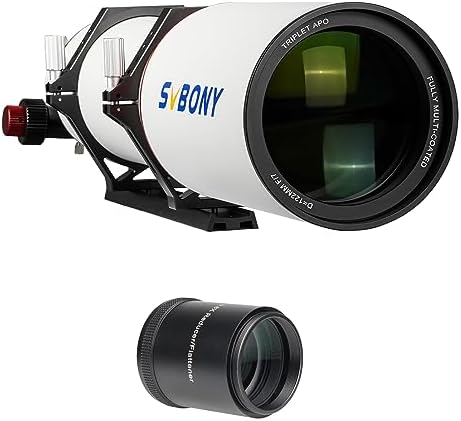
The SV550 122mm imaging bundle earns a 5.0 rating by combining a large FPL-51 triplet with the SV209 0.8X focal reducer and field flattener. It is the most ambitious premium package in the guide, pairing a 122mm aperture with accessories explicitly designed to address field curvature and broaden the imaging field.
We may earn a commission when you buy through this link, at no additional cost to you.
The optical tube has an 854mm focal length and F/7 native focal ratio, but the 0.8X reducer changes that working relationship to deliver a wider field. The field flattener is specified for prime-focus use with the 122mm scope, so the optical train is intended to work as a coordinated system rather than as unrelated accessories. Chromatic-aberration control comes from the FPL-51 triplet arrangement.
This level of capability comes with a meaningful weight and complexity penalty. The OTA weighs 6.44kg, or 14.18lb, before adding the camera, reducer, flattener, and guiding equipment. The mount must therefore be stable and well balanced, while field spacing must be set carefully. The package also does not include a camera, filter set, or guide scope, so it is comprehensive in optics but not in the entire imaging chain.
The bundle is ideal for an astrophotographer who wants large-aperture gathering power and a wider field without changing the main optical train. It can suit ambitious deep-sky projects and also serve visual observing when configured appropriately. For a smaller or lighter system, the 80mm bundle is more convenient, but for maximum aperture among the listed choices, this is the most complete wide-field configuration.
The 0.8X reducer lowers the effective focal ratio to create a broader field, while the field flattener is designed to correct curvature across that field. Together they address two common obstacles to sharp astrophotos with a fast astrograph.
The FPL-51 triplet structure combines one ED element with correction lenses to improve color and sharpness. In a 122mm instrument, that correction is especially valuable for keeping stellar detail coherent while gathering substantial light.
We may earn a commission when you buy through this link, at no additional cost to you.
The SVBONY SV550 122mm Triplet APO Telescope Kit offers a 122mm aperture, 854mm focal length, and an F/7 native focal ratio. Its focal reducer and field flattener are designed specifically for prime-focus imaging with the SV550, while the supplied handle and SV211 dovetail base focus on transporting and installing the large optical tube.
We may earn a commission when you buy through this link, at no additional cost to you.
The triplet lens structure uses one FPL-51 ED element along with correction glass to reduce chromatic aberration and enhance clarity. The 0.8X reducer broadens the field, and the flattener is intended to correct field curvature and improve image quality toward the edge of the frame. This combination gives the kit more imaging capability than a standard optical tube alone.
Weight is the decisive compromise. The optical tube's listed 6.44kg weight becomes more substantial once the reducer, flattener, camera, and guide equipment are mounted. A capable equatorial or alt-az tracking mount is therefore essential for serious imaging use, and portability is relative rather than absolute despite the included handle and dovetail base.
This kit is a strong option for an intermediate or advanced imager who wants a large-aperture astrograph and already has a suitable camera and mount. It may also appeal to a visual observer who values the long focal length and triplet correction, provided the chosen eyepiece can accommodate the instrument. Compared with the SV550 122mm bundle, the principal distinction is the supplied base and handle rather than the 0.8X imaging optics.
Because the 0.8X reducer and flattener are specified for the SV550 122mm F7 scope, users have a clearer starting point than buyers assembling accessories independently. The result is an imaging train designed around a conventional 55mm-style back focal distance.
The 854mm focal length gives the scope strong reach for smaller targets, while the reducer expands the usable framing. This makes it useful for imagers who want magnification and resolution without committing to an even longer catadioptric or apochromatic platform.
We may earn a commission when you buy through this link, at no additional cost to you.
The SVBONY SV550 80 Triplet APO Telescope Kit combines an 80mm F6 optical tube with a matched SV209 field flattener and a carrying handle. It follows a familiar apochromatic formula: one S-FPL51 low-dispersion element and two correction lenses assembled to improve blue-edge chromatic aberration and produce bright, detailed images.
We may earn a commission when you buy through this link, at no additional cost to you.
The SV209 is a field flattener designed specifically for the SV550 80 F6 OTA, making it more useful than a generic close-focus solution. It is intended to improve the fringe field curvature associated with the optical system. A fully coated lens surface helps reduce reflections, and the handle can be adjusted for a more secure installation process during transport and setup.
One detail that visual observers should note is the stated inverted eyepiece image. The supplied information identifies this as normal for the product, but it can affect the experience for users accustomed to an upright view. As with the other bare optical-tube and partial-kit options, a diagonal, eyepieces, camera, filters, mount, and guiding equipment are not all included in the supplied package information.
This kit is well suited to an observer-imager who wants a traditional 80mm triplet and a correctly matched field flattener. It is especially convenient for users who value portability and prefer a straightforward F/6 focal length for wide-field deep-sky work. The 80mm aperture is modest compared with the 102mm and 122mm models, but the package remains one of the most balanced choices for a mobile setup.
The field flattener is explicitly made for the SV550 80 F6 optical tube, reducing uncertainty when setting the sensor position. That specificity is a major benefit for imagers who want to avoid experimenting with incompatible adapters.
The adjustable carrying handle makes the instrument easier to manage during assembly and relocation. It does not change the optical performance, but it improves the handling of a sensitive triplet in the field.
We may earn a commission when you buy through this link, at no additional cost to you.
The SV550 Imaging System combines a 122mm F7 triplet apochromatic refractor with an SV165 mini guide scope and SV905C color camera. It has no listed customer rating in the supplied data, but the package is distinctive because it includes both a guide optic and a dedicated camera intended to support autoguiding or planetary imaging.
We may earn a commission when you buy through this link, at no additional cost to you.
The SV905C uses a 1.23-megapixel color CMOS sensor with a resolution of 1280 by 960 pixels and 3.75-micron pixels. Its stated peak quantum efficiency of 80% and low read noise are favorable characteristics for finding faint guide stars and recording signals efficiently. Compatibility is listed with mainstream autoguiding cameras through 1.25-inch and M42 interfaces, although some camera models may need extra focusing accessories.
The main refractor retains the familiar SV550 strengths: a 122mm aperture, FPL-51 triplet construction, an 854mm focal length, and a stated weight of 6.44kg. It is a serious instrument rather than a lightweight grab-and-go setup. The bundled guide scope and camera improve convenience, but the package still requires a mount, imaging camera, filters, and the software or control equipment needed to coordinate acquisition and guiding.
This system is best for an astrophotographer who wants a guided apochromatic platform and values having the guiding hardware in the same package. It could also support planetary imaging because of the dedicated color camera. Buyers who need a fully independent deep-sky imaging train should note that the SV905C is described as useful for autoguiding or planetary imaging, while the main imaging camera is not included.
The SV165 mini guide scope and SV905C camera create a coordinated guiding solution. This is a practical advantage for imagers who want a ready-made guiding concept rather than selecting and matching a separate guide train.
With 3.75-micron pixels, 80-percent stated peak quantum efficiency, and low read noise, the camera is designed to support faint-star detection. Its compact 1.23-megapixel color format also makes it relevant to planetary recording.
We may earn a commission when you buy through this link, at no additional cost to you.
Choosing an apochromatic refractor involves balancing optical correction, aperture, focal length, weight, and the accessories you already own. The following factors help narrow the field before you compare the ten models in this guide.
In short, prioritize a genuine multi-element correction system when planetary detail or bright stars are important.
Choose the smallest aperture that comfortably reaches your targets, or step up when faint deep-sky detail is the priority.
Match the focal length to your targets rather than choosing solely by magnification, and account for any reducer in your final framing.
Use a matched flattener or self-flattening optic for wide sensors, and confirm the image circle covers the full frame.
Confirm the required back focal length before ordering, then measure the complete image train rather than estimating it.
Choose a dual-speed focuser with enough travel for every accessory in the imaging train, then test the assembled setup for sag.
Balance the whole payload, including camera and accessories, against your mount's capacity and your ability to carry it safely.
List the accessories you already own, then choose the scope that fills the most important gap in your visual or imaging setup.
Begin by confirming that the optical tube, camera, reducer, flattener, and guide scope are securely connected and that the focuser is properly tightened. For a visual session, insert the diagonal and eyepiece, then perform a rough focus before making fine adjustments. For astrophotography, set the sensor spacing according to the specified back focal length, attach the camera and guiding equipment, and verify that the image circle covers the entire frame. The inverted image noted for the 80mm kit is normal for that system.
Protect the objective lens from dust, moisture, and fingerprints. Use a blower or soft cleaning brush for loose particles, follow a lens-cleaning procedure for residue, and avoid touching the glass with bare fingers. Keep the retractable dew shield extended when condensation is possible, especially during long imaging sessions. Do not leave the instrument pointed toward the Sun without an appropriate front-aperture solar filter; ordinary eyepiece or camera filters are not safe substitutes for solar observing.
After use, collapse the dew shield and cap the aperture, then store the refractor in a dry, dust-free location. Keep the focusing seat and adjustment screws free of grit, and inspect dovetail clamps and mounting screws before each setup. For a triplet, avoid bumps that could disturb collimation. If stars appear consistently soft, check spacing, focus, camera tilt, and collimation in that order before assuming the optics are defective.
An apochromatic refractor is designed to reduce chromatic aberration more effectively than a basic achromat or some simpler ED designs. The result is generally cleaner color around bright stars, improved planetary detail, and higher-contrast views. Actual results also depend on coatings, focus, alignment, seeing conditions, and the rest of the optical system.
Yes, an 80mm apochromatic refractor is a common choice for wide-field deep-sky imaging. The short focal length covers broad targets and can make framing and guiding easier. A matched field flattener, suitable camera spacing, and a stable mount remain important for sharp results, especially across the corners of a full-frame sensor.
Choose 80mm for portability, broad framing, and lower weight; 102mm for a balanced middle ground; and 122mm for greater light gathering and smaller targets. The larger models are more rewarding on faint objects but require a more capable mount and are harder to transport. Accessories such as reducers and flatteners can also influence the most useful final configuration.
That depends on the optical design and sensor. The self-flattened Askar 71F is designed to handle field curvature internally, while several SV550 packages include a matched SV209 flattener. If a telescope lacks a compatible flattener, especially when using a wide-field reducer or full-frame camera, one is usually needed to keep the edges sharp.
A triplet typically uses three lens elements, often including one low-dispersion element, while a quadruplet uses four. The Askar 71F is an air-spaced quadruplet, whereas the listed SV550 80mm and 122mm models use triplet designs. Both approaches can provide strong color control, but focal length, glass selection, flatness, weight, and intended use should be compared as well.
It is not always necessary. A reducer is useful when the native field of view is too narrow or when a wider, faster imaging configuration is desired. The 122mm SV550 bundle includes a 0.8X reducer and field flattener, while the 80mm bundle uses a 1.0X flattener to correct curvature without changing magnification.
Weight matters because the mount must carry the optical tube and all attached imaging accessories without shaking or shifting. It also affects transport and setup at a dark site. The Askar 71F is particularly light, while the 122mm SV550 requires a more substantial rig even when its carrying handle and dovetail base improve handling.
Check the diagonal or camera connection, focuser security, image spacing, and full-frame coverage first. Then inspect a bright star for focus, color fringing, and signs of tilt. Use a nearby guide star to verify tracking, and make small collimation adjustments only after ruling out camera spacing, focus, and alignment issues.
The SVBONY SV550 80mm bundle stands out as the most complete compact choice because it pairs a triplet optical tube with a matched field flattener. The Askar 71F is the most portable and field-friendly model, while the 122mm SV550 bundle offers the most ambitious premium configuration with a 0.8X reducer and large-aperture triplet optics.
Your decision should begin with how you will use the telescope most. Choose the Askar for mobility, the 80mm SV550 package for a balanced wide-field setup, the SV503 for a 102mm balance of aperture and handling, or a 122mm SV550 system when gathering power and a long focal length are the priority. Check the supplied accessories, sensor requirements, mount capacity, and back focal distance before completing a purchase.
Product availability, bundle contents, and current costs can change over time, so review the latest listing and specifications before ordering. Confirm the exact optical tube, included reducer or flattener, camera compatibility, and mounting hardware. With those details verified, you can choose an apochromatic refractor that supports your observing and astrophotography goals without paying for features you will never use.