
1/2-inch NPT Hall Effect Flow Sensor
4.7Editor score
1–30 L/min rated range
1/2-inch NPT threaded connection
Sealed magnetic Hall sensor
Works with Arduino projects
An Arduino flow meter can turn an ordinary water line into a useful source of live measurements, but choosing the right sensor depends on pipe size, expected flow rate, electrical output, and installation conditions. Hall-effect and turbine models offer different trade-offs in accuracy, visibility, and component size.
This guide compares 10 flow meters suited to Arduino, Raspberry Pi, reverse-osmosis, appliance, and maker projects. We considered rated flow ranges, working voltages, pressure limits, connection types, pulse characteristics, included cables, and documented environmental resistance, without claiming any hands-on testing.
Each review explains the strongest use case and important limitations of that model. The top selections range from a practical budget option to higher-capacity and feature-focused choices, while availability and prices can change at any time, so compare current listings before purchasing.
4.7Editor score

4.8Editor score

5.0Editor score
As an Amazon Associate we earn from qualifying purchases.
The table below compares all 10 sensors by their principal installation and operating characteristics. It highlights the trade-offs among low-flow, standard residential, and high-capacity systems, while noting where listings provide incomplete or inconsistent flow information.


This compact 1/2-inch flow sensor combines a straightforward NPT connection with a rated 1–30 L/min range, making it a practical choice for common Arduino water-monitoring projects. Its 4.7 rating is strong among a field where fitting, range, and pulse behavior often matter more than advanced digital features.
We may earn a commission when you buy through this link, at no additional cost to you.
The defining feature is its integrated magnetic Hall-effect sensor. A rotor turns as water moves through the body, and the Hall sensor produces an electrical pulse with each revolution. Because the sensing electronics are sealed away from the water pipe, the dry output side can remain isolated from the wetted flow path.
Installation direction is an important limitation. The product information states that it must be installed according to the indicated flow direction or it will not generate a usable signal. The listing also provides fewer electrical details than some alternatives, so builders should verify connector details and supply requirements in the current listing before wiring it.
It is best suited to DIY aquariums, water purifiers, beverage equipment, leak monitoring, and other modest-flow installations. For makers who want a clearly threaded, inexpensive, broadly compatible sensor without paying for a large enclosure or premium instrumentation, this is the most straightforward overall recommendation.
The rotating assembly produces one pulse per revolution, allowing an Arduino to count pulses over a defined interval and convert that count into a flow rate. This method is intuitive for beginners and works with common interrupt and millisecond timing routines.
The small, lightweight body is easy to incorporate into water heaters, coffee machines, drinking fountains, and similar lines. Its 1/2-inch NPT fitting also makes matching the sensor to an appropriately threaded pipe or adapter a central part of planning the installation.
We may earn a commission when you buy through this link, at no additional cost to you.
The DEVMO 1/2-inch water flow Hall sensor offers a 1–30 L/min measurement range and a 4.9 rating, making it one of the strongest-rated products in this guide. It is aimed at Arduino-compatible water testing, cooling, heating, and flow-control systems.
We may earn a commission when you buy through this link, at no additional cost to you.
What distinguishes the listing is its explicit electrical signal information. It specifies a high amplitude of at least 4.6 V and a low amplitude of no more than 0.5 V, giving electronics builders useful clues about the shape of the pulse signal. Electric strength is listed at 1,250 V per minute.
The trade-off is that the product information provides less detail about connector type, cable length, pressure rating, and thread standard than the most thoroughly documented models. Those omissions make it especially important to inspect the package and listing photographs before finalizing a build.
Choose this option when a standard half-inch line, a 1–30 L/min operating window, and a clearly defined pulse amplitude are priorities. It is particularly attractive for Arduino projects involving water cooling, water heaters, vending equipment, and embedded flow measurement.
The published high and low signal amplitudes help you distinguish a working sensor from a disconnected or incorrectly powered one. Those values are also useful when selecting pull-up or pull-down components and troubleshooting input conditioning on an Arduino.
The product is intended for water testing and water-cooling systems, along with heaters, vending machines, credit-card equipment, and flow-measurement devices. That makes it a versatile choice for projects where actual water consumption is the quantity being monitored.
We may earn a commission when you buy through this link, at no additional cost to you.
This DIGITEN model is the clear high-capacity choice, with a 5–150 L/min range, a 1.5-inch BSPT connection, and a perfect 5.0 rating in the supplied data. It is intended for larger Arduino, Raspberry Pi, and reverse-osmosis installations that exceed the capacity of typical household line sensors.
We may earn a commission when you buy through this link, at no additional cost to you.
Its documentation is comparatively complete. The operating voltage is DC 5–18 V, permissible water pressure is below 1.75 MPa, and the output is a square-wave pulse signal. Materials are stated to align with RoHS testing standards and to be suitable for potable-water applications, although buyers should check local plumbing and food-contact requirements.
The major compromise is installation scale. A G1.5-inch fitting is less common on small maker rigs than a 1/4-inch hose or 1/2-inch adapter, and NPT use would require suitable thread-seal tape. Its large range also means it may not be the most sensitive choice for very low trickles, even though it handles substantially more flow than the other selections.
This sensor is ideal for water heaters, purifiers, dispensers, fountains, and beverage equipment with moderate-to-high flow. Select it when maximum rated capacity and comprehensive specifications matter more than the smallest possible body.
A 5–150 L/min span covers flows that would exceed the nominal limits of many 1/2-inch sensors. That makes the model more appropriate for larger purification, heating, dispensing, and commercial-style beverage applications.
Documented voltage, pressure, thread, and waveform specifications reduce guesswork during system design. The square-wave output is particularly convenient for an Arduino input configured to count edges over a timed interval.
We may earn a commission when you buy through this link, at no additional cost to you.
This 1/2-inch flow sensor uses food-grade plastic and has a documented 1–30 L/min range, DC 5–24 V operating voltage, and pressure limit of 1.75 MPa. Its 4.1 rating places it behind the stronger-rated options, but its specification detail gives it a distinct practical advantage.
We may earn a commission when you buy through this link, at no additional cost to you.
The listing provides a calibration relationship of F=(7.5*Q)±2%, with Q expressed in liters per minute. This is valuable because it gives the Arduino sketch a mathematical basis for converting pulse counts into flow rather than relying on a generic formula. The materials are stated to conform to RoHS testing standards.
Its G1/2-inch BSPT connection may require an adapter in a North American NPT setup. The food-grade material description and appliance-oriented use cases make it relevant to coffee machines, water heaters, purifiers, drinking fountains, and beverage machines, but material claims should still be checked against the exact application and local requirements.
This is a sensible choice for builders who value a stated calibration formula and wide voltage compatibility more than a top customer rating. It is best for calibrated project measurements around the 1–30 L/min band, paired with a suitable thread adapter where needed.
The stated F=(7.5*Q)±2% relationship gives programmers a direct basis for flow calculation. You can still use a measured calibration constant if your plumbing, mounting, or operating conditions produce different pulse rates.
The plastic body is described as food grade, supporting use in beverage and drinking-water equipment. Confirm the complete assembly, sealing method, and applicable local requirements before treating it as certified for a specific potable-water installation.
We may earn a commission when you buy through this link, at no additional cost to you.
The YF-S201C package includes two transparent 1/2-inch turbine flow sensors, each rated for 1–30 L/min. Its 3.7 rating is the second lowest here, yet the clear housing and two-sensor bundle offer concrete advantages for education, comparison, and redundant installations.
We may earn a commission when you buy through this link, at no additional cost to you.
The transparent valve body lets you observe water movement and rotor behavior directly. Its impeller contains stainless-steel beads intended to improve wear resistance, while the separation of the lines from the water helps protect the internal rotor assembly. The clear construction is especially helpful while learning how flow changes rotor speed.
Care is needed with the voltage specification. The product information assigns DC 3.5–12 V to the black version and DC 3.5–24 V to the transparent version, with a load capacity of no more than 10 mA at DC 5 V. Verify which version is included and use the correct supply voltage.
This two-pack suits classroom demonstrations, paired inlet-and-outlet measurements, or keeping a spare on hand. It is less compelling for users who require the highest customer rating, but the visible mechanism and included duplicate hardware make the package unusually useful for learning and troubleshooting.
The transparent housing exposes the rotor, allowing you to confirm that water is moving in the intended direction and that the impeller is spinning. This visibility makes installation faults easier to diagnose than with an opaque inline body.
Two sensors support before-and-after testing, side-by-side calibration, or simultaneous measurement of inlet and outlet flow. They can also serve different branches, provided each has compatible wiring, voltage, and fluid conditions.
We may earn a commission when you buy through this link, at no additional cost to you.
This 1/4-inch sensor is built for small hoses and low-flow projects. It connects to tubing with an inner diameter of about 5–7 mm, uses a Hall-effect output, and has a 4.2 rating. It is a good fit when a full-size 1/2-inch water sensor would be cumbersome.
We may earn a commission when you buy through this link, at no additional cost to you.
Its product title states a 0.3–6 L/min range, while the detailed information lists 0.5–3 L/min and a pressure limit of 0.8 MPa. This inconsistency matters when sizing a system, so the safest approach is to design around the narrower documented range unless the seller provides clarification.
The stated frequency relationship is F=(98*Q)±3%, with Q in liters per minute, giving programmers a clear starting point for conversion. Its working voltage of DC 5–24 V is broad, while the food-grade plastic construction and RoHS-conforming raw materials suit appliance and beverage-oriented experiments.
This model makes sense for low-volume water lines, compact rigs, and applications using flexible hose. It is not the best choice when flow can surge or when uncertainty about the usable range is unacceptable, but its small physical format is genuinely useful for constrained projects.
The 5–7 mm hose specification allows the sensor to be incorporated into compact lines without threading a larger fitting. A secure hose clamp and leak-free connection remain essential because the operating pressure limit is lower than on many 1/2-inch alternatives.
The title and detailed listing disagree on the supported flow window. Use 0.5–3 L/min as the conservative planning range, and verify the exact model and manufacturer documentation if your application depends on the upper figure.
We may earn a commission when you buy through this link, at no additional cost to you.
The Taidacent YF-S201 is a black Hall-effect flow sensor with a four-point interface and G1/2-inch connection. Its 5.0 rating makes it one of the highest-rated options here, and its description clearly connects the magnetic rotor, Hall sensor, and controller feedback process.
We may earn a commission when you buy through this link, at no additional cost to you.
Inside the valve body, water causes a magnetic rotor to turn. Rotor speed changes with flow rate, and the Hall sensor creates a corresponding pulse signal for the controller. This architecture is well suited to water-heater inlets, dispensers, and other systems that need a controller to regulate operation.
The primary drawback is missing information. The supplied product details do not state a rated flow range, working voltage, pressure limit, cable length, or the precise role of all four electrical points. Those are meaningful gaps for an Arduino designer, so the current listing and package should be checked before wiring.
Choose this model when a four-point Hall output and controller feedback are important and you can verify its electrical requirements. It is particularly attractive for replicated water-heater or dispenser projects, but a model with fully published range and voltage data may be safer for a first standalone Arduino build.
As flow changes, the magnetic rotor's speed changes with it. The Hall sensor translates that mechanical movement into a corresponding electrical signal, allowing a controller to determine the flow magnitude and regulate the connected system.
A four-point interface may involve more connections than a simple three-wire Hall sensor arrangement. Review the pinout, supply requirements, and grounding details in the current package documentation before connecting it to an Arduino or controller.
We may earn a commission when you buy through this link, at no additional cost to you.
The DIGITEN G1/2-inch model combines a 1–30 L/min range with a preattached 1.2-meter, or 3.9-foot, cable and a 4.8 rating. Its blend of useful documentation, standard half-inch sizing, and installation-friendly cable makes it the strongest all-around choice for many Arduino projects.
We may earn a commission when you buy through this link, at no additional cost to you.
The electrical details are easy to plan around: DC 5–18 V operation, a 1.75 MPa pressure limit, square-wave pulse output, and an SM2.54 three-pin connector. The cable gives you substantially more freedom to keep the sensor in a wet plumbing area while placing the Arduino in a dry enclosure nearby.
The fitting is G1/2-inch BSPT rather than NPT. If your plumbing uses NPT, an appropriate adapter and thread-seal tape may be required, so confirm thread compatibility before purchase. As with other inline sensors, orientation and a leak-free connection are essential to valid measurements.
This is our recommendation for water purifiers, reverse-osmosis systems, coffee machines, fountains, heaters, and general consumption monitoring. It is especially attractive to first-time builders because the long cable and clearly identified connector simplify wiring outside the pipe area.
The 1.2-meter cable allows the sensor body to remain at the water line while the Arduino and power circuitry sit farther away. This separation can simplify enclosure design and reduce exposure of electronics to moisture.
The stated three-pin connector, operating voltage, pressure ceiling, square-wave output, and range give you a solid basis for selecting a supply and writing the measurement routine. Thread compatibility remains the detail to verify most carefully.
We may earn a commission when you buy through this link, at no additional cost to you.
The DIGITEN G3/8-inch model covers 0.3–10 L/min, making it a middle ground between very low-flow hose sensors and common 1–30 L/min units. Its 4.5 rating and compact format suit compact Arduino, Raspberry Pi, and reverse-osmosis monitoring setups.
We may earn a commission when you buy through this link, at no additional cost to you.
A key benefit is the DC 3.5–12 V working range, which includes 5 V operation and can suit projects using common low-voltage logic. The output is documented as a square-wave pulse, allowing straightforward edge counting and time-based flow calculation.
The listing says the sensor is waterproof and resistant to heat, pressure, and cold, and that its materials comply with RoHS standards. However, it does not state a numerical pressure limit, cable length, or connector details, so those installation requirements should be confirmed in the current package information.
This sensor is a good middle option for lines expected to move more than a trickle but less than a busy household fixture. It works well in compact filtration, cooling, and appliance-monitoring projects where 3/8-inch plumbing and a low operating voltage are priorities.
The 0.3–10 L/min range covers many controlled water lines that exceed the limits of very small hose sensors. It remains below the 1–30 and 1–60 L/min ranges of the larger comparison models, so estimate real demand before committing.
The DC 3.5–12 V specification makes the sensor suitable for common 5 V Arduino arrangements. Confirm the output levels and grounding arrangement before connecting the pulse line to a microcontroller input.
We may earn a commission when you buy through this link, at no additional cost to you.
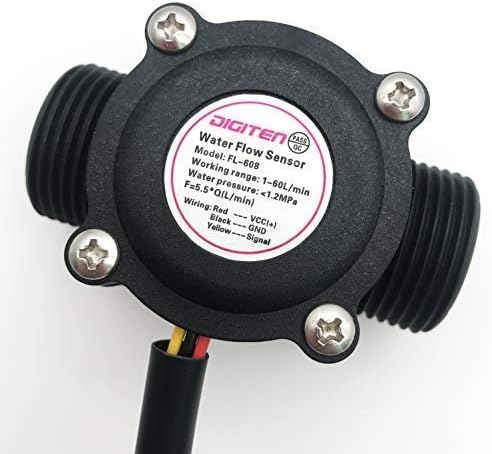
This DIGITEN model raises the flow ceiling to 1–60 L/min while retaining a 1.2-meter attached cable and DC 5–18 V operation. Its 3.2 rating is the lowest in the comparison, so buyers should examine current customer feedback and verify fit before committing.
We may earn a commission when you buy through this link, at no additional cost to you.
Its main practical benefit is capacity. The 1–60 L/min range fits between standard 1/2-inch units and the 5–150 L/min high-flow sensor. The documented pressure ceiling of 1.75 MPa, square-wave pulse output, and G3/4-inch BSPT connection make it suitable for demanding water-heater, purifier, fountain, and beverage-machine lines.
Despite those useful specifications, the lower rating suggests that the experience may be less consistent than the leading models. The listing also does not state a connector type, so the cable termination must be checked before wiring. A proper 3/4-inch adapter is also required if the available pipe uses a different standard.
Choose this sensor when the system needs more capacity than a 1/2-inch model and the included cable length is useful. For a first Arduino project, one of the higher-rated standard-range options may offer a more reassuring overall ownership experience, but this model serves a legitimate higher-flow niche.
The 1–60 L/min rating offers a useful middle ground for appliances and water systems that exceed 30 L/min. The 3/4-inch body remains more manageable in size than the 1.5-inch premium selection while supporting a higher operating ceiling.
The long cable simplifies placement, but its final connector is not identified in the supplied information. Check the package for pin order and ensure the G3/4-inch BSPT thread matches the available plumbing or planned adapter.
We may earn a commission when you buy through this link, at no additional cost to you.
The right Arduino flow meter depends first on where it will be installed and how much water the line must carry. After narrowing the mechanical and flow requirements, electrical details and calibration information become equally important.
In short, select a range that fits your real flow—not merely the pipe size.
In short, confirm thread standard and hose size before the sensor arrives.
In short, plan for edge counting, verify signal levels, and respect flow direction.
In short, use only a documented supply voltage and confirm the output is input-safe.
In short, confirm pressure, fluid, temperature, and material suitability before plumbing.
In short, choose enough cable for a dry electronics area, then verify its connector.
In short, use the published formula initially, then calibrate when accuracy matters.
In short, match the body and range to the installation rather than choosing by maximum specification.
Start by identifying the flow direction, nominal thread size, rated range, and electrical requirements. Compare those specifications with the actual pipe and expected operating conditions. Install the sensor in the marked direction, use the correct adapter, and apply the appropriate thread-seal tape or hose connection. Keep the body upright as required, tighten fittings without forcing the plastic, and make sure the complete assembly is leak-free before connecting power.
Wire the Hall output to a suitable Arduino input and supply the sensor from a documented DC source. Configure the pin appropriately for the known signal type, attach a pull-up or pull-down if required by the output arrangement, and begin with a short pulse-counting test. Measure pulses over a fixed interval, apply the model-specific conversion or your own calibration, and compare several samples. The sensor should be checked with its Arduino board away from the pipe whenever possible, especially when a preattached cable is available.
For ongoing care, keep the sensor and fittings dry externally, inspect seals and connections for drips, and remove debris that could restrict the rotor or alter the flow profile. Avoid exceeding the listed flow, pressure, or voltage limits. Recheck calibration if the pipe configuration changes, and do not rely on a pulse reading from a stationary or incorrectly oriented rotor as evidence of accurate flow.
Most of the models in this guide use a Hall-effect sensor that emits pulses as an internal rotor turns with the water. An Arduino can count those pulses over a timed interval and convert the result into liters per minute. A model with documented connector, voltage, range, and calibration details is usually easier to use than one with incomplete specifications.
It depends on the sensor's operating voltage and output levels. Several options accept DC 5–18 V, while others work from DC 3.5–12 V or even DC 5–24 V. The sensor supply and its signal output are separate considerations, so verify both the input range and whether the pulse line requires a pull-up or level conditioning.
No. They are different thread standards even though both may be described as half-inch. BSPT models need a compatible BSPT fitting, while NPT setups require a proper adapter or a sensor with an NPT connection. Do not rely on tape alone to make mismatched threads compatible; verify the male and female thread standards first.
Count the pulses received during a fixed interval, calculate the pulse frequency, and apply the sensor's published relationship between frequency and flow. Two products provide explicit formulas, while other models can be calibrated by passing a known volume of water and recording the resulting pulse count. A project-specific calibration often reflects the real installation better than a generic formula.
First confirm that power is within the sensor's specified voltage range, the Arduino is using the correct input and ground, and the output arrangement is correct. Then check whether the rotor turns, because a reversed installation or blocked line can prevent a signal. Also inspect the connector, wire order, flow speed, and whether the measured rate is below the sensor's useful lower limit.
Not automatically. A high-range sensor can measure a larger maximum flow, but it may be less appropriate for very low flow depending on its pulse behavior. Choose a range that closely matches expected operation, mount it in a stable upright position, and calibrate it under representative conditions for better results.
The product information mentions heat resistance for several models, but it does not provide a complete temperature specification for every sensor. The listed pressure and material information should not be treated as a universal fluid rating. Confirm the operating temperature, chemical compatibility, sealing method, and application requirements before using a sensor with anything other than suitable water.
A longer cable is helpful when the Arduino must be kept away from wet plumbing or placed in a separate enclosure. The two DIGITEN models with 1.2-meter cables offer documented reach. For other sensors, verify the lead length and connector before buying, and protect any extension from moisture, impact, and electromagnetic interference.
The 1/2-inch NPT Hall sensor is the best budget-oriented all-rounder, while the DIGITEN G1/2-inch model with a 1.2-meter cable is the most practical editor's choice for typical Arduino installations. The DIGITEN G1.5-inch unit stands apart for projects requiring a 5–150 L/min range and higher flow capacity.
Prioritize four things before purchasing: a range that covers real operating flow, a connection that matches the plumbing, a documented voltage that suits your supply, and enough published information to support the Arduino sketch. Thread standards, direction, calibration, and pressure limits matter just as much as the headline flow number. Transparent and cable-equipped models can make installation and troubleshooting easier.
Ratings and product details provide a useful starting point, but current listing information, availability, and prices can change. Recheck the seller page, package contents, connector details, and technical specifications before ordering, especially when a project depends on a precise flow range or specialized pipe connection.
