
ACEIRMC CH341A BIOS Programmer Kit
4.4Editor score
CH341A USB programmer included
SOIC8 clip and adapter
Supports 24 and 25 series
Best Bios Programmer Kit guide comparing 10 options for chip support, adapters, voltage handling, programming speed, ease of use plus PCB.
A Bios Programmer Kit is a compact hardware and software solution for reading, erasing, writing, and verifying the memory chips that store firmware on motherboards, graphics cards, routers, TVs, and other electronics. The most useful kits combine broad chip compatibility with dependable adapters, safe voltage selection, and software that makes common jobs easy to understand.
This guide compares ten available BIOS programmer listings by examining supported 24, 25, and 93 series chips, the hardware and adapters included, automatic detection features, programming speed, voltage options, in-circuit clip access, and likely repair applications. Products with missing technical information are included for completeness but are evaluated cautiously rather than assigned unsupported advantages.
The top selections favor a balanced mix of capability and value: a compact CH341A kit for practical repair work, an EZP2023 with automatic functions, and a broad EZP2019 package with numerous sockets and clip options. Individual ratings, package contents, and listing details can change, so confirm the current specifications and accessories before purchasing.
4.4Editor score

4.5Editor score

4.4Editor score
The table below compares the ten listed programmer kits by their hardware platform, chip-family support, automation, included connection accessories, and practical use. Products with sparse supplied information are clearly limited to what their listings confirm.


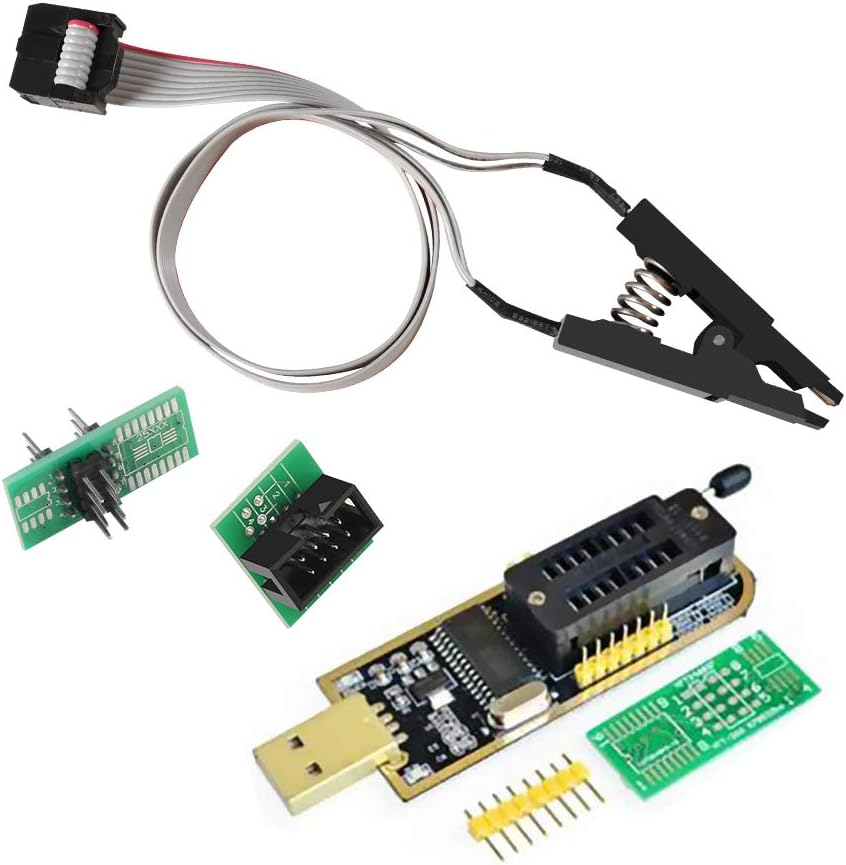


This ACEIRMC kit pairs a CH341A USB programmer with the accessories needed to handle many common 24 and 25 series BIOS and EEPROM devices. It carries a 4.4 rating and distinguishes itself with a SOIC8-to-DIP8 adapter, a 1.8V adapter, and a SOIC8 test clip. Together, these components make it a practical entry point for motherboard and consumer-electronics repair.
We may earn a commission when you buy through this link, at no additional cost to you.
The supplied information describes programming as two to three times faster than an ordinary ATMEGA8-based 25 series programmer, with erasing and checking reaching an estimated 2 to 3 Mbit per minute. The clip enables programming without physically removing an eight-pin chip, while the adapter permits socketed use. Its listed applications include desktop motherboards, LCD panels, routers, notebooks, cards, DVDs, TVs, and set-top boxes.
The main limitation is the absence of the automatic identification and voltage-selection features found in the EZP2023 listings. A CH341A program also has device-specific compatibility constraints. For example, the separate double-clip listing notes that ESMT SST-class 25 chips can be read but not written, illustrating why chip identification and manufacturer cross-checks remain important even with a well-equipped kit.
This is a strong choice for a repair technician who wants a compact USB programmer and several common connection methods without moving to a more advanced platform. It is especially attractive for users who value the included test clip, DIP adapter, and 1.8V option. Confirm the exact chip marking and electrical requirements before attempting a write, and keep a verified firmware backup whenever possible.
The programmer, SOIC8-to-DIP8 adapter, and test clip cover both removable-chip and in-circuit workflows. That flexibility is useful when the repair involves a socketed BIOS chip on one device and a soldered chip on another.
The included 1.8V adapter expands the kit's relevance for selected phone and motherboard flash memory. Supply voltage should still be verified from the target device documentation rather than inferred from the package shape.
We may earn a commission when you buy through this link, at no additional cost to you.
The EZP2023 listing combines a USB SPI programmer with automatic setup features intended to reduce configuration errors. It has a 4.3 rating and supports 25-series SPI flash as well as 24, 25, 93, and 95 series EEPROM families. The supplied package description also includes a 15-pin adapter, making this a more focused system than the larger EZP2019 accessory collection.
We may earn a commission when you buy through this link, at no additional cost to you.
Its defining advantage is automation. The programmer can identify many chip models automatically, detect whether a chip is seated correctly, and select the supply voltage. Some 24, 25, 93, and 95 EEPROM devices still require manual selection, but the automatic functions make it easier to move between common SPI flash parts without repeatedly checking manual settings.
The listing claims an EN25T80 read time of three seconds and a write time of nine seconds. These figures are useful as a relative performance indication, although actual results depend on the chip, connection quality, system configuration, and verification process. The product is positioned for reading, writing, and offline copying, including batch-oriented work where repetitive operation matters.
This EZP2023 is the most balanced choice for a technician who values automatic setup but does not need a large collection of sockets. It should appeal to users repairing motherboards, TVs, DVDs, hard drives, and similar equipment. Before using it on an unknown chip, read the full marking, confirm the required voltage, and make sure the physical package matches a supported socket or adapter.
Automatic model recognition, placement detection, and voltage selection can prevent common user errors. Manual chip selection remains relevant for certain EEPROM families, so the software should still be treated as a tool rather than a substitute for checking the hardware.
The offline-copy function supports repeatable workflows, while the claimed three-second EN25T80 read is a strong indicator of responsive operation. Independent backup and verification remain essential even when speed is high.
We may earn a commission when you buy through this link, at no additional cost to you.
This USB SPI Flash Programmer Kit is a strong all-around selection for users who want automated chip handling and broad repair applications. It has the highest confirmed rating in the supplied data at 4.5. The listing identifies support for 25-series flash, 24-series EEPROM, 25-series EEPROM, and 93-series EEPROM, while also covering other compatible memory chips.
We may earn a commission when you buy through this link, at no additional cost to you.
Automatic functions are central to the design. The programmer identifies the chip model, checks whether it is placed properly, and selects the operating voltage. It also provides a fully automatic offline-copy function, which the listing highlights as useful for batch programming and factory-oriented memory-chip preparation.
The product is presented as a practical tool for product-development teams, electronics repair businesses, and individual technicians. Its stated applications include color televisions, DVDs, computer motherboards, and hard disks. It also supports PC software and programmer firmware upgrades, adding a maintenance dimension that matters for a tool expected to remain useful as supported devices and procedures evolve.
Compared with the other EZP2023 listing in this roundup, this product provides a particularly clear description of the automatic workflow and its intended repair environments. It is a sensible pick for users who prioritize fewer manual setup steps. The supplied information does not enumerate the full adapter set, so buyers should verify the package contents and chip list for their actual devices.
The 4.5 rating reflects favorable user feedback, while the automatic functions address a real source of programming errors. The combination is compelling for repeat work involving several chip types or multiple boards.
The stated use cases span consumer electronics, computers, and product development. A technician can move from a firmware backup to a programmed replacement while relying on automatic placement and voltage checks.
We may earn a commission when you buy through this link, at no additional cost to you.
The EZP2019 is the most accessory-heavy product in this comparison, combining the programmer with several sockets, clip options, a USB cable, software, and a 1.8V socket. Its 4.4 rating reflects a generally favorable reception, and the package is designed for both chip-in-socket and clip-based access to 24, 25, and 93 series memory.
We may earn a commission when you buy through this link, at no additional cost to you.
The supplied specifications state a USB 2.0 interface with speeds up to 12 MBPS. The listing reports an EN25T80 read time of approximately three seconds and a write time of approximately nine seconds. Automatic chip identification, automatic placement detection, automatic voltage selection, and an automatic offline-copy function give the tool a similar convenience profile to the EZP2023 models.
What distinguishes it is the breadth of the included hardware. The package lists simple SOIC8 and SOP16 sockets, a 300-mil SOP16 socket, 200-mil and 150-mil SOIC8 sockets, a 1.8V socket, a SOIC8 clip, a USB cable, and CD software. Its long chip list includes devices from MXIC, Nexflash, PMC, Saifun, Spansion, SST, GigaDevice, ST, Winbond, Atmel, and other families.
This package is best for a technician or serious repair hobbyist who expects to encounter varied package sizes and chip families. The breadth reduces the need for separate adapters, while automatic setup helps keep jobs efficient. Its disadvantages are mainly size and complexity compared with simpler kits, plus the possibility that a more current EZP2023 platform may offer a more streamlined package.
Sockets in 150-mil, 200-mil, 300-mil, and 16-pin formats cover common SPI devices. The included clip and 1.8V socket extend the package beyond the bare programmer.
Automatic identification, placement detection, voltage selection, and offline copying reduce repetitive configuration. Those features are particularly useful for repair shops and batch programming environments.
We may earn a commission when you buy through this link, at no additional cost to you.
This CH341A package is a simple USB programmer kit centered on SOIC8 clip programming for 24 and 25 series BIOS and EEPROM chips. It has a 3.0 rating, lower than the other confirmed product ratings in the roundup, so buyers should weigh the concise feature set carefully. Its strongest selling point is the ability to connect a test clip directly to a mounted chip without soldering.
We may earn a commission when you buy through this link, at no additional cost to you.
The listing states that the kit supports 1.8V, 3.3V, and 5V output, making it relevant to devices that use more than one flash-memory voltage. The included programmer and adapters are designed for backup, erase, programming, and related memory operations, while the SOIC8 clip simplifies in-circuit access.
The rating suggests that some buyers may have encountered limitations involving hardware, software, instructions, or component quality, although the supplied information does not establish the cause. It is therefore more prudent to verify operating-system support, the available software, and the exact chip list before relying on it for a difficult repair.
This kit is best for a learner, hobbyist, or technician who wants a straightforward CH341A setup and no-solder clip workflow. It may also serve as a lightweight secondary programmer for straightforward 24 and 25 series jobs. For critical board-level work, the EZP2023 and EZP2019 packages provide more clearly documented automation or a wider accessory set.
The SOIC8 test clip connects to a chip while it remains soldered to the board. This can shorten repair time, although the clip must be positioned carefully and held securely.
Support for 1.8V, 3.3V, and 5V output covers several common device classes. The correct voltage must still be confirmed from the target board or chip documentation.
We may earn a commission when you buy through this link, at no additional cost to you.
This ACEIRMC offering combines a CH341A USB programmer with two SOIC8 test clips and a USB connection. It holds a 4.4 rating and supports many 24, 25, and 93 series devices commonly encountered in BIOS repair. The double-clip arrangement is the key distinction, giving the user two options for reaching mounted eight-pin chips.
We may earn a commission when you buy through this link, at no additional cost to you.
The test clips are designed for in-circuit EEPROM programming, allowing a technician to back up, erase, program, calibrate, or otherwise work with compatible memory without removing it from the board. The programmer's supported families cover 24CXX, 25CXX, and 93CXX devices, while its broader listing references most common 24 and 25 series BIOS chips.
There are two important device-specific cautions. First, the CH341A-based unit can only read, not write, ESMT SST-class 25 chips according to the listing. Second, surrounding peripheral circuits can sometimes prevent a clip from establishing a reliable connection, so the physical placement of the BIOS chip should be checked before attempting an in-circuit operation.
This kit is a good fit for repairers who appreciate having a spare clip and value a simple direct-connection approach. It is less suited to users wanting automatic chip recognition or automatic voltage selection. It can also serve as a second tool alongside a socket-based programmer, allowing one setup for removable chips and another for boards that should not be disassembled.
Having two test clips can help when one does not fit a board's geometry or must be reserved for a separate device. Clip quality and contact pressure remain important to reliable programming.
The stated inability to write ESMT SST-class 25 chips is a meaningful restriction. Board-level circuitry can also obstruct an in-circuit connection, making socketed programming the safer alternative in some cases.
We may earn a commission when you buy through this link, at no additional cost to you.
The supplied data for this ASIN contains only a product link, with the title, description, rating, image, and technical details all listed as unavailable. It is therefore impossible to establish whether the product uses CH341A, EZP, RT809F, or another programmer architecture, or whether it supports 24, 25, 93, or 95 series chips.
We may earn a commission when you buy through this link, at no additional cost to you.
Because the supported chip list, included adapters, voltage handling, and software compatibility cannot be confirmed, this listing should not be selected on the basis of the general category name alone. A buyer would need to review the live product page carefully and verify every relevant specification before making a repair-tool purchase.
The most responsible recommendation is to treat this option as a listing requiring further research rather than a recommended all-purpose kit. Confirm the exact hardware, supported operating systems, software availability, chip identifiers, adapter inventory, voltage range, and warranty terms before committing to it.
A working listing is not the same as a well-documented one. Check for a clear chip-support list, package contents, power specifications, and recent buyer feedback before ordering.
Do not assume that a product labeled as a BIOS programmer supports the same voltage, package, and chip families as the other selections. The missing information is the central purchasing issue.
We may earn a commission when you buy through this link, at no additional cost to you.
This ASIN is another listing for which the factual source provides no title, description, rating, image, or product specifications. Its presence in the product set establishes only that it is associated with the BIOS programmer category. It does not establish its hardware platform, accessory set, or supported memory devices.
We may earn a commission when you buy through this link, at no additional cost to you.
Without a chip compatibility table, it is impossible to compare this product reliably with the CH341A, EZP2019, EZP2023, and RT809F options. It could be preferable for a specialized package size or obscure chip family, but the supplied information does not support that conclusion. It could equally lack the voltage options or software needed for a particular job.
This entry should be reviewed only after checking the live listing for a manufacturer name, programmer model, supported chips, included sockets, operating-system requirements, and instructions. Those checks are especially important if the device will be used to recover firmware from a valuable board.
The target chip's family, manufacturer, model number, package, and voltage determine whether a programmer is useful. Compare all five details with the manufacturer's support list before buying.
A programmer may need a suitable socket, adapter, clip, USB cable, and software. Without package details, assume none of these accessories are included until the listing explicitly confirms them.
We may earn a commission when you buy through this link, at no additional cost to you.
This package supplies two CH341A programmer sets, each accompanied by a 1.8V adapter, a SOIC8-to-DIP8 adapter, and a SOIC8 test clip. It has a 4.2 rating and is aimed at technicians who want duplicate equipment or want to keep separate tools for separate repair benches.
We may earn a commission when you buy through this link, at no additional cost to you.
The hardware is suitable for amateur programming of 24 and 25 series flash, while the supplied applications extend to television memory, desktop motherboards, LCD equipment, notebooks, routers, cards, DVDs, and set-top boxes. The listing also reports programming performance of two to three times an ordinary ATMEGA8-based 25 series programmer, with erase and check rates estimated at 2 to 3 Mbit per minute.
Two complete sets remove the inconvenience of sharing one programmer across two work areas. A spare unit can also remain available for setup, troubleshooting, or comparison, although the package does not add capabilities beyond the underlying CH341A platform. Automatic chip identification, placement detection, and voltage selection are not claimed.
This is a good pick for a small repair business, electronics classroom, or serious hobbyist working on multiple devices. An individual user with a single bench can obtain similar core accessories with a one-set kit. The two-set format makes sense when parallel work or redundancy is more valuable than advanced automation.
Two programmers let two devices or benches be prepared at once. This can improve workflow in a busy shop or reduce delays when one cable, clip, or adapter is in use.
The duplicated hardware does not introduce a second chip family or a new voltage system. Both sets use the same CH341A-based approach and include the same primary connection accessories.
We may earn a commission when you buy through this link, at no additional cost to you.
The RT809F listing is the most advanced-looking option by platform name and is described as including eight adapters, an IC clip clamp, and a 1.8V adapter. Unlike the EZP and CH341A products, its supplied description does not enumerate supported chip models, explain automatic functions, or state the working voltage for each included adapter.
We may earn a commission when you buy through this link, at no additional cost to you.
An RT809F-based platform is often associated in the broader market with broader device-programming capabilities, but the factual source for this particular listing does not confirm those details. It would therefore be inappropriate to claim support for specific BIOS chips, microcontrollers, or other memory families based only on the product title and terse description.
The adapter variety nevertheless makes this an attractive package to investigate for a technician who works with varied physical chip packages. The IC clamp can support in-circuit access, while the 1.8V adapter offers a lower-voltage connection option. The eight adapters may improve flexibility, although their exact types and dimensions are not stated in the supplied data.
This is the premium pick for its broader stated hardware selection, not because the source confirms faster performance or a longer chip-support list. A buyer should review the live listing for the exact RT809F version, adapter sizes, software, operating-system requirements, and supported devices. Those checks are essential before using it for mission-critical firmware recovery.
Eight listed adapters suggest a broader physical toolkit than the simpler one-programmer packages. The exact package sizes should be confirmed because the supplied description does not name them.
The listing lacks a rating and detailed chip-support information. Its premium position reflects the stated hardware assortment, while actual programming suitability depends on verified device compatibility.
We may earn a commission when you buy through this link, at no additional cost to you.
The right BIOS programmer depends on the chips you need to service, the board layouts you encounter, and whether you need removable-chip or in-circuit programming. Compare protocol support, voltage handling, physical adapters, software, and verified backups rather than focusing only on the number of accessories.
A programmer is useful only when it supports the precise memory device on the target board. The confirmed options in this guide cover combinations of 24, 25, and 93 series chips, with one EZP2023 listing also naming 95 series EEPROM support. Some products identify many chips automatically, while others require manual selection, and a manufacturer can produce compatible parts that still have different write behavior. Match the full chip marking, not merely the capacity, and review the supported-device list before buying.
Prioritize a model-specific support list over a vague claim of broad compatibility.
The products in this guide primarily use USB-connected SPI programming, with several built around the CH341A controller. That architecture suits many common SPI flash and EEPROM devices used in motherboard and consumer-electronics firmware. The EZP2019 listing specifies USB 2.0 and a maximum interface rate of 12 MBPS, while the EZP2023 listings highlight fast read and write cycles for an EN25T80. These claims are useful comparisons, but actual performance also depends on the chip, connection, computer, software, and verification step.
Choose a platform whose protocol and software match the devices you actually service.
Flash memory may operate at 1.8V, 3.3V, or 5V, and applying the wrong supply can damage a programmer, adapter, or target chip. The CH341A SOP8 kit explicitly lists all three output voltages, the ACEIRMC kits include 1.8V adapters, and the EZP platforms advertise automatic voltage selection. None of those claims should replace verification of the target chip's rated voltage. Some boards also regulate the programming line differently or require a specific adapter arrangement.
Confirm both chip voltage and board-level programming requirements before operating the tool.
Removable-chip programming usually depends on the correct package socket, while in-circuit work relies on a well-fitting test clip. The EZP2019 package stands out with SOIC8 sockets in multiple dimensions, a SOP16 socket, a clip, a 1.8V socket, and other adapters. The CH341A kits offer a SOIC8-to-DIP8 converter and a test clip, giving them two common connection routes. Package dimensions must match the chip body and pin pitch exactly, and clips need clean contacts and stable pressure.
Match every adapter to the target package before ordering.
Automatic chip identification, placement detection, and supply-voltage selection can make a programmer more convenient and reduce configuration errors. The EZP2019 and both EZP2023 listings advertise these features, while the CH341A products are more dependent on manual device selection. The EZP2023 universal kit also includes an offline-copy function intended for batch work, and the EZP2019 supports software and firmware upgrades. Verify which operating systems are supported and whether required software is included.
Favor automation only when it is matched by a clear, maintained software workflow.
Reading a working image before writing is one of the most important parts of BIOS recovery. Look for a programmer that can read, save, write, and verify rather than one that only advertises writing speed. A clip-based workflow is convenient, but it may be unreliable when surrounding circuitry interferes with the connection. A removable socket can provide a cleaner connection at the cost of desoldering. In either case, keep more than one verified copy of the original firmware and compare the result after programming.
A successful write is not enough; always verify the stored image.
A compact programmer is easier to carry between a bench and a customer site, while a broad adapter set saves time when different package sizes are encountered. The EZP2019 is compact yet heavily accessorized, offering a useful middle ground. The EZP2023 listings emphasize automated operation for repeated work, and the double-clip and two-set CH341A packages support parallel jobs or multiple benches. Choose the level of mobility that matches your actual work rather than carrying unnecessary hardware.
Balance compactness against the adapters and duplicate tools you genuinely use.
Clear documentation matters because incorrect voltage, package, or chip assumptions can lead to failed or damaging operations. Several listings provide detailed compatibility information, while two products in the supplied data have no title, description, image, rating, or specifications. Those entries require live-page verification before purchase. Reviews can also reveal missing cables, difficult software, adapter limitations, or device-specific write failures, but individual experiences should be checked against the exact product version.
Treat incomplete listings as research prompts, not automatically as suitable purchases.
Begin by identifying the target device and reading the complete chip marking, package type, supply voltage, and manufacturer. Inspect the programmer, USB cable, socket, adapter, or clip for damaged pins and loose contacts. Connect the programmer to the computer, install the software appropriate to its platform, and confirm that the computer recognizes the USB device before placing a chip in a socket or attaching a clip.
For the first operation, read the existing firmware and save it to a clearly named file. Compare the read size and checksum with the expected device information where possible. Keep that backup unchanged, and make a second copy if the board or firmware is important. Select the exact chip model, verify the voltage and adapter arrangement, then perform a test write only after confirming that the target is a supported device and that power removal will not create additional problems.
After writing, read the chip again and verify the new image before testing the repaired equipment. Disconnect power from the target and USB power from the programmer before changing adapters or clips. Store the kit in a dry, static-safe area, keep clips free from dust, and avoid forcing pins into sockets. Treat firmware backups as irreplaceable service data rather than temporary files.
A BIOS programmer kit reads, backs up, erases, writes, and checks firmware stored in EEPROM or SPI flash chips. It is commonly used for motherboard recovery, graphics-card firmware work, router and television repair, and other electronics that contain programmable memory. The exact jobs available depend on the programmer's supported chip families and software.
A suitable test clip can enable in-circuit programming on many compatible SOIC8 boards without removing the chip. The clip must fit the package, make reliable contact, and avoid interference from surrounding circuits. A socketed or adapter-based method is often preferable when a direct clip connection is unstable or the board layout prevents proper placement.
These labels represent different families of programmable memory with distinct device identifiers, interfaces, and procedures. A 25 series chip is commonly associated with SPI flash, while 24 and 93 series devices are listed here as EEPROM families. A programmer may support one family but not another, so the exact model number must appear on its supported-device list.
Some flash chips and motherboard programming circuits use a 1.8V supply instead of 3.3V or 5V. The included adapter is intended to provide the correct operating level for compatible devices. Verify the target voltage before connecting anything because an incorrect setting can damage the chip, board, adapter, or programmer.
Yes, reading and preserving the original image should be the first step whenever the device still powers on. A verified backup allows recovery if the replacement file is wrong or the programming operation is interrupted. Save multiple copies and confirm that the file matches the target device and expected capacity before proceeding.
They can be valuable for frequent repair work because they reduce manual model selection, placement errors, and voltage mistakes. They are less decisive for a user who handles one known chip and already understands the required settings. The EZP2019 and EZP2023 options provide the clearest automatic functions in this comparison, while CH341A kits often rely more heavily on manual configuration.
Common causes include poor clip alignment, an incorrect package size, unstable contact, incorrect voltage, an unsupported device, or interference from nearby board components. Check the socket and clip for bent or dirty contacts, confirm the chip model, and try a compatible adapter or socketed method. Repeatedly writing a chip without a reliable read is not a sound troubleshooting strategy.
It can if the programmer supports the chip family, package, voltage, and connection method required by each product. The listings name motherboards, televisions, DVDs, routers, notebooks, LCD devices, and set-top boxes among potential applications. These are use cases rather than a guarantee of compatibility, so every chip should be checked against the supported list before programming.
The ACEIRMC CH341A kit is the most balanced budget-oriented choice because it combines a USB programmer with a test clip, a DIP8 adapter, and a 1.8V adapter. The EZP2023 universal kit stands out for automatic identification, placement detection, voltage selection, and offline copying, while the EZP2019 package offers the broadest stated collection of sockets, adapters, and chip identifiers.
Prioritize the target chip, supply voltage, physical package, and required connection method before considering extra accessories. Automatic operation and a large accessory inventory are helpful for repeated professional work, but a simpler CH341A setup may be enough for a learner or occasional repair. Always create a verified backup, check the complete chip marking, and confirm that the programmer supports the exact write procedure.
Listings, ratings, included accessories, and software availability can change, so review the current product page and seller information before ordering. In particular, verify the hardware model, operating-system support, adapter dimensions, voltage requirements, and chip list. Those checks will help ensure that the chosen BIOS Programmer Kit matches the devices and repair tasks you actually intend to handle.