
MEIYA 1000g Digital Lab Scale
4.8Editor score
1000g capacity, 0.01g resolution
Seven switchable measurement units
Tare, counting, leveling functions
Compare the best Digital Lab Scale options for precision, capacity, units, portability, data transfer, and lab weighing needs with practical guidance for
A digital lab scale must deliver more than a precise-looking display. Capacity, readability, stabilization speed, calibration, unit conversion, and build quality all influence whether a balance can handle powders, jewelry, hardware, chemical ingredients, or inventory. The right model reduces guesswork and makes routine measurements easier to repeat.
We compared ten digital laboratory balances using the specifications and feature details supplied for each model. The guide covers capacities from 600g to 5000g, resolutions of 0.01g or 0.1g, portable and benchtop designs, counting and percentage functions, power options, and models with data-transfer interfaces.
Each selection identifies the feature that makes the scale most useful within its category, while also noting limitations that could affect your choice. Product ratings, specifications, and availability can change, so readers should confirm the current listing and technical details before purchasing.
4.8Editor score

4.5Editor score

4.2Editor score
The comparison below highlights each balance's capacity, resolution, display, and primary connectivity or power features, making it easier to identify the model that matches your accuracy and workflow requirements.



The Bonvoisin 5000g Analytical Balance combines a generous 5000g capacity with 0.01g readability, giving it broad appeal across laboratories, jewelers, schools, and small businesses. Its 4.5 rating reflects a well-rounded feature set, particularly the stainless steel pan, multiple conversion units, and support for routine lab functions.
We may earn a commission when you buy through this link, at no additional cost to you.
A major strength is the balance's ability to cover several types of work without changing equipment. Its optional capacity ranges begin at 200g and extend to 5000g, while a high-sensitivity sensor is designed to produce quick, repeatable readings. Tare, memory, counting, fault visualization, and external calibration broaden the practical functions available to the user.
The platform measures 180 by 140mm, giving it enough room for jewelry, screws, powders, and several small components at once. Thirteen units—including grams, carats, ounces, pounds, percent, and specialized weight denominations—make it useful in mixed environments. The large LCD is also easier to interpret than a minimal two-digit display, particularly when the scale is used in a dim workspace.
There are two important trade-offs. Calibration weights are not included with the 5000g version because the manufacturer states that shipping heavier weights could damage the scale, and buyers must separately consider a suitable calibration weight. The broad range of modes can also feel more complicated than needed for basic kitchen or classroom weighing. Even so, the combination of capacity, resolution, unit support, and a large pan makes this an excellent general-purpose choice.
Choose this model when you need a single balance for jewelry, laboratory samples, small parts, or formulation work and want more flexibility than a basic six-unit scale. It is a particularly strong option for users who regularly switch between metric, jewelry, and general weight units and who want counting and tare support without a separate data interface.
The 5000g maximum and 0.01g resolution make the balance suitable for both small samples and moderately heavy batches. Adjustable feet, a level bubble, overload alarm, and error indication help users maintain stable operating conditions.
Tare removes container weight, counting streamlines repetitive inventory tasks, and memory can help with repeated workflows. Thirteen conversion units reduce the need to calculate weights manually during jewelry, laboratory, or general production work.
We may earn a commission when you buy through this link, at no additional cost to you.
This 5000g scientific analytical balance is designed for users who need fine 0.01g resolution alongside a high maximum capacity. It carries a 4.3 rating and offers a large stainless steel pan, a high-definition LED display, and a durable ABS body suited to laboratories, universities, jewelers, and business workspaces.
We may earn a commission when you buy through this link, at no additional cost to you.
The listed stabilization time of five seconds or less is important for fast, repeatable work. A linearity error of ±0.03g gives users a clearer picture of performance across the range, while the high-sensitivity sensor and built-in level support more consistent results. The square 170 by 170mm pan can accommodate chemicals, powders, herbs, coins, precious metals, and other small materials.
Its strongest workflow feature is the built-in counting function, which can total multiple matching pieces automatically. Tare, external calibration, overload alarm, and error indication add further utility. Conversion among grams, ounces, carats, and pounds keeps the scale useful for both scientific and jewelry-related tasks.
The scale includes calibration weights but does not include batteries, and the RS232 interface does not come with a data cable. That distinction matters if you expect to connect it to a computer or printer immediately. These are manageable omissions for a buyer who already owns a suitable cable and power source, but they reduce the convenience of the package as delivered.
This model is best for users who value capacity, quick readings, and counting over a fully self-contained accessory package. It is also a practical choice for students and professionals who want multiple unit options and a substantial platform without moving to a more specialized portable balance.
A listed stabilization time of five seconds or less supports quick checks and repeated measurements. The 170mm square stainless steel platform provides a broad, practical loading area for powders, jewelry, coins, and small components.
The RS232 port can serve compatible computer or printer workflows, but the data line is not included. Buyers should confirm their equipment's connector requirements and source the appropriate cable separately before relying on digital export.
We may earn a commission when you buy through this link, at no additional cost to you.
The Bonvoisin 600g Precision Scale focuses on accurate measurements of smaller loads while keeping operation straightforward. Its 4.4 rating, 0.01g resolution, and clear LCD display make it a practical option for jewelry, schools, sample preparation, and lighter laboratory tasks.
We may earn a commission when you buy through this link, at no additional cost to you.
A high-precision strain gauge sensor is designed to provide fast and accurate responses. The scale converts among grams, ounces, carats, pennyweight, Tola, and grains, covering the units most relevant to jewelry, small-parts, and educational work. Tare is useful for weighing ingredients in a container, while counting can total small pieces of similar weight.
The auto-off function shuts the scale down after 270 seconds of inactivity, helping conserve power during intermittent use. It can run from an AC adapter or two AA batteries, although the batteries are not included. This dual-power approach offers flexibility in a fixed workspace or away from an outlet.
Its main limitation is that the 600g maximum capacity is much lower than that of the 5000g alternatives. Calibration weights are also not included, so a buyer needing recalibration must arrange the appropriate weight separately. These drawbacks make it less suitable for larger sample batches, but for portable, modest-capacity work the feature set is focused and useful.
Choose this model when you routinely weigh jewelry, small components, herbs, or classroom samples and prefer a straightforward six-unit balance. Its compact capacity and automatic shutdown are particularly helpful for users who want precise results without carrying every laboratory function.
Tare and counting cover the two most common repetitive tasks: determining net material weight and counting uniform small pieces. The six included units cover the needs of jewelry, education, and light sample work without unnecessary menu complexity.
AC adapter and battery power give the balance more placement flexibility. Automatic shutdown after 270 seconds helps preserve battery life, although two AA batteries must be supplied separately.
We may earn a commission when you buy through this link, at no additional cost to you.
The Ohaus Scout SJX1502N/E stands apart as a portable, legal-for-trade balance rather than a general-purpose high-capacity scale. Its 4.2 rating reflects a specialized offering with a 1500g capacity, 0.01g resolution, a Class II designation, and an NTEP 0.1g configuration described in the product title.
We may earn a commission when you buy through this link, at no additional cost to you.
Its 0.8-inch backlit LCD is compact but designed for easy reading, while the 6.7 by 5.5-inch stainless steel pan provides ample space for jewelry, parcels, small production parts, or field samples. The ABS housing helps keep the overall design manageable for a portable balance.
This model supports an unusually broad unit list, including grams, kilograms, carats, ounces, troy ounces, pennyweights, pounds, grains, ticals, Tola, and other specialized denominations. That makes it attractive for professional, instructional, and commercial environments where users switch between standard and precious-metal measurements.
It can operate from the included AC adapter or four AA batteries, though batteries are not supplied. Unlike some laboratory balances in this roundup, it does not advertise a USB or RS232 connection, so automated data transfer may require a separate solution. Users who need connected records should consider that limitation before choosing it.
The Scout is best for buyers who prioritize portability, legal-for-trade positioning, and a broad unit selection over maximum capacity or direct computer output. It is an especially logical choice for jewelers, educators, inspectors, and field users who need dependable 0.01g readings from a compact platform.
The 1500g capacity balances useful sample size with a manageable platform, while dual power supports bench and mobile operation. The stainless steel pan provides a practical, cleanable surface for repeat measurements.
The extensive unit menu includes troy ounces, ticals, Tola, and precious-metal measures. This selection gives the Scout a clear advantage for jewelry, instructional, and trade-related tasks.
We may earn a commission when you buy through this link, at no additional cost to you.
The Bonvoisin USB Laboratory Scale is a strong option for users who want measurements to move directly into office software without relying on a separate interface. It combines a 5000g maximum, 0.01g readability, and a seven-inch stainless steel pan with USB output, and it holds a 4.3 rating.
We may earn a commission when you buy through this link, at no additional cost to you.
The enlarged platform is one of its most visible practical advantages. Its 7.2-inch square surface offers more room than conventional round pans, making it easier to position bulky or irregular objects. A detachable pan and protected membrane over the buttons and display also support routine cleaning and help guard against light splashes.
Its minimum start weight is listed as 0.05g, and linearity error is within ±0.03g. Thirteen units, including percentage mode, serve formulation, soap making, candle crafting, jewelry, and general production. Single-point and multi-point calibration functions offer useful support for maintaining long-term performance.
The USB port is the defining feature, but the cable is not included, and compatible software or a micro-printer may require separate setup. A 2000g calibration weight for the 5000g model is also sold separately. These additional accessories mean buyers should budget for a complete working setup rather than expecting everything needed for data logging and recalibration in the box.
This scale is best for users who combine bulkier weighing tasks with digital recordkeeping. It suits small laboratories, studios, and production workspaces where direct export is more valuable than portable battery operation or certification for legal trade.
The scale can send output directly to a computer or micro-printer and is described as working with office software without extra drivers. Users still need a compatible USB cable and should confirm the format supported by their receiving application.
The seven-inch square pan offers more usable area for irregular components and containers. Its detachable, cleanable construction and splash-resistant control covering suit busy work areas where cleanliness matters.
We may earn a commission when you buy through this link, at no additional cost to you.
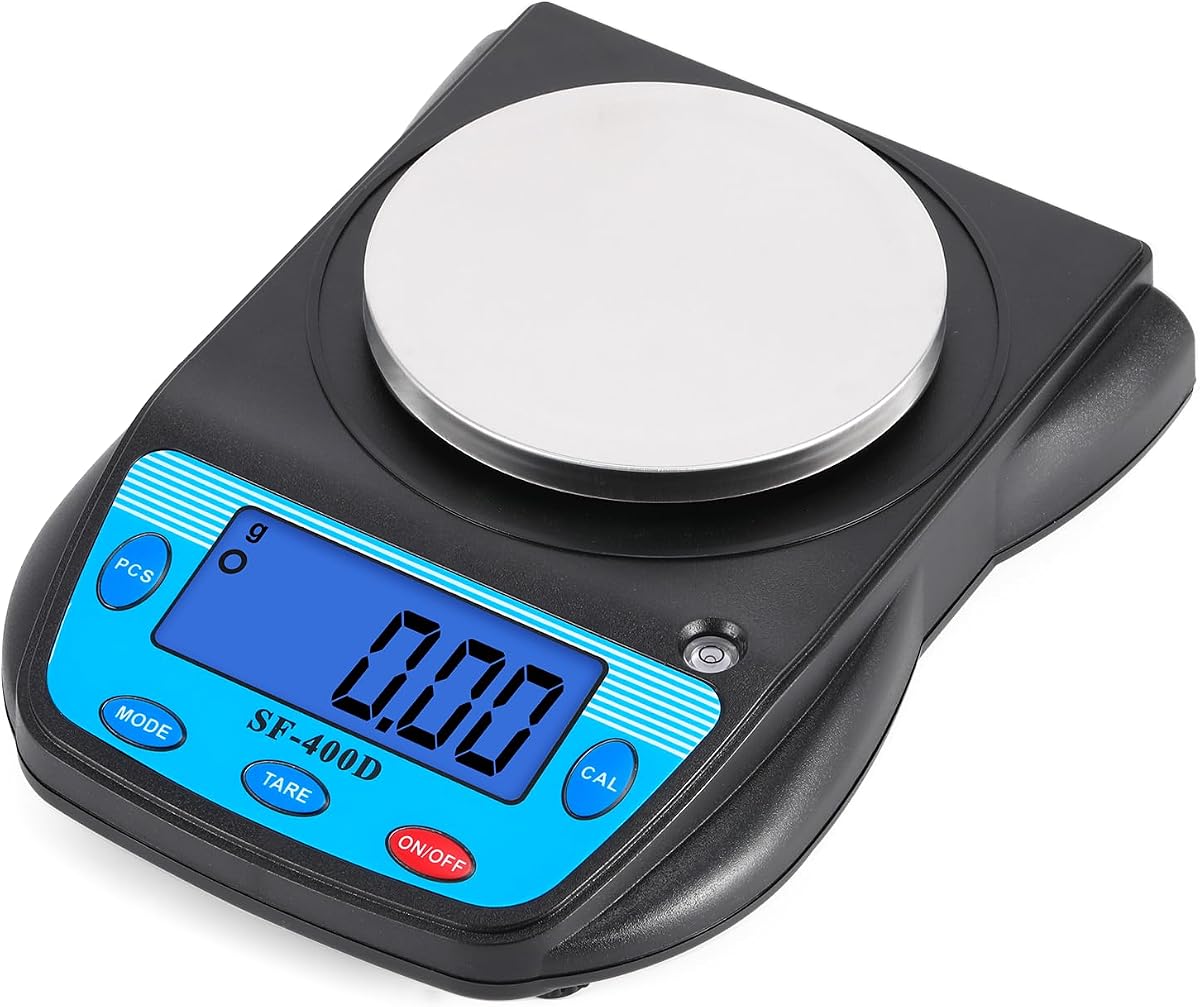
The MEIYA 1000g Digital Lab Scale pairs a 0.01g resolution with a 1000g maximum and carries the highest listed rating in the group at 4.8. It is a compelling budget-oriented choice for jewelry, small components, schools, kitchens, herbs, and light industrial work.
We may earn a commission when you buy through this link, at no additional cost to you.
Its high-precision sensor supports stable readings in 0.01g and 0.001oz increments. Seven units—ounces, grams, carats, pennyweight, Tola, grains, and troy ounces—give it useful coverage for jewelry and small-parts work. Tare removes a container's weight, while the piece-counting function handles beads, screws, and other uniform items.
The package is unusually convenient for a portable balance because it includes two AAA batteries and a 100g calibration weight. A leveling function, display lock, automatic power-off, low-power alarm, and overload alert help with routine operation. Anti-slip feet and a stainless steel platform support steadier measurements.
The principal limitation is capacity. At 1000g, this model cannot accommodate the larger batches supported by 5000g balances. It also lacks a documented data interface, so users requiring computer exports should choose a model with USB or RS232 support. Neither limitation matters if the intended loads remain below 1000g.
This is the best budget pick for readers who want fine 0.01g readings, a useful set of jewelry units, and essential counting and tare functions without paying for a high-capacity model. Its included batteries and calibration weight also reduce the setup friction associated with many competing scales.
Two AAA batteries and a 100g calibration weight are included, so users can begin with fewer separate purchases. Portable power and automatic shutdown make the scale practical for intermittent work away from a permanent outlet.
Carat, pennyweight, Tola, grain, and troy-ounce readings cover common precious-metal and gemstone tasks. Tare and counting further reduce manual work during repetitive jewelry and small-parts projects.
We may earn a commission when you buy through this link, at no additional cost to you.
This 5000g Precision Laboratory Balance offers a strong combination of high capacity, 0.01g readability, and broad unit support. Its 4.4 rating and extensive feature set make it suitable for laboratory research, jewelry appraisal, industrial parts, handmade production, and general professional weighing.
We may earn a commission when you buy through this link, at no additional cost to you.
The 7.1 by 5.9-inch square stainless steel pan provides a broad bearing area and easier placement than a small round platform. Adjustable feet help stabilize the scale on uneven work surfaces, while the detachable pan and protected controls simplify cleaning. The design is practical for environments where materials may create dust, residue, or light splashes.
Thirteen switchable units include grams, carats, ounces, troy ounces, newtons, pounds, drams, grains, pennyweight, percent, and specialized tonnage-style readings. Percentage mode supports formulation and recipe work, while piece counting handles repeated inventory tasks and tare isolates the contents of a container.
The included 110V adapter is the most practical power option. A 9V battery can provide backup operation, but the stated runtime is only about 30 minutes with a fresh battery, and that battery is not included. The 5000g model also requires a separately sold 2000g weight for nonlinear calibration.
Choose this balance when high capacity and detailed unit conversion matter more than connected data output. It is a broad, well-equipped option for serious jewelry work, small-scale formulation, and general laboratory tasks where a large pan and 0.01g resolution are both important.
The square pan provides more room than compact models, allowing users to place components or containers without repeatedly repositioning them. Adjustable feet and a robust body support regular use across different work surfaces.
Percentage weighing is useful for recipes, soap making, candle work, and other ratio-based processes. Thirteen units broaden the scale's usefulness across laboratory, jewelry, industrial, and everyday tasks.
We may earn a commission when you buy through this link, at no additional cost to you.
The FLB 5000g Digital Balance combines high capacity, 0.01g precision, and an RS232 interface in a format aimed at laboratory, industrial, commercial, and home users. Its 4.5 rating reflects a versatile feature set, including a backlit display, taring, counting, percentage weighing, and two power approaches.
We may earn a commission when you buy through this link, at no additional cost to you.
The RS232 connection can link the balance to a printer or laptop, making this one of the more useful options for users who need recorded measurements. The high-sensitivity sensor is designed for quick and stable readings, while four adjustable feet and a non-slip mat help maintain consistency on different surfaces.
A 500g calibration weight is included for recalibration, which reduces the need for an immediate extra purchase. Pennyweight support is specifically called out, adding value for jewelry work, while the 5000g capacity accommodates larger parts and batches than the smaller balances in this list.
The scale can use a power cord or a 7.4V lithium battery, but the battery is not included. The manufacturer explains that shipping restrictions prevent it from being sent with the scale and recommends adapter charging as the more durable approach. The RS232 cable is also not specifically listed as included, so connected users should verify the necessary accessory.
This model is a good fit for users who need portable high-capacity measurements and computer or printer output without the larger platform of the USB-focused option. It is especially relevant for small industrial operations, jewelry workshops, and labs where a hardwired data trail is useful.
RS232 support allows compatible printers and laptops to receive measurement data. This reduces manual transcription and makes the balance more useful for production logs, experiments, and repeated inventory checks.
A 500g calibration weight is included, helping users maintain or restore performance. Four adjustable feet and a non-slip mat improve stability on shared or imperfect work surfaces.
We may earn a commission when you buy through this link, at no additional cost to you.
The 5000g High-Precision Analytical Balance combines a 4.7 rating with a 5000g capacity, 0.01g accuracy, and a broad set of practical functions. It is a strong all-around recommendation for laboratories, jewelry appraisal, kitchens, and general weighing environments.
We may earn a commission when you buy through this link, at no additional cost to you.
Automatic calibration technology and a high-stability sensor support long-term reliability, while the built-in level bubble and adjustable feet help maintain a stable operating position. These features are particularly useful on shared benches where a scale may be moved and leveled repeatedly.
The large, high-definition backlit LCD is easy to read in dim rooms and bright workspaces. One-touch tare quickly removes a container's weight, and the counting function can total uniform items such as screws, pills, or seeds. Thirteen units support varied measurement standards without requiring manual conversion.
Its 175 by 155mm stainless steel platform provides a stable loading area, and a non-slip mat helps position objects. The scale supports an included adapter and 9V battery operation, although the battery is not included. There is no documented USB or RS232 connection, so buyers who need automatic records should choose a connected alternative.
This model is best for users who want high capacity and fine resolution without the larger square platform or specialized legal-for-trade emphasis of other options. It is an accessible, versatile choice for anyone whose needs center on accurate measurements, fast tare, counting, and flexible units.
A built-in level bubble and adjustable feet help the balance settle securely on imperfect worktops. These details support more repeatable readings when the scale is moved between different stations.
The one-touch tare control reduces delays when working with containers, while automatic counting handles repetitive small items. Together, they streamline common laboratory and inventory tasks.
We may earn a commission when you buy through this link, at no additional cost to you.
The Rechargeable 5000g Scientific Scale prioritizes flexible power and portability, with a built-in rechargeable battery, USB power, and two AAA batteries as alternatives. It supports a 5000g maximum and 0.1g accuracy, earning a 4.0 rating among the most specialized choices in the roundup.
We may earn a commission when you buy through this link, at no additional cost to you.
Its 0.1g resolution is adequate for many school, kitchen, jewelry, and general weighing tasks, but it is less suitable when a laboratory procedure requires readings to 0.01g. Its strongest advantage is the ability to operate away from a wall outlet without being immediately dependent on disposable batteries.
The backlit LCD improves visibility in low-light conditions, and unit conversion among ounces, pounds, grams, and kilograms covers common needs. Tare, piece counting, and calibration add useful functions, while sensitive sensors and non-slip feet support everyday measurements.
A 5.9 by 5.9-inch stainless steel platform provides a workable surface for jewelry, screws, powders, and other small materials. The removable or detachable nature of the platform is not specified, so buyers concerned with cleaning may wish to confirm the product manual before use.
Choose this scale when mobile operation and multiple charging options matter more than 0.01g readings. It is well suited to outdoor demonstrations, mobile inventory checks, classrooms, and kitchens, but the 0.1g resolution makes it a less natural fit for precision analytical work.
A built-in rechargeable battery supports cordless use, while USB offers another charging route and two AAA batteries provide a disposable alternative. This flexibility is useful for field work, demonstrations, and changing workspaces.
The backlit display, tare, counting, and calibration support routine weighing in schools, kitchens, jewelry shops, and laboratories. The 0.1g resolution remains the decisive limitation for highly precise analytical tasks.
We may earn a commission when you buy through this link, at no additional cost to you.
The right laboratory balance depends on the smallest and largest loads you routinely handle, the precision required, and the way measurements must be recorded. Capacity, resolution, stability, calibration, connectivity, and power should be evaluated together rather than in isolation.
Capacity is the highest load the scale can handle, while readability is the smallest increment it can display. A 5000g capacity with 0.01g readability is useful for both small jewelry samples and larger batches, while a 600g or 1000g model may be more manageable for a mobile workspace. Avoid selecting solely by maximum weight: a scale with ample capacity but 0.1g readability is not equivalent to one that resolves 0.01g throughout its stated range.
Choose a capacity that comfortably exceeds your normal loads and a resolution appropriate to the smallest material you must measure. For fine laboratory or jewelry work, 0.01g readability is the stronger target.
Calibration keeps readings aligned with reference standards over time. Some models include calibration weights, while others require users to obtain the appropriate weight separately. This is especially important for 5000g models, where several listings specify a 2000g weight for nonlinear calibration. Confirm both the calibration method and the required weight before buying, and check whether the manufacturer provides instructions or a suitable accessory.
A scale that includes calibration weights is more convenient to set up. Otherwise, verify the correct standard and its compatibility with the balance before ordering.
Unit conversion determines whether the scale can display results in the units already used by your workflow. General-purpose balances commonly include grams, ounces, pounds, carats, and troy ounces, while more advanced models add grains, pennyweight, Tola, percent, and tonnage-style units. Percentage mode is useful for formulations, and counting mode accelerates repetitive inventory tasks.
Select a model with the units your work genuinely uses, not simply the largest menu. Specialized modes are valuable only when they match regular requirements.
USB or RS232 connectivity can move readings into a computer, printer, or lab software system, reducing manual transcription. Some models advertise output directly to office software, while an RS232 port may require a particular data cable, connector, or communication format. Buyers should verify the interface, included cable, and receiving equipment before assuming digital records will work immediately.
Choose direct USB for easier modern setup or RS232 for established laboratory equipment. If neither is necessary, prioritize stability and weighing features instead.
Benchtop adapters provide consistent operation, while battery power allows the balance to move between workstations or operate in the field. Some scales support dual power, while the rechargeable model in this roundup offers three options. Battery runtime, included batteries, and shipping restrictions matter when a balance must function away from an outlet. A portable model may also offer a smaller platform or lower capacity than a fixed bench balance.
Choose adapter-only operation for a permanent lab, dual power for flexible placement, or rechargeable power for frequent mobile use. Check every required battery and cable before purchase.
A large backlit or high-definition LCD makes readings easier to interpret and reduces transcription errors. Stabilization time is another important measure: one model in this group is listed at five seconds or less, which benefits repeated work. The housing and platform should also suit the environment. Stainless steel pans are durable and easy to wipe down, while ABS bodies provide a lighter structural shell.
Prioritize a readable display, quick stable readings, a suitable platform, and leveling support. These practical details often affect daily usability more than rarely used modes.
Laboratory balances should be kept clean, dry, and level, especially when measuring powders or liquids. Adjustable feet, a level bubble, and non-slip mats reduce errors caused by an uneven bench. Overload alerts and error indication help protect the device and signal when a result should not be trusted. Models with removable pans or protected control surfaces are easier to maintain around production materials.
Look for a stable platform, leveling aids, overload protection, and a surface that can be cleaned without exposing controls to liquid. Use a separate container rather than placing chemicals directly on the pan.
A legal-for-trade scale is intended for situations governed by specific transaction and regulatory requirements, and its certification matters more than appearance. The Ohaus Scout is identified as a Class II legal-for-trade scale with an NTEP configuration. Buyers in such settings should verify that the exact model and configuration meet their applicable rules rather than assuming every precision laboratory balance is approved for trade use.
Choose certified models when regulatory or transactional requirements apply. For research, education, jewelry, and general household measurements, confirm the stated accuracy, warranty, and calibration support instead.
Place the scale on a flat, stable, clean surface away from vibration, drafts, direct sunlight, and strong temperature changes. Before switching it on, level the platform using the adjustable feet and built-in bubble level, if provided. Inspect the weighing pan for debris, connect the correct adapter, and allow the scale to stabilize according to the manufacturer's instructions before beginning a formal measurement.
Zero the display with an empty pan, then use the tare control when weighing material inside a container. Place the object centrally and wait for the reading to stabilize. Avoid exceeding the stated capacity, and do not lean on the platform or use the scale to restrain materials. For counting, first establish the sample weight as directed in the manual, then add identical pieces while the counting function is active.
Clean the stainless steel pan and housing with a soft, lightly dampened cloth, but do not immerse the scale, flood the display, or spray cleaner directly onto it. Remove batteries during long periods of nonuse, store the balance in a dry location, and keep the calibration weight in a separate, protected container. Recheck calibration at the interval recommended by the manufacturer and after moving, dropping, or exposing the balance to significant impact.
A 0.01g resolution is the most practical target for jewelry, powders, small components, and general precision laboratory work. A 0.1g scale can still be useful for heavier classroom, kitchen, or inventory tasks, but it cannot display changes as small as a hundredth of a gram. Match the resolution to the smallest quantity you actually need to measure rather than choosing solely by maximum capacity.
It depends on the size and quantity of the samples. Jewelry, herbs, and small parts usually fit within lower capacities, while larger batches, bulk ingredients, or industrial components may require a 5000g balance. A 1000g or 1500g model can be easier to manage and may be sufficient for a portable workspace. Choose enough headroom above your largest normal load without sacrificing the resolution you need.
No. Some models in this roundup include a calibration weight, while others explicitly do not. Several 5000g versions require a separate 2000g weight because heavier calibration accessories may be damaged in transit. Confirm the required calibration mass, the supported calibration method, and whether the manufacturer sells a suitable weight before completing the purchase.
USB is generally the more convenient modern option and may connect directly to a computer or micro-printer, although a compatible cable and software support may still be required. RS232 is common in laboratory and industrial equipment but needs a matching data line and the correct communication settings. Neither interface guarantees compatibility with every program, so check connector type, data format, and receiving equipment first.
Disconnect the power and remove the sample before cleaning. Wipe the platform and housing with a soft, lightly dampened cloth, taking care not to allow liquid to enter the display, buttons, battery compartment, or ports. Do not immerse the scale or spray cleaner directly onto it. For powders or sticky residues, follow the manual's removal instructions and keep the weighing pan and leveling feet free from buildup.
An uneven surface can tilt the internal sensor and change how the load transfers to the weighing system, potentially causing errors that look like instability. Adjustable feet, a bubble level, and non-slip feet help keep the platform stable. Check the level before each important series of measurements, especially if the scale has been moved between benches.
No. Legal-for-trade status is important when measurements are used in transactions or activities governed by specific regulatory requirements. General research, education, jewelry, and internal inventory work may not need that certification. If local rules apply, verify the exact model, its stated approval, capacity, and configuration with the relevant authority before relying on it commercially.
Not every scale requires full calibration for every measurement, and the appropriate routine depends on the model and its condition. A quick zero and level check is sensible before work, while periodic calibration with the correct reference weight is important for maintaining accuracy. Recalibrate sooner if the scale is moved, overloaded, dropped, exposed to a temperature change, or produces inconsistent results.
The MEIYA 1000g model is the strongest budget-oriented choice, combining a 4.8 rating, 0.01g resolution, useful jewelry units, counting, included batteries, and a calibration weight. The Bonvoisin 5000g Analytical Balance is the most versatile overall option, while the Ohaus Scout SJX1502N/E stands out for portable professional use and legal-for-trade positioning.
Prioritize the resolution and capacity needed for your actual loads, then consider connectivity, calibration availability, leveling features, and power based on your workspace. USB or RS232 is valuable for digital records, a large pan helps with bulky items, and battery options improve flexibility, but those features should support rather than distract from the core measurement requirement.
Ratings, specifications, included accessories, and product availability can change over time. Before purchasing, confirm the current listing, calibration requirements, power accessories, and interface compatibility. Those checks will help ensure that the selected digital lab scale fits both your present workflow and future measuring needs.