
Baofeng UV-5R
4.5Editor score
Compact dual-band design
Selectable transmit power
CHIRP programming support
Ham Radio for Backpacking guide compares ten handheld radios for range, battery life, weather alerts, GPS, charging, and portability.
Ham radio can give backpackers a dependable way to communicate beyond cellular coverage, coordinate with a group, and receive local weather information. The best unit balances useful transmission power, battery endurance, compact size, accessible controls, and the features needed in remote terrain rather than relying on one exaggerated range claim.
This guide compares ten handheld transceivers based on the supplied specifications, including supported frequency bands, battery capacity, charging options, programming methods, emergency features, and physical conveniences such as antennas and speaker microphones. It covers traditional analog radios, dual-mode DMR equipment, and a compact QRP transceiver for more experienced operators.
Each review explains where a radio fits best, who will benefit from it, and where its compromises may matter. The leading options range from a budget dual-band handheld to a feature-rich GPS model and a premium portable station. Product listings and prices can change, so readers should verify current availability, licensing requirements, and accessories before purchasing.
4.5Editor score
4.6Editor score

4.5Editor score
The comparison below highlights the most consequential differences among these radios, including operating modes, battery configuration, navigation features, emergency functions, and charging convenience for backpack-based use.


The Baofeng UV-5RM is a 4.6-rated dual-band handheld that offers one of the strongest combinations of outdoor practicality and feature control in this guide. Its listed receiving coverage extends across several bands, while licensed amateur transmissions cover 144–148MHz and 420–450MHz. A 1.77-inch color display, 999 memory channels, and an ergonomic housing make it easier to manage as a primary trail radio.
We may earn a commission when you buy through this link, at no additional cost to you.
Its 2500mAh battery is well suited to days away from reliable wall power. The radio accepts a USB-C cable or desktop charging base, allowing it to be replenished from a wall outlet, power bank, laptop, car adapter, or other USB port. A one-touch frequency-cloning function simplifies coordination with a compatible radio, while CHIRP compatibility gives prepared operators more advanced programming options.
The built-in NOAA receiver adds a useful safety layer by delivering severe-weather information when cellular service is unavailable. A high-quality speaker microphone supports hands-free communication in noisy conditions, although users will need to learn the controls and programming workflow before departing. As with any transmitting device, appropriate licensing and frequency authorization must be observed.
This is the strongest general recommendation for backpackers who want useful transmit power, modern charging, weather reception, and sufficient channel storage without moving to a specialist digital or QRP platform. It is particularly suitable for paired units, trail teams, ski trips, and campers who value a single radio capable of handling both everyday communication and weather monitoring.
The combination of a 2500mAh battery and USB-C charging is especially relevant on long trails. Backpackers can carry a small power bank and top up the radio without returning to a vehicle, campsite, or fixed outlet.
Frequency cloning provides a straightforward way to duplicate compatible settings between radios. CHIRP support remains available for users who need a more structured programming workflow.
We may earn a commission when you buy through this link, at no additional cost to you.
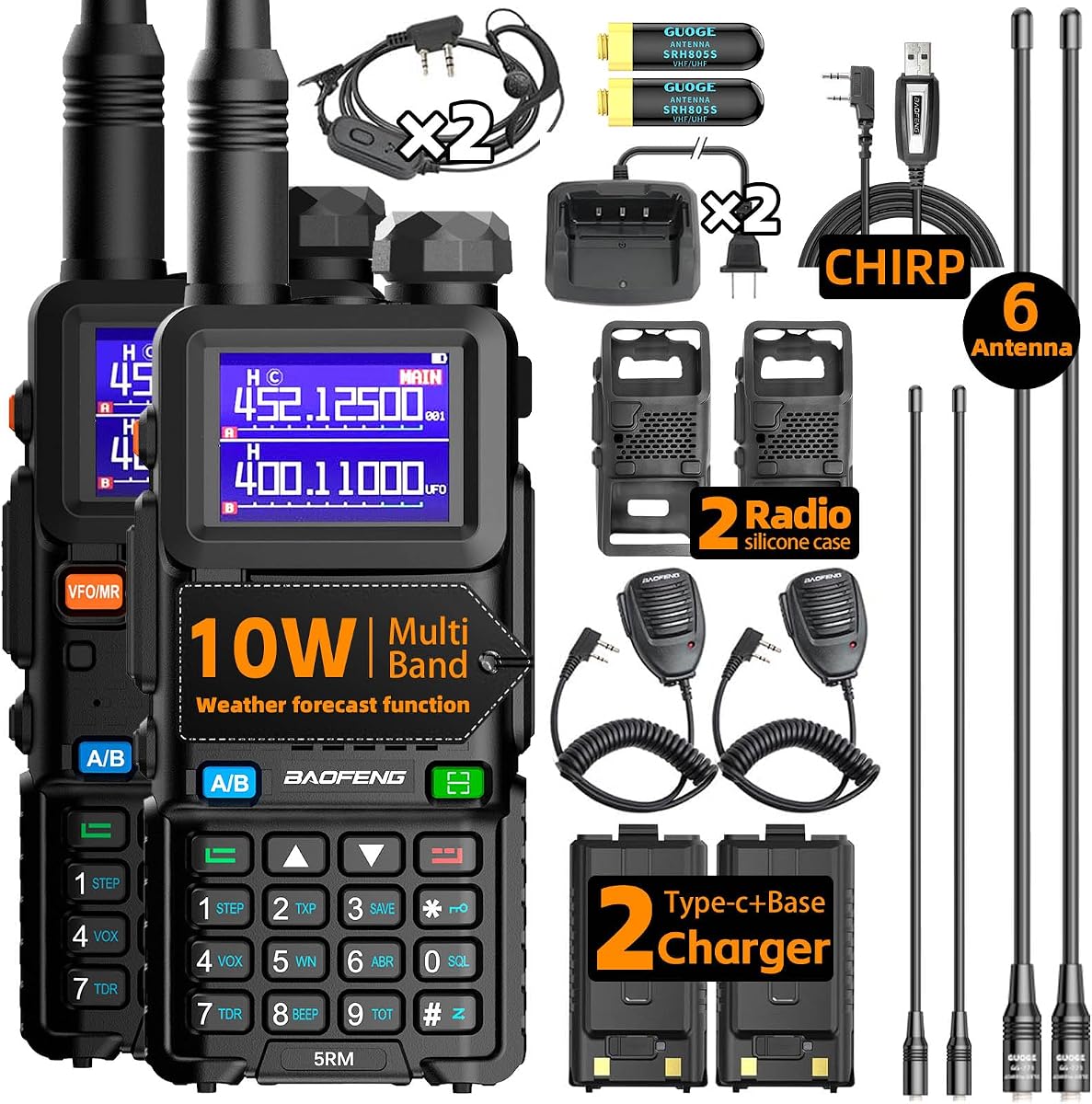
This 4.5-rated two-pack gives backpackers a ready-made communication pair based on the AR-5RM platform. Each radio supports dual-band amateur transmission, wide analog reception, a 1.77-inch color screen, and up to 999 storage channels. The two-radio arrangement is more relevant to couples, families, or small trail groups than to a solitary hiker.
We may earn a commission when you buy through this link, at no additional cost to you.
The package is notably complete. It includes two radios, two 2500mAh batteries, USB-C cables, desktop charging bases, a programming cable, speaker microphones, earpieces, belt attachments, hand straps, and a manual. That arrangement reduces the need to assemble a compatible spare radio, spare battery, charging arrangement, and private listening setup separately.
The trade-off is portability. Carrying two complete setups is logical for a group but less attractive when weight and pack volume are priorities. Frequency cloning helps match radios, although users should still verify channels, tones, power settings, and operating permissions before relying on them in the field. NOAA reception and the speaker microphones improve the package's usefulness outdoors.
For a two-person or small-team expedition, this two-pack is more convenient than sourcing radios and accessories individually. It is a strong choice for hiking, camping, hunting, skiing, and road-trip scenarios where each participant needs a separate radio and the group values a unified feature set.
Two batteries, two charging bases, two speaker microphones, and earpieces create a ready-to-configure communication system. That convenience can matter more than shaving a small amount of weight from each individual setup.
The included speaker microphones allow users to transmit without repeatedly reaching for the radio. They are useful near streams, wind, traffic, or other environments where holding a handheld at the mouth is inconvenient.
We may earn a commission when you buy through this link, at no additional cost to you.
The Baofeng UV-32 is a 4.4-rated upgrade focused on trail-specific convenience. It builds on the UV-5RM concept with 10W high power, high, medium, and low power switching, built-in GPS, AM reception, frequency duplication, FM reception, a stopwatch, an LED flashlight, DTMF, VOX, an alarm, and a 2500mAh battery.
We may earn a commission when you buy through this link, at no additional cost to you.
Its most distinctive physical feature is the high-gain tactical antenna, listed at up to 18.89 inches. That can help a stationary user gain stronger reception or improve the usable signal path, but it also adds bulk to a pack. Backpackers should consider whether the antenna is valuable enough at their camps or falls back into a trekking-pole position when traveling.
Frequencies can be copied through the side keys or written through an app, while a base charger and USB-C cable support flexible charging. The GPS, stopwatch, alarm, and flashlight make this a broader field tool than a basic voice transceiver. NOAA alerts add another layer of information during changing mountain or camping weather.
This two-pack is best for a small group that wants modern charging, navigation features, and a long antenna in each radio. It is less compelling for minimalist solo hikers because the antenna and extra functions increase bulk, and operators must learn enough of the menu to avoid accidental changes.
The integrated GPS is a meaningful addition for backpackers who want position information on the same device they use for voice communication. It is not presented as a full mapping or emergency-location service, so it should complement rather than replace dedicated navigation tools.
High, medium, and low transmit power settings let operators match output to terrain and battery needs. Lower settings are often more practical for short-range camp communication, while maximum power may be reserved for ridge-top or emergency use.
We may earn a commission when you buy through this link, at no additional cost to you.
The Malahit trusdx is a 4.5-rated, five-band QRP transceiver for backpackers who want a compact station for longer-distance amateur operating rather than a conventional push-to-talk handheld. Its listed bands are 80, 60, 40, 30, and 20 meters, and it supports multimode operation. The product arrives assembled in an army-green 3D-printed case.
We may earn a commission when you buy through this link, at no additional cost to you.
It is ready for substantial configuration out of the box. The mainboard has the bootloader installed and firmware programmed, with the serial number attached inside the package. The operator can later explore the official programming version or a beta version that offers a spectrum display, with a tradeoff involving fewer main-menu functions.
The principal compromise is power infrastructure. A battery case is not included, and the specified power jack is 3.5mm by 1.35mm, so users must plan a compatible power arrangement. Programming a call sign also requires reading the included instructions carefully. Those demands separate this radio from a simple handheld intended for immediate group use.
This is the premium choice for an experienced ham radio operator who values a lightweight, low-power station and broad HF access. It is not the easiest recommendation for a beginner or for someone who simply wants push-to-talk communication with hiking partners, but it offers a distinctive and highly portable alternative.
The trusdx brings low-power shortwave operating into a packable form. It is useful for operators who want to work beyond local line-of-sight distances and can manage portable power and antenna arrangements.
The assembled case and preconfigured bootloader reduce the initial build work normally associated with compact amateur transceivers. Operators still need to understand programming, call-sign settings, and external power requirements.
We may earn a commission when you buy through this link, at no additional cost to you.
The BF-F8HP PRO is a 4.3-rated tri-band handheld aimed at operators who want organized channel lists and clear controls. It stores 1,000 memories across ten named zones, allowing home, travel, club, event, simplex, and receive channels to remain logically separated. That makes it a strong fit for backpackers who participate in different radio groups or trip types.
We may earn a commission when you buy through this link, at no additional cost to you.
Its interface is designed around analog operation. Users can scan selected named zones, temporarily skip a busy channel, and choose between a two-channel view or a full-screen single-watch display. Dual Watch alternates one receiver between two displayed frequencies, while approximate dBm readings add signal context.
The radio supports common keypad changes and computer-based planning through BTECH CPS or supported CHIRP-next with a separately sold PC03. Firmware updating also requires the appropriate cable and matching instructions. This is less convenient than an all-in-one USB setup, but the published, model-specific update process can help users maintain a predictable configuration.
Direct radio-to-radio location sharing is a useful trail feature, although it generally does not work through repeaters and is not a substitute for APRS mapping or continuous tracking. Overall, the BF-F8HP PRO is most attractive to users who value memory organization, clear English menus, and maintainable software over a very compact or budget-focused design.
Named zones let a backpacker keep regional repeaters, simplex calls, local clubs, and event frequencies separate. This reduces the chance of switching to the wrong channel when a trip or group changes.
Two compatible radios can exchange a location on the same channel, which is convenient for a pause during a hike. The feature does not provide repeater-based tracking, mapping, APRS, or an emergency-location service.
We may earn a commission when you buy through this link, at no additional cost to you.
The original Baofeng UV-5R remains a 4.5-rated budget favorite because it delivers the essential features backpackers need without a large collection of specialized functions. It transmits on 144–148MHz and 420–450MHz, includes 128 channels, and supports dual-frequency display, dual standby, and independent A/B band operation.
We may earn a commission when you buy through this link, at no additional cost to you.
Its controls cover busy-channel lockout, selectable transmit power, a keypad lock, VOX, voice companding, CTCSS and DCS tones, a tri-color backlight, an emergency alert, and an LED flashlight. Manual programming is supported, while CHIRP offers a convenient computer-based method for more structured frequency management.
The main limitations reflect its position as a budget entry point. It does not list the large color display, NOAA receiver, 999-channel memory capacity, 10W output, or USB-C flexibility found in several newer alternatives. The supplied information also does not identify the battery capacity or charging method, so users should verify those details for a specific trip.
For a new ham radio operator or a hiker who wants a dependable basic handheld, this remains an economical way to begin. A pair configured before departure can handle camp and trail communications, and the low-power options help preserve battery life when maximum output is unnecessary.
The UV-5R is easier to recommend to beginners than the Malahit trusdx or DM-32UV because its controls and programming options focus on conventional analog handheld use. Familiar functions reduce the amount of configuration required.
Selectable high and low transmit power lets backpackers conserve energy around camp or on nearby trails. Maximum power can remain available when distance and visibility justify the additional battery consumption.
We may earn a commission when you buy through this link, at no additional cost to you.
The Baofeng K5PLUS combines a 4.5 rating with 10W maximum output, up to 999 channels, NOAA reception, and modern USB-C charging. It offers many of the conveniences associated with newer 10W handhelds, including airband reception, FM radio, an LED flashlight, a stopwatch, DTMF, VOX, an alarm, CTCSS, DCS, and a time-out timer.
We may earn a commission when you buy through this link, at no additional cost to you.
A high-gain flexible antenna listed at up to 15.35 inches can improve the practical signal path compared with a short stock antenna. Backpackers should think of it as a field antenna: useful when stopped or moving slowly, but likely to be repositioned or removed during aggressive hiking. The radio also includes a US desktop charger and USB-C cable.
Frequency copying is particularly simple, requiring the user to press the BAND button according to the listed procedure. The 10 NOAA channels provide emergency alerts and weather information. A large lithium-ion battery is mentioned, but the supplied product data does not state its exact capacity, so prospective buyers should verify battery specifications before comparing endurance directly.
The K5PLUS is a compelling middle ground for backpackers who want more capability than the standard UV-5R without moving to a digital radio. Its best fit is a tent-camping or hiking group that values easy cloning, weather reception, and a flexible high-gain antenna.
One-button frequency copying reduces the effort required to align a pair before a trip. Users should still confirm channel spacing, tones, and operating permissions in advance.
The flexible high-gain antenna may improve communication flexibility but occupies more space than a short antenna. It works best for operators who accept a bulkier setup.
We may earn a commission when you buy through this link, at no additional cost to you.
The Baofeng DM-32UV is the specialist option for backpackers whose group already uses DMR or needs advanced digital features. It operates in both DMR and analog modes, reaches 10W maximum power, and includes high, medium, and low settings. Compatibility with existing analog equipment broadens its usefulness during a mixed group trip.
We may earn a commission when you buy through this link, at no additional cost to you.
Its feature set extends well beyond ordinary voice communication. Built-in GPS and APRS support position reporting, while the radio provides FM, AM, and NOAA reception, emergency alarms, digital encryption options, text messaging in Chinese and English, a voice recorder, and remote monitoring. A full keyboard and 2.0-inch display facilitate on-the-go programming, and customizable side keys can surface frequently used functions.
The radio supports up to 4,000 channels and TDMA dual-time-slot operation. Its Type-C connection handles charging, frequency writing, and firmware updates. These capabilities come with a steeper learning curve than a conventional handheld, and a backpacker should ensure that other team members own compatible equipment and know the selected digital talkgroup and color-code settings.
This radio is best for an organized group that already values digital voice, location reporting, or remote monitoring. It can work for solo backpackers, but the extra benefits only become valuable when the operator and contacts are prepared to use the relevant functions.
GPS and APRS support can add position information to a compatible communication setup. It is valuable for coordinated trips, but users still need appropriate equipment, settings, and monitoring procedures.
Dual-mode operation is the key advantage for real-world groups. Digital features are available when needed, while analog mode provides a familiar fallback for compatible contacts and local systems.
We may earn a commission when you buy through this link, at no additional cost to you.
The AR-5RM two-pack carries the highest customer rating in this selection at 4.8. It is positioned as an upgraded UV-5R with multi-band reception, FM reception, 999 channels, CTCSS and DCS codes, a 1.77-inch LED color display, and a 2500mAh rechargeable battery. Its transmission range remains limited to 144–148MHz and 420–450MHz for amateur use.
We may earn a commission when you buy through this link, at no additional cost to you.
The receiving specification covers 108–136MHz, 136–174MHz, 220–260MHz, 350–390MHz, and 400–520MHz. The product information notes that manual AM aviation input cannot be written into programming, which is a subtle but important limitation for users who may encounter confusing transmit or receive restrictions on non-amateur bands.
Both base and USB charging are supported, frequency cloning is available, and the NOAA receiver provides real-time weather updates and emergency information. A flashlight, VOX, DTMF, alarm, time-out timer, and CHIRP support round out a practical outdoor setup. The included programming cable allows compatible computer configuration.
This pair is an excellent choice for couples or trail teams that want a high-rated, modern handheld with weather monitoring and easy charging. Backpackers should remember that two complete radios represent additional weight and should only transmit where their operator privileges and local regulations allow.
Support for both USB and base charging gives the operator flexibility at a vehicle, campsite, or with a portable power bank. A 2500mAh battery helps support longer operating periods between charges.
Quick frequency copying helps establish a shared channel without manually entering every parameter on both radios. A brief bench test before departure remains essential.
We may earn a commission when you buy through this link, at no additional cost to you.
The BTECH BF-F8HP is a 4.5-rated, 8-watt dual-band handheld that emphasizes a durable shell, a complete accessory kit, and accessible operation. It supports 136–174MHz and 400–520MHz receive and transmit ranges, with high, medium, and low output settings of 8W, 4W, and 1W.
We may earn a commission when you buy through this link, at no additional cost to you.
The kit includes the radio, a 2100mAh battery, V-85 antenna, desktop charging equipment, earpiece kit, wrist strap, belt clip, and user manual. A 30-percent larger battery and hardened shell are positioned as upgrades over earlier UV-5R generations, which may appeal to users who expect regular trail use and occasional impacts.
Wide and narrow bandwidth selection can help operators match their transmissions to local channel spacing, while the V-85 antenna is designed to improve the radio's stock antenna performance. PC programming is possible, with a PC03 FTDI cable recommended for easier setup. The included guide and described support resources are helpful for users who are new to amateur radio.
The BF-F8HP is a sensible first radio or dependable secondary set for a backpacker who values a full kit and simple power selection. It is less advanced than the UV-32, DM-32UV, and BF-F8HP PRO, but its straightforward analog design makes it easier to understand and maintain.
The included antenna, charging hardware, earpiece, strap, clip, and manual create a practical starting package. New operators do not need to identify every basic accessory before a first outing.
Three power levels help balance communication distance against battery use. Wide and narrow bandwidth settings offer control that can be useful when matching established local operating practices.
We may earn a commission when you buy through this link, at no additional cost to you.
A backpacking radio should be judged by its real operating system rather than by maximum range alone. Battery endurance, permitted frequencies, antenna behavior, programming demands, weather information, and group compatibility usually matter more than any single headline specification.
Begin by distinguishing reception from transmission. Several radios listed here receive across aviation, commercial, broadcast, weather, or other portions of the spectrum, but they transmit on amateur bands only. In the United States, valid amateur authorization is required to transmit on amateur frequencies, and operators must remain within their actual privileges and any station identification rules that apply. A wide receiving range does not create permission to broadcast on every frequency shown in a listing.
Battery capacity is only one part of endurance; transmit power, display use, accessory loads, signal quality, and temperature also affect consumption. The listed 2500mAh batteries offer a useful baseline, but the K5PLUS and DM-32UV descriptions do not provide directly comparable exact capacity figures. USB-C is especially convenient when a backpacker already carries a power bank. Some radios also include desktop bases, allowing charging from a wall or vehicle without constantly carrying a special cable.
A technically capable radio can still be a poor pack choice if its antenna or controls are awkward to operate while moving. The UV-32's 18.89-inch tactical antenna and the K5PLUS's 15.35-inch antenna may improve signal flexibility but require more consideration around trekking poles, branches, and crowded shelters. Compact traditional handhelds are easier to carry quickly, while the Malahit trusdx offers a different form of portability as a small multiband station.
Most backpackers begin with analog FM voice communication because it is direct, widely understood, and compatible with many inexpensive radios. DMR adds text messaging, higher channel capacity, remote monitoring, and other digital functions, but every participant may need compatible equipment and matching talkgroup settings. Mixed-mode radios can be useful during a transition, although they still demand more careful programming than a basic analog handheld.
NOAA reception is a major practical benefit for backpacking radios because it can provide weather forecasts and severe-weather alerts without cellular data. Flashlights, alarms, emergency alert tones, and dual watch are useful supplements, but they do not replace a paper map, compass, satellite messenger, first-aid kit, or sound emergency procedure. A radio should be one layer of a broader safety plan.
A radio that is difficult to program can be a liability on the trail. Frequency cloning provides the quickest method for matching two compatible units, while CHIRP or vendor software offers greater control over channels, tones, and zones. Dedicated programming cables and correct model support add preparation steps, so backpacking radios should be configured, charged, and tested before leaving home. Write down the primary channel, backup channel, and any tone requirements as a paper backup.
A color screen can improve menu visibility, but controls must also work well in rain, cold, darkness, and while wearing gloves. The BF-F8HP PRO emphasizes clear English menus, while several Baofeng handhelds offer side keys, VOX, and shortcut functions. Larger screens and more menu options can help experienced users but may make a radio less intuitive. Operators should know how to tune the primary channel, adjust power, scan, activate emergency functions, and read the battery indicator without hesitation.
The two-pack listings often include spare batteries, charging bases, earpieces, speaker microphones, straps, and programming cables, reducing the chance of discovering a missing essential at departure. A single-radio purchase may be better for a solo hiker who already owns accessories, but it should not be treated as a complete group solution. Backpackers should also consider belt clips, lanyards, weather protection, and a way to keep the radio accessible without it swinging into gear or falling into a stream.
Begin with a legal and practical setup. Obtain any required amateur license, identify a suitable local channel or repeater, and program the radio while seated with its manual and the relevant software open. For a paired setup, use frequency cloning where appropriate, then verify the frequency, channel spacing, offset, CTCSS or DCS tone, power setting, and emergency alert behavior on both units. Test a handheld and a compatible base station or nearby team member at several short distances before the trip.
On the trail, use the lowest transmit power that provides reliable communication. Move to a higher location when signals are weak, orient the radio with a clear antenna view, and avoid transmitting immediately after changing bands without allowing the radio to settle. Use short, clear transmissions and confirm important information by repeating it. Keep the radio accessible in a weather-resistant pocket or attached with a secure lanyard, but protect the connector and controls from rain, dirt, and impact.
Care for the radio by charging it with the intended cable and base, keeping contacts clean, and avoiding unattended charging on combustible surfaces. Carry a modest battery reserve rather than relying on one charge to last an unexpectedly long trip. After returning, inspect the antenna, belt clip, battery, buttons, and charging contacts; update programmed channels when needed; and replace any swollen, damaged, or unusually warm battery. A radio is most dependable when its configuration, accessories, and operating habits are checked before every major journey.
In the United States, transmitting on amateur frequencies requires valid amateur radio authorization. Receiving public-band and broadcast signals may not require a license, but that permission does not allow you to transmit on those frequencies. Check current Federal Communications Commission rules, identification requirements, and the restrictions that apply to your operating privileges before using a radio in the field.
The Baofeng UV-5RM is the most balanced general recommendation because it combines 10W transmission, a 2500mAh battery, USB-C charging, NOAA alerts, and frequency cloning. The best alternative depends on the trip: the UV-5R suits strict budgets, the UV-32 adds GPS and a high-gain antenna, and the Malahit trusdx targets experienced operators seeking portable shortwave operation.
Yes. Amateur radio communication does not depend on cellular networks, although ordinary radio waves still follow line-of-sight and terrain limitations. Mountains, forests, and deep valleys can reduce range, so operators should establish checkpoints, use repeaters where appropriate, and plan a fallback for contacting emergency services.
One radio per person who needs independent communication is the safest arrangement, especially when the group may split along a trail. A smaller team can share a radio only if everyone agrees on where to wait and how to relay urgent information. Two-radio packs are practical for couples, while full kits are more appropriate for families, guides, clubs, or search-and-rescue teams.
No. Higher power can improve communication over difficult terrain, but it also consumes more battery and may be unnecessary around camp or along a sheltered trail. Most groups benefit from using low or medium power for local communication and reserving higher settings for ridge-top or emergency scenarios.
Analog is simpler and more compatible with many inexpensive handhelds, making it a sensible starting point for occasional hikers. DMR can add text messaging, remote monitoring, larger channel capacity, and APRS, but all group members need compatible radios and matching digital settings. Choose DMR when the group already uses it or specifically needs those functions.
Yes, if the radio includes NOAA reception and you are within range of a NOAA transmitter. It can provide forecasts and severe-weather alerts when cellular service is unavailable. Weather radio is not a guarantee of official emergency information in every location, so it should be used with forecasts, changing conditions, and an appropriate turnaround plan.
Program both radios, clone or enter the same confirmed settings, and verify them with a supervised communication test. Check tones, offsets, power levels, battery condition, and emergency functions, then record the primary and backup channels on paper. Repeat the process after firmware changes or a fall rather than assuming the configuration remains intact.
The Baofeng UV-5RM is the strongest all-around choice, balancing 10W output, a 2500mAh battery, USB-C charging, NOAA reception, and easy frequency cloning. The original UV-5R remains the budget option for simple analog use, while the Malahit trusdx stands apart as the premium portable station for experienced operators who want five-band QRP operation.
The right radio for a backpacker is not necessarily the one with the most functions. Match the radio to your group, licensing status, antenna tolerance, and navigation needs. A straightforward analog handheld is often more dependable for local trail use; GPS, APRS, DMR, or shortwave capability becomes valuable when the group has a specific plan and the time to configure it correctly.
Before purchasing, verify the current listing, battery details, included accessories, programming requirements, and legal operating restrictions. Prices and package contents can change, and current product information should always be checked. Whichever model you choose, program it, test it, carry a backup power plan, and use it as one part of a well-prepared backpacking safety kit.
