
Bingfu FM Dipole Antenna
4.5Editor score
300-ohm FM dipole
Bare-wire two-pin connection
Flexible tabletop placement
Explore the best FM Radio Antenna options for home receivers, stereos, and vehicles, with connector, mounting, and reception details compared.
An FM radio antenna can improve a home stereo’s reception, restore reception lost to a damaged or poorly positioned antenna, and make listening more comfortable in rooms filled with electronics. The right choice depends on your receiver connector, available space, mounting preferences, and whether the antenna must serve FM only or FM and AM.
We compared all ten antennas by connector type, impedance, cable length, mounting method, intended equipment, and the practical placement guidance supplied with each product. The list covers indoor dipoles, telescopic antennas, magnetic-base models, a combined FM and AM kit, and a vehicle option without implying that every antenna suits every radio.
Each review explains the standout feature, relevant limitations, compatibility considerations, and the situations in which that model makes the most sense. Product availability and pricing can change, so check the current listing and connector requirements before making a final purchase.
4.5Editor score

4.4Editor score

4.2Editor score
This side-by-side comparison highlights each antenna’s connector, impedance, cable or antenna length, mounting approach, and intended use so you can quickly identify the model that matches your radio and placement needs.
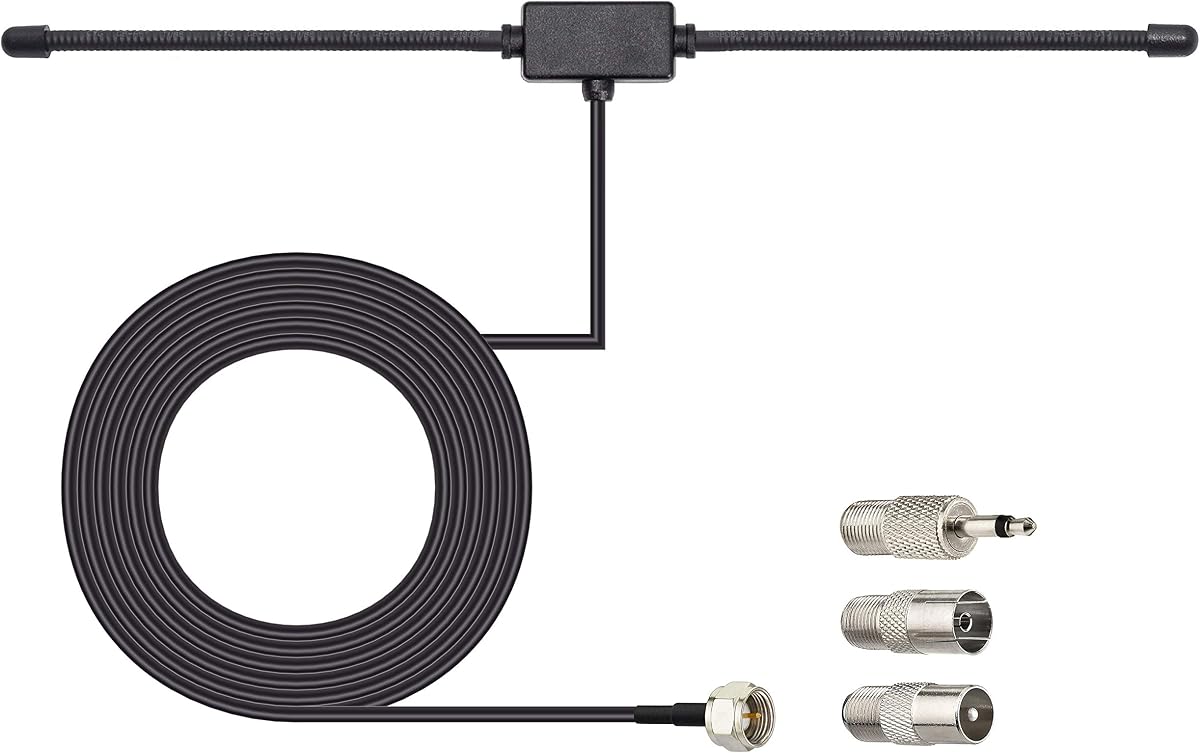


This Bingfu indoor dipole antenna carries a 4.1 rating and offers a practical way to improve FM reception for a home receiver, Bluetooth stereo, AV unit, or compact music system. Its defining feature is the ten-foot coaxial extension, which gives the antenna more freedom to move away from the receiver and potentially away from interference-producing electronics.
We may earn a commission when you buy through this link, at no additional cost to you.
The antenna uses a 75-ohm unbalanced FM dipole arrangement and an F-type plug connector. The supplied package includes adapters for a TV female socket, 3.5 mm audio plug, and TV male plug, making it useful for receivers with several common terminal styles. Its adhesive wall mounting offers a cleaner alternative to leaving a long wire draped around a cabinet or entertainment area.
The main limitation is that the correct adapter must match the receiver exactly, and the adhesive design may not suit renters or anyone expecting to reposition the antenna frequently. Reception also depends on location, terrain, weather, buildings, and nearby electronics. No antenna can guarantee a particular station or override a weak transmitter signal, but greater freedom of placement can still help.
This is a sensible choice for someone with a compatible indoor stereo who wants more antenna length than a compact telescopic model and does not want to install an outdoor antenna. Check the receiver’s antenna terminals before ordering, mount the dipole as high and as far from interference as practical, and keep all coaxial connections secure.
The extended coaxial cable allows the antenna to sit near a window or on an upper wall while the receiver remains elsewhere. Changing location is often as important as changing the hardware because walls, metal objects, and electronics can weaken or distort reception.
The three included adapters make the package more versatile, but compatibility still depends on the socket shape and impedance expectations of the radio. Confirm the terminal type and compare it directly with the included options before installation.
We may earn a commission when you buy through this link, at no additional cost to you.
This magnetic-base FM antenna earns a 4.2 rating and combines a five-meter coaxial cable, retractable antenna, and strong magnetic base. It is a well-rounded option for home theaters and stereo receivers that need a longer run between the radio and the antenna position.
We may earn a commission when you buy through this link, at no additional cost to you.
Its most useful feature is placement flexibility. A metal surface can support the magnetic base while the extended cable reaches toward a window, higher shelf, or area with a clearer view of transmitters. The retractable component makes the setup easier to compact when it is not in use, and the strong base is designed to resist slipping.
The product is listed as compatible with Pioneer, Onkyo, Yamaha, Marantz, Sherwood, and other leading stereo receiver brands. As with any antenna, connector verification remains essential, and performance in urban environments depends on local transmitters, building materials, and interference. The magnetic base also creates a practical requirement: you need a suitable metal surface for stable placement.
Choose this model when cable length, easy repositioning, and a magnetic installation matter more than selecting the smallest possible antenna. It is particularly useful for a home theater located away from the best reception position or for anyone who wants to move one antenna between different setups.
The 16-foot length gives the receiver more freedom to remain near the speakers or entertainment equipment while the antenna itself is moved to a more favorable location. A window-side position can be useful where internal walls or electronics create interference.
The magnetic base provides a straightforward way to attach, remove, and carry the antenna. It is a better fit for temporary setups than for permanently exposed installations where adhesive or screwed mounting would be more appropriate.
We may earn a commission when you buy through this link, at no additional cost to you.
This Superbat kit has a 4.0 rating and offers a compact, direct replacement for compatible indoor radios. It is a 75-ohm FM dipole with a Type F connector and a telescoping antenna that extends to approximately 20 inches, making it less visually and physically demanding than a long cable antenna.
We may earn a commission when you buy through this link, at no additional cost to you.
The package includes a telescopic antenna and adapters for PAL male, PAL female, and 3.5 mm connections. It is listed for use with FM, DAB, and AV receivers, including several Sangean, Tivoli Audio, Sony, Yamaha, Denon, Teac, Pioneer, Panasonic, Onkyo, Marantz, and Sansui systems.
Installation is straightforward because the Type F male connector screws into a matching female terminal. The product guidance says to extend the antenna as far as possible and away from the device, which is sensible because keeping the antenna close to the receiver chassis can reduce the benefit of a longer element.
This kit works well for listeners who want a smaller antenna without permanent adhesive mounting. It is less suitable if you need a long cable to reach a distant window or if your radio requires a two-pin or 75-ohm coaxial connector that is not among the included fittings.
The telescoping format is easy to place on a cabinet, side table, or shelf without leaving a coil of cable around the room. It also makes the antenna straightforward to remove when the radio is relocated.
Steel and brass components provide a simple, durable-looking option, while the Type F male plug allows fast setup. Check the radio’s socket and the required antenna impedance before making a selection.
We may earn a commission when you buy through this link, at no additional cost to you.
The Ancable indoor telescopic antenna has a 4.1 rating and is built around ten extension sections that provide more reach than the shortest replacement antennas. It is described as a 75-ohm FM antenna with a Type F male connector and is positioned as a simple alternative to a wire-coax indoor aerial.
We may earn a commission when you buy through this link, at no additional cost to you.
Its stated compatibility covers Bose Wave, Bose 321, Sangean, Cambridge Audio One, Pure Evoke, Tivoli Audio, Denon, Roberts, Sony, Marantz, Yamaha, Hitachi, JVC, Sherwood, Pioneer, Panasonic, Onkyo, and other compatible indoor receivers. Adapters for PAL male, PAL female, and 3.5 mm connections are included.
The segmented construction makes it easy to adjust the physical length, but it cannot be repositioned around a room as freely as a cable-mounted dipole. Buyers should also note that the listing’s compatibility statement is broad, yet its opening description specifically mentions the F-type male configuration. The socket on the receiver remains the deciding factor.
This antenna is a good choice for a tabletop radio or stereo with a matching socket and a desire for a tidy setup. It also comes with a stated 12-month warranty and a no-questions-asked guarantee, adding reassurance for a replacement accessory.
Ten sections let the user tune the physical length to the available space. Extending the element can help it reach a clearer signal area, although reception still depends on the receiver and local broadcast conditions.
Before buying, inspect the antenna socket and compare it with the supplied Type F and adapter options. A long brand list cannot substitute for confirming the exact physical connector and antenna type.
We may earn a commission when you buy through this link, at no additional cost to you.
This Bingfu magnetic telescopic antenna earns a 4.4 rating and stands out as the most balanced indoor option in the group. It combines a strong magnetic base, a ten-foot coaxial extension, a Type F male connector, and three adapters without requiring a complex installation.
We may earn a commission when you buy through this link, at no additional cost to you.
It is designed for indoor radio tuners, Bluetooth music systems, AV receivers, home theater units, speaker selectors, and tabletop stereos. Listed compatible brands include Pioneer, Onkyo, Yamaha, Marantz, and Sherwood. The cable provides useful separation between the antenna and receiver, while the magnetic base allows repositioning without adhesive residue.
Its trade-off is that the magnetic base needs a metal surface, and the correct adapter must match the receiver. The antenna should also be placed vertically on that surface for the best reception, as the product guidance recommends. Like every indoor model, it cannot overcome severe interference or an extremely weak local signal on its own.
This is the most versatile pick for a typical home stereo because it supports extended placement, simple mounting, and multiple connection formats. It is a strong recommendation for receivers with an F-type antenna terminal and for anyone who wants to move the antenna around while tuning reception.
The magnetic base gives the antenna a stable home on a metal shelf or cabinet while preserving the ability to move it quickly. This makes the model useful for comparing a window position with a higher or less obstructed location.
The included 3.5 mm and TV-style adapters cover several common receiver terminals. Its ten-foot extension also allows the radio to remain near the rest of the system while the antenna occupies a more favorable reception area.
We may earn a commission when you buy through this link, at no additional cost to you.
This black Bingfu magnetic antenna carries a 3.9 rating and largely follows the practical format of the related magnetic-base model. Its ten-foot coaxial cable, strong magnetic base, Type F male plug, and three included adapters make it suitable for many indoor receiver configurations.
We may earn a commission when you buy through this link, at no additional cost to you.
The product is aimed at radio tuners, Bluetooth stereos, AV receivers, home theater systems, speaker selectors, and tabletop music systems. Pioneer, Onkyo, Yamaha, Marantz, and Sherwood are among the listed compatible brands. The black finish may also fit more discreetly into a dark entertainment setup.
Compared with the closely related Bingfu model at 4.4, this version has a lower customer rating, though ratings can reflect many factors beyond antenna performance. Its placement instructions are also straightforward: mount it vertically on a metal object and tighten the connection to reduce potential signal leakage.
Choose it when appearance, magnetic mounting, and cable reach are the priorities. Verify the receiver terminal and consider the related non-black model if you want the strongest customer-rating history among these two very similar Bingfu antennas.
The black finish is intended to blend into darker shelves and media furniture. Because the antenna is temporary rather than permanently adhered, it can also be removed when the system is not in use.
The strong base, extended coax, and three adapters closely match the related magnetic model. The deciding factors are the black finish, current customer rating, and the physical connector required by your receiver.
We may earn a commission when you buy through this link, at no additional cost to you.
This antenna kit has a 4.1 rating and is the only option that combines a 75-ohm FM coaxial antenna with a separate AM loop. That makes it particularly useful for older home stereo receivers or AV units that still include both AM and FM bands.
We may earn a commission when you buy through this link, at no additional cost to you.
The FM component measures 4.9 feet and terminates in a Type F male plug. The AM loop uses two bare-wire pins and a fold-out base. Both are designed for straightforward connection to the corresponding antenna ports on the back of a receiver, and the package is portable enough to move between a home, garage, basement, attic, or office.
Its primary limitation is reach. The FM cable is shorter than the ten-foot and 16-foot options in this list, so it may not make as much difference when the receiver sits far from the best window position. The bare-wire AM connection also requires care to prevent loose strands from causing an intermittent connection.
This kit is the best match for a dual-band receiver where the original FM and AM aerials are missing or weak. Users with FM-only equipment can still use the coax portion, but they would be paying for a second component that their radio may not need.
The included AM loop removes the need to search separately for an AM aerial. It is especially useful for receivers with two-pin AM terminals that accept bare-wire leads.
The compact antenna set can be moved to a basement, attic, garage, or office without permanent mounting. This makes it useful when the radio itself is portable or when reception needs to be tested in several rooms.
We may earn a commission when you buy through this link, at no additional cost to you.
This hidden windshield antenna has a 4.0 rating and serves a different use case from the home-oriented models. Its slim body measures approximately 4.53 by 0.85 by 0.22 inches, and its ten-foot cable allows the receiver to be installed away from the antenna position.
We may earn a commission when you buy through this link, at no additional cost to you.
The antenna is marketed for cars, trucks, motorcycles, street rods, show cars, hot rods, classics, boats, campers, and golf carts. An adhesive label mounting system allows the small housing to be positioned for better reception while keeping the visible installation minimal.
The main concern is compatibility. The supplied data does not explicitly list a connector type for this model, so buyers should verify the vehicle radio’s antenna terminal and cable requirements before ordering. It is also not designed as an indoor desktop aerial for a household stereo.
This is a specialized choice for a mobile radio installation where a conventional mast or visible windshield aerial is undesirable. For a home receiver, choose one of the indoor dipole, telescopic, or magnetic models with a clearly specified matching connector instead.
The small housing can sit against or near a windshield without resembling a traditional radio mast. That makes the antenna appealing for modified cars, motorcycles, boats, and other vehicles where appearance matters.
Ten feet of cable allows the antenna to be separated from the radio and routed around trim or interior panels. Confirm that the cable end matches the radio before installation to avoid returning an incompatible unit.
We may earn a commission when you buy through this link, at no additional cost to you.
This Bingfu 300-ohm dipole antenna has a 4.5 rating, the highest numerical rating among the ten products. It is a compact, budget-conscious replacement for home receivers that use a two-pin bare-wire FM connection rather than a coaxial socket.
We may earn a commission when you buy through this link, at no additional cost to you.
The T-shaped antenna has a 1.6-meter cable, with each dipole leg measuring approximately 75 centimeters. It is listed for Yamaha, Pioneer, Panasonic, Onkyo, Sony, Sherwood, and other home stereo receivers, including table-top radios, AV equipment, and HDTV tuners.
Its simplicity is both an advantage and a limitation. The bare-wire leads can be quick to attach, but they must be positioned and secured carefully; loose conductors can interrupt the signal. It also cannot be connected to a Type F or other coaxial terminal without an appropriate matching arrangement, so inspecting the receiver is essential.
This is the top budget selection for a compatible two-pin receiver and the best pick when a compact indoor aerial is preferred over a long coax cable. It is also a straightforward first replacement to try before investing in a larger or more specialized antenna.
The antenna provides a straightforward FM dipole without the larger footprint of a long cable model. It is especially attractive for older stereo receivers that use spring clips or a small two-pin terminal.
The T-shaped layout can sit on top of a stereo or cabinet and can be turned or separated for placement. Keeping the two conductors secure and away from electronics helps maintain a stable connection.
We may earn a commission when you buy through this link, at no additional cost to you.
This Superbat magnetic replacement antenna has a 3.7 rating and offers a portable alternative for indoor receivers. Its magnetic base, ten-foot extension cable, Type F male connector, and three adapters provide the essential flexibility expected from a modern replacement antenna.
We may earn a commission when you buy through this link, at no additional cost to you.
It is listed for Yamaha, Pioneer, Onkyo, Marantz, Sherwood, Bose Wave, Bluetooth music systems, home theater receivers, speaker selectors, tabletop stereos, and other radio tuners. The magnetic base makes it easy to install on a metal surface and move the antenna to another room or temporary setup.
The lowest rating in the group should be considered when setting expectations, although individual reviews can be influenced by connector confusion, placement, local reception, or an incompatible device. The package still needs to be matched carefully to the receiver, and a magnetic base cannot provide the reach of a long cable antenna.
This model is most useful for listeners who prioritize portability and quick setup over a permanent installation. It is a reasonable secondary option when the ten-foot reach, magnetic base, and included adapters align with the receiver, but alternatives in the same category have stronger customer ratings.
The base can be attached to a metal surface and removed without tools. This makes the antenna convenient for moving a home radio, testing a location, or taking it along for temporary use.
The Type F plug and supplied adapters cover common terminals, but the receiver’s socket remains the decisive check. Confirm both connector shape and antenna type before installing it.
We may earn a commission when you buy through this link, at no additional cost to you.
Choosing an FM radio antenna starts with the receiver’s terminal and ends with placement. Connector type, antenna impedance, cable reach, mounting method, portability, and intended radio category determine which option is most likely to work well.
Inspect the antenna terminal on the back of the radio before choosing a model. Common formats in this roundup include a Type F male plug, a two-pin bare-wire connection, and adapter-based connections for 3.5 mm or TV-style sockets. A connector that looks similar can still be wired differently, so compare the number, shape, and purpose of the contacts rather than relying only on diameter.
Choose the antenna whose native connector matches the receiver, or confirm that one of the supplied adapters creates the correct connection. Do not force an adapter or cut a bare-wire lead until the terminal type has been verified.
The products include 75-ohm unbalanced coaxial or dipole designs and one 300-ohm two-wire dipole. These specifications should correspond to the antenna input expected by the receiver. A visually similar plug does not guarantee electrical compatibility, especially when moving between 75-ohm coaxial systems and older 300-ohm spring-clip or two-pin terminals.
In short, confirm both impedance and connector before ordering. This check eliminates the most common source of disappointment and helps prevent a damaged or ineffective installation.
An antenna needs room to receive cleanly. Long cable models can be separated from the receiver and placed near a window, on a higher shelf, or away from electronics. Telescopic antennas should be extended as far as the space permits. Magnetic models should be mounted vertically on a suitable metal surface when directed by the manufacturer.
Prioritize a location with fewer obstructions and less electronic interference. Moving the antenna by several feet can sometimes help more than replacing it with a nearly identical model.
Cable length determines how far the antenna can sit from the receiver. A five-foot FM coax can work when the radio and best position are close, while ten-foot and 16-foot options provide more freedom in larger rooms or entertainment setups. Longer cable is not inherently better, but it can make an optimal placement easier to achieve.
Pick enough length to reach a useful location without creating a messy installation. For temporary setups, a magnetic or telescopic design may be easier to manage than a long permanent cable.
Adhesive mounting provides a clean appearance but may be difficult to remove and is best suited to surfaces that can tolerate the adhesive. Magnetic bases are stable, repositionable, and convenient for portable or temporary setups, although they require a metal surface. Telescopic antennas avoid both permanent adhesive and fixed metal supports, but their reach is more limited.
Select the mounting method that matches the space and how often you expect to move the antenna. Always follow the stated orientation, especially for magnetic-base models recommended for vertical placement.
Most options in this roundup focus on FM, which is appropriate for a receiver with a single FM aerial. The combined FM coax and AM loop kit is more relevant when the system supports AM and needs both terminals restored. An FM-only antenna will not provide meaningful AM reception.
Check which bands and antenna inputs your radio actually has. Choose the combined kit for a dual-band system, or a dedicated FM model when AM performance is irrelevant to your listening.
Indoor dipoles and cable antennas are intended for home receivers, AV units, Bluetooth stereos, and tabletop radios. The hidden vehicle antenna is designed for cars, boats, motorcycles, campers, and other mobile installations. Its low-profile adhesive housing and ten-foot cable serve a different mounting challenge from a living-room stereo.
For a home system, favor a model with a clearly documented connector and enough reach. For a vehicle, select the dedicated hidden antenna only after confirming its cable termination matches the radio.
Adapters can make one antenna suitable for several receiver styles, while an AM loop or additional adapter may eliminate the need for a second accessory. However, a larger bundle does not guarantee better reception; antenna design and placement usually matter more than the number of included fittings.
Prioritize the native connector, correct impedance, and useful mounting hardware. Treat extra adapters as a convenience, not as a substitute for compatibility verification.
Begin by disconnecting the receiver from power and identifying the correct FM or AM antenna input. Compare that terminal with the antenna’s native plug and included adapters. Connect the correct fitting firmly, route the cable so it is not pinched, and avoid placing the antenna directly beside power supplies, computers, televisions, or other electronics that may interfere with reception.
Power the radio on and scan the available stations. If reception is noisy or unstable, disconnect and reconnect the antenna, then move it gradually toward a window, higher shelf, or other less obstructed location. For magnetic models, place the base vertically on a metal surface as directed. For telescopic models, extend the element fully where space permits and keep it away from the receiver chassis.
For long-term care, inspect connectors periodically and tighten any loose coaxial fittings. Keep adhesive mounts and bare-wire connections secure without crushing the conductors, and avoid sharply bending a cable near its plug. When moving the receiver or changing rooms, reposition the antenna rather than leaving it behind, and reconnect all terminals before scanning again.
The correct connector depends on the antenna terminal on the back of the receiver. The models reviewed use Type F plugs, two-pin bare wires, 3.5 mm connections, or TV-style adapters. Inspect the socket carefully and compare its shape and number of contacts with the included fittings before purchasing or attaching anything.
A longer cable can improve results when it allows the antenna to move away from the receiver, electronics, or obstructions. Length alone does not strengthen every signal, and the antenna element itself still needs suitable placement. Try a higher position or one near a window, then reconnect and scan the radio to compare results.
Not automatically. A 75-ohm coaxial antenna and a 300-ohm dipole input use different electrical arrangements, even when adapters make the physical connection look plausible. Use an antenna designed for the receiver’s specified impedance, or use a correctly engineered matching arrangement if such conversion is appropriate for the system.
A position near a window, higher in the room, and away from electronics is often worth testing. Metal, concrete, wiring, and powered equipment can weaken reception. Avoid placing the antenna directly against the receiver or a power supply, and experiment with several locations because the ideal position depends on the building and transmitter coverage.
No, if the radio receives FM only, an AM loop adds no relevant reception. The combined FM and AM kit is useful for a dual-band stereo or AV receiver whose AM terminal is missing or weak. Check which bands the receiver supports before choosing that package.
They are designed for convenient repositioning, but the base should be attached to a stable metal surface and kept away from moving machinery, sharp edges, and moisture. Place the antenna vertically if the product guidance recommends it. Pull the base straight away from the surface rather than dragging it across the metal.
Technically it may receive FM, but it is specifically designed for vehicle-style installations and its connector details are less clearly specified than those of the indoor models. A home receiver usually benefits from a documented Type F, two-pin, or adapter-based antenna matched to its terminal. Confirm compatibility before considering a mobile antenna indoors.
FM signals can be weakened or distorted by walls, metal objects, nearby electronics, and the receiver chassis. Moving the antenna changes its relationship to those sources and may expose it to a clearer signal path. If results remain poor after testing several locations, check the connectors, scan again, and consider whether a dedicated outdoor antenna is needed.
The Bingfu 300-ohm dipole is the strongest budget choice for a receiver with a matching two-pin terminal, while the Bingfu magnetic telescopic model offers the most balanced package for many indoor stereo systems. For longer placement freedom and a retractable design, the five-meter magnetic-base antenna is the premium-oriented pick.
Start with the receiver’s socket and impedance rather than appearance. Choose a telescopic model for a compact installation, a long cable dipole when you can move the antenna to a better location, a magnetic model for portable placement on metal, the combined kit for FM and AM, or the hidden antenna for a compatible vehicle installation.
Finally, check current product details, availability, and pricing before ordering, and avoid relying on a generic compatibility claim without inspecting the actual connector. Placement, secure connections, and a receiver reset after installation can make a meaningful difference in the final listening experience.