
MOES 2 Zone Water Timer
4.5Editor score
Two independent watering zones
Brass hose connections
No WiFi or app required
Programmable rain delay
Manual watering mode
Compare the best smart outdoor faucet timer options for scheduling, multi-zone control, weather response, easy setup, and dependable irrigation.
A smart outdoor faucet timer turns an ordinary garden faucet into a more consistent and convenient irrigation system. The right model can automate daily watering, support several hose zones, respond to changing weather, and operate through an app. Useful options range from straightforward digital timers to WiFi-connected systems built for large yards.
This guide compares ten faucet timers across the factors that matter most outdoors: zone capacity, programming flexibility, rain-delay behavior, connectivity, water-flow considerations, installation requirements, display readability, and construction details. It includes app-based systems, Bluetooth models, hub-dependent products, and non-WiFi timers for buyers who value straightforward automatic control.
Each review explains the product's strongest benefits, practical trade-offs, and ideal setting for a home. The selections show how a timer can serve a compact flower bed, a multi-area garden, or a larger lawn without treating every gardener identically. Product availability and pricing change, so confirm current details and compatibility before purchasing.
4.5Editor score

4.4Editor score

4.0Editor score
The comparison below places all ten timers side by side, emphasizing zone count, connectivity, scheduling, and outdoor features. It shows which products need only a faucet and batteries, which rely on Bluetooth or an app, and which include a hub for long-range remote control.




This WiFi Water Timer Smart Irrigation Controller with Gateway earns a 4.4 rating and stands out as the most capable all-around system in the group. It combines phone-based scheduling with a sub-GHz radio system designed to reach watering devices farther than ordinary Bluetooth or standard WiFi connections. That combination makes it especially appealing for larger properties where a hose timer might sit beyond the reliable range of a phone's Bluetooth link.
We may earn a commission when you buy through this link, at no additional cost to you.
The controller supports independent zones for lawns, drip irrigation, and garden beds, allowing each area to receive its own schedule. Daily, interval, and odd-or-even watering modes give gardeners useful flexibility when plant needs or local watering restrictions change. Automatic rain delay can suspend scheduled runs and potentially reduce water use by as much as 50 percent, while the gateway can coordinate as many as 64 devices. AES-128 encryption and over-the-air updates also help address security and long-term software support.
Its most attractive feature is freedom from household wiring. Two AA batteries are stated to power the timer for up to eight months, allowing it to operate near a distant spigot. The trade-off is that this is a more involved system than a standalone digital timer: users must set up the gateway, pair the device, configure an account and app, and keep the batteries maintained. The claimed 984-foot maximum range is also a best-case specification, with walls, terrain, interference, and gateway placement potentially affecting real-world results.
This is the strongest recommendation for a homeowner who wants phone control, several watering areas, and extended wireless reach without running electrical cable across the yard. Buyers with only one simple flower bed may find the setup excessive, but households with multiple irrigation needs can gain the most from its flexible scheduling and gateway capacity.
Phone-based control makes it possible to review, modify, or start watering while away from home. The same accessibility is useful for checking a schedule after a weather change or for maintaining multiple garden areas without physically revisiting each faucet.
The long-range radio architecture and support for numerous devices distinguish this system from a basic single-outlet timer. It is particularly useful when the garden faucet is distant from the home or when several watering stations need coordinated automation.
We may earn a commission when you buy through this link, at no additional cost to you.
The Orbit Programmable Digital Hose Watering Timer 62061 has a 4.1 rating and offers a mature, uncomplicated alternative to app-based irrigation. It turns one outdoor faucet into an automatic watering outlet through familiar digital controls and a clear LCD screen. There is no account, hub, smartphone pairing, or home-network configuration to manage, which makes it appealing to first-time timer buyers and anyone who prefers local operation.
We may earn a commission when you buy through this link, at no additional cost to you.
Its core strengths are clear programming, adjustable watering duration, water-resistant construction, and a built-in rain delay. The display makes it easier to verify the chosen run time and schedule without opening an app, while the single-outlet format keeps installation and operation uncomplicated. Orbit also includes a six-year limited warranty for private-use purchases, which adds reassurance compared with many compact electronic timers.
This is not a connected smart device, so buyers should not expect remote changes, flow alerts, weather-based adjustments, notifications, or multiple independently controlled zones. Its single outlet also means that a gardener watering a lawn, flower bed, and drip line from the same faucet would need to change hoses manually or add a splitter and another timer. The feature set is intentional, though: this model focuses on dependable automatic watering rather than elaborate ecosystem integration.
Choose the Orbit 62061 when simplicity, readability, and a single automated outlet are the main priorities. It is well suited to a small garden, container area, or one fixed sprinkler zone. Buyers seeking app control or simultaneous watering should move to a multi-zone or connected model.
Programming occurs directly on the timer, making it a practical choice for gardeners who do not want to depend on a phone, cloud service, or wireless network. The automation remains useful even when the homeowner is away.
The LCD provides an easy-to-read view of settings, reducing uncertainty during programming and routine checks. That visibility is helpful for users who may not want to navigate menus on a small app screen.
We may earn a commission when you buy through this link, at no additional cost to you.
The Insoma Two-Zone Outdoor Hose Timer carries a 4.2 rating and combines independent watering control with more rugged connection components. Its upgraded brass inlet and outlet are designed to resist deformation and long-term wear, while a built-in metal filter helps keep sediment and larger particles from entering the irrigation path. Those details give it a practical advantage over timers constructed entirely with plastic fittings.
We may earn a commission when you buy through this link, at no additional cost to you.
Two outlets can operate separately or simultaneously, allowing a lawn sprinkler and drip system to follow different schedules. Users can select Zone 1, Zone 2, or both through the zone button. Programming covers start time, frequency from one hour to 23 hours or one to 15 days, and run durations from one to 360 minutes. Manual mode lasts up to 360 minutes without erasing the saved schedules, while a one-to-15-day rain delay pauses and later resumes programmed watering.
The primary limitation is that it is not an app-connected system. Schedules must be configured at the device, and it does not offer remote access, flow monitoring, weather forecasts, or notifications. Running both outlets at the same time may also divide available water pressure, potentially reducing sprinkler coverage compared with sequential irrigation. Owners considering simultaneous operation should evaluate the flow demands of both connected lines.
The Insoma timer is a well-balanced recommendation for buyers who need two independent zones but not smartphone automation. It suits raised beds, vegetable gardens, lawns, greenhouses, and other areas that benefit from separate water windows. Its brass fittings, waterproof design, child lock, and flexible run times make it particularly convincing for everyday outdoor family use.
Independent zone programming allows one outlet to serve thirsty crops while another maintains a drip line on a different schedule. This separation avoids forcing every connected area onto a single watering window.
Brass connections, a metal filter, anti-UV materials, and an IPX5-rated housing add useful resistance to ordinary outdoor exposure. The sealed battery cover is another thoughtful detail for reducing moisture intrusion.
We may earn a commission when you buy through this link, at no additional cost to you.
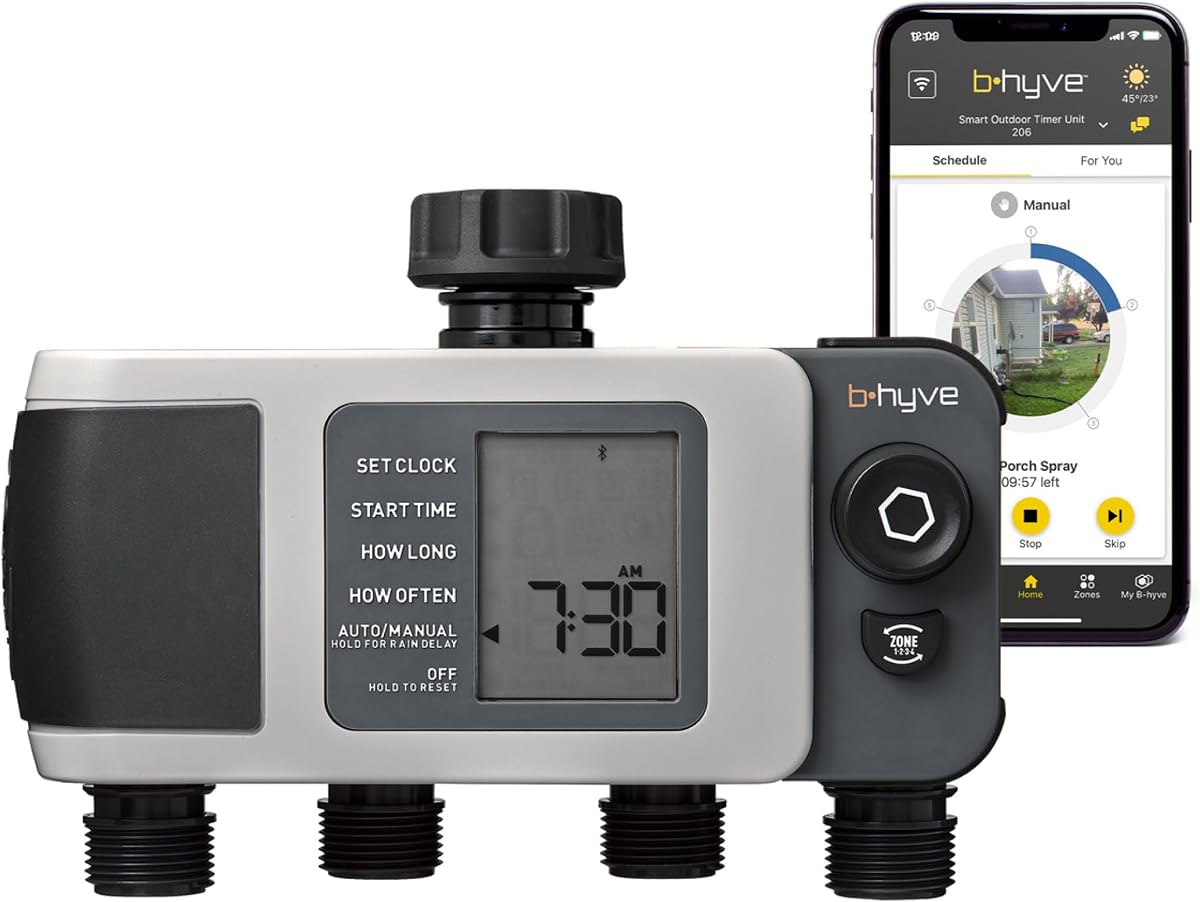
The Orbit B-hyve XD 4-Port Smart Hose Watering Timer 24634 has a 4.0 rating and brings four-port automation to a Bluetooth-controlled faucet timer. It allows separate schedules for lawns, flower beds, and other irrigation areas while keeping the faucet installation simple. The ability to program from a phone adds convenience without requiring the user to manually press a dial at the spigot.
We may earn a commission when you buy through this link, at no additional cost to you.
Its four outlets make it more versatile than a single-zone smart timer, while the B-hyve app supports flexible scheduling and remote control within Bluetooth range. Advanced monitoring and smart weathersense technology can adjust irrigation in response to drought conditions, helping reduce unnecessary watering when conditions do not call for a full schedule. Orbit also backs the product with a two-year limited warranty for private-use purchases.
The important limitation is the nature of the connection. Bluetooth control is tied to proximity, so the feature set differs from a true WiFi system that offers access from anywhere. The listed rating of 4.0 also suggests some variability in overall satisfaction, although it does not identify a specific weakness. Users should confirm that their phone, app, and outdoor faucet are positioned for a dependable Bluetooth link.
This model is a good middle ground for buyers who want several outlets and app-based programming but do not need a hub or internet-wide remote access. It works particularly well for nearby gardens with multiple hose lines. For a remote property, wider-area control, or a larger network of watering points, a WiFi or hub-based system would be a more logical choice.
Four outlets reduce the need to swap hoses whenever a different part of the yard needs attention. Separate scheduling allows each line to reflect the water requirements of its assigned zone.
Smart weathersense technology can modify irrigation according to drought conditions. This helps the system avoid following a fixed schedule when local conditions may already have supplied enough moisture.
We may earn a commission when you buy through this link, at no additional cost to you.
The MOES 2 Zone Water Timer holds a 4.5 rating, tying for the highest score in this comparison, and stands out as the best budget-oriented choice. It delivers two independently programmable outlets without requiring WiFi, Bluetooth, a hub, or an app. That balance of scheduling flexibility and uncomplicated operation makes it a particularly strong option for buyers who want reliable automation without a connected ecosystem.
We may earn a commission when you buy through this link, at no additional cost to you.
Each outlet can have its own start time, run time, and frequency, allowing a drip-irrigated bed and a sprinkler line to operate on different schedules. Three-quarter-inch brass inlet and outlet connectors offer a more durable connection than many plastic-only fittings. The timer also provides a one-to-15-day rain delay, a manual mode for immediate watering, and operation from two AA alkaline batteries.
There are no phone-based conveniences, so remote scheduling, usage alerts, and automatic forecast-based adjustments are not part of the feature set. Batteries are not included, and rechargeable batteries are not recommended. The product is also designed for normal pressurized outdoor faucets. Low-pressure plumbing, long hose runs, clogged filters, or gravity-fed rain barrels can reduce flow and affect sprinkler coverage, making the water source an important consideration.
This is the top pick for a straightforward two-zone garden where dependable local programming matters more than remote access. It also suits users who want to avoid cloud accounts and recurring ecosystem complexity. Buyers should confirm the faucet size, install the gasket properly, align the threads, and hand-tighten the connections to reduce the chance of leaks.
Independent settings deliver the most important part of smart watering without a network dependency. The result is useful automation that continues to operate at the faucet, even without a phone or internet connection.
Normal pressurized faucets provide the operating conditions this timer expects. Unusual water supplies may reduce flow, so buyers should confirm pressure and filter condition before relying on the timer for sprinkler coverage.
We may earn a commission when you buy through this link, at no additional cost to you.
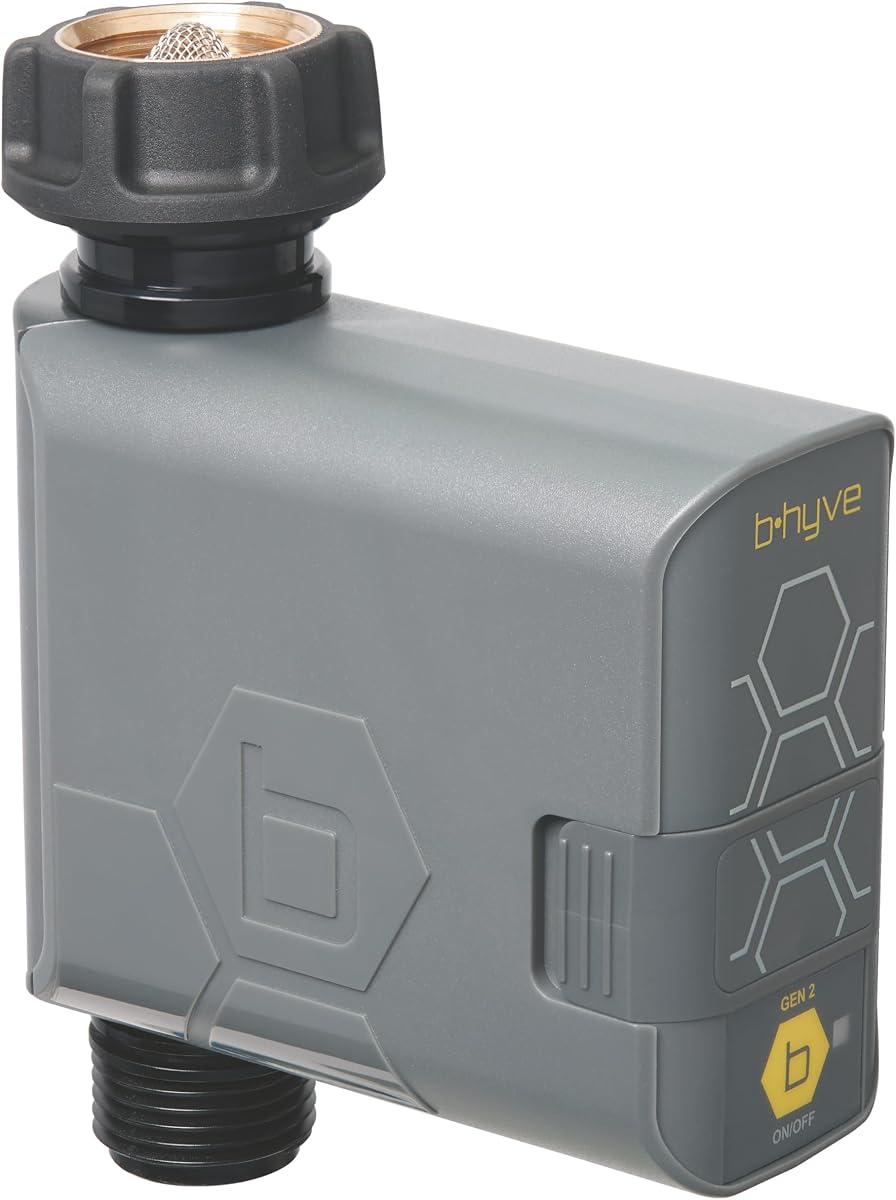
The Orbit B-hyve Gen 2 Smart Hose Watering Timer 90205Z has a 3.8 rating and offers a flexible approach to smart control. It includes built-in Bluetooth for setup, scheduling, and local operation through the B-hyve app. Buyers can begin using the timer without a hub, then add a compatible B-hyve Gen 2 Hub when they want remote access, smart watering capabilities, notifications, and control from beyond the property.
We may earn a commission when you buy through this link, at no additional cost to you.
Flow monitoring is a notable feature. The timer can track water usage and provide alerts for unexpected watering conditions, helping a homeowner identify a possible leak, stuck valve, or unintended cycle. Its hose faucet format also supports quick installation, making it suitable for gardens, flower beds, raised beds, and drip systems without the complexity of a full irrigation controller.
The 3.8 rating is the lowest among the products reviewed, so buyers should consider compatibility carefully. Remote access does not come from the timer alone; it requires the appropriate Gen 2 hub and is not compatible with B-hyve Gen 1 Bridge devices. WeatherSense-based schedule adjustments likewise depend on the hub. This modular design can be economical for local use, but it may frustrate buyers who expect the full smart feature set immediately.
The 90205Z works best for a nearby garden where direct Bluetooth control is sufficient and a hub might be added later. It also suits users who value flow alerts more than multiple outlet zones. Those wanting immediate access from anywhere should plan for the compatible hub from the outset.
Flow monitoring and unexpected-watering alerts can reveal problems that a basic schedule might conceal. This makes the timer more informative than many conventional hose timers.
The built-in Bluetooth connection supports convenient nearby control, while the optional hub expands the system into a remotely accessible one. Buyers should verify hub generation compatibility before installation.
We may earn a commission when you buy through this link, at no additional cost to you.
The MOES 4 Zone Water Timer has a 4.5 rating and is a strong choice for a larger yard that needs more than two hose outlets. It manages sprinklers, drip lines, garden beds, shrubs, and separate lawn sections from one faucet, with independent schedule settings for each outlet. Like the smaller MOES model, it works without WiFi or app control.
We may earn a commission when you buy through this link, at no additional cost to you.
Sequential watering is the feature that sets it apart. When multiple zones share the same start time, the timer finishes Zone 1 before moving through the others rather than opening all four outlets simultaneously. This approach helps reduce pressure conflicts and can produce more predictable operation when the connected lines have different flow demands. The large LCD provides access to the settings, which include watering durations from one minute to 23 hours and 59 minutes and frequencies from one hour to 30 days.
Its one-inch main inlet is supplied with a three-quarter-inch adapter for common garden faucets, and the timer uses four AA alkaline batteries. A 1-to-15-day rain delay, manual watering, and low-battery valve protection round out the core controls. Buyers must install the gasket correctly and hand-tighten the adapter to help prevent leaks. The multi-outlet body and multiple batteries also create a larger installation than a single-zone timer requires.
Choose this model when a property has four distinct watering needs but the owner prefers local programming over an app. It is particularly useful for scheduled drip irrigation and sprinklers that should not run simultaneously. A connected multi-zone system would be more appropriate for users who need remote changes, flow alerts, or centralized monitoring across a much larger property.
Running zones one after another reduces the chance that all four outlets will compete for the same flow at once. The result can be steadier irrigation and fewer pressure-related coverage issues.
Long watering durations and flexible frequencies accommodate everything from short daily misting to extended irrigation cycles. The broad range is useful for varied plant types and seasonal outdoor routines.
We may earn a commission when you buy through this link, at no additional cost to you.
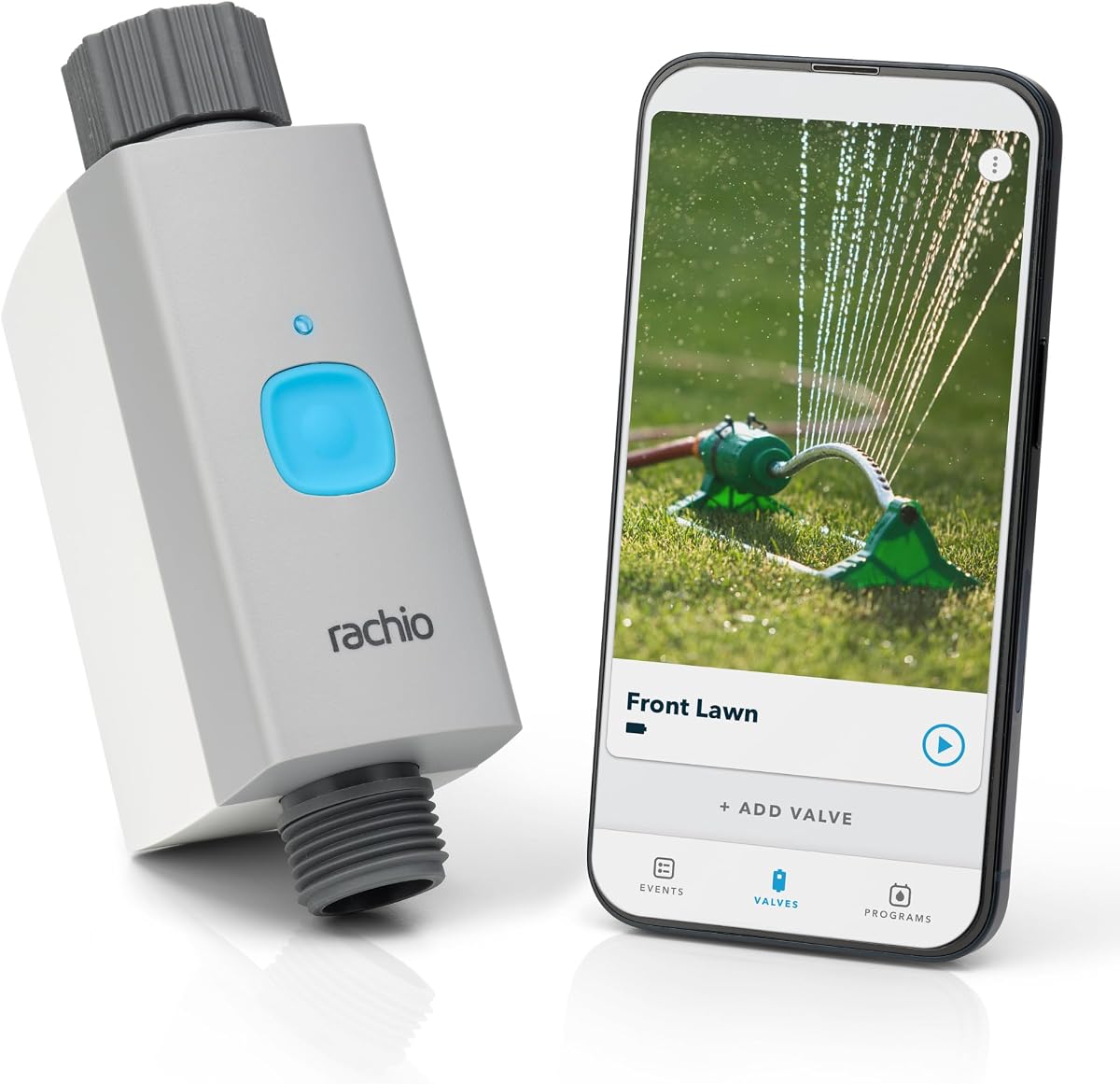
The Rachio Smart Hose Timer with one valve and one WiFi Hub earns a 4.0 rating and represents the most app-focused premium system in the group. It provides a polished alternative to mechanical dial timers, with full scheduling in the Rachio app, flow monitoring, low-battery alerts, and quick-start manual watering from either the app or the built-in button. The hub can also support as many as eight hose valves.
We may earn a commission when you buy through this link, at no additional cost to you.
Its rain-skip feature automatically avoids watering when rain is forecast, offering a convenient way to conserve water without manually revising the schedule. Smart home compatibility with Alexa, Google Home, and IFTTT broadens the system's usefulness for voice control and connected routines. The inclusion of both a valve and hub provides a more complete starting package than the valve-only Rachio option.
The main requirement is a compatible network. The hub works only with 2.4GHz WiFi, so homes with a modern router that disables the 2.4GHz band will need to make an adjustment. As with any hub-based system, setup involves the gateway, app, account, and wireless network, which is more involved than programming a timer directly at the faucet. The 4.0 rating should also prompt buyers to consider compatibility and ecosystem preferences carefully.
This product is an excellent match for a homeowner who wants detailed app control, useful notifications, forecast-aware watering, and smart-home integration. It is particularly attractive for households planning to expand from one valve to several. Buyers should verify 2.4GHz WiFi availability before installation and confirm the desired automation platform.
Flow monitoring and low-battery alerts extend the timer beyond scheduling, helping users notice irregular water use and maintenance needs. These notifications can make unattended irrigation more manageable.
Although the package includes one valve, the hub can coordinate up to eight hose valves. That makes it a practical starting point for a homeowner who expects to add zones around a yard over time.
We may earn a commission when you buy through this link, at no additional cost to you.
The Rachio Smart Hose Timer Valve Only has a 3.8 rating and is designed primarily for a buyer who already owns a compatible Rachio WiFi Hub. It adds a remotely controlled irrigation valve to an existing setup without requiring the hub to be purchased again. The product uses the Rachio app for schedules, flow monitoring, low-battery alerts, rain skips, and manual watering.
We may earn a commission when you buy through this link, at no additional cost to you.
Its app-first approach offers detailed control and convenient notifications, while compatibility with Alexa, Google Home, and IFTTT supports voice commands and connected home routines. The included valve installs at a standard hose faucet and is intended to automate sprinklers or other outdoor watering in lawns, gardens, and yards. A quick-run button on the device provides a physical alternative to starting water through the app.
The obvious limitation is that no hub is included. A buyer starting from scratch would need the separate hub before the promised remote functionality can be used. That makes this model less complete than the Rachio package that contains both a valve and hub. The 3.8 rating also suggests that compatibility questions or setup experiences may affect satisfaction, although the provided data does not specify a single recurring complaint.
Existing Rachio hub owners will find this a practical way to expand irrigation coverage to another faucet. It is less suitable as a standalone first purchase unless the buyer already has the required ecosystem. For a new buyer wanting one complete package, the valve-and-hub set is the more coherent starting point.
The valve-only format is useful when a compatible hub is already installed and another outdoor zone needs smart scheduling. It avoids duplicating gateway hardware and creates a cohesive app-managed system.
The hub provides the network connection, so buyers without one should not expect full remote access from this product alone. Confirm compatibility before ordering and treat the missing hub as an essential part of the setup.
We may earn a commission when you buy through this link, at no additional cost to you.
The RAINPOINT Two-Zone Water Timer earns a 4.3 rating and focuses on readable controls, durable outdoor construction, and independent zone programming. Its 2.5-inch LED display presents watering time, the next irrigation plan, power status, and other information in a format that should be easy for a broad range of users to check. The product is especially appealing to anyone who values a large display over app-based operation.
We may earn a commission when you buy through this link, at no additional cost to you.
Each zone can have its own start time, duration, and frequency. Watering duration extends from one minute to three hours and 59 minutes, while frequency options cover one- to 12-hour intervals and one- to seven-day intervals. Manual controls allow Zone 1, Zone 2, or both to be selected, and 24-, 48-, or 72-hour rain delays help avoid watering during wet weather. A low-battery warning gives users time to replace the batteries, and the valve automatically closes if power becomes low.
The product uses a rotating 360-degree interface intended to simplify installation, and the listing notes that hose timers are not included. It also specifies a three-quarter-inch connection, so buyers should verify the interface of their faucet or pipe. Rust or corrosion on an existing connection could cause a loose fit and reduced compatibility. Its maximum programmed duration is shorter than the long-cycle ranges offered by some multi-zone alternatives.
This timer is a good choice for a two-area yard where clarity, battery warnings, and independent programs matter. It suits older users, large gardens that benefit from visible status information, and anyone who wants rain delay without a phone. It is less appropriate for installations requiring very long watering cycles or extensive remote monitoring.
The oversized LED screen makes the next watering plan and operating status easy to check at a glance. This reduces the need to open menus or navigate a phone when making a routine adjustment.
The warning indicator alerts users before batteries fail, and automatic valve closure helps limit unintended watering. That combination supports dependable unattended operation.
We may earn a commission when you buy through this link, at no additional cost to you.
The best smart outdoor faucet timer depends on the number of watering areas, desired control method, available water pressure, and the owner's tolerance for app or hub setup. Comparing these practical requirements before buying prevents an attractive smart feature from becoming an unnecessary complication.
Count the distinct watering areas first, then add a margin for future expansion. Choose only the number of independently programmed outlets you need while accounting for faucet size, available flow, and physical space around the timer.
Prioritize remote access if you travel often, manage several areas, or want flow and battery notifications. Choose local programming if simplicity, privacy, and minimal setup are more important.
Confirm hub inclusion, app compatibility, WiFi frequency, and gateway range before ordering. Treat the hub as part of the total system, not an optional accessory.
Choose forecast-aware automation for convenience and water savings. Choose manual rain delay for fewer dependencies and direct control over each interruption.
Test the faucet before installation and inspect the hose, filter, and fittings. Use sequential watering when pressure conflicts appear.
Prioritize sealed controls, durable fittings, and clear environmental ratings. Protect the display and battery door from prolonged direct exposure when practical.
Choose a display and menu that you can read comfortably. Ensure the available duration and frequency settings suit your plants and local water rules.
Use the specified battery type and keep a spare set available. Routine inspections are inexpensive protection against leaks, blockages, and unattended watering failures.
Begin by confirming that the faucet is operational, the hose or irrigation lines fit the specified connection, and the available pressure is suitable. Install the gasket, align the threads carefully, and hand-tighten the connector. For a multi-zone model, attach each hose to the correct labeled outlet and avoid forcing an adapter onto a faucet of the wrong size. Position the timer where its display and controls remain accessible but protected from direct weather and accidental knocks.
Next, complete the setup. A local timer can be programmed directly using its start-time, frequency, duration, zone, rain-delay, and manual controls. A smart timer may require an app account, Bluetooth pairing, WiFi connection, or hub installation. Name each zone according to the area it serves, then set a conservative initial schedule. Starting with shorter runs is a prudent way to verify coverage and pressure before committing to long watering periods.
Care for the timer by checking the battery indicator on a regular schedule and replacing batteries before the low-battery warning activates. Remove the batteries during periods of freezing weather if the manufacturer's instructions recommend it. Clean the filter when it becomes restricted, inspect the gasket for cracks, and confirm that connections remain dry and tight. For connected systems, keep the app and hub firmware current, review flow alerts, and verify that rain-skip behavior still matches the homeowner's local watering plan.
Not all of them. Several models in this guide operate entirely through local controls and do not need WiFi, Bluetooth, an app, or a hub. App-connected timers may use direct Bluetooth for nearby control, while others need a gateway for remote access. Choose the connectivity that matches how you expect to use the timer and confirm any hub requirements before buying.
Yes, if the timer has multiple outlets. Two- and four-zone models can run separate hose lines with different schedules, although simultaneous operation may reduce water pressure. Some four-zone timers use sequential watering so one zone completes before the next begins. Confirm the outlet count, scheduling options, and pressure requirements for the sprinklers or drip lines you plan to connect.
Rain delay usually pauses the programmed schedule for a set number of days, after which it resumes automatically. Automatic rain skip uses forecast or weather data to decide whether a watering cycle should be skipped. The latter is more hands-off but normally depends on a compatible app or hub. Rain delay gives the gardener direct control without requiring a weather-data connection.
It depends on the water source and the model. The MOES two-zone product is designed for standard pressurized outdoor faucets, and gravity-fed systems may reduce flow or prevent reliable operation. Some other timers may work with suitable gravity-fed arrangements, but buyers should check manufacturer guidance and confirm adequate pressure before installation. Low flow can also cause sprinklers to cover unevenly.
Replacement frequency depends on the model, battery type, number of zones, watering schedule, and temperature. Replace batteries when the low-battery indicator appears rather than waiting for the valve to stop operating. Models with an automatic close feature can limit water loss, but a complete shutdown can still interrupt the schedule. Use the battery type specified by the manufacturer and avoid rechargeable batteries when they are not recommended.
Yes, a multi-zone timer can assign one outlet to a sprinkler and another to drip irrigation, often with separate schedules. This is useful because lawns and drip lines may require different run times. Check the flow demand of both systems and avoid opening high-flow outlets together if pressure is inadequate. A timer with sequential operation can be especially helpful in larger installations.
No. Some products include a gateway, some use direct Bluetooth for local control, and some require a separately purchased hub for remote features. Orbit B-hyve Gen 2, for example, includes Bluetooth but needs a compatible Gen 2 hub for remote access and weather features. Rachio offers both a valve-and-hub package and a valve-only option, so ecosystem needs should be considered before purchase.
Check the faucet thread size, operating pressure, hose type, and number of watering areas. Also inspect the existing pipe for rust or corrosion, because a damaged connection can leak even when the timer fits properly. Read the battery, weather protection, and installation instructions, and make sure the display will remain visible after the timer is attached.
The WiFi Water Timer Smart Irrigation Controller with Gateway is the best overall choice for buyers who want phone control, flexible multi-zone scheduling, rain delay, and long-range wireless coverage. The MOES two-zone timer is the best budget pick for straightforward automation with independent schedules and no network requirement, while the Rachio valve-and-hub package is the best premium option for advanced app control, smart-home integration, and future expansion.
Prioritize the number of watering areas, your need for remote access, the faucet's pressure, and the setup complexity you are willing to manage. A large display and local programming may be more useful than app features for a small garden, while a hub-based system becomes increasingly practical when several faucets need coordinated control. Always verify connector size, hub generation, network requirements, and water pressure before installation.
Ratings, feature availability, product bundles, and pricing can change, so check the current listing before making a final purchase. Reviewing the included components is especially important for valve-only products and smart timers whose full functionality depends on a separate hub.