
Jonard Tools WBK-100 Panel Buddy
4.5Editor score
Front and rear knockouts
Works around installed panels
Avoids drywall damage
Simple push-to-remove operation
Supports multiple panel types
Removing an electrical-panel knockout requires a tool that separates the thin metal cleanly without damaging the enclosure or surrounding wall. The right kit combines the correct punch size, sufficient force, comfortable handling, and a safe way to catch or split the removed slug.
This guide compares ten knockout kits selected for different jobs, including compact panel-knockout removers, manual ratchet systems, and hydraulic punch sets for electrical enclosures and sheet metal. We evaluated the documented hole sizes, material limits, force capacity, included components, portability, and specialized features.
Each review explains who benefits most from that particular design and where its limitations matter. The top three selections represent a capable hydraulic all-rounder, a dedicated panel-knockout remover, and a premium professional kit, while prices and availability can change over time.
4.5Editor score

4.2Editor score

4.5Editor score
As an Amazon Associate we earn from qualifying purchases.
The comparison below separates purpose-built knockout removers from manual and hydraulic hole-punching kits, making it easier to match the tool to the panel, conduit size, material thickness, and available working space.


The VEVOR 15 T Hydraulic Knockout Punch Kit is the most versatile selection in this guide, combining a 15-ton hydraulic mechanism with punches and dies from 1/2 inch through 4 inches. Its 4.2 rating reflects a capable, broad-purpose package, while the unusually large range of conduit sizes gives it an advantage over most competing kits.
We may earn a commission when you buy through this link, at no additional cost to you.
The included system goes beyond the basic pump and dies. It provides 10 punches and dies, a step drill bit, two draw studs, a piston shaft, a spacer, sealing rings, and a carrying case. A flexible ram angle helps the operator align the tool in confined areas, and laser-engraved alignment marks support consistent positioning. The split-die design is also intended to make slug removal more manageable.
There are trade-offs. A hydraulic system is more involved than a simple panel-knockout remover, and the broad collection of parts takes more time to inventory. Maximum material thickness also depends on metal type: the listed limit is 0.1 inch for soft carbon steel and 0.08 inch for stainless steel. Those limits make material verification essential before beginning work.
This kit is the strongest all-around choice for contractors who routinely work on electrical enclosures, conduit runs, or sheet-metal housings and want more than two-inch openings. It is particularly attractive when one tool must cover several conduit sizes. For a single factory knockout in an installed panel, however, a dedicated Panel Buddy is simpler and less intrusive.
The 1/2-inch through 4-inch selection is the standout feature, allowing the same kit to handle common small conduit openings and much larger service penetrations. That range makes it more adaptable than the many sets that stop at 2 inches.
The adjustable ram angle and quick pressure-release control improve positioning around a panel or enclosure. The anti-skid handle and split dies also address common ergonomic concerns during repeated punching operations.
We may earn a commission when you buy through this link, at no additional cost to you.
The Jonard Tools WBK-100 Panel Buddy is a purpose-built solution for removing knockouts from electrical panels already embedded in drywall. It holds a 4.5 rating and distinguishes itself from conventional punch kits by addressing the awkward situation created when a panel cannot be removed from the wall.
We may earn a commission when you buy through this link, at no additional cost to you.
Instead of cutting a new opening around the panel, the tool pushes against the knockout to loosen and remove it. It works with both front and rear knockouts and is listed for electrical, security, alarm, and datacom panels. The straightforward push operation makes it much less demanding than a hydraulic punch when the desired opening is already molded into the enclosure.
Its limitations are important. This is a knockout remover, not a complete conduit hole-cutter set, so it cannot create arbitrary new holes of a selected diameter. The product information also includes a clear warning not to use it near live circuits. Users must follow electrical safety procedures and ensure the circuit is properly de-energized before touching any panel.
The WBK-100 is a sensible choice for electricians, security installers, technicians, and remodelers who repeatedly remove factory knockouts from installed panels. It offers the most direct solution among these picks for avoiding drywall damage. For broader sheet-metal work or custom conduit openings, one of the hydraulic kits is the better fit.
Because the tool removes the knockout without cutting into the drywall, it is valuable during repairs, additions, and service changes where preserving a finished wall is a priority. That focused purpose is its main advantage over general-purpose punch sets.
A push-to-remove design avoids the setup associated with pumps, hoses, draw studs, and hydraulic pressure. For front or rear factory knockouts, that simplicity can make the tool more approachable and efficient.
We may earn a commission when you buy through this link, at no additional cost to you.
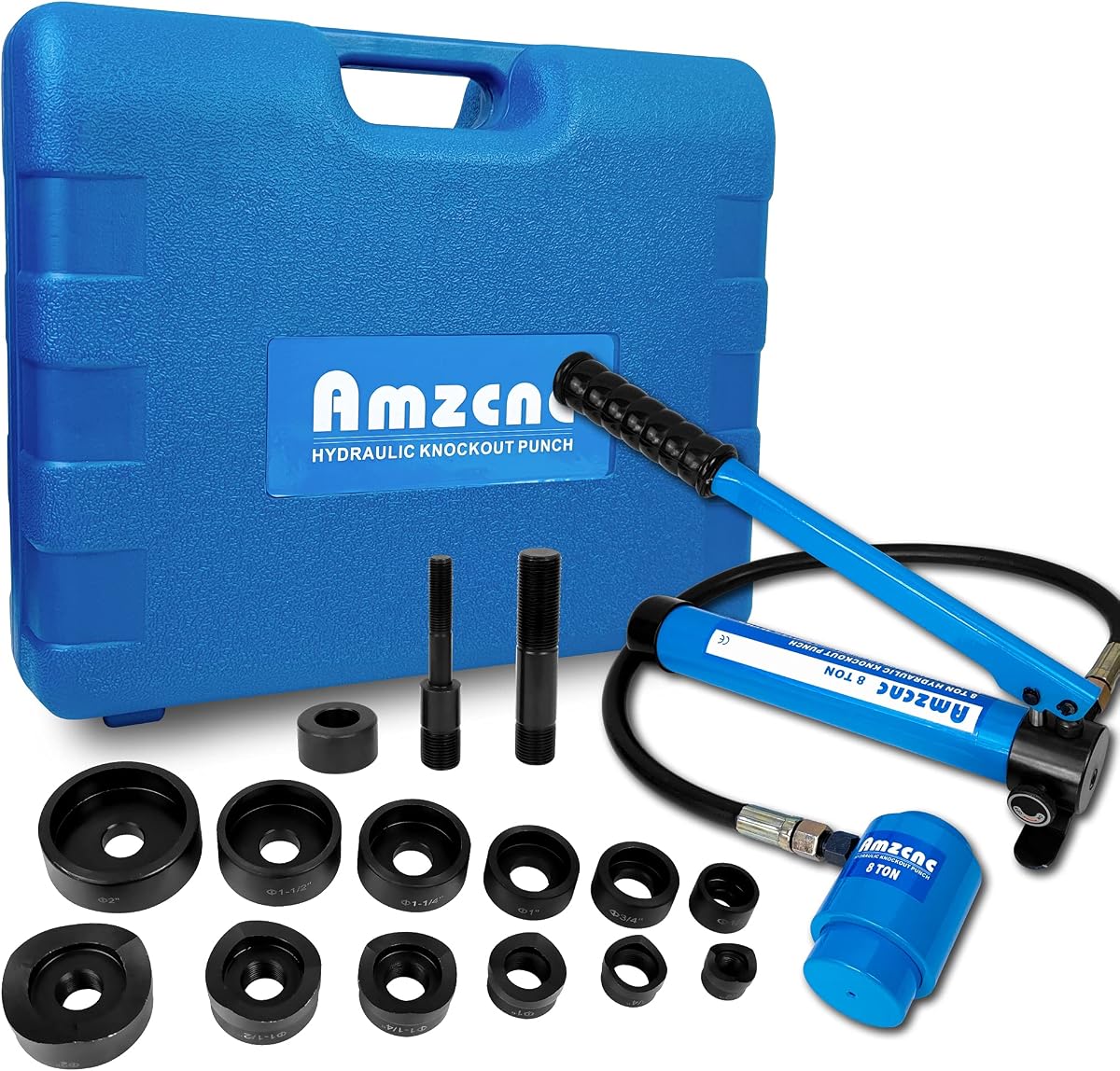
The AMZCNC 8 Ton Hydraulic Knockout Punch Kit combines an eight-ton hydraulic system with six conduit die sizes from 1/2 inch to 2 inches. Its 4.4 rating and compatibility with Greenlee and other domestic 3/4-16 threaded punch tooling make it a versatile option for technicians who may already own compatible accessories.
We may earn a commission when you buy through this link, at no additional cost to you.
The kit supports steel, stainless steel, brass, copper, soft aluminum, fiberglass, and plastic. Its stated capacity reaches 1/8 inch for steel and 1/16 inch for stainless steel, which covers many common electrical-enclosure applications. A long plastic handle is intended to reduce sliding and transfer force effectively while a drill bit and driving bolt help produce a clean, uniform opening.
The main limitation is range. Every included die is 2 inches or smaller, so this package cannot handle the 2-1/2-inch to 4-inch openings covered by larger kits. It also depends on a drill-assisted operating arrangement, which means the user must understand the correct relationship between the drill, driving bolt, punch, and die.
This is a strong option for electricians and installers who need a hydraulic set within the common 1/2-inch to 2-inch conduit range, especially where compatibility with standardized threaded tooling is valuable. It is less suitable for large service entrances or crews seeking a single kit that spans every standard enclosure size.
Compatibility with 3/4-16 threads and domestic punch tooling can be useful for users who want to mix existing accessories with the supplied system. It also provides a clearer path to expanding beyond the included dies.
The supported list includes common construction and electrical materials, from mild and stainless steel to brass, copper, soft aluminum, fiberglass, and plastic. Users should still verify the actual thickness against the stated limits for each material.
We may earn a commission when you buy through this link, at no additional cost to you.
The Rack-A-Tiers Panel Buddy 7WBK100 is designed to remove knockouts from electrical, security, alarm, and datacom panels. It carries a 4.3 rating and distinguishes itself by working with both lipped and non-lipped panel constructions, covering an important variation in panel geometry.
We may earn a commission when you buy through this link, at no additional cost to you.
A dedicated knockout-removal tool is useful when the required opening is already present in the enclosure. Rather than assembling a punch and die, the operator can use the tool at the knockout location and work directly on the weakened section. This reduces component handling and avoids the need for a separate hole-cutting system.
The scope remains narrower than that of a full conduit punch kit. The product is categorized for knockout removal, so it should not be treated as a way to create a new opening at an arbitrary location or diameter. Users must also make sure the panel can be accessed safely and that electrical conductors and live components are not exposed during the operation.
Rack-A-Tiers is a solid choice for technicians who service multiple categories of installed panels and need compatibility with both lipped and non-lipped knockouts. It is less relevant to fabricators who need custom sheet-metal holes. In those situations, a manual or hydraulic punch set provides greater dimensional flexibility.
Compatibility with lipped and non-lipped panels is the key advantage. It gives service technicians a broader choice than a remover designed around only one enclosure profile.
When adding conduit to an existing enclosure, a dedicated remover keeps the workflow simple. The tool is best suited to factory knockouts, not custom openings or unusually thick enclosure material.
We may earn a commission when you buy through this link, at no additional cost to you.
The SLUG-Buster CC-60 Ratchet Knockout Kit offers manual punching across six common sizes, from 22.5 mm to 61.5 mm. Its 4.7 rating is the strongest listed among the ten products in this comparison, making it an attractive option for users who want a broad manual set with a favorable customer reception.
We may earn a commission when you buy through this link, at no additional cost to you.
The package contains six punches, one wrench, two pull rods, and a connector, all stored in a durable red plastic case. The ratchet mechanism and long ergonomic handle are designed to reduce effort while producing smooth, round holes with clean edges. Intended materials include mild steel, aluminum, fiberglass, and plastic.
As a manual system, it will not match the effortless operation of a hydraulic kit for thicker stock or repeated high-force work. The included range also stops at 61.5 mm, so users needing 2-1/2-inch through 4-inch conduit openings must choose a larger set. Material thickness is another consideration: the product information names the compatible materials but does not provide a detailed maximum-gauge rating.
The CC-60 is well suited to electricians, maintenance technicians, and DIY users who regularly need 1/2-inch through 2-inch openings and prefer a non-powered tool. Its organized case, ratchet action, and strong rating make it particularly appealing for mobile work where carrying a hydraulic pump would add unnecessary bulk.
Because the kit uses ratchet-driven manual force, it can travel without a pump, hydraulic hose, or separate power source. That simplifies storage and makes the set practical for service vehicles and remote jobs.
The six punch measurements cover several frequently used conduit openings. The included wrench, pull rods, and connector provide the core pieces needed to complete the ratcheting punch setup.
We may earn a commission when you buy through this link, at no additional cost to you.
The VEVOR 10 Ton Hydraulic Knockout Punch Kit fills the space between compact manual tools and larger high-force systems. It has a 4.4 rating, a 10-ton hydraulic mechanism, and six die sizes covering 1/2 inch through 2 inches, making it suitable for many routine electrical and sheet-metal openings.
We may earn a commission when you buy through this link, at no additional cost to you.
The complete package includes a hydraulic punch, six knockout punches and dies, a step drill bit, two draw studs, a piston shaft, a spacer, sealing rings, a user manual, and a carrying case. Laser-engraved marks on the dies aid positioning, while the adjustable ram angle helps when access is restricted. A quick pressure-release knob and anti-skid handle are intended to improve control.
The steel capacity is listed at 0.1 inch, or 10 gauge, but the maximum stainless-steel thickness is only 0.04 inch, or 20 gauge. This distinction matters when the enclosure is stainless rather than standard carbon steel. The kit also cannot address the 2-1/2-inch to 4-inch openings found in larger conduit punch packages.
This VEVOR set is a strong choice for electricians and fabricators who want hydraulic power without carrying the larger 15 T configuration. It is especially useful when all required openings fall between 1/2 inch and 2 inches. Users needing larger conduit sizes or thicker stainless material should choose a more capable system.
The 10-ton mechanism provides a useful middle ground between manual ratcheting and the larger 15-ton selection. The compact case and adjustable ram make it practical for confined installations.
A tool that punches 10-gauge steel may not handle equally thick stainless steel. Checking the material-specific limit before applying pressure helps prevent incomplete cuts, damaged tooling, or unnecessary work.
We may earn a commission when you buy through this link, at no additional cost to you.
The Manual Knockout Hole Punch Driver Kit provides six punch sizes matching 1/2-inch, 3/4-inch, 1-inch, 1-1/4-inch, 1-1/2-inch, and 2-inch conduit sizes. Its 4.3 rating reflects a capable manual package built for technicians who want useful cutting performance without a powered hydraulic mechanism.
We may earn a commission when you buy through this link, at no additional cost to you.
A notable construction detail is the use of 5140 steel, heat treated to HRC48 hardness, for the punches, studs, and ratchet wrenches. The long handle and ergonomic arrangement are intended to reduce operator fatigue. The complete package contains one wrench, six punches, two pull rods, and a compact plastic case.
The stated maximum thickness is 1/8 inch for steel and 1/16 inch for stainless steel. The kit can also work with brass, copper, soft aluminum, fiberglass, and plastic, although the product information specifically warns that aluminum should be a soft alloy. Manual force still requires more physical effort than hydraulic assistance, especially in thick material or during prolonged use.
This is a practical choice for electricians, maintenance workers, and advanced DIY users handling enclosure openings within the two-inch range. It offers a good balance of compactness and mechanical strength. Those who routinely punch thick plate or need larger conduit openings should consider a hydraulic kit instead.
Heat treatment to HRC48 is a useful construction specification for tools that repeatedly transfer force into hardened sheet metal. The forged punches, studs, and wrenches are designed for durability within their stated limits.
The case includes the main components needed for manual operation, and the six sizes cover frequently encountered conduit dimensions. The system is easy to carry and does not require a pump or electrical connection.
We may earn a commission when you buy through this link, at no additional cost to you.
The Greenlee 7906SB is a professional hydraulic knockout system with an eight-ton punch, a Quick Draw 90 driver, 1/2-inch through 2-inch Slug-Buster punches and dies, and short hydraulic draw studs. Its 4.5 rating and detailed component design make it the premium pick for users who value purpose-built construction and access in difficult spaces.
We may earn a commission when you buy through this link, at no additional cost to you.
The right-angle driver head rotates over 180 degrees, allowing it to approach an enclosure from more than one orientation. That flexibility is especially valuable when a panel is boxed in by studs, conduit, framing, or other equipment. The compact, lightweight design is also framed around quick one-person operation, while knurled edges on the punches provide a more secure grip.
Stud handling is another refined area of the design. Drawing studs can be installed using the dog-point tip, reducing the risk of cross-threading, while hex-key access allows a stud to be removed from the tool more easily. A labeled KCC-QD2 case helps technicians identify parts and return them to the correct locations after a job.
The Greenlee system is best for professional electrical, plumbing, or mechanical work where a dependable dedicated toolkit matters more than minimizing the number of components. Its opening range is limited to 2 inches, so it does not replace a 2-1/2-inch through 4-inch set. It also represents a more substantial purchase than basic manual or purpose-built removal tools.
The over-180-degree rotating head is particularly valuable where the punch axis cannot be aligned with a straight approach. It reduces the need to reposition the panel or build an improvised clearance around the work area.
The marked case, knurled punches, dog-point stud tip, and hex-key removal access show attention to repeated professional use. These details make components easier to handle, identify, and maintain.
We may earn a commission when you buy through this link, at no additional cost to you.
The Milwaukee 49-16-2695 M18 Exact Knockout Set is built around a different part of the size spectrum from most kits in this guide. It covers 2-1/2-inch through 4-inch openings and has a listed customer rating of 5.0, making it the clear option here for large conduit penetrations.
We may earn a commission when you buy through this link, at no additional cost to you.
Its M18 platform offers a familiar cordless-tool approach that can improve portability at job sites. The product information emphasizes straightforward operation, manageable handling, and high durability. These qualities are particularly relevant to technicians who may already use M18 equipment and want a knockout solution that does not depend on a manually operated ratchet.
The available information does not provide a detailed material-thickness rating, force value, or complete component inventory. Buyers should therefore verify the included punch sizes, accessory requirements, and material limits against the current manufacturer documentation before purchasing. Its narrow large-size focus also means it cannot replace a general 1/2-inch through 2-inch kit.
This Milwaukee set is most appropriate for installers working on larger conduit entrances, service connections, or substantial panel openings in the stated range. It is a strong specialist choice, but the information provided is too limited to make it the broadest recommendation for all electrical-panel knockout work.
The 2-1/2-inch through 4-inch range fills a gap left by most compact kits. It is designed for projects where a standard half-inch or one-inch punch would be entirely unsuitable.
Using the M18 ecosystem can simplify transport and make the system convenient for crews that already rely on cordless tools. The absence of a manual ratchet reduces physical effort during powered operation.
We may earn a commission when you buy through this link, at no additional cost to you.
The MILWAUKEE M18 Forcelogic 6T Knocko is a compact powered knockout tool built around the manufacturer's M18 platform. Its 4.3 rating makes it a credible choice for users who want cordless operation and a six-ton force designation without carrying a full hydraulic punch kit.
We may earn a commission when you buy through this link, at no additional cost to you.
Powered operation can reduce the repetitive physical effort associated with a manual punch. It may also fit naturally into a tool bag used by electricians or maintenance technicians who already standardize on M18 equipment. The supplied listing states that the product ships with relevant accessories and is brand new in its box.
The published information is notably brief. It does not specify the supported knockout diameters, material-thickness limits, die or punch inventory, or detailed operating procedure. As a result, the product should be selected only after confirming that the required size and accessories are included or can be obtained for the M18 system. The nominal force figure alone does not guarantee suitability for every material.
This tool is best considered by experienced M18 users who value a compact powered solution and can verify the exact accessory package for their project. It is less suitable as an informed all-purpose recommendation from the limited information shown, or for a technician who needs a clearly documented set of 1/2-inch through 2-inch dies.
A six-ton powered design can make repeated knockout work more comfortable than manual ratcheting. The M18 cordless format also avoids dependence on a separate hydraulic pump during mobile work.
Before buying, confirm the required knockout diameter, punch, die, and any additional accessories. The listing does not provide enough detail to assume that every common conduit size is covered.
We may earn a commission when you buy through this link, at no additional cost to you.
The best knockout kit depends on whether you are removing a factory knockout, creating a new conduit opening, working around an installed panel, or handling repeated jobs. Match the tool type, size range, force, and material capacity to the actual task before comparing features.
A knockout remover is intended to release a weakened, factory-formed section from an electrical panel. A knockout punch kit uses matched punches and dies to cut a new circular opening in metal or another supported material. A hydraulic tool adds powered force for thicker stock, larger openings, and repeated use. These categories solve different problems, so choosing based only on the number of included pieces can lead to the wrong tool. Consider whether the panel already has the required knockout and whether it can be moved away from the wall.
Choose a dedicated remover for an installed panel and a punch set for a new opening. Choose hydraulic equipment when the work demands easier force delivery or higher productivity.
Most general-purpose kits cover 1/2-inch through 2-inch conduit sizes, while larger hydraulic and cordless systems may extend to 4 inches. Within that common range, punches are often identified in inches, millimeters, or both. Measure the desired opening and confirm the actual included size rather than assuming that a nominal kit rating covers it. A set advertised from 1/2 inch to 2 inches may use metric punch measurements, so compatibility with the intended fitting should be verified before ordering.
Match every required diameter and keep a separate small set for unusual fittings. Do not substitute a nearby size without confirming the conduit and fitting specifications.
Punch capacity is not a single universal number. A kit may support 10-gauge mild steel while handling only 14-gauge stainless steel or 20-gauge stainless steel, as seen among the hydraulic choices here. Aluminum, brass, copper, fiberglass, and plastic can have different behaviors, and some manufacturers specifically limit aluminum to soft alloys. Compare the panel or enclosure material with the documented rating for that exact material. Thickness is just as important as the nominal hole size because an underpowered setup can leave an incomplete cut.
Identify the panel material and measure its thickness first. Use the lowest stated limit when the material is uncertain.
Manual ratchet systems are lightweight, straightforward, and suitable for occasional work. Hydraulic and cordless tools reduce the effort needed to break through metal and can be more efficient for repeated installations. However, higher force is not automatically better: it can also mean more components, greater cost, and additional operating considerations. Choose manual equipment for portability and infrequent use, an eight- or ten-ton system for routine professional work, or a larger system when handling thick stock, large openings, or substantial daily volume.
Balance force against workload. The most powerful option is rarely necessary for one carefully planned knockout.
The punch must approach the panel or sheet metal along the correct axis, and surrounding studs, conduit, wiring, walls, or equipment can prevent that alignment. A hydraulic kit with an adjustable ram or a Greenlee driver with a rotating right-angle head provides more positioning flexibility. A dedicated Panel Buddy can be especially useful when the panel is already embedded in drywall, because it is designed to reach front or rear knockouts without cutting the wall. Always consider where the removed slug will fall and how you will prevent it from entering an energized enclosure.
Check clearance from several angles before purchasing. Access features can be more valuable than a slightly larger force rating.
A complete kit may include a pump or powered driver, punches, dies, draw studs, pull rods, a step drill bit, spacers, sealing rings, a wrench, a connector, a manual, or a carrying case. Component lists vary substantially between models. Hydraulic sets may require compatible tooling threads and correctly matched dies, while cordless systems depend on the manufacturer's accessory system. Check whether batteries, chargers, connecting links, or adapters are included when those items are needed for operation.
Compare the actual contents with the steps required for the job. Missing adapters can prevent an otherwise complete tool from working as intended.
A knockout tool can expose sharp metal edges, stored energy, and conductors inside an electrical enclosure. Ensure the circuit is de-energized and locked out according to applicable electrical safety procedures. Wear appropriate eye protection and gloves, keep fingers clear of the cutting path, and control the removed slug. For hydraulic tools, inspect seals, hoses, and connectors before applying pressure. For powered tools, confirm that the tool and accessories are correctly secured. The Panel Buddy listing specifically warns against use near live circuits.
Safety planning is not an accessory. De-energize, secure the work area, and use the correct punch and die before operating any tool.
Begin by identifying the knockout, panel material, sheet thickness, and required opening. If the panel is energized or its status is uncertain, stop and follow the applicable lockout procedure. For a factory knockout in an installed panel, choose a dedicated remover and work from the side that provides safe access. For a custom opening, select a punch and die that exactly match the intended conduit size, then confirm that the material and thickness fall within the tool's documented limits.
Install the die on the back of the panel and the punch on the working side, following the manufacturer's instructions. Secure the tool so it cannot shift, and position a container or hand guard to control the slug without placing fingers behind the panel. For manual kits, operate the ratchet smoothly until the knockout separates. For hydraulic and powered kits, advance the tool in controlled stages, release pressure as directed, and check that the cut is complete before removing the punch.
After the cut, handle the panel and slug carefully because the edges may be sharp. Wipe away metal debris, return punches and dies to their labeled locations, and inspect the tool for damaged teeth, cracks, stripped threads, or leaking seals. Store hydraulic units in their cases and protect sealing components from impact and contamination. Retire any component that no longer holds the punch or die securely, because inconsistent alignment can damage both the enclosure and the knockout kit.
A knockout remover releases a factory-formed knockout from an installed panel, often without cutting the surrounding drywall. A knockout punch kit creates a new opening using a matched punch and die. A remover is best for an existing knockout, while a punch kit is necessary when the required hole is not already molded into the enclosure.
The Jonard Tools WBK-100 and Rack-A-Tiers Panel Buddy are specifically designed to remove knockouts from installed panels in some configurations. The Jonard model supports front and rear knockouts and is intended to avoid cutting the drywall. Always confirm access, panel construction, and electrical safety before use.
Many electrical jobs use openings from 1/2 inch through 2 inches, which is the most common range among the general-purpose kits reviewed. Larger conduit may require a set covering 2-1/2-inch through 4-inch openings. Measure the conduit and confirm the exact punch diameter before choosing a kit.
Not always. A manual ratchet kit is often sufficient for routine openings within its thickness rating, while a hydraulic system is helpful for thicker material, repeated work, or reduced operator effort. A dedicated remover is even simpler when the panel already has the required factory knockout.
Limits vary by model and material. The 15 T VEVOR lists a maximum of 0.1 inch for soft carbon steel and 0.08 inch for stainless steel. The 10 T VEVOR lists 0.1 inch for soft carbon steel but only 0.04 inch for stainless steel. The AMZCNC and manual set list 1/8-inch steel and 1/16-inch stainless steel limits. Check the specifications for the exact material before use.
No electrical work should begin until the circuit is verified de-energized and protected according to applicable safety procedures. The Jonard Tools WBK-100 information explicitly warns not to use it near live circuits. Even when a knockout appears isolated, internal wiring or back-feed sources may still be present.
Stop applying force and verify that the punch, die, material, and thickness are correct. A partial cut can occur when a tool is undersized, the die is misaligned, the material exceeds the rating, or the assembly shifts during operation. Disconnect power before inspection and replace or resize damaged tooling rather than forcing the cut.
A case improves organization and protects components during transport, which is especially helpful with hydraulic sets containing several punches, dies, studs, and seals. Replacement dies may not be included, so buyers with frequent use should check the manufacturer's parts availability. Keep matched components together to prevent size confusion and incomplete cutting.
The VEVOR 15 T Hydraulic Knockout Punch Kit is the strongest all-around recommendation because it combines substantial force with the broadest range of conduit sizes. The Jonard Tools WBK-100 Panel Buddy is the most efficient choice for releasing front or rear factory knockouts from installed panels, while the Greenlee 7906SB stands out as a premium professional system built around compact, thoughtful access features.
Prioritize the job before the feature list. Choose a dedicated remover for a molded knockout, a manual set for portable and occasional work, and a hydraulic or powered system for custom openings, larger openings, tougher material, or repeated use. Within each category, confirm the diameter, material, thickness, required accessories, and working clearance before ordering.
Prices and product availability can change, so check the current listing and manufacturer specifications before purchasing. Also verify that the current package includes the punch, die, and support pieces required for your installation. With the correct tool, verified ratings, and a safe work area, removing a knockout or creating a conduit opening can be accurate, controlled, and efficient.